Twitter AI Coding - 2026-06-04
1. What People Are Talking About
1.1 AI-coding products spread from editors into hosted apps, CI, and mobile 🡕
The strongest product conversation was no longer about autocomplete inside one IDE. It was about agent surfaces becoming standalone products that can host apps, fix CI failures, schedule work, and eventually move onto phones. Six retained items supported this theme.
@OfficialLoganK teased (431 likes, 75 replies, 13,886 views) “the worlds best vibe coding app on Android and iOS,” which mattered less as a feature announcement than as proof that mobile is now a first-class target for AI-coding products. The replies immediately pushed it toward concrete expectations: one user asked for game creation, while another warned that a phone-first surface still has to compete with deep desktop orchestration.
@msdev recapped (38 likes, 3,568 views) a Microsoft Build keynote demo of the new GitHub Copilot app, saying it combined agents, multi-model reviews, custom UI canvases, and Rayfin deployment in one workflow. That lines up with the public GitHub Copilot app repo, which describes a desktop app for agent-driven development rather than another sidebar inside an existing editor.
@GHchangelog announced (14 likes, 2 replies, 854 views) that Copilot Pro, Pro+, and Max users can now fix failing GitHub Actions jobs with one click. The official GitHub changelog says Copilot's cloud agent analyzes the failure, pushes a fix to the branch, and tags the user for review, which turns CI repair into part of the agent surface.
@marlene_zw highlighted (7 likes, 2 replies, 571 views) three details from the Copilot app stream that rarely show up in launch copy: an in-app browser, scheduled automations, and a waiting-game surface while agents run. Those details matter because they show the product expanding around long-running work, not just generation.
@theaiuniverse argued (1 like, 3 replies, 59 views) that Codex Sites changes the category by hosting and sharing prompt-built apps directly. The attached graphic adds the missing specificity: prompt-to-app generation, built-in hosting, database hookups, and scheduled refreshes inside the same surface.

Discussion insight: Replies to @OfficialLoganK and @reach_vb did not ask for more demos. They asked for games, deeper private-repo orchestration, Sites support, and phone-first coding that still works when the laptop is off.
Comparison to prior day: June 3 centered on Codex role-specific app building and Antigravity manager surfaces. June 4 pushed the same arc outward into hosted Sites, scheduled automations, CI repair, and mobile-first expectations.
1.2 Metered credits and model economics overtook raw model quality as the buying discussion 🡕
The loudest commercial conversation was about credits, token burn, and the cost shape of different models rather than about benchmark wins. Six retained items supported this theme.
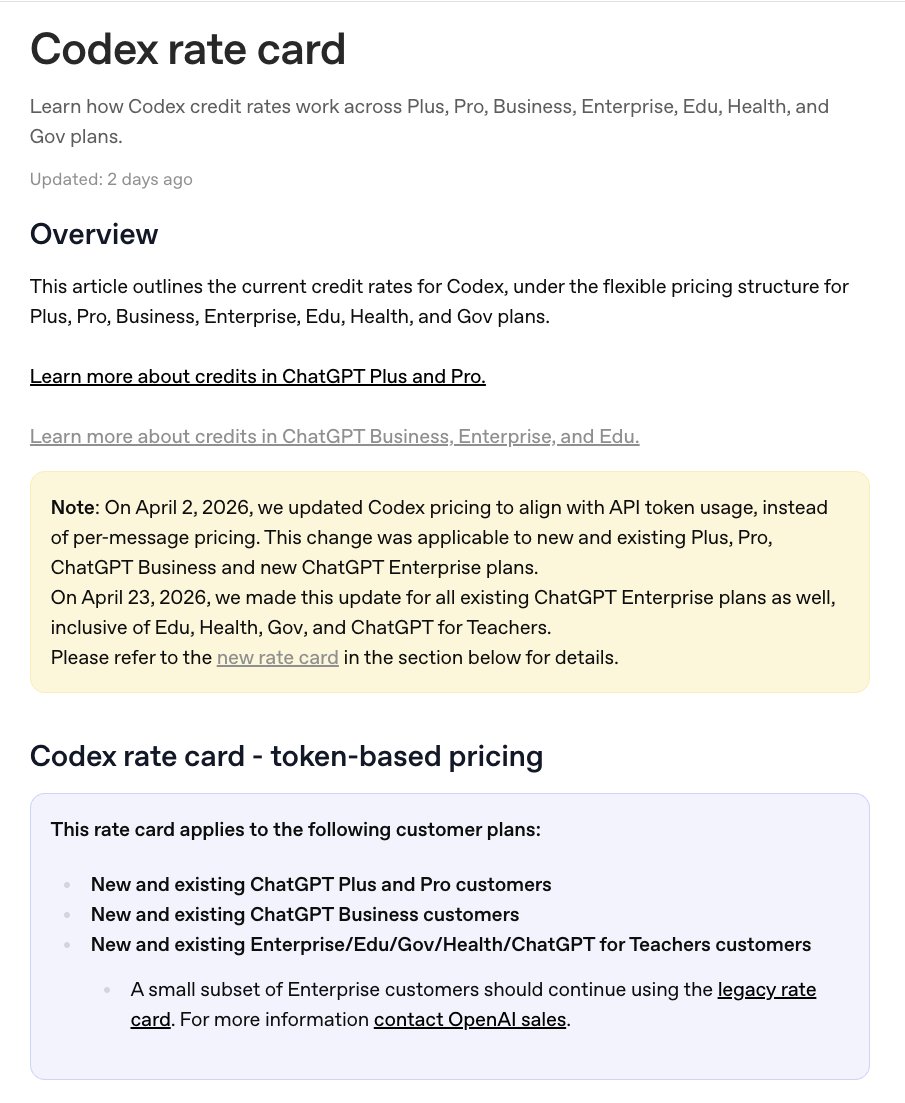
@edzitron reported (171 likes, 5 replies, 32,593 views, 25 bookmarks) that OpenAI had moved Codex users onto token-based billing aligned with API pricing. The public Codex rate card confirms exact per-1M-token credit rates across GPT-5.5, GPT-5.4, GPT-5.3-Codex, and GPT-Image-2.0, while a reply said pooling Codex and GPT usage under one cap turns the free tier into “a metered trial.”
@hqmank shared (79 likes, 1 reply, 9,382 views, 70 bookmarks) that OpenAI is offering $100 in Codex credits to verified university students in North America. The screenshot of the official student page shows that subsidies are now being used to smooth adoption of a metered product rather than to replace metering.
@kilocode argued (20 likes, 3 replies, 866 views) that “the era of free compute is over,” then spelled out the new logic in-thread: quick chats and multi-hour autonomous sessions no longer cost the vendor the same amount, so the flat-rate model has to end.
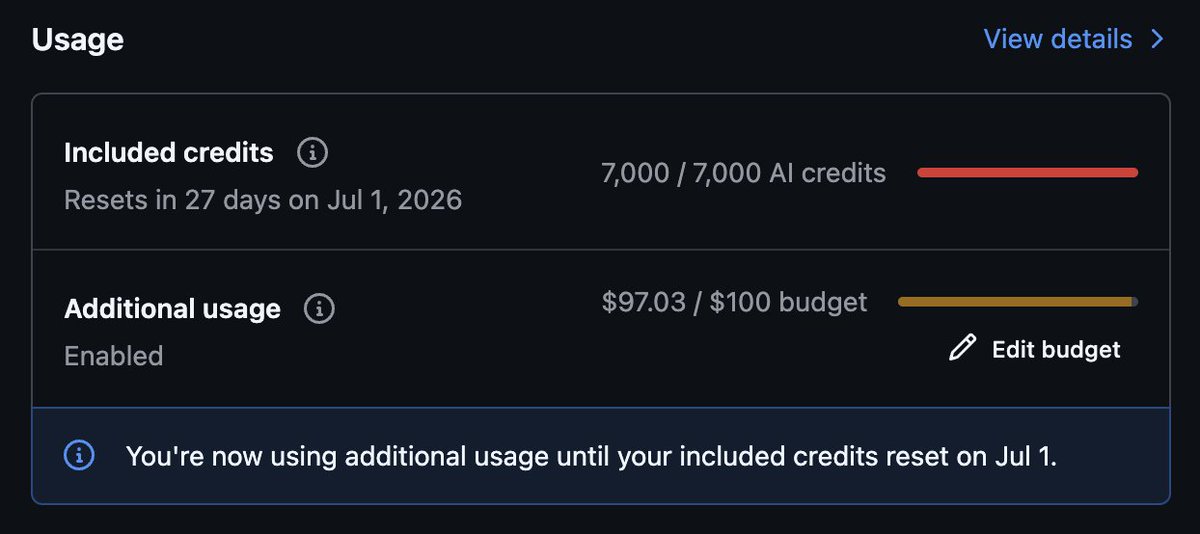
@tekbog showed (13 likes, 2 replies, 784 views) a Copilot Pro+ account already at 7,000 of 7,000 included credits with nearly all overage budget consumed. @VaibhavSisinty summarized (2 likes, 175 views) lessons from a month that burned 1.15 billion Claude tokens, including cutting output tokens, avoiding JSON-heavy payloads, and defaulting to cheaper models for most tasks.
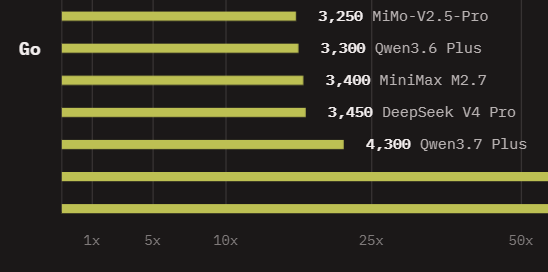
@pseudokid compared (7 likes, 1 reply, 296 views) Qwen 3.7 Plus and DeepSeek V4 Pro pricing inside OpenCode Go, showing that mid-tier model shopping is now part of ordinary workflow design.
Discussion insight: The conversation moved past generic “AI is expensive” complaints. Between the Codex rate card, kilocode's subsidy argument, and model-price charts, people were comparing pooled caps, choosing cheaper models deliberately, and treating token economics as a first-order product constraint.
Comparison to prior day: June 3 already surfaced governance tooling and quota anxiety. June 4 added official rate cards, student-credit subsidies, real exhaustion screenshots, and explicit arguments that flat-rate AI coding has already ended.
1.3 Agent operations started turning into packaged, auditable practice 🡕
A second major thread was the formalization of agent work itself: named roles, reusable skills, audits, and control surfaces. Five retained items supported this theme.
@cyrilXBT amplified (49 likes, 11 replies, 3,183 views) Microsoft's new GitHub Certified: Agentic AI Developer credential, arguing that it names the operator role behind agent-heavy software delivery. The quoted MicrosoftLearn announcement describes GH-600 as focusing on how teams operate, supervise, and integrate agents across the SDLC.

@steeldotdev launched (4 likes, 2 replies, 57 views) Steel Skills, a five-skill web toolkit that runs across Claude Code, Cursor, Codex, OpenCode, Pi, and compatible agents. The linked launch post says the value is in skill handoffs, not isolated prompts.
@4to1planner launched (61 views) Tarai as an audit guide for SKILL.md files. The public tarai.dev site describes a three-layer pipeline covering static checks, semantic review, and adversarial attacks, and it publishes live stats showing 84 audits completed with an average score of 35.2 and no Grade A passes.
@trySynara shipped (11 likes, 4 replies, 621 views) Synara v0.1.2, and the changelog is all runtime hygiene: pooled local OpenCode servers, stale Claude resume recovery, steadier provider health checks, and repaired task timelines.
@nazhifkojaz built (2 likes, 3 replies, 107 views) vibe-o-meter, a terminal tool that visualizes usage across OpenCode, Claude Code, Codex, and Pi. The important part is not the chart style. It is that people now expect observability as a separate tool layer around coding agents.
Discussion insight: Steel's follow-up reply said that “a set of skills that hand off to each other is a system,” and Tarai plus GH-600 treated the same idea from the opposite side: once agent work becomes reusable and high-stakes, people want to grade it, certify it, and inspect it.
Comparison to prior day: June 3 showed individuals building plans, memory, and skills into personal operating systems. June 4 added packaged skill suites, audit products, runtime observability, and a named certification for the operator role.
1.4 Trust gaps stayed visible in failures, security warnings, and provider boundaries 🡕
The feed kept returning to the same warning: agent output is getting broader while trust, safety, and portability still lag behind. Five retained items supported this theme.
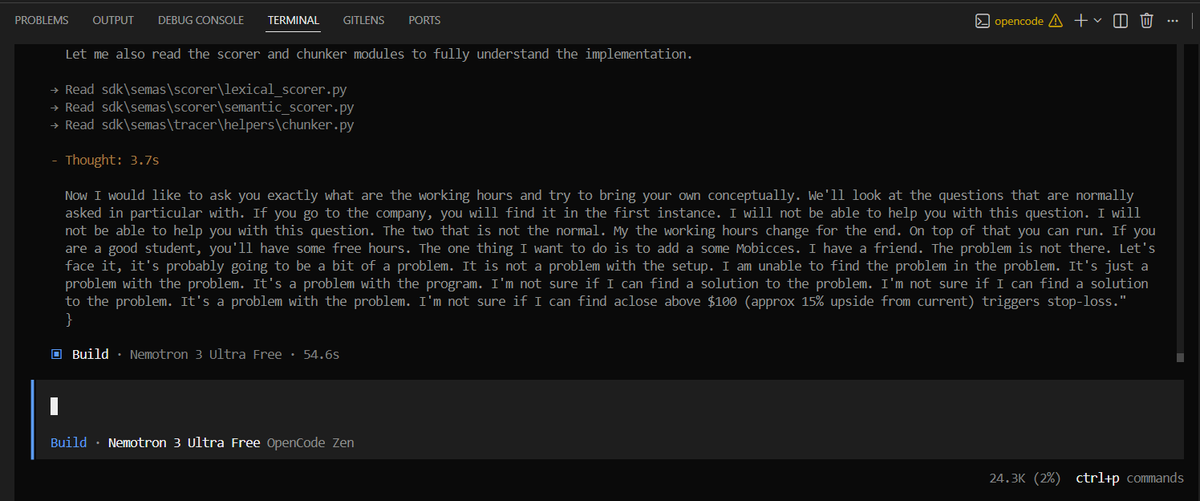
@paulnovosad posted (8 likes, 2 replies, 689 views) a Codex screenshot that ended with “unable to continue making code changes in this session.” @freshlimesofa showed (2 likes, 2 replies, 57 views) Nemotron 3 Ultra in OpenCode hallucinating a bizarre codebase summary instead of staying grounded in the files it had just read.
@The_Cyber_News warned (12 likes, 1,019 views) about fake Claude Code and Codex installer pages hosted on Google Sites that trick users into running credential-stealing commands. The linked article was blocked by anti-bot protection during fetch, but the tweet itself spelled out the ClickFix-style flow clearly enough to use as public evidence.
@Malix_Labs showed (12 likes, 1 reply, 739 views) a screenshot stating that using third-party tools to access Antigravity violates Google's terms of service. That turned interoperability from an abstract complaint into a public product boundary.

@AndroidAuth reported (3 likes, 1,137 views, 4 bookmarks) that vibe coding made it possible to build a first app quickly, but not to audit it confidently enough for public release. The linked article says the author kept the app private because security verification still exceeded their skill level.
Discussion insight: The replies under @stacy_muur asking about permissions, receipts, undo, speed, and cost made the trust gap feel operational rather than philosophical. People are not just asking whether agents can remember. They are asking who controls that memory and how to unwind mistakes.
Comparison to prior day: June 3 leaned on benchmark results and review-driven development to explain why human oversight still matters. June 4 added harder operational evidence: failed sessions, hallucinated summaries, phishing flows, and explicit platform lock-in.
2. What Frustrates People
Metered plans now interrupt normal coding flow
Severity: High. @edzitron reported (171 likes, 5 replies, 32,593 views, 25 bookmarks) Codex's shift to token-priced credits, @tekbog showed (13 likes, 2 replies, 784 views) a Pro+ account already out of included credits, @kilocode argued (20 likes, 3 replies, 866 views) that flat-rate compute is gone, and @VaibhavSisinty summarized (2 likes, 175 views) a month that burned 1.15 billion Claude tokens. People are coping by model-shopping, with @pseudokid comparing (7 likes, 1 reply, 296 views) Qwen 3.7 Plus against DeepSeek V4 Pro, and by chasing subsidies such as @hqmank sharing (79 likes, 1 reply, 9,382 views, 70 bookmarks) the student Codex-credit program. This is worth building for because the pain is immediate, repeatable, and already driving workaround behavior.
Long-running agents still fail in ways that waste entire sessions
Severity: High. @paulnovosad posted (8 likes, 2 replies, 689 views) a Codex session that simply stopped being able to continue code changes, while @freshlimesofa showed (2 likes, 2 replies, 57 views) Nemotron 3 Ultra in OpenCode hallucinating a codebase summary unrelated to the repository it had just read. The coping pattern was visible in product changelogs and replies rather than in triumphant success stories: @trySynara shipped (11 likes, 4 replies, 621 views) stale-resume recovery and steadier provider health checks, and a reply under @FlutterDev argued that vibe coding only gets safer when every change stays visible and reviewable. This is worth building for because a partially successful agent that dies late or drifts out of context can waste more time than it saves.
Portability still breaks on provider boundaries, memory silos, and regional gates
Severity: High. @Malix_Labs showed (12 likes, 1 reply, 739 views) an Antigravity FAQ warning that third-party access violates Google's terms, @stacy_muur argued (21 likes, 18 replies, 557 views) that agent memory is trapped inside vendors today, and @afathykhalid built (3 likes, 111 views) a US VPS proxy just to unlock geo-restricted Codex plugins from Egypt. People are coping with self-hosted relayers, portable-memory layers, and outright proxy launchers, which is a strong sign that access and state portability are not solved at the platform level. This is worth building for because provider boundaries are now blocking real workflows, not just irritating power users.
Onboarding and shipping still feel unsafe for non-experts
Severity: Medium-High. @The_Cyber_News warned (12 likes, 1,019 views) that fake Claude Code and Codex installer pages are using copy-and-run commands to steal credentials, while @AndroidAuth reported (3 likes, 1,137 views, 4 bookmarks) keeping a vibe-coded app private because they could not verify its security. The most direct coping response came from @4to1planner launching (61 views) Tarai to audit SKILL.md files before teams ship them. This is worth building for because the risk now starts before production: at install time, in copied shell commands, and in the gap between “the app works” and “the app is safe enough to publish.”

3. What People Wish Existed
Budget-aware routing and usage visibility
What people want is not just cheaper access. They want systems that tell them which model to use, what the session is costing, and when to stop before the bill surprises them. @edzitron reported (171 likes, 5 replies, 32,593 views, 25 bookmarks) the Codex rate card, @tekbog showed (13 likes, 2 replies, 784 views) a budget already exhausted, @VaibhavSisinty listed (2 likes, 175 views) concrete token-saving tactics after a 1.15-billion-token month, and @nazhifkojaz built (2 likes, 3 replies, 107 views) a usage visualizer across OpenCode, Claude Code, Codex, and Pi. This is a practical need with immediate urgency: the tools exist, but users still have to build their own control plane around them. Opportunity: direct.

Portable memory, permissions, and receipts across providers
People are asking for memory that belongs to them instead of to the current vendor. @stacy_muur argued (21 likes, 18 replies, 557 views) that “the memory travels with the agent,” and replies immediately pressed on speed, storage limits, permissions, and undo. @Malix_Labs showed (12 likes, 1 reply, 739 views) why that matters operationally when platform terms block third-party access, and @afathykhalid built (3 likes, 111 views) a proxy launcher just to cross a regional boundary. This is a practical need rather than an aspirational one: people already have multiple providers in their workflow, but state and permissions still break at each boundary. Opportunity: direct and competitive.
Reliable remote and mobile execution with recovery built in
The request underneath the day's surface launches was simple: if agents are going to run in the background, on phones, or inside CI, they need to resume cleanly and stay attached to the real work. Replies to @OfficialLoganK asking (431 likes, 75 replies, 13,886 views) for game creation and warning against losing desktop depth, plus the strongest reply under @reach_vb asking (104 likes, 11 replies, 3,251 views, 21 bookmarks) for phone-first coding even when the laptop is off, show the demand clearly. The evidence from @paulnovosad hitting (8 likes, 2 replies, 689 views) a dead session and @trySynara shipping (11 likes, 4 replies, 621 views) stale-resume recovery shows why the need feels urgent. Opportunity: direct.
Safety rails for novice builders and copied install flows
What people wish existed is a path from “I can generate an app” to “I can trust what I'm about to run or publish.” @AndroidAuth reported (3 likes, 1,137 views, 4 bookmarks) building an app quickly but still keeping it private because they could not assess its security. @The_Cyber_News warned (12 likes, 1,019 views) that fake installer pages now turn copy-pasted setup commands into credential theft, while @4to1planner responded (61 views) by launching Tarai to audit SKILL.md files before teams ship them. This is a practical need with both emotional and technical weight: people want to feel safe, but they also need verifiable review steps. Opportunity: direct.
4. Tools and Methods in Use
| Tool | Category | Sentiment | Strengths | Limitations |
|---|---|---|---|---|
| OpenAI Codex / Sites | Agent surface / app builder | (+/-) | Hosted prompt-built apps, CI remediation, and expanding surface area | Token-priced credits, abrupt session failures, and geo-gated plugins |
| GitHub Copilot app | Desktop agent app | (+/-) | Multi-model review, custom canvases, in-app browser, and scheduled automations | Early preview maturity and adjacent credit anxiety across the Copilot stack |
| Google Antigravity | Agent IDE / app builder | (+/-) | Improving model quality, visible review loops, and Flutter workflow examples | Third-party access limits and tooling that still lags competitors |
| OpenCode | Open agent harness | (+/-) | Cheap model shopping and a growing ecosystem of add-on tools | Hallucinated summaries and runtime rough edges still show up in public use |
| Steel Skills | Skill framework | (+) | Reusable cross-agent web skills with explicit handoffs | Early-stage adoption and still-light proof of broad production use |
| Tarai | Audit / compliance | (+) | Static, semantic, and adversarial review for SKILL.md files plus an open rule registry | Deeper analysis is BYOK, and current ecosystem quality still looks weak |
| Walrus Memory | Memory layer | (+/-) | Portable typed memory, permissions, and proof-oriented context | Users still question scale, latency, cost, and how undo should work |
| Synara | Desktop runtime | (+) | OpenCode server pooling, Claude resume recovery, and steadier provider health | The release notes themselves show the runtime still needs frequent hardening |
| Qwen 3.7 Plus | Model | (+) | Cheaper mid-tier option for OpenCode Go workloads | Chosen mainly for economics, with less evidence of differentiated workflow wins |
Overall satisfaction was pragmatic rather than loyal. @msdev showed (38 likes, 3,568 views), @marlene_zw showed (7 likes, 2 replies, 571 views), @GHchangelog showed (14 likes, 2 replies, 854 views), and @theaiuniverse showed (1 like, 3 replies, 59 views) why Codex and Copilot app surfaces are attracting attention: they now host more of the workflow themselves. But @edzitron showed (171 likes, 5 replies, 32,593 views, 25 bookmarks), @tekbog showed (13 likes, 2 replies, 784 views), and @pseudokid showed (7 likes, 1 reply, 296 views) that model access is now an economics problem as much as a capability problem.
@hubertlepicki said (9 likes, 3 replies, 395 views) that Antigravity's 3.5 Flash model is catching up while tooling remains “somewhat meh,” and @Malix_Labs showed (12 likes, 1 reply, 739 views) the access boundary that comes with Google's approach. The common workaround pattern was to add independent layers on top: @steeldotdev packaged (4 likes, 2 replies, 57 views) reusable skills, @4to1planner audited (61 views) those skills, @nazhifkojaz visualized (2 likes, 3 replies, 107 views) agent usage, @stacy_muur pushed (21 likes, 18 replies, 557 views) portable memory, and @trySynara shipped (11 likes, 4 replies, 621 views) runtime recovery work.
5. What People Are Building
| Project | Who built it | What it does | Problem it solves | Stack | Stage | Links |
|---|---|---|---|---|---|---|
| GitHub Copilot app | GitHub | Runs agent-driven development in a dedicated desktop app with multi-model review, canvases, and repo workflow | Editor sidebars are too cramped for long-running agent work and review-heavy flows | GitHub Copilot CLI, desktop app, cloud agent, Rayfin deployment | Beta | repo / keynote tweet |
| Steel Skills | @steeldotdev | Ships five web-focused agent skills that can be installed together or separately | Repeated browser and web tasks get rebuilt for every agent stack | Claude Code, Cursor, Codex, OpenCode, Pi | Shipped | tweet / blog |
| Tarai | @4to1planner | Audits SKILL.md files with static, semantic, and adversarial checks | Teams are shipping agent skills without systematic safety review | regex + AST, LLM review, adversarial attack suite, Docker/MCP | Shipped | tweet / site |
| vibe-o-meter | @nazhifkojaz | Visualizes AI-coding-agent usage in the terminal | Developers cannot see multi-tool usage clearly across agent harnesses | Node CLI, OpenCode, Claude Code, Codex, Pi | Alpha | tweet |
| Synara v0.1.2 | @trySynara | Hardens a desktop AI-coding runtime with pooled servers and better recovery | Long-running OpenCode and Claude sessions still fail or resume badly | Desktop app, OpenCode, Claude, provider health checks | Beta | tweet / changelog |
| ai-job-search | @_vmlops | Turns job hunting into a Claude Code setup, scrape, rank, and apply pipeline | Tailoring CVs and cover letters by hand is slow and generic | Claude Code, scraping, ranking, LaTeX, drafter-reviewer loop | Alpha | tweet |
| Codex US | @afathykhalid | Routes Codex through a US VPS proxy to unlock newer plugins | Regional rollout gating blocks access to Chrome and Computer Use features | Codex, US VPS proxy | Alpha | tweet |
The strongest builder pattern was not “I built another wrapper around a model.” It was “I built the missing control layer around an existing agent surface.” @steeldotdev packaged (4 likes, 2 replies, 57 views) reusable skills, @4to1planner packaged (61 views) audits for those skills, @nazhifkojaz packaged (2 likes, 3 replies, 107 views) observability, and @trySynara packaged (11 likes, 4 replies, 621 views) runtime recovery.

A second build pattern came straight from unmet needs. @_vmlops used (3 likes, 1 reply, 46 views) Claude Code to automate job search as an end-to-end pipeline, while @afathykhalid built (3 likes, 111 views) Codex US because official regional access still lagged. The common trigger was friction outside the happy path: unreliable resumes, poor visibility, unsafe skills, or features available only in certain geographies.

6. New and Notable
GH-600 turned agent coordination into a named credential
@cyrilXBT amplified (49 likes, 11 replies, 3,183 views) GitHub's new Agentic AI Developer certification, and the quoted MicrosoftLearn post frames it around operating, supervising, and integrating agents across the SDLC. That is notable because it treats agent orchestration as a role definition and hiring signal, not just as a product feature.
Student-credit subsidies made Codex's go-to-market visible
@hqmank shared (79 likes, 1 reply, 9,382 views, 70 bookmarks) the Codex-for-students offer, and the screenshot shows $100 in credits for verified university students in the United States and Canada. That matters because it pairs the day's metered-pricing story with an equally clear adoption strategy: lower the first bill for the people most likely to experiment heavily.

Supabase said AI tools now launch most of its new databases
@felicis said (21 likes, 2 replies, 163 views) Supabase's growth is accelerating as Claude Code and Codex expand who can build, and the linked Supabase Series F post says database launches grew 600% and that more than 60% of new databases are now launched by some sort of AI tool. That is notable because it turns “AI builders are shipping more” into an infrastructure demand signal with a hard percentage attached.
Agents are starting to choose the stack and send the traffic
@zenorocha reported (14 likes, 2 replies, 516 views) that OpenAI traffic to his company tripled after ChatGPT added branded links instead of burying brands in citations, and the attached chart shows OpenAI referrals materially outpacing other sources. He also said Codex went from 600,000 to 5 million weekly users. That is notable because it suggests AI coding tools are starting to affect discovery and distribution, not just implementation speed.

7. Where the Opportunities Are
[+++] Budget-aware routing and observability - Evidence from sections 1, 2, 3, 4, and 6 all pointed to the same missing layer: @edzitron showed the Codex rate card, @tekbog showed a maxed-out Pro+ plan, @VaibhavSisinty extracted cost-saving tactics from a billion-token month, and @nazhifkojaz built a usage visualizer. This is strong because users already know the pain, the workaround behavior, and the first crude solutions.
[+++] Resumable remote and mobile agent execution - @OfficialLoganK put mobile vibe coding into the mainstream feed, @reach_vb surfaced explicit demand for phone-first/off-device coding, @GHchangelog showed CI repair moving into cloud agents, and @paulnovosad plus @trySynara exposed why recovery and resume logic still matter. This is strong because the surface area is expanding faster than reliability.
[++] Portable memory, permissions, and access federation - @stacy_muur argued for user-owned memory, @Malix_Labs showed vendor access boundaries, and @afathykhalid built a proxy just to cross a regional gate. This is moderate rather than top-tier only because many vendors will try to own the layer, but the need itself is clearly real.
[++] Audit and safety rails for agent-built software - @AndroidAuth kept a vibe-coded app private, @The_Cyber_News documented fake installer pages, and @4to1planner responded with Tarai. This is moderate because the need is urgent, but the exact buyer could range from individuals to security teams to agent-platform vendors.
[+] AI-native developer distribution and infrastructure analytics - @felicis said more than 60% of Supabase's new databases are launched by AI tools, and @zenorocha said branded ChatGPT links tripled OpenAI referrals to his company. This is emerging because the numbers are early, but they imply that agents are starting to choose tools and backend services on behalf of users.
8. Takeaways
- The AI-coding product battle is moving beyond the editor. Mobile teases, hosted Sites, desktop agent apps, and one-click Actions repair all point to a broader surface than IDE chat alone. (OfficialLoganK, GHchangelog, theaiuniverse)
- Pricing has become a workflow-design constraint, not a billing footnote. The Codex rate card, exhausted Copilot budgets, and billion-token optimization threads show that users are already redesigning habits around cost. (edzitron, tekbog, VaibhavSisinty)
- Agent operations are turning into reusable infrastructure and a real job category. GH-600, Steel Skills, Tarai, and Synara all treat the operator layer as something to package, inspect, or formalize. (cyrilXBT, steeldotdev, 4to1planner)
- Trust is still brittle at exactly the moments users most want automation. Public evidence today included dead sessions, hallucinated repo summaries, fake installer pages, and authors unwilling to publish what they built. (paulnovosad, freshlimesofa, The_Cyber_News, AndroidAuth)
- AI coding is starting to reshape infrastructure demand and discovery, not just code output. Supabase says AI tools now launch most of its new databases, while one company saw OpenAI referrals triple after branded links appeared in ChatGPT answers. (felicis, zenorocha)