Twitter AI Coding - 2026-06-08
1. What People Are Talking About
1.1 Skills, contracts, and routines turned prompting into files 🡕
June 8 Twitter activity kept moving away from one-off prompting and toward reusable artifacts the agent can rerun: skill packs, Markdown contracts, checkpoint docs, and scheduled routines. Four retained items supported this theme.
@VaibhavSisinty argued (7 likes, 1 reply, 207 views, 10 bookmarks) that Addy Osmani's Agent Skills package gives coding agents 23 production-grade skills and seven lifecycle commands from /spec to /ship. The Agent Skills repo backs up the claim: it presents the pack as reusable workflows, quality gates, and anti-rationalization tables that install across Claude Code, Cursor, Gemini CLI, GitHub Copilot, OpenCode, and Codex.
@TheTuringPost highlighted (14 likes, 3 replies, 1,214 views, 17 bookmarks) OpenProse as a way to turn agent workflows into reusable programs. The OpenProse repo describes *.prose.md files as Markdown contracts and its Reactor runtime as doing expensive model work only when subscribed inputs materially change, which is a stronger promise than "save this prompt."
@PrajwalTomar_ said (8 likes, 4 replies, 109 views, 3 bookmarks) that Matt Pocock's /grill-me loop works by extracting decisions question by question into a knowledge doc, and that checkpointing every answer into a brainstorms folder prevents long sessions from losing earlier context.
@AunySillyMe showed (1 like, 1 reply, 70 views, 2 bookmarks) the same idea applied to scheduled work: Claude Code routines pointed at protocol files in an Obsidian vault, wrote dated Markdown outputs, and ran eight tasks overnight without re-entering instructions.

Discussion insight: The strongest nuance was not "use better prompts." It was "make the human context durable first." A reply on the /grill-me thread said checkpointing matters because messy decisions become reusable build context instead of disappearing inside a long chat.
Comparison to prior day: June 7 already favored skill packs and harness-level systems. June 8 narrowed that into protocol files, checkpoint docs, and routines that can keep running without a fresh prompt each session.
1.2 Antigravity became both the access layer and the workspace 🡕
Antigravity showed up less as a novelty app and more as the place where people got premium models, reviewed Codex output, or consumed Google's latest agent features. Four retained items supported this theme.
@hqmank reported (744 likes, 113 replies, 160,975 views, 420 bookmarks) that Google AI Pro subscribers could use Claude Opus 4.6 inside Antigravity at no extra cost. The replies mattered as much as the post: several people corrected that Opus had been there since February, and @hqmank answered that the real value was simply having another usable Opus path. The screenshot adds concrete evidence by showing Opus in the model picker rather than as a vague access claim.

@sunnykgupta described (36 likes, 9 replies, 2,076 views, 9 bookmarks) a manual loop where Codex writes code, Antigravity is the place to review the changes, GitHub Copilot reviews the PR, and Codex applies the notes. That is a telling shift: Antigravity is not just another model surface in this workflow. It is the working environment between generation and review.
@Google said (60 likes, 2 replies, 4,690 views, 7 bookmarks) that Search can use Antigravity with Gemini 3.5 Flash to build custom generative UI and interactive visuals, while a reply in the same thread said Search can also create information agents that monitor topics and send detailed updates. Separately, Ars Technica reported that NotebookLM now has its own "cloud computer" with embedded Antigravity and more than 100 software skills.
Discussion insight: The replies were not obsessed with launch novelty. They kept returning to whether Antigravity was a stable route to the right model and whether it fit into a broader working stack.
Comparison to prior day: June 7 treated access arbitrage as the story. June 8 pushed Antigravity further into the role of shared workspace and Google-wide runtime.
1.3 Agent control planes started solving runtime problems instead of prompt problems 🡕
The most technical builder posts were about controlling long-running agents: live steering, warmed search state, isolated worktrees, and mobile execution surfaces. Four retained items supported this theme.
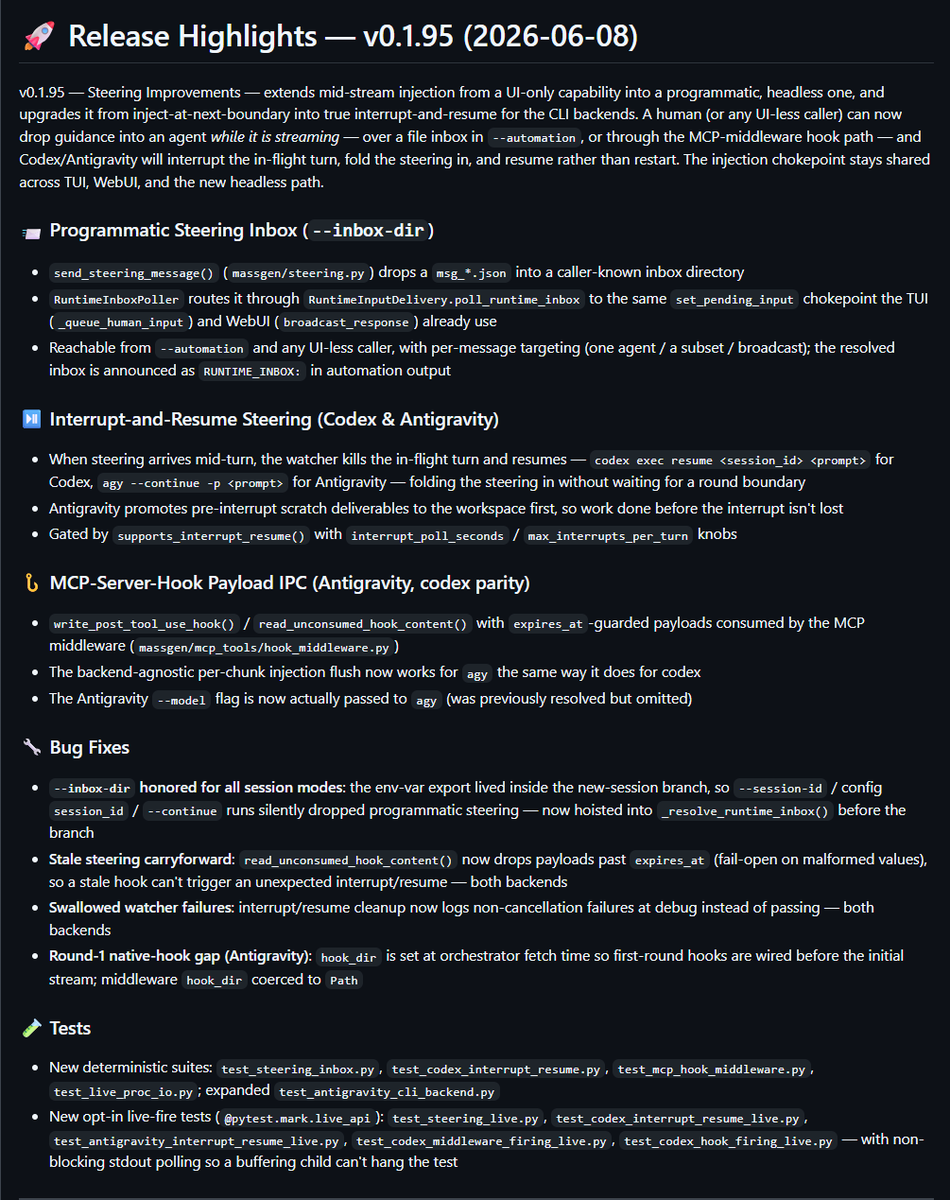
@massgen_ai announced (2 likes, 114 views) MassGen v0.1.95, extending mid-stream steering from TUI and WebUI into headless callers and upgrading Codex and Antigravity backends to interrupt and resume instead of waiting for a round boundary. The post also tied that to collaborative multi-agent teams, permissioned tools, and Docker-isolated code execution, which makes this a control-plane update rather than a prompt-library release.
@nexxeln showed (204 likes, 10 replies, 8,076 views, 38 bookmarks) that the next OpenCode release will power file search with fff, rank files higher after the agent opens them, and reuse the same search layer across tool calls so the search does not start cold every time. @neogoose_btw added (56 likes, 6 replies, 1,765 views, 4 bookmarks) that the same layer is already handling at least 50 million searches per day.
@orca_build introduced (41 likes, 7 replies, 1,961 views, 29 bookmarks) a mobile emulator inside Orca ADE, with one emulator per worktree so agents can build, test, debug, and validate mobile flows where the code lives. The Orca repo fills in the broader surface around that tweet: worktree-native orchestration, side-by-side CLI agents, GitHub-linked workflows, and notifications.
@mardehaym pushed back (12 likes, 3 replies, 603 views, 2 bookmarks) on the wave of agent loop diagrams by arguing that safe loops still need codebase maps, sandboxes, cost ceilings, audit logging, RBAC, and human gates. A reply crystallized the gap: the loop is what wins the demo, but invisible infrastructure is what survives production.
Discussion insight: The argument is no longer about whether an agent can act. It is about what state, steering, and safety primitives have to exist around that action before people will trust it.
Comparison to prior day: June 7 said the harness mattered more than the model. June 8 made that concrete with steering inboxes, warmed search state, and isolated execution surfaces.
2. What Frustrates People
Budgeting for AI coding still feels like rationing
Severity: High. @devXritesh asked (68 likes, 76 replies, 1,149 views) which single $20 purchase developers would choose, and the replies split between ChatGPT Plus, Claude Pro, and buying nothing at all; one reply said many developers are too busy writing code to afford tools that still do not solve the whole problem. @edzitron amplified (664 likes, 11 replies, 18,637 views, 27 bookmarks) the mainstream "AI bill surprise" story, and replies added concrete sticker-shock examples such as finance teams treating usage as a fixed subscription and consumers hitting credit limits mid-chat. @hqmank showed (744 likes, 113 replies, 160,975 views, 420 bookmarks) the coping pattern: people will switch workspaces quickly if a bundle exposes Opus at no extra cost. This is worth building for because the workflow choice is already being shaped by billing boundaries, not just model quality.
Free and fallback models still break inside the harness
Severity: High. @shaun_on_x reported (10 likes, 5 replies, 1,050 views) that the free Nemotron 3 Ultra option in OpenCode fails in tool calling, stops mid-run, and does not work well with the harness. Replies said MiMo or DeepSeek felt more usable, which makes this a practical quality-routing complaint rather than a one-off rant. At the same time, @nexxeln framed (204 likes, 10 replies, 8,076 views, 38 bookmarks) OpenCode's new fff layer as a way to cut wasted context from cold search starts, while @sunnykgupta described (36 likes, 9 replies, 2,076 views, 9 bookmarks) a still-manual Codex to Antigravity to Copilot handoff. This is worth building for because users are already stitching together workarounds to survive brittle runs.
Loop demos still look easier to sell than to run safely
Severity: Medium. @mardehaym argued (12 likes, 3 replies, 603 views, 2 bookmarks) that safe agent loops need live codebase maps, sandboxing, cost ceilings, audit logging, RBAC, and human gates before the first iteration ever runs. A reply on the thread made the same point in sharper terms: the loop wins the demo, but invisible infrastructure is what survives production. @massgen_ai shipping (2 likes, 114 views) headless steering and interrupt-and-resume support for Codex and Antigravity is evidence that builders are patching those missing control surfaces in real time. This is worth building for because unattended agent work is arriving faster than the guardrails around it.
3. What People Wish Existed
Portable workflow contracts
What people are asking for is practical and immediate: one workflow layer they can install once and carry across tools. @VaibhavSisinty presented (7 likes, 1 reply, 207 views, 10 bookmarks) Agent Skills as reusable slash-command workflows, @TheTuringPost pointed (14 likes, 3 replies, 1,214 views, 17 bookmarks) to OpenProse contracts, and @Oluwaphilemon1 described (2 likes, 73 views, 3 bookmarks) ECC as a cross-harness operating system with skills and subagents. The need is not emotional. It is operational: stop rebuilding the same process in every agent. Opportunity: direct.
A build-review-fix loop that automates the handoffs
@sunnykgupta asked (36 likes, 9 replies, 2,076 views, 9 bookmarks) how to automate a workflow that already spans Codex, Antigravity, GitHub pull requests, and Copilot review. The Real Python tutorial shared by @pycoders explains (5 likes, 338 views, 3 bookmarks) Copilot review as a fast first pass when human review is slow or inconsistent, while @orca_build added (41 likes, 7 replies, 1,961 views, 29 bookmarks) mobile validation inside the same worktree-driven workspace. Parts of this loop exist today, but people are still manually chaining them. Opportunity: direct.
Safe loop operations with steering, sandboxes, and audit trails
@mardehaym said (12 likes, 3 replies, 603 views, 2 bookmarks) that a production loop needs codebase maps, sandboxes, cost ceilings, audit logging, RBAC, and human gates before it is trustworthy. @massgen_ai showed (2 likes, 114 views) one partial answer with programmatic steering inboxes and interrupt-and-resume support, but the broader control plane is still fragmented across niche tools. This need is practical, not aspirational: the community is already trying to run agents unattended. Opportunity: direct.
Budget-aware model routing without a quality cliff
The pricing pain is concrete, but so is the routing behavior. @hqmank valued (744 likes, 113 replies, 160,975 views, 420 bookmarks) another path to Opus inside Antigravity, @devXritesh turned (68 likes, 76 replies, 1,149 views) the decision into a $20 allocation problem, and @shaun_on_x showed (10 likes, 5 replies, 1,050 views) what happens when the free fallback is too brittle to trust. Bundles and free menus partially address the need today, but not with a stable quality floor. Opportunity: competitive.
4. Tools and Methods in Use
| Tool | Category | Sentiment | Strengths | Limitations |
|---|---|---|---|---|
| Claude Code | Agent CLI | (+/-) | Works well when paired with routines, saved protocol files, and external skill packs | Users still add their own checkpointing and memory patterns to keep long runs coherent |
| Google Antigravity | Multi-model workspace | (+/-) | Premium-model access, review surface for Codex output, expanding into Search and NotebookLM | Discovery and access are inconsistent enough that users keep bundle-hunting and composing manual workflows |
| OpenAI Codex | Coding agent | (+) | Rapid prototyping, in-app browser work, PR generation, and experiment-review skills | Often still needs a second layer for orchestration, review, or policy checks |
| GitHub Copilot | PR review assistant | (+/-) | Fast first-pass pull-request review and still useful as a maintenance layer | Frequently used downstream of another coding agent rather than as the workflow owner |
| OpenCode | Open-source agent | (+/-) | Faster file search, warmed context, large-repo navigation, provider flexibility | Free-model quality can collapse on tool calling or stop mid-task |
| Agent Skills | Skill pack | (+) | Encodes spec, plan, build, test, review, and ship discipline with verification gates | Requires installation and a command-driven workflow that some users still have to learn |
| OpenProse | Workflow DSL | (+) | Markdown contracts, receipts, and desired-state execution for repeatable agent work | Early-stage vocabulary and runtime complexity make it a power-user tool |
| Orca | Multi-agent workspace | (+) | Worktree-native orchestration, GitHub integration, and now mobile validation inside the same surface | Broad surface area means teams still need to learn or standardize how to use it |
| MassGen | Orchestration layer | (+) | Headless steering, interrupt-resume control, multi-agent coordination, Docker-isolated code execution | Still an early v0.1x control plane with a lot of moving parts |
Overall sentiment was most positive toward layers that turn chat into process: skills, contracts, receipts, reusable search state, and PR review. The common workaround was stacking tools instead of waiting for one winner—@sunnykgupta described (36 likes, 9 replies, 2,076 views, 9 bookmarks) a Codex to Antigravity to Copilot chain, while @mardehaym warned (12 likes, 3 replies, 603 views, 2 bookmarks) that loops still need maps, sandboxes, and cost ceilings before they are production-safe. Migration pressure is therefore moving in two directions at once: premium surfaces such as Antigravity and Codex win when they fit into a broader stack, and open systems such as OpenCode, Orca, MassGen, Agent Skills, OpenProse, and ECC win when they expose more control over workflow, state, and execution.
5. What People Are Building
| Project | Who built it | What it does | Problem it solves | Stack | Stage | Links |
|---|---|---|---|---|---|---|
| /last30days | mvanhorn | Agent-led search across Reddit, X, YouTube, HN, TikTok, Polymarket, GitHub, and the web, scored by real engagement | No single assistant can search the public sources developers actually use to track fast-moving AI work | Skill spec, per-source connectors, setup wizard, ranking and synthesis pipeline, HTML brief export | Shipped | repo, post |
| OpenProse + Reactor | openprose | Declarative language and runtime for AI sessions using Markdown contracts and receipts | Replaces brittle prompt chains with reusable, reviewable workflow state | *.prose.md contracts, ProseScript, Reactor runtime, npm packages |
Beta | repo, post |
| Agent Skills | Addy Osmani | Cross-harness skill pack that maps the software lifecycle to slash commands and verification gates | Keeps coding agents from skipping spec, test, review, and ship discipline | Markdown skills, slash commands, anti-rationalization tables, multi-harness install guides | Shipped | repo, post |
| Orca Mobile Emulator | @orca_build | Adds per-worktree mobile emulators inside a multi-agent coding workspace | Lets agents build, test, debug, and validate mobile flows without leaving repo context | Worktrees, CLI agent tabs, GitHub integration, mobile emulator | Beta | repo, post |
| MassGen v0.1.95 | @massgen_ai | Multi-agent orchestration layer with headless steering inboxes and interrupt-resume control | Makes long-running agents steerable by automation instead of UI-only intervention | TUI, WebUI, file inbox, CLI backends, MCP hooks, Docker isolation | Beta | post |
| ECC | affaan-m | Harness-native operator system with skills, subagents, memory, security, and cross-harness workflows | Turns one agent session into a reusable engineering system instead of a prompt stack | Skills, hooks, MCP configs, dashboard, multi-language rules | Beta | repo, post |
@israfill surfaced (37 likes, 13 replies, 1,609 views, 25 bookmarks) /last30days as a cross-platform research skill, and the repo explains why it resonated: a single skill can bridge Reddit, X, YouTube, HN, TikTok, Polymarket, GitHub, and the open web, then score the results by what people actually engaged with. OpenProse, Agent Skills, and ECC push the same pattern in a different direction. Instead of adding one more chat surface, they package process itself into contracts, skills, or operator systems that can be installed and reused.
Orca and MassGen show the next layer down the stack: execution control. @orca_build framed (41 likes, 7 replies, 1,961 views, 29 bookmarks) its new emulator as a way to keep mobile validation inside the same worktree-driven environment, while @massgen_ai framed (2 likes, 114 views) steering and interrupt-resume as primitives for unattended runs. The repeated build pattern is clear: less effort is going into prettier prompts, and more effort is going into where the agent runs, how it is steered, and what state it can keep.
One adjacent builder pattern mattered even without a standalone public app. @aakashgupta reported (4 likes, 1 reply, 1,537 views, 8 bookmarks) that an OpenAI PM used Codex to replace seven Databricks and Tableau dashboards with one prototype web app, then attached a FAQ instead of writing a traditional PRD. That suggests a widening builder class around AI coding: not just engineers shipping tools for engineers, but operators and PMs using coding agents to skip the document queue and arrive with something running.

6. New and Notable
Google turned Antigravity into a platform capability
The clearest product-expansion signal came from Google. @Google said (60 likes, 2 replies, 4,690 views, 7 bookmarks) that Search can use Antigravity with Gemini 3.5 Flash to build custom generative UI and interactive visuals, and a reply on the thread said Search can also create information agents that monitor topics and send updates. Ars Technica added the complementary product move: NotebookLM now has a "cloud computer" with embedded Antigravity and more than 100 software skills. That matters because the coding-runtime layer is escaping the IDE and moving into research and search surfaces.
Copilot stayed relevant by becoming the review and maintenance layer
June 8 did not produce a big new Copilot launch, but it did show a durable role. @sunnykgupta used (36 likes, 9 replies, 2,076 views, 9 bookmarks) Copilot as the PR-review step after Codex and Antigravity, which is a narrower but still valuable place in the stack. @pycoders shared (5 likes, 338 views, 3 bookmarks) a tutorial on Copilot code review in pull requests, and @phoronix reported (30 likes, 1,488 views) that GitHub Copilot was helping clean up the old AMD R600 graphics driver while linking to a public article. The noteworthy pattern is not that Copilot won the model race on June 8. It is that it remained useful where teams want fast review and maintenance help.
7. Where the Opportunities Are
[+++] Portable workflow operating layer — The strongest repeated signal was durable process as a product: Agent Skills, OpenProse, ECC, the /grill-me checkpointing pattern described by @PrajwalTomar_, and file-backed routines described by @AunySillyMe. This is strong because the same need appeared in what people shared, what they installed, and what they built.
[++] Agent control plane for unattended work — @massgen_ai shipped headless steering and interrupt-resume support, @orca_build added mobile validation inside worktrees, and OpenCode's search-state reuse was shown by @nexxeln and amplified by @neogoose_btw. @mardehaym shows why this is only moderate rather than strong: the pieces are arriving, but safe maps, audit trails, RBAC, and cost ceilings are still fragmented.
[+] Budget-aware model routing with a quality floor — @hqmank treated bundled Opus access as valuable on its own, @devXritesh turned the problem into a $20 allocation choice, @edzitron amplified billing shock, and @shaun_on_x showed the quality cliff when the fallback is a weak free model. The signal is emerging because users clearly care, but the current solutions are still bundles, hacks, and manual routing.
8. Takeaways
- The biggest upgrade was process durability, not prompt cleverness. June 8's strongest posts all externalized workflow into files or commands: Agent Skills, OpenProse contracts,
/grill-mecheckpoints, and Claude Code routines. (source) - Antigravity graduated from a bundle trick into a broader workspace and runtime layer. It showed up as an Opus access path, a place to review Codex output, a Search runtime, and a NotebookLM cloud computer. (source)
- The hard part of agentic coding is now control-plane engineering. Headless steering, warmed search state, worktree-native emulators, and safe-loop requirements all mattered more than another prompt recipe. (source)
- Cost still shapes workflow decisions as much as capability does. Users compared subscriptions as a budget line item, hunted bundle access, and complained when free fallbacks were too brittle to trust. (source)
- Codex is widening the builder class beyond engineers. The clearest June 8 example was an OpenAI PM using Codex to replace dashboard sprawl with a working prototype and FAQ instead of a PRD. (source)