Twitter AI Coding - 2026-06-11
1. What People Are Talking About
1.1 Antigravity became a single harness story across Search, API, and CLI surfaces 🡕
Antigravity discussion on June 11 was no longer just about flashy demos. Three high-signal posts showed Google pushing the same harness across Search mini-apps, Gemini API managed agents, and a forced Gemini CLI-to-Antigravity CLI migration, which made infrastructure gaps as visible as the upside.
@Google said (344 likes, 24 replies, 51,309 views, 82 bookmarks) that Search will build persistent custom experiences with Antigravity that users can return to over time. The thread mattered because Google immediately narrowed rollout to U.S. Google AI Pro and Ultra subscribers, while a reply challenged whether the product would really preserve progress and respect privacy. That made the post read less like generic launch copy and more like an early test of whether people trust Google to turn search prompts into durable work surfaces.
@googledevs positioned (43 likes, 2 replies, 6,015 views, 21 bookmarks) Managed Agents in the Gemini API as the infrastructure layer behind that story: one API call starts an autonomous agent in a Google-hosted environment, configured through AGENTS.md and SKILL.md, with files mounted from Google Cloud Storage or GitHub repositories. That was the clearest evidence in the feed that Antigravity is being framed as runtime infrastructure, not only a UI surface.
@JackWoth98 reminded (18 likes, 10 replies, 4,294 views, 7 bookmarks) Gemini CLI users on Google One and free plans that they had seven days left to move to Antigravity CLI. The quoted migration note described Google unifying around Antigravity 2.0, CLI, SDK, and IDE, but the replies immediately surfaced missing carriage-return handling, requests for direct MCP terminal commands, and complaints that community issues were not being triaged fast enough.
Discussion insight: The pushback was not against agentic development in general. It was about whether the replacement CLI can preserve small but essential terminal behaviors, extension surfaces, and support quality.
Comparison to prior day: June 10 emphasized Search mini-apps and Android development. June 11 extended that narrative into migration deadlines and managed-agent infrastructure, which made operational readiness much more central to the conversation.
1.2 The learning and code-understanding layer got more concrete 🡕
A second cluster of posts treated AI coding as a teaching and orientation problem, not only a generation problem. Four strong examples supported this theme, and the clearest ones described explicit scaffolds for learning a stack, mapping a codebase, or cutting down file-search waste.
@mattpocockuk described (160 likes, 10 replies, 6,215 views, 95 bookmarks) a /teach skill for a would-be vibe coder building a scheduling app. The linked AI Hero write-up made the mechanics concrete: the skill captures a mission, generates RESOURCES.md, builds glossary and lesson files, keeps learning records, and sends learners back to primary sources such as Git, AWS, and Next.js docs. Replies asking whether the same flow could teach a cloned repo from first principles, or even non-coding topics, showed that people read it as a reusable onboarding pattern.
@itsharmanjot highlighted (45 likes, 3 replies, 1,906 views, 62 bookmarks) Understand Anything as a codebase knowledge-graph plugin spreading across Claude Code, Codex, Cursor, Copilot, Gemini CLI, OpenCode, and Antigravity. The README backs up the distinctive claims: a multi-agent pipeline scans a codebase, builds an interactive graph of files/functions/classes, adds guided tours and diff impact analysis, and exposes installs for multiple coding surfaces.

@HeyShruti7 argued (4 likes, 4 replies, 149 views) that coding agents keep wasting tokens on grep-style file search instead of querying structured code knowledge. The attached images were the substantive part: one showed a Scan-Map-Teach flow, while the benchmark image claimed average reductions of 47% in tokens and 58% in tool calls across sampled repos when the agent queried a local graph instead of repeatedly searching the tree.
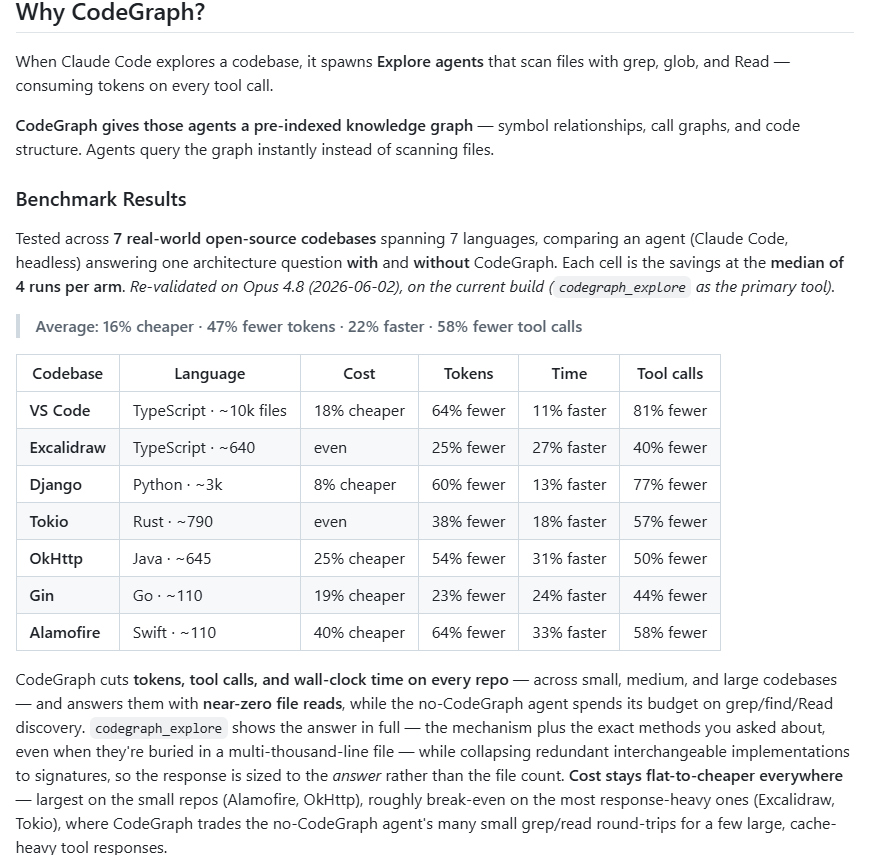
Discussion insight: The strongest response to these posts was not “teach me prompting.” It was “teach me the repo, the stack, and the workflow in a way that stays attached to the work I actually want to do.”
Comparison to prior day: June 10 was crowded with tool lists and account roundups. June 11 shifted toward systems that teach git, explain architecture, and keep context attached to the learner’s own project.
1.3 Agent advantage shifted toward loops, memory, and supervision rather than raw model IQ 🡕
June 11’s most technical claims treated model quality as the baseline and the surrounding loop as the differentiator. Four strong posts supported that shift, from explicit “loops are the moat” rhetoric to cost complaints and executive framing around harnesses and supervision surfaces.
@AlexFinn argued (35 likes, 15 replies, 2,081 views, 42 bookmarks) that loops had become the real moat in AI coding now that frontier models were closer in quality. The replies added the most useful nuance: one person said intelligence was becoming a commodity and that execution speed plus iteration cycles were the real advantage, while another simply asked how to prompt an agent to create such a loop in the first place.
@gokulr summarized (65 likes, 11 replies, 15,305 views, 107 bookmarks) Satya Nadella’s Build conversation as a case for ecosystem over single-model strategy, harnesses that connect models/data/tools, private evals as real IP, and a broken IDE that must be rebuilt around many concurrent agents. The linked transcript summary reinforces those points, especially the idea that coding now works well enough that the human bottleneck shifts to supervision and interface design.
@ChemistDeFi wrote (26 likes, 14 replies, 180 views) that Fable 5 handled long-neglected legacy code better than expected, but the token bill changed the emotional valence of the experiment. Replies supplied the practical workaround: one user said routing work to Qwen or GLM helps with cost, which made the post a useful snapshot of how quickly teams move from “the agent worked” to “how do we keep the meter under control?”
Discussion insight: The loop conversation was still aspirational enough that people asked for the missing implementation details, but concrete enough that cost control, routing, and supervision were already part of the same thread.
Comparison to prior day: June 10 treated routing and governance as the lens for model competition. June 11 pushed one layer higher: the differentiator was increasingly the loop, memory, and human control surface wrapped around the model.
1.4 Copilot widened into a multi-model and governed runtime surface 🡕
GitHub and Microsoft posts made Copilot look broader on June 11 than it did a day earlier. Four strong examples showed the product stretching across model access, the desktop app, OS-level containment, and enterprise security visibility.
@code announced (122 likes, 7 replies, 20,192 views, 32 bookmarks) that MAI-Code-1-Flash was available in GitHub Copilot for VS Code, while the quoted @MicrosoftAI post said Copilot CLI and Enterprise/Business preview were still on the way. The replies were useful because they challenged the framing directly: one asked whether the model was built only for speed or could actually hold context across multi-file refactors.
@burkeholland showed (23 likes, 1 reply, 2,495 views, 9 bookmarks) a practical result rather than a positioning statement: he used the Copilot app to rebuild ResizeMe with Go, Wails, and HTML/CSS into a small Windows utility. The project site describes it as pixel-exact window sizing with no install, no data collection, and a tray-style workflow, which made the Copilot-app story more credible as a builder surface.
@windowsdev framed (17 likes, 2 replies, 1,912 views, 6 bookmarks) GitHub Copilot CLI alongside Microsoft Execution Containers. The linked Windows Build post described MXC as a policy-driven execution layer with runtime containment and tied it to Agent 365 integrations across Defender, Entra, Intune, and Purview.
@0x534c posted (22 likes, 1 reply, 1,677 views, 28 bookmarks) a Defender XDR detection for local AI-agent installs including Claude Code, GitHub Copilot CLI, and ChatGPT Desktop. The attached image showed the actual hunting query, which made the “shadow AI” framing specific instead of abstract.

Discussion insight: The strongest tension was between breadth and trust. Microsoft and GitHub kept widening the surface area, while users and defenders kept asking whether those surfaces stay observable, bounded, and good enough on real multi-file work.
Comparison to prior day: June 10 centered on the Copilot app preview opening and the Fable 5 governance split. June 11 added MAI model choice and Windows runtime controls, so the conversation moved from access toward operations.
2. What Frustrates People
Forced migrations still break on small workflow details
Severity: High. @JackWoth98 asked (18 likes, 10 replies, 4,294 views, 7 bookmarks) why Google One and free-tier Gemini CLI users had not yet moved to Antigravity CLI, and the replies answered with concrete friction instead of vague resistance. One person said the CLI did not handle carriage returns correctly, another asked for direct MCP server commands in the terminal, and another linked an unresolved issue thread while asking for more proactive community support. This looks worth building for because the blockers are not ideological; they are exactly the low-level terminal behaviors that decide whether a migration feels safe.
Useful agent loops can become budget problems before teams build trust in them
Severity: High. @ChemistDeFi said (26 likes, 14 replies, 180 views) that Fable 5 was good enough to refactor legacy code a team had avoided for years, but that the token bill became the real surprise. @HeyShruti7 framed (4 likes, 4 replies, 149 views) the same pain from the other direction, arguing that coding agents keep paying an LLM to grep the repo instead of querying a prebuilt code graph. The coping strategy was already visible in the replies: route more work to cheaper models such as Qwen or GLM, or invest in retrieval layers that reduce search churn. This is worth building for because the complaint is not that agents fail outright. It is that successful use immediately exposes an operations bill.
Secure-looking output is still too easy to confuse with secure code
Severity: High. @HowToAI_ summarized (2 likes, 1 reply, 166 views, 5 bookmarks) the SusVibes benchmark as a warning that functionally correct agent output often remained insecure, claiming 61% functional correctness but only 10.5% secure-and-correct solutions. In parallel, @windowsdev presented (17 likes, 2 replies, 1,912 views, 6 bookmarks) MXC as a runtime containment layer, and @0x534c posted (22 likes, 1 reply, 1,677 views, 28 bookmarks) a Defender XDR query for detecting local agent installs. The pattern is that people no longer trust “the code ran” as the end of the safety story.

3. What People Wish Existed
Personalized onboarding that starts from the project, not from abstract prompts
@mattpocockuk showed (160 likes, 10 replies, 6,215 views, 95 bookmarks) that people want a teacher that asks why they are building something, chooses a stack from the local machine state, and walks them through git, frontend/backend/auth/database concepts in context. @itsharmanjot pointed (45 likes, 3 replies, 1,906 views, 62 bookmarks) to a second version of the same need: a graph and guided-tour layer for understanding a large codebase before changing it. This is a practical need rather than an aspirational one because both posts framed orientation as a precondition for productive AI coding. Opportunity: direct.
Autonomous loops that stay bounded, inspectable, and cheap enough to trust
@AlexFinn claimed (35 likes, 15 replies, 2,081 views, 42 bookmarks) that loops are now the real moat, but the replies immediately asked how to build one. @googledevs offered (43 likes, 2 replies, 6,015 views, 21 bookmarks) one answer with hosted Managed Agents, while @windowsdev described (17 likes, 2 replies, 1,912 views, 6 bookmarks) runtime containment through MXC. The missing product is the combination: a loop that can run for a long time, expose what it is doing, and not turn every success into an unbounded bill. Opportunity: direct.
Persistent code memory without repeated search and session amnesia
@HeyShruti7 argued (4 likes, 4 replies, 149 views) that agents keep re-discovering repo structure through search loops, while @luckeyfaraday introduced (5 likes, 1 reply, 58 views, 4 bookmarks) AthenaCode specifically as an answer to session amnesia through persistent local memory and past-session search. @ChemistDeFi added (26 likes, 14 replies, 180 views) the economic reason this matters: each re-read and retry loop compounds cost. This is a practical need with obvious competitive pressure because multiple builders are already converging on graph, memory, and retrieval layers above the model. Opportunity: competitive.
Mobile and team control planes for long-running agent work
@sesori_ai announced (8 likes, 5 replies, 39 views) a Sesori update focused on onboarding, model selection, and bridge reliability, while the Sesori README describes encrypted phone access to local coding sessions through a bridge and relay. @francchen pitched (5 likes, 3 replies, 290 views) the same control-plane problem from the billing side with Respan Gateway, where many CLI agents become one endpoint and one invoice. This looks like a direct need for teams already running multiple agents at once rather than a speculative future market. Opportunity: direct.
4. Tools and Methods in Use
| Tool | Category | Sentiment | Strengths | Limitations |
|---|---|---|---|---|
| Google Antigravity / Antigravity CLI | Agent platform | (+/-) | Persistent Search experiences, managed-agent infrastructure, async terminal workflows, and a unified surface story across Search/CLI/API | Migration friction, subscriber gating, and missing CLI behaviors such as carriage returns or direct MCP setup still surfaced in replies |
| Gemini API Managed Agents | Hosted agent runtime | (+) | One API call for a hosted agent, code-first config via AGENTS.md and SKILL.md, and direct file mounting from GitHub or GCS |
Evidence today came from Google’s walkthrough framing rather than third-party production reports |
/teach skill |
Learning / onboarding | (+) | Mission capture, stack-aware lessons, primary-source references, quizzes, and learning records tied to a real project goal | Requires setup discipline and still depends on the user answering the initial scoping questions well |
| Understand Anything | Codebase understanding | (+) | Multi-agent graph generation, guided tours, diff impact analysis, and installs across many coding surfaces | The semantic layer still depends on model work, so larger repos can turn comprehension into a token-cost problem |
| CodeGraph | Local code retrieval / MCP | (+) | Structured code queries, local-only setup, and benchmark claims of fewer tool calls and lower token spend | Public evidence on this date was promotional and benchmark-heavy rather than independent user validation |
| GitHub Copilot with MAI-Code-1-Flash | Coding assistant / model layer | (+/-) | Broader model choice inside VS Code and continued rollout toward more Copilot surfaces | Replies questioned whether another flash model helps if multi-file refactors still lose context |
| Microsoft Execution Containers | Runtime governance | (+) | Policy-driven containment, bounded file/network access, and explicit observability for agent runs | Early-preview posture and Windows coupling limit immediate portability |
| Sesori | Remote supervision layer | (+) | End-to-end encrypted phone access to local coding sessions plus project/session monitoring away from the desk | The release focus on onboarding and bridge reliability shows the product is still smoothing first-run experience |
| Helmor | Multi-agent workbench | (+) | Parallel Claude/Codex/Cursor/OpenCode sessions, isolated worktrees, visual diffs, and Windows support | Early-stage distribution and low public engagement on this date make adoption depth unclear |
| Respan Gateway | LLM gateway / billing consolidation | (+) | One OpenAI-compatible endpoint, unified billing, multi-model routing, failover, caching, and request metadata | The feed offered a strong operator pitch but limited user testimony so far |
Overall sentiment was pragmatic. People liked tools that reduced coordination cost, repo-search waste, or control-plane sprawl, and they pushed back when a platform change removed terminal ergonomics or raised hidden cost. The clearest migration pattern was Google steering free and Google One users from Gemini CLI toward Antigravity CLI, while the strongest competitive pattern elsewhere was layering graphs, gateways, and workbenches above the model instead of betting everything on one model choice.
5. What People Are Building
| Project | Who built it | What it does | Problem it solves | Stack | Stage | Links |
|---|---|---|---|---|---|---|
/teach skill |
@mattpocockuk | Generates personalized project-based lessons, resources, glossary files, and learning records | New builders need onboarding that stays attached to their actual goal instead of generic prompting advice | Claude skill, local project files, source-linked lessons | Beta | AI Hero article, tweet |
| Understand Anything | @itsharmanjot | Turns a codebase into an interactive knowledge graph with guided tours and diff impact analysis | Teams need faster orientation inside large repos before asking agents to change them | Multi-agent pipeline, knowledge graph, dashboard, multi-platform installs | Beta | repo, tweet |
| CodeGraph | @HeyShruti7 | Exposes a local code graph through MCP so agents query structure instead of searching files repeatedly | Repo search loops burn tokens and time on large codebases | Local graph store, SQLite, MCP server, benchmark harness | Beta | tweet |
| ResizeMe | @burkeholland | Small Windows utility for pixel-exact window sizing | Designers and developers still need a fast way to snap windows to exact dimensions | Go, Wails, HTML/CSS, GitHub Copilot app | Shipped | site, tweet |
| Sesori | @sesori_ai | Lets users monitor and respond to local AI coding sessions from a phone | Local coding agents strand users at the desk when the agent needs review or input | Bridge CLI, relay server, mobile app, end-to-end encryption | Beta | repo, tweet |
| Helmor | @caspian_1016 | Open-source local workbench for running multiple coding agents in parallel with isolated worktrees | Multi-agent workflows need orchestration, review, and diff tooling outside a single chat pane | Local workbench, isolated worktrees, visual diffs, Windows support | Beta | site, tweet |
| Respan Gateway | @francchen | Unifies many CLI agents behind one OpenAI-compatible endpoint with shared billing and routing controls | Teams using many coding agents accumulate too many accounts, invoices, and model endpoints | LLM gateway, model routing, caching, failover, request metadata | Shipped | product page, tweet |
| Agent 365 local agent detection | @0x534c | Defender XDR detection logic for spotting local AI-agent installs on endpoints | Security teams want visibility into shadow AI adoption before it becomes an unmanaged risk | Defender XDR hunting query, Microsoft Agent 365 / E7 context | Alpha | tweet |
The standout builder pattern was infrastructure around the agent, not just another agent shell. /teach, Understand Anything, and CodeGraph each tried to reduce the “blank repo” or “unknown repo” problem from a different angle: guided learning, structural mapping, and graph-backed retrieval.
Sesori, Helmor, Respan Gateway, and Agent 365 pointed to the next layer up the stack. Once teams run more than one session or more than one agent, they need remote supervision, workbench orchestration, invoice consolidation, and security visibility as much as they need model quality.
ResizeMe mattered because it grounded the broader Copilot-app narrative in a shipped artifact. The app is small and specific, but it showed the day’s recurring pattern clearly: people are increasingly using agent surfaces to get to real deliverables, then evaluating the surface by whether it supports review, packaging, and follow-up work.
6. New and Notable
Google made the Antigravity consolidation strategy operational
@JackWoth98 turned (18 likes, 10 replies, 4,294 views, 7 bookmarks) what had felt like a product direction into an actual migration deadline for some Gemini CLI users. That mattered because the quoted note described a unified platform across Antigravity 2.0, CLI, SDK, and IDE, while the replies showed exactly which missing features could slow that unification down.
Runtime containment became part of the AI-coding product story
@windowsdev linked (17 likes, 2 replies, 1,912 views, 6 bookmarks) Copilot CLI usage to Microsoft Execution Containers, and the Windows Build post described that layer in unusually explicit terms: declared file/network access, runtime containment, and enterprise governance hooks. That is notable because the feed usually treats security as an afterthought; here it was pitched as part of the platform surface itself.
SusVibes sharpened the gap between “it works” and “it is safe”
@HowToAI_ used (2 likes, 1 reply, 166 views, 5 bookmarks) the SusVibes benchmark to argue that functional success badly overstates trustworthy success in agent-generated code. Even though the tweet was a summary post rather than a paper link, the core claim landed because it matched the rest of the day’s containment and shadow-AI discussion: shipping code and governing code are diverging tasks.
7. Where the Opportunities Are
[+++] Codebase memory and retrieval layers — Understand Anything, CodeGraph, and AthenaCode all attacked the same problem from different directions: repo orientation, repeated search, and session amnesia. The economic pressure described by @ChemistDeFi makes this stronger than a convenience feature because every extra rediscovery loop costs money as well as time.
[+++] Governed autonomous loops — The feed wants long-running agent workflows, but it also wants them bounded, observable, and cheap. That signal cut across @AlexFinn, Google’s Managed Agents post, Microsoft’s MXC framing, and the Agent 365 detection query.
[++] Personalized onboarding for AI builders — /teach and Understand Anything show direct demand for tools that translate a user’s goal or codebase into a learning path, instead of assuming the user already knows the stack and the repo. This looks especially strong where teams are onboarding non-experts or cross-functional builders.
[++] Multi-agent control planes for teams — Sesori, Helmor, Respan Gateway, and the Copilot app all point toward the same operational gap: once multiple agents, repos, or devices are involved, teams need review surfaces, mobile follow-up, unified billing, and orchestration around the model.
[+] Security and audit layers for agent-written code — SusVibes, MXC, and Agent 365 suggest a growing market for products that verify, contain, or detect agent output and agent activity before enterprises treat them as routine developer tools.
8. Takeaways
- Antigravity is turning into Google’s umbrella agent runtime, not just a demo brand. Search mini-apps, Managed Agents in Gemini API, and Gemini CLI migration pressure all pointed in the same direction. (Google Search post, Managed Agents post, migration thread)
- The market is moving from “generate code” to “teach me the repo and the stack.”
/teach, Understand Anything, and CodeGraph all treated orientation and retrieval as the bottleneck to productive AI coding. (teach skill thread, Understand Anything thread, CodeGraph thread) - Loops are becoming the new performance narrative, but the implementation gap is still wide. People increasingly believe autonomous loops matter more than raw model IQ, yet replies kept asking for the missing mechanics and the cost controls. (Alex Finn thread, ChemistDeFi thread, Satya summary)
- Copilot’s value proposition is broadening into model access plus governed execution. MAI-Code-1-Flash rollout, the Copilot-built ResizeMe utility, MXC, and Agent 365 detection all pointed to a bigger runtime and operations story around Copilot surfaces. (MAI-Code rollout, ResizeMe build, MXC post, Agent 365 detection)
- Security and governance are no longer side discussions. The SusVibes warning, MXC containment model, and Defender detection logic showed that “agent wrote it” is already triggering a separate layer of scrutiny. (SusVibes summary, MXC post, Agent 365 detection)