Twitter AI Coding - 2026-06-12
1. What People Are Talking About
1.1 Knowledge graphs and markdown knowledge bundles moved into the main workflow 🡕
June 12's clearest signal was a shift from prompt tricks toward durable context layers. Five strong items supported it: two graph tools, Google's OKF launch, a public MCP course, and repeated claims that agents should query structured memory instead of re-reading raw files.
@SeeratFatima112 highlighted (21 likes, 6 replies, 91 views) that Understand Anything had grown from a side project into a 56,400-star code-understanding plugin. The post listed the concrete mechanics that made it matter: Tree-sitter for structure, LLM agents for semantics, an interactive dashboard, guided tours, diff impact analysis, and post-commit auto-updates. The public README confirms the same positioning and shows installs across Claude Code, Codex, Cursor, Copilot, Gemini CLI, and other agent surfaces.

@oliviscusAI showcased (12 likes, 1 reply, 434 views, 9 bookmarks) Graphify as another answer to the same problem. The attached screenshot and the public README showed a broader multimodal angle than a normal code plugin: Graphify can ingest code, PDFs, markdown, screenshots, and diagrams, then emit graph.html, GRAPH_REPORT.md, graph.json, and optional wiki-style outputs so the graph persists across sessions.

@Marie_Haynes argued (17 likes, 1,291 views, 34 bookmarks) that Google's Open Knowledge Format could make a "digital brain" that agents can query or edit. Google's OKF announcement described v0.1 as a vendor-neutral directory of markdown files with YAML frontmatter, while the public OKF README adds that the reference agent emits portable bundles and example visualizations rather than a proprietary service.

@freeCodeCamp promoted (80 likes, 4 replies, 2,994 views, 66 bookmarks) a FastMCP course that teaches people to build MCP servers around a calculator app, API integrations, and tests with GitHub Copilot. That mattered because the feed treated context protocols as practical build skills, not just architecture talk.
Discussion insight: The common demand was persistent, inspectable context. The strongest posts all tried to stop agents from rediscovering the same repo or knowledge-base facts over and over.
Comparison to prior day: June 11 already featured code-understanding tools, but June 12 extended that idea into multimodal graphs and a vendor-neutral markdown format for shared agent memory.
1.2 Quota controls and rate-limit workarounds became part of the product story 🡕
The second major theme was that quota visibility and rate handling are now product features in their own right. Four strong items supported it, and each one treated resets, meters, or budget burn as part of the core AI-coding experience.
@vikaskansalHQ launched (447 likes, 58 replies, 28,639 views, 52 bookmarks) an improved modal quota meter plus reset behavior for Gemini limits in Google Antigravity. The attached screenshot mattered because it showed separate weekly and five-hour pools for Gemini models and for Claude/GPT models, making quota management visible instead of implicit. Replies immediately pushed back with reports of paid-plan weekly caps, fast token burn, and weaker output than existing Codex or Claude setups.

@kimmonismus celebrated (179 likes, 23 replies, 11,847 views, 14 bookmarks) OpenAI's new ability to save Codex rate-limit resets for later, quoting the OpenAI announcement that the rollout started with Go, Plus, Pro, and Business users. The replies sharpened the takeaway: people read the feature less as generosity than as better rate handling than Anthropic currently offers.
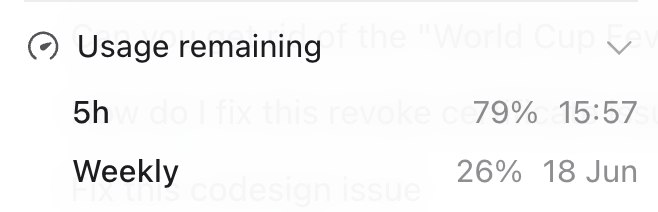
@_mauriciorubio reported (1 like, 1 reply, 167 views) that Codex had consumed an entire weekly allowance in less than 24 hours without finishing work. The screenshot backed up the complaint by showing 79% of the five-hour budget still available but only 26% of the weekly budget left, and the post added mobile sync and connectivity complaints on top of the quota issue.
@pcshipp argued (13 likes, 14 replies, 897 views) that Antigravity still could not compete with Cursor, Codex, and Claude Code even after going free. That short post mattered because it summarized the day's bluntest competitive rule: quality beats free access.
Discussion insight: The feed did not treat meters and saved resets as billing trivia. People treated them as controls for systems that still waste work or hide where the spend is going.
Comparison to prior day: June 11 already linked loops and cost; June 12 made quota dashboards, saved resets, and weekly-vs-short-window burn rates explicit parts of the conversation.
1.3 Agent surfaces kept broadening beyond “write code” 🡒
A third cluster of posts showed AI-coding products stretching into broader workflow surfaces. Four strong items supported this theme, and they were about reducing handoffs more than about introducing a new model.
@github said (64 likes, 11 replies, 15,384 views, 15 bookmarks) that the GitHub Copilot app keeps the whole loop in one place from issue to merge. A reply from @BrandGrowthOS made the user value concrete: for someone without a strong developer mental model, one window switch is enough to lose context and start rebuilding it from scratch.
@pierceboggan added (50 likes, 7 replies, 3,755 views, 4 bookmarks) that the Copilot app was spreading beyond software engineers into adjacent roles, and that the top onboarding error was simply Git not being installed. That made the bottleneck look operational rather than algorithmic.
@zswang24 described (66 likes, 2 replies, 3,800 views, 52 bookmarks) how OpenAI teams use Codex with the Data Analytics plugin to define north-star metrics, identify data gaps, schedule KPI reports, and turn Databricks results into dashboards for adoption, retention, revenue, and risk. The tweet mattered because it moved the agent surface from code generation into analytics operations.
@freeCodeCamp framed (80 likes, 4 replies, 2,994 views, 66 bookmarks) MCP server creation as an approachable development skill instead of a specialist protocol exercise. Together with the Copilot and Codex posts, that suggested the workflow surface is getting wider in both directions: more adjacent users and more adjacent tasks.
Discussion insight: The most positive workflow posts were about keeping context together and wiring tools together. The differentiator was less “which model is smartest?” and more “which surface removes the most handoffs?”
Comparison to prior day: June 11 emphasized runtime and governance around Copilot and Antigravity. June 12 leaned harder into practical workflow breadth: adjacent-role onboarding, analytics dashboards, and MCP tooling education.
2. What Frustrates People
Limit visibility is poor enough that users now optimize around resets
Severity: High. @_mauriciorubio said (1 like, 1 reply, 167 views) that Codex burned through a weekly allowance in less than 24 hours without completing useful work, while @vikaskansalHQ showed (447 likes, 58 replies, 28,639 views, 52 bookmarks) a new Antigravity quota meter because users clearly needed more visibility into model limits. @kimmonismus picked up (179 likes, 23 replies, 11,847 views, 14 bookmarks) OpenAI's saved-reset rollout as welcome relief, but even that thread treated resets as a workaround for inefficient usage rather than a full fix. People are coping by watching meters, preserving resets, and routing expensive reasoning more selectively. This looks worth building for because trust now depends on bounded execution and predictable burn, not just on final output quality.
Platform migrations still lose on everyday ergonomics
Severity: High. @JackWoth98 asked (39 likes, 17 replies, 8,064 views, 10 bookmarks) why free-tier and Google One Gemini CLI users had not yet moved to Antigravity CLI, and the replies gave precise answers. One cited broken carriage-return handling, another asked for direct MCP server commands in the terminal, and @pcshipp summed up (13 likes, 14 replies, 897 views) the broader sentiment by saying free Antigravity still could not match Cursor, Codex, or Claude Code on quality. The coping strategy today was not to adapt faster; it was to stay on the tools that already fit established habits. This looks worth building for because terminal ergonomics and setup primitives still decide whether a migration feels safe.
Setup and context-switch tax still blocks broader adoption
Severity: Medium. @github positioned (64 likes, 11 replies, 15,384 views, 15 bookmarks) the Copilot app as a way to keep the whole issue-to-merge loop in one place, and a reply said that one extra window switch is enough to break a fragile mental model. @pierceboggan added (50 likes, 7 replies, 3,755 views, 4 bookmarks) that the top onboarding error was simply Git not being installed. The workaround is still manual setup and extra guidance. This is worth building for because the adoption ceiling now includes adjacent roles who are willing to use AI coding tools but are easily derailed by missing local prerequisites or too many surfaces.
3. What People Wish Existed
Portable knowledge bundles agents can read, write, and diff
@Marie_Haynes framed (17 likes, 1,291 views, 34 bookmarks) OKF as a way to build a living wiki for agents, while @SeeratFatima112 described (21 likes, 6 replies, 91 views) a graph layer that teaches a large codebase in the right order and @oliviscusAI pitched (12 likes, 1 reply, 434 views, 9 bookmarks) a persistent graph that can be queried later without re-reading raw files. The shared request is for memory that survives sessions, moves across tools, and stays inspectable in ordinary files. This is a practical need rather than a speculative one because public builders are already implementing it in both graph and markdown form. Opportunity: direct.
Hybrid agent loops that spend cheap tokens on execution and expensive tokens on decisions
@jamesgregoryseo outlined (2 likes, 3 replies, 95 views) a manual routing loop where Codex writes and tests while Claude Fable plans and debugs, with approval before any private context leaves the machine. @kimmonismus welcomed (179 likes, 23 replies, 11,847 views, 14 bookmarks) saved Codex resets, while @_mauriciorubio showed (1 like, 1 reply, 167 views) what happens when the loop is not bounded well enough. The missing product is a first-class controller for cost, escalation, and approval instead of a hand-built bridge between tools. Opportunity: competitive.
Lower-setup agent workspaces for adjacent roles
@github sold (64 likes, 11 replies, 15,384 views, 15 bookmarks) the Copilot app on reduced context switching, @pierceboggan reported (50 likes, 7 replies, 3,755 views, 4 bookmarks) that non-engineering adoption was already happening, and @freeCodeCamp packaged (80 likes, 4 replies, 2,994 views, 66 bookmarks) MCP server creation as a guided course. The pattern is a clear wish for agent tooling that assumes less prior setup and less systems knowledge from the user. This is a practical need with growing demand from non-expert or cross-functional users. Opportunity: direct.
4. Tools and Methods in Use
| Tool | Category | Sentiment | Strengths | Limitations |
|---|---|---|---|---|
| Google Antigravity / Antigravity CLI | Agent platform | (+/-) | Clearer quota visibility, free access, and a broad surface spanning terminal and multimodal workflows | Users still reported bugs, fast token burn, missing terminal ergonomics, and weaker output than rival tools |
| OpenAI Codex | Coding agent | (+/-) | Saved resets, strong builder goodwill, analytics workflows, and plugin-driven KPI/dashboard tasks | Some users reported weekly budget burn in under 24 hours, degraded efficiency, and mobile/connectivity issues |
| GitHub Copilot app | Workflow surface | (+) | Keeps issue-to-merge work in one place and appears to onboard adjacent roles, not just engineers | Local prerequisites such as Git still block onboarding, and plan access questions remain in replies |
| Understand Anything | Code understanding / knowledge graph | (+) | Tree-sitter plus LLM analysis, guided tours, diff impact analysis, and installs across many agent surfaces | The semantic layer still costs tokens on large repos |
| Graphify | Multimodal memory layer | (+) | Converts code, docs, PDFs, screenshots, and diagrams into a persistent graph plus reports and wiki outputs | Evidence today came mostly from creator-promotional material rather than deep reply validation |
| Open Knowledge Format (OKF) | Knowledge format | (+) | Vendor-neutral markdown plus YAML bundles, version control friendliness, and no required SDK | Still early, with most evidence coming from launch materials and exploratory use rather than production case studies |
| FastMCP / MCP | Protocol / integration tooling | (+) | Standardizes how agents interact with databases, functions, and apps, and is teachable enough for a mainstream course | Still requires server setup, testing, and protocol literacy before it pays off |
| Claude Fable 5 / Claude Code | Model + coding surface | (+/-) | Useful for planning, debugging, and higher-end reasoning inside hybrid loops | Cost, harness regressions, and model-retirement chatter kept the sentiment mixed |
Overall sentiment was pragmatic rather than ideological. People liked tools that reduced search churn, context switching, or wiring effort, and they rejected tools that consumed quota too quickly or missed small but essential terminal behaviors.
The clearest migration pattern was still Google pushing some Gemini CLI users toward Antigravity CLI, while the clearest method shift was from single-model workflows toward explicit routing: Codex for execution, Claude for planning, and graph or markdown memory layers for recall. Competitive pressure was strongest around quality-per-token, not around simple availability or free access.
5. What People Are Building
| Project | Who built it | What it does | Problem it solves | Stack | Stage | Links |
|---|---|---|---|---|---|---|
| Understand Anything | Lum1104 / Egonex-AI | Turns a repo or knowledge base into an interactive graph with guided tours and diff impact analysis | Teams need faster orientation before asking agents to change a large codebase | Tree-sitter, multi-agent analysis, interactive dashboard, multi-platform plugin installs | Shipped | repo, tweet |
| Graphify | Safi Shamsi | Builds a persistent graph from code, docs, PDFs, screenshots, and diagrams | Agents waste tokens re-reading raw files and lose context across sessions | Claude Code skill, tree-sitter, Claude vision, Python CLI, graph/wiki outputs | Shipped | repo, tweet |
| Open Knowledge Format reference agent | GoogleCloudPlatform | Emits portable markdown knowledge bundles with YAML frontmatter plus example visualizations | Internal context is fragmented across wikis, APIs, and metadata silos | Markdown, YAML frontmatter, Google ADK, Gemini, BigQuery | Alpha | blog, repo, tweet |
| GitHub Copilot app | @github | Keeps issue, branch, coding, and merge work in one surface | Context switching and cross-role onboarding still slow down agent-assisted work | GitHub app surface, Copilot plans, local Git workflow | Beta | tweet, builder note |
| Codex Data Analytics plugin workflows | @zswang24 | Uses Codex to define metrics, schedule KPI reports, and build launch dashboards from Databricks results | Analytics planning and reporting still require repetitive manual coordination | Codex, Data Analytics plugin, Databricks dashboards | Shipped | tweet |
| OpenCode v1.17.4 | @OpenCodeLog | Adds connector auth, MCP cwd and header fixes, v2 API and SDK growth, and better visible failures in the TUI | Terminal agents still need better auth, MCP compatibility, and operational observability | TUI, MCP, OAuth/key connectors, API, SDK | Shipped | tweet |
The standout build pattern was external memory and workflow infrastructure around existing models, not a new model shell. Understand Anything, Graphify, and OKF each tried to solve the same meta-problem from different angles: make context durable, portable, and inspectable before the next prompt is ever sent.
The second pattern was operational surfaces around agent use. The Copilot app, Codex analytics workflows, and OpenCode release all focused on what happens after you already have a capable model: auth, dashboards, visibility, branch flow, and fewer handoffs.
6. New and Notable
Google gave agent memory a file format, not just another service
@Marie_Haynes surfaced (17 likes, 1,291 views, 34 bookmarks) OKF as something agents can query and edit, and Google's launch post made the differentiator unusually explicit: markdown files, YAML frontmatter, no required SDK, and portability across tools. That was notable because most AI-coding memory discussions are about a specific product, while this one proposed a shared substrate.
Saved Codex resets turned quota timing into an explicit workflow control
@kimmonismus amplified (179 likes, 23 replies, 11,847 views, 14 bookmarks) OpenAI's new ability to save Codex resets, quoting the original OpenAI post. The feature was notable because it formalized something users had been improvising around for weeks: when to spend scarce agent capacity.
Code-understanding layers kept scaling while the rest of the feed argued about cost
@SeeratFatima112 pointed to (21 likes, 6 replies, 91 views) Understand Anything reaching 56,400 stars, while @oliviscusAI pitched (12 likes, 1 reply, 434 views, 9 bookmarks) Graphify as a cross-tool graph layer with persistent outputs. That contrast mattered: one part of the market is trying to reduce agent cost by making context reusable before the token meter starts.
7. Where the Opportunities Are
[+++] Portable agent memory layers — Understand Anything, Graphify, and OKF all attacked the same bottleneck from different directions: agents keep losing context or re-reading files they should already understand. The signal is strong because it spans open-source plugins, a new Google format, and direct user complaints about token waste.
[+++] Quota governance and bounded execution — Antigravity's new quota meter, OpenAI's saved resets, and complaints about Codex burning weekly allowance all point to the same opening: users need hard controls for when, how, and how much an agent is allowed to spend.
[++] Cross-role agent workspaces — The Copilot app posts showed real interest from adjacent roles, but also showed that setup and context-switch costs are still too high. The opportunity is moderate because the demand is clear, but the product has to solve onboarding and workflow continuity at the same time.
[++] Analytics-native coding agents — Codex with the Data Analytics plugin pushed beyond writing code into KPI definition, launch tracking, and dashboard generation. That suggests room for tools that sit between software development, analytics engineering, and PM work.
[+] Quality verification for vibe-coded output — The "looks vibed" discussion translated vibe-coding criticism into specific product omissions such as empty states, permissions, error copy, and awkward mobile layouts. The signal is emerging, but it points toward review layers that audit generated work for product completeness rather than just syntax.
8. Takeaways
- The conversation moved closer to persistent context infrastructure than to model launches. Understand Anything, Graphify, and OKF all focused on keeping knowledge reusable across sessions and tools. (Understand Anything tweet, Graphify tweet, OKF launch post)
- Quota handling is now part of the AI-coding product surface. Antigravity added a visible quota meter, OpenAI added saved Codex resets, and users still complained that badly bounded loops can destroy a weekly budget in a day. (Antigravity quota post, Codex resets post, Codex budget complaint)
- Workflow breadth mattered more than raw model novelty. The Copilot app, MCP tutorial, and Codex analytics workflow posts all sold AI coding on fewer handoffs and wider task coverage. (Copilot app post, FastMCP course post, Codex analytics post)
- Free access did not erase quality comparisons. Replies and standalone posts kept measuring Antigravity against Cursor, Codex, and Claude Code on execution quality and ergonomics rather than on price. (migration thread, quality comparison post)
- Vibe coding criticism is getting more specific. The strongest complaint was no longer "AI code is bad" in the abstract; it was that generated products often miss the boring but necessary details that make software feel finished. (Benji Taylor thread)