Twitter AI Coding - 2026-06-16
1. What People Are Talking About
1.1 Codex and Copilot kept turning agent features into visible product surfaces 🡕
The clearest cluster on June 16 was not a new model release. It was product surfaces becoming more concrete: browser control in Codex, wider regional rollout of Codex features, and multiple GitHub Copilot App UI updates for orchestration and visualization. Five retained items supported the theme.
@testingcatalog reported (740 likes, 27 replies, 44,368 views, 331 bookmarks) that Codex now supports Chrome DevTools Protocol for browser use. The post framed that as a way for Codex to inspect and modify websites, and the replies immediately pushed the conversation toward operational control rather than hype: one asked for a touched-tab log, while another said browser use moves web apps into the same inspect-edit-test loop as code.
@RoundtableSpace said (151 likes, 12 replies, 51,500 views, 139 bookmarks) OpenAI was giving qualifying users up to $1,200 in credits, six months of ChatGPT Pro, and Codex access in exchange for a public GitHub repo. Replies mattered here because they treated the offer as a way to revive abandoned or half-finished projects, while still questioning whether Codex would stay stable enough to be useful.
@testingcatalog added (58 likes, 4 replies, 3,521 views) that OpenAI was expanding Codex computer use, the Chrome extension, personalized memory, and Chronicle to users in the EEA, UK, and Switzerland, quoting the underlying OpenAIDevs post. That made the browser-use story look like a broader rollout, not a one-off experiment.
@_Evan_Boyle showed (32 likes, 4 replies, 1,997 views, 16 bookmarks) a new /orchestrate skill in the GitHub Copilot App for coordinating work across sessions and repos. In a reply, he said sessions can send and receive messages from each other, which is a more specific claim than generic "multi-agent" marketing.

@mariorod1 showed (49 likes, 3 replies, 1,409 views) Mermaid diagrams rendering inside the GitHub Copilot App, while @_Evan_Boyle highlighted (37 likes, 2,065 views) a smaller but related session-sorting control by time or last activity. Together those posts suggested that Copilot App work is moving beyond core agent execution into organization and visual explanation.
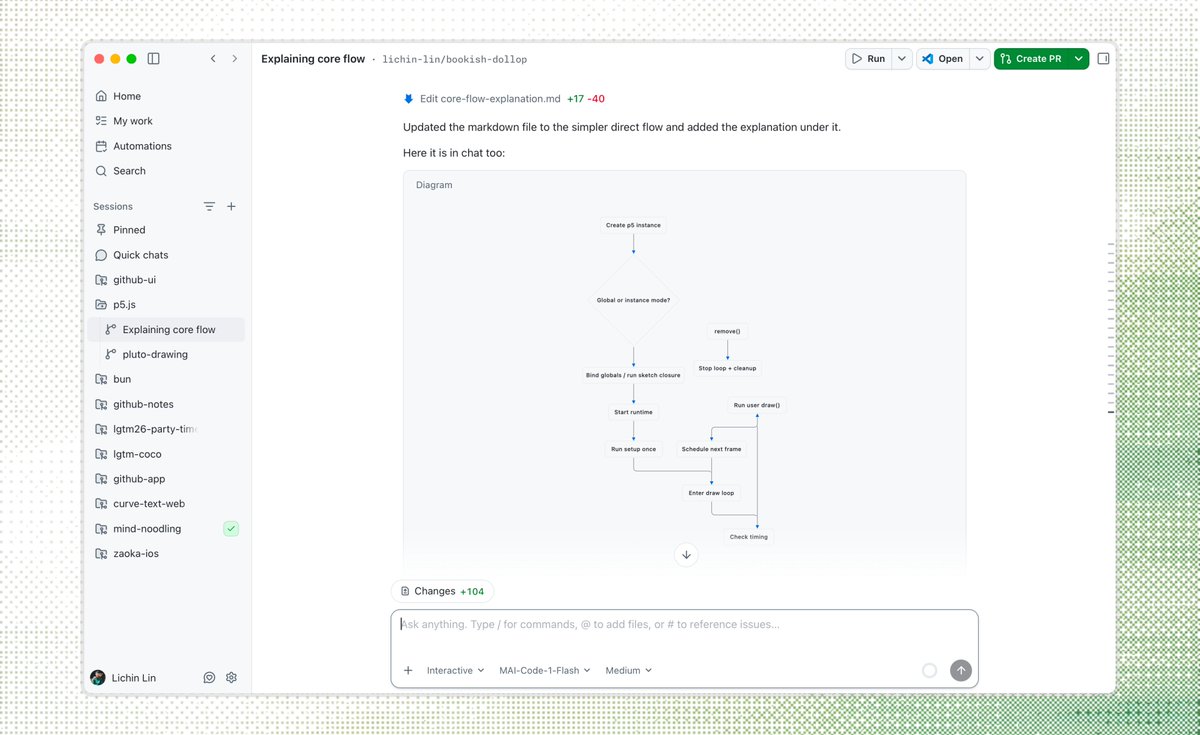
Discussion insight: The most useful replies were about guardrails and legibility. People did not just want "computer use"; they wanted evidence of what the agent touched, which session was doing what, and how multiple sessions were coordinated.
Comparison to prior day: June 15 already emphasized orchestration as a harness problem. June 16 shifted that same story into visible product UI: browser control, /orchestrate, Mermaid rendering, and session-management polish.
1.2 Practitioners shared more explicit playbooks for supervising many agents at once 🡕
The second major theme was operational. Instead of debating whether multi-agent coding is possible, several posts described how to run it: discuss first, split work, preserve context, supervise many sessions, and even share one session between multiple humans. Four retained items supported the theme.
@KingBootoshi outlined (27 likes, 7 replies, 1,413 views, 40 bookmarks) a long Claude Code/Codex workflow built around an initial discussion thread, a master PRD, a foundation branch, and parallel worktrees branched from cached context. The distinctive claim was not just "use more agents," but that APFS copy-on-write clones and branched chats keep file context warm enough to make parallel work both cheaper and faster.
@aakashadesara posted (2 likes, 2 replies, 75 views) CTOP as a terminal view over Claude, Codex, OpenCode, and Devin sessions. The attached screenshot mattered because it showed live context percentage and cost in one pane, which is the kind of supervision surface people need once they stop running one agent at a time.

@tdinh_me shared (1 like, 2 replies, 428 views) a funny but revealing example: one Claude Code session, exposed through Telegram, proactively pinged the wrong human in a shared workflow. The joke was the point. A single stateful session was already being treated as shared infrastructure for two users.
@oliviscusAI pointed to (12 likes, 2 replies, 340 views, 9 bookmarks) ECC as an "operating system for AI coding agents" with 271 skills, 67 agents, and 92 commands across Claude Code, Cursor, Codex, OpenCode, Gemini CLI, Zed, and GitHub Copilot. Even if the post was promotional, it reinforced the same pattern: people increasingly expect a reusable environment layer around the model.
Discussion insight: The strongest practitioner nuance was about state and supervision, not model IQ. The hard problems were preserving context across branches, understanding what each agent is doing, and keeping shared sessions from becoming confusing.
Comparison to prior day: June 15 featured orchestration as a benchmark and plugin-API topic. June 16 added more explicit operating procedures, monitoring surfaces, and shared-session behavior.
1.3 Quota math and reliability still decided whether people trusted the workflow 🡕
The third big theme was that even enthusiastic users still judged AI-coding tools by quota clarity, price predictability, and whether the app stayed stable. Five retained items supported the theme.
@rxhit05 reported (17 likes, 14 replies, 469 views) that Google Antigravity had just received a 3x quota increase. The screenshot was informative because it turned "more quota" into a visible product change, but the replies were mixed: one said it was enough to build a SaaS, another said limits still arrived at roughly the same point.

@manu_varru said (2 replies, 104 views) that after using Google AI Studio for images, their Antigravity countdown jumped from hours to days and the panel lacked a proper usage tracker. The screenshot mattered because it turned a vague complaint into a specific request for a counter users can trust.

@_mauriciorubio reported (2 likes, 197 views) that Codex remained unstable even after an update, with looping, empty chats, repeated errors, and continued token burn. The attached screenshots showed the contradiction directly: one screen said the app was up to date while another still surfaced a blocking error state.

@slicknet linked (2 likes, 260 views) to a detailed pricing analysis arguing that GitHub Copilot's June 1 shift to usage-based AI credits makes background agents, code review, cloud agents, and multi-agent flows much harder to price mentally. That article was useful because it connected the day's smaller complaints to a wider product-design problem: once agents run asynchronously, cost becomes difficult to predict.
@alexcovo_eth added (24 likes, 2,174 views, 6 bookmarks) that heavier Codex plus Hermes usage was burning enough tokens to make fixed client pricing harder, and the usage heatmap screenshot backed up the point with concrete daily activity rather than a generic "AI is expensive" complaint.
Discussion insight: People were willing to spend money or watch quotas, but only when the meter was legible and the app stayed responsive. The hardest complaints were about hidden burn, contradictory countdowns, and recovering from broken updates while tokens kept draining.
Comparison to prior day: June 15 already treated limits and meters as part of the product. June 16 kept that pressure on, but with more explicit complaints about tracker accuracy, background spend, and production instability.
2. What Frustrates People
Quota accounting is still too fuzzy for long-running agent work
Severity: High. @manu_varru said (2 replies, 104 views) that Antigravity showed hours remaining for minor site updates, then jumped to days after using Google AI Studio for images, and explicitly asked for a proper usage tracker. @rxhit05 celebrated (17 likes, 14 replies, 469 views) a 3x quota increase, but one reply still said the product kept hitting limits at roughly the same point. @alexcovo_eth added (24 likes, 2,174 views, 6 bookmarks) that heavy Codex plus Hermes usage made it hard to quote fixed prices to clients. People are coping by watching panels, routing work more selectively, and trying to invent their own cost heuristics. This looks worth building for because agent workflows now last long enough that bad meters directly interrupt planning and client work.
Stability failures still destroy trust faster than feature launches create it
Severity: High. @_mauriciorubio reported (2 likes, 197 views) that Codex remained unusable after an update, with looping, empty chats, and continued token burn while trying to recover. Even the highest-engagement Codex browser-use thread carried a reply from @SlykePhoxenix saying the desktop app still could not save settings correctly on their machine, inside @testingcatalog's launch thread (740 likes, 27 replies, 44,368 views, 331 bookmarks). The workaround today is mostly retrying, reloading, or abandoning the flow. This looks worth building for because background agents, browser control, and multi-session work only help if the client stays stable enough to supervise them.
Google's coding stack still reads as fragmented to many users
Severity: Medium. @haider1 asked (73 likes, 12 replies, 4,618 views) what Google was "cooking" because AI Studio, Antigravity, IDE surfaces, and Jules still felt strategically confusing. Replies disagreed on whether the products overlap or each serve a distinct role, which is itself the problem: users could not easily tell where one workflow ends and another begins. The practical coping strategy today is experimentation and word-of-mouth translation from other users. This looks worth building for because even interested users lose confidence when the platform map is hard to explain.
3. What People Wish Existed
Trustworthy quota and budget controls
The most direct request on June 16 was not for a smarter model. It was for metering people can actually trust. @manu_varru explicitly asked (2 replies, 104 views) for a proper usage tracker after Antigravity's countdown jumped unexpectedly, while @slicknet linked (2 likes, 260 views) to a longer argument that usage-based Copilot credits become hard to reason about once agents run in the background. @alexcovo_eth made (24 likes, 2,174 views, 6 bookmarks) the same need concrete from the consulting side by saying token burn is getting hard to price. This is a practical need with direct revenue implications. Opportunity: direct.
Better supervision for many parallel or shared agents
The day also showed a clear desire for a control layer above individual sessions. @_Evan_Boyle introduced (32 likes, 4 replies, 1,997 views, 16 bookmarks) /orchestrate for coordinating work across sessions and repos, @aakashadesara showed (2 likes, 2 replies, 75 views) CTOP as a dashboard over many agent sessions, and @tdinh_me revealed (1 like, 2 replies, 428 views) how messy a shared session can get when one bot starts addressing the wrong user. The implied wish is for multi-agent work that is inspectable, attributable, and safe to share. Opportunity: direct.
Local-first and mobile agent workspaces with less setup tax
Builder posts suggested a strong appetite for workspaces that collapse setup friction. @RFzinc launched (3 likes, 3 replies, 55 views) Shelly as Codex CLI running natively on Android without PC, Termux, or proot, while @kalyan_kpl framed (27 likes, 2 replies, 2,243 views, 19 bookmarks) Colab CLI as a zero-friction bridge from local terminal to remote accelerators. The repeated ask is not just "AI on more devices"; it is less wiring before productive work can start. Opportunity: competitive.
4. Tools and Methods in Use
| Tool | Category | Sentiment | Strengths | Limitations |
|---|---|---|---|---|
| OpenAI Codex | Coding agent | (+/-) | Browser use via Chrome DevTools Protocol, expanding regional rollout, strong real-world usage, grants/access for public-repo builders | Updater failures, looping/empty chats, unstable desktop behavior, hard-to-price token burn |
| GitHub Copilot App | Agent workspace | (+) | /orchestrate across sessions/repos, Mermaid diagrams, session sorting, visible UI polish around longer workflows |
Questions about pricing, BYOK, and platform support still show up in replies |
| Google Antigravity | Planning/orchestration tool | (+/-) | Architecture/planning, second-opinion review role, quota increases, works alongside Claude Code | Users still report quota confusion and an unclear role versus AI Studio and Jules |
| Claude Code | Execution-oriented coding agent | (+/-) | Strong at milestone execution, file edits, tests, and paired workflows with planning tools | Cache/worktree behavior still needs manual handling, and shared-session flows can get messy |
| Google Colab CLI | Remote execution CLI | (+) | GPU/TPU provisioning from the terminal, remote execution, artifact download/log retrieval, agent-friendly ML workflows | Evidence today came from one explanatory thread rather than broad user validation |
| Shelly | Mobile coding workspace | (+) | Runs Codex CLI natively on Android with Agent Chat and quota/cost widgets, avoids Termux/proot setup | Early-stage usage signal and still one-maker evidence today |
| 9Router / Hermes / UsePod-style routing | Cost/routing layer | (+/-) | Cheap backup/free-tier routing, alternative provider pricing, localhost bridge into existing tools | Mostly promotional evidence and requires users to understand provider/routing complexity |
| CopilotKit MCP server | Context server / docs layer | (+) | Free, no-limits positioning; indexes repos, chats, docs, PDFs, and updates with product changes | Evidence today was mainly vendor-claimed rather than independently validated |
The satisfaction spectrum was practical. People praised tools that made agent work visible, cheaper, or easier to start, and they complained when quota math, update behavior, or product boundaries stayed opaque.
The clearest method split was plan in Antigravity or another orchestration layer, then execute in Claude Code or Codex. The clearest market split was between full agent workspaces and the growing layer of support tools around them: routing, MCP/context servers, output filtering, mobile wrappers, and supervision dashboards.
5. What People Are Building
| Project | Who built it | What it does | Problem it solves | Stack | Stage | Links |
|---|---|---|---|---|---|---|
| BugHunter / Claude Bug Bounty | @tom_doerr / shuvonsec | Automates recon, hunting, validation, and reporting for bug bounty work inside Claude Code or as a standalone CLI | Security researchers want an end-to-end agent workflow instead of stitching together prompts and scanners by hand | Python CLI, shell scanners, Claude Code plugin, standalone mode, Ollama/Groq/DeepSeek/Claude/OpenAI providers | Shipped | repo, tweet |
| Postrboard | @burkeholland | A personal CSS framework and design language with live docs and components | Quickly shaping a custom design system without starting from scratch each time | Design tokens, CSS component library, live docs site, skills-based install flow | Shipped | site, tweet |
| mfertown / mferland | @HeresMyEth | An open MMO for humans and agents with quests, fights, skills, and live world state | Turns agents into first-class users inside a persistent environment instead of just code generators | Live web game, wallet-authenticated agents, skill router, read-only world/player APIs | Shipped | game, skill, tweet |
| Shelly | @RFzinc / RYOITABASHI | Runs the real Codex CLI natively on Android with live Agent Chat and quota widgets | Removes the desktop/Termux/proot setup tax for mobile AI coding | Native Android app, app-owned PTY, Codex CLI, bundled Git/Bash/Python, Expo, TypeScript | Shipped | Product Hunt, repo, tweet |
BugHunter stood out because the public README made the stack and scope unusually explicit. It is not just a prompt pack; it packages recon, validation gates, reporting templates, and provider selection into one agent workflow, which is exactly the kind of "workflow as product" move that kept showing up across the feed.
Postrboard was smaller in scope but revealed another builder pattern: using Copilot to produce personal infrastructure rather than customer-facing SaaS. The live docs page showed real tokens and components, so the result was more than a logo or landing-page mockup.
mfertown and Shelly pointed in two different but related directions. mfertown treated agents as in-world actors with public state and quests, while Shelly treated the phone as a full local AI-coding workstation with Codex in a bundled terminal. In both cases, the builders were extending where agents can live, not just what prompts they answer.
The repeated build pattern was clear: people are wrapping coding agents with domain workflows, custom interfaces, or alternate runtimes rather than waiting for the base tool to do everything.
6. New and Notable
Output filtering turned into a token-saving product
@carsonthedev shipped (4 likes, 4 replies, 87 views) opencode-smartsnip, a tool that filters shell output before it reaches the model. The claim was unusually concrete for a small launch: git output down 72%, pnpm output down 48%, and about 1 million tokens of context traffic removed in one real workday. That mattered because it attacked a practical cost center other threads kept complaining about.
MCP infrastructure is being sold on freshness and zero limits
@CopilotKit argued (24 likes, 1 reply, 1,032 views, 16 bookmarks) that its MCP server can stay free and uncapped because it only maintains one ecosystem, while indexing repos, Discord threads, Slack conversations, Notion pages, and PDFs. The interesting shift was not the usual "we have docs." It was the promise that context servers should update as fast as the product changes.
Price discovery around frontier models is becoming its own layer
@0xgilbert posted (61 likes, 7 replies, 3,605 views) a pricing panel showing GPT-5.5 available at far below OpenAI's direct price through marketplace routing. Replies explicitly called this "inference capital markets," which made the point clear: provider arbitrage is becoming part of the coding-agent toolkit, not just a backend concern.
7. Where the Opportunities Are
[+++] Agent quota control planes — Evidence came from section 1 and section 2 at the same time: Antigravity's quota increase, explicit requests for a better tracker, Copilot's usage-based pricing debate, and real consulting-side difficulty pricing token-heavy work. The strongest opening is not another model wrapper; it is spend visibility, task-level accounting, and clearer failure boundaries for background agents.
[++] Multi-agent supervision and shared-session safety — /orchestrate, CTOP, KingBootoshi's worktree-and-cache playbook, and the shared Telegram/Claude session all pointed to the same need: once several agents or people touch one workflow, attribution and monitoring matter. There is room for products that show which session changed what, which user is being addressed, and how cost/context is moving across the fleet.
[+] Low-setup local and mobile workspaces — Shelly and Colab CLI showed appetite for work that starts faster on constrained or unusual devices, while Google-stack confusion showed that too many entry points still slow people down. The opportunity is emerging because the demand is visible, but the strongest evidence still comes from individual builders rather than a broad crowd.
8. Takeaways
- AI-coding products kept broadening outward from "write code" into browser control, orchestration, and visualization. Codex browser use and the regional rollout of computer use/Chrome extension features sat alongside Copilot App posts for
/orchestrate, Mermaid diagrams, and session sorting. (source) - The community is getting more serious about operating many agents, not just prompting one. Detailed worktree-and-cache guidance, CTOP monitoring, and shared-session experiments all pointed to a real operating model emerging around agent fleets. (source)
- Quota clarity and reliability are still the biggest trust killers. Users complained about tracker accuracy, unpredictable burn, unstable updates, and pricing models that become hard to reason about once agents run in the background. (source)
- Builders are shipping wrappers, runtimes, and domain workflows around agents rather than waiting for the core tools to mature. BugHunter, Postrboard, mfertown, and Shelly all extended where agents work or what workflows they can own. (source)