Twitter AI Coding - 2026-06-25
1. What People Are Talking About
1.1 Codex started looking like a company-wide execution layer (🡕)
The clearest theme was Codex moving beyond software engineering into a general execution surface for knowledge work. Four retained items supported it: OpenAI staff shared department-level usage data, an external summary surfaced paper-level growth numbers, and another OpenAI employee listed everyday non-engineering tasks already being handed to Codex.
@thsottiaux shared (516 likes, 76 replies, 30,759 views, 54 bookmarks) an image showing Codex's share of OpenAI output rising to 99% in engineering, 91% in finance, 89% in recruiting, and 88% in legal, while the quoted OpenAI post said the tool is already being used for longer-running, cross-functional work across the company.

@Hesamation summarized (4 likes, 2 replies, 1,540 views, 3 bookmarks) the public paper "The Shift to Agentic AI: Evidence from Codex," calling out a 5x increase in active users in the first half of 2026, skills adoption rising from 5.4% in March to 26.6% in June, and the share of users assigning eight-hour-plus tasks rising from 2.1% in December to 25.6% in May.
@reach_vb said (46 likes, 7 replies, 3,913 views, 5 bookmarks) colleagues were already using Codex to order groceries, file taxes, fill forms, follow up on emails, and manage finances. That mattered because it turned the paper's adoption numbers into concrete evidence of coding-agent workflows spilling into administrative work.
Discussion insight: The replies kept framing the shift as delegated work, not better chat. One OpenAI reply under the thread said the February Codex app launch was the point where adoption outside engineering visibly accelerated.
Comparison to prior day: June 24 already treated Codex as broader than a pure coding assistant. June 25 added hard public measurement: department-by-department share charts, user-growth figures, and explicit evidence that long-horizon delegated tasks are becoming normal.
1.2 GitHub kept turning Copilot into an agent platform, not just a chat shell (🡕)
The second theme was GitHub adding more workflow infrastructure around Copilot rather than chasing a single headline model. Three retained items supported it: the Copilot app was framed as a home for automations and MCPs, Agent Finder turned skill and MCP discovery into a product surface, and Copilot CLI got a public path to semantic code intelligence through language servers.
@github showed (94 likes, 10 replies, 22,979 views, 35 bookmarks) the Copilot app as a place for automations, MCP integrations, and custom skills. The strongest replies were practical rather than aspirational: one user asked what the point of the app is when rate limits still stop work, and another asked for first-class WSL support.
@_Evan_Boyle announced (70 likes, 6 replies, 4,163 views, 28 bookmarks) Agent Finder, a semantic search engine for discovering skills, MCPs, and other extensions inside the Copilot app. His follow-up reply said it uses LLM-driven search and reranking, while another reply raised the immediate trust question of how users avoid malicious skills; Boyle answered that the index is manually curated for now.

@github announced (71 likes, 9 replies, 13,972 views, 20 bookmarks) the new LSP Setup skill for Copilot CLI. GitHub's public blog post says the skill installs and configures language servers for 14 languages so the CLI can use definitions, references, and types instead of text-search heuristics; replies added two caveats, with one developer warning about slow LSP cold-init on large projects and another saying billing changes had already pushed his team toward Claude and Codex.
Discussion insight: The trust questions moved one layer up the stack. People were less concerned with whether Copilot can generate code at all and more concerned with extension safety, cold-start behavior, Windows/WSL compatibility, and whether billing makes the workflow sustainable.
Comparison to prior day: June 24 emphasized desktop distribution and BYOK. June 25 was more infrastructure-heavy, focusing on discovery, semantic code navigation, and the mechanics of turning Copilot into an extensible agent runtime.
1.3 Builders kept wrapping coding agents into adjacent operating systems (🡕)
The third theme was builders using familiar coding-agent surfaces as the control plane for other kinds of work. Four retained items supported it: OpenMontage repurposed coding agents into a video-production pipeline, My Brain Is Full — Crew wrapped agents around Obsidian and email, Cockpit added a desktop shell around Copilot CLI, and Windows Copilot API turned a consumer Copilot login into a local OpenAI-compatible endpoint.
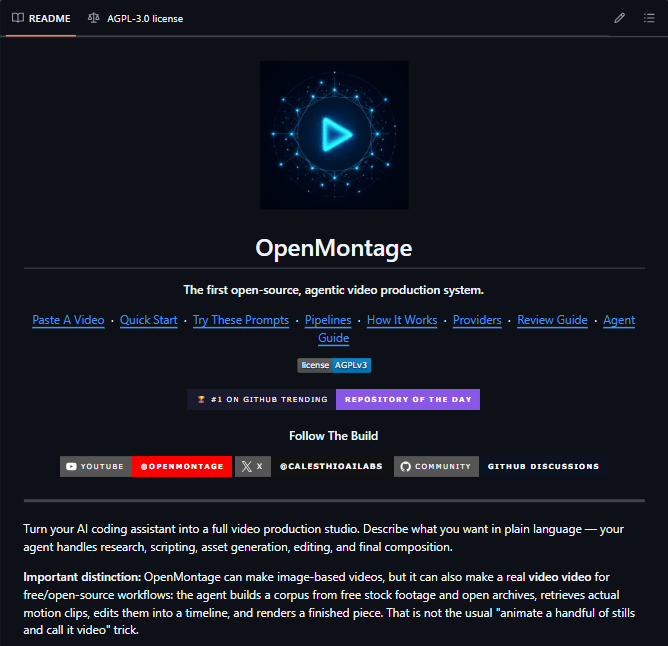
@TheWhizzAI highlighted (6 likes, 6 replies, 326 views, 2 bookmarks) OpenMontage as a way to turn Claude Code, Copilot, Cursor, or Codex into a full video-production system. The public repo describes 12 pipelines, 52 tools, and 500+ agent skills built around research, scripting, asset generation, editing, and final composition.
@DanKornas shared (8 likes, 3 replies, 1,068 views, 11 bookmarks) My Brain Is Full — Crew, and the public repo says it uses 8+ agents and 14 skills to manage an Obsidian vault, search notes, triage email, and support multilingual workflows across Claude Code, Gemini CLI, OpenCode, and Codex CLI.
@IeuanTWalker built (4 likes, 2 replies, 655 views, 2 bookmarks) Cockpit, a desktop GUI for GitHub Copilot CLI. Public project materials describe multi-session management, an integrated terminal, file attachments, diffs, activity logs, and permission controls in a C# shell around the CLI.
@_jaydeepkarale pointed to (2 likes, 1 reply, 252 views, 1 bookmark) Windows Copilot API, an unofficial Python bridge that exposes a signed-in Microsoft Copilot session as a local OpenAI-compatible API. Its repo explicitly frames it as personal-use automation rather than an official Microsoft interface.
Discussion insight: These projects all assume the same thing: users want to keep the natural-language, agent-first workflow, but they want to redirect it into video production, personal knowledge systems, desktop supervision, or low-cost local routing without waiting for one vendor to cover every use case.
Comparison to prior day: June 24 was still centered on memory, observability, and app-surface expansion. June 25 showed more builders turning coding agents into domain-specific operating systems that sit on top of existing clients instead of replacing them.
2. What Frustrates People
Pricing, quotas, and account controls still interrupt active work
Severity: High. The most consistent frustration was losing control of model access right when people want to depend on one workflow surface. @buildwithhassan said (3 likes, 1 reply, 81 views) that Copilot free and student plans no longer let users choose models manually, forcing auto-select instead. @gideonfip said (4 likes, 1 reply, 1,761 views) he hit his monthly OpenCode Go usage cap with 15 hours left in the cycle and had to fall back to free models he described as unreliable. A reply under @github showed (94 likes, 10 replies, 22,979 views, 35 bookmarks) that some users still see the Copilot app through the lens of rate limits, and @bdsqlsz reported (2 likes, 1 reply, 601 views) being randomly banned from a Pro 20X account and losing years of records. People are coping by switching tiers, falling back to free models, or reaching for unofficial bridges. This is worth building for because the pain is immediate and workflow-breaking.


Security and provenance still need explicit guardrails
Severity: High. Several posts showed that agent workflows still create avoidable trust problems. @samelldev warned (3 likes, 1 reply, 32 views) that Claude Code v2.1.179 was appending a session URL into git history via the default attribution trailer, and the screenshot included the settings fix to disable sessionUrl. Under @_Evan_Boyle announcing (70 likes, 6 replies, 4,163 views, 28 bookmarks) Agent Finder, one of the first substantive questions was how users can avoid installing malicious skills or MCPs; Boyle replied that the catalog is manually curated for now. Even the public Windows Copilot API repo explicitly says it is unofficial and for personal use, which is its own signal that people are stretching unsupported routes to get the control they want. People are coping by turning features off, relying on manual curation, and preferring local wrappers they can inspect. This looks worth building for because the failure mode is not abstract mistrust; it is leaked provenance, unclear extension trust, and unsupported workarounds.

Windows and environment integration still lag behind the product pitch
Severity: Medium to High. The product surfaces are getting broader faster than their environment handling is maturing. @awakecoding said (6 likes, 2 replies, 671 views) he had figured out why the GitHub Copilot app on Windows misses command-line tools that are visible in PATH, linking to a public GitHub issue comment. Under the main @github app thread (94 likes, 10 replies, 22,979 views, 35 bookmarks), another reply explicitly asked for first-class WSL support. And under the @github LSP Setup announcement (71 likes, 9 replies, 13,972 views, 20 bookmarks), one developer warned that LSP cold-start on large projects can delay the first useful response by 40 seconds or more. People are coping by debugging PATH behavior manually, narrowing platform expectations, and treating semantic tooling as something that still needs careful setup. This looks worth building for because it blocks adoption at the environment layer before model quality even matters.
3. What People Wish Existed
Model choice and spend control without leaving the agent surface
The strongest practical need was to keep one workflow surface while changing the economics underneath it. @buildwithhassan said (3 likes, 1 reply, 81 views) lower-tier Copilot users lost the ability to pick a model manually, @gideonfip said (4 likes, 1 reply, 1,761 views) OpenCode Go limits forced him onto unreliable fallback models, and @_jaydeepkarale pointed to (2 likes, 1 reply, 252 views, 1 bookmark) an unofficial Windows Copilot API bridge because there is still demand for OpenAI-compatible access without official API billing. This is a practical need with clear willingness to route around official product boundaries. Opportunity: Direct.
Persistent, inspectable workflow memory across sessions and tools
People also want the workflow itself to survive when the chat window changes. @Hesamation summarized (4 likes, 2 replies, 1,540 views, 3 bookmarks) that skills usage in Codex rose to 26.6% in June and that the highest-intensity users were running many hours of parallel agent work per day, which is exactly the sort of behavior that strains one-session memory. @DanKornas shared (8 likes, 3 replies, 1,068 views, 11 bookmarks) My Brain Is Full — Crew as a cross-platform memory-and-triage shell for Obsidian, while @IeuanTWalker built (4 likes, 2 replies, 655 views, 2 bookmarks) Cockpit to keep multiple Copilot CLI sessions, history, and activity visible in one desktop surface. The need is practical and already somewhat competitive, but still under-served. Opportunity: Competitive.
Safer extension ecosystems with clearer provenance
A third need was for extension systems that stay inspectable when agents install tools, write commits, or act with higher autonomy. Under @_Evan_Boyle launching (70 likes, 6 replies, 4,163 views, 28 bookmarks) Agent Finder, one of the first questions was how to filter malicious skills and MCPs, and the answer was manual curation. @samelldev warned (3 likes, 1 reply, 32 views) that Claude Code session identifiers were leaking into git history by default. The need is practical, urgent, and tied directly to trust in higher-autonomy workflows. Opportunity: Direct.
4. Tools and Methods in Use
| Tool | Category | Sentiment | Strengths | Limitations |
|---|---|---|---|---|
| Codex | Coding agent | (+) | Public paper and OpenAI staff posts show strong long-horizon, cross-functional adoption and skills reuse | Users still report account bans, quota dependence, and delayed feature expectations |
| GitHub Copilot app | Desktop agent workspace | (+/-) | Automations, MCP integrations, custom skills, extension discovery | Rate-limit complaints, WSL requests, and Windows environment rough edges |
| GitHub Copilot CLI + LSP Setup | CLI / code intelligence | (+/-) | Adds definitions, references, and type-aware navigation across 14 languages | LSP cold-init can be slow; some teams still see billing as a reason to switch away |
| Linear external agents | Issue-tracker runtime | (+) | Makes tickets a shared execution boundary for humans and agents | Replies immediately asked for more model-control options such as BYOK |
| Claude Code | Coding agent | (+/-) | Won the XDA frontend comparison on UX polish; strong ecosystem gravity | Session-attribution leak and provenance concerns hurt trust |
| OpenCode Go / Zen | Harness / model routing | (+/-) | Gives users fallback providers and free-model entry points | Monthly caps and reliability complaints remain visible |
| OpenMontage | Agentic video-production framework | (+) | Extends coding agents into research, scripting, editing, subtitles, and rendering | Requires a code-oriented setup and still assumes comfort with repo-driven workflows |
| My Brain Is Full — Crew | Knowledge / memory system | (+) | Wraps Obsidian, email, and meetings in a multi-agent, multi-skill shell | Niche workflow; value depends on maintaining an Obsidian-style knowledge base |
| Windows Copilot API | Local API bridge | (+/-) | Gives a free OpenAI-compatible endpoint backed by a signed-in Copilot account | Unofficial, personal-use only, and dependent on browser/session automation |
| Cockpit | GUI shell for Copilot CLI | (+) | Adds multi-session control, terminal visibility, history, attachments, and diffs | Early ecosystem tool with limited adoption signal so far |
The overall satisfaction spectrum was polarized. People liked tools that widened what agents could do or made them easier to supervise, but they were quick to object when those same surfaces hid model choice, quota boundaries, or extension provenance.
The common workaround pattern was to keep the workflow and swap the infrastructure: use unofficial local bridges, fall back to free models, add a GUI around a CLI, or push more state into skills and sidecar tooling rather than depend on a single vendor surface.
The migration dynamic was less about abandoning agents and more about wrapping them. Codex, Copilot, Claude Code, and OpenCode stayed central, but the interesting action moved into shells, bridges, memory layers, and domain-specific kits that changed how those agents were used.
5. What People Are Building
| Project | Who built it | What it does | Problem it solves | Stack | Stage | Links |
|---|---|---|---|---|---|---|
| OpenMontage | calesthio | Turns coding agents into an end-to-end video production system | Coding agents can script code, but usually stop before research, narration, editing, subtitles, and rendering | Python, FFmpeg, Node/Remotion, multi-provider media pipeline, 500+ agent skills | Shipped | repo |
| My Brain Is Full — Crew | gnekt | Uses a crew of agents to manage an Obsidian vault, email triage, and personal knowledge workflows | Second-brain setups become another maintenance burden without agentic organization and recall | Shell-based installer, Obsidian workflow, multi-platform support for Claude Code, Gemini CLI, OpenCode, and Codex CLI | Shipped | repo |
| Cockpit | Ieuan Walker | Adds a desktop GUI on top of GitHub Copilot CLI | Copilot CLI users want visible session history, diffs, terminal output, and multi-session control | C#, integrated terminal, diff viewer, activity log, attachment support | Alpha | site |
| Windows Copilot API | sums001 | Exposes a signed-in Microsoft Copilot session as a local OpenAI-compatible API | Developers want API-style access without official API billing or a new client surface | Python, Playwright/browser session automation, local OpenAI-compatible server | Beta | repo |
OpenMontage was the clearest example of today's builder pattern. @TheWhizzAI highlighted (6 likes, 6 replies, 326 views, 2 bookmarks) it as a way to make Claude Code, Copilot, Cursor, or Codex handle research, scripting, media generation, narration, and final composition, and the public repo documents 12 pipelines, 52 tools, and 500+ agent skills around that claim.
My Brain Is Full — Crew pushed the same wrapping instinct in a different direction. @DanKornas shared (8 likes, 3 replies, 1,068 views, 11 bookmarks) it as an 8-agent, 14-skill shell for Obsidian and email, with the repo explicitly framing chat as the interface and the vault as persistent memory.
Cockpit and Windows Copilot API were smaller-signal but revealing. @IeuanTWalker built (4 likes, 2 replies, 655 views, 2 bookmarks) a GUI because Copilot CLI still leaves room for more visible control, while @_jaydeepkarale pointed to (2 likes, 1 reply, 252 views, 1 bookmark) an unofficial bridge because people still want API-style access without changing clients.

The repeated build pattern was not "new base model." It was "new shell around an existing agent": more memory, more domain specificity, more UI, or cheaper routing. That is a direct response to the feed's two biggest pressures, which were workflow continuity and access friction.
6. New and Notable
Public metrics finally put hard numbers on the agentic shift
The biggest new evidence artifact was public, not just anecdotal. @Hesamation summarized (4 likes, 2 replies, 1,540 views, 3 bookmarks) the public Codex paper, and @thsottiaux shared (516 likes, 76 replies, 30,759 views, 54 bookmarks) the internal department chart. Together they moved the discussion from "agents feel bigger" to measurable claims about growth, long-horizon tasks, multi-agent management, and cross-functional usage.
A concrete Claude Code provenance footgun showed up in the wild
@samelldev warned (3 likes, 1 reply, 32 views) that Claude Code session URLs were being written into git history by default in v2.1.179, and the accompanying screenshot showed the settings change needed to stop it. That mattered because it was not a theoretical supply-chain or privacy concern; it was a specific, reproducible provenance leak in a mainstream coding-agent workflow.
7. Where the Opportunities Are
[+++] Cost-aware, model-selectable agent surfaces — Multiple sections pointed to the same gap: Copilot users lost model choice on lower tiers, OpenCode users hit monthly caps, Copilot app users still complained about rate limits, and unofficial bridges like Windows Copilot API are getting attention because official access patterns still feel too rigid. The strongest opportunity is to keep the workflow surface stable while making model choice, usage burn, and failover explicit.
[++] Workflow shells with stronger visibility and provenance — Cockpit, Agent Finder, the Copilot app, and the Claude Code session-leak PSA all point to demand for better supervision layers around agents. There is moderate but widening opportunity in products that make sessions, permissions, extensions, and commit provenance inspectable before trust breaks.
[+] Agent repurposing kits for non-code domains — OpenMontage, My Brain Is Full — Crew, and the OpenAI employee posts about groceries, taxes, and email all suggest coding agents are being repurposed into adjacent operating systems for media, knowledge work, and personal admin. The signal is still emerging, but it is notable because builders are extending existing agent clients rather than waiting for new vertical products.
8. Takeaways
- The strongest signal today was measurement, not marketing. Public Codex evidence moved from anecdotes to charts and paper-level adoption data, including 5x active-user growth and a steep rise in long-horizon tasks. (source)
- GitHub's competitive move is workflow depth. Agent Finder, app-native automations, and LSP-backed code intelligence all push Copilot toward an extensible runtime, but replies showed that extension trust, Windows rough edges, and billing still shape whether people stay. (source)
- Users will tolerate unofficial bridges when official access feels too rigid. Windows Copilot API, OpenCode fallback behavior, and complaints about forced auto-select all point to demand for cheaper, more controllable backend access without changing the top-level workflow. (source)
- The most interesting builder activity is happening around the agents, not beneath them. OpenMontage, My Brain Is Full — Crew, and Cockpit all wrap familiar coding agents in new memory, UI, or domain-specific control layers instead of trying to replace the base models outright. (source)