Twitter AI Coding - 2026-06-30
1. What People Are Talking About
1.1 Sonnet 5 moved from rumor to default path across multiple coding-agent surfaces (🡕)
The strongest product signal on June 30 was not a benchmark or a teaser. It was the visible rollout of Claude Sonnet 5 into real coding-agent surfaces: GitHub Copilot announced general availability, GitHub published platform and billing details, and low-engagement but concrete screenshots showed the model appearing inside Claude Code pickers and pricing tables. At least six public posts and product artifacts supported this theme.
@github announced (66 likes, 5 replies, 8 bookmarks, 7,266 views) that Claude Sonnet 5 is generally available and rolling out in GitHub Copilot, highlighting strong CLI-style performance, cache utilization, and latency. The linked GitHub changelog adds the operational detail: the model is rolling out across VS Code, Visual Studio, Copilot CLI, the cloud agent, Copilot App, github.com, mobile, JetBrains, Xcode, and Eclipse, under usage-based billing.
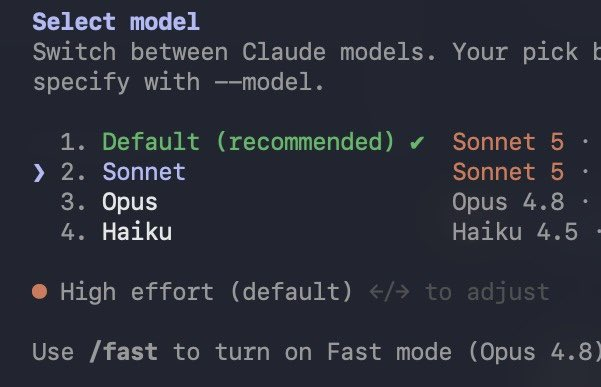
@DanDr1s showed (2 replies, 129 views) Sonnet 5 already appearing in Claude Code's model picker, with the default path mapped to Sonnet 5 while /fast still points to Opus 4.8. A separate artifact from @chetaslua surfaced (20 likes, 4 replies, 1,281 views) promo/list pricing and a 1M-context tier directly from Claude Code artifacts, which turned model-launch chatter into concrete packaging evidence.
@GHchangelog added (11 likes, 1,146 views) that GitHub Copilot is now a native agent option inside JetBrains AI Assistant, and the linked announcement says developers can pick Copilot from the AI Assistant agent picker, choose models, and tune reasoning depth inside chat. On the product-UI side, @burkeholland spotted (37 likes, 5 replies, 22 bookmarks, 2,439 views) the /impeccable frontend-design skill shipping by default in the Copilot app's experimental area, while @brunoborges showed (9 likes, 1 reply, 2,419 views) a TOML schema editor inside the same app.
Discussion insight: The notable follow-on questions were about rollout details and usefulness, not whether the launch mattered. Replies to the pricing artifact immediately focused on whether the 1M-context tier would justify its cost, and replies to the /impeccable post described people comparing it to paid alternatives rather than dismissing skills as a gimmick.
Comparison to prior day: June 29 centered on Copilot harness efficiency and a new fast-mode preview. June 30 moved that energy into shipping reality: model picker defaults, billing tiers, and broader surface availability.
1.2 The conversation kept shifting from IDEs to orchestration layers of skills, memory, and workflows (🡕)
A second major cluster treated AI coding as an operations problem: how to delegate, how to remember, how to share workflows, and how to let multiple agents cooperate. The common thread was that the value is moving up from raw text generation into the layer that coordinates agent work. At least seven public posts and product artifacts supported this theme.
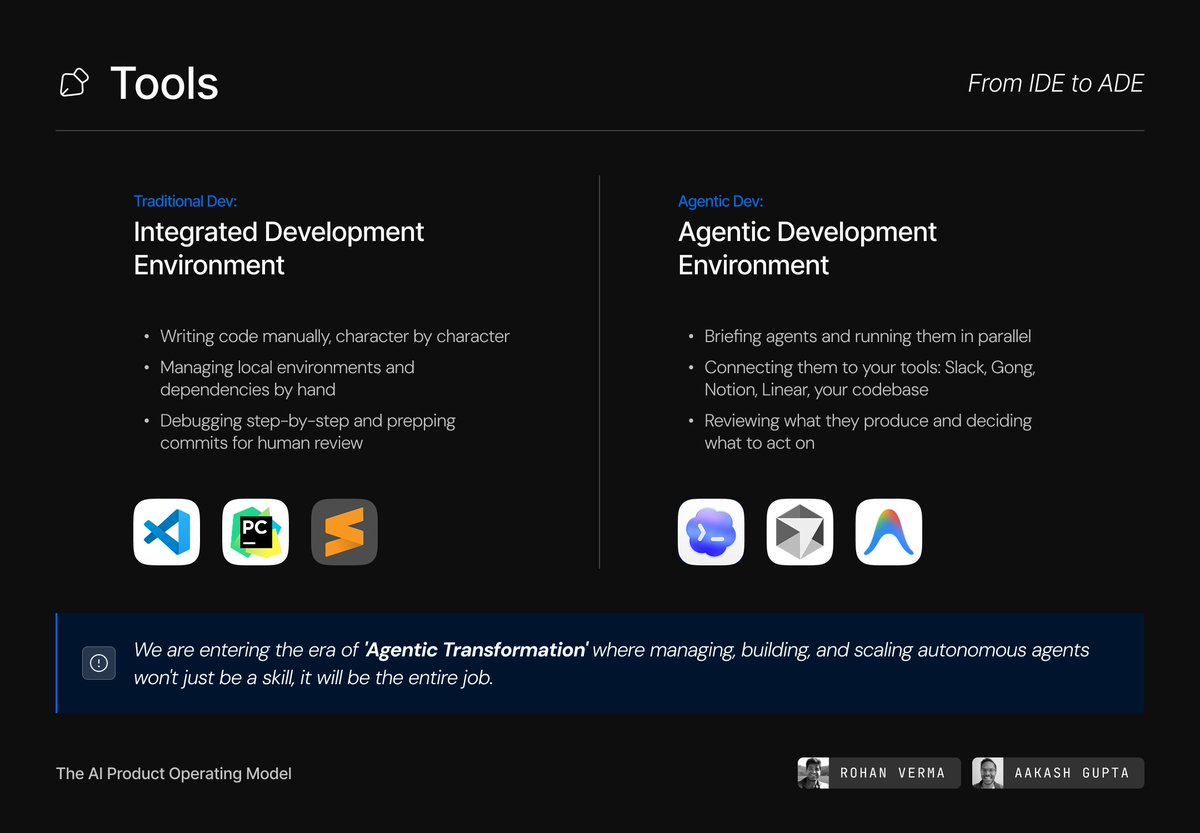
@aakashgupta argued (19 likes, 9 replies, 10 bookmarks, 4,690 views) that the IDE is being replaced by an "agentic development environment" where humans brief agents, run them in parallel, wire them into tools, and review what comes back. The post matters because it did not stay abstract: the attached slide explicitly contrasts IDE assumptions with an agent-orchestration model, and one reply distilled the practical consequence as "review became the new bottleneck."
@0xMovez amplified (48 likes, 14 replies, 37 bookmarks, 3,365 views) a Codex-lead claim that 90% of OpenAI uses Codex and that agent loops do 40% of the coding at Codex itself. @milan_milanovic added (10 likes, 521 views) a concrete five-step "agent factory" pattern: research, plan, cross-review with another model, implement, then fresh-context review before merge.
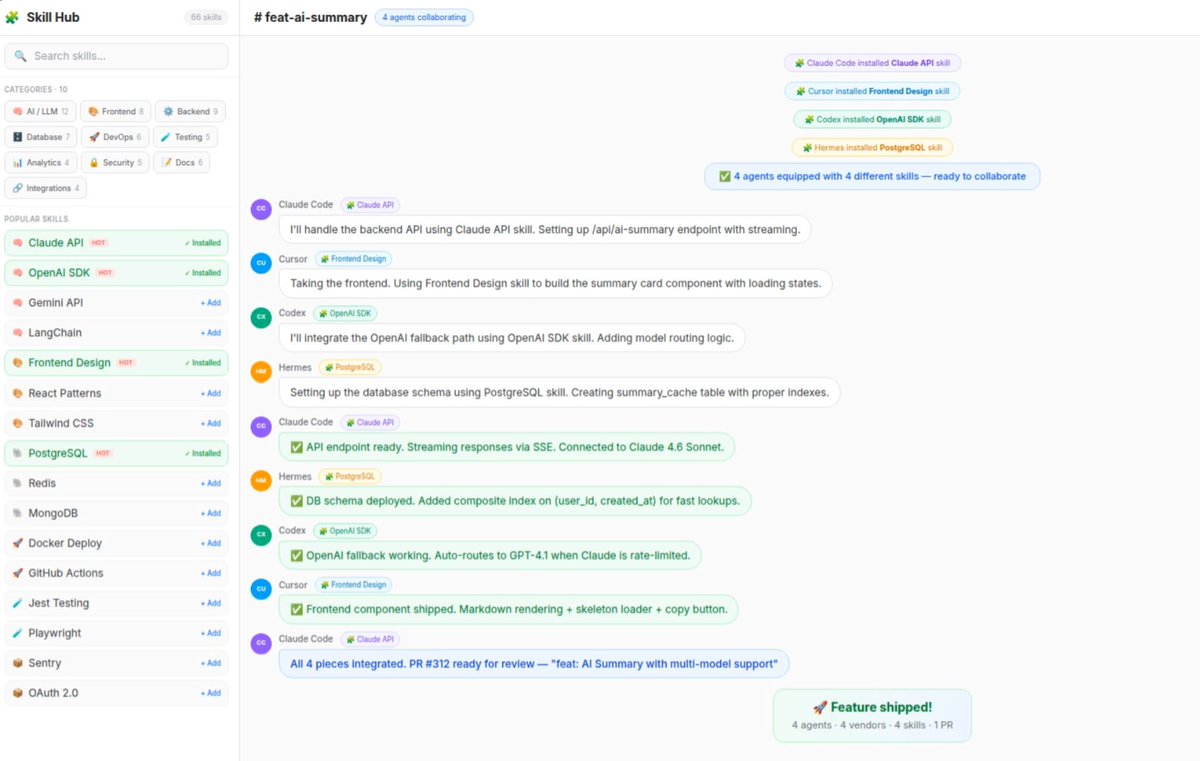
Low-engagement posts still carried strong evidence here. @OpenAgentsAI showed (1 like, 1 bookmark, 66 views) four agents from four vendors collaborating on one feature while each picked a skill from a 66-skill hub. @DanKornas introduced (2 bookmarks, 533 views) CC Workflow Studio, whose public repo says it ships as a VS Code extension plus CLI and MCP server that exports workflows into formats for Claude Code, Copilot Chat/CLI, Codex CLI, Cursor, Gemini CLI, and Antigravity. @repocatai_git highlighted (37 views) agentmemory, and the repo README confirms a cross-client memory layer for Claude Code, GitHub Copilot CLI, Cursor, Gemini CLI, Codex CLI, OpenCode, and other MCP clients. Finally, @TraffAlex reported (5 likes, 4 bookmarks, 586 views) that X opened MCP servers, with the attached slide naming the hosted endpoint and bridge configuration.
Discussion insight: The strongest reply-driven nuance was not skepticism about multi-agent orchestration itself. It was concern about the human role after orchestration: review, approval, and judgment. That showed up both in replies to the ADE thread and in Milan Milanovic's insistence on never merging what you could not have written yourself.
Comparison to prior day: June 21 and June 29 already pushed memory, delegation, and control planes toward the center of the workflow. June 30 extended that arc with a visual workflow editor, a cross-tool memory layer, a skill marketplace, and an official MCP endpoint from a major platform.
1.3 Control surfaces for coding agents kept spreading into hardware and phones (🡕)
June 29 already hinted that AI coding might get dedicated hardware. June 30 made that surface expansion more concrete by pairing the Codex Micro teaser with a shipping competitor and a mobile operator console for OpenCode. The pattern was not one-off novelty; it was multiple builders trying to put agent controls somewhere other than the editor pane.
@stufflistings reported (147 likes, 18 replies, 8,130 views) that OpenAI and Work Louder are bringing a dedicated Codex Micro macropad with remappable shortcuts on July 15. The hardware itself matters less than the reply pattern: one of the first concrete requests was for a dedicated stop/show-diff key, which implies users are already thinking about review and interruption ergonomics, not just aesthetics.

@secondstateinc countered (2 replies, 72 views) that it has already been shipping VibeKeys Max for three months, a vibe-coding keyboard that works with Codex, Claude Code, and Cursor. The attached photo shows real hardware plus integration details like BLE remapping, display text, Wi-Fi/ASR, and agent-specific labels, which makes this a shipping competitor rather than a mockup.
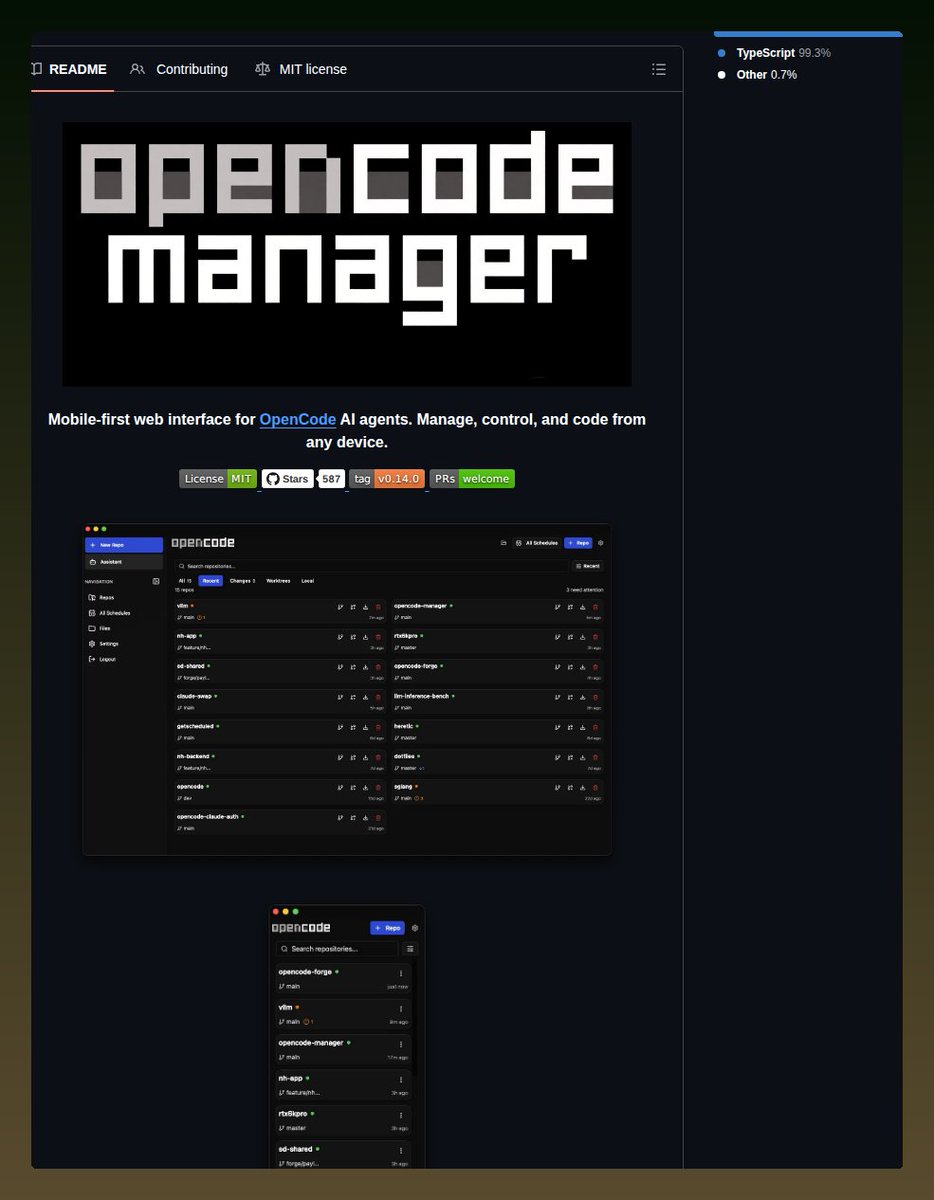
@tom_doerr shared (13 likes, 21 bookmarks, 3,108 views) a mobile-first web interface for managing OpenCode agents, and the linked repo describes repo/git controls, sessions, schedules, MCP management, notifications, and PWA support. That is a different answer to the same question: if agents work asynchronously, the operator should be able to monitor them from anywhere.
Discussion insight: Replies under the broader Codex-hardware conversation pushed back on the form factor, not the need. One reply called the device too niche for laptop-first users and asked for the same control surface on a phone, which lines up neatly with the OpenCode Manager direction.
Comparison to prior day: June 29 had a teaser and speculation. June 30 added a second shipping hardware answer and a real mobile control console, so the "beyond the IDE" surface story strengthened.
1.4 Cost, limits, and operational quality still dictated which tools felt usable (🡒)
The feed still treated AI coding as something you operate under limits: resets, token budgets, CPU overhead, compaction, and model availability problems. The difference from earlier days is that more posts now showed concrete artifacts or workarounds instead of generic complaining. This theme remained broad and persistent across at least six public posts.
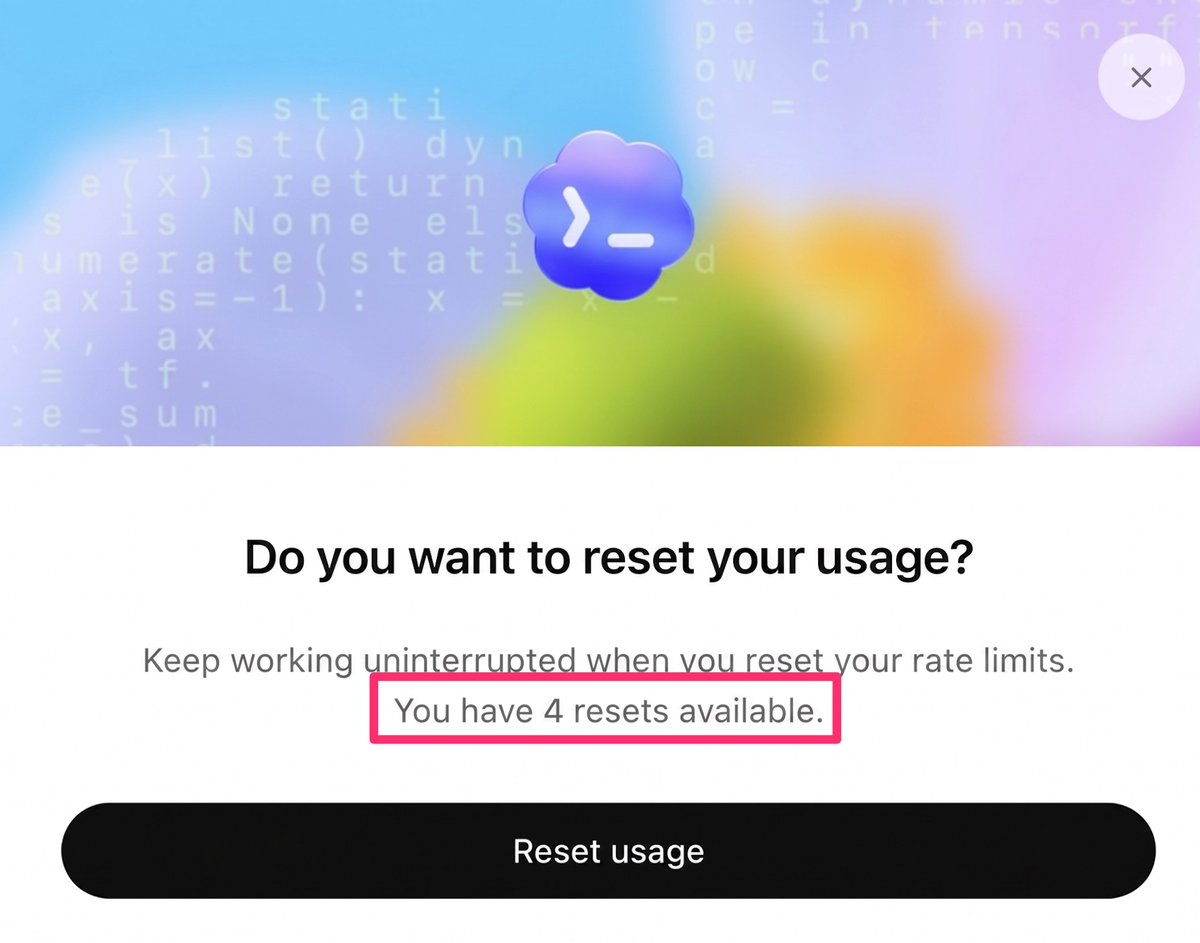
@hqmank warned (31 likes, 7 replies, 5 bookmarks, 3,041 views) that Codex was getting another usage reset, and the attached modal shows "You have 4 resets available." Replies said resets feel frequent and that different counters do not update consistently. @githubstatus added (6 likes, 1,619 views) a primary-source reminder that Copilot had a real degraded frontier-model incident on June 17 across all regions.
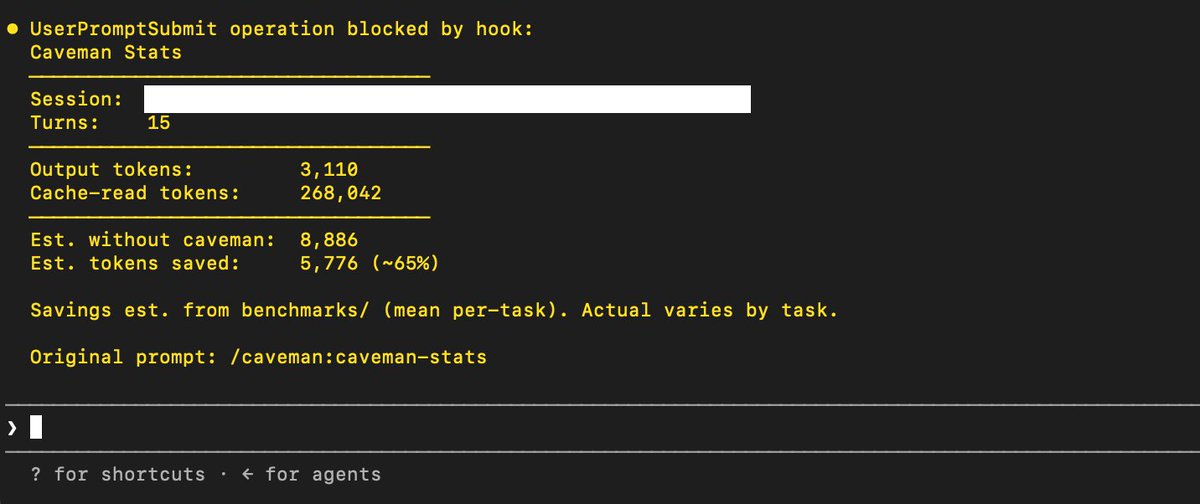
@_vmlops claimed (4 replies, 468 views) that teams are making Claude and Codex "talk like cavemen" to cut output costs, and the attached stats panel shows about 3,110 output tokens versus 8,886 estimated without the mode, roughly a 65% reduction. That post matters because it turns cost pressure into an explicit workflow control rather than a vague complaint.
@artillain complained (2 replies, 49 views) that PhpStorm still redlines a six-core CPU while OpenCode itself stays light, and the image gives that complaint a concrete performance artifact. On the model/platform side, @_can1357 measured (146 likes, 6 replies, 24 bookmarks, 16,195 views) Antigravity at 386 tok/s on Gemini 3.5 Flash versus 150 tok/s on Vertex, while @Soso_fun_yt documented (30 likes, 9 replies, 16 bookmarks, 2,820 views) a much deeper Antigravity critique: 5-image uploads, 2-minute audio caps, about 20,000 characters of customization space, aggressive compaction, and a Jan 2025 knowledge cutoff.
Discussion insight: The operational response pattern is now obvious. Users do not wait for vendors to fix the problem; they watch resets, route around slower paths, strip out verbose tokens, move to lighter clients, or externalize instructions when the built-in memory budget is too small.
Comparison to prior day: June 29's cost theme was mostly about credits, free tiers, and provider failover. June 30 kept the pressure steady but made it more operational: compression plugins, CPU charts, quota modals, and detailed context-budget complaints.
2. What Frustrates People
Quotas, outages, and hidden context budgets still interrupt active work
Severity: High. The clearest frustration remained simple: people still cannot trust that access, context, or model availability will persist through a normal session. @hqmank showed (31 likes, 7 replies, 5 bookmarks, 3,041 views) Codex resets becoming routine workflow objects, complete with a visible reset bank. @githubstatus documented (6 likes, 1,619 views) a real Copilot degradation incident where frontier models disappeared from the picker. The most detailed single complaint came from @Soso_fun_yt describing (30 likes, 9 replies, 16 bookmarks, 2,820 views) Antigravity's 5-image cap, 2-minute audio cap, roughly 20,000-character customization budget, aggressive compaction, and outdated knowledge cutoff. @_can1357 added (146 likes, 6 replies, 24 bookmarks, 16,195 views) the performance-and-cost angle by contrasting Antigravity throughput with slower Vertex routing. The coping pattern is consistent: users watch reset banks, externalize instructions, reroute traffic, or change clients. This is worth building for because the failure mode is a hard stop, not a mild annoyance.
Review and quality assurance still absorb the human time AI does not remove
Severity: Medium-High. The most sophisticated practitioners were explicit that AI does not remove judgment; it moves the work. @milan_milanovic wrote (10 likes, 521 views) that agents now write 99% of code while he reviews 100% of it, with separate research, planning, cross-review, implementation, and final review stages. A reply under @aakashgupta's ADE thread (19 likes, 9 replies, 4,690 views) boiled the problem down even further: building now takes two days; deciding what to keep takes three. The builder response is already visible. @iam_elias1 promoted (28 likes, 8 replies, 11 bookmarks, 1,724 views) React Doctor after a YC founder got tired of agents shipping bad React, and the public repo shows deterministic scans, CI hooks, and an install path for coding agents. @burkeholland spotted /impeccable in the Copilot app for the same reason: design quality still needs specialized help. This is worth building for because the friction is persistent and close to the merge button.
AI removed the build wall faster than it removed the distribution wall
Severity: Medium. The sharpest evidence came from @mikewchan sharing (1 like, 1 quote, 83 views) a screenshot that says Claude helped build and ship four iOS apps and five more were in development, yet the portfolio still had 0 users and $0 revenue. The point of the post was not anti-AI; it was that once the technical barrier falls, the next hard problem becomes customer acquisition. A more promotional response from @JoeyMoose framed (62 likes, 40 replies, 3,660 views) getting an agent hired and paid as "the missing half," which shows builders are already trying to sell solutions to the same gap.

This is worth building for, but the signal is earlier and noisier than quota pain or review pain. The unmet need is real; the proven solution is not.
3. What People Wish Existed
A portable memory-and-workflow layer that survives tool switching
The clearest practical wish was not for one more model. It was for a layer that remembers context, preserves workflows, and works across whatever client or harness a team happens to use. @repocatai_git pitched (37 views) agentmemory explicitly as the answer to "I already explained this before," and the public repo confirms cross-client support plus knowledge-graph and hybrid-search retrieval. @DanKornas pushed (2 bookmarks, 533 views) the same need from the workflow angle with CC Workflow Studio, while @DanKornas separately framed (18 likes, 10 bookmarks, 1,504 views) Agent Skill Creator as a way to avoid rewriting the same workflow for every coding tool. @OpenAgentsAI showed (1 bookmark, 66 views) that even vendor-mixed agent teams now want shared skills. This is a practical need with clear urgency. Opportunity: Direct.
A spend, quota, and performance governor for agent loops
People are not just asking for cheaper models; they are asking for a control layer that keeps long-running work alive. @_vmlops highlighted (4 replies, 468 views) a token-compression mode that claims 65-75% output savings. @hqmank showed (31 likes, 7 replies, 3,041 views) why that matters: resets and quota banks are now ordinary workflow objects. @Soso_fun_yt wanted (30 likes, 9 replies, 2,820 views) explicit, much larger context budgets and less destructive compaction. @artillain wanted (49 views) a lighter IDE path that did not peg CPU cores. This is an operational need, not an aspirational one. Opportunity: Direct.
Quality gates that understand agent output before it reaches production
The feed kept asking, implicitly and explicitly, for stronger review layers between "agent completed the task" and "ship it." @milan_milanovic made (10 likes, 521 views) review the center of the workflow. @iam_elias1 highlighted (28 likes, 8 replies, 1,724 views) React Doctor because the pain is specific: agents keep shipping bad React. @burkeholland surfaced (37 likes, 5 replies, 2,439 views) /impeccable as a specialized design skill already bundled into Copilot. Existing tools partially address the need, but the amount of review-centric discussion shows the gap is still open. Opportunity: Competitive.
Distribution and monetization help for AI-built products
Once building stops being the main barrier, builders start asking what comes next. @mikewchan made (1 like, 1 quote, 83 views) the need painfully concrete with 4 shipped apps, 5 more in progress, and still 0 users and $0 revenue. @JoeyMoose answered (62 likes, 40 replies, 3,660 views) that gap with a self-promotional attempt to get agents hired and paid. That combination suggests the demand is real even if the product category is early. Opportunity: Aspirational.
4. Tools and Methods in Use
| Tool | Category | Sentiment | Strengths | Limitations |
|---|---|---|---|---|
| GitHub Copilot | Coding agent platform | (+/-) | Rapid Sonnet 5 rollout across many surfaces, bundled skills in the app, JetBrains agent integration | Usage-based billing questions and outage history still affect trust |
| Claude Sonnet 5 | Frontier coding model | (+) | Strong CLI-style task performance, prompt-cache efficiency, broad distribution | Pricing and 1M-context cost already drew pushback |
| Claude Code | Coding agent client | (+/-) | Popular in multi-session/worktree workflows; Sonnet 5 surfaced quickly in-product | Output-cost management and tier pricing remain active concerns |
| OpenAI Codex | Coding agent platform | (+/-) | Heavy internal-use claims, strong operator mindshare, growing hardware/control-surface ecosystem | Resets and usage-bank management remain part of normal operation |
| OpenCode | Open-source coding agent | (+) | Lightweight runtime, mobile-first manager, good fit for async operator workflows | Surrounding management and observability tooling are still emerging |
| Antigravity | Google coding stack | (+/-) | Very high throughput on Gemini 3.5 Flash and strong frontend/visual output | Media limits, small customization budget, aggressive compaction, stale knowledge, and CLI-governance concerns |
| agentmemory | Memory layer | (+) | Persistent cross-client memory, knowledge graph, hybrid search, hooks/MCP tooling | Adds another layer to operate and had low direct reach in today's discussion |
| CC Workflow Studio | Workflow editor / MCP | (+) | Visual editor plus CLI and MCP export path across many agent clients | Early, low-reach signal; abstraction layer still niche |
| React Doctor | Quality gate / linter | (+) | Deterministic React audits, agent install path, CI integration | Narrowly focused on React rather than general agent QA |
| X MCP Servers | MCP infrastructure | (+) | Official hosted endpoint for search, timeline, bookmark, and article tasks via config | Platform-specific and still early in public adoption |
| caveman | Token-optimization mode | (+/-) | Quantified token savings and explicit cost control | Readability tradeoffs and limited public validation so far |
The overall spectrum on June 30 ran from high-engagement managed platforms toward lower-engagement but highly concrete operator layers around them. Copilot, Codex, Claude Code, and Antigravity still dominated attention, but much of the builder energy went into wrappers and controls: memory, workflow export, design skills, quality gates, compression modes, and mobile managers. Common workarounds included externalizing instructions when context budgets were too small, stripping verbose output to save tokens, keeping fresh-context review steps, and moving to lighter clients when the IDE itself became the bottleneck. The clearest migration pattern was not from one foundation model to another; it was from single-client loyalty toward cross-client abstractions that promise to work with Claude Code, Copilot, Codex, Cursor, Gemini, and OpenCode at the same time.
5. What People Are Building
| Project | Who built it | What it does | Problem it solves | Stack | Stage | Links |
|---|---|---|---|---|---|---|
| React Doctor | aidenybai | Deterministically scans React code for architecture, performance, security, and accessibility issues | AI coding agents shipping bad React into production | React CLI, agent install path, GitHub Actions / CI integration | Shipped | tweet · repo |
| agentmemory | rohitg00 | Gives coding agents persistent memory across sessions and clients | Re-explaining project context every session | Hooks, MCP tools, knowledge graph, hybrid search | Shipped | tweet · repo |
| CC Workflow Studio | breaking-brake | Visually designs agent workflows and exports them into agent-ready formats | Scattered prompts and tool-specific workflow rewriting | VS Code extension, CLI, MCP server, workflow.json, multi-agent exports |
Shipped | tweet · repo |
| Agent Skill Creator | FrancyJGLisboa | Turns plain-English workflows or source materials into portable agent skills | Rebuilding the same workflow for Claude Code, Copilot, Codex, Cursor, and others | Python repo, eval spec, validation, security scan, 17-platform installer | Shipped | tweet · repo |
| OpenCode Manager | chriswritescode-dev | Mobile-first web console for managing OpenCode agents and repos | Monitoring and controlling async agent work away from the main editor | Bun + Hono backend, React + Vite frontend, SQLite, PWA, MCP management | Beta | tweet · repo |
| VibeKeys Max | @secondstateinc | Hardware keyboard for driving coding agents | Need for dedicated physical controls and shortcuts | BLE remapping, display text, Wi-Fi/ASR, Codex/Claude/Cursor integrations | Shipped | tweet |
| OpenMontage | calesthio | Agentic video production system that handles research, scripting, assets, editing, and composition | Extending agent workflows from code into full media production | Multi-agent workflow over research, scripting, asset generation, and composition | Beta | tweet · repo |
React Doctor stood out because it framed AI-generated frontend quality as a deterministic audit problem rather than a prompting problem. The public repo says it can run as a one-off audit, install itself as an agent skill, and add CI checks that report only issues introduced by the current PR. That makes it a strong example of the day’s larger pattern: builders are creating guardrails around agents, not just new agents.
CC Workflow Studio, Agent Skill Creator, and agentmemory point at the same ecosystem direction from three different angles. CC Workflow Studio makes workflows visual and exportable; Agent Skill Creator turns plain-English or document-based processes into portable skills; agentmemory keeps context alive across clients and sessions. Together they imply that the most active building frontier is the portability layer above the model.
OpenCode Manager and VibeKeys Max show a second recurring pattern: operator surfaces. One assumes the user wants to supervise agents from a phone or remote browser; the other assumes agent work benefits from dedicated physical controls. OpenMontage is the far edge of the same trend. It is no longer just "code generation" tooling; it packages agent workflows as a generalized production system.
6. New and Notable
Sonnet 5 became visible as a default path, not just another model option
@github announced (66 likes, 5 replies, 7,266 views) general availability in Copilot, but the more distinctive evidence came from @DanDr1s showing (2 replies, 129 views) Sonnet 5 already mapped to the default slot inside Claude Code. That combination matters because it turns a normal launch post into a real workflow change: people did not just get a new option; they got a new default path.
X opened official MCP servers for agent access to social workflows
@TraffAlex reported (5 likes, 4 bookmarks, 586 views) that X had opened MCP servers, and the attached slide names a hosted endpoint plus bridge configuration rather than just promising future support. That is notable because it points toward mainstream SaaS surfaces exposing agent-friendly control planes instead of relying on custom integrations.

Copilot became a first-class agent inside JetBrains AI Assistant
@GHchangelog announced (11 likes, 1,146 views) that Copilot is now a native agent option inside JetBrains AI Assistant, and the linked post says users can pick Copilot from the agent picker, choose models, and tune reasoning depth inside AI chat. That is notable because it expands Copilot from plugin territory into the IDE's own agent-selection surface.
Google's coding CLI story shifted further toward Antigravity
@Sahil_Gulihar_ showed (4 likes, 212 views) an official transition notice ending support for Gemini CLI in favor of Antigravity CLI. In isolation that is a small post, but in the context of the day's many Antigravity speed and friction threads it matters: one of the most discussed Google coding stacks is consolidating around a more closed, productized path.
7. Where the Opportunities Are
[+++] Cross-agent operating system for memory, skills, and workflow portability — The strongest evidence clustered around the layer above the model: agentmemory, CC Workflow Studio, Agent Skill Creator, OpenAgents' skill hub, X MCP servers, and OpenCode Manager all solve pieces of the same problem. The opportunity is strong because multiple builders independently converged on memory, export formats, skill portability, and remote control in the same day.
[++] Spend-and-reliability governor for long-running agent work — Reset banks, outage reminders, compression modes, throughput arbitrage, context-budget complaints, and CPU overhead all point to a missing control plane for keeping agent work alive under limits. The opportunity is moderate because the pain is obvious and repeated, but different teams may want different answers: cost routing, token compression, local execution, or better IDE performance.
[++] Quality and review gates built specifically for agent output — The human bottleneck is shifting from writing code to deciding what ships. React Doctor, /impeccable, and Milan Milanovic's review-heavy workflow all imply a market for tools that understand agent artifacts, not just source files. The opportunity is moderate because teams already feel the pain, but the winning product could take several forms: linting, design review, plan review, or merge gating.
[+] Distribution and monetization assistants for AI-built products — The build wall is falling faster than the go-to-market wall. @mikewchan made that explicit in the post cited above with 0 users and $0 revenue despite multiple shipped apps, and @JoeyMoose immediately tried to sell an answer. The opportunity is emerging because the need is visible, but the product shape is still unstable.
8. Takeaways
- June 30 was a rollout day, not a benchmark day. @github announced (66 likes, 5 replies, 7,266 views) Sonnet 5 general availability in Copilot, and separate public screenshots showed it surfacing as a default path inside Claude Code rather than sitting on the sidelines as a rumor.
- The most concrete builder activity was in the orchestration layer above the model. @DanKornas showed (2 bookmarks, 533 views) a visual workflow editor that exports into multiple agent clients, which matched the same-day push toward memory layers, skill generators, and MCP endpoints.
- Reliability, cost, and context limits still decide which tools feel usable. @hqmank showed (31 likes, 7 replies, 5 bookmarks, 3,041 views) reset banks becoming ordinary workflow objects, while other posts added compaction, CPU, and token-cost evidence.
- Human judgment has shifted from typing code to reviewing plans, diffs, and shipped behavior. @milan_milanovic wrote (10 likes, 521 views) that agents write 99% of the code while he reviews 100% of it, which fits the same-day rise of tools like React Doctor and
/impeccable. - AI removed one bottleneck and exposed another. @mikewchan shared (1 like, 1 quote, 83 views) the clearest version of the new wall: multiple shipped apps, but still 0 users and $0 revenue.