Twitter AI Coding - 2026-07-03
1. What People Are Talking About
1.1 Harnesses, handoff layers, and cross-model orchestration became concrete workflow products (🡕)
The most technical cluster was about the layer above the model. At least four strong items argued that coding agents are now judged by their harnesses: how context is rebuilt, how work is handed off, and how execution is validated. Compared with July 2’s control-plane discussion, July 3 moved from abstract orchestration talk to specific coordination products and workflow-discipline packs.
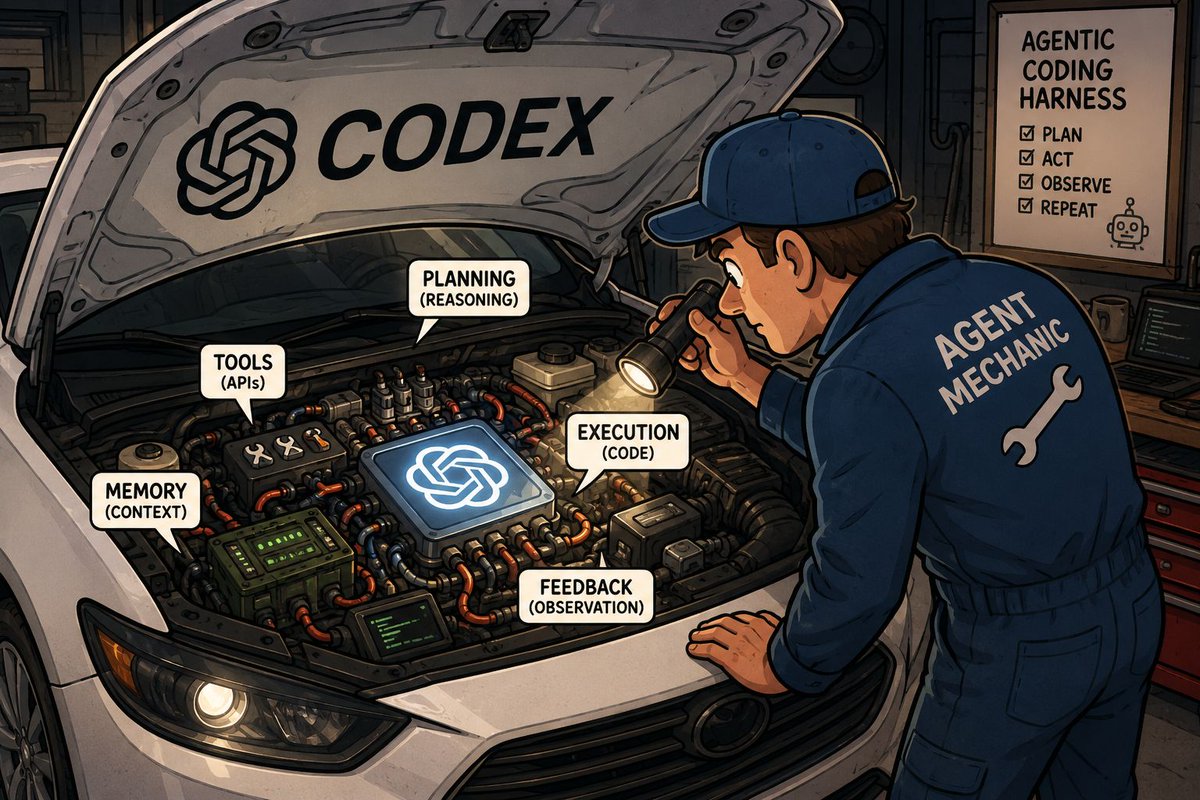
@SemiAnalysis_ argued (167 likes, 9 replies, 23,691 views, 279 bookmarks) that coding harnesses differ less by magic than by how they rebuild context, declare tools, and loop through plan, act, and verify. The thread’s own follow-up replies make the mechanics explicit: every turn repacks system prompts, tool definitions, and message history, while a reply from @Timur_Yessenov pushed the discussion further by saying the product value is in what gets packed, trusted, and discarded between turns.
@theo asked (111 likes, 24 replies, 7,063 views, 13 bookmarks) whether T3 Code should ship a branch that lets Claude spawn Codex subagents and vice versa. The quoted thread explains why this matters: he is already using Claude as the architect and Codex as the steerable implementation fallback for token-hungry tasks, and one reply said multi-model orchestration is exactly what teams are still hacking together manually.

@DanKornas framed (19 likes, 4 replies, 1,385 views, 20 bookmarks) Engineering Discipline as a workflow layer that turns vague requests into clarified, validated work through explicit stages like clarification, planning, execution, review, debugging, cleanup, and optimization. A later post (9 likes, 4 replies, 899 views, 10 bookmarks) introduced squad, a 554-star Rust CLI that uses shell commands plus a shared SQLite database to coordinate manager, worker, and inspector agents across Claude Code, Gemini CLI, Codex CLI, and OpenCode.

Discussion insight: The strongest replies were not anti-agent. They asked for more control over routing, more explicit handoffs, and clearer rules for what the harness should trust or reject.
Comparison to prior day: July 2 treated the harness as the real product boundary. July 3 extended that into installable coordination layers and explicit workflow-discipline packages.
1.2 Price, quotas, and open-weight options drove tool choice as much as model quality (🡕)
Cost was inseparable from capability. At least five strong items focused on low-cost or open-weight alternatives, plan shopping, or why premium agent offerings stop making financial sense. Compared with July 2’s spend-visibility theme, July 3 looked more like public procurement: choose the right model, the right price band, and the right fallback path.
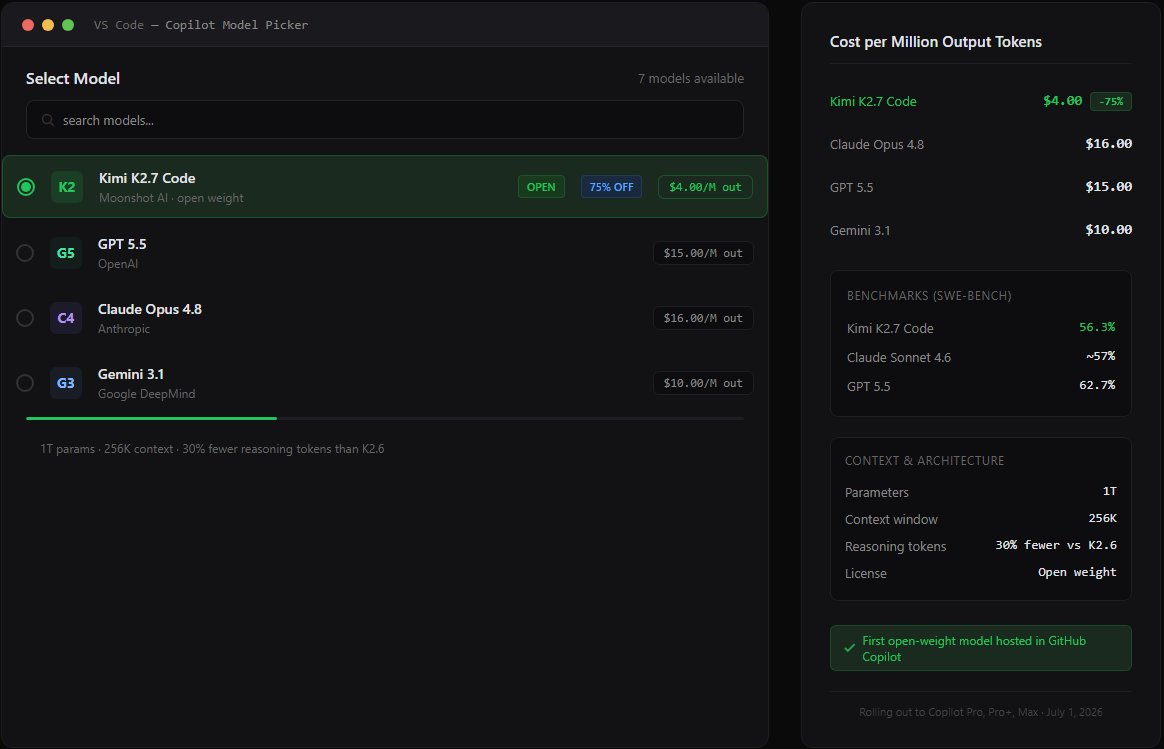
@github announced (341 likes, 33 replies, 41,645 views, 63 bookmarks) that Kimi K2.7 Code is the first open-weight model in GitHub Copilot’s model picker. The replies immediately turned that into a workflow question rather than a branding one: users asked whether Copilot will recommend the right model per task automatically, and whether Kimi holds up against Claude or GPT in real repo work.
@Alan_Earn claimed (50 likes, 20 replies, 1,201 views, 9 bookmarks) that Kimi K2.7 Code costs about 75% less than the other Copilot picker options. The screenshot is the substantive part: it shows Kimi inside the picker, labeled open-weight, with a visibly lower price card than frontier alternatives.
@kingofknowwhere posted (82 likes, 16 replies, 5,154 views, 116 bookmarks) a dense plan-by-plan survey spanning free tools, $1 starter plans, $20 unlimited-style offers, and $100 Claude Max or Codex 5x subscriptions. It reads like a field guide to arbitrage, and the replies keep extending it with regional pricing, invite-only plans, and questions about which offers really stay unlimited.
@quxiaoyin argued (47 likes, 12 replies, 2,320 views, 13 bookmarks) that startups are ditching managed Claude agents for Hermes or OpenCode because API pricing can reach $6,000 per user per month, while also locking builders to Claude models and Claude-held traces. Even if the number is a user estimate rather than vendor documentation, the thread is valuable because it names the exact objections people raise when hosted-agent economics stop working.
@jamesob said (17 likes, 2 replies, 809 views, 10 bookmarks) that GLM-5.2 REAPs plus OpenCode are getting “close to Claude” locally, and his local-llm repo is a 367-star guide to running state-of-the-art models on local hardware. That makes the migration pattern explicit: cheaper open or local stacks are no longer only hobbyist experiments.
Discussion insight: The replies cared less about leaderboard prestige than about routing, margin, rate limits, and whether a product exposes or hides the real cost of a workflow.
Comparison to prior day: July 2 centered on spend visibility and silent fallback behavior. July 3 widened that into public price shopping, open-weight adoption, and explicit switching away from managed-agent stacks.
1.3 Codex roadmap speculation became a planning signal of its own (🡕)
Speculation about the next Codex model release became practical workflow planning. Three higher-engagement items tied unreleased Sol, Terra, and Luna strings to feature flags, reset scarcity, and the removal of Fable 5 from subscription plans. Compared with July 2’s official Kimi rollout, July 3 spent far more attention on what might land next and how to budget for it.
@DevAdventur3s posted (206 likes, 19 replies, 19,013 views, 30 bookmarks) a Codex popup showing Sol, Terra, Luna, and a speed selector. The important correction came in the replies: this was a feature-flagged UI state, not confirmed live access to the model, which keeps the evidence at the “unreleased strings surfaced in product UI” level rather than a launch announcement.

@kimmonismus speculated (479 likes, 51 replies, 18,453 views, 21 bookmarks) that July 7 would be the perfect time for OpenAI to release GPT-5.6 as Fable 5 leaves the subscription tier. The replies did not debate model internals so much as market timing: several treated it as a customer-acquisition opening if Anthropic meters a top coding model and Codex is waiting with a stronger offer.
@hqmank posted (36 likes, 16 replies, 6,552 views, 5 bookmarks) that three saved Codex resets might expire before Sol lands. That turns roadmap rumor into a practical planning problem, because the replies immediately shifted into crowdsourced expiry-date math and referrals for obtaining more resets.
Discussion insight: The most useful replies were corrections and quota workarounds, not hype. Users want to know whether a model actually exists, when it lands, and whether their credits survive long enough to use it.
Comparison to prior day: July 2’s flagship model story was a live, official rollout. July 3’s version was feature flags, release theories, and reset timing.
1.4 Trust and evaluation started to look like standalone product categories (🡕)
Trust questions shifted from principle to implementation. A trust-grading tool, a concrete exploit write-up, and a production-style security investigation framework all treated agent behavior as something to test, constrain, or wrap in domain-specific workflows. Compared with July 2’s governance conversation, July 3 made trust operational.
@socialwithaayan highlighted (33 likes, 8 replies, 9,366 views, 20 bookmarks) iFixAi, which he says auto-discovers an agent’s real configuration, runs 45 inspections, and returns an A-F grade in under five minutes. The public repo backs up the core claim and makes the distinctive angle clear: the grading is done by a different vendor’s model, because users do not trust agents to grade themselves.
@TakSec summarized (6 likes, 791 views, 3 bookmarks) ODIN research showing Google Antigravity can be tricked through a hidden <title> tag into dumping environment variables and exfiltrating an API key via a rendered image URL. The linked write-up makes the chain explicit: prompt injection, terminal access, and rich rendering are enough even when the user still approves the step.

@tom_doerr shared (15 likes, 3,557 views, 12 bookmarks) the Security Investigation Automation System, a 224-star Python project that combines GitHub Copilot, Microsoft Sentinel, Defender XDR, Graph API, KQL, MCP servers, and 25 specialized Agent Skills. That is the other side of the trust theme: if agents are going to touch security operations, builders are wrapping them in explicit workflows, skills, and logs.
Discussion insight: The strongest trust signal was not a philosophy post. It was users preferring cross-vendor grading for evaluation and concrete exploit chains for security review, plus a lower-volume complaint from one Codex-for-OSS user that account enforcement can feel opaque when security-adjacent work is involved.
Comparison to prior day: July 2 emphasized governance and review roles. July 3 added test harnesses, exploit write-ups, and operational trust tooling.
2. What Frustrates People
Quota fog and hard limits interrupt work
Severity: High. @jgonzalezferrer posted (71 likes, 67 replies, 3,060 views) a Claude session-limit message right in the middle of a coding session, and @hqmank said (36 likes, 16 replies, 6,552 views, 5 bookmarks) that three saved Codex resets might expire before GPT-5.6 Sol ever lands. The replies under the reset post are unusually practical: people trade expiry dates, referral tricks, and even tell each other to ask Codex itself when a reset expires. @dfinke responded (2 likes, 272 views, 2 bookmarks) by shipping CodexResets, an unofficial PowerShell utility that reads local reset grants and expiry dates. The coping pattern is clear: users either stop working, crowdsource quota math, or install local utilities just to understand their own remaining runway. This is worth building for because the workaround already exists and the product still does not answer the basic question cleanly.



Managed-agent economics and vendor lock-in are hard to justify
Severity: High. @quxiaoyin argued (47 likes, 12 replies, 2,320 views, 13 bookmarks) that managed Claude agents can reach about $6,000 per user per month while forcing builders onto one model family and one vendor’s trace surface. @kingofknowwhere backed that broader mood (82 likes, 16 replies, 5,154 views, 116 bookmarks) with a crowdsourced pricing map spanning free tools to $100 premium plans, and @jamesob pointed (17 likes, 2 replies, 809 views, 10 bookmarks) at local GLM-5.2 plus OpenCode as a credible lower-cost path. The workaround is not subtle: reserve premium agents for architecture, push implementation or research to cheaper models, or move part of the stack local. This is worth building for because people are not merely complaining about price; they are actively migrating around it.
Output and collaboration rough edges still waste time
Severity: Medium. @tylerangert asked (33 likes, 2,154 views, 5 bookmarks) for Codex CLI output that can be copied into notes or another terminal without weird spacing artifacts, saying he sometimes feeds the copied text to another model just to clean it up verbatim. @phraggel reported (4 likes, 489 views, 2 bookmarks) that a shared OpenCode server was easy to connect to but could not preserve each participant’s identity inside the session. These are not benchmark problems; they are product-surface problems that show up only after people try to work with agents collaboratively. They look worth building for because the requests are specific, operational, and not solved by changing prompts.
Trust and safety still require extra audit layers
Severity: Medium. @socialwithaayan promoted (33 likes, 8 replies, 9,366 views, 20 bookmarks) iFixAi precisely because teams do not trust agents to follow their own rules without independent checks. @TakSec linked (6 likes, 791 views, 3 bookmarks) a real Antigravity prompt-injection chain that exfiltrates an API key through a rendered image URL, and @realmrfakename posted (10 likes, 4 replies, 952 views) a screenshot showing their Codex-for-OSS account disabled for “cyber abuse.” The frustration here runs in both directions: people do not fully trust what the agent might do, and they also do not fully trust how the platform will interpret their own use. This is worth building for because the current answer is extra tooling, public escalation, or both.
3. What People Wish Existed
Built-in cross-model handoff
The clearest workflow wish was for orchestration to stop being a manual hack. @theo asked (111 likes, 24 replies, 7,063 views, 13 bookmarks) whether T3 Code should ship Claude-to-Codex subagents directly, and one reply answered the broader demand plainly: multi-model orchestration is what “everyone hacks together manually right now.” @DanKornas introduced (9 likes, 4 replies, 899 views, 10 bookmarks) squad for exactly that gap, which suggests the need is practical rather than aspirational. Opportunity: Direct.
Automatic task-to-model routing
Users do not just want more models in the picker; they want the product to choose intelligently. In the replies to GitHub’s Kimi K2.7 Code announcement, one user asked whether Copilot will recommend the best model per task automatically, while another said the real test is routing work to the right model instead of forcing manual selection every time. This is a practical need driven by mixed fleets, cost pressure, and different strengths across models, and it already has competition from teams hand-rolling the logic themselves. Opportunity: Competitive.
Transparent reset, limit, and spend state
People want the agent to explain how much runway is left before it cuts them off. @hqmank said (36 likes, 16 replies, 6,552 views, 5 bookmarks) he has three Codex resets but no clear idea when they started expiring, @jgonzalezferrer showed (71 likes, 67 replies, 3,060 views) a Claude session-limit interruption mid-flow, and CodexResets exists only because the default product view is not enough. This is an urgent practical need, not an emotional one. Opportunity: Direct.
Identity-preserving shared sessions and cleaner terminal export
The lower-volume asks were also the most concrete. @phraggel wanted (4 likes, 489 views, 2 bookmarks) shared OpenCode sessions to preserve each participant’s identity, and @tylerangert wanted (33 likes, 2,154 views, 5 bookmarks) Codex CLI output that can be copied without spacing artifacts. Nothing in today’s feed suggested these are impossible problems; they are missing product finish. Opportunity: Direct.
4. Tools and Methods in Use
| Tool | Category | Sentiment | Strengths | Limitations |
|---|---|---|---|---|
| Claude Code | Coding agent | (+/-) | Strong architect role, rich skill ecosystem, works in multi-model workflows | Session limits, high-effort spend sensitivity, trust and compliance concerns |
| Codex | Coding agent | (+/-) | Steerable implementation fallback, popular for agent chaining, visible reset grants | Reset expiry is opaque, copy/paste artifacts, roadmap uncertainty shapes usage |
| GitHub Copilot | IDE / agent platform | (+) | Open-weight Kimi in the picker, broad IDE reach, better CI auth with GITHUB_TOKEN |
Users still want automatic model routing and tougher-repo validation |
| Kimi K2.7 Code | Model | (+) | Low-cost, open-weight, 256k context, first open-weight option in Copilot | Real-world edge-case quality is still being questioned |
| OpenCode | Agent harness / CLI | (+/-) | Cheap or free access paths, growing docs and plugin ecosystem, useful fallback layer | Shared-session identity is rough and orchestration is still manual |
| Managed Claude Agents | Managed agent platform | (-) | Turnkey hosted-agent surface | Claimed margin-killing API pricing, Claude-only model choice, trace/data worries |
| squad | Coordination layer | (+) | SQLite task bus, no daemon, built-in roles, slash-command setup across major CLIs | Requires explicit multi-terminal workflow management |
| Engineering Discipline | Workflow / skill pack | (+) | Clarification, checkpoints, worker-validator separation, cleanup and optimization stages | Adds process overhead and sits outside first-party products |
| iFixAi | Evaluation tool | (+) | 45 inspections, independent grading, under-five-minute feedback, model-agnostic | Separate audit step rather than a native platform feature |
| CodexResets | Utility | (+/-) | Exposes reset grant and expiry timing locally | Unofficial and depends on undocumented backend behavior |
| Google Antigravity | Agent IDE | (+/-) | Active ecosystem of personas, templates, and tutorials | Browser-reading and render surfaces need stronger prompt-injection defenses |
| Local GLM-5.2 plus OpenCode stack | Local / open model workflow | (+/-) | Lower cost, more control, increasingly credible for serious coding work | Setup and hardware complexity still fall on the user |
The usage pattern was portfolio-based rather than loyalist. @theo described (111 likes, 24 replies, 7,063 views, 13 bookmarks) teaching Claude to hand implementation work to Codex, @quxiaoyin said (47 likes, 12 replies, 2,320 views, 13 bookmarks) startups are moving away from managed Claude agents toward Hermes or OpenCode, and @jamesob argued (17 likes, 2 replies, 809 views, 10 bookmarks) that GLM-5.2 plus OpenCode is getting close to Claude locally. On the official-platform side, @github added (341 likes, 33 replies, 41,645 views, 63 bookmarks) an open-weight Kimi option to Copilot, while the GitHub changelog shows Copilot CLI getting easier to run in Actions through the built-in GITHUB_TOKEN.
The common workaround pattern was to reserve premium models for architecture or final judgment, then shift execution, research, or commodity coding onto cheaper or local options. Competitive energy is also moving upward in the stack: squad, Engineering Discipline, iFixAi, and CodexResets are not trying to win benchmark wars; they are filling coordination, verification, and quota-management gaps that the major agent products still leave open.
5. What People Are Building
| Project | Who built it | What it does | Problem it solves | Stack | Stage | Links |
|---|---|---|---|---|---|---|
| squad | mco-org | Local coordination layer for manager, worker, and inspector terminal agents | Missing handoff and task routing between multiple AI CLI agents | Rust, SQLite, slash commands for Claude, Gemini, Codex, and OpenCode | Shipped | repo, tweet |
| Security Investigation Automation System | SCStelz | Natural-language security investigation workflow with 25 specialized skills | Automating Sentinel and Defender XDR triage, enrichment, and reporting | Python, GitHub Copilot, Microsoft Sentinel, Defender XDR, Graph API, MCP | Beta | repo, tweet |
| PromptDeck | @waynesutton | BYOK teleprompter for generating, organizing, and reading scripts | Avoiding tool switching between script generation and live prompting | TypeScript, React, Vite, Convex, Codex, Firecrawl, ElevenLabs | Beta | repo, tweet |
| The Agency | msitarzewski | Catalog of specialized agents organized by business function | Replacing one-size-fits-all prompting with role-specific agent packs | Shell installers, Markdown/YAML agent definitions, cross-tool conversion scripts | Shipped | repo, tweet |
| iFixAi | ifixai-ai | Audit layer that runs 45 inspections and returns an A-F grade | Making agent trust and policy-following testable before deployment | Python, auto fixture generation, cross-vendor LLM grading | Beta | repo, tweet |
| CodexResets | @dfinke | PowerShell helper that exposes Codex reset grants and expiry dates | Opaque quota timing in Codex | PowerShell, local auth inspection, undocumented Codex endpoint | Alpha | repo, tweet |
@DanKornas introduced (9 likes, 4 replies, 899 views, 10 bookmarks) squad as a handoff layer rather than another daemon. The design choice matches the day’s broader orchestration mood: shell commands plus SQLite, built-in roles, and no background service are all attempts to make multi-agent coordination feel like normal terminal work instead of a new platform tax.

@tom_doerr shared (15 likes, 3,557 views, 12 bookmarks) the Security Investigation Automation System, which is notable because it does not stop at “Copilot for security.” It wraps GitHub Copilot in explicit Sentinel, Defender XDR, Graph API, and MCP-driven workflows so investigations become repeatable procedure instead of ad hoc prompting.

@waynesutton showed (20 likes, 7 replies, 802 views, 3 bookmarks) that the same agent stack is escaping the repo and moving into adjacent creator workflows. PromptDeck combines BYOK model access, Firecrawl context gathering, Convex-backed storage, and live teleprompter controls, which is the same “agent as application substrate” pattern seen elsewhere in the feed, just applied to video scripting instead of code shipping.
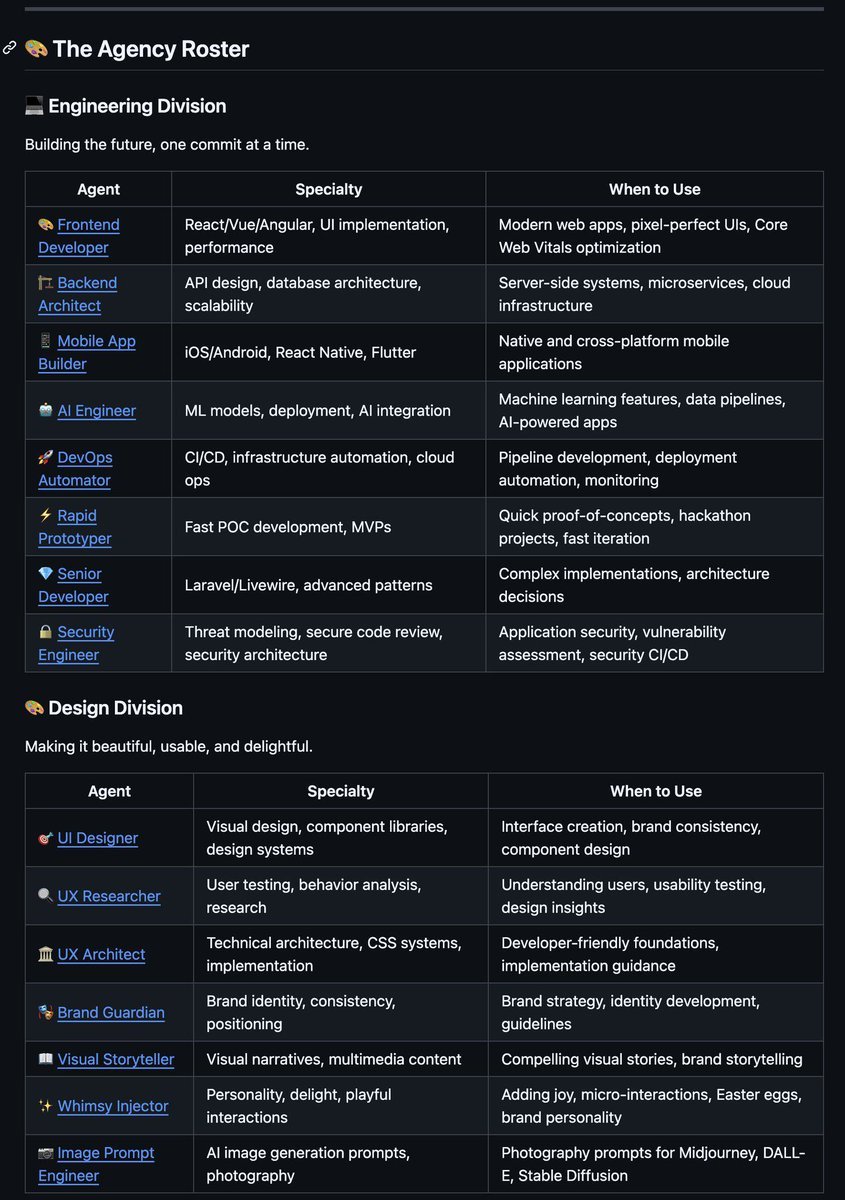
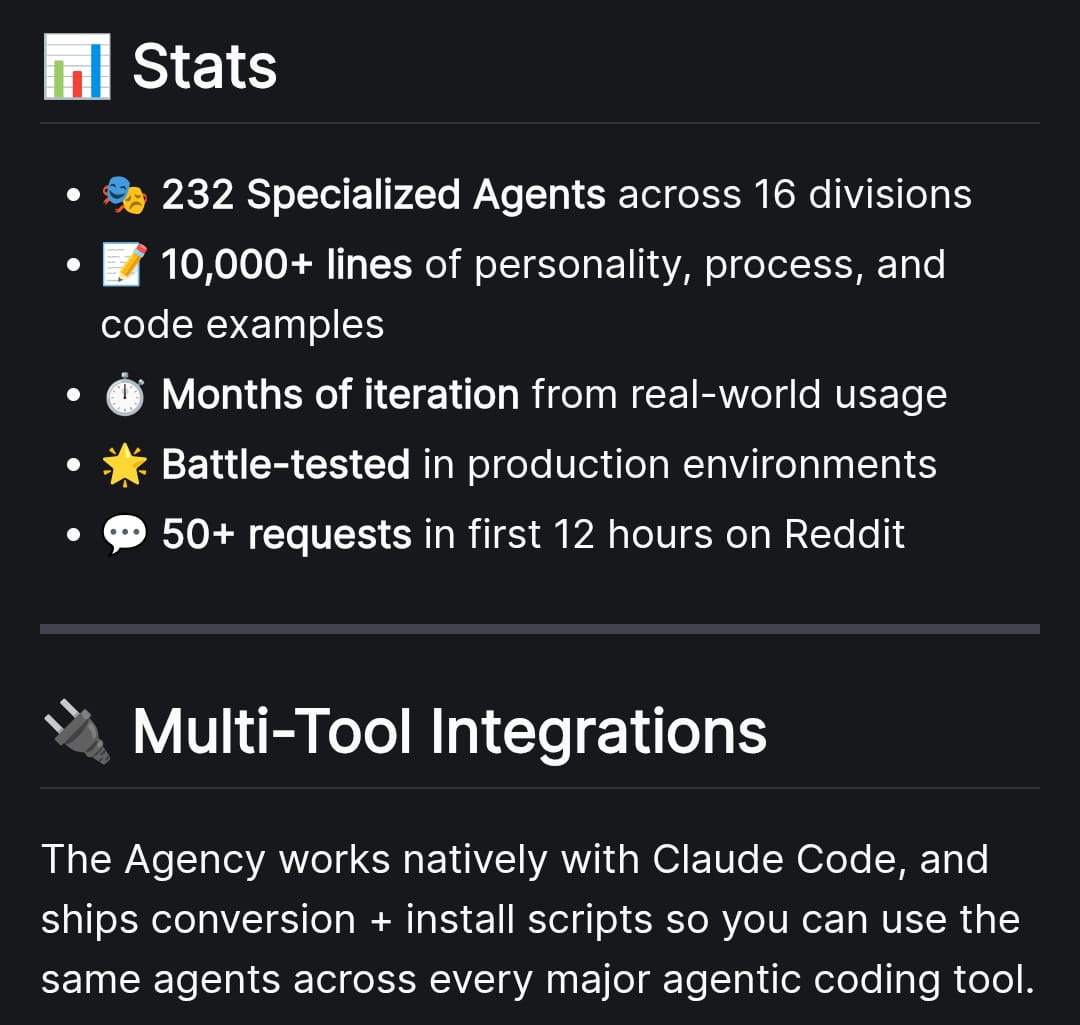
@DivyanshT91162 reframed (10 likes, 892 views, 14 bookmarks) The Agency as “an entire AI company” rather than a prompt library. The tweet still used the older 147-agents-across-12-divisions framing, but the current repo and the stats screenshot in the post now show 232 specialized agents across 16 divisions, which tells its own story about how fast this category is expanding.
@socialwithaayan surfaced (33 likes, 8 replies, 9,366 views, 20 bookmarks) iFixAi, and @dfinke shared (2 likes, 272 views, 2 bookmarks) CodexResets. Those two are smaller than The Agency in raw attention, but they reveal the same build pattern from a different direction: when agent platforms do not expose trust or quota state clearly enough, builders ship audit layers and introspection utilities on top.
The repeated pattern across these projects is that builders are no longer shipping “another AI wrapper.” They are shipping coordination layers, test layers, role catalogs, and workflow-specific shells around existing coding agents. The triggers are equally consistent: handoff pain, trust pain, security process pain, and the need to carry agent behavior into a domain-specific workflow without starting from a blank prompt every time.
6. New and Notable
Copilot CLI in GitHub Actions lost its PAT requirement
@GHchangelog announced (35 likes, 2,908 views, 10 bookmarks) that Copilot CLI in GitHub Actions now uses the built-in GITHUB_TOKEN. The linked changelog makes the operational impact concrete: workflows need copilot-requests: write, no longer need a personal access token, and organization-owned repositories can bill the consumed AI credits directly to the organization.
Early large-scale evidence on CLI-agent adoption finally arrived
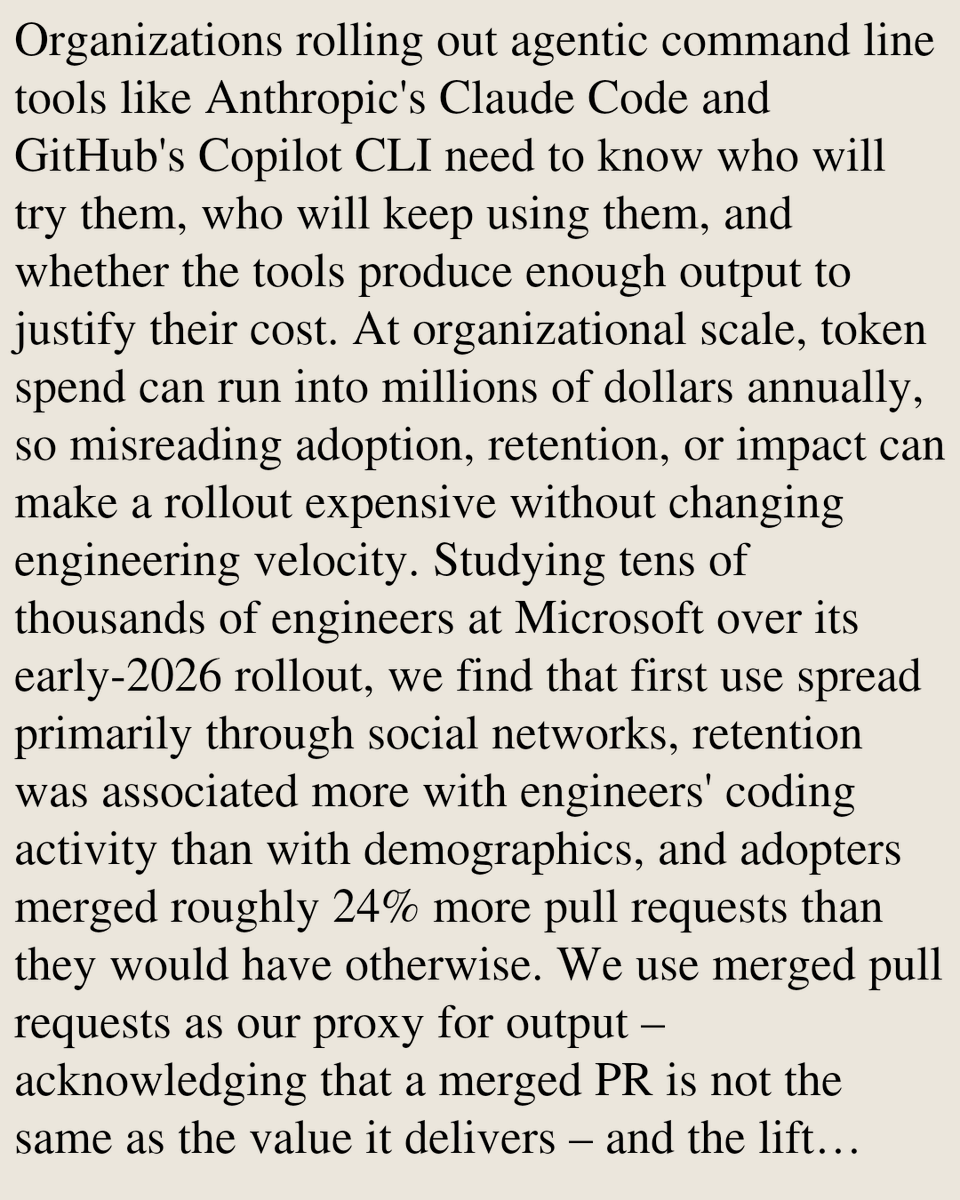
@ComputerPapers linked (81 views, 1 bookmark) an arXiv paper, Adoption and Impact of Command-Line AI Coding Agents, covering Microsoft’s early-2026 rollout of Claude Code and GitHub Copilot CLI. The abstract is unusually concrete for this space: first use spread mainly through social networks, retention aligned more with coding activity than demographics, and adopters merged roughly 24% more pull requests than they otherwise would have over a four-month window.
Anthropic turned agent-skill learning into a formal course catalog
@aiwithjonny highlighted (19 likes, 4 replies, 127 views, 5 bookmarks) that Anthropic is offering 18 free official courses with certificates across Claude Code, MCP, Agent Skills, subagents, API work, and general AI fluency. The notable part is not only that the courses are free; it is that agent workflows are being packaged as structured training rather than left to scattered threads and demos.

7. Where the Opportunities Are
[+++] Spend orchestration and quota observability — Evidence came from nearly every layer of the feed: a public pricing map across dozens of plans, Claude session-limit interruptions, Codex reset-expiry confusion, and a user-built utility just to read reset grants and dates. The strongest version of this opportunity is not another cheap model; it is a control layer that explains remaining runway, routes work to the cheapest acceptable model, and makes resets, limits, and billing visible before the session breaks. (price survey, session limit, reset expiry, CodexResets)
[++] Cross-agent coordination and verification layers — The feed repeatedly showed people building around the orchestration gap rather than waiting for one flagship model to solve it. The evidence spans harness anatomy, Claude-to-Codex subagents, squad as a SQLite handoff layer, Engineering Discipline as a process layer, and iFixAi as an evaluation layer. (harness thread, subagents, squad, iFixAi)
[+] Secure content mediation for agentic IDEs — Trust is becoming a product surface of its own. The Antigravity exploit shows that webpage reading, terminal access, and rich rendering can combine into an exfiltration path, while iFixAi and Security Investigation Automation System show builders already responding with testing and workflow guardrails. The opportunity is emerging because the need is now concrete, but the market is still early and fragmented. (ODIN write-up, iFixAi, Security Investigation Automation System)
8. Takeaways
- Harness design is now part of the product, not hidden plumbing. The strongest technical discussion was about how context, tools, and handoffs are assembled and controlled between turns, not just which model sits underneath. (source)
- Tool choice is becoming portfolio management across price bands. Official open-weight support in Copilot, grassroots price shopping, and migration talk around OpenCode or local GLM-5.2 stacks all point to the same behavior: premium models are being reserved for the moments that really need them. (source)
- Rumor cycles already affect how users ration quotas and time their work. Feature-flagged Sol, Terra, and Luna strings were enough to make people discuss expiring Codex resets and how Fable subscription changes might redirect demand. (source)
- Builders are targeting orchestration, trust, and workflow shells more than raw chat.
squad, iFixAi, Security Investigation Automation System, and The Agency all sit above the model layer and try to make agent behavior usable, inspectable, or role-specific. (source) - The ecosystem is maturing into organizational practice. A Microsoft rollout study now reports measurable adoption and output lift for CLI coding agents, while Anthropic is packaging Claude Code, MCP, and Agent Skills into a formal course catalog. (source)