Twitter AI Coding - 2026-07-05
1. What People Are Talking About
1.1 Workflow layers and orchestration kits kept multiplying (🡕)
The strongest cluster was not a new flagship model launch. It was the continued packaging of context, memory, coordination, and review around existing coding agents. At least seven retained items supported the theme: GitHub custom agents, AI Workflow skill bundles, multi-agent-shogun, Maestro, Happier, Orca, and a design-skill registry. Compared with July 4's first-party multi-agent push, July 5 widened into third-party workflow kits and operator surfaces.
@github announced (171 likes, 18 replies, 28,102 views, 54 bookmarks) custom agents in GitHub Copilot CLI, and the linked GitHub blog says the agents live in .github/agents as Markdown profiles with YAML frontmatter, explicit tool access, and reviewable guardrails for repeated terminal workflows.
@DanKornas highlighted (20 likes, 5 replies, 1,737 views, 25 bookmarks) AI Workflow, whose public README confirms 170+ installable skills, domain-specific workflow bundles, npx add-skill, and support for Claude Code, Cursor, Codex, OpenCode, GitHub Copilot, and Gemini CLI. The important shift is not another prompt pack; it is reusable workflow context being distributed as a cross-tool install surface.
@DanKornas shared (24 likes, 6 replies, 1,834 views, 18 bookmarks) multi-agent-shogun, and the public README backs up the distinctive claim: one strategist plus multiple workers can run in parallel inside visible tmux panes, with YAML files used for delegation, reports, and coordination instead of hidden state.

@DanKornas posted (9 likes, 6 replies, 1,143 views, 5 bookmarks) Maestro, whose README describes 25 workflow commands, seven reference files, persistent memory, an audit trail, and an MCP server. In the replies, one reader immediately pressed on whether memory units can stay fresh instead of turning into stale wiki summaries, which shows that persistence itself is now a practical design question.
@DanKornas surfaced (8 likes, 3 replies, 1,522 views, 7 bookmarks) Happier, an end-to-end encrypted cross-device client for Claude Code, Codex, OpenCode, and others, while @YoussefHosni951 described (3 likes, 3 replies, 97 views) Orca as an environment for fanning one task across isolated git worktrees and comparing results side by side. Together they extend the theme from “install a workflow” to “supervise several workflows across machines and devices.”
Discussion insight: The useful skepticism was about memory quality and safety, not whether workflow layers matter. Replies under the GitHub post questioned whether Markdown guardrails are enough for risky incidents, and the strongest reply under the Maestro post asked whether session memory can stay structured and current instead of going stale.
Comparison to prior day: July 4 pushed official custom agents and Codex-inside-Claude integration into view. July 5 broadened that same direction into reusable skill libraries, memory layers, multi-agent shells, and mobile supervision surfaces.
1.2 Routing around limits turned into product surfaces rather than ad hoc hacks (🡕)
Cost and quota pressure stayed central, but the tone shifted again. July 4 focused on reset visibility and Azure credit workarounds; July 5 emphasized control planes that route across providers, prepaid wallets, and explicit local-versus-cloud task policies. The strongest items were about keeping sessions alive and choosing a cheaper lane without rebuilding the whole workflow.
@VaibhavSisinty said (71 likes, 10 replies, 7,614 views, 142 bookmarks) that 9Router can sit between Claude Code and 40+ providers, switch to cheaper or free models when one lane is exhausted, compress tool output, and expose quota state in a live dashboard. The attached dashboard is the important evidence because it shows connected OAuth providers, free providers, and API-key providers all in one routing surface rather than as a theoretical feature list.

@StudentOffersHQ said (61 likes, 3 replies, 3,330 views, 64 bookmarks) that Inference.net puts 26 frontier models behind one OpenAI-compatible key and starts users with $26 in credits. The wallet screenshot matters because it shows a $25 support credit plus a $1 starter credit and immediate usage debits, which makes the prepaid-credit route concrete instead of abstract.

@elbruno published (7 likes, 2 replies, 505 views, 4 bookmarks) a new CopilotHarness series arguing for “the right model for the right task,” and the linked project docs describe policy-based routing across Ollama, Microsoft Foundry Local, and cloud models with Aspire orchestration.
@khanUmarCodes argued (3 replies, 58 views) that he gets useful daily work out of OpenCode plus open-weight MiniMax and DeepSeek models for about $10, but only because the workflow starts with clarification, then a PRD, then implementation issues, then testable slices. That makes the routing theme more operational: cheaper models are viable when the task structure is stricter.
Discussion insight: The replies were not mainly celebrating “free AI.” They kept returning to continuity and debugging. One reply under the 9Router thread asked for the same kind of control across Cursor and Antigravity, while another competing reply argued that provider abstraction matters because tools should behave the same regardless of which model is active underneath.
Comparison to prior day: July 4 treated quota management as reset timing and billing-lane workarounds. July 5 moved one layer higher into routers, prepaid multi-model wallets, and policy-based local/cloud selection.
1.3 Agent workflows spread into adjacent domains: web apps, offensive security, and mathematical research (🡕)
A third cluster showed the coding-agent pattern leaving the usual “edit my repo” frame. The retained evidence covered browser-native agents, offensive-security swarms, and expert mathematical workflows. The common move was to keep the expert in the loop while pushing more structured execution into the agent system.
@israfill highlighted (53 likes, 21 replies, 4,286 views, 59 bookmarks) Alibaba's Page Agent, and the public repo confirms the key claims: one-line in-page JavaScript integration, text-based DOM interaction instead of screenshots, bring-your-own model support, and optional browser-extension or MCP paths for broader control. That matters because it reframes browser automation as an embeddable product feature rather than a separate headless stack.
@IntCyberDigest summarized (34 likes, 2 replies, 3,456 views, 25 bookmarks) T3MP3ST as a multi-agent offensive-security framework for Claude Code and Codex subscriptions. The attached table is the key evidence because it spells out what the system claims to hunt and how mature each lane is: stable coverage for web apps and CTFs, pipeline-stable robotics or OT work, Python-only ingest for source-code analysis, and smart-contract reproduction rather than novel discovery.

@nasqret wrote (17 likes, 575 views, 9 bookmarks) that Claude Code and Codex are changing his workflow in arithmetic algebraic geometry by letting him generate and inspect CAS code at the pace of thought instead of hand-typing every verification. The most informative image is the verified correction table because it shows the workflow is being used for concrete mathematical checking and paper support, not just generic note-taking.

Discussion insight: These posts were not arguing that agents replace subject-matter expertise. They showed the opposite pattern: experts keep the judgment while agents take over repetitive but highly structured execution inside web interfaces, exploit pipelines, or symbolic-computation workflows.
Comparison to prior day: July 4 had security checklists and training tracks. July 5 showed more lived, domain-specific workflows: browser copilots, offensive-security swarms, and research mathematicians using coding agents for real verification work.
1.4 The harness itself kept being framed as the real advantage (🡒)
This theme was already strong on July 3 and July 4, and it stayed present on July 5. The new detail is that people increasingly backed the claim with process diagrams, benchmark deltas, and concrete workflow patterns rather than only intuition. The repeated message was that the model matters, but the loop around it matters more.
@0x_kaize argued (29 likes, 13 replies, 1,094 views, 17 bookmarks) that prompt engineering is being displaced by loop engineering. The attached diagram is the main evidence because it makes the comparison explicit: prompt engineering is a one-shot prompt-response path, while loop engineering is organized around goal, plan, act, verify, reflect, and iterate, with failure recovery and success conditions built into the flow.

@PhiloGroves flagged (2 replies, 109 views) Tencent's Xuanwu Atuin AI CyberGym write-up, which reports 84.0% pass@1 on CyberGym Level 1 with GLM-5.1, compared with a cited 68.7% GLM-5.1 result under Claude Code. Tencent attributes the gap to manager/subagent orchestration, security-specific skills, SOP adherence, TODO tracking, and workflow hooks that detect drift.
@khanUmarCodes added (3 replies, 58 views) a practitioner version of the same idea: his gains with cheaper open-weight models came after changing the workflow so the agent clarifies ambiguity, writes a PRD, breaks work into testable slices, and avoids over-engineering.
Discussion insight: The operational question was no longer “which base model wins?” It was “what workflow keeps the agent on task, on budget, and reviewable long enough to finish real work.”
Comparison to prior day: July 4 treated orchestration as a role-splitting and product-surface problem. July 5 added explicit loop diagrams, a same-model benchmark gap, and more detailed practitioner accounts of why the process layer changes outcomes.
2. What Frustrates People
Limits, credits, and provider switching still interrupt otherwise good workflows
Severity: High. The strongest cost posts were all workaround posts. @VaibhavSisinty said (71 likes, 10 replies, 7,614 views, 142 bookmarks) people are using 9Router precisely so a Claude Code session can drop to cheaper and then free providers without stopping, while @StudentOffersHQ pitched (61 likes, 3 replies, 3,330 views, 64 bookmarks) prepaid credits and one-key model access as a practical way to keep working. @elbruno responded (7 likes, 2 replies, 505 views, 4 bookmarks) by building a local-versus-cloud routing harness for Copilot, and @khanUmarCodes said (3 replies, 58 views) he only made cheap models work once the workflow became structured enough to reduce wasted retries. People are coping with proxies, prepaid wallets, local models, and routing policies. This is worth building for because the workaround layer is already turning into standalone products.
Raw prompting still leads to drift, over-engineering, and session amnesia
Severity: High. @0x_kaize argued (29 likes, 13 replies, 1,094 views, 17 bookmarks) that one-shot prompting is too fragile for long runs because it lacks memory, verification, and recovery. @khanUmarCodes described (3 replies, 58 views) the same failure mode from the opposite side: vague requests make agents confidently resolve ambiguity, which then shows up later as over-engineering or drift. @DanKornas shared (9 likes, 6 replies, 1,143 views, 5 bookmarks) Maestro as a memory and workflow layer, and the most useful reply immediately asked whether memory entries go stale unless they track claim, scope, status, and source trace. This is worth building for because users are now explicitly asking for workflow structure, not just better autocomplete.
Supervising several agents at once is still awkward without extra shells or companion apps
Severity: Medium. @DanKornas shared (24 likes, 6 replies, 1,834 views, 18 bookmarks) multi-agent-shogun because “coordinating eight is the hard part,” not running one agent. @DanKornas posted (8 likes, 3 replies, 1,522 views, 7 bookmarks) Happier to keep sessions accessible across phone, web, desktop, and terminal, and @YoussefHosni951 presented (3 likes, 3 replies, 97 views) Orca as an environment for comparing several agents in isolated worktrees. The coping pattern is clear: tmux hierarchies, cross-device clients, and dedicated agent IDEs. This looks worth building for because the pain appears only after teams try to operate multiple agents continuously.
Browser-capable agents still expose a serious security surface
Severity: High. @TakSec warned (11 likes, 1 reply, 1,274 views, 8 bookmarks) that Google Antigravity can be tricked into leaking an API key from a hidden <title> tag, and the linked ODIN write-up says the exfiltration path runs through terminal access plus a rendered image URL after the user approves what the agent described as a harmless “visual debug token.” @IntCyberDigest showed (34 likes, 2 replies, 3,456 views, 25 bookmarks) that offensive multi-agent frameworks like T3MP3ST are also being productized with domain-specific hunt modes and maturity claims. Even Page Agent highlights human confirmation before critical actions in its public docs, which shows builders already treat this as a live risk. This is worth building for because the exposure is specific, reproducible, and tied directly to browser-plus-terminal agents.
3. What People Wish Existed
Native spend-aware routing and visible quota state
The clearest practical need was for products to expose their own operating envelope instead of pushing users into external proxies and spreadsheets. @VaibhavSisinty showed (71 likes, 10 replies, 7,614 views, 142 bookmarks) why 9Router is resonating: fallback rules, quota tracking, and one endpoint across many providers. @StudentOffersHQ framed (61 likes, 3 replies, 3,330 views, 64 bookmarks) prepaid credits and one-key model access as the practical alternative, and @elbruno made (7 likes, 2 replies, 505 views, 4 bookmarks) the same point with a policy-driven local/cloud routing harness. This is an urgent practical need rather than an aspirational one. Opportunity: Direct.
Durable workflow memory and structure that survives across sessions
People are not just asking for bigger context windows. They are asking for workflows that preserve the right units of state. @DanKornas promoted (9 likes, 6 replies, 1,143 views, 5 bookmarks) Maestro as a memory, audit, and workflow layer, but the strongest reply immediately asked how to stop memory from going stale. @DanKornas also shared (20 likes, 5 replies, 1,737 views, 25 bookmarks) AI Workflow precisely because new sessions otherwise start from zero, and @khanUmarCodes said (3 replies, 58 views) the real unlock was forcing clarification, PRDs, issues, and testable slices before implementation. This is a direct product gap with active experimentation but no settled default. Opportunity: Direct.
Mission control for many agents across devices and worktrees
The strongest supervision wish was for better operator surfaces once work becomes asynchronous and multi-agent. @DanKornas shared (24 likes, 6 replies, 1,834 views, 18 bookmarks) multi-agent-shogun because coordination, not invocation, is the hard part. @DanKornas presented (8 likes, 3 replies, 1,522 views, 7 bookmarks) Happier for cross-device continuation, and @YoussefHosni951 positioned (3 likes, 3 replies, 97 views) Orca as a way to compare several agents in isolated worktrees from one surface. This is a practical need with several emerging answers but no dominant standard. Opportunity: Competitive.
Safer browser agents and approval flows people can actually trust
The web-agent posts made the missing need unusually concrete. Alibaba's Page Agent already advertises human confirmation for critical actions, while @TakSec showed (11 likes, 1 reply, 1,274 views, 8 bookmarks) that a user-approval step can still fail if the agent misdescribes the action as a harmless debug token. This is a practical safety need with clear competition from policy systems, scanners, and UI-layer mitigations, but core tools still leave room for a stronger native answer. Opportunity: Competitive.
4. Tools and Methods in Use
| Tool | Category | Sentiment | Strengths | Limitations |
|---|---|---|---|---|
| GitHub Copilot CLI custom agents | CLI workflow layer | (+) | Repo-defined roles, tools, and guardrails for repeatable terminal work | Replies questioned whether Markdown guardrails alone are enough for risky real-world runs |
| 9Router | Routing proxy | (+/-) | Auto-fallback, quota tracking, token compression, one endpoint for many coding clients | Adds another control plane to debug and can hide provider switches behind one interface |
| Inference.net | Multi-model API / credits | (+/-) | One key, prepaid starter credits, frontier-model access, OpenAI-compatible clients | Requires a payment card and large models consume the starter balance quickly |
| AI Workflow | Skill bundle / workflow pack | (+) | 170+ installable skills, domain bundles, broad assistant support | External curation layer rather than a native product default |
| multi-agent-shogun | Agent orchestration | (+) | Visible tmux panes, parallel workers, YAML coordination, versionable handoffs | Coordination overhead is still the main problem it is trying to tame |
| Maestro | Workflow and memory layer | (+) | Commands, anti-pattern guidance, persistent memory, audit trail, MCP server | Readers immediately questioned whether memory stays fresh and whether it overlaps built-in features |
| Happier | Session companion / control surface | (+) | Cross-device continuation, replay and fork, encrypted session access | Solves continuity and control, not the core quality of the model itself |
| Orca | Parallel-agent ADE | (+) | Isolated worktrees, mobile companion, design mode, diff annotation | Requires a separate environment and multiple underlying agent subscriptions |
| Page Agent | Browser agent | (+/-) | One-line integration, DOM-native control, optional MCP and extension support | Depends on DOM cleanliness and sends page context to the configured model |
| CopilotHarness | Routing method | (+) | Local-when-possible model selection across Ollama, Foundry Local, and cloud models | Still early and presented more as an architecture pattern than a mainstream default |
| OpenCode plus open-weight models | Low-cost coding stack | (+) | Fast, cheap daily work when tasks are clarified and sliced carefully | Breaks down when requests are ambiguous or the workflow allows drift |
The overall pattern was composition, not replacement. @VaibhavSisinty showed (71 likes, 10 replies, 7,614 views, 142 bookmarks) a routing layer on top of existing coding tools, @StudentOffersHQ marketed (61 likes, 3 replies, 3,330 views, 64 bookmarks) one-key access to many model families, and @khanUmarCodes argued (3 replies, 58 views) that cheap open-weight models only become reliable once the workflow gets stricter. On the workflow side, @DanKornas used (20 likes, 5 replies, 1,737 views, 25 bookmarks) AI Workflow to package repeatable skills, shared (9 likes, 6 replies, 1,143 views, 5 bookmarks) Maestro for memory and commands, and surfaced (8 likes, 3 replies, 1,522 views, 7 bookmarks) Happier for session continuity. Migration pressure was visible in both directions: premium agents still handle architecture, review, or harder reasoning, while routing layers and cheaper models are being pushed into bulk execution and long-running work.
@elbruno published (7 likes, 2 replies, 505 views, 4 bookmarks) a CopilotHarness example of the same dynamic: local when possible, cloud when necessary, with policy rather than habit deciding the route.

5. What People Are Building
| Project | Who built it | What it does | Problem it solves | Stack | Stage | Links |
|---|---|---|---|---|---|---|
| Custom agents in GitHub Copilot CLI | @github | Defines reusable terminal agents in Markdown with explicit tools and guardrails | Re-running the same CLI workflows and re-explaining team context | Markdown agent profiles, YAML frontmatter, GitHub Copilot CLI | Shipped | tweet, blog |
| 9Router | @VaibhavSisinty surfaced decolua's project | Routes coding tools across many providers with fallback, quota tracking, and token compression | Session caps, manual provider switching, and wasted quota | JavaScript proxy, OpenAI-compatible endpoint, OAuth/API-key providers | Shipped | tweet, repo |
| Page Agent | @israfill surfaced Alibaba's project | Embeds a natural-language GUI agent directly inside a webpage | Legacy or internal web UIs that lack APIs or need lighter automation than a headless stack | TypeScript, in-page JavaScript, optional browser extension, MCP server | Shipped | tweet, repo |
| AI Workflow | @DanKornas surfaced nicepkg's project | Installs reusable workflow and skill bundles across many assistants | Starting every session from zero and re-teaching domain rules | SKILL.md workflow packs, npx add-skill, cross-tool skill directories |
Shipped | tweet, repo |
| multi-agent-shogun | @DanKornas | Runs multiple coding agents in parallel under a visible shell hierarchy | Coordinating many agents without losing track of state, tasks, or reports | Shell, tmux, YAML coordination files, Memory MCP | Beta | tweet, repo |
| Happier | @DanKornas | Continues, controls, and replays coding-agent sessions across phone, web, desktop, and terminal | Agents being stuck on the machine where they started | TypeScript, mobile/web/desktop clients, end-to-end encryption | Beta | tweet, repo |
| Maestro | @DanKornas | Adds workflow commands, references, memory, and audit to AI coding tools | Session amnesia, inconsistent process, and repeated workflow mistakes | TypeScript, skills, MCP server, JSONL audit and memory files | Beta | tweet, repo |
| Orca | @YoussefHosni951 surfaced StablyAI's project | Fans one task across isolated worktrees and lets users compare agent outputs side by side | Merge chaos and context switching when several agents run at once | TypeScript, git worktrees, mobile companion, embedded Chromium tools | Shipped | tweet, repo |
| ArcKit | @DanKornas | Wraps enterprise architecture and assurance into reusable commands, agents, and templates | Architecture governance living in disconnected documents instead of repeatable workflows | JavaScript toolkit, commands, templates, hooks, governance overlays | Beta | tweet, repo |
Several of the bigger projects point to the same build pattern: the new product surface is not “a smarter model” but “a better layer around the model.” @VaibhavSisinty presented (71 likes, 10 replies, 7,614 views, 142 bookmarks) 9Router as a control plane for fallback and quota routing, while @YoussefHosni951 framed (3 likes, 3 replies, 97 views) Orca as the place where several agents can run in isolated worktrees and be reviewed together. @DanKornas shared (9 likes, 6 replies, 1,143 views, 5 bookmarks) Maestro for memory and repeatable commands, and @DanKornas shared (8 likes, 3 replies, 1,522 views, 7 bookmarks) Happier for cross-device control.
The repeated trigger for these builds was not lack of raw model intelligence. It was loss of continuity, opaque routing, weak supervision, and too much workflow being trapped inside one long chat. That same pattern also explains the more specialized builds: Page Agent for internal web UIs, ArcKit for architecture governance, and AI Workflow for domain-specific skill bundles.
6. New and Notable
Same-model harness gains were quantified in a public cyber benchmark
@PhiloGroves flagged (2 replies, 109 views) Tencent's Xuanwu Atuin AI result on CyberGym Level 1: 84.0% pass@1 with GLM-5.1, versus a cited 68.7% GLM-5.1 baseline under Claude Code. The write-up is explicit that the claimed gain comes from manager/subagent orchestration, SOP adherence, reusable cyber skills, TODO tracking, and workflow hooks rather than from changing the base model.
Labor-market charts made the junior-programmer squeeze harder to ignore
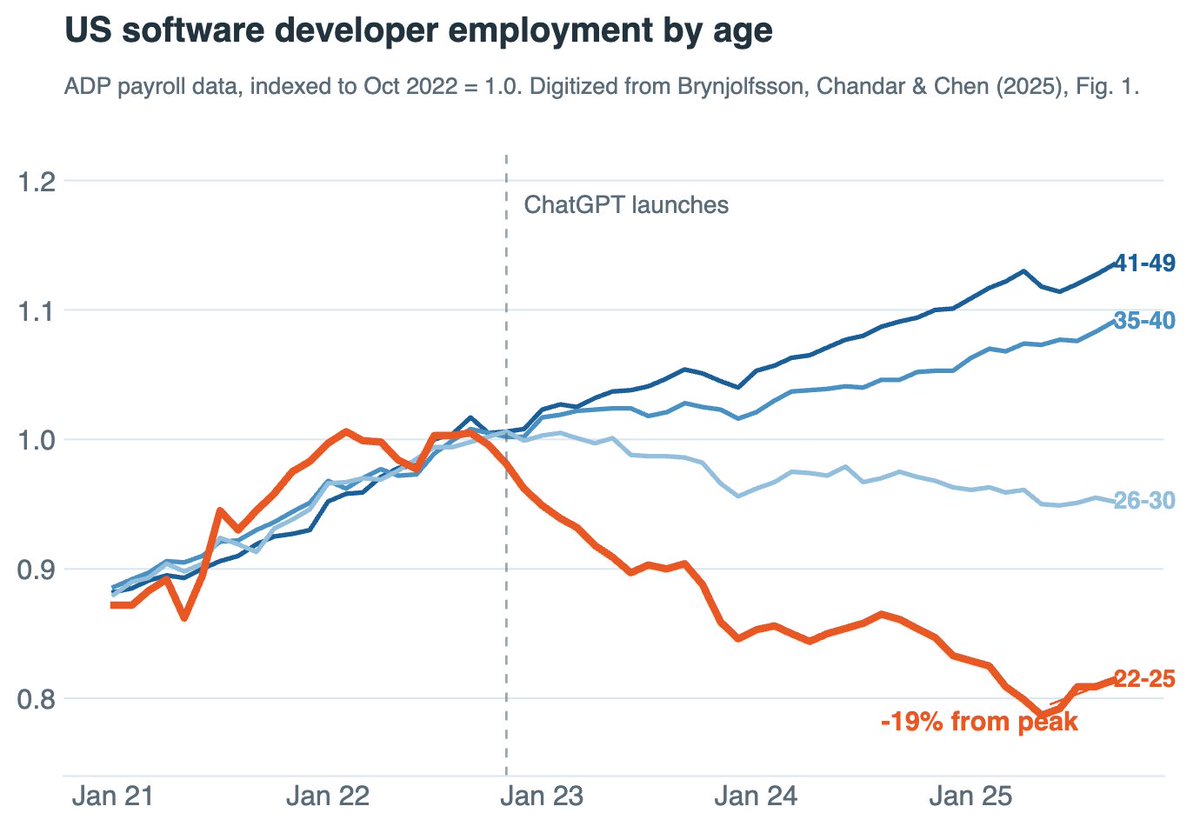
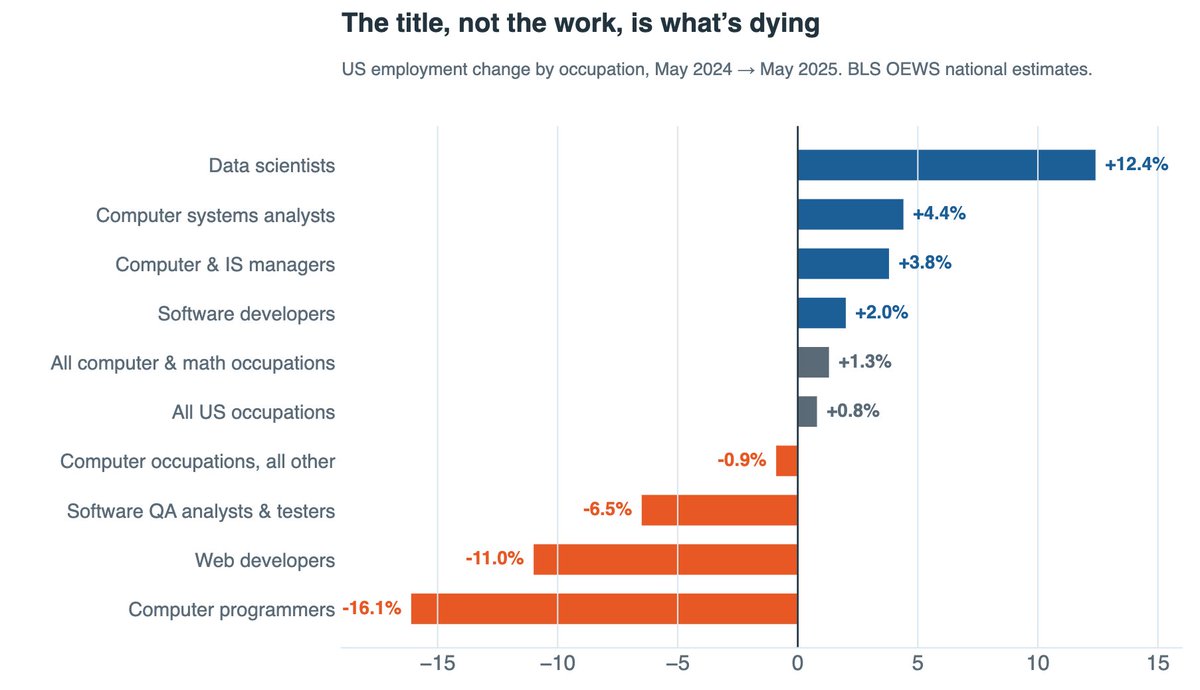
@OwenGregorian argued (13 likes, 4 replies, 2,996 views, 4 bookmarks) that AI has hit junior programming work much harder than senior cohorts, and the attached charts are the key evidence. One chart shows US software developer employment by age with the 22–25 cohort down 19% from peak while older cohorts rose, and another shows programming and web-development job titles down while software developers and data scientists stayed positive.
Skills are spreading from code workflows into design-system packaging
@tom_doerr shared (3 likes, 2 replies, 2,172 views, 7 bookmarks) awesome-design-skills, a registry of 67 design-system skill files for agentic tools. That is notable not because of engagement, but because it extends the day's workflow-packaging trend from coding instructions into paired SKILL.md and DESIGN.md artifacts for interface work.
7. Where the Opportunities Are
[+++] Routing and quota control planes for coding agents — Evidence ran through sections 1, 2, 3, and 4: 9Router, Inference.net, CopilotHarness, and open-weight OpenCode workflows all exist because users still need a visible way to route by quota, price, and task. The opportunity is strong because people are already adopting separate routers and prepaid wallets just to keep work continuous.
[++] Workflow memory plus structured task decomposition — AI Workflow, Maestro, the loop-engineering thread, and Umar Khan's clarification -> PRD -> issues -> testable-slices workflow all point to the same gap. Users want agents to remember the right things, ask clarifying questions, and keep work reviewable across sessions without drifting or over-engineering.
[++] Multi-agent mission control across worktrees and devices — multi-agent-shogun, Happier, and Orca all target the supervision problem rather than the model problem. The opportunity is moderate-to-strong because the pain is concrete, but there are now multiple early answers competing on shell, desktop, and mobile surfaces.
[++] Secure browser and terminal agent guardrails — The ODIN Antigravity exploit and the growth of offensive-security agent frameworks show that browser-plus-terminal agents already need stronger approval, policy, and audit layers. The opportunity is moderate because builders are aware of it, but the core products still leave large gaps.
[+] Domain-specific workflow packs for expert work — ArcKit, awesome-design-skills, and the arithmetic-algebraic-geometry workflow suggest a newer layer of opportunity: specialized packs for architecture, design systems, mathematical verification, and other expert domains. The signal is still emerging, but the examples are more concrete than generic “vertical AI” chatter.
8. Takeaways
- The workflow layer kept expanding faster than the model story. GitHub custom agents, AI Workflow, multi-agent-shogun, Maestro, Happier, and Orca all treated coding quality as a packaging, memory, and supervision problem rather than a raw model-selection problem. (source)
- Quota avoidance is now a product category of its own. 9Router, Inference.net, CopilotHarness, and cheaper OpenCode workflows all existed to keep sessions running across limits, prepaid credits, and local/cloud splits. (source)
- People increasingly trust cheaper models only when the workflow is stricter. The strongest low-cost success stories on the day combined open-weight or mixed fleets with clarification, PRDs, issue slicing, and explicit verification loops. (source)
- Browser-capable agents remain powerful and risky at the same time. Page Agent showed how lightweight browser copilots are getting, while the ODIN Antigravity exploit showed how that same browser-plus-terminal surface can be abused for key exfiltration. (source)
- The harness-versus-model debate picked up stronger evidence. Tencent's CyberGym write-up argued that the same GLM-5.1 model achieved materially better results under a more specialized multi-agent workflow, reinforcing the feed's larger shift toward loop design and orchestration. (source)