Twitter AI Coding - 2026-07-15
1. What People Are Talking About
1.1 Google's coding story is widening from one leaked model to an entire platform map (🡕)
The biggest engagement went to Google-adjacent posts, but the evidence split between rumor, ecosystem marketing, and outright product confusion. Two high-engagement leak posts treated Gemini 3.5 Pro as imminent, while lower-volume but more concrete posts tried to frame Gemini CLI, Antigravity, Jules, ADK, and A2A as one connected development stack.
@LuminaXspace posted (321 likes, 24 replies, 25,732 views, 45 bookmarks) an unverified Gemini 3.5 Pro rumor list: a July 17 target, a new pretraining run, a 2M-token context window, and stronger coding and reasoning. The useful signal is not that any one claim was proven today; it is that a coding-model release rumor dominated attention without an official benchmark or product page.
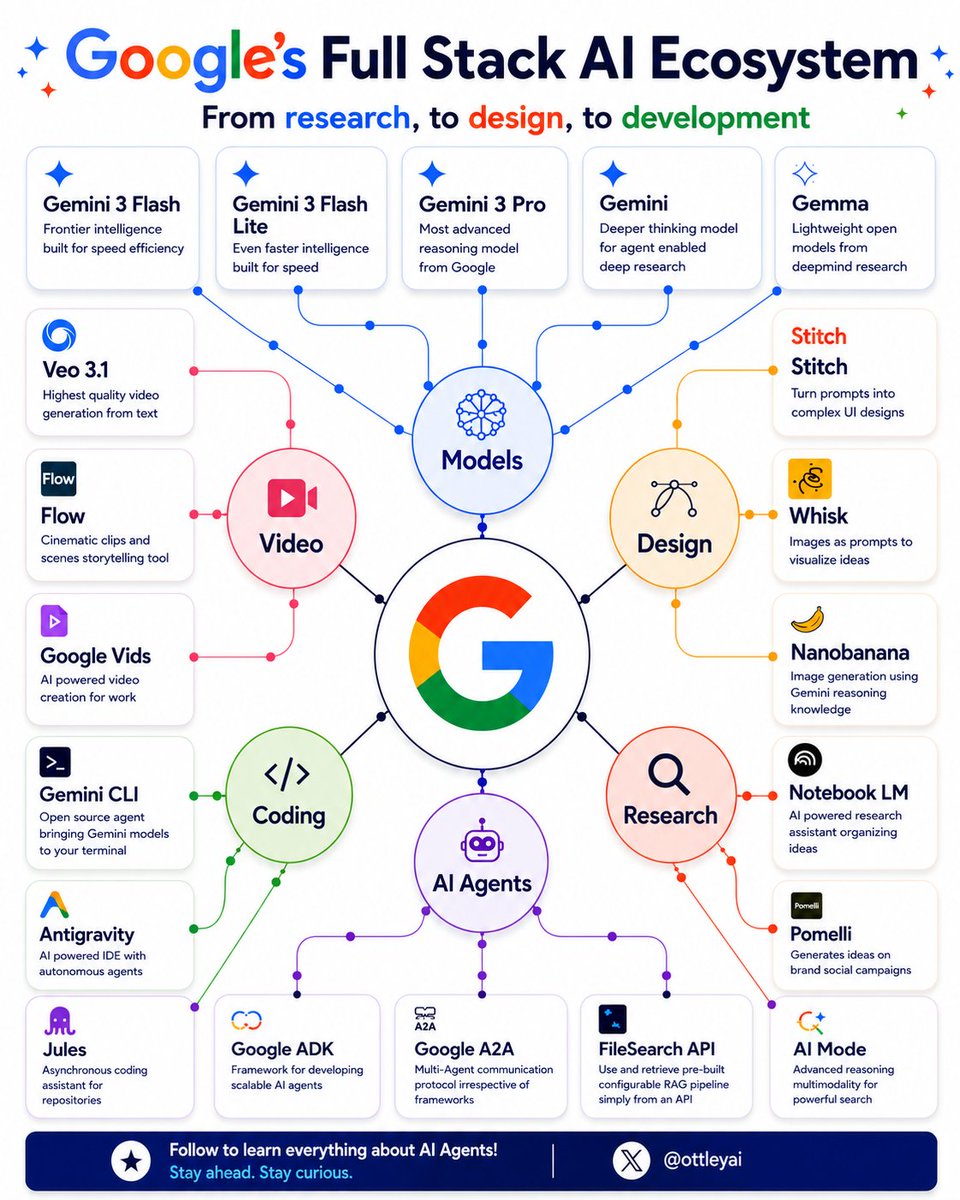
@ottleyai argued (21 likes, 14 replies, 1,290 views, 11 bookmarks) that Google is building a full-stack AI ecosystem rather than chasing a single model win. The attached map is the clearest artifact from the thread: it groups Gemini, Gemma, Stitch, Whisk, NotebookLM, Veo, Flow, Google Vids, Antigravity, Gemini CLI, Jules, ADK, A2A, and FileSearch API into one development surface.
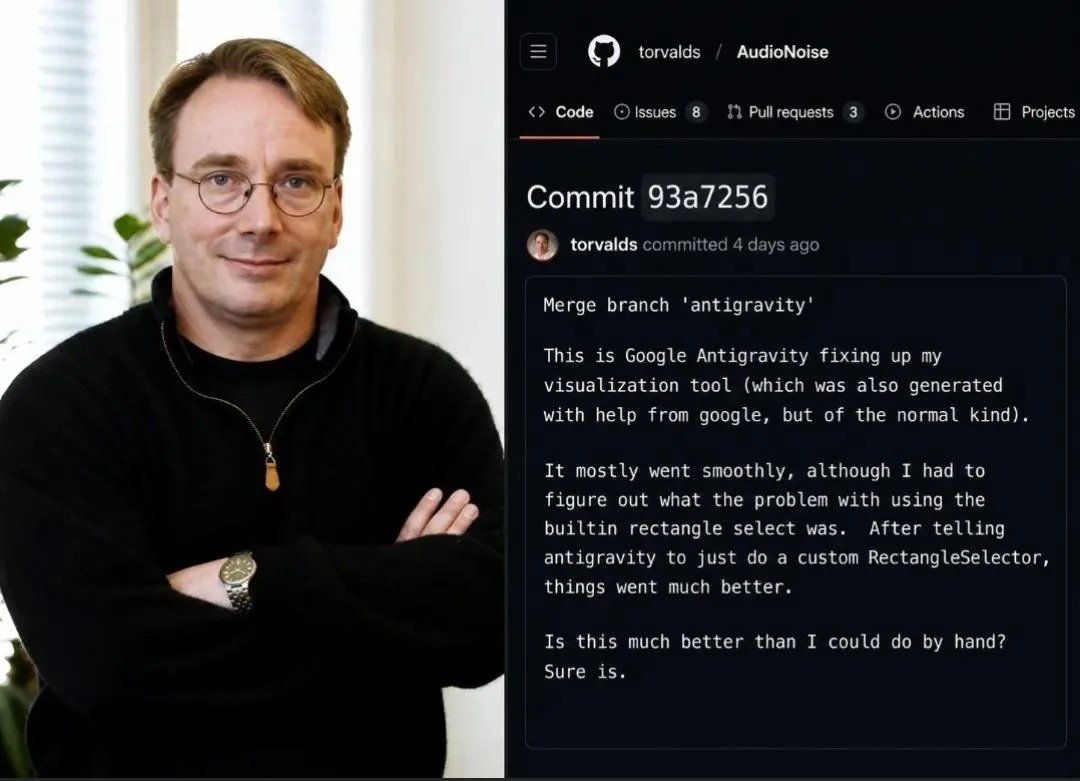
@ishivgaur shared (8 likes, 4 replies, 175 views) a screenshot of Linus Torvalds' AudioNoise repo showing a commit message that says Google Antigravity helped fix a visualization tool once a built-in rectangle selector was replaced with a custom one. That image matters because it is concrete usage evidence, not another ecosystem slogan.
@pigeon__s quote-reacted (43 likes, 1,982 views) to a Jules V2 teaser by asking whether Jules still exists separately from Antigravity at all. That was the sharpest counter-signal in the day: even engaged users are struggling to track which Google coding surface is current.
Discussion insight: Replies under the Gemini leak mostly asked for proof or said they wanted another serious frontier competitor. The stronger contradiction came from the Jules thread, where the problem was not performance skepticism but product-map confusion.
Comparison to prior day: On 2026-07-14, Google discussion centered more narrowly on Antigravity as an agent surface. On 2026-07-15, the conversation expanded into a broader Google stack story, but the expansion brought naming and product-boundary confusion with it.
1.2 Agent status is escaping the editor and showing up in Jira, phones, and hardware (🡕)
A second theme was control surfaces for work already in flight. The strongest product evidence came from GitHub's Jira integration and Visual Studio usage features, while builders and accessory makers explored phone and hardware surfaces for monitoring and steering agents.
@github announced (80 likes, 9 replies, 22,787 views, 28 bookmarks) that GitHub Copilot for Jira is now generally available. GitHub's GA changelog says the release adds streaming agent progress in the Jira issue, post-session steering from the Jira chat panel on the same draft pull request, and simplified onboarding; it also notes earlier preview additions such as model selection, Confluence context via MCP, custom agents, and custom fields. The replies were notably less enthusiastic than the announcement, warning about AI-generated ticket spam and noisy auto-comments.
@GHchangelog released (19 likes, 1 reply, 2,046 views, 4 bookmarks) a Visual Studio update whose official changelog adds real-time Copilot usage tracking and alerts, trust validation for MCP server fingerprints, PR-to-chat context import, and C++ modernization GA. That is a meaningful shift from “agent present in the IDE” to “agent cost and tool trust visible in the IDE.”
@ridark_eth promoted (23 likes, 12 replies, 347 views, 13 bookmarks) Orca as a way to run Claude Code, Codex, Copilot, and other CLI agents side by side. The Orca repo and its mobile docs support the core claims: isolated git worktrees, phone notifications and replies, and account-level usage-state tracking.
@testingcatalog highlighted (20 likes, 2 replies, 2,089 views) Work Louder's Codex Micro, and the product page says its RGB keys reflect agent states while command keys, a joystick, and a dial let users trigger workflows and adjust reasoning depth. The post is low-volume, but it is a notable sign that agent supervision is turning into a hardware category.

Discussion insight: The Jira thread produced a clear warning that “AI in the workflow” can become “AI-generated workflow noise.” The Orca and Codex Micro threads point in the opposite direction: people want more explicit state, faster intervention, and less context-switching when an agent needs attention.
Comparison to prior day: Yesterday's strongest supervision artifact was GitHub Mobile showing a remote session that needed input. Today that same supervision logic appeared in Jira, Visual Studio usage windows, mobile companion apps, and even dedicated hardware.
1.3 Teams are starting to formalize the agent loop instead of just prompting harder (🡕)
The third theme was process hardening. Instead of celebrating raw generation speed, today's better posts tried to remove ambiguity before execution, expose tools explicitly, reduce token waste, or constrain what delegated agents can do.
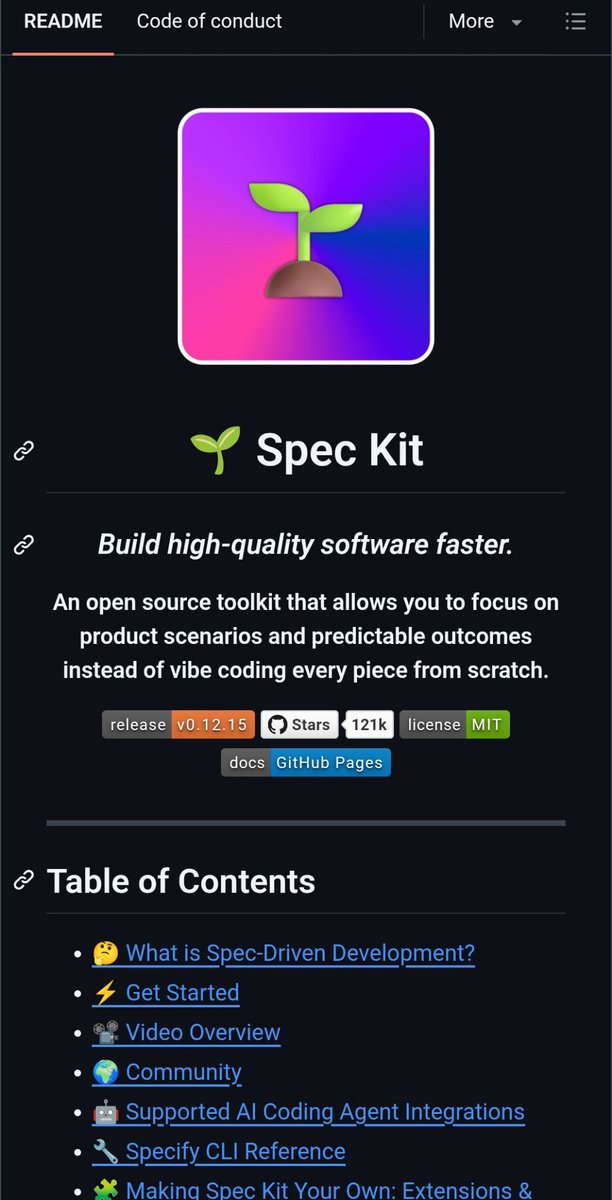
@RituWithAI argued (11 likes, 4 replies, 164 views, 6 bookmarks) that GitHub's Spec Kit exists to stop agents from coding the wrong thing quickly. The Spec Kit repo and GitHub's spec-driven development post back up the core workflow: constitution, specify, plan, tasks, then implement, with the spec treated as a living source of truth.
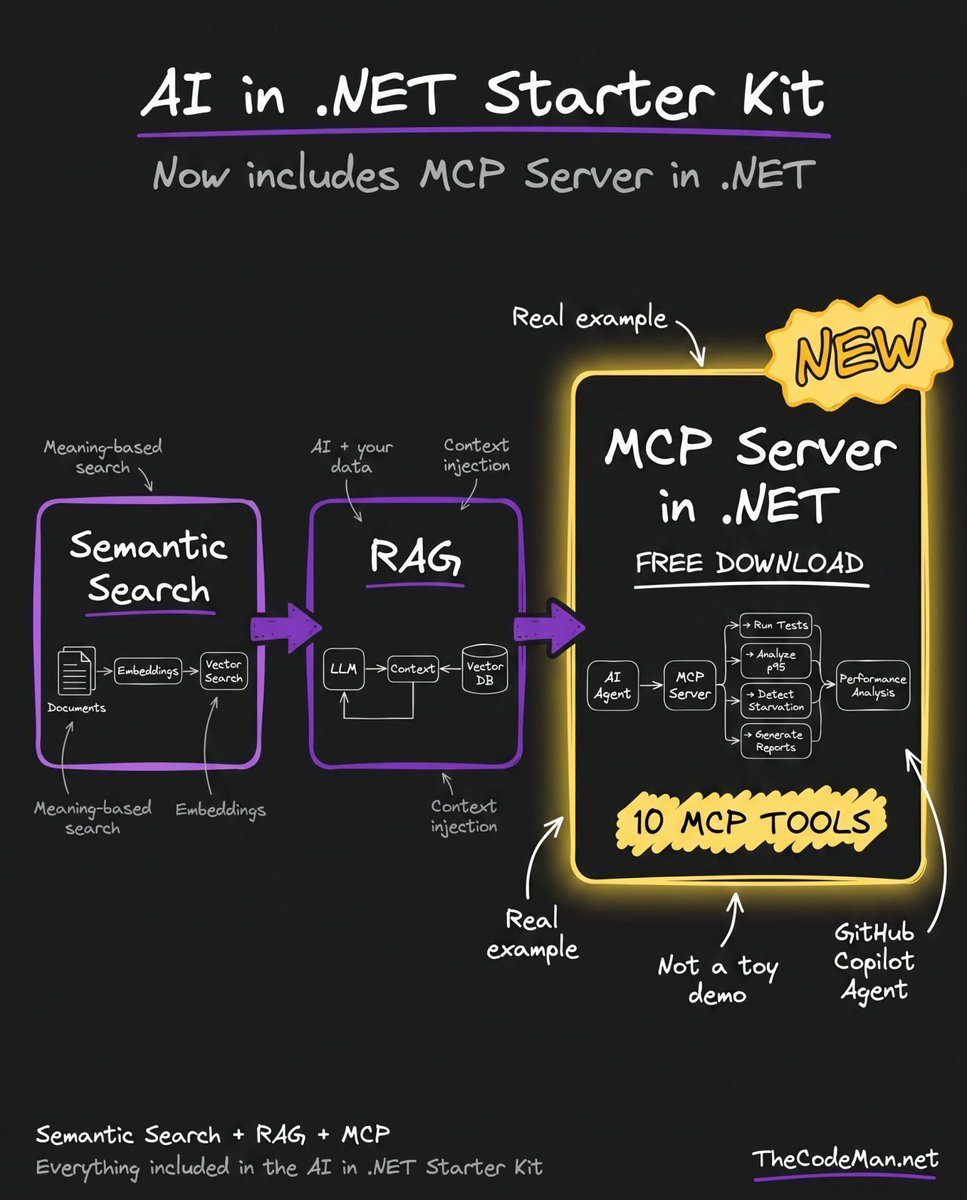
@TheCodeMan__ shared (10 likes, 3 replies, 296 views, 3 bookmarks) a concrete MCP server example for .NET. His starter-kit page and deep dive describe a performance lab where Copilot agent mode can trigger load tests, compare endpoints, report p95/p99 latency, and flag thread-pool starvation from a chat prompt.
@RetroChainer claimed (37 likes, 12 replies, 1,158 views, 20 bookmarks) that RTK can cut shell-driven token burn by roughly 80% without changing code. The RTK repo documents the same benchmark shape and says the proxy compresses command output before it reaches the model, but the thread's most useful reply asked the obvious question: whether aggressive filtering can hide the stack traces an agent actually needs.
@thdxr said (19 likes, 3 replies, 978 views) that OpenCode subagents will soon need extra configuration to call more subagents. That small note matters because it reframes delegation as a permission design problem, not merely a capability problem.
Discussion insight: The common move across these items is to structure agent work before or around execution: define the spec, expose real tools, compress shell noise, or make recursive delegation opt-in. The RTK thread added the most useful skepticism by asking what gets lost when output is compressed too aggressively.
Comparison to prior day: On 2026-07-14, people were mainly routing work across different models and agents. On 2026-07-15, the stronger signal was workflow discipline: explicit specs, explicit tools, explicit budgets, and explicit delegation rules.
2. What Frustrates People
Overlapping product surfaces make it hard to know where work belongs
Severity: Medium. The Google threads show that ecosystem breadth is now creating a navigation problem. @pigeon__s asked (43 likes, 1,982 views) whether Jules still exists separately from Antigravity after seeing a Jules V2 teaser, while @ottleyai promoted (21 likes, 14 replies, 1,290 views, 11 bookmarks) a map that spans Gemini, Antigravity, Jules, ADK, A2A, FileSearch API, and more. The frustration is not opposition to Google's tools; it is uncertainty about which surface to learn, adopt, or trust as the durable one. This is worth building for because the visible failure mode is wasted attention before any coding starts.
Trust boundaries around agent actions still look brittle
Severity: High. @Hamaaadite flagged (2 replies, 113 views) GhostApproval, and the public Wiz report plus CSA note describe a symlink-based approval flaw across six coding assistants, including Claude Code and Google Antigravity. The point is not abstract security theory: the prompt can describe a harmless-looking file while the actual write lands in ~/.ssh/authorized_keys or another sensitive target.

@xyz3va complained (77 likes, 5 replies, 4,658 views) that previously reported OpenCode security issues had still not been acknowledged while a mobile app was being promoted. That is a one-sided accusation, but it is still useful evidence of eroding trust. @thdxr added (19 likes, 3 replies, 978 views) a smaller but related point: nested subagents will require additional configuration, reflecting that delegation rules remain sensitive enough to tighten in production. This is worth building for because users clearly want agent power, but only with approval surfaces and delegation rules they can actually reason about.
Teams can see spend more easily than value
Severity: High. Several posts converged on the same operational complaint: cost and usage are becoming measurable sooner than engineering return. @Herald_Dev argued (3 likes, 1 reply, 62 views) that teams are already paying for Claude Code or Cursor without a reliable way to distinguish a disciplined high-output user from a high-spend "tokenmaxxer." The attached chart makes the complaint legible even though it does not provide a public methodology.
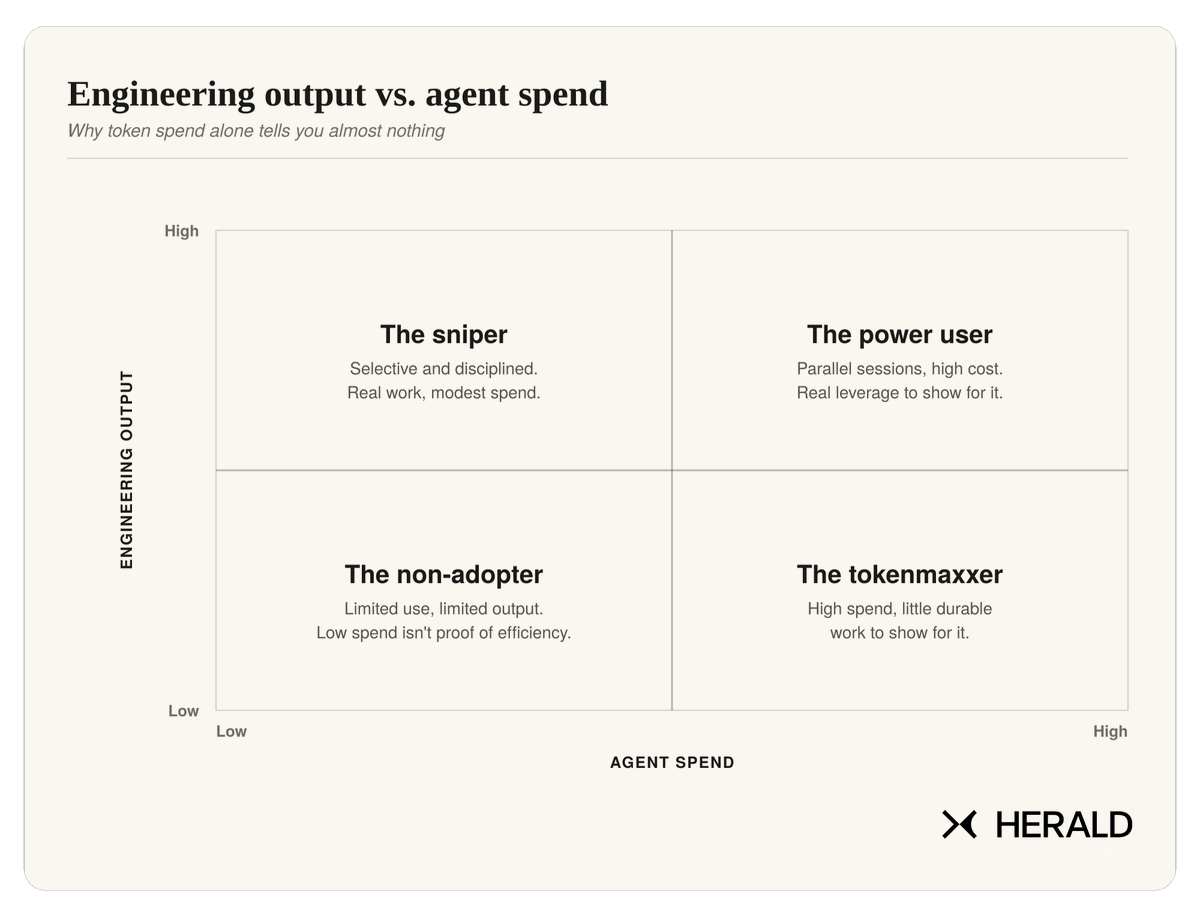
@GHchangelog released (19 likes, 1 reply, 2,046 views, 4 bookmarks) a Visual Studio update with usage alerts, @burkeholland showed (43 likes, 3 replies, 2,837 views, 27 bookmarks) a cache-miss extension that exposes hidden model-switch costs, and @ludvigrask_ shared (6 likes, 1 reply, 70 views) an OpenCode Console billing screen with seats, invoices, and auto-recharge thresholds.

@RetroChainer claimed (37 likes, 12 replies, 1,158 views, 20 bookmarks) RTK can compress shell output enough to cut token burn sharply, but even that thread ended with questions about whether savings come at the cost of missing debugging detail. Orca's usage-tracking docs show the same demand from another angle: people want remaining quota and reset visibility before a session stalls. This is worth building for because the coping behavior today is still manual monitoring, dashboard checking, and ad hoc compression rather than a trusted ROI view.
Workflow-native agents can also create workflow-native noise
Severity: Medium. The clearest pushback against GitHub Copilot for Jira was not that it existed, but that it might accelerate already noisy project-management habits. In replies to @github announcing (80 likes, 9 replies, 22,787 views, 28 bookmarks) Jira GA, multiple respondents predicted hallucinated acceptance criteria, auto-generated ticket floods, and auto-comments that make paper productivity look better than team signal quality. The product adds real control points such as streamed progress and post-session steering, but the visible fear is that management surfaces are easier to clutter than to improve. This is worth building for if agent activity can be summarized and routed without multiplying review noise.
3. What People Wish Existed
One coherent map from chat to agent to product family
The Google threads show a practical need for fewer overlapping labels and clearer continuity between surfaces. @pigeon__s asked (43 likes, 1,982 views) whether Jules had effectively been folded into Antigravity, while @ottleyai presented (21 likes, 14 replies, 1,290 views, 11 bookmarks) a map that spans Google models, coding tools, and agent infrastructure. The need is practical rather than aspirational: users want to know which surface owns which job, and how assets or skills move between them. Opportunity: Direct.
Approval and delegation controls that show the real risk
GhostApproval shows why users cannot rely on generic “approve this edit” prompts when the path itself may be misleading. @Hamaaadite surfaced (2 replies, 113 views) the issue, and @thdxr noted (19 likes, 3 replies, 978 views) that nested subagent spawning is being pushed behind extra configuration. The implied requirement is a system that exposes canonical targets, inherited permissions, and escalation rules before work runs or delegates. Opportunity: Direct.
Output-aware ROI tracking instead of raw token telemetry
Several posts point to a missing management layer above simple usage meters. @Herald_Dev argued (3 likes, 1 reply, 62 views) that spend without output context is nearly meaningless, while @GHchangelog announced (19 likes, 1 reply, 2,046 views, 4 bookmarks) real-time usage alerts in Visual Studio and Orca's docs describe reset-aware usage displays. The practical need is to connect quota, latency, and cost to actual shipped work, review burden, and defect rate. Opportunity: Competitive.
Specification and tool contracts that force clarification before execution
Spec Kit was the clearest supply-side answer to a demand visible throughout the day: people want agents to ask clarifying questions before building. @RituWithAI described (11 likes, 4 replies, 164 views, 6 bookmarks) the wrong-spec problem, while @TheCodeMan__ showed (10 likes, 3 replies, 296 views, 3 bookmarks) what it looks like when an agent has explicit MCP tools instead of vague instructions. The need is for workflows where requirements, callable tools, and validation criteria are explicit before the model starts improvising. Opportunity: Direct.
4. Tools and Methods in Use
| Tool | Category | Sentiment | Strengths | Limitations |
|---|---|---|---|---|
| Google Antigravity + Jules + Gemini CLI | Agent platform family | (+/-) | Presented as part of a broad Google development stack spanning models, CLI, IDE, async coding, and agent infrastructure | Product boundaries are unclear enough that users still ask whether Jules and Antigravity are separate |
| GitHub Copilot for Jira | Project-management integration | (+/-) | Streams coding-agent progress into Jira, supports follow-up steering in the same PR, simplifies onboarding | Replies predict ticket spam, auto-comments, and hallucinated workflow noise |
| GitHub Copilot in Visual Studio | IDE telemetry and trust | (+) | Real-time usage alerts, MCP fingerprint validation, PR context import, C++ modernization GA | Improves visibility, but still does not answer ROI or code-quality questions by itself |
| Cache-miss Copilot extension | Copilot extension | (+) | Shows cache breaks and model-switch penalties directly inside a live session | Personal extension example rather than a standard product feature |
| Spec Kit | Workflow toolkit | (+) | Turns requirements into specs, plans, and tasks before implementation; works across many coding agents | Adds process overhead and depends on careful human review at each phase |
| AI in .NET Starter Kit / MCP Server | MCP developer tooling | (+) | Gives Copilot agent mode explicit performance-testing tools, p95/p99 analysis, and practical orchestration examples | Educational example, explicitly not positioned as production-ready |
| RTK | CLI proxy / token optimization | (+/-) | Compresses noisy shell output, reduces token burn, low overhead, broad agent coverage | Only helps shell-driven output paths; aggressive compression may hide debugging detail |
| Orca | Multi-agent ADE | (+) | Parallel worktrees, phone control, usage tracking, SSH worktrees, GitHub/Linear integration | Orchestration complexity rises with more agents and accounts |
| OpenCode | Coding agent | (+/-) | Real users report successful troubleshooting; built-in build/plan agents and desktop app broaden access | Public trust complaints about unresolved security issues cut against the product narrative |
| Codex Micro | Agent-control hardware | (+/-) | Live status keys, command buttons, joystick, and dial provide a tactile control surface for Codex | Device is product-specific and adds another surface to manage |
The satisfaction spectrum ran from pragmatic workflow aids to clear trust concerns. People were not abandoning frontier agents; they were layering new controls around them: usage windows in Visual Studio, cache introspection in Copilot, billing views in OpenCode, and phone supervision in Orca. The migration pattern also remained plural rather than winner-take-all. Orca's value proposition is running Codex, Claude Code, Copilot, and others side by side, while TheCodeMan's MCP example assumes any compatible client should be able to call the same tools. The dominant workaround set was explicit structure: spec-first planning, MCP tool exposure, shell-output compression, and local usage monitoring instead of hoping a single model or UI will solve the whole loop.
5. What People Are Building
| Project | Who built it | What it does | Problem it solves | Stack | Stage | Links |
|---|---|---|---|---|---|---|
| Spec Kit | GitHub | Turns requirement prompts into specs, plans, tasks, and implementation workflows | Reduces wrong-direction agent coding caused by vague prompts | specify CLI, markdown artifacts, cross-agent slash commands |
Shipped | Repository |
| AI in .NET Starter Kit / MCP Server | @TheCodeMan__ | Gives agents callable .NET tools for API performance testing and analysis | Makes MCP concrete for real developer workflows instead of toy demos | ASP.NET Core, MCP, Blazor, custom load-testing engine, GitHub Copilot agent mode | Shipped | Starter kit |
| RTK | rtk-ai | Filters and compresses shell output before it reaches coding agents | Cuts token waste from repetitive command output | Rust, CLI proxy, shell hooks | Shipped | Repository |
| Orca | StablyAI | Runs multiple CLI coding agents in parallel worktrees with mobile supervision | Lets one developer compare and steer several agents at once | Desktop app, mobile companion, git worktrees, SSH, GitHub/Linear integrations | Shipped | Repository |
| GitHub Copilot for Jira | GitHub | Brings coding-agent execution, progress, and follow-up steering into Jira | Keeps ticket context and agent progress in the planning workflow | GitHub Copilot, Jira, Confluence context via MCP | Shipped | Changelog |
| Codex Micro | Work Louder | Physical controller for monitoring and steering Codex agents | Gives users tactile status and command controls instead of another floating window | RGB status keys, command keys, joystick, dial, direct Codex integration | Beta | Product page |
The strongest build pattern was not “a new model beats the old model.” It was “wrap the existing agent with a better operating system for work.” @RituWithAI described (11 likes, 4 replies, 164 views, 6 bookmarks) Spec Kit as a way to force clarification before coding, while @TheCodeMan__ shared (10 likes, 3 replies, 296 views, 3 bookmarks) a performance-testing MCP server that lets Copilot call real tools and interpret results. @RetroChainer highlighted (37 likes, 12 replies, 1,158 views, 20 bookmarks) the same pattern from the cost side: do not change the agent, change what reaches its context.
A second pattern was supervision and recovery around live agent work. @ridark_eth promoted (23 likes, 12 replies, 347 views, 13 bookmarks) Orca as a fleet controller for side-by-side agents, and @testingcatalog showed (20 likes, 2 replies, 2,089 views) Codex Micro as a physical version of that same idea. On the support side, @cocktailpeanut shared (8 likes, 809 views, 4 bookmarks) a user screenshot where OpenCode spotted that a Pinokio installer was fetching the wrong package name and fixed the conflict by updating the config.

That screenshot matters because it shows the day's agent tooling in its most practical form: not a benchmark, but a real broken install getting debugged and corrected by an assistant embedded in the workflow.
6. New and Notable
GhostApproval turns old symlink bugs into an AI-agent trust problem
@Hamaaadite surfaced (2 replies, 113 views) GhostApproval as a category-wide flaw, and the public Wiz writeup plus CSA note make the novelty clear: the bug is not just symlink following, but approval UIs that hide the real target file. That matters because agent safety promises often rest on the assumption that human approval is informed approval.
Repository-attack drills are becoming an agent-era operational skill
@BradGroux reported (10 likes, 1 reply, 20,203 views) winning GitHub's "Repository Under Attack" red-team workshop, and the attached diagram shows why this is notable: the incident path combined PAT leakage, deploy keys, malicious npm publishing, GitHub Actions secrets, and cross-repository credentials. The most useful detail in the thread is that Codex, OpenClaw, and the Copilot app were helpful only when the team also kept evidence, decisions, containment steps, and verification tightly linked.

Tactile and billing surfaces are starting to count as agent features
The day also made clear that "agent UX" now includes hardware knobs and finance screens. @testingcatalog showed (20 likes, 2 replies, 2,089 views) a Codex-focused controller, while @ludvigrask_ shared (6 likes, 1 reply, 70 views) a billing page with seats, invoice timing, and auto-recharge thresholds. That combination is notable because it suggests the next layer of competition is no longer just model quality; it is how clearly the tool exposes status, spend, and intervention.
7. Where the Opportunities Are
[+++] Trust-preserving agent permissions and approval UX — GhostApproval shows that users cannot safely approve actions if the tool hides the canonical target, while OpenCode's nested-subagent change and public security complaints show that delegation rules are still unsettled. A product that exposes real file targets, inherited permissions, and escalation boundaries before execution would answer the strongest trust pain in the dataset.
[+++] Output-aware ROI and budget control — Visual Studio's usage alerts, Orca's usage tracking, OpenCode's billing screen, RTK's token-compression pitch, and Herald's output-versus-spend chart all point to the same unmet layer: teams can see cost and limits, but not durable engineering return. The strongest opportunity is a control plane that ties quota, latency, review burden, and shipped output together.
[++] Workflow-native supervision without workflow spam — Jira GA, Orca mobile, Codex Micro, and GitHub's broader supervision surfaces all show demand for agents that can be monitored and steered while they run. The counter-signal is fear of ticket spam and noisy auto-comments. There is room for products that summarize work, request only high-value interventions, and preserve traceability without multiplying project-management noise.
[+] Spec-first and MCP-backed execution kits — Spec Kit and TheCodeMan's .NET MCP example show a practical path away from vague prompting: define intent clearly, expose explicit tools, and validate with concrete outputs. The emerging opportunity is domain-specific starter kits that package requirements structure, tool contracts, and validation loops for real engineering tasks.
8. Takeaways
- Google owned the day's mindshare, but mostly through ecosystem framing and rumor rather than verified product evidence. The highest-engagement Gemini 3.5 Pro post was explicitly unverified, while the strongest concrete artifact was a stack map that bundled Gemini, Antigravity, Jules, and agent infrastructure into one story. (source)
- The visible frontier is no longer just coding faster; it is supervising and steering work already underway. Jira GA, Visual Studio usage alerts, Orca mobile, and Codex Micro all push agent status into places where users can intervene mid-run. (source)
- Trust and security are now first-order product requirements for coding agents. GhostApproval turned a classic symlink bug into a failure of informed approval, while public complaints about unresolved issues and tightened subagent permissions show that users are watching these boundaries closely. (source)
- The strongest builder energy went into structure around the agent, not model replacement. Spec Kit, MCP server examples, RTK, and real-world troubleshooting posts all focus on defining intent, exposing tools, reducing noise, or making recovery easier. (source)