Twitter AI Coding - 2026-07-29
1. What People Are Talking About
1.1 Cost, quotas, and vendor swaps replaced pure demo chatter 🡕
The strongest Twitter AI-coding conversation was no longer about a prettier demo reel. It was about whether agents are getting cheaper to run, whether quota fixes actually restore usable headroom, and which vendor large teams trust enough to standardize on. Four high-signal items supported the theme: OpenAI's self-optimization claim for Codex, Disney's reported move from Copilot to Codex, a broader Copilot growth update from Microsoft, and a reply-heavy thread on Sol usage limits.
@OpenAIDevs said (881 likes, 53 replies, 44,085 views, 73 bookmarks) that GPT-5.6 Sol was used inside Codex to optimize Codex's own infrastructure and performance. The quoted OpenAI post gave the concrete numbers missing from the main tweet: 20% lower serving costs from production GPU kernel improvements and 15%+ better token-generation efficiency from speculative decoding. The replies immediately turned that infrastructure win into a user-value question, asking whether the gain shows up as lower latency, lower quota burn, or just better backend throughput.
@wallstengine reported (60 likes, 6 replies, 17,167 views) that Disney plans to drop GitHub Copilot in the U.S. in August, adopt OpenAI Codex, keep Claude Enterprise and Cursor, and remove Amazon Kiro and Q. Business Insider adds the operator-level detail: eight Disney tech employees said they rarely or never used Copilot, one product manager called its output “needlessly complex,” and one engineer said about 80% of their coding AI usage was Claude in the terminal. The post's replies were skeptical of over-reading a single leak, but they still treated it as meaningful evidence that enterprise teams are actively re-testing vendor choices rather than locking into one stack.
@wallstengine added (60 likes, 13,654 views) that Satya Nadella said Copilot revenue accelerated more than 60% quarter over quarter, majority-worker enterprise deployments grew nearly 75%, GitHub reached 225 million users, and GitHub Copilot reached 50 million. That made the Disney story more interesting, not less: one large buyer was reportedly switching away even as Microsoft's aggregate Copilot adoption kept rising.
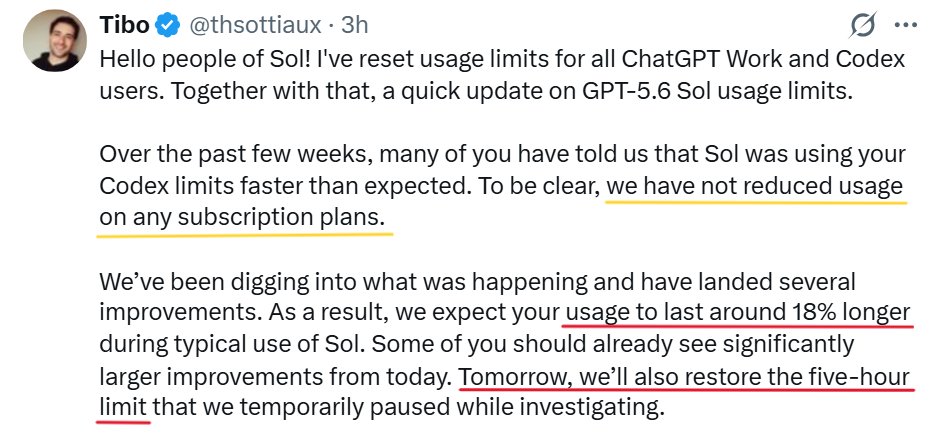
Discussion insight: @TimJayas framed (27 likes, 11 replies, 1,786 views) the same-day Codex reset as an 18% usage improvement, but the replies were more suspicious than celebratory: one user argued the change only returns a fraction of previously lost capacity, another mocked “Yay we are more restricted,” and others asked what the real weekly cap now is. The strongest pattern was not blind loyalty to one model vendor; it was distrust of opaque quota math.
Comparison to prior day: July 28's Copilot conversation was led by model availability — especially Grok 4.5 landing in Copilot. July 29 kept Copilot and Codex central, but the center of gravity moved to cost, limits, and enterprise purchasing.
1.2 Google's agent stack kept widening beyond demo apps 🡒
Google and Antigravity stayed highly visible, but the emphasis shifted from pure UI tricks toward real workflows and bundle breadth. Three retained items supported the theme: an Antigravity research-evals thread, Google's Farm Brain deployment story, and a widely bookmarked rundown of Google's free AI tool stack.
@antigravity showed (376 likes, 14 replies, 18,155 views, 125 bookmarks) Antigravity being used for research-eval analysis, where the system analyzes tables in natural language, proposes hypotheses, and spins up parallel subagents to isolate failure modes. That is a more operational pitch than yesterday's canvas-to-UI demo: the value proposition is replacing manual eval scripts and table parsing with a repeatable analysis workflow. The strongest reply came from a paying user who asked for mobile task handoff and BYOK model support because the native Opus option is still on 4.6.
@Google showed (353 likes, 51 replies, 121,037 views, 94 bookmarks) Michigan farmer Paul Windemuller's “Farm Brain,” described as a local multi-agent system built with Gemini 3.6 Flash inside Antigravity to automate daily farm-performance tracking. That made the day's Google story harder to dismiss as only marketing for coders: replies focused on the economics of a loop cheap enough to run every morning for a 260-cow farm and on whether models trained on past data stay resilient when markets go sideways.
@AIHighlight listed (133 likes, 11 replies, 9,158 views, 111 bookmarks) 14 Google AI tools spanning design, coding, docs, backend, and content tasks, including Pomelli, Stitch, Opal, Gemini CLI, Code Wiki, Jules, and Antigravity. The post landed because it framed Google's offer as a free stack rather than a single chatbot; Pomelli's Google Labs page confirms at least one of the headline products is real and live.
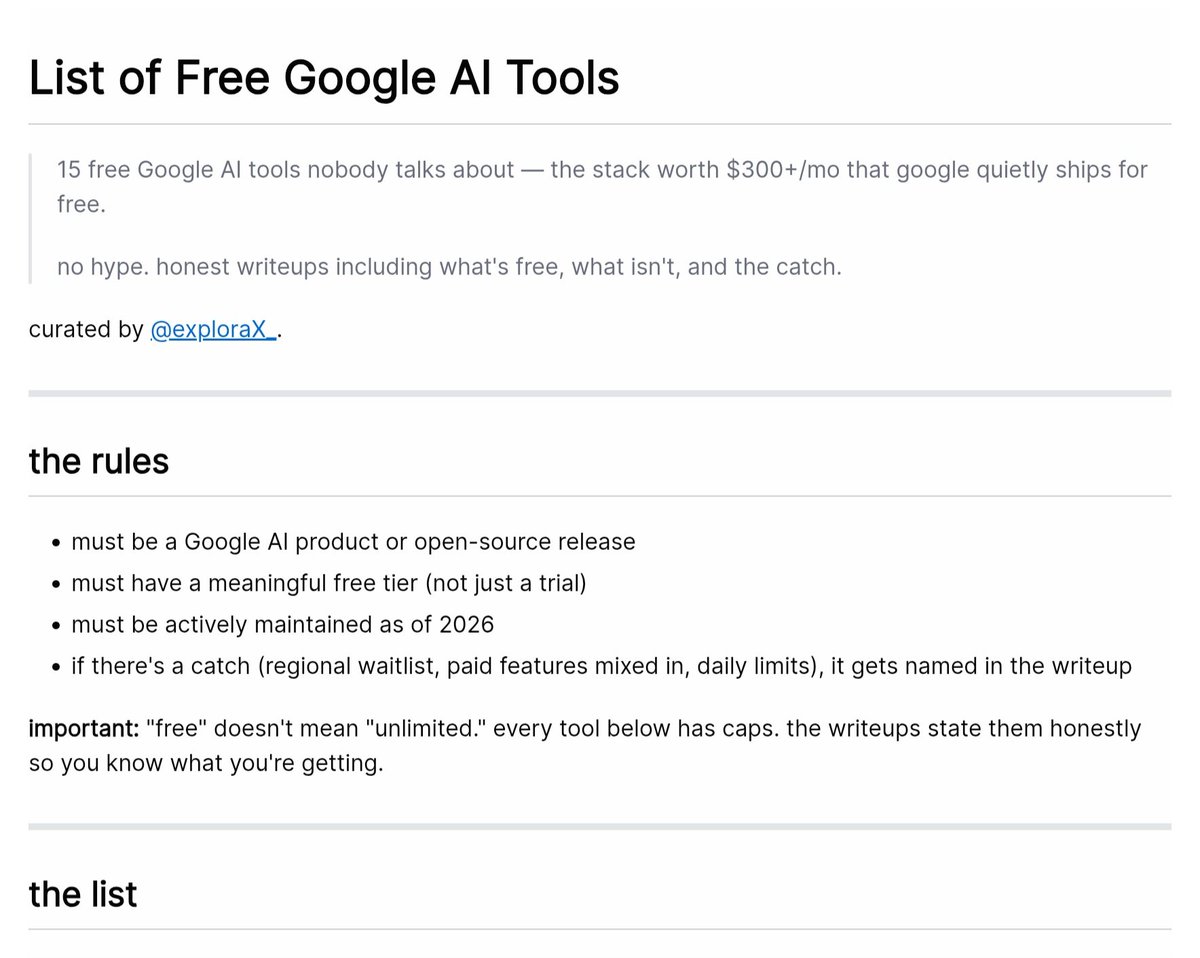
Discussion insight: The pushback was practical, not ideological. Antigravity users asked for phone-to-laptop handoff and newer model access, while free-stack readers asked whether tools like Pomelli are actually good and whether “free” hides real limits elsewhere.
Comparison to prior day: July 28 already had Antigravity demos and Farm Brain in circulation. July 29 broadened that story into research operations and “free stack” distribution, while the same access and model-choice complaints persisted.
1.3 Remote control and agent-native workspaces moved from hacks to products 🡕
Another clear pattern was that people are no longer treating remote-control and multi-agent coordination as side quests. They are turning them into first-class products. Two posts anchored the theme: a long Buzz walkthrough and Theo's launch of T3 Connect.
@rileybrown walked through (146 likes, 12 replies, 12,645 views, 232 bookmarks) Buzz as a free, Slack-like workspace where agents are “equals” rather than add-ons, with Codex and Claude Code subscriptions plugged into shared channels. The post packed in concrete workflow details — adding OpenCode and Cursor, a mobile app, shared compute, automations, and a “management channel” use case — and the bookmark count suggests readers were saving it as a playbook, not just reacting to the idea.
@theo launched (319 likes, 31 replies, 29,820 views, 103 bookmarks) T3 Connect as a minimal open-source tunnel layer for remotely controlling T3 Code instances without first setting up Tailscale. The main thread promises a four-step flow — install your coding harness, run npx t3 connect, sign in, and control that computer from web, desktop, or a coming mobile app — while the first reply points to app.t3.codes for account-linked control.
Discussion insight: The most useful replies were not cheerleading. Under the Buzz walkthrough, one user asked how the product prevents two agents from editing the same files at once, while another warned that most agent demos collapse when they need real context or memory across steps. Under Theo's thread, the repeated reaction was simpler: “no more Tailscale side quest,” followed immediately by requests for the promised mobile app.
Comparison to prior day: July 27 and July 28 already had many-session and many-agent demos. July 29 pushed the conversation one level down into the control plane itself: shared channels, remote tunnels, and device handoff.
1.4 Skills, customizations, and observability became the harness layer 🡕
The day also produced unusually concrete evidence that the new differentiation layer sits around the model: reusable skills, review-time context, spend telemetry, and packaged Copilot setups. Community examples and official GitHub surfaces both pointed in the same direction.
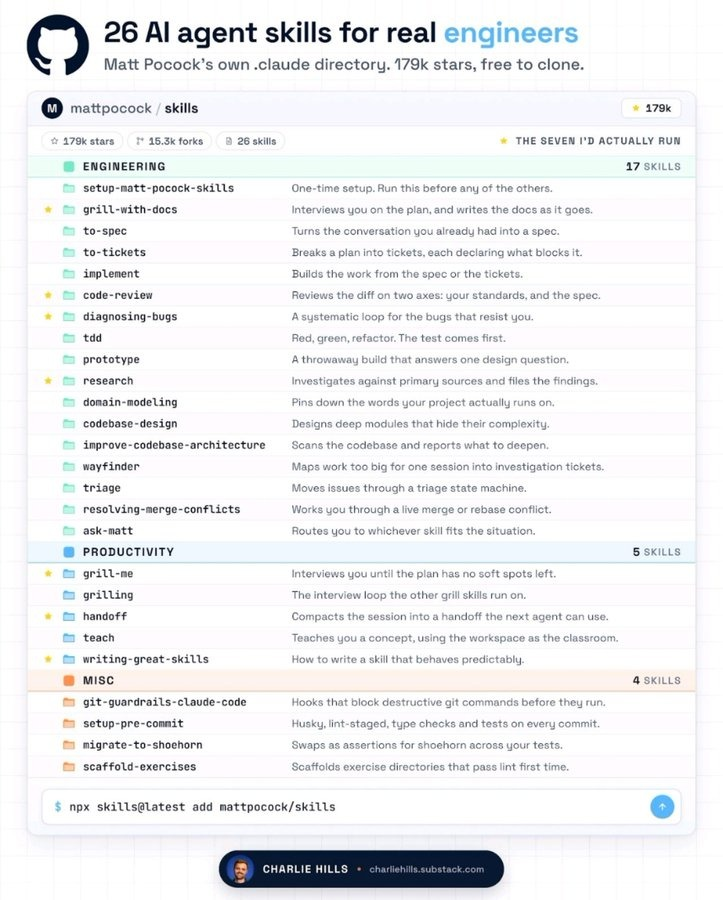
@RoundtableSpace amplified (17 likes, 11 replies, 14,115 views) Matt Pocock's mattpocock/skills repo as a full AI-coding workflow with 26 production-ready skills. The image matters because it shows the actual structure: engineering skills like to-spec, implement, code-review, diagnosing-bugs, and wayfinder, plus productivity and misc layers, all installable with npx skills@latest add mattpocock/skills. GitHub's repo API currently shows mattpocock/skills at 194,783 stars, and the README explicitly positions the pack as small composable skills rather than a giant process framework.
@GHchangelog reported (5 likes, 440 views) that Copilot code review now generally supports agent skills and MCP servers. The linked GitHub changelog says repositories can add .github/skills/.../SKILL.md context, MCP calls are read-only in review, existing cloud-agent MCP configuration carries over automatically, and review comments now attribute when skills or MCP context were used.
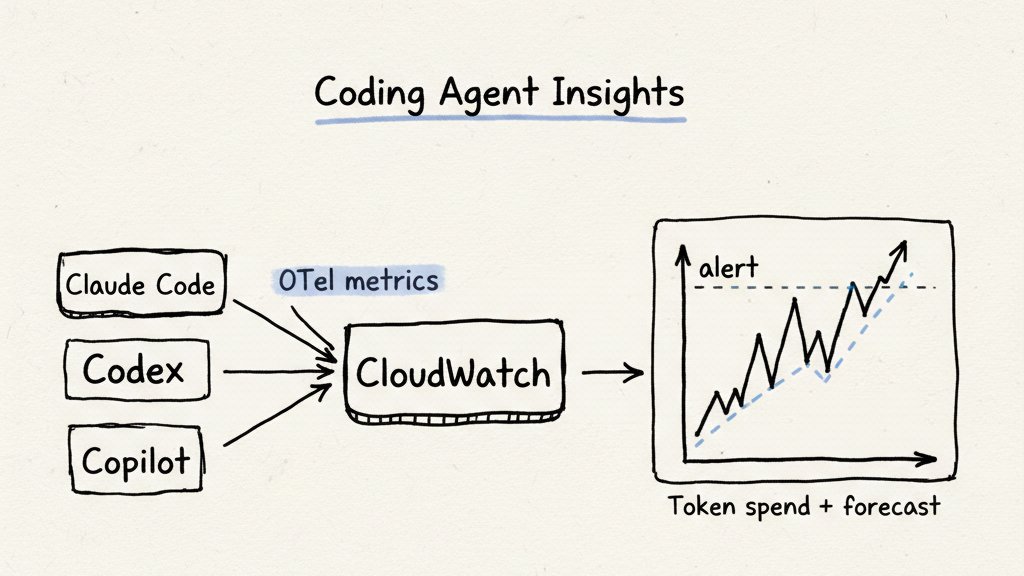
@tpschmidt_ showed (1 like, 3 replies, 541 views, 4 bookmarks) AWS CloudWatch “Coding Agent Insights,” which uses OpenTelemetry from Claude Code, Codex, and Copilot to track spend and forecast token burn. @DanKornas separately highlighted (4 likes, 2 replies, 912 views) a community-built “Awesome GitHub Copilot Customizations” directory that breaks Copilot setup into custom instructions, reusable prompts, and custom chat modes.
Discussion insight: Skills do not remove portability problems by themselves. A reply under the Matt Pocock thread said a similar skill set ran “clean” in a Flutter codebase while quietly producing wrong results because of baked-in Next.js assumptions — a stronger warning than generic anti-hype talk because it names the failure mode.
Comparison to prior day: Earlier in the week, “skills” mostly appeared as marketplaces, tips, and cache-related advice. July 29 moved the idea into durable artifacts: a giant public skills repo, first-party GitHub review support, spend telemetry, and reusable Copilot configuration bundles.
2. What Frustrates People
Opaque meter math and quota distrust
Severity: High. The most consistent frustration was not that models are expensive in the abstract, but that developers still do not know what a real session will cost until after they have burned the tokens. @forgebitz summed it up (72 likes, 19 replies, 2,057 views) with “your view on vibe coding really changes once you are on api pricing,” and the replies immediately filled in the lived examples: one user reported a €599 Gemini bill, another said API pricing is the only way to “see clearly,” and another described manually routing prompts to different models through a Codex plugin.
@TimJayas celebrated (27 likes, 11 replies, 1,786 views) OpenAI's claim of roughly 18% longer Sol usage, but the replies treated the screenshot more like a trust-repair attempt than a win. One user said the fix still left Sol impossible to use for a full five hours, another argued users were just getting back a slice of what they had already lost, and a third asked what the hidden weekly cap actually is. A lower-reach but unusually concrete post from @notjazii claimed (6 likes, 4 replies, 202 views) that the same K3 model used roughly 61k tokens in Kimi Code, 67k in Hermes, and 340k in Claude Code for a median task; it is only one screenshot, but it matches the day's broader fear that harness overhead can dominate model cost.
People are coping with routers, cheaper models, and telemetry add-ons instead of trusting the default meter. This is worth building for because the pain is operational, recurrent, and attached directly to purchasing behavior: the same day developers argued about quotas, Disney was reported to be replacing Copilot with Codex.
Quietly wrong outputs and silent workflow failures
Severity: High. Practitioners kept drawing the trust boundary in the same place: AI is useful, but only under active human review. @NateSilver538 wrote (229 likes, 21 replies, 33,994 views) that AI tools are very helpful with relevant domain knowledge in the loop, but would likely produce “extremely buggy models” without a human expert. His replies added concrete failure modes rather than generic fear — one user said Claude forgot basic context and mangled chart text, another described nonsense math in a simulation workflow.
The same complaint showed up in the skills layer. A reply under @RoundtableSpace sharing Matt Pocock's skills pack said a similar setup ran clean in a Flutter codebase while silently producing wrong outputs because the skills assumed a Next.js-style project structure. @onderceylan built SHIP explicitly because “coding agents are getting faster” while “software quality is getting out of control,” arguing that review, testing, and cost gates have not kept pace with generation speed.
The workaround today is more harness, not more faith: reusable specs, review skills, QA gates, security scans, and human approvals. This is worth building for because the failures are often silent; they pass the command line and still miss the real requirement.
Remote continuity is still brittle enough to create new tooling
Severity: Medium. The replies under remote-control products showed that “work from anywhere” is still fragile in agentic coding. @theo launched (319 likes, 31 replies, 29,820 views, 103 bookmarks) T3 Connect specifically to eliminate the Tailscale and public-IP setup burden, and the most enthusiastic reactions were simply relief that the side quest might disappear. At the same time, the thread's next question was “How do I get that mobile app?” — a sign that remote access is still incomplete.
A paying reply under @antigravity showing (376 likes, 14 replies, 18,155 views, 125 bookmarks) research-eval analysis asked for the same missing feature from the other side: let users send tasks from a phone to agents running on a host laptop, and let them bring newer models through BYOK. @ryanvogel described (2 likes, 1 reply, 927 views, 5 bookmarks) a workaround built on Coast and Hark that reconstructs what he worked on from screen recordings and sends a morning summary site, which is useful precisely because session continuity is still too easy to lose.
This is worth building for because people are already assembling partial fixes — tunnels, local-memory tools, morning summaries, phone handoff requests — instead of getting end-to-end continuity from the main coding products.
3. What People Wish Existed
Predictable agent budgets and harness-level cost controls
This was the clearest practical need of the day. @forgebitz argued (72 likes, 19 replies, 2,057 views) that API pricing changes how you see “vibe coding” at all, while @TimJayas shared (27 likes, 11 replies, 1,786 views) a screenshot of OpenAI trying to reassure users that Sol now lasts roughly 18% longer. Neither post reads like satisfaction. They read like people wanting a control plane that tells them, before they start, what a task is likely to cost and when a harness is wasting tokens.
Partial answers exist. @tpschmidt_ showed (1 like, 3 replies, 541 views, 4 bookmarks) CloudWatch spend tracking, and a reply under @forgebitz saying (72 likes, 19 replies, 2,057 views) described a manual router plugin that picks models case by case. Opportunity: Direct. The unmet need is a budgeting and routing layer that sits above vendors and harnesses, not another isolated pricing dashboard.
Mobile handoff, remote control, and memory that survives devices
This was also a direct need, and users stated it plainly. A paying user replying under @antigravity showing (376 likes, 14 replies, 18,155 views, 125 bookmarks) research-eval analysis asked for a mobile app that can send tasks to agents running on a host laptop, explicitly comparing the gap to Cursor and Claude. @theo showed (319 likes, 31 replies, 29,820 views, 103 bookmarks) that T3 Connect already solves part of the problem with remote control over the web, but the first follow-up question was still how to get the mobile app.
@ryanvogel showed (2 likes, 1 reply, 927 views, 5 bookmarks) another slice of the same need: use Coast to remember what happened across screen recordings, then generate a morning recap. Opportunity: Direct. People do not just want a remote terminal; they want continuity across phone, laptop, and yesterday's work.
Reusable team skills that understand the local stack
The day's skills enthusiasm came with a built-in warning. @RoundtableSpace amplified (17 likes, 11 replies, 14,115 views) Matt Pocock's 26-skill repo, and @GHchangelog confirmed (5 likes, 440 views) that GitHub now supports review-time skills and MCP context as a first-party feature. But the most useful reply under the Matt Pocock post said similar skills quietly misfired in a Flutter codebase because they assumed a Next.js project.
@DanKornas framed (4 likes, 2 replies, 912 views) the same problem from the Copilot side: teams want reusable instructions, prompts, chat modes, hooks, and workflows instead of rebuilding setup from scratch. Opportunity: Competitive. Partial solutions already exist, but the gap is a portable skill/config layer that checks whether its assumptions match the repo before it starts acting.
4. Tools and Methods in Use
| Tool | Category | Sentiment | Strengths | Limitations |
|---|---|---|---|---|
| GPT-5.6 Sol / Codex | LLM + coding agent | (+/-) | OpenAI says Sol improved Codex serving cost and token-generation efficiency; enterprise buyers are testing it seriously; Codex Security extends the stack into repo scanning | Users still distrust quota math, hidden weekly caps, and harness-level token burn |
| GitHub Copilot | Agent platform | (+/-) | 50 million users, strong enterprise scale, stacked-PR/app momentum, first-party review-time skills and MCP support | One reported enterprise defection, complaints about complex output, fragmented customization surface |
| Antigravity | Agent workspace | (+/-) | Research-eval analysis, real-world Farm Brain deployment, adjacency to Google's broader free tool stack | Users want mobile handoff, BYOK, newer model access, and stronger trust on harder work |
| Buzz | Multi-agent workspace | (+) | Agent-native channels, shared compute, works with existing Codex and Claude Code subscriptions | Open questions about file-collision handling and long-run context durability |
| T3 Connect / T3 Code | Remote-control harness | (+) | One-command remote control, no Tailscale prerequisite, web endpoint for linked instances | Mobile still pending; Theo says free status may change if tunnel bills rise |
| mattpocock/skills | Skill pack / harness layer | (+/-) | 26 composable skills, huge repo adoption, installable with npx skills@latest add or plugin flow |
Can silently misfit repositories whose stack assumptions differ |
| Copilot custom instructions / prompts / chat modes | Agent configuration | (+) | Reusable guidance, task-specific prompts, role-specific workflows, better repo consistency | Still fragmented across surfaces; third-party assets need inspection before trust |
| AWS CloudWatch Coding Agent Insights | Observability | (+) | Per-agent and per-model spend tracking, alerts, forecasted token burn, correlation with delivery metrics | Requires OpenTelemetry-producing agents or gateway support |
| Codex Security CLI | Security tool | (+) | Bulk repository scans, finding validation, suggested fixes, export/CI path, 5k+ GitHub stars | Public 0.1.x package, API may change, requires Node 22+ and Python 3.10+ |
| Coast | Local memory | (+) | Fully local memory for what you've seen, privacy-first positioning, practical recall workflows | Evidence today came from one workflow example, not a broad user base |
| SHIP | Engineering orchestration | (+) | Takes Linear tickets through planning, coding, review, ops, testing, and cost/time reporting | Closed beta; still looking for design partners |
Overall, satisfaction splits less by raw model brand than by how much harness overhead a tool adds or removes. @wallstengine reported (60 likes, 6 replies, 17,167 views) that Disney will replace Copilot with Codex while keeping Claude Enterprise and Cursor, which is the cleanest migration signal in the dataset: teams are not choosing one permanent winner, they are keeping optionality and swapping whichever layer feels weakest. @wallstengine also reported (60 likes, 13,654 views) Copilot's 50 million-user scale, so the market is simultaneously consolidating around big platforms and testing substitutes inside them.
The day's workarounds were also revealing. @theo built (319 likes, 31 replies, 29,820 views, 103 bookmarks) around remote-access friction instead of waiting for it to disappear, @tpschmidt_ built (1 like, 3 replies, 541 views, 4 bookmarks) around spend opacity, and @onderceylan built (7 likes, 1 reply, 457 views) around review/test governance. Even the skills wave is competitive rather than settled: @RoundtableSpace amplified (17 likes, 11 replies, 14,115 views) a massive public skills repo, while @GHchangelog confirmed (5 likes, 440 views) that GitHub is pulling skills and MCP into first-party code review.
5. What People Are Building
| Project | Who built it | What it does | Problem it solves | Stack | Stage | Links |
|---|---|---|---|---|---|---|
| Buzz | @hot_town | Agent-native workspace where agents sit in channels as first-class participants | Coordinating multi-agent work without forcing teams to abandon Codex or Claude Code subscriptions | Buzz, Codex, Claude Code, OpenCode, Cursor, OpenRouter/Muse, iOS app | Beta | walkthrough, video |
| T3 Connect | @theo | Remote-control tunnel for T3 Code instances on any internet-connected box | Removes Tailscale/public-IP setup friction for remote coding sessions | T3 Code, app.t3.codes, Cloudflare-backed tunnel layer | Beta | launch tweet, app |
| mattpocock/skills | Matt Pocock | 26 reusable engineering and productivity skills for coding agents | Gives agents repeatable planning, review, debugging, and handoff workflows instead of one-off prompts | Shell/Markdown skills, Claude Code plugin, skills.sh installer | Shipped | repo, skills.sh |
| Codex Security CLI | OpenAI | CLI and TypeScript SDK that scans repos, validates findings, and proposes fixes | Adds security review and CI-ready scanning to agentic coding workflows | TypeScript, Node 22+, Python 3.10+, Codex runtime | Beta | repo, docs |
| SHIP | @onderceylan | Agentic engineering platform that pushes Linear tickets through planning, coding, review, ops, and testing | Restores quality gates and cost visibility as coding agents speed up delivery | Linear, GitHub PRs, autonomous CI/test/review gates, multi-provider model support | Beta | launch tweet |
| Coast recap workflow | @ryanvogel | Uses Coast CLI over screen recordings, then Hark to generate a morning summary site | Helps developers recover what they worked on across sessions and days | Coast, opencode, Hark, local screen recordings | Alpha | tweet, Coast |
@rileybrown showed (146 likes, 12 replies, 12,645 views, 232 bookmarks) Buzz as a serious multi-agent operating surface rather than a toy collaboration layer: agent channels, shared compute, model mixing, and a manager-view workflow. The best reply was also the hardest question — how does the product stop two agents from changing the same files at once — which is exactly the kind of systems problem a real shared workspace has to solve.
@theo showed (319 likes, 31 replies, 29,820 views, 103 bookmarks) that T3 Connect is not a speculative idea but a usable remote-control path available now, free for up to three devices. The replies made its value crisp: less interest in tunnel architecture than in the fact that people might finally skip the Tailscale setup loop.
@RoundtableSpace shared (17 likes, 11 replies, 14,115 views) Matt Pocock's skills repo, whose current GitHub metadata shows 194,783 stars and whose README describes a lightweight alternative to process-heavy frameworks. @onderceylan launched (7 likes, 1 reply, 457 views) SHIP from the opposite angle: not more prompt craft, but an orchestration layer that keeps planning, review, testing, ops, and spend visible as tickets move through the SDLC.

Security and memory were the other two notable builder directions. Cointelegraph reported (42 likes, 25 replies, 22,007 views) that Codex Security CLI had arrived as an open-source scanning tool, and the public README says it is designed to find, validate, and fix vulnerabilities. @ryanvogel showed (2 likes, 1 reply, 927 views, 5 bookmarks) a smaller but revealing pattern: developers are already building their own memory infrastructure around existing agents instead of waiting for the core products to remember enough on their own.
Repeated build patterns were clear: remote-control wrappers around existing harnesses, repo-aware skill packs, governance layers above multi-provider agents, and recall systems that persist across sessions. The common trigger was not “we need a new model.” It was “we need the surrounding system to be less brittle.”
6. New and Notable
Skills and MCP reached first-party Copilot code review
@GHchangelog reported (5 likes, 440 views) that Copilot code review now generally supports repository skills and MCP servers. The linked GitHub changelog makes the release notable because it is not just “more context”: reviews can use .github/skills/.../SKILL.md, MCP calls are read-only, existing cloud-agent MCP config carries over, and generated comments now disclose when skills or MCP context were involved.
Codex Security made security scanning part of the coding-agent stack
Cointelegraph reported (42 likes, 25 replies, 22,007 views) the release of Codex Security CLI, and the public Codex Security docs say it is built to find, confirm, and fix vulnerabilities, store findings for review, and export results for CI. What made it stand out on this date was the shift in framing: security work was presented as a normal companion to coding agents, not a separate specialist workflow.
Farm Brain was a rare non-software deployment that still mattered to AI-coding readers
@Google showed (353 likes, 51 replies, 121,037 views, 94 bookmarks) a local multi-agent system for dairy-farm performance tracking built with Gemini 3.6 Flash inside Antigravity. It mattered because it translated the usual “agentic workflow” language into a concrete daily operations loop outside software, which replies immediately recognized as a cost and reliability story rather than just a novelty demo.
7. Where the Opportunities Are
[+++] Cost-control plane for agentic coding — Evidence showed up everywhere: @forgebitz said (72 likes, 19 replies, 2,057 views) that API pricing changes the whole vibe-coding equation, @TimJayas circulated (27 likes, 11 replies, 1,786 views) OpenAI's 18%-longer-usage screenshot to a skeptical audience, @tpschmidt_ showed (1 like, 3 replies, 541 views, 4 bookmarks) CloudWatch spend telemetry, and @wallstengine reported (60 likes, 6 replies, 17,167 views) Disney's switch to Codex. The strong opportunity is a vendor-neutral layer that predicts cost, routes work, and exposes waste before a session starts.
[+++] Review and governance harnesses above the model — Nate Silver's warning about buggy outputs, the Flutter/Next.js mismatch under Matt Pocock's skills thread, SHIP's quality-gate pitch, and Codex Security's scan-and-fix workflow all point to the same gap. The market is rewarding systems that add review, validation, security, and auditability around existing models rather than trying to replace those models.
[++] Remote, mobile, and memory continuity — Buzz, T3 Connect, Antigravity mobile-handoff requests, and Coast's local-memory recap workflow all point to a practical hole between “the agent worked once” and “the agent is part of my day.” A durable cross-device control plane with memory that survives sleep, travel, and tab closure has clear demand and only partial solutions today.
[+] Portable skill packs with stack-awareness — Reusable skills and Copilot customizations clearly have adoption, but the sharpest reply in the dataset said the same skills could silently fail when their framework assumptions were wrong. That makes compatibility-checking, repo introspection, and assumption validation an emerging but real product surface.
8. Takeaways
- Cost has become a user-facing feature, not just backend plumbing. @OpenAIDevs said (881 likes, 53 replies, 44,085 views, 73 bookmarks) that Codex got cheaper and more efficient, and the replies still asked whether users would actually feel the savings in quota or latency.
- Enterprise AI-coding stacks are still fluid even at large scale. Business Insider reported Disney's move from Copilot to Codex while @wallstengine reported (60 likes, 13,654 views) that Copilot still reached 50 million users.
- Google's agent narrative is broadening from flashy demos to workflow and operations stories. @antigravity showed (376 likes, 14 replies, 18,155 views, 125 bookmarks) a research-eval workflow, while @Google showed (353 likes, 51 replies, 121,037 views, 94 bookmarks) Farm Brain as a daily operations loop.
- The real product battle is shifting toward the harness layer. @theo launched (319 likes, 31 replies, 29,820 views, 103 bookmarks) remote control for T3 Code, and @RoundtableSpace shared (17 likes, 11 replies, 14,115 views) a reusable skills repo with 26 agent workflows.
- Human review is still the hard trust boundary. @NateSilver538 wrote (229 likes, 21 replies, 33,994 views, 23 bookmarks) that AI tools help when domain expertise is in the loop, but would otherwise produce “extremely buggy models.”