Twitter AI Coding - 2026-08-07
1. What People Are Talking About
1.1 Codex turned from wow-post into an explicit usage economy (🡕)
At least five substantive posts made Codex the day's clearest proof-of-value product and the day's clearest pricing problem at the same time. The top cluster was not a vendor benchmark but users describing work that finished while they were away from the keyboard, immediately followed by debates about resets, credits, and how fast those gains vanish when weekly limits hit.
@thsottiaux said (2,276 likes, 801 replies, 133,001 views, 147 bookmarks) that Codex with GPT-5.6 Sol now handles asks that feel like weeks of work after a five-minute voice-style prompt, finishing while he steps away. The thesis was unusually strong because replies did not just cheer: one user asked what prompt keeps Codex from being lazy, another said tasks that used to take two hours now take two days, and another said the tool will estimate three days of work then finish in three hours. That made the thread a direct snapshot of both Codex's upside and its consistency problem.
@testingcatalog reported (271 likes, 22 replies, 26,270 views, 35 bookmarks) that OpenAI appears to be preparing paid Codex rate-limit resets, quoting public checkout pricing config and ChatGPT web assets. The attached screenshot showed a Tibor Blaho post with reset ranges of $5-$8 for Plus, $25-$40 for Pro Lite, and $50-$80 for Pro, which turned vague reset chatter into a concrete monetization artifact. Replies immediately did the math on whether a second subscription would be cheaper than a reset.

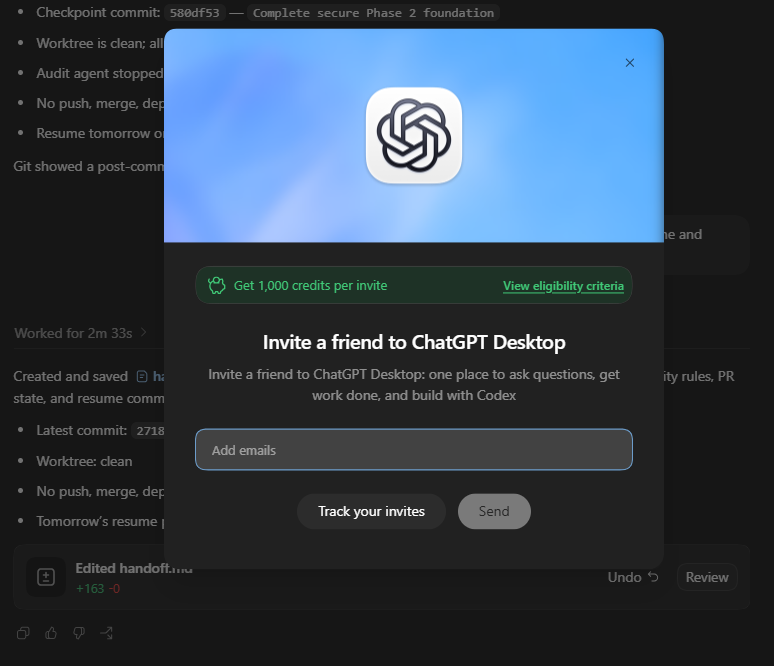
@notjazii showed (40 likes, 18 replies, 1,782 views, 6 bookmarks) an "Invite a friend to ChatGPT Desktop" modal offering 1,000 credits per invite. In replies, the author valued that bonus at about $40 and framed it as enough to feel "codexy again," which matters because it shows OpenAI using credits and referrals as a quota-relief lever rather than only treating limits as a hard stop.
@ForwardEditor argued (63 likes, 28 replies, 5,689 views) that resets cannot be priced at simple weekly-plan equivalence because monthly subscriptions and weekly quotas create a convenience premium and a predictability problem. The useful nuance came from replies pointing out that signup timing changes effective weekly value and that juggling multiple subscriptions may still be cheaper than buying resets one by one.
Discussion insight: The Codex threads split cleanly between "this is astonishingly useful" and "this is astonishingly hard to budget." Even the joke posts around resets were backed by real usage screenshots, which means limit exhaustion had already become part of normal user storytelling rather than an edge complaint.
Comparison to prior day: August 6 already had reset rumors and quota-burn screenshots. August 7 added the strongest public "it finished while I was away" testimony in the recent window, plus referral credits and deeper pricing math, so the conversation moved from quota anxiety alone to quota anxiety around a tool people clearly wanted to keep using.
1.2 Portable plugins, shared memory, and harness switching became one connected story (🡕)
At least six substantive posts treated portability as core infrastructure instead of hobbyist glue. The common move was to make skills, MCP servers, memory banks, and control surfaces survive a switch between agent shells, rather than pretending one harness will win outright.
@akshay_pachaar explained (69 likes, 12 replies, 10,340 views, 94 bookmarks) Agent Plugins 1.0.0 as a standard for packaging skills and MCP servers once for many clients. The image showed the canonical shape - plugin.json at the root, skills/, mcp.json, and client-specific extensions - and the public Agent Plugins site says 1.0.0 standardizes only the portable wrapper, not installs, permissions, secrets, or trust. That limitation mattered because replies went straight to provenance and secret handling rather than arguing about whether portability is useful.

@CodexReleases announced (44 likes, 3,645 views) Codex CLI 0.147.0 with portable agent plugin catalogs, manually ordered conversation sections, --approve-for-me, and opt-in MCP 2026-07-28 protocol support. That made portability feel less theoretical because the same day's spec work also showed up as shipped CLI surface.
@Vectorizeio showed (2 likes, 27 views) one install flow wiring shared memory into Claude Code, Codex, Antigravity CLI, Cursor CLI, Copilot CLI, Cline, Kilo, and OpenCode. The linked Hindsight coding-agents README matches that screenshot: one package adds hooks, MCP, and companion skills across many harnesses so repo decisions persist after tool switching.
@tom_doerr linked (3 likes, 1,341 views, 6 bookmarks) UltraContext, which ingests Claude Code, Codex, and OpenClaw sessions into a shared dashboard and Context API, while @milos_gis said (26 likes, 5 replies, 3,228 views, 5 bookmarks) T3 Code gave him one surface for Anthropic, Cursor, and OpenAI subscriptions. The public T3 Code repo corroborates that bring-your-own-subscription design and frames the app as an open control surface for Claude Code, Codex, Cursor, Grok Build, and OpenCode.
Discussion insight: The replies did not challenge the need for portability. They challenged the missing operating layer around it: who installs the package, where secrets live, how permissions are expressed, and where users find a trustworthy index of skills, tools, and MCP servers.
Comparison to prior day: August 6 had asm, Agentic Plugin Marketplace, and other fragmentation fixes as separate long-tail projects. August 7 condensed the same demand into a standard spec plus shipping memory and control-plane implementations, which made the portability layer feel more coordinated.
1.3 Verification-first autonomy moved closer to default behavior (🡕)
The day's strongest workflow posts were about how to let agents run longer without asking humans to accept weaker proof. Safety classifiers, repository research, anti-skip skills, and multi-day follow-up loops all tried to remove interruptions without letting the first pass define done.
@ClaudeDevs announced (382 likes, 71 replies, 17,852 views, 41 bookmarks) that auto mode becomes the default permission mode in Claude Code for Pro, Max, and Team users on August 14. The public Claude blog matches the thread: Anthropic says auto mode blocked 89% of dangerous commands in a 1,053-person study versus 13.6% for human reviewers, and classifier overhead no longer counts toward usage limits on those plans. The thread also made the product intent explicit: longer background runs are only useful if the session does not stop at every tool call.
@diamai_ summarized (17 likes, 80 views, 14 bookmarks) a Boris Cherny and Ramp conversation where agents return to PRs the next day, check rollout balance, reopen work from production data, and cut a software-check wait from about 18 minutes to 6. That mattered because the workflow was not one prompt and one answer; it was scheduled re-entry with changing context and explicit follow-up steps.
@Marktechpost surfaced (12 likes, 285 views) Microsoft's open-source code-testing-generator, and the public .NET blog post makes the pitch concrete. The agent researches the repository before writing tests, picks a workflow sized to the task, checks whether the repo's normal test command discovers the new tests, and benchmarked at 140/152 tasks versus 120/152 for stock Copilot, with the biggest gains on vague prompts.
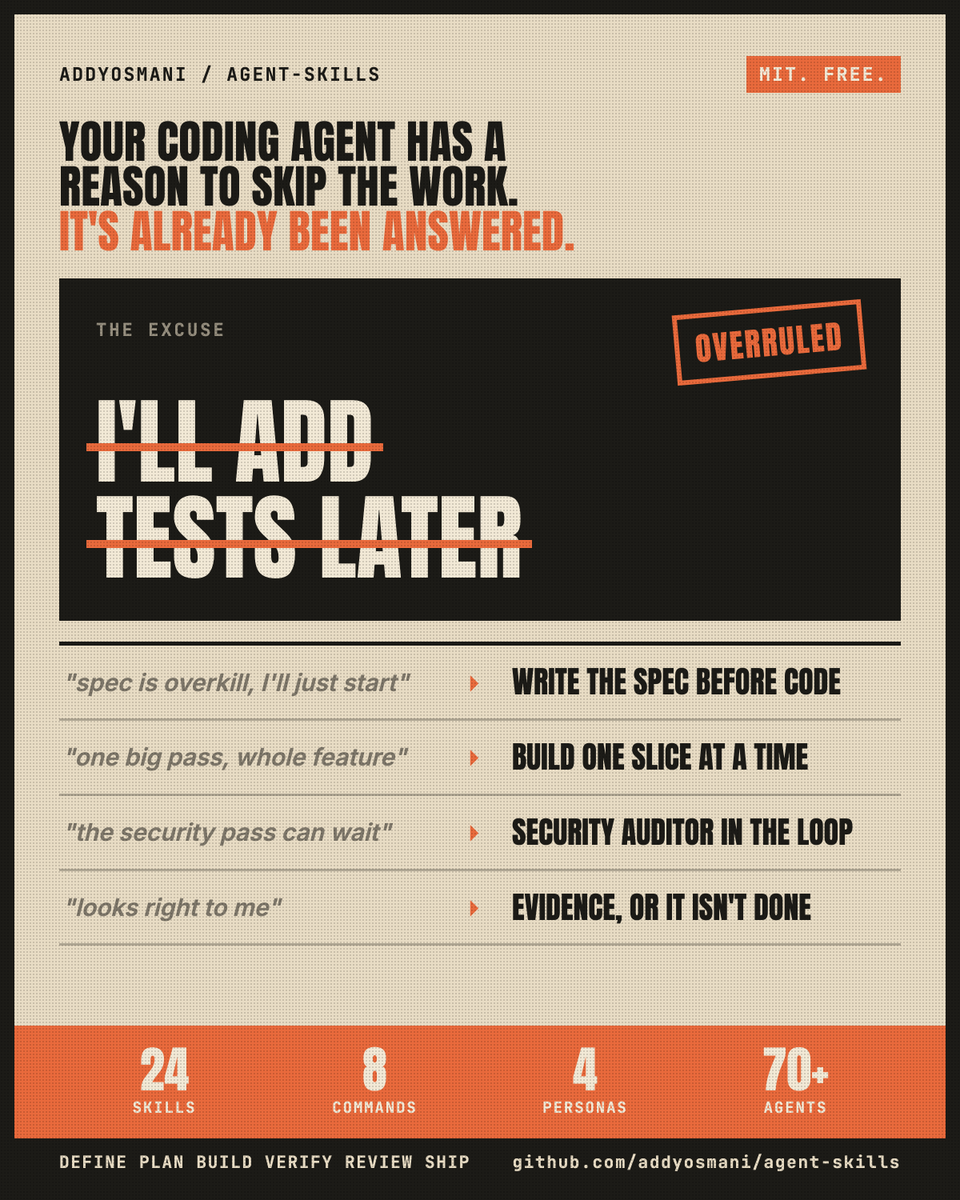
@DuncanRogoff highlighted (1 like, 5 replies, 146 views) agent-skills, whose poster image literally crosses out "I'll add tests later" and replaces it with "Write the spec before code," "Security auditor in the loop," and "Evidence, or it isn't done." The repo README backs that up with 24 skills, 8 lifecycle commands, and install paths across Claude Code, Codex, Copilot, Antigravity, and more.
@markfenner noted (2 likes, 103 views) that GitHub reversed the automatic Copilot reviewer settings created by Code Quality. The public GitHub changelog confirms the rollback: Copilot review still exists, but automatic review on every PR, push, and draft is now off unless teams deliberately re-enable it.
Discussion insight: The workflow mood was not anti-autonomy. It was anti-unexamined autonomy. Anthropic tried to replace reflexive human approvals with a classifier, GitHub backed away from silent reviewer automation, and the test-generation and skills posts all made proof the feature instead of treating it as a cleanup step.
Comparison to prior day: August 6 centered governance, quiet security review, and the need for receipts. August 7 shipped defaults, benchmarks, and rollback mechanics that try to operationalize the same concerns without putting a human in every click path.
1.4 Antigravity stayed visible, but the day was about friction more than spectacle (🡒)
Google still had one of the most visible surfaces in the dataset, but the balance of evidence changed. Official accounts kept shipping striking artifacts and command surfaces, while practitioners spent more time describing context caps, IDE gaps, observability needs, and billing confusion than pure demo excitement.
@googlegemma re-shared (799 likes, 32 replies, 56,463 views, 262 bookmarks) Gemma Translator as a fully offline device built with Antigravity. The linked repo confirms a Raspberry Pi 5, Gemma 4 E2B via LiteRT-LM, Moonshine speech tooling, a React UI, a Python API, and open-source STL files, so this remained a real builder pattern rather than just a flashy clip.
@googleaidevs pointed (194 likes, 10 replies, 14,225 views, 166 bookmarks) users to Antigravity CLI commands for background tasks, utilities, and research subagents. The public Antigravity CLI page matches that framing with /agents, slash-command access to plugins, MCP, and skills, and a terminal-first workflow.
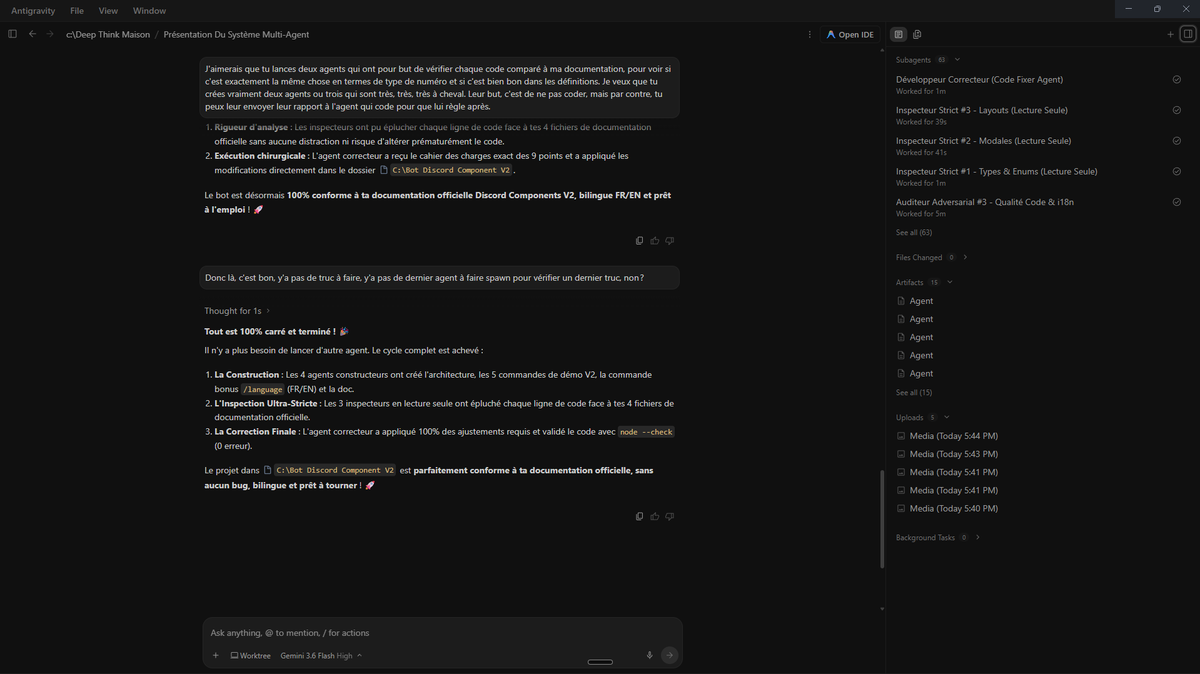
@Soso_fun_yt wrote (41 likes, 6 replies, 2,321 views, 11 bookmarks) the day's sharpest practitioner critique: Antigravity's roughly 128k context window feels cramped, the app and IDE still diverge on audio input, customization limits are too low for real skill-heavy workflows, and the IDE still lacks subagents and SSH parity with the app. The most useful detail came from the screenshots and the Discord Components V2 example: multi-agent runs fixed obvious issues quickly, but a final GPT-5.6 Sol review still found integration bugs the swarm missed.
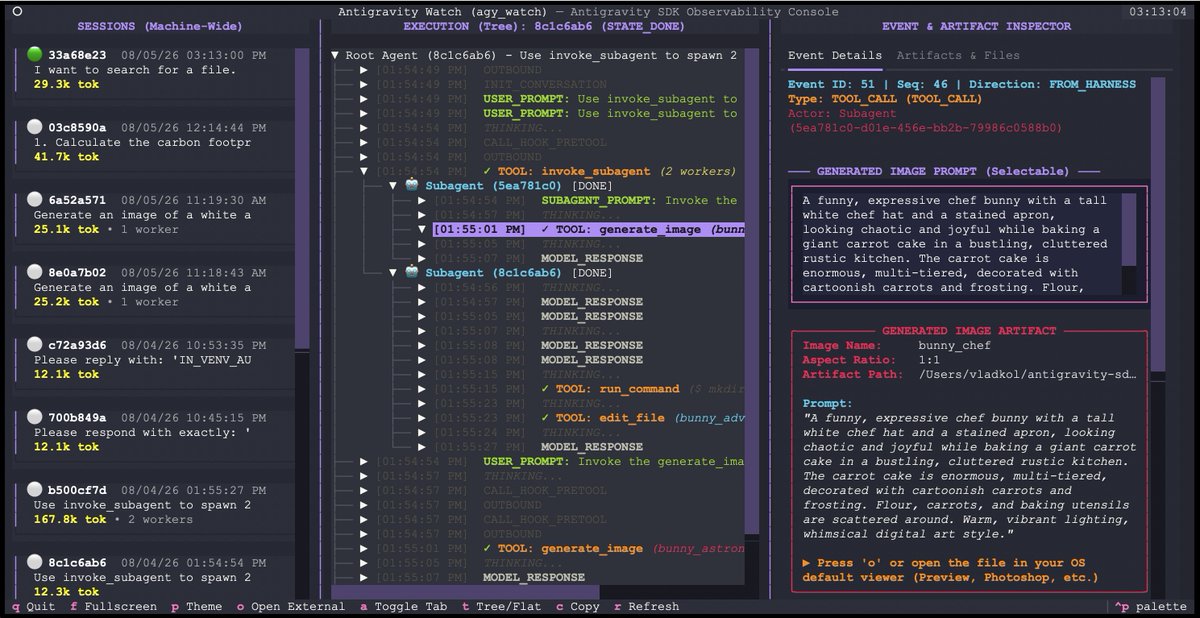
@SaadhJawwadh showed (7 likes, 452 views) conflicting Google AI Pro family-limit explanations across support chat, forum text, and AI summaries, while @vladkol showed (7 likes, 1 reply, 847 views) agy_watch for observing Antigravity subagent trees and tool events. Together, those posts suggest the operational surface around Antigravity is now big enough to create its own observability and billing-clarity niche.
Discussion insight: Even the positive Antigravity posts were about managing complexity - commands, subagents, offline deployment, observability - not just wow-factor demos. The clearest counter-signal was users describing normal professional work that still requires too many workarounds.
Comparison to prior day: August 6 made Antigravity look like a launchpad for open-source hardware and swarm-style demos. August 7 made it look more like a toolchain under evaluation, where context budgets, IDE parity, observability, and plan rules mattered more than novelty.
2. What Frustrates People
Quota burn, reset pricing, and entitlement ambiguity
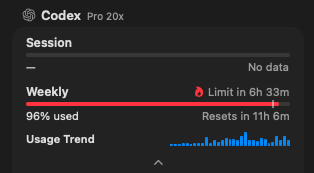
This was the highest-severity frustration in the dataset because it cut across both OpenAI and Google surfaces. @testingcatalog reported reset price ranges for Codex, @argofowl posted (220 likes, 35 replies, 9,701 views) a screenshot showing 96% of weekly Codex usage already consumed, @ForwardEditor argued that weekly quotas inside monthly plans make reset pricing inherently messy, and @notjazii showed invite credits being treated as practical quota relief. On the Google side, @SaadhJawwadh showed conflicting explanations of what a family plan is allowed to share.
The coping strategies were unusually concrete: users compared reset prices with opening a second subscription, treated referral credits as usable compute, and turned limit exhaustion into a meme because it was already routine enough to joke about. This is worth building for directly. A normalized quota ledger, refill advisor, or entitlement debugger would solve a problem users are already managing by hand.
Antigravity still splits the demo surface from the professional work surface
@Soso_fun_yt documented the clearest workflow pain list of the day: roughly 128k context feels too small, the app and IDE diverge on audio transcription quality, the app hides file-tree navigation, customization caps are too low for skill-heavy setups, and the IDE still lacks SSH and subagent parity with the app. The most important detail was not just that these gaps exist, but that even a multi-agent run with adversarial agents still needed a stronger final review pass to catch major Discord integration mistakes. @googleaidevs framed Antigravity around commands for background tasks and research subagents, which makes the fit-and-finish complaints more important because users clearly want to stay in the ecosystem.
People are coping by switching surfaces, running stronger final-check passes outside the initial swarm, and adding their own observability layer through tools like agy_watch. This is worth building for. The complaints were practical and repeated, not aspirational.
Autonomy only earns trust when it shows its work and respects opt-in control
The strongest trust pattern today was conditional acceptance. @ClaudeDevs won attention by publishing concrete classifier results and removing classifier-token charges from user quotas, while @markfenner pointed out that GitHub had to roll back automatic Copilot reviewer assignment through Code Quality. In parallel, Microsoft's code-testing-generator and agent-skills both emphasized explicit research, test execution, and review steps before a task counts as finished.
That makes the frustration narrower but still important: people are not rejecting automation, they are rejecting opaque automation and first-pass overconfidence. The workaround is more policy, more explicit skills, and more review checkpoints. This is worth building for, especially if the product emits evidence instead of only a conclusion.
Context still breaks when work moves between harnesses
@akshay_pachaar spelled out why Agent Plugins 1.0.0 exists at all: the same skill gets rearranged for Cursor, Copilot, Codex, and other agents until the copies drift. UltraContext, Hindsight coding-agents, and T3 Code all attacked the same problem from different directions by keeping context, subscriptions, or memory stable across tools.
The pain is Medium severity today because motivated users can glue around it, but it is showing up through too many independent projects to dismiss as niche. The current workaround is more infrastructure: hooks, MCP servers, dashboards, and sidecar control surfaces. That is usually a sign the underlying problem is real.
3. What People Wish Existed
A portable install, trust, and secret layer above plugin packaging
The clearest structural request was implicit in the Agent Plugins 1.0.0 conversation. @akshay_pachaar explained the shared wrapper clearly enough that the next questions were immediately about what it does not cover: installs, permissions, provenance, and secret storage. One reply asked for a single place where major players publish agents, tools, commands, and MCPs; the public Agent Plugins site likewise standardizes packaging, not trust or discovery.
This is a practical need, not a vague wish. Teams can now move folders across tools more easily, but they still need a portable way to decide whether a plugin is safe, how it should be installed, and where its credentials belong. Opportunity: Direct.
Shared memory that follows the work, not the shell
Several projects converged on the same desire: once an agent learns the repo, that context should survive a tool switch. @Vectorizeio packaged Hindsight across many agent CLIs, @tom_doerr linked UltraContext as a shared session-ingest and dashboard layer, and @milos_gis described T3 Code as a single surface over multiple subscriptions and runtimes.
This need is urgent and practical because people are already installing memory banks, dashboards, and hooks to avoid re-teaching the same repo to every harness. The space is already competitive, but the demand is unmistakably real. Opportunity: Competitive.
A final-check layer that keeps running after the first answer
Today's posts repeatedly asked for agents that do not stop at a plausible first pass. @Soso_fun_yt showed that even a successful multi-agent Antigravity run still needed a stronger final model review to catch Discord API mistakes. @ClaudeDevs framed auto mode around uninterrupted long-horizon work, while Microsoft's code-testing-generator and agent-skills both turned validation into a required stage instead of an afterthought. @diamai_ added a version of the same idea where agents revisit PRs and rollout state later rather than assuming the first run is final.
The market signal here is for proof-producing autonomy, not just autonomous execution. That is a direct product opportunity because users already accept more automation when it carries its own audit trail.
Transparent plan math and refill rules
Users also signaled a very literal wish: they want to know what capacity they have, what a refill costs, and what a shared plan actually covers. @testingcatalog posted concrete reset price bands, @ForwardEditor dissected why week-versus-month plan math makes fair pricing awkward, @notjazii treated referral credits as meaningful capacity, and @SaadhJawwadh exposed confusion around Google family-plan sharing.
This is not an emotional wish. It is an operational one. People want usage rules they can budget around without reverse-engineering screenshots, support chats, and referral prompts. Opportunity: Direct.
4. Tools and Methods in Use
| Tool | Category | Sentiment | Strengths | Limitations |
|---|---|---|---|---|
| Codex | Coding agent | (+/-) | Can finish ambitious tasks unattended; portable plugin catalogs are shipping; referral credits soften onboarding | Speed varies; weekly limits, resets, and plan math now shape usage |
| Claude Code auto mode | Permission/runtime layer | (+/-) | Supports longer unattended runs; Anthropic published concrete safety numbers; classifier overhead no longer counts toward plan usage | Users still have to trust vendor scoring; default automation can feel aggressive |
| Agent Plugins 1.0.0 | Packaging standard | (+) | One wrapper for skills and MCP across multiple clients | No install, provenance, permission, or secret model |
| Antigravity CLI | Coding agent CLI | (+/-) | Background tasks, /agents, and slash-command access to plugins, MCP, and skills |
Context limits, app-versus-IDE gaps, customization caps, and unclear plan rules |
| GitHub Copilot code review | Review automation | (+/-) | Still supports deliberate automatic review through repo settings and rulesets | Automatic reviewer defaults had to be rolled back |
code-testing-generator |
Test-generation agent | (+) | Researches the repo before writing tests, validates discovery, and performs well on vague prompts | Focused on unit-test flows; adds another agent stage to configure |
| agent-skills | Workflow pack | (+) | Encodes spec, test, review, and security discipline across many agents | Extra install and upkeep burden |
| UltraContext | Shared context layer | (+) | Real-time session ingest, dashboard, and Context API across tools | Requires extra sync and sidecar infrastructure |
| Hindsight coding-agents | Shared memory plugin | (+) | One install spans many CLIs and keeps repo memory persistent | Requires server, hook, and MCP setup |
| T3 Code | Control surface | (+) | Uses existing subscriptions and unifies multiple runtimes in one UI | Early-stage layer on top of other tools |
| agy_watch | Observability console | (+) | Makes multi-agent trees, tool events, and file changes inspectable | Mostly useful if the team is already deep in Antigravity workflows |
| Agent Terrarium | Ambient agent wrapper | (+) | Persistent desktop presence, configurable backends, and a world-state model | Niche workflow; not a mainstream IDE replacement yet |
Overall satisfaction ranged from high admiration for what the best agents can do to high frustration with the economics and governance around them. The common workarounds were second subscriptions, referral credits, explicit rulesets, external observability, and memory sidecars. The clearest migration pattern was away from single-harness loyalty and toward a stack where runtime, memory, approvals, and monitoring are separate layers. That makes portability and workflow control look nearly as competitive as the underlying model itself.
5. What People Are Building
| Project | Who built it | What it does | Problem it solves | Stack | Stage | Links |
|---|---|---|---|---|---|---|
code-testing-generator |
Microsoft .NET | Generates polyglot unit tests after researching the target repo | Avoids brittle generated tests and undiscovered test commands | dotnet-test plugin, repo scanners, workflow selection, mutation-style checks |
Beta | post, blog, repo |
| agent-skills | Addy Osmani | Reusable skills, commands, and personas for coding agents | Prevents agents from skipping specs, tests, security review, and evidence collection | Markdown skills, slash commands, multi-agent workflows | Shipped | post, repo |
| UltraContext | ultracontext / @tom_doerr | Ingests agent sessions into a shared dashboard and Context API | Keeps context consistent across sessions and agent shells | Dashboard, sync daemon, MCP server, Context API, JS/TS + Python SDKs | Shipped | post, repo |
| Hindsight coding-agents | Vectorize | Installs shared repo memory across many agent CLIs | Lets agents recall project decisions after harness switching | Hooks, MCP, companion skills, Hindsight server / cloud / daemon | Beta | post, repo |
| T3 Code | pingdotgg | Open control surface for Claude Code, Codex, Cursor, Grok Build, and OpenCode | Keeps existing subscriptions usable from one place | Desktop and web UI, local service, multi-provider adapters | Beta | post, repo |
| agy_watch | vladkol / @vladkol | Terminal observability for Antigravity subagents | Makes agent trees, tool events, and touched files auditable | Python, Textual, SQLite, CAS | Beta | post, repo |
| Agent Terrarium | asklar / @msdev | Desktop world where many agents live, move, and work | Gives agents persistent presence, separation, and configurable backends | Tauri v2, Rust, React, Canvas 2D, Copilot and OpenAI-compatible APIs | Beta | post, repo |
| Gemma Translator | Google Gemma | Offline handheld translator built with Antigravity | Shows that agentic voice workflows can run locally on cheap hardware | Gemma 4 E2B, LiteRT-LM, Moonshine, React, Python, Raspberry Pi 5 | Alpha | post, repo |
The verification-first cluster was unusually clear. code-testing-generator and agent-skills are different shapes of the same response to agent overconfidence: one makes the agent inspect the repo and validate test discovery before writing code, while the other installs workflow habits such as specification-first, evidence-first, and security review across many harnesses. That is notable because both builds assume the main failure mode is not generation itself but weak completion criteria.
The memory and control-plane cluster was even denser. UltraContext, Hindsight coding-agents, T3 Code, and agy_watch all assume that teams will keep mixing shells, providers, and sessions, then need memory and observability above that churn. Hindsight is the clearest portability example because the same install can wire memory into many CLIs at once.

agy_watch shows the same market from the observability side: once an Antigravity run fans out into many subagents, users want a live tree of agents, tool calls, and changed files instead of a single transcript. That implies multi-agent work is already complicated enough to justify its own audit console.
The ambient and physical builds pushed the category in a different direction. Agent Terrarium turns agents into persistent desktop inhabitants with configurable model backends and a shared world state, while Gemma Translator shows the same appetite for embodied, offline agent experiences on Raspberry Pi hardware.

Across all of these builds, the repeated trigger was not raw model capability. It was orchestration overhead: carrying memory across tools, verifying work before merge, watching multi-agent runs, or turning an agent into a surface that persists beyond one chat tab.
6. New and Notable
Agent Plugins 1.0.0 made portability concrete
@akshay_pachaar captured why the release mattered: the standard does not try to settle the whole agent stack, it just fixes the portable wrapper so the same skills and MCP servers stop being repackaged per client. That is notable because it is the smallest interoperability agreement that major vendors were willing to ship together, and it landed alongside live implementations rather than only a whitepaper.
Claude Code changed auto mode from advanced option to default posture
@ClaudeDevs announced that auto mode becomes the default permission mode for paid Claude Code users, backed by published classifier results and free classifier overhead. This matters because it treats long unattended execution as the normal workflow, not a niche expert setting.
GitHub backed away from forced Copilot review defaults
@markfenner noticed a small but telling reversal: GitHub Code Quality no longer adds Copilot as a reviewer automatically. The public changelog makes the boundary clear - Copilot review remains available, but teams must now opt into the always-on behavior again.
Codex CLI 0.147.0 turned the portability conversation into shipped product surface
@CodexReleases announced portable agent plugin catalogs, ordered conversation sections, and --approve-for-me in the same release. That is notable because it linked three separate themes from the day - portability, approval automation, and workflow ergonomics - inside one actively shipping CLI.
7. Where the Opportunities Are
[+++] Plan and quota intelligence for coding agents - Evidence came from multiple directions: Codex reset pricing (testingcatalog), usage exhaustion (argofowl), referral credits used as capacity (notjazii), pricing math complaints (ForwardEditor), and Google family-plan ambiguity (SaadhJawwadh). This is strong because users are already hacking around the problem with credits, second subscriptions, and support threads.
[+++] Cross-harness plugin trust, memory, and installation - Agent Plugins 1.0.0 solved packaging but left trust and lifecycle open, while UltraContext, Hindsight coding-agents, and T3 Code all tried to preserve memory or control above the harness layer. This is strong because the market already produced both a standard and several sidecar products on the same day.
[+++] Proof-producing autonomy - Claude auto mode, code-testing-generator, agent-skills, and Ramp-style follow-up loops all pushed toward agents that keep moving but also keep checking. This is strong because users appear willing to accept more autonomy when the system can explain what it did, rerun checks, and revisit work later.
[++] Professional fit-and-finish for multi-agent IDE workflows - Antigravity had obvious demand, but the complaints centered on context limits, app-versus-IDE gaps, weak customization ceilings, missing SSH parity, and the need for separate observability through agy_watch. This is moderate because the pain is concrete, but it is currently clustered around one visible ecosystem.
[+] Persistent and embodied agent surfaces - Agent Terrarium and Gemma Translator suggest there is still appetite for agents that live outside a terminal tab or browser pane. This is emerging rather than proven, but both projects show that presence, persistence, and hardware integration are becoming part of the design space.
8. Takeaways
- Codex crossed the threshold where usage economics became part of the product story. The same day that one of the highest-engagement users said Codex finished weeks of work unattended, other posts focused on reset pricing, invite credits, and burned weekly quotas. (source, source)
- Portability won a minimum viable standard, not a complete operating model. Agent Plugins 1.0.0 standardized the wrapper for skills and MCP servers, but the open questions users immediately asked were about trust, installs, secrets, and discovery. (source, source)
- The new autonomy race is about proof, not just speed. Claude Code auto mode,
code-testing-generator, and agent-skills all tried to keep agents moving while adding stronger evidence, review, or validation steps. (source, source, source) - Users will still reject automation that feels too eager or too silent. GitHub's rollback of automatic Copilot reviewer assignment showed that even useful review automation needs an explicit opt-in boundary. (source)
- Antigravity's attention shifted from spectacle to workflow realism. Official posts still drove interest, but the sharpest practitioner post focused on context ceilings, IDE gaps, and missed final-review bugs rather than wow-factor alone. (source, source)
- Shared memory and observability are becoming their own product layer above the model. UltraContext, Hindsight coding-agents, T3 Code, and agy_watch all assumed teams will keep moving between harnesses and need continuity above that churn. (source, source, source)