Twitter AI Coding - 2026-08-09
1. What People Are Talking About
1.1 Workflow engineering is overtaking prompt engineering as the live frontier (🡕)
At least four substantive items treated coding agents as workload systems that need routing, retry logic, cache strategy, and explicit convergence checks, not just better prompts. The shift was visible in both practitioner talk and research summaries: people described graph engineering, turn-level serving, and loop control as the new bottlenecks once the model is already good enough to write code.
@0xMovez argued (73 likes, 9 replies, 8,756 views, 94 bookmarks) that an OpenAI engineer said 85% of OpenAI engineers are already running hundreds of agents with Codex, and framed the next layer as graph engineering rather than prompt craft. The important part was not just the headline claim; replies immediately treated it as obvious that “prompting was only the first layer,” which makes the post a sentiment marker as much as a news item.
@rohanpaul_ai summarized (20 likes, 5 replies, 2,971 views, 19 bookmarks) Microsoft’s Agentic Coding in the Wild: Characterizing GitHub Copilot Traces at Production Scale and supplied the day’s clearest production numbers: 13.5 million sampled Copilot sessions, 87% of LLM calls coming from the agent instead of the user, within-turn KV-cache hit rates rising from about 45% to 92-94%, and model switches collapsing that to 8%. Those numbers matter because they argue that coding-agent infrastructure should schedule around turns and sessions, not isolated requests.

@marfinxx added (4 likes, 40 views, 4 bookmarks) a second research-flavored layer with LoopsBench, listing evidence-gated retries, context-isolated loop state, checkpointing, diagnostic probes, and deterministic convergence gates as the mechanics that separate static harness evaluation from long-horizon agent execution. Even at smaller scale, it reinforced the same point: once the agent is allowed to run for dozens of steps, the loop design becomes the product.
Discussion insight: The replies did not argue about whether prompts still matter. They treated prompting as table stakes and argued about retries, cache boundaries, job state, and loop discipline.
Comparison to prior day: August 8 already showed users building sidecars and fallback layers around agents. August 9 pushed further into explicit workload engineering, with more concrete evidence about turn-level serving and self-correcting execution loops.
1.2 Portable agent packaging stayed hot, and the conversation moved up into trust and install semantics (🡒)
At least four substantive items assumed portable packaging is now real enough to stop debating, then focused on the harder layer above it: who installs a package, what permissions it gets, how provenance works, and how the same bundle should behave across clients. The common frame was that shipping one folder across Claude Code, Codex, Cursor, Antigravity, and similar shells is becoming possible, but safe distribution is still unresolved.
@bibryam reported (42 likes, 3 replies, 2,980 views, 56 bookmarks) that Google, OpenAI, Amazon, Microsoft, Cursor, and Vercel now share an open Agent Plugins spec for packaging skills and MCP together once and reusing them across clients. Google’s public launch post confirms the narrow but important contract: a portable directory with plugin.json, skills/, and mcp.json, while install flows, permissions, sandboxing, trust, and provenance are deliberately left out.

@_vmlops reframed (17 likes, 5 replies, 1,023 views, 7 bookmarks) the same standard as a distribution problem that packaging solves only partially. The replies were the useful part: one asked for a shared compliance fixture so a socket-opening skill fails the same way everywhere, while another warned that packaging without a capability manifest inherits every supply-chain lesson from npm on day one.
@sabir_huss50540 pointed to (5 likes, 692 views) Google’s public google/skills repo, which the README describes as a one-command catalog of Google-authored skills plus plugin bundles for Claude Code, Codex, and Antigravity CLI. That made the portability story more concrete: the standard is already being used to ship current cloud procedures instead of asking the model to guess against stale docs.
@DanKornas showed (10 likes, 4 replies, 1,333 views, 11 bookmarks) Citadel, an open-source operating layer around Claude Code and Codex with /do routing, repo-local state, handoffs, verification artifacts, and hooks. It is not a packaging spec, but it showed what people immediately build once portability exists: a control plane above the agent.
Discussion insight: The loudest unanswered questions were about vetting and authority, not syntax. Packaging solved “how do I ship the folder” faster than the ecosystem solved “what is this folder allowed to do.”
Comparison to prior day: August 8 made Agent Plugins look credible. August 9 added Google as a core maintainer and surfaced working skill packs and operating layers that assume cross-client movement is normal.
1.3 Google’s AI-coding stack remained visible, but the strongest developer evidence was still distrust (🡖)
Google stayed prominent in the feed, but not because developers were celebrating a clean coding workflow. The public evidence split in two: broad ecosystem maps and standards participation on one side, and direct complaints about policy, bindings, and harness quality on the other.
@coderjohn0 mapped (36 likes, 4 replies, 1,575 views, 31 bookmarks) Google’s stack across models, agents, coding tools, video, design, and research. The attached image is informative because it puts Antigravity, Jules, Gemini CLI, Google ADK, A2A, NotebookLM, and Gemini/Gemma models into one six-layer picture, making the company’s product ambition easy to see.

@theo argued (402 likes, 28 replies, 24,613 views) that Antigravity is aggressive about banning subscription use outside Google’s own tools, offers no ACP bindings, and replaced Gemini CLI’s openness with a closed AGY path. That post dominated the day’s Google-coding sentiment because replies mostly amplified the account-risk point instead of correcting it.
@elshayib_ summed it up (16 likes, 3 replies, 791 views) in one blunt sentence: Google needs a good harness before another pro model release, because the current state of Antigravity is basically unusable. Taken together with the standards and skill-pack posts, the picture was not “Google is absent.” It was “Google is everywhere, but the developer-facing coding surface is still not trusted.”
Discussion insight: The developer pushback was about workflow reliability and account policy, not model ambition. Visibility alone is not fixing trust.
Comparison to prior day: August 8 already centered Antigravity complaints around bans, limits, and product-surface mismatch. August 9 had slightly fewer raw Google-coding mentions, but the sharpest practitioner comments were still negative.
1.4 Users are treating the interface as stable and swapping the model or runtime underneath it (🡕)
Several of the day’s strongest practical posts assumed the shell, editor, or command surface could stay the same while the model, endpoint, or runtime changed underneath it. That is a more mature behavior than single-vendor loyalty: people want the workflow they know, with a backend they can swap for privacy, price, rate limits, or session durability.
@OlivercrestAI laid out (48 likes, 15 replies, 7 bookmarks) a five-step LM Studio setup that turns a local model into an OpenAI-compatible localhost API for Hermes, Codex, or custom scripts. The image mattered because it made the migration concrete: install LM Studio, pick a model by RAM budget, enable the local server, and point existing tools at localhost instead of a cloud endpoint.

@EOEboh recommended (6 likes, 1,101 views) Continue in VS Code with Ollama on localhost:11434 as a fully local pair-programming setup. The public Continue site and repo confirm the project still exists as an open-source coding agent even though it is now read-only after its acquisition by Cursor, which turns “local and offline” into both a strength and a maintenance tradeoff.
@Dan_Jeffries1 described (14 likes, 3 replies, 2,789 views, 9 bookmarks) the same backend-swapping instinct from another angle: Cursor gave way to Codex with Sol/Fable, and Kimi K3 sits in a separate harness for other work. The claim was not that one model solves everything; it was that long sessions work only when the environments, logins, tools, and feedback loops are set up well.
Discussion insight: The positive sentiment attached to compatibility and control, not just intelligence. Even the replies that liked local setups immediately raised the cost: you gain privacy and freedom from plan limits, but lose some ability to pick the best model moment by moment.
Comparison to prior day: August 8 framed local runtimes and routers as fallback plans. August 9 turned that into direct operating advice: same interface, different backend.
2. What Frustrates People
Account risk, quota state, and plan economics still steer tool choice
This remained a High-severity frustration because it affects whether a workflow can continue at all. @theo said (402 likes, 28 replies, 24,613 views) that Antigravity can punish subscription use outside Google’s own tools and still offers no ACP bindings, while @OlivercrestAI pitched (48 likes, 15 replies, 7 bookmarks) local LM Studio as a direct escape from bans, price hikes, and cloud limits. The coping behavior is explicit rather than theoretical: move the same interface to localhost, switch harnesses, or own the endpoint yourself.
This is worth building for directly. People are not asking for a prettier billing page; they are changing runtimes to avoid uncertainty. A usable quota ledger, entitlement debugger, or account-safe adapter layer would solve a problem users already treat as operationally serious.
Harness quality and workflow state are still brittle once agents run for a while
This was the other High-severity complaint. @elshayib_ called (16 likes, 3 replies, 791 views) Antigravity “basically unusable,” while @rohanpaul_ai showed (20 likes, 5 replies, 2,971 views, 19 bookmarks) why request-shaped infrastructure wastes the strongest signals in real agent workflows. @tonysimons_ surfaced (36 likes, 6 replies, 1,523 views, 32 bookmarks) a new server-side compaction path for long GPT-5.6 sessions, but the first useful reply was not celebration; it was a request to test whether resume state quietly forgets pending approvals or tool results.
The workaround today is extra operating discipline: keep state local, add compaction carefully, or install a layer like Citadel to preserve handoffs and verification. That makes this worth building for. The problem is not only model quality; it is durable job state across long runs.
Default agent behavior still overbuilds simple tasks and hides engineering judgment
This was Medium severity, but it appeared in unusually concrete form. @simplifyinAI demonstrated (14 likes, 3 replies, 1,183 views, 16 bookmarks) the date-picker failure mode directly: many agents install flatpickr, wrap it, and talk about timezones when the browser already has <input type="date">. The public Ponytail repo makes the same complaint measurable with its native/stdlib-first ladder and benchmark claims, while @techNmak argued (6 likes, 1 reply, 634 views, 7 bookmarks) that AI is commoditizing syntax production, not architecture, testing judgment, or edge-case detection.
This is worth building for because the pain is not abstract. It shows up as extra dependencies, unnecessary code, and false confidence. The best current coping behavior is to add a skill or review habit that forces the boring implementation to be considered first.
3. What People Wish Existed
A portable trust and capability layer above plugin packaging
The most repeated structural need was not another skill bundle. It was the control layer above the bundle. @bibryam made the packaging contract concrete, and Google’s Agent Plugins post makes the missing parts just as explicit: install flow, permissions, provenance, sandboxing, and revocation. @_vmlops pushed that further in replies by asking for shared compliance fixtures and capability manifests. Opportunity: Direct.
State that survives long sessions, branches, and interruptions without guesswork
Several items wanted the same thing from different angles: stop losing the work between turns. @rohanpaul_ai showed that coding-agent workloads are structured around turns and sessions rather than isolated requests, @tonysimons_ exposed a concrete compaction setting for long GPT-5.6 runs, and @DanKornas pointed to Citadel as a repo-local memory and handoff layer. This is an urgent practical need, not a speculative one. Opportunity: Direct.
Private, local, or cheaper backends that keep the same coding surface
The local-model and offline-IDE posts were asking for continuity, not novelty. @OlivercrestAI wanted a localhost API that existing tools can already speak, @EOEboh wanted a local VS Code agent over Ollama, and @Dan_Jeffries1 wanted the freedom to keep the harness while changing the model underneath it. The need is real, but the field is already getting crowded. Opportunity: Competitive.
Agents that prefer the simplest viable implementation before they build anything extra
This was one of the cleanest direct product wishes in the dataset, even when it was phrased as a demo instead of a request. @simplifyinAI made the native date input versus flatpickr example painfully specific, and the public Ponytail repo turns that instinct into an installable rule set with published benchmark claims. The need is practical: less code, fewer dependencies, fewer review surprises. Opportunity: Direct.
4. Tools and Methods in Use
| Tool | Category | Sentiment | Strengths | Limitations |
|---|---|---|---|---|
| Agent Plugins 1.0.0 | Standard | (+/-) | One portable wrapper for skills and MCP across several clients | Leaves installs, permissions, sandboxing, trust, and provenance to each client |
| Google Skills | Skill pack / plugin bundle | (+) | Current Google-authored procedures, one-command install, plugin bundles for major agent shells | Google-specific scope; repo is still under active development |
| Citadel | Operating layer | (+) | Repo-local state, /do routing, handoffs, verification artifacts, hooks, parallel work |
Extra setup; most valuable only once work spans prompts, branches, or sessions |
| Google Antigravity | Coding IDE / CLI | (-) | Broad ecosystem visibility and adjacent tooling around Gemini, Jules, ADK, and A2A | Account-risk complaints, no ACP bindings, closed CLI direction, and harness-usability criticism |
| Codex + GPT-5.6 Sol | Coding agent / model | (+/-) | Can stay on task for long sessions when given the right environment and feedback loops | Still makes architectural mistakes, can overrun usage limits, and still needs human review |
| GitHub Copilot | Coding agent surface | (+/-) | Massive real-world agent usage and clear evidence about how production coding workloads behave | Request-style infrastructure assumptions fit poorly; usage economics remain a live concern |
| LM Studio + local models | Local runtime | (+) | OpenAI-compatible localhost API, privacy, no cloud plan limits, works with existing tools | Model choice is constrained by hardware; users give up some model-switch flexibility |
| Continue + Ollama | Local IDE agent | (+/-) | Offline VS Code pairing with local models and no internet requirement | Continue is now read-only; local setup and model tuning stay on the user |
| Hermes native Responses compaction | Harness feature | (+) | Server-side compaction for long GPT-5.6 sessions with less transcript baggage | Limited to specific OpenAI/Codex routes; users still need to test whether state survives resume |
| Ponytail | Agent skill | (+) | Forces native/stdlib-first decisions, reduces unnecessary code and dependency sprawl | Helps most when the default agent tends to overbuild; still another layer to install |
The day did not show a winner-take-all stack. It showed people stabilizing the interface they like, then swapping the backend, memory layer, or guardrails underneath it. @Dan_Jeffries1 moved from Cursor to Codex while keeping a separate harness for other models, @OlivercrestAI replaced a ChatGPT Plus workflow with a localhost API, and @EOEboh used Continue plus Ollama to keep the IDE surface but remove the cloud dependency.
The satisfaction spectrum followed that same pattern. Raw model capability still mattered, but the strongest positive sentiment attached to tools that preserve state, reduce overbuilding, or make provider switching less painful. The strongest negative sentiment attached to unclear policies, brittle long-run state, and coding surfaces that stay visible without becoming trustworthy.
5. What People Are Building
| Project | Who built it | What it does | Problem it solves | Stack | Stage | Links |
|---|---|---|---|---|---|---|
| Citadel | SethGammon | Operating layer for Claude Code and Codex with routing, repo-local state, verification, and handoffs | Long-running work that spans prompts, sessions, branches, and reviews | JavaScript, Node.js, git hooks, repo-local state, multi-agent workflows | Beta | repo · post |
| open-kritt | Kritt-ai | Self-hosted AI vulnerability-research platform that orchestrates parallel agents and validates findings | Repository-wide security research is noisy and hard to verify when done with one giant prompt | JavaScript, Docker Compose, Node.js, Codex / Claude Code / OpenRouter integrations | Beta | repo · docs · post |
| AI Website Cloner Template | JCodesMore | One-command scaffold for rebuilding a site as a clean Next.js app with AI coding agents | Reverse-engineering production UI by hand is slow and repetitive | Next.js 16, React 19, TypeScript, Tailwind CSS v4, shadcn/ui | Shipped | repo · post |
| Google Skills | Installable Google-authored skill packs and plugin bundles for agent shells | Agents hallucinate stale cloud procedures when product surfaces change faster than model training | Python repo, markdown skills, plugin bundles, Google Cloud procedures | Shipped | repo · post | |
| Life System Starter Kit | davidhariri | Plain-text life operating system that uses Claude Code for planning, journaling, and decision records | Plans, goals, notes, and daily execution drift when they live in separate tools | Shell scripts, markdown files, Claude Code skills/commands | Beta | repo · post |
| Ponytail | DietrichGebert | Skill/plugin that forces agents to prefer native or standard-library solutions before adding libraries | Agents overbuild simple UI tasks and leave large diffs for routine work | JavaScript, plugin packaging, benchmark harnesses, cross-agent support | Shipped | repo · site · post |
The repeated build pattern was not “train a new model.” It was “wrap an existing model with stronger operating rules.” Citadel adds state and verification, Google Skills adds up-to-date procedures, Ponytail adds a simplicity ladder, and Life System Starter Kit turns Claude Code into a personal operating loop instead of a one-off chat.

A second pattern was domain scaffolding. open-kritt turns security research into parallel, de-duplicated, validated workflows, while AI Website Cloner Template turns visual reverse engineering into a repeatable multi-phase pipeline with section builders and QA. Both assume the raw model is not the hard part anymore; the hard part is packaging the procedure so the agent does the same thing reliably every time.
The most novel expansion of scope came from personal operating systems. Life System Starter Kit and the day’s higher-engagement “mirror” prompt both treat Claude Code outputs and logs as durable life-planning material, not just code artifacts. That is a smaller trend than portability or local runtimes, but it is a distinctive one.

6. New and Notable
Coding-agent transcripts are starting to be treated as personal operating data
@EXM7777 posted (46 likes, 6 replies, 2,797 views, 107 bookmarks) a six-phase prompt that tells an agent to inventory local session archives, sample them carefully, build an evidence file, interview the user, and then propose changes to CLAUDE.md, AGENTS.md, and custom skills. The notable part was not self-improvement language; it was the insistence on receipts, gates, and dated evidence before interpretation. Replies immediately picked up that distinction, arguing that the interesting move is forcing the model to separate evidence from advice.
Long-session compaction became a concrete operator setting, not just a research promise
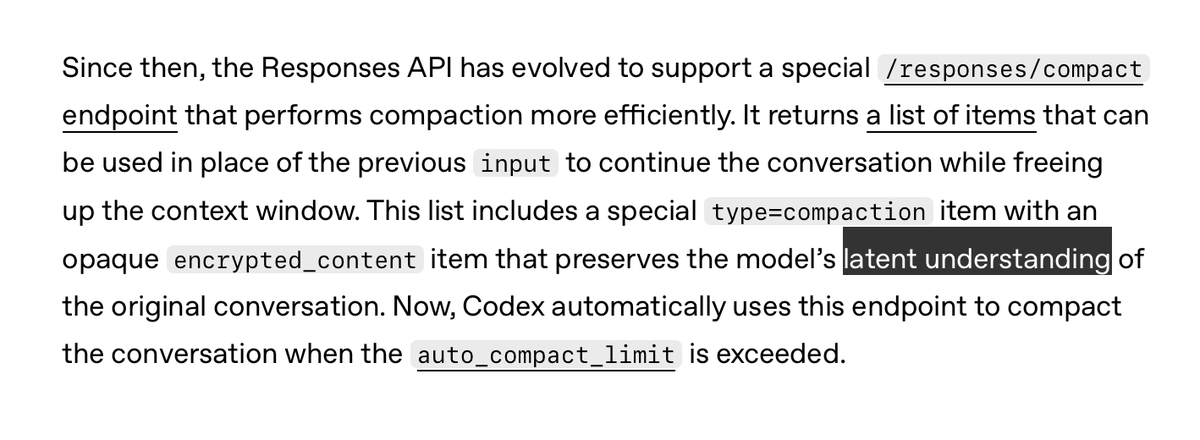
@tonysimons_ reported (36 likes, 6 replies, 1,523 views, 32 bookmarks) that Hermes can now use OpenAI’s native Responses API compaction for long GPT-5.6 sessions, with compression: codex_responses_native: true as the exposed knob. The image and replies made it notable because they turned “better long context” into a specific operational question: whether compaction preserves the encrypted checkpoint, pending approvals, tool state, and resume semantics you actually need in a real coding run.
7. Where the Opportunities Are
[+++] Workflow-native operating systems for coding agents — Section 1 showed the shift from prompt talk to graph engineering, turn-level serving, and loop control. Sections 2 and 4 showed the pain directly: brittle long-session state, compaction uncertainty, and request-shaped infrastructure that does not match real agent behavior. Citadel, Hermes compaction, and the Copilot traces paper make this a strong opportunity now.
[+++] Trust and control planes above portable plugins — Portable packaging is getting standardized faster than authority, permissions, sandboxing, and provenance. Agent Plugins, Google Skills, and the replies around compliance fixtures and capability manifests all point to the same missing layer. This is strong because the standard is already good enough to expose the next bottleneck.
[++] Local-first, API-compatible fallback infrastructure — LM Studio localhost setups, Continue plus Ollama, and harness-level model swapping all describe a market that wants to keep the same commands while changing price, privacy, or provider underneath. This is a durable opportunity, but it is getting competitive quickly.
[++] Minimal-diff guardrails that force the boring solution first — Ponytail, the date-input example, and the wider “fundamentals move upstream” argument all point to a narrower but very practical need: stop agents from overbuilding before the reviewer has to clean it up. The value is immediate and legible in smaller diffs, lower dependency count, and easier review.
[+] Personal operating systems built on agent logs — The mirror prompt and Life System Starter Kit suggest a smaller emerging category where Claude Code sessions, journals, and decisions become a durable personal operating record. The evidence is thinner than the workflow or plugin trends, but the use case is clearly starting to escape pure software development.
8. Takeaways
- The conversation is moving from prompts to operating discipline. The most substantive items focused on graph engineering, turn-level serving, retries, checkpoints, and loop control rather than on single-prompt cleverness. (source)
- Portable packaging is getting real faster than trust and permissions are. Agent Plugins, Google Skills, and the reply thread around capability manifests all show that distribution is no longer the only problem. (source)
- Google’s coding stack is visible, but trust in the developer workflow is still weak. The strongest public evidence on Antigravity was about account risk, missing bindings, and unusable harness quality, not about superior day-to-day coding results. (source)
- Users want backend freedom without changing their working surface. LM Studio localhost APIs, Continue plus Ollama, and multi-model harnesses all point to the same demand: keep the editor or shell, swap the runtime underneath it. (source)
- The liveliest builders are wrapping existing agents with state, playbooks, and guardrails. Citadel, open-kritt, Google Skills, Life System Starter Kit, and Ponytail are all evidence that the market is currently innovating more around procedure than around raw inference. (source)