Twitter AI Coding - 2026-08-12
1. What People Are Talking About
1.1 Antigravity is becoming a packaging layer for specialized agents and plugins (🡕)
The strongest cluster on August 12 was not a single model launch. It was a push to package agent behavior into reusable product surfaces: custom agents, provider plugins, and small offline builds that can be shared or rerun. Compared with August 11's emphasis on portable runtimes and model choice, August 12 moved one layer higher into how teams package roles, skills, and integrations around an agent shell.
@antigravity announced (466 likes, 29 replies, 32,592 views, 124 bookmarks) Custom Agents in Antigravity, and the public custom-agents blog says the feature works through Markdown plus YAML agent files under .agents/agents/ or ~/.gemini/config/agents/. The same write-up says the same agent can run directly as a main agent or as a delegated subagent, which makes the launch more than a UI tweak. It turns agent specialization into a repo-shareable artifact.

@JackWoth98 introduced (144 likes, 13 replies, 8,473 views, 73 bookmarks) a Gemini API plugin bundled into Antigravity. The interesting part of the thread was not the announcement copy; it was the replies. One user said the feature only appeared after updating, another called it too complicated, and a technically detailed reply asked whether the plugin abstracts Gemini function_declarations differences versus OpenAI tool schemas, which makes integration friction the real story.
@googledevs showed (59 likes, 5 replies, 8,205 views, 27 bookmarks) a fully offline translator built with Gemma 4, Antigravity, and a Raspberry Pi 5. The post described a custom interface, printed case, and wired electronics, which matters because it shows Antigravity being used as a build surface for portable edge hardware, not just desktop coding sessions.
Discussion insight: Replies treated custom agents and plugins as valuable only if they reduce setup and schema friction. The strongest positive response was to agents that fit a workflow; the sharpest pushback was that integrations still feel too hidden or too complicated.
Comparison to prior day: August 11 centered on moving between runtimes and models. August 12 centered on how those runtimes are being wrapped into role-specific agents, plugins, and small end-user builds.
1.2 Memory and persistent context are becoming the next competitive layer (🡕)
Multiple posts focused on keeping context alive between runs without forcing users to re-explain a project every time. The split was between constructive memory systems - repo-level facts, retain/recall/reflect plugins, linked repo maps - and the downside of keeping too much stale instruction state. Compared with August 11's broader portability discussion, August 12 made persistence mechanisms much more concrete.
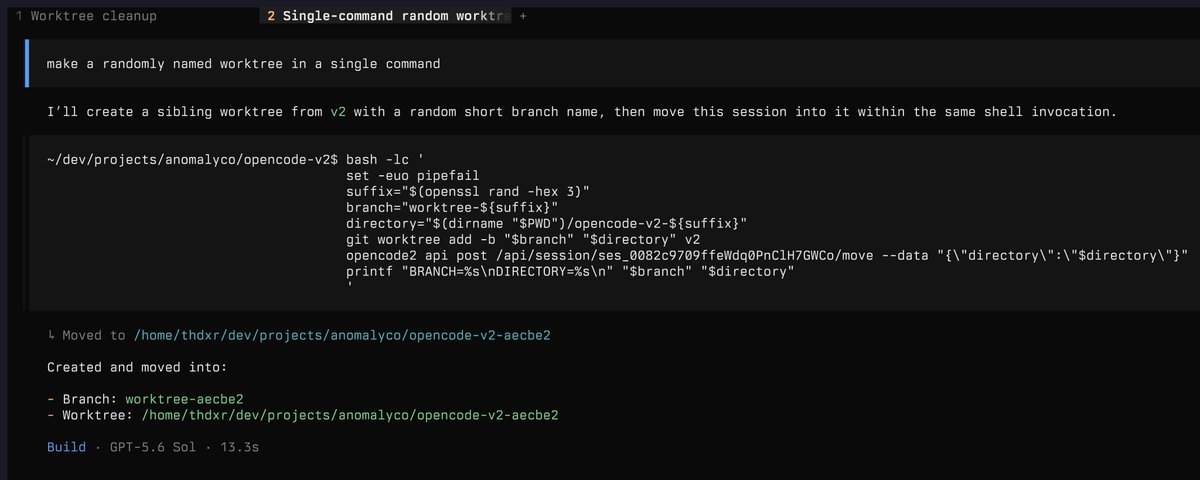
@thdxr showed (167 likes, 17 replies, 8,136 views, 51 bookmark) a workflow where Opencode creates a new worktree and then moves the active session into it in the same shell invocation. The screenshot matters because it makes the pattern explicit: state is not only the code tree, it is also the live agent session. Replies added nuance by pointing out that shared MCP servers can remain reachable even after the files move into a separate worktree.
@markfenner noted (4 likes, 3 replies, 105 views) that Copilot Memory in JetBrains can carry coding conventions, architecture decisions, build commands, and project rules across agent chats, but that these are repository-level facts rather than private notes. The same tweet says GitHub validates memories against the current code and removes unused memories after 28 days, which makes the memory boundary concrete enough for teams to reason about.

@Vectorizeio said (9 likes, 363 views, 4 bookmarks) Hindsight now ships for Vercel's Agent Plugins standard, with one bundle handling retain, recall, and reflect. The official Hindsight docs make the architecture more concrete: the system combines semantic, keyword, graph, and temporal retrieval, and stores memory as mental models, observations, and facts.
@rewind02 argued (6 likes, 3 replies, 83 views) that the real problem with coding agents is that every session starts blind. The public Graft repo says it builds a linked Markdown graph of the repo, rides Claude Code hooks automatically, and in its own cold-versus-graft comparison cuts tool calls by 46%, tokens by 42%, and time by 60%.

@HeyGurisaroy summarized (8 likes, 1 reply, 651 views, 3 bookmarks) the August 2026 paper Why Does CLAUDE.md Keep Growing? Catastrophic Remembering in Agentic Coding. The paper reports 247,694 instruction lifetimes across 1,867 repositories, +226% prompt growth over a file's life, and says prompt comments remove 99.3% of excess while improving instruction-following by up to 23.1%, which turned instruction sprawl into a measured systems problem rather than a meme.

Discussion insight: Users want persistence, but not blindly. Replies in the worktree and memory discussions worried about shared infrastructure crossing boundaries, stale state surviving too long, and the cost of cleaning up what the agent has been told before.
Comparison to prior day: August 11 treated portability as moving workflows across shells. August 12 treated persistence as deciding what the agent should remember, where that memory lives, who can see it, and when it should expire.
1.3 The new product surface is the operating layer around the model (🡕)
A third cluster was builders shipping everything around the generation step: embeddable runtimes, workflow capture, transcript analytics, endpoint-security inspection, and autonomous test loops. These posts were less about “write code for me” and more about how to instrument, embed, reuse, analyze, or harden the agent after it becomes useful. Compared with August 11's trust-and-review framing, August 12 showed more concrete open-source implementations of that layer.
@GithubProjects announced (27 likes, 1 reply, 5,091 views, 17 bookmarks) that the engine behind Copilot CLI is now a six-language SDK. The public repo says the SDK exposes the same Copilot runtime through JSON-RPC, supports Python, TypeScript, Go, .NET, Java, and Rust, and can run with BYOK as well as GitHub-authenticated flows. That makes the runtime itself a product surface for other apps and services.

@seeconvm reported (20 likes, 4 replies, 1,056 views, 5 bookmarks) that Microsoft open-sourced Skill Recorder, which records a human workflow once and reconstructs it into a reusable skill or automation. The public Skill Recorder repo says it prefers native tools such as gh and web_fetch over replaying UI clicks, while the tweet and replies make the trust boundary explicit: the recording stays local until Analyze uploads screenshots, event timelines, and narration to GitHub cloud.
@dosu_ai launched (5 likes, 102 views, 2 quotes, 2 retweets) Decant as an open-source session analytics tool for Claude Code and Codex logs. The public repo says it indexes transcripts locally into SQLite, breaks runs into categories like context, planning, code, and communication, and makes no outbound network calls at runtime.
@SpecterOps introduced (3 likes, 107 views, 2 bookmarks) Blacklight as a toolkit for mapping and analyzing local AI-agent artifacts. The public article and repo say it inventories authentication material, settings, session content, indexes, and workspace metadata across Codex, Claude Code, Cursor, and Antigravity CLI.
@awakecoding showed (6 likes, 1 reply, 321 views, 1 bookmark) GitHub Copilot autonomously running an end-to-end test of the IronRDP pen-input extension by opening Paint, drawing a smiley through ironrdp-agent, and verifying the result with a screenshot. The screenshot matters because it shows planning, execution, and verification all in one trace rather than a vague claim about “agentic testing.”

Discussion insight: The trust questions were specific, not abstract: when does screen context leave the device, what artifacts remain on endpoints, and what evidence is passed between agent steps.
Comparison to prior day: August 11 asked for governable agents. August 12 showed more people building the governance, capture, analytics, and verification layers themselves.
2. What Frustrates People
Sessions still either forget too much or remember too much
This was a High-severity frustration because it sits at the start of every run. @rewind02 argued (6 likes, 3 replies, 83 views) that Claude Code starts blind every session, re-grepping the same repo and rebuilding a mental map it already had yesterday, while the public Graft repo presents itself as the fix. The opposite failure showed up in @HeyGurisaroy summarizing (8 likes, 1 reply, 651 views, 3 bookmarks) the paper on CLAUDE.md growth: prompts more than triple over their lifetime, and the proposed fix is to attach rationale comments so old instructions can be pruned safely.
People are coping by adding memory layers rather than trusting the default session boundary. @markfenner described (4 likes, 3 replies, 105 views) Copilot Memory as repo-level facts with validation and expiry, and @Vectorizeio positioned (9 likes, 363 views, 4 bookmarks) Hindsight as a retain/recall/reflect plugin for multiple agents. This is worth building for directly because the workaround today is to bolt on memory systems or ever-growing instruction files.
Multi-agent worktrees still create arbitration and cleanup problems
This landed between Medium and High severity because the workflows are already useful, but the operational edges are obvious. @thdxr showed (167 likes, 17 replies, 8,136 views, 51 bookmark) a careful workaround where the session moves into the newly created worktree immediately, yet one reply still pointed out that shared MCP servers remain reachable across trees. The same coordination problem surfaced under @reach_vb shipping (138 likes, 14 replies, 6,857 views, 20 bookmarks) Codex for Linux, where replies asked who arbitrates when two parallel agents edit the same file from different worktrees and complained that model plus auto-review combinations burn limits at very different rates.
Cleanup is part of the same frustration. @burkeholland said (20 likes, 6 replies, 3,443 views, 6 bookmarks) worktrees can consume a hard drive quickly, quoting a complaint about 20GB of repeated node_modules, and pointed to Copilot's archive-plus-auto-delete settings as the current mitigation. This is worth building for directly because people do not just need more parallel agents; they need conflict handling, lifecycle cleanup, and visible cost controls around those agents.

Spend, capture, and endpoint exposure are still under-instrumented
This was a High-severity operational frustration because the failure modes range from wasted budget to leaked context. @mohitmishr93531 pitched (14 likes, 5 replies, 390 views, 1 bookmark) Guardrail as visibility into AI spend, projects, tools, members, and spending limits across Claude Code, Cursor, Codex, and GitHub Copilot, which only makes sense because teams already feel that gap. @seeconvm warned (20 likes, 4 replies, 1,056 views, 5 bookmarks) that Skill Recorder keeps capture local only until Analyze, when screenshots, event timelines, and narration go to GitHub cloud.
The security version of the same problem came from @SpecterOps introducing (3 likes, 107 views, 2 bookmarks) Blacklight, whose public write-up inventories auth material, settings, session content, indexes, workspace metadata, and rules left behind by local agents. The coping behavior today is separate point solutions: spend dashboards, endpoint triage, or cautious workflow capture. This is worth building for directly because teams want controls before cost or leakage happens, not just a report afterward.
3. What People Wish Existed
Durable project memory with ownership, validation, and a reason for every rule
The strongest need was not generic “remember me.” It was memory that is repository-aware, attributable, and easy to prune. @markfenner described (4 likes, 3 replies, 105 views) Copilot Memory as validated repo-level facts with 28-day expiry, @Vectorizeio promoted (9 likes, 363 views, 4 bookmarks) Hindsight as retain/recall/reflect across agents, and @HeyGurisaroy pointed to (8 likes, 1 reply, 651 views, 3 bookmarks) research arguing that prompt comments can stop instruction files from growing without bound. This is a practical need, not an aspirational one, because users are already inventing memory layers and comment systems to compensate. Opportunity: Direct.
Multi-agent pipelines that separate triage, implementation, and review cleanly
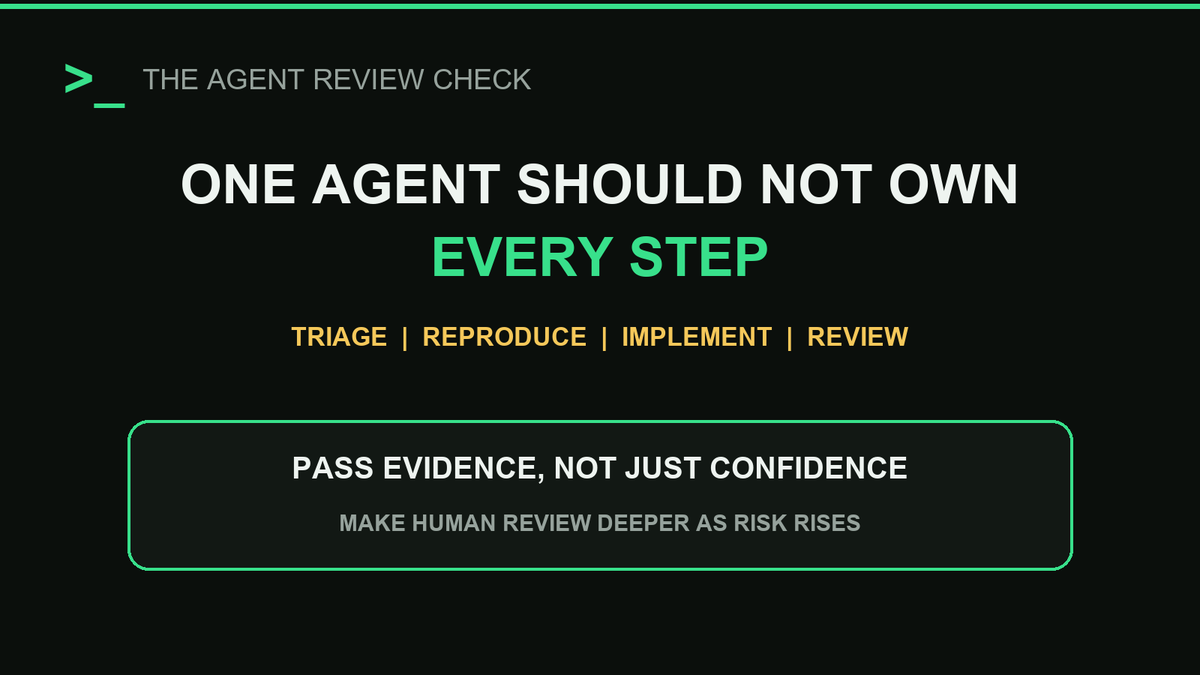
People are visibly asking for coordination surfaces even when they do not phrase it as a feature request. @thdxr moves (167 likes, 17 replies, 8,136 views, 51 bookmark) sessions into new worktrees to keep execution aligned with the edited tree, and replies under @reach_vb shipping (138 likes, 14 replies, 6,857 views, 20 bookmarks) Codex for Linux asked who arbitrates conflicts when parallel agents touch the same file. @codeglitch distilled (3 likes, 2 replies, 126 views, 1 bookmark) the desired pattern into one sentence: one agent should not own every step; split work into triage, reproduce, implement, and review, and pass evidence between those steps. This is urgent and practical. Opportunity: Direct.
Visibility and policy controls that act before the run goes wrong
The negative form of this request ran through the whole day. @mohitmishr93531 sold (14 likes, 5 replies, 390 views, 1 bookmark) spend limits and team-wide visibility because teams do not have them by default. @dosu_ai launched (5 likes, 102 views, 2 quotes, 2 retweets) Decant so developers can understand where context, planning, code, and communication time went after the fact, while @SpecterOps framed (3 likes, 107 views, 2 bookmarks) Blacklight around the artifacts left on endpoints. What people want is the same thing one step earlier: policy, cost, and trust boundaries that intervene before a run spends money or leaks context. Opportunity: Competitive.
4. Tools and Methods in Use
| Tool | Category | Sentiment | Strengths | Limitations |
|---|---|---|---|---|
| Antigravity Custom Agents | Agent shell / customization | (+/-) | Repo-shareable agent files, direct main-agent or subagent use, growing plugin surface | Update friction, plugin setup complexity, open questions about schema normalization |
| GitHub Copilot app + JetBrains plugin | Agent platform | (+/-) | Linux desktop support, memory, Ollama BYOK, cleanup controls, broad model surface | Worktree cleanup burden, repo-memory sharing semantics need review, usage burn varies by mode |
| MAI-Code-1.1-Flash | Model | (+) | Native vision, lower price, broad Copilot availability | Enterprise/business access requires policy enablement; replies still raise trust concerns |
| Graft | Repo context layer | (+) | Linked Markdown graph, fewer tool calls/tokens/time, no vector DB required | Adds another local layer to maintain and understand |
| Hindsight | Memory system | (+) | Retain/recall/reflect model, plugin-standard portability, temporal and graph retrieval | Another infrastructure layer; production fit is still being tested in public |
| Skill Recorder | Workflow capture | (+/-) | Turns one human workflow into reusable skills or automations, prefers native tools over replayed clicks | Analyze uploads screenshots, event timelines, and narration to GitHub cloud |
| Decant | Session analytics | (+) | Local-first transcript, cost, file, and tool analytics with no outbound runtime calls | Mostly post-hoc visibility rather than prevention |
| Blacklight | Security / defender tooling | (+) | Endpoint triage and artifact analysis across multiple coding-agent tools | Security-team workflow, early project, and narrower audience |
| Guardrail | Spend governance | (+) | Team-level spend visibility and spending limits across multiple agent tools | Governance layer only; does not improve the underlying workflow itself |
| OpenCode harness + HF Jobs + TRL/OpenEnv | Training stack | (+) | Makes coding-agent training look more accessible and reproducible | Early and infrastructure-heavy, with limited third-party validation in the thread |
Satisfaction broke along a simple line. People reacted most positively to layers that preserve state, cut repeated exploration, or lower operating cost: repo maps, memory systems, lower-price models, BYOK providers, and local analytics. Sentiment turned mixed when those same layers exposed new boundaries to manage, such as who can reuse repository memory, when a recording leaves the device, or how much storage and quota multi-agent worktrees quietly consume.
Migration behavior was explicit too. Some users are externalizing project context into Graft, Hindsight, or Copilot Memory instead of relying on a fresh session prompt. Others are keeping Copilot but changing the provider underneath it with Ollama or choosing cheaper model tiers like MAI-Code-1.1-Flash. The competitive fight is increasingly about who owns the operating layer around the agent, not just the smartest underlying model.
5. What People Are Building
| Project | Who built it | What it does | Problem it solves | Stack | Stage | Links |
|---|---|---|---|---|---|---|
| Graft | rewind02 | Builds a linked repo map that rides Claude Code hooks and gives agents persistent codebase context | Coding agents start blind every session and waste time re-exploring the same repo | TypeScript, tree-sitter, Markdown graph, Claude Code hooks, npm CLI | Shipped | repo · post |
| Skill Recorder | seeconvm | Records one human workflow and turns it into a reusable skill or automation | Repeated UI-heavy work is hard to teach to agents in a reusable way | Electron, TypeScript, GitHub Copilot CLI, local capture, cloud analyze | Beta | repo · post |
| GitHub Copilot SDK | GithubProjects | Exposes Copilot's agent runtime as an embeddable six-language SDK | Builders want agent orchestration without writing planning and tool loops from scratch | Copilot CLI server, JSON-RPC, Python, TypeScript, Go, .NET, Java, Rust | Shipped | repo · post |
| Decant | dosu_ai | Local-first analytics for Claude Code and Codex sessions | Teams need visibility into cost, context use, files touched, and tool behavior after runs | TypeScript, SQLite, CLI, local web UI | Shipped | repo · post |
| Blacklight | SpecterOps | Endpoint triage and artifact analysis for local coding-agent traces | Security teams need to understand what local agents leave behind on endpoints | Python CLI, scout binaries, detection guidance | Beta | repo · post |
| Gemma Translator | googledevs | Portable offline translator with a custom interface and hardware enclosure | Edge/offline translation without cloud dependence | Gemma 4, Antigravity, Raspberry Pi 5, custom hardware | Alpha | post |
| Bear-case Chrome extension | SowingAlphaSeed | Adds a button to stock-related tweets that generates a bear case | Users want a fast way to pressure-test hype without building backend infrastructure | Codex, Chrome extension, OpenAI API, no backend | Alpha | post |
@rewind02 made (6 likes, 3 replies, 83 views) the clearest build response to the day's biggest pain point: agents forgetting the repo between sessions. The public Graft repo says the graph is just files, not embeddings, and publishes measurable improvements in tool calls, tokens, and runtime. That makes it more than another memory pitch; it is a concrete attempt to move codebase understanding into versionable local structure.
@seeconvm surfaced (20 likes, 4 replies, 1,056 views, 5 bookmarks) Skill Recorder, while @dosu_ai launched (5 likes, 102 views, 2 quotes, 2 retweets) Decant. Those projects sit on opposite sides of the same workflow: Skill Recorder turns human work into reusable instructions before the next run, while Decant turns finished agent runs into searchable local evidence afterward. Together they show a repeated build pattern of externalizing process rather than trusting ephemeral chats.
@SpecterOps built (3 likes, 107 views, 2 bookmarks) Blacklight around the security residue of local agent use, which is another sign that “what happens after the run” is becoming its own product surface. On the more end-user side, @googledevs showed (59 likes, 5 replies, 8,205 views, 27 bookmarks) a Raspberry Pi translator powered by Gemma and Antigravity, while @SowingAlphaSeed shared (8 likes, 2 replies, 1,616 views, 10 bookmarks) a no-backend Chrome extension built by Codex. The two projects are very different in polish, but they point to the same builder pattern: fast agent-assisted apps that are small, specific, and disposable.

A fourth pattern was autonomous verification. @awakecoding showed (6 likes, 1 reply, 321 views, 1 bookmark) Copilot executing and verifying an IronRDP pen-input test end to end, which suggests some teams are already treating the agent as part of the QA loop, not just the implementation step.
6. New and Notable
Prompt comments became a concrete fix for instruction-file sprawl
@HeyGurisaroy summarized (8 likes, 1 reply, 651 views, 3 bookmarks) a new paper that names the problem “catastrophic remembering” in agentic coding. The paper Why Does CLAUDE.md Keep Growing? Catastrophic Remembering in Agentic Coding reports 247,694 instruction lifetimes across 1,867 repositories, says agentic prompt files grow by 226% over their lifetime, and argues that comment-style rationale on instructions removes 99.3% of excess while improving instruction-following by up to 23.1%. That matters because it turns a familiar complaint into a measured systems problem with a specific intervention.
The model race tightened enough that cost and packaging matter more
@code announced (145 likes, 4 replies, 14,931 views, 19 bookmarks) MAI-Code-1.1-Flash with native vision support and a 73% lower list price than MAI-Code-1-Flash, while GitHub's public changelog shows that the model is available across Copilot CLI, cloud agent, app, GitHub chat, IDEs, and mobile surfaces. In parallel, @cb_doge posted (32 likes, 14 replies, 7,406 views) an InferenceEval chart with Grok 4.6 at 46.9%, GPT-5.6 Sol at 44.1%, and Opus 5 at 43.0%. The notable part was not just who ranked first; it was that the top cluster was tight enough for price, vision support, and integration surface to become decisive.

Evidence-first multi-agent assembly is becoming explicit design doctrine
@codeglitch used (3 likes, 2 replies, 126 views, 1 bookmark) Vercel's AI SDK workflow as a lesson in how to split one issue into triage, reproduction, implementation, verification, and review without letting one agent approve its own assumptions. The attached slide states the rule plainly: one agent should not own every step, and humans should receive evidence rather than confidence. That is notable because it treats agent orchestration as a review architecture problem, not just an automation problem.
7. Where the Opportunities Are
[+++] Durable repository memory with explicit rationale — Graft, Copilot Memory, Hindsight, and the CLAUDE.md paper all point to the same gap: agents need persistent project context, but teams also need to know why each remembered rule exists, who can reuse it, and when it should expire. This is strong because both the pain and the proposed fixes were concrete on August 12.
[+++] Multi-agent worktree orchestration and reconciliation — thdxr's session-move workflow, Codex for Linux replies about conflicting edits, Burke Holland's cleanup controls, and codeglitch's evidence-first review slide all describe the same missing layer. This is strong because the workflows already exist; what is missing is arbitration, lifecycle management, and review structure.
[++] Governance before the run, not just after it — Guardrail, Decant, Skill Recorder, and Blacklight each cover one piece of cost, upload, artifact, or auditability risk. This is moderate because credible point solutions are appearing, but none of them yet span spend, capture boundaries, and endpoint residue in one surface.
[++] Embeddable operating layers around coding agents — The Copilot SDK and Skill Recorder both expose a broader market for agent infrastructure: one embeds the runtime, the other turns one workflow into reusable instructions. This is moderate because the value is clear, but platform vendors are already moving quickly.
[+] Small, agent-built utilities and edge devices — The Gemma Translator and the bear-case Chrome extension show that AI-coding output is spreading into narrow, fast, low-backend apps. This is emerging because the pattern is visible, but the public examples are still early and lightweight.
8. Takeaways
- The center of gravity moved above the model and into packaging. Antigravity's custom agents, Gemini plugin, and the Gemma Translator all treated the shell as something to specialize, not just something to prompt. (source)
- Persistent context is now one of the clearest unsolved problems in AI coding. Graft, Copilot Memory, Hindsight, and the CLAUDE.md paper all attacked the same issue from different angles: agents either forget too much between runs or accumulate too much stale instruction state. (source)
- A distinct market is forming around the operating layer of coding agents. Copilot SDK, Skill Recorder, Decant, and Blacklight all sit around generation rather than inside it, covering embedding, capture, analytics, and security. (source)
- Multi-agent worktrees are useful enough to keep, but messy enough to need their own control plane. August 12 showed session moves, merge-arbitration worries, usage-burn complaints, and archive-delete cleanup settings all in one cluster. (source)
- Cost and policy controls are becoming as important as raw capability. MAI-Code-1.1-Flash competed on price plus packaging, InferenceEval showed a tight top tier, and Guardrail plus Blacklight highlighted the operational need to control spend and exposure around those models. (source)