Twitter AI Coding - 2026-08-13
1. What People Are Talking About
1.1 Work-history memory is moving from repo facts to full activity timelines (🡕)
The memory conversation shifted materially on August 13. August 12 was mostly about repo-level memory, recall layers, and instruction-file sprawl; August 13 extended that idea to a broader activity log that can reconstruct what a person was doing across apps and sites. The cluster is supported by the dominant Computer History launch and complementary memory-layer posts such as Hindsight.
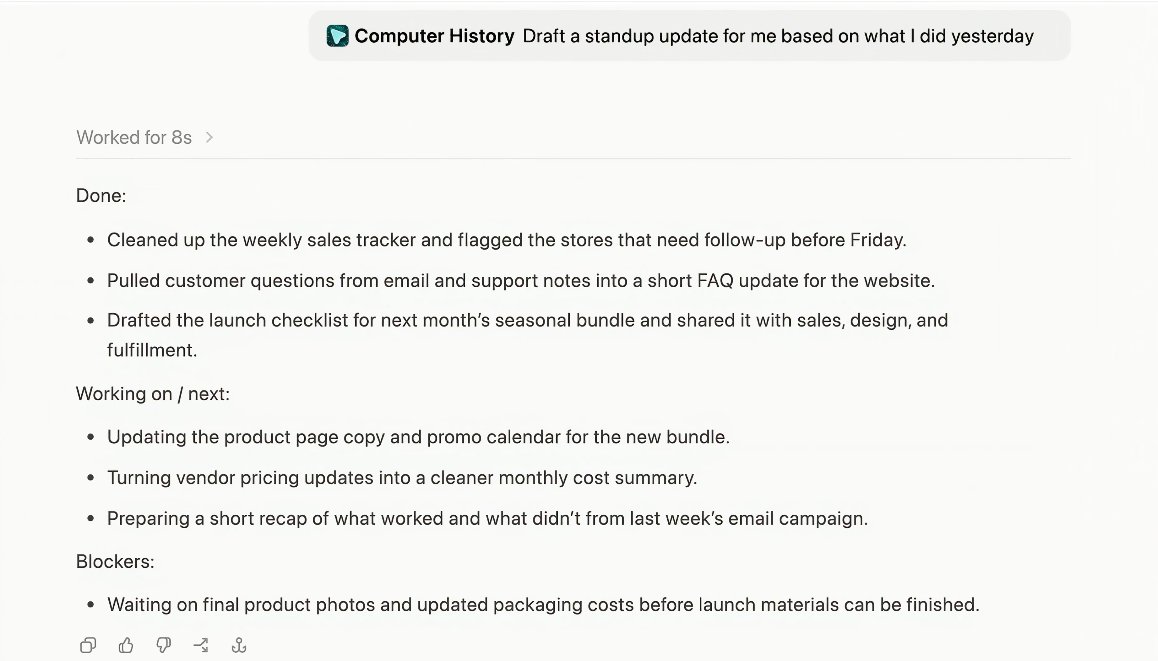
@OpenAIDevs announced (1,044 likes, 62 replies, 53,989 views, 306 bookmarks) that Codex and ChatGPT can use Computer History as recent-work context. The public Computer History docs say the feature is off by default, requires the macOS desktop app plus Memories, turns interaction events rather than screenshots into timeline summaries, and can suggest skills or automations when it spots repeated workflows.
@Vectorizeio positioned (9 likes, 422 views, 5 bookmarks) Hindsight as a memory plugin that works across agent surfaces, and the public docs say it combines semantic, keyword, graph, and temporal retrieval and stores mental models, observations, and facts instead of a flat vector cache. That made the day's memory debate less about whether agents should remember and more about what kind of retrieval and control surfaces are acceptable.
Discussion insight: The positive reaction was to continuity and workflow reuse, but the wary reply pattern was immediate: one reply framed Computer History as ChatGPT scrutinizing yesterday's work, and the docs themselves emphasize opt-in controls, exclusions, and the lack of screenshots or audio.
Comparison to prior day: August 12's memory discussion was mostly repository-scoped and about stale instruction files. August 13 expanded the scope to whole-work histories, local memory files, and skill generation from repeated behavior.
1.2 Antigravity became the packaging layer for custom agents, plugins, and Gemini 3.7 Flash (🡕)
Antigravity dominated the day's vocabulary, and Gemini 3.7 Flash appeared as both a model launch and a distribution event. The thread tying them together was packaging: file-based agents, plugin manifests, new model availability, and concrete builds on top of the shell. Compared with August 12's focus on custom agents as a feature, August 13 showed Antigravity turning into a distribution surface for models and extensions.
@antigravity announced (686 likes, 40 replies, 54,516 views, 186 bookmarks) Custom Agents, and the public custom agents blog says the files live under .agents/agents/ or ~/.gemini/config/agents/ and can run symmetrically as main agents or delegated subagents. The attached image matters because it shows the dropdown surface where those roles become selectable rather than hidden config.

@antigravity announced (646 likes, 48 replies, 18,625 views) Gemini 3.7 Flash in Antigravity, and Google's public model announcement says 3.7 Flash improves over 3.6 Flash on DeepSWE v1.1 (65.3% vs 49.0%), FrontierCode 1.1 Main (43.6% vs 34.4%), WebDev Arena (1588 vs 1538), and AutomationBench (30.4% vs 17.0%). That gives Antigravity a cheaper workhorse model with publicly described gains in coding and agent workflows.

@JackWoth98 introduced (188 likes, 17 replies, 11,965 views, 106 bookmarks) a Gemini API plugin bundled with Antigravity, while Google Cloud's public plugin docs define plugin.json as the required manifest for skills, agents, MCP config, hooks, and rules. @googledevs shared (153 likes, 10 replies, 17,117 views, 66 bookmarks) the Gemma Translator repo, which runs Gemma 4 locally on a Raspberry Pi 5 with LiteRT-LM and Moonshine, showing Antigravity being used to ship a concrete offline device rather than just demo prompts.
Discussion insight: Replies were positive about lower-cost flash models and reusable agent files, but the sharpest friction points were discoverability and gating: one custom-agent reply said the dropdown did not appear until after updating, and Copilot replies noted that enterprise admins must enable Gemini 3.7 Flash before it becomes selectable.
Comparison to prior day: August 12 introduced custom agents as a new specialization surface. August 13 showed that surface accumulating model rollouts, plugin manifests, and real hardware projects.
1.3 The operating layer around agents is getting more visual, reviewable, and multi-surface (🡕)
The most interesting builder posts were not one-better-model claims. They were new control surfaces around existing agents: visual editors, graph control planes, spec-first command stacks, ACP-based IDE switching, replayable sessions, and reproducible evaluation. That is a continuation of August 12's operating-layer trend, but the designs were more explicit and more opinionated on August 13.
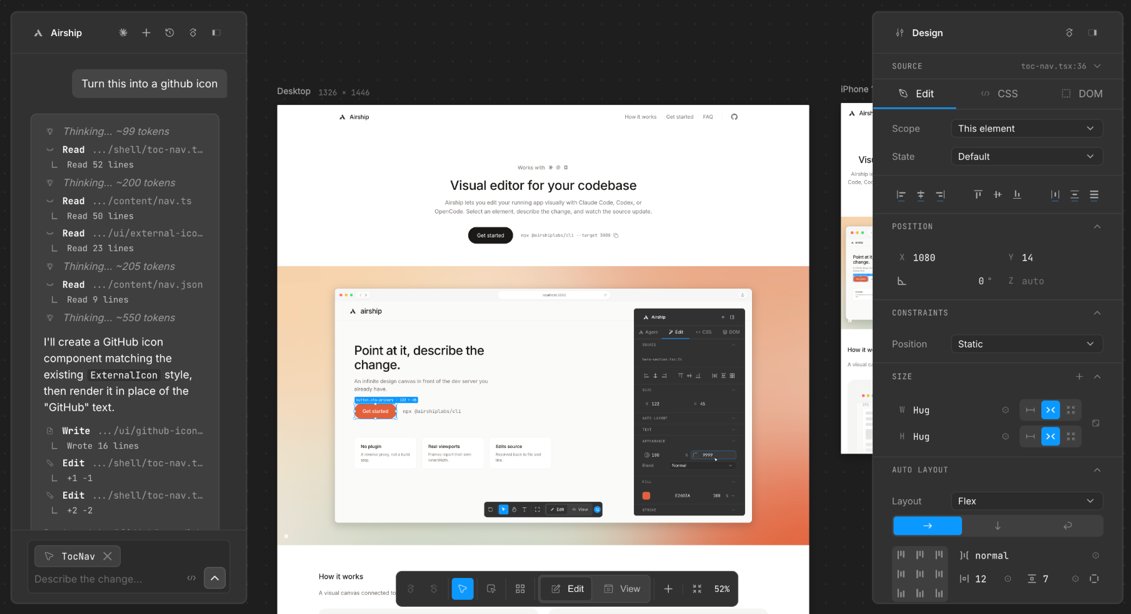
@charliejhills argued (23 likes, 12 replies, 2,555 views) that GitHub's Spec Kit fixes coding backwards by forcing requirements, clarification, planning, tasks, and implementation into a structured sequence. @Alan_Earn shared (24 likes, 10 replies, 370 views, 6 bookmarks) Airship, whose public README says it puts a design canvas in front of a running dev server so a user can click an element, describe a change, and let Claude Code, Codex, or OpenCode write the diff locally.
@WebStormIDE introduced (16 likes, 2 replies, 1,150 views) ACP-based agent choice inside WebStorm, and the public JetBrains article says ACP lets teams switch providers without giving up local indexing or paying for an extra JetBrains AI subscription. @airealitynoslop noted (3 likes, 1 reply, 35 views, 3 bookmarks) that DeepSeek Harness treats models, tools, skills, sessions, sandboxes, storage, loops, scheduling, and UI as plugins on top of Cordis, which pushes modularity deeper than a normal tool/plugin split.
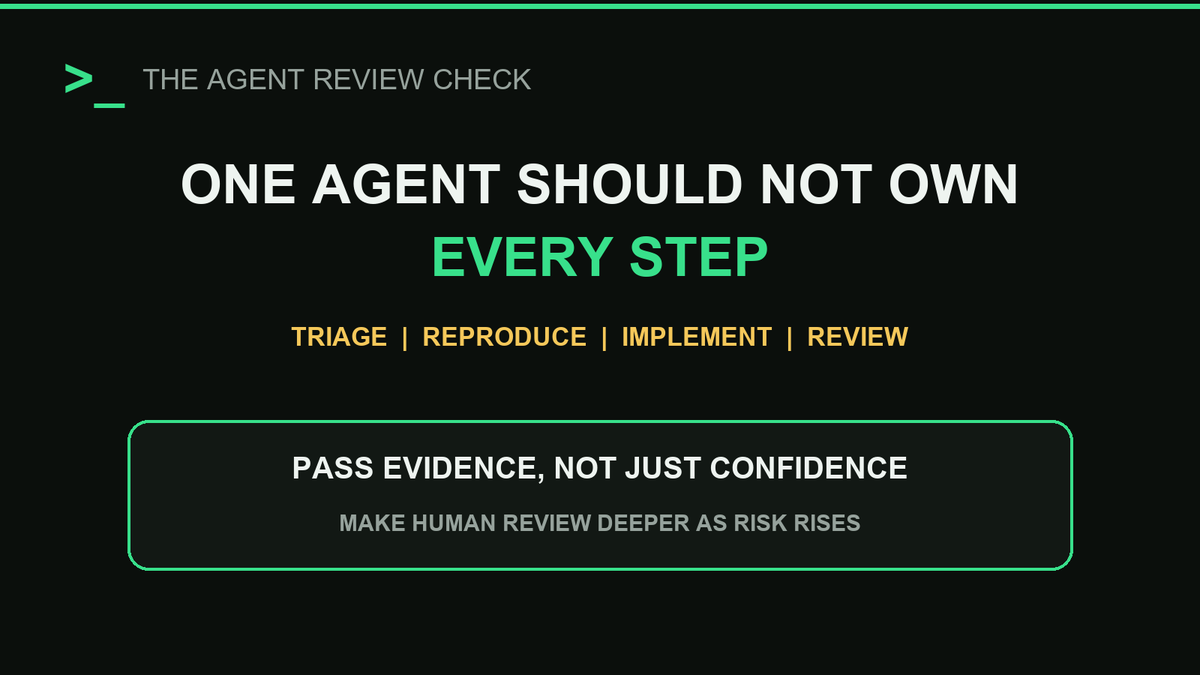
@codeglitch distilled (4 likes, 3 replies, 162 views) the review doctrine behind this layer in one image: one agent should not own every step, and evidence should flow from triage to reproduction to implementation and review. That same reviewability showed up in @s7rthaks building (1 like, 1 reply, 64 views) a reproducible benchmark CLI that runs a solver in one container and evaluates the patch in a fresh one.
Discussion insight: The strongest practitioner nuance was about coordination cost rather than raw capability. One reply on named Claude Code sessions said the pattern works but creates a high token tax as agents wake each other up and chat, which reinforces the move toward explicit graphs, protocols, and review stages.
Comparison to prior day: August 12 showed the operating layer emerging around capture, analytics, and security. August 13 pushed that layer into more concrete UX: canvases, protocols, graphs, quality gates, and proof-bearing evaluation loops.
2. What Frustrates People
Memory that is useful without feeling invasive
This was a High-severity frustration because the biggest positive signal and the biggest skepticism were the same feature. @OpenAIDevs announced (1,044 likes, 62 replies, 53,989 views, 306 bookmarks) Computer History as a way for ChatGPT and Codex to pick up recent work, but the public docs spend as much time on exclusions, deletion, local storage, prompt-injection risk, and consent-sensitive apps as they do on convenience. One reply summarized the discomfort plainly by joking about ChatGPT scrutinizing work from yesterday and last week.
The technical version of the same frustration appeared in @Vectorizeio positioning (9 likes, 422 views, 5 bookmarks) Hindsight as a memory layer because, as the public docs describe it, simple vector recall is not enough for questions that need temporal reasoning or consolidated observations. People are coping by adding explicit memory banks, exclusions, and retention rules instead of trusting the default chat window. This is worth building for directly because the need is clear, but the product has to make scope, provenance, and deletion obvious.
One-shot agents still need review architecture and repeatable evaluation
This was a High-severity frustration in builder posts even when those posts had modest engagement. @codeglitch distilled (4 likes, 3 replies, 162 views) the core complaint into one rule: one agent should not own every step. @s7rthaks built (1 like, 1 reply, 64 views) a benchmark CLI specifically to stop trusting exit codes or solver output by running an isolated solve and a fresh evaluation pass, while @PatrickToulme described (11 likes, 10 replies, 1,657 views) AgentSage as replayable session traces with redaction and secret scanning before anything leaves the machine.
The coordination cost showed up in discussion too. @adocomplete showed (8 likes, 2 replies, 334 views, 4 bookmarks) named Claude Code sessions that can DM each other, but a reply said the setup becomes expensive because the agents waste context chatting and waking each other up. The workaround today is to add gates, separate roles, or replay tools around the agent. This is worth building for directly because the failure mode is not that agents do nothing; it is that teams cannot trust or cheaply verify what they did.
Model access is improving faster than deployment economics
This landed between Medium and High severity because the capability curve is moving fast, but access is still constrained by policy and hardware. @github announced (91 likes, 16 replies, 24,044 views) Gemini 3.7 Flash in Copilot, yet the public changelog says enterprise and business admins must enable the preview policy before users can select it. Rollout is gradual across the Copilot surfaces even for eligible plans.
At the local end of the spectrum, @burkeholland reported (67 likes, 13 replies, 8,567 views, 19 bookmarks) Qwen3-Coder 30B running in the GitHub Copilot app through Ollama at roughly 85 tokens per second, but the replies immediately focused on the 96GB VRAM requirement and the price of the hardware. The attraction of flash-tier models in the Antigravity and Copilot posts was partly about price for retries and tool calls, not just quality. This is worth building for competitively because people need help routing between hosted, local, and policy-gated model choices without becoming infrastructure experts.
3. What People Wish Existed
Memory that can turn repeated work into reusable artifacts
People were not just asking for an agent that remembers. They were asking for one that can transform repeated work into something reusable and reviewable. The public Computer History docs say repeated workflows can trigger a suggested skill or automation, and @OpenAIDevs framed (1,044 likes, 62 replies, 53,989 views, 306 bookmarks) the feature around picking up where you left off and understanding work patterns. @Vectorizeio backed that up with a cross-agent memory layer whose public docs explicitly model retain, recall, and reflect. This is a practical need, not an aspirational one. Opportunity: Direct.
Packaging that survives tool switching
Custom agents, plugin manifests, protocol adapters, and model rollouts all pointed to the same request: define behavior once and keep it portable as the surrounding tools change. @antigravity showed (686 likes, 40 replies, 54,516 views, 186 bookmarks) file-based custom agents, Google Cloud's public plugin docs expose plugin.json as the packaging root, and @WebStormIDE positioned (16 likes, 2 replies, 1,150 views) ACP as a way to bring GitHub Copilot, Claude Code, or any compliant agent into the same IDE without an extra subscription. The need is practical and competitive because developers clearly expect to move between shells, IDEs, and providers without rewriting the whole operating layer. Opportunity: Competitive.
Orchestration that separates planning, execution, verification, and review
Several posts converged on the same desired pattern even when they used different language. @charliejhills described (23 likes, 12 replies, 2,555 views) Spec Kit as a way to force requirements, planning, and tasks before coding. @tom_doerr shared (4 likes, 1,023 views) Pilot Shell, whose public repo turns Claude Code and Codex into /prd, /spec, /build, and /fix workflows with quality gates. @ctrlnodeai built (3,488 views) a graph control plane, while @codeglitch argued (4 likes, 3 replies, 162 views) that evidence should be handed off between steps rather than one agent doing everything. This is an urgent, direct need because users are already stitching together their own orchestration layers. Opportunity: Direct.
4. Tools and Methods in Use
| Tool | Category | Sentiment | Strengths | Limitations |
|---|---|---|---|---|
| Computer History | Memory / work-history capture | (+/-) | Turns recent app and website activity into usable context; can suggest skills or automations from repeated work | macOS desktop only, opt-in, admin gating, privacy and prompt-injection concerns |
| Antigravity Custom Agents | Agent shell / packaging | (+/-) | File-based agents, main-agent or subagent symmetry, team-shareable configs | Discoverability/update friction and another customization layer to manage |
| Gemini 3.7 Flash | Model | (+) | Better coding/web-dev benchmarks than 3.6 Flash, cheaper retries and tool loops, broad rollout momentum | Gradual availability and some benchmarks still favor stronger but pricier models |
| GitHub Copilot app + Ollama | Agent platform / local-model surface | (+/-) | Lets teams try hosted and local models inside a familiar shell | Local experiments can demand expensive hardware, and model access still depends on policy toggles |
| Hindsight | Memory system | (+) | Retain/recall/reflect API, temporal plus graph retrieval, structured memory types | Extra infrastructure layer that teams must operate and trust |
| WebStorm ACP | IDE protocol / BYOK | (+) | Switch agents without leaving the indexed IDE, no extra JetBrains AI subscription required | Requires ACP-compliant agents and setup discipline |
| Spec Kit | Planning workflow | (+) | Forces requirements, clarification, planning, and tasks before implementation; broad agent integration | Adds up-front process and is less attractive to pure prompt-and-go usage |
| Airship | Visual editor / UI workflow | (+) | Puts a design canvas directly in front of a dev server and keeps edits local | Early product tradeoffs around agent capability differences and safety modes |
| Pilot Shell | Workflow layer | (+) | Adds spec/build/fix lanes, TDD, quality hooks, memory sharing, and a local console | Opinionated operating layer with its own install and conventions |
| DeepSeek Harness | Agent harness | (+/-) | Everything-as-plugin architecture across model, tool, session, storage, and UI surfaces | Developer preview with explicit compatibility-breaking changes ahead |
| CTRL NODE | Agent graph control plane | (+/-) | Graph canvas, mixed providers, outbound-only bridge, live task activity | Early-stage product seeking workflow fit and operator feedback |
| OpenCode | Open-source agent shell | (+) | Multi-provider support, ongoing context-compaction work, usage stats, mobile client ecosystem | Still tuning compaction, routing, and provider behavior in public |
Satisfaction broke along a clear line. People reacted most positively to layers that preserved context, cut repeated prompting, or made existing agents easier to steer: work-history memory, cheaper flash models, spec-first workflows, visual editors, and protocol adapters. Sentiment turned mixed when those same layers raised new questions about privacy boundaries, admin enablement, GPU cost, or whether another control plane was worth operating.
Migration patterns were visible too. Instead of committing to one generalist chat surface, people were adding packaging and control around multiple agents: ACP in the IDE, plugin manifests in Antigravity, graph orchestration in CTRL NODE, spec-first flows in Spec Kit and Pilot Shell, and local/mobile extensions around OpenCode. The competition is increasingly about who owns the operating layer around the model, not just the model itself.
5. What People Are Building
| Project | Who built it | What it does | Problem it solves | Stack | Stage | Links |
|---|---|---|---|---|---|---|
| Gemma Translator | Google Creative Lab via @googledevs | Portable offline voice translator for two-way conversations | Cloud dependence and connectivity limits for translation workflows | Gemma 4, LiteRT-LM, Moonshine, Raspberry Pi 5, React frontend, Python API | Alpha | repo · post |
| CTRL NODE | @ctrlnodeai | Control plane for AI agent graphs with a local Bridge | Teams want branching, multi-provider agent workflows without exposing local workspaces publicly | Graph canvas, outbound Bridge, WebSocket control plane, Claude/Copilot/Gemini/Codex/OpenRouter/Ollama support | Alpha | repo · post |
| Airship | 0xnyn via @Alan_Earn | Visual editor that sits in front of a live dev server and sends edits to coding agents | UI editing and design-to-code handoff remain awkward in text-only agent workflows | Node CLI, live browser frames, Claude Code, Codex, OpenCode | Beta | repo · post |
| Spec Kit | GitHub via @charliejhills | Specification-first workflow kit for coding agents | Agents often start coding before requirements and constraints are explicit | Python CLI, slash commands, multi-agent integrations, markdown specs | Shipped | repo · post |
| Pilot Shell | Max Ritter via @tom_doerr | Workflow layer that adds PRD, spec, build, and fix lanes around Claude Code and Codex | Raw agent runs skip tests, lose context, and need quality gates | Claude Code, Codex, hooks, memory sharing, local console | Shipped | repo · post |
| DeepSeek Harness | DeepSeek AI via @airealitynoslop | Plugin-first harness where model, tools, sessions, storage, and UI are replaceable | Builders want a swappable runtime instead of a fixed shell/provider stack | Cordis, Node.js, web UI, plugin runtime | Alpha | repo · post |
| Hindsight | @Vectorizeio | Cross-agent memory bank with retain/recall/reflect behavior | Agents forget session history and struggle with time-aware retrieval | Semantic search, BM25, graph retrieval, temporal retrieval, structured memory types | Beta | docs · post |
| AgentSage | @PatrickToulme | Replayable coding-agent sessions and side-by-side arena comparisons | Finished agent runs are hard to inspect, compare, or publish safely | CLI capture, session replay, redaction, secret scanning, multi-agent arena | Alpha | post |
| OpenCode iOS Client | grapeot via @ivanfenenko | Native iPhone/iPad/Vision Pro client for OpenCode servers | Developers want to monitor sessions, diffs, and tool calls away from the desktop | Swift, iOS/iPadOS/visionOS, SSH tunnel, OpenCode server | Beta | repo · post |
| Reproducible coding-agent benchmark CLI | @s7rthaks | Runs a solver on a pinned repo state, then evaluates the patch in a fresh container | Teams need auditable agent evaluation instead of trusting exit codes | Docker, pinned commits, isolated solver/evaluator lifecycle | Alpha | post |
The strongest repeated build pattern was not another agent wrapper. It was scaffolding around trust. @charliejhills shared (23 likes, 12 replies, 2,555 views) Spec Kit as a way to force explicit requirements and task breakdowns before coding, while @tom_doerr shared (4 likes, 1,023 views) Pilot Shell as a way to impose PRD/spec/build/fix lanes, TDD, and quality hooks on top of Claude Code and Codex. @s7rthaks added (1 like, 1 reply, 64 views) the evaluation end of the same idea: fresh-container verdicts instead of trusting solver output.

The second build pattern was new surfaces around the same underlying agents. @Alan_Earn surfaced (24 likes, 10 replies, 370 views, 6 bookmarks) Airship's design canvas in front of a dev server, @ctrlnodeai built (3,488 views) a graph control plane with a local Bridge, and @ivanfenenko shared (2 likes, 19 views) a public TestFlight + repo path for an OpenCode mobile client. @PatrickToulme positioned (11 likes, 10 replies, 1,657 views) AgentSage as a replayable view of agent sessions rather than just another place to prompt them.


A third pattern was portability through modular infrastructure. @googledevs showed (153 likes, 10 replies, 17,117 views, 66 bookmarks) Gemma Translator as a Pi-based offline device built with Antigravity, while @airealitynoslop highlighted (3 likes, 1 reply, 35 views, 3 bookmarks) DeepSeek Harness and @Vectorizeio highlighted (9 likes, 422 views, 5 bookmarks) Hindsight as systems where the memory/runtime layer is explicitly swappable. The repeated trigger for these builds was not missing raw generation quality; it was the need to package, observe, route, and verify agent work in ways that survive tool churn.
6. New and Notable
Packaging conventions became visible product surfaces
@GoogleCloudTech posted (7 likes, 1 reply, 601 views) a minimal plugin.json example as the entry point for any compatible agent workspace, and the public Antigravity plugin docs say the manifest can anchor skills, agents, MCP config, hooks, and rules. That is notable because packaging details usually stay hidden in docs; on August 13 they were being promoted as a front-door workflow concept.

Plugin-first harnesses are pushing modularity below the tool layer
@airealitynoslop flagged (3 likes, 1 reply, 35 views, 3 bookmarks) DeepSeek Harness as a developer-preview runtime where the model itself sits in the same swappable slot as tools, sessions, sandboxes, storage, loops, scheduling, and UI. The public repo and DeepSeek page both describe an everything-is-a-plugin architecture on top of Cordis. That makes the day notable not just for more plugins, but for a deeper architectural move where the harness treats core agent behavior as configurable infrastructure.

The strongest proof artifact today was a passing GUI test trace
@awakecoding showed (8 likes, 3 replies, 467 views) GitHub Copilot autonomously testing IronRDP pen input by opening Paint through ironrdp-agent, drawing a smiley, and confirming the result with a screenshot. The attached trace is notable because it combines planning, execution, and verification in one visible artifact instead of claiming that an agent can test software in the abstract.

7. Where the Opportunities Are
[+++] Privacy-preserving work history and memory governance — Computer History and Hindsight both show strong demand for continuity across sessions, but the OpenAI docs and reply pattern make it clear that source exclusions, deletion controls, provenance, and consent boundaries are part of the product, not optional policy text.
[+++] Reviewable orchestration with explicit verdicts — Spec Kit, Pilot Shell, the benchmark CLI, codeglitch's review slide, and AgentSage all point to the same gap: teams need flows where planning, solving, checking, and publishing are separate stages with evidence attached.
[++] Cross-agent packaging and protocol tooling — Antigravity custom agents, plugin.json, WebStorm ACP, and DeepSeek Harness all treat portability as a first-order need. There is room for tools that translate, validate, or manage the same agent package across shells, IDEs, and providers.
[++] Visual, graph, and mobile control surfaces around coding agents — Airship, CTRL NODE, and the OpenCode iOS client suggest that the terminal is no longer the only serious interface for agentic coding work. The opportunity is moderate because the value is visible, but the products are still early and fragmented.
[+] Local-first edge builds and offline agent experiences — Gemma Translator and local-model experimentation inside Copilot show that people still want agents and models that work on their own hardware. This is emerging because the examples are concrete, but cost and hardware constraints still narrow the audience.
8. Takeaways
- Memory moved from repo context to work-history capture. OpenAI's Computer History launch turned recent app and website activity into agent-usable context and even skill suggestions, while Hindsight showed the same demand from the infrastructure side. (source)
- Antigravity's role widened from custom-agent feature to packaging layer. On August 13 it was the home for custom agents, Gemini plugins, Gemini 3.7 Flash, and an offline Gemma hardware project rather than just one UI surface. (source)
- The operating layer around coding agents is becoming more explicit and more productized. Spec Kit, Airship, WebStorm ACP, CTRL NODE, Pilot Shell, and DeepSeek Harness all focused on how work is structured, routed, and reviewed rather than on raw generation alone. (source)
- Verification and evidence are becoming differentiators. The benchmark CLI, codeglitch's review slide, AgentSage replay, and the IronRDP GUI test trace all tried to make agent output inspectable instead of merely plausible. (source)
- Model choice is now inseparable from distribution economics. Gemini 3.7 Flash's momentum came from benchmark gains plus broad rollout and cheaper tool loops, while local-model experimentation still ran into VRAM cost and policy gating. (source)