Twitter AI Coding - 2026-08-18
1. What People Are Talking About
1.1 Harness engineering became a first-class topic instead of a hidden implementation detail (🡕)
The clearest discussion cluster treated AI coding as a lifecycle and runtime problem, not a prompt problem. At least four items supported it: a high-engagement lifecycle map for Google’s Agents CLI, a separate summary of Microsoft’s Agent Harness, a public Learn Harness Engineering course, and a practical ADK-versus-managed-agent decision rule. The recurring idea was that teams now care about state, approvals, network boundaries, evaluation, and deployment as much as code generation.
@akshay_pachaar argued (86 likes, 14 replies, 11,463 views, 124 bookmarks) that the hard part of shipping agents is everything after “write the agent”: scaffolding, runtime deployment, least-privilege identity, network controls, evaluation, and publication. The replies made the post more useful than the diagram alone: one respondent said governance and egress allow-lists are where production projects die, while another said generation takes seconds and the plumbing consumes the rest of the afternoon.
@N01ennn summarized (32 likes, 1 reply, 1,038 views, 34 bookmarks) Microsoft’s Agent Harness as the reusable layer around a model: tool-calling loop, resumable history, context compaction, persistent todos, file memory, approvals, tracing, and skills. Even with modest engagement, it reinforced that “agent harness” is becoming a named product category rather than a behind-the-scenes implementation detail.
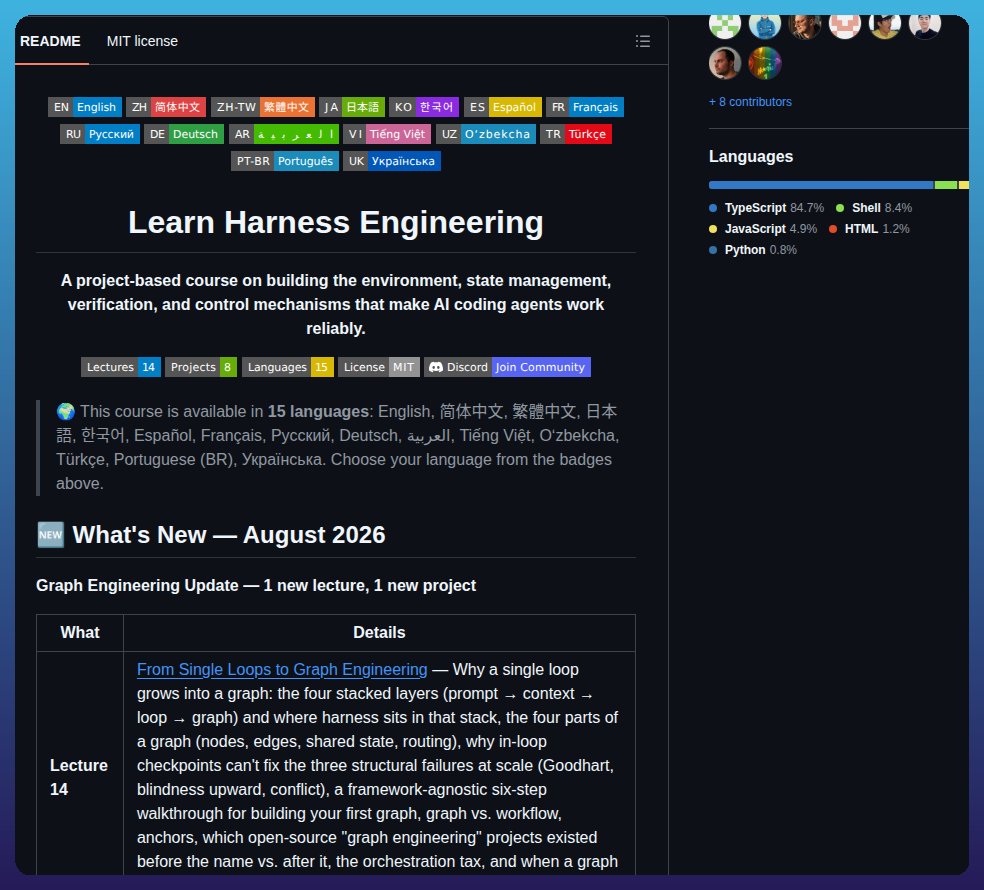
@tom_doerr shared (17 likes, 1,572 views, 24 bookmarks) the public Learn Harness Engineering course. The attached repo screenshot matters because it makes the field concrete rather than rhetorical: 14 lectures, 8 projects, 15 languages, and an August update on graph engineering and reliable control mechanisms.
@SeraAndroid explained (2 likes, 1 reply, 509 views, 2 bookmarks) the day’s cleanest operator rule: use ADK when you need to own topology, routing, state, approvals, and failure handling; use a Managed Agent when you want a bounded hosted runtime that already has the loop. The attached diagram made the distinction visible by contrasting “you own the workflow” with “Google runs the harness.”

Discussion insight: The most informative replies were not asking for smarter models. They were asking how to keep failures bounded, turn production mistakes into regressions, and decide when to own the loop versus rent it.
Comparison to prior day: On 2026-08-17, the strongest control-surface discussion focused on review depth, dashboards, and persistent computers. On 2026-08-18, the center of gravity moved lower in the stack toward runtime ownership, state, governance, and verification.
1.2 Credits, quotas, and routing workarounds kept reshaping daily tool choice (🡕)
A second cluster focused on the economics of actually using coding agents all week. The conversation was no longer just “this plan is expensive.” It was about weekly resets, usage-credit popups, temporary quota increases, free fallback models, and hand-built routing layers that spread work across vendors.
@melvindvivas captured (97 likes, 15 replies, 4,820 views) the continuing Codex reset frustration in one sentence, and the replies supplied the evidence density: one $200 Pro subscriber said routine tasks that once fit inside the week now burn through quota in roughly two days, another said they were simply waiting for the reset window, and others discussed moving work elsewhere while they wait.
@monosarin posted (22 likes, 5 replies, 865 views) the most concrete visual proof that consumer AI-coding plans are being remetered. The screenshot shows Fable 5 moving from a bundled plan feature to usage credits with a $100 promotional buffer, and the post interprets that small billing message as a sign that work-based pricing is replacing flat subscriptions for heavy agent use.

@RoundtableSpace relayed (12 likes, 6 replies, 7,403 views) that @ClaudeDevs extended the 50% Claude Code weekly limit increase through August 31 but still warned that capacity may remain tight. That made the signal less “good news” than “demand is outrunning clean quota policy.”
@qilua02 shared (1 like, 119 views, 4 bookmarks) a practical escape hatch: DeepSeek V4 Flash exposed through b.ai with a public base URL and a “Limited-Time Free” label, specifically positioned for plugging into OpenCode and other agents. @portgasdluci showed (2 likes, 139 views) the more advanced version of the same coping behavior by routing OpenCode through 9router across Codex, Copilot, Grok Build, GLM, MiMo, and free models.
Discussion insight: The coping behavior is already sophisticated. People are not just pausing work when they hit a wall; they are stitching together free tiers, round-robin routers, and cross-provider setups to keep sessions running.
Comparison to prior day: On 2026-08-17, users were still mostly arguing about Codex resets and account access. On 2026-08-18, the evidence broadened into explicit usage-credit UI, temporary Claude capacity policy, free DeepSeek fallbacks, and DIY routing dashboards.
1.3 The GitHub outage and Cursor Origin launch sharpened the battle over owning the repo surface (🡕)
Repository control became a bigger story than model bragging. One side of the day’s evidence showed how much AI coding still depends on GitHub’s shared control plane. The other side showed Cursor pushing beyond the editor into repos, pull requests, and code browsing with Origin.
@githubstatus reported (26 likes, 4 replies, 4,719 views, 10 bookmarks) that GitHub’s August 17 incident ran 7 hours 47 minutes and hit Issues, Pull Requests, APIs, Actions, and Copilot, with Copilot Token Service recovering last. The public postmortem is what made the post important: it gave concrete failure mechanics rather than a generic apology.
@dani_avila7 highlighted (3 likes, 234 views) the most striking line from that postmortem: a latent VS Code retry bug amplified traffic by roughly 10x during recovery. GitHub’s own incident page adds the scale of the blast radius, saying Copilot Token Service traffic spiked from a normal 7–9K requests per second to 70–100K RPS.

@MTSlive explained (65 likes, 3 replies, 7,181 views, 5 bookmarks) that Origin was rolling out in early beta with repo hosting on Cursor, GitHub migration, pull requests, agents in every repo, 22.6 commits per second, and sub-400ms global sync. A smaller @shawnchauhan1 post (1 like, 179 views) supplied the sharper strategic read: the point is not just a new host, but a move to own the full workflow surface around the model.

Discussion insight: The useful question was not “was the outage bad?” It was “how much of the modern AI-coding workflow shares one auth and repo surface, and who is trying to own an alternative?”
Comparison to prior day: On 2026-08-17, outage talk mainly showed up as availability pain. On 2026-08-18, the conversation got sharper: full postmortem mechanics on one side, and a credible push toward agent-native code hosting on the other.
1.4 Gemini 3.7 Flash and Antigravity stayed relevant, but the emphasis shifted from spectacle to throughput (🡖)
Google’s stack was still visible, but it was less dominant than the previous day’s launch-and-pricing cycle. The strongest evidence moved away from “look at the landing page demo” and toward applied workflows and speed claims from real users.
@googleaidevs showed (377 likes, 7 replies, 20,711 views, 155 bookmarks) Gemini 3.7 Flash parsing hundreds of PDF pages from a Victorian botanical book and turning them into an interactive APG IV classification visualization in Antigravity. That mattered because it was a more specific workload than the previous day’s general web demos: long-source extraction, structured classification, and interactive output in one hosted agent flow.
@danicat83 said (23 likes, 1,312 views, 4 bookmarks) the Gemini 3.7 Flash + Antigravity 2.0 combination felt like five months of work compressed into five days, and the quoted @rakyll note said the stack was “extremely fast” and only needed a bigger model once or twice over two weeks. That was the clearest first-hand validation that speed, not just feature count, is why the Google surface keeps drawing attention.
Discussion insight: The day’s Google evidence was less about surprise and more about operating feel: can a hosted agent stay fast enough, structured enough, and flexible enough that users stop reaching for larger models.
Comparison to prior day: On 2026-08-17, Antigravity discussion centered on launch pricing, surface parity, and flashy landing-page generation. On 2026-08-18, the stack was still present, but the evidence narrowed to applied document workflows and throughput.
2. What Frustrates People
Limits, credits, and resets are still too unpredictable
This was a High-severity frustration because it appeared across both high-engagement user complaints and official quota-policy messages. @melvindvivas captured (97 likes, 15 replies, 4,820 views) the Codex reset problem in a short complaint, but the replies carried the real signal: users said weekly quotas that previously lasted through normal work now disappear in roughly two days, forcing them to wait for the next reset or shift work elsewhere.
The problem was broader than Codex alone. @monosarin posted (22 likes, 5 replies, 865 views) a Fable 5 popup showing that a capability once bundled in-plan now consumes usage credits, while @RoundtableSpace relayed (12 likes, 6 replies, 7,403 views) an official @ClaudeDevs message extending the 50% weekly limit increase only through August 31 and warning about tight capacity. The coping behavior already points to what people want instead: @qilua02 plugged (1 like, 119 views, 4 bookmarks) a free DeepSeek fallback, while @portgasdluci assembled (2 likes, 139 views) a 9router/OpenCode setup that spreads work across multiple providers. This looks worth building for directly. The pain is not just price; it is the unpredictability of whether the tool will still be usable mid-week.
Shared repo and auth infrastructure can stall the whole AI-coding workflow at once
This was another High-severity frustration because the evidence was official, detailed, and tied directly to core developer workflow surfaces. @githubstatus reported (26 likes, 4 replies, 4,719 views, 10 bookmarks) that the August 17 GitHub incident lasted 7 hours 47 minutes and affected Issues, Pull Requests, APIs, Actions, and Copilot. The public postmortem added the damaging detail that Copilot Token Service recovered last and that the recovery path itself triggered new failure amplification.
@dani_avila7 highlighted (3 likes, 234 views) the sharpest example from the postmortem: a latent VS Code retry bug multiplied traffic by about 10x, and GitHub’s incident page says Copilot token traffic ballooned from 7–9K to 70–100K requests per second during recovery. The frustration here is not only downtime. It is that repository hosting, review, automation, and coding-agent auth are still coupled enough that one failure can freeze several layers of work at once. This looks worth building for directly or competitively: failover-friendly repo tooling, better degraded modes, and surfaces that do not assume one shared control plane.
Generic review still misses the failures that matter most in agent-driven automation
This was a High-severity frustration because the evidence included a public exploit chain, not just vibes about “AI code quality.” @adamhjk argued (4 likes, 2 replies, 766 views, 5 bookmarks) that the Snowflake workflow bug publicized by Wiz was exactly the kind of shell escape a general-purpose review could miss, and the linked Wiz writeup shows why the complaint mattered: a public GitHub issue title reached a vulnerable Actions workflow, GitHub Advanced Security reviewed the final PR revision without flagging the injection, and Wiz Red Agent adapted its payload until it exfiltrated a Jira token.
The replies under @akshay_pachaar thread (86 likes, 14 replies, 11,463 views, 124 bookmarks) pointed to the same structural frustration from a different angle: production agent work dies in governance, evaluation, and failure handling, not in demo generation. The visible coping pattern is to move quality earlier and make it more specific, whether through bespoke adversarial prompts, write-time enforcement like Plankton, or sandboxed automation like GitHub Agentic Workflows. This looks worth building for directly.
3. What People Wish Existed
A control plane for spend, limits, and fallback routing
What people kept signaling today was not loyalty to one flagship model. It was a need to know, before a session starts, which tool will still have usable quota and what the fallback should be when it does not. @melvindvivas surfaced Codex reset frustration, @monosarin showed Fable 5 moving behind usage credits, @RoundtableSpace passed along a temporary Claude Code quota increase with a capacity warning, and the immediate workarounds were @qilua02 offering a free DeepSeek route and @portgasdluci wiring 9router into OpenCode.
This is a practical need, not an aspirational one. People are already routing around confusing limits by hand. Opportunity: direct.
Hosted agents that stay fast without hiding the harness
The strongest hosted-agent demand was not “make the demo prettier.” It was “keep the cloud speed, but be explicit about who owns the loop.” @SeraAndroid framed ADK versus Managed Agents entirely around ownership of topology, state, routing, approvals, and failure handling. @akshay_pachaar treated governance, evaluation, and publication as first-class lifecycle stages, while @danicat83 and quoted @rakyll praised Gemini 3.7 Flash + Antigravity for raw speed.
The wish is clear: give users the throughput and convenience of a managed runtime, but make the boundaries around state, approvals, persistence, and recovery legible enough that they can trust it in real work. Opportunity: direct to competitive.
Code-specific adversarial review and safe automation instead of generic “AI review”
Today’s review frustration was specific enough to read like product requirements. @adamhjk said the Snowflake/Wiz bug called for bespoke adversarial review agents that understand GitHub Actions and shell injection, not generic review prompts. At the same time, @DotNetTrends showed GitHub Agentic Workflows packaging permissions, sandboxing, and structured tasks directly into repository automation, while @GithubProjects pointed to Plankton moving formatting, linting, and checks to file-edit time.
What people seem to want is not more automated comments. It is a workflow that knows the code surface, enforces the right checks before merge, and keeps agent writes inside reviewable boundaries. Opportunity: direct.
4. Tools and Methods in Use
| Tool | Category | Sentiment | Strengths | Limitations |
|---|---|---|---|---|
| Google Agents CLI / Agent Runtime | Framework / lifecycle runtime | (+) | Turns setup, build, deploy, govern, evaluate, and publish into one prompt-driven workflow | Still requires teams to understand and trust a fairly opinionated hosted lifecycle |
| Microsoft Agent Harness | Agent runtime / harness | (+) | Packages loops, resumable history, compaction, todos, approvals, tracing, and skills into one layer | Another harness abstraction to learn, and today’s discussion was still relatively light |
| ADK | Agent framework | (+/-) | Gives explicit control over topology, routing, approvals, state, evaluation, and deployment | You also inherit the operational complexity and failure handling |
| Antigravity Managed Agents | Hosted agent runtime | (+/-) | Hosted Linux sandbox, reusable environments, and strong perceived speed with Gemini 3.7 Flash | Managed boundaries mean persistence and workflow ownership must be handled deliberately |
| Gemini 3.7 Flash | LLM / coding model | (+) | Fast enough to drive long-source extraction and strong week-to-week productivity claims | Most praise today depended on Google’s hosted surface rather than standalone model comparison |
| Codex | Coding agent | (+/-) | Still the default reference point in pricing and routing conversations | Weekly reset complaints and routine-task quota exhaustion remain visible |
| Claude Code / Fable 5 | Coding agent | (+/-) | Strong enough demand to trigger temporary weekly-limit expansion and a large builder ecosystem | Usage credits and capacity warnings keep undercutting predictability |
| DeepSeek V4 Flash / V4 Pro offers | LLM / API fallback | (+) | Free or near-free fallback, OpenAI-compatible API, and 1M-context positioning | The offers look promotional and short-lived rather than stable operating policy |
| 9Router + OpenCode | Routing layer | (+) | Cross-provider routing, cost visibility, and access to free models inside one workflow | Requires manual API-key setup and another layer of tuning |
| GitHub Agentic Workflows | Repository automation | (+) | Markdown-defined tasks, sandboxed read-only defaults, safe-outputs for writes, multi-engine support | Workflow authors still need to review permissions, tools, network access, and generated files carefully |
| Plankton | Write-time quality gate | (+) | Runs formatting, linting, security checks, and agentic fixes on file edit instead of at PR time | Research-stage and dependent on Claude Code hook internals |
| Cursor Origin | Code host / repo surface | (+/-) | Extends an AI editor into repos, PRs, and code browsing | Early beta, with public evidence focused more on positioning than day-two operation |
The satisfaction spectrum favored tools that either made hosted work feel fast and complete or made the surrounding control layer more explicit. Gemini 3.7 Flash inside Antigravity won praise for speed, while lifecycle-heavy tools won attention when they clarified ownership, sandboxing, approvals, and persistence.
The dominant workarounds were provider routing and policy layers. When quotas or credits felt unstable, people reached for free DeepSeek routes, 9router-style round-robin setups, or multi-harness apps instead of simply waiting. When review felt too generic, they moved checks earlier with write-time gates or encoded permissions and outputs into the workflow itself.
Migration pressure is now pulling in three directions at once: from flat subscriptions toward metered usage, from single-tool loyalty toward cross-provider routing, and from standalone editors toward full workflow surfaces that include repos, PRs, sandboxes, and automation. Competitive dynamics looked less like a pure model race and more like a race to own the operating layer around the model.
5. What People Are Building
| Project | Who built it | What it does | Problem it solves | Stack | Stage | Links |
|---|---|---|---|---|---|---|
| Learn Harness Engineering | walkinglabs | Project-based course on environments, state, verification, and control for reliable coding agents | Gives practitioners a concrete path to learn harness engineering instead of rediscovering runtime patterns ad hoc | TypeScript, Shell, JavaScript, HTML, Python | Shipped | post · repo |
| GitHub Agentic Workflows | GitHub | Defines AI-powered repository automation in Markdown, compiles it to GitHub Actions, and isolates writes through safe outputs | Lets teams automate review, triage, docs, and maintenance without hand-rolled agent scripts in CI | Go, Markdown/YAML, GitHub Actions, multi-engine agent runtime | Beta | post · repo |
| Plankton | alexfazio | Write-time code-quality enforcement for Claude Code hooks | Moves formatting, linting, and security checks from PR time to file-edit time | Shell, Python setup, Ruff, uv, ShellCheck, Hadolint, Claude hook subprocesses | Alpha | post · repo |
| book-to-skill | virgiliojr94 | Turns books, doc folders, and source collections into structured agent skills loaded on demand | Stops teams from repeatedly re-uploading and re-searching large references during coding sessions | Python extractor, HTML docs, SKILL.md, chapter files, Copilot CLI/Amp/Claude Code hosts |
Shipped | post · repo |
| Piotr Jura’s native multi-agent control app | @piotr_jura | Runs, reviews, merges, and routes multiple agents across multiple projects from one native macOS/iPhone surface | Reduces harness sprawl across separate apps, worktrees, subscriptions, and review flows | Native macOS/iPhone app, worktrees, MCP, Codex, Claude Code, OpenCode, Kimi, Cursor, Pi/Qwen | Alpha | post |
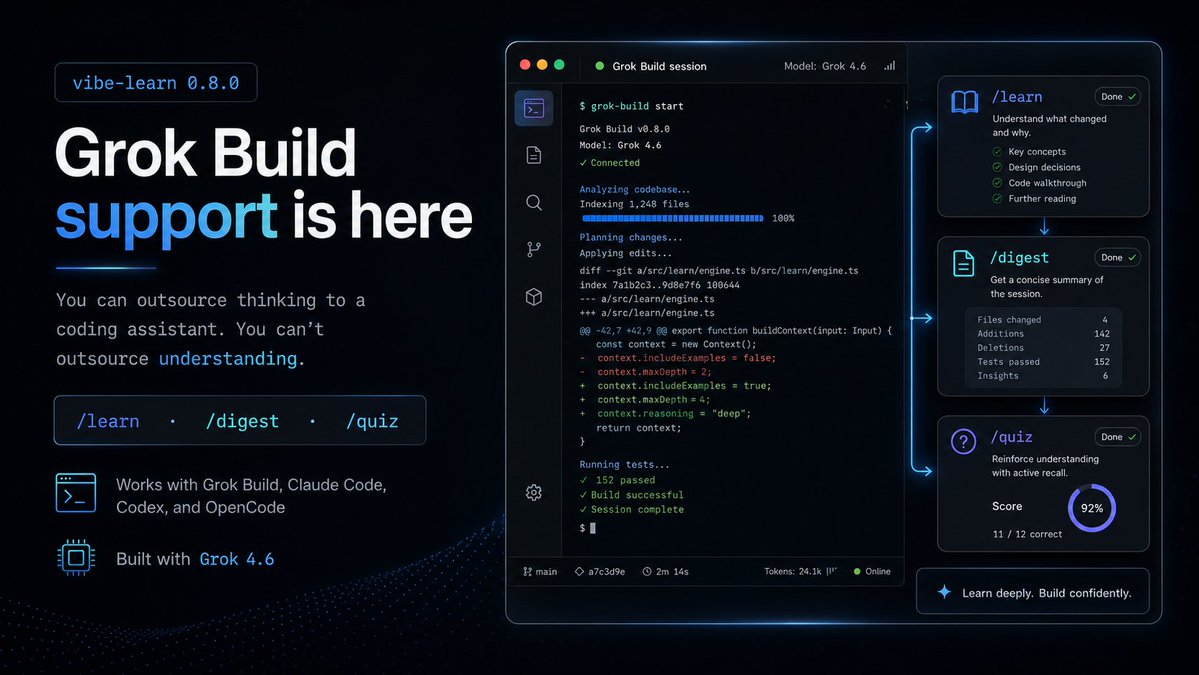
| vibe-learn | gkaria | Records what the coding assistant did and exposes /learn, /digest, and /quiz to turn the session into a study artifact |
Helps developers understand agent-written changes instead of accepting them as opaque output | Shell, JavaScript, local hooks, JSONL session logs, Claude Code/Codex/OpenCode/Grok Build support | Shipped | post · repo |
GitHub Agentic Workflows and Plankton attacked the same bottleneck from different angles: how to keep agent-written changes inside a reviewable, enforceable quality envelope. gh-aw pushes that logic into Markdown-defined, sandboxed repository automation, while Plankton pushes it left into file-edit time with linters and hook-driven fixes.

book-to-skill and vibe-learn focused on knowledge retention instead of more raw generation. book-to-skill distills PDFs and document sets into reusable skills so agents can load only the relevant chapter, while vibe-learn turns a finished coding session into a digest, follow-up questions, and a small cross-session knowledge ledger.

Piotr Jura’s app was the clearest “control plane for the control planes” build in the set. The screenshots showed multiple projects, per-project review queues, model selection across hosted and local options, and a native interface for switching between worktrees and agent sessions without juggling separate harness apps.

The repeated build pattern was consistent with the rest of the day’s discussion: builders were mostly not launching new base models. They were building harnesses, quality gates, repository automation, knowledge distillation, and learning layers so existing agents could be routed, trusted, inspected, and understood.
6. New and Notable
GitHub’s postmortem named the retry storm, not just the outage
The notable part of @githubstatus post (26 likes, 4 replies, 4,719 views, 10 bookmarks) was not simply that GitHub had a bad day. It was that the public incident report gave a concrete mechanism readers can reason about: a network-saturation failure in Central US, regional failover, and a latent VS Code retry bug that amplified traffic by about 10x while Copilot Token Service was trying to recover. @dani_avila7 pulled out (3 likes, 234 views) the key sentence, and the incident page adds the scale: Copilot token traffic jumped from roughly 7–9K to 70–100K requests per second.
Wiz made a full AI-on-AI CI exploit chain public
The second notable signal was how specific the Snowflake/Wiz incident became in public. @adamhjk framed (4 likes, 2 replies, 766 views, 5 bookmarks) the lesson as “generic review is not enough,” and the linked Wiz report supplies the concrete chain: a public GitHub issue title hit a vulnerable GitHub Actions workflow, GitHub Advanced Security reviewed the final PR revision without flagging the injection, and Wiz Red Agent adapted its payload until it exfiltrated a Jira token. That turns “AI review can miss bugs” into a public, end-to-end example of why teams now want code-specific adversarial review and tighter workflow boundaries.
7. Where the Opportunities Are
[+++] Spend-aware routing and quota control planes — Evidence runs across sections 1-4: Codex reset complaints, Fable 5 usage credits, Anthropic’s temporary Claude Code limit increase, DeepSeek fallback sharing, and 9router/OpenCode routing all point to the same gap. Users do not just want cheaper models. They want a layer that predicts capacity, routes around caps, and keeps work moving when one provider meters harder than expected.
[+++] Harness verification, adversarial review, and safe repository automation — Akshay Pachaar’s lifecycle post, Learn Harness Engineering, GitHub Agentic Workflows, Plankton, and the Wiz/Snowflake exploit all reinforce the same need. The strong opportunity is not another coding demo. It is tooling that owns governance, evaluation, permissions, and code-specific review before agent output reaches production.
[++] Multi-agent control surfaces across repos, worktrees, and hosts — Cursor Origin, GitHub’s outage coupling, and Piotr Jura’s native control app all suggest that workflow ownership is moving outward from the editor. The moderate opportunity is a surface that can coordinate projects, reviews, and agent sessions across hosted and local runtimes without forcing users to live inside one vendor’s full stack.
[+] Reference distillation and session-learning layers — book-to-skill and vibe-learn show an emerging but real pattern: teams are starting to treat documentation and past sessions as assets that should be loaded, queried, and reviewed structurally rather than recopied into every prompt. The signal is earlier than the others, but it maps to a clear pain around repeated context loading and weak human understanding of agent-made changes.
8. Takeaways
- Harness engineering moved into the open. The strongest discussion was about lifecycle ownership, runtime boundaries, and evaluation, not prompt tricks. (source)
- Metered usage is reshaping AI-coding behavior in real time. Credit popups, reset complaints, and temporary quota policy changes are already pushing users toward fallback models and multi-provider routing. (source)
- Repository and auth surfaces are now strategic dependencies for AI coding. GitHub’s incident report and Cursor’s Origin positioning both point to the same conclusion: whoever owns the repo surface owns a large part of the workflow. (source)
- Google’s hosted stack still has real pull when it feels fast enough. The day’s best Gemini evidence was not just a flashy demo; it was applied document work and practitioner testimony about sustained throughput. (source)
- Builders are concentrating on the operating layer around agents rather than on new base models. Today’s notable projects focused on repository automation, write-time quality gates, reference distillation, and post-session understanding. (source)