Twitter AI Coding - 2026-08-20
1. What People Are Talking About
1.1 Antigravity turned into a distribution layer across IDEs, enterprise plans, and access tiers (🡕)
The strongest volume shift was around Google moving Antigravity from a single-agent product into a wider delivery surface. At least seven items supported it: the IDE-extension launch, Gemini Enterprise expansion, student-plan giveaways, a hidden remote/mobile interface sighting, CLI customization docs, and multiple reactions treating Antigravity as the cheapest or most convenient way to reach other models. Compared with 2026-08-19, when the coding conversation leaned harder on Codex ROI and governed review loops, 2026-08-20 focused more on where Antigravity can run and who now gets access.
@antigravity announced (812 likes, 56 replies, 38,764 views, 148 bookmarks) that Antigravity IDE extensions were live for Visual Studio Code, Visual Studio, Zed, and JetBrains. The replies added useful operator detail: one user asked whether the extension could hook into VS Code's "Open in Agents" surface, while another could not find the marketplace listing yet, so the demand was not just for the model but for tighter IDE-native placement and rollout clarity.
@GoogleCloudTech said (147 likes, 7 replies, 14,319 views, 25 bookmarks) that Antigravity was expanding to more Gemini Enterprise customers, and the linked Google Cloud post made the enterprise pitch explicit: supported IDEs, CLI access, and new governance and FinOps controls for software-delivery teams. @antigravity repeated (290 likes, 8 replies, 17,562 views, 29 bookmarks) the same launch directly to developers, which turned the story from a blog-post detail into a broad public release signal.
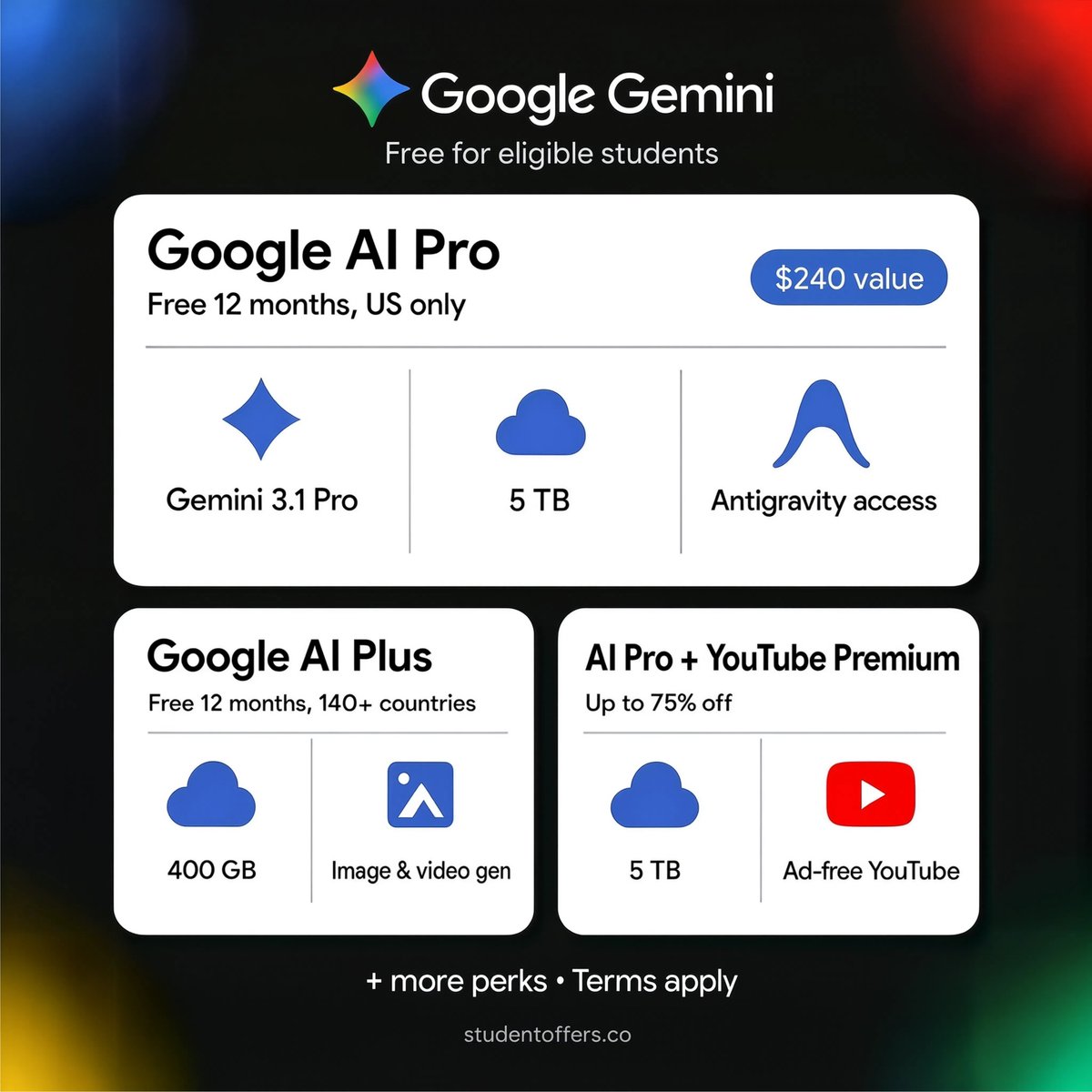
@StudentOffersHQ reported (61 likes, 2 replies, 6,544 views, 29 bookmarks) that Google AI Pro was free for US students for 12 months, Google AI Plus was free in 140+ countries, and that Antigravity access sat inside AI Pro and the AI Pro plus YouTube bundle rather than AI Plus. The three-card image mattered because it showed the exact entitlement split, not just a headline about a promotion.
@ash_twtz asked (45 likes, 33 replies, 1,414 views) whether everyone was now using Antigravity "just for Claude," which is a small but revealing community signal: some of the perceived value was already shifting from Google's own model quality to Antigravity's workflow surface and access mechanics. Separately, @thtbee_ showed (105 likes, 5 replies, 10,445 views, 38 bookmarks) a hidden remote-friendly Antigravity interface running locally, adding more evidence that multi-surface delivery had become part of the product story.
Discussion insight: The replies were less about benchmark bragging and more about distribution questions: marketplace visibility, IDE integration points, and whether Antigravity had quietly become the shell people wanted even when they preferred another model underneath.
Comparison to prior day: On 2026-08-19, enterprise agent talk was mostly about Codex ROI and safety posture. On 2026-08-20, the center of gravity shifted toward Antigravity's editor footprint, license packaging, and surface expansion.
1.2 Collaboration surfaces and shareable agent context started to matter as much as raw generation (🡕)
Another strong cluster treated AI coding as coordination work rather than solo prompting. At least five items supported it: Slack Code's launch, Slack's follow-up rollout notes, OpenAI's shared-thread release, Record & Replay distribution for ChatGPT Work and Codex, and GitHub's own push to use the Copilot app beyond strict code authoring. Compared with the prior day's emphasis on hard ROI and proof artifacts, the story here was about where agent work gets reviewed, replayed, and handed off.
@SlackHQ introduced (350 likes, 19 replies, 37,559 views, 102 bookmarks) Slack Code as a way to run Claude Code, Devin, Copilot, ChatGPT, and Vercel agents inside shared channels. A second Slack post (121 likes, 17 replies, 16,239 views, 41 bookmarks) clarified the useful operational detail in the replies: rollout was staggered over about a week, and one user highlighted that the channel-level diffs and live HTML preview were the part worth keeping because humans still wanted to approve before shipping.
@OpenAIDevs said (276 likes, 22 replies, 17,535 views, 72 bookmarks) that shared threads in Codex and ChatGPT Work now let teams pass around a read-only link with the full reasoning trail behind a pull request, deep dive, or handoff. The strongest reply compressed the value into one phrase: PR context should not require screenshot archaeology. @OpenAIDevs also reshared (67 likes, 4 replies, 9,042 views, 9 bookmarks) Record & Replay, which turns a demonstrated workflow into an inspectable skill instead of relying on another long natural-language explanation.
@pierceboggan wrote (46 likes, 4 replies, 3,348 views, 9 bookmarks) that the GitHub Copilot app was already being used for telemetry analysis, specs, and PowerPoints in addition to coding, and later pointed out (19 likes, 4 replies, 1,512 views, 5 bookmarks) that BYOK let users route the same surface through Cerebras, OpenRouter, or LM Studio models. That is another version of the same theme: the sticky product layer is increasingly the workspace, not the underlying model alone.
Discussion insight: The highest-signal replies did not ask for more autonomy. They asked for better rollout clarity, review checkpoints, live previews, and reusable traces of what the agent already did.
Comparison to prior day: On 2026-08-19, the discussion centered on whether agents could justify their cost and prove their safety. On 2026-08-20, the community spent more time on how agent work becomes a shared artifact that teammates can inspect and redirect.
1.3 Operators spent the day reading quotas, retry storms, and broken session state instead of just writing code (🡕)
The sharpest negative theme was operational overhead. At least six items supported it: claims that Codex limits were cut, complaints that a $200 OpenAI Pro plan could be exhausted in a day, GitHub's August 17 postmortem, a separate warning about Copilot Cloud Agent status lag, Codex remote-session failures, and a practitioner's claim that coding-agent vendors are not naturally incentivized to lower customer spend. Compared with 2026-08-19, when users were already digging through hidden counters and promotions, 2026-08-20 sounded more frustrated because the failures were blocking real work instead of just making pricing harder to predict.
@alexgetmancom reported (88 likes, 15 replies, 2,730 views, 10 bookmarks) that NerfTrack users believed weekly Codex value on ChatGPT Plus had fallen from roughly $160 to about $80 within days. The image is informative because it shows the step-down visually rather than leaving the claim at anecdote.

@bridgemindai said (43 likes, 21 replies, 1,387 views) that one day of Codex work had already consumed the weekly GPT-5.6 Sol quota on an OpenAI Pro subscription, while the replies made the tradeoff explicit: some agreed the limits had become terrible, but others still preferred Codex quality to cheaper or looser competitors. @shensi added (30 likes, 1 reply, 200 views) a more structural complaint from the operator side: customers were telling Merge that most AI spend now lands in coding agents, and the vendors selling those agents make more when usage climbs.
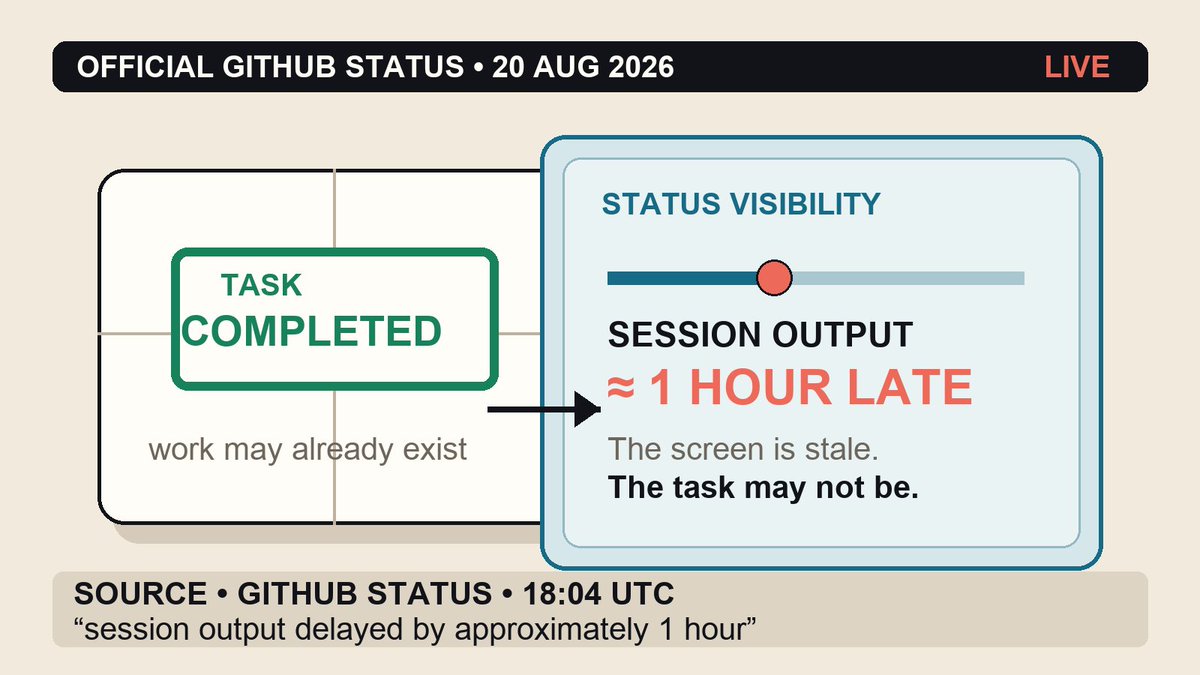
Reliability problems landed just as hard. @twtayaan summarized (17 likes, 2 replies, 2,137 views, 5 bookmarks) GitHub's August 17 postmortem: an Istio sidecar concurrency cap blocked autoscaling, traffic failed over, and a latent Visual Studio Code retry bug pushed the Copilot Token Service from its normal 7,000 to 9,000 requests per second up to roughly 70,000 to 100,000. @stackzz focused (53 likes, 151 views) on the adjacent failure mode in Copilot Cloud Agent: tasks could finish while the status surface lagged by about an hour, which makes duplicate launches or duplicate deployments an operator error waiting to happen.
@elijahmuraoka_ described (4 likes, 169 views) a separate Codex failure where switching between remote-session chats froze the app, produced repeated "conversation state not found" errors, and triggered repeated reconnects. Even with modest engagement, the post is a strong firsthand signal because it includes repeatable steps and differentiates a 7 MB broken chat from a 355 MB chat that still opens.
Discussion insight: The common complaint was not merely that tools were expensive or occasionally down. It was that state could not be trusted: quota ceilings changed, retries cascaded, dashboards went blind, and session history itself could lock the app.
Comparison to prior day: On 2026-08-19, users were still instrumenting spend with DevTools and promotional fallbacks. On 2026-08-20, the operator mood got harsher because pricing, status, and session-state failures were colliding in the same workday.
1.4 Builders packaged harnesses, plugins, and spend-control planes around the agent instead of betting on one prompt (🡕)
The most credible builder activity sat one layer above generation. At least seven items supported it: AIUsage's cross-provider quota dashboard, TeamAI's shared harness manager, AI Design Components' skill bundles, Learn Harness Engineering's new course material, Rstack's multi-client plugin, OpenAI Cookbook guidance for long-running Codex workflows, and a prompt-template repo meant to keep builders from starting from zero. Compared with 2026-08-19, when governed surfaces and verification loops were already rising, 2026-08-20 made the packaging more explicit: people were shipping reusable systems for state, rules, skills, and cost control.
@tom_doerr shared (11 likes, 1,584 views, 6 bookmarks) AIUsage, a macOS dashboard that tracks quotas, costs, and accounts across 12+ providers while also exposing native proxies for Claude, Codex, and OpenCode. The repo description is unusually concrete for this genre: multi-account switching, per-model cost views, unified local endpoints, and a managed CLIProxyAPI gateway rather than another vague "router" claim.

@abhishek__AI highlighted (1 like, 22 views) Tencent's TeamAI, which keeps skills, rules, docs, hooks, and MCP configs in Git and syncs them across Claude Code, Codex, Cursor, CodeBuddy, and WorkBuddy. The public README matters here because it turns the tweet into a concrete pattern: auto-pull on session start, team hooks, MCP injection, recall subagents, and a searchable knowledge base instead of another one-off wrapper.

@DanKornas surfaced (2 replies, 419 views) AI Design Components, whose docs describe 76 Claude skills across 10 domains and guided skillchains for dashboards, REST APIs, Kubernetes, and RAG pipelines. @TheUltronAi surfaced (3 likes, 2 replies, 22 views) Learn Harness Engineering, a 14-lecture, 8-project course on instructions, state, verification, scope, loops, and graph engineering. @rspack_dev added (17 likes, 2 replies, 1,723 views, 5 bookmarks) a narrower but similar packaging move with the Rstack Agent Plugin: one Agent Plugins 1.0 bundle that carries Rstack skills across GitHub Copilot, Codex, Cursor, and other compatible clients.
@danteisshipping called out (22 views) OpenAI Cookbook guidance for long-running Codex workflows, and @A1KingLeo shared (1 like, 2 replies, 134 views) the open-source AI Builder Prompt Structures repo, which packages 46+ application structures and template files for builders using Cursor, Bolt.new, Lovable, Windsurf, Cline, or Aider. The common thread across all of these is explicit external state: skills on disk, templates in Git, shared hooks, reusable playbooks, and knowledge recall outside the chat window.
Discussion insight: The most believable builder story was no longer "I found the perfect prompt." It was "I packaged the surrounding system so the agent can reuse rules, share state, and survive provider switches."
Comparison to prior day: On 2026-08-19, people were already asking for receipts and verification. On 2026-08-20, the builders most worth watching shipped those ideas as reusable harnesses, plugin packs, and spend-control layers.
2. What Frustrates People
Quota volatility and pricing opacity make daily planning impossible
This was a High-severity frustration because the evidence came from both user complaints and builders racing to patch around the problem. @alexgetmancom said (88 likes, 15 replies, 2,730 views, 10 bookmarks) that NerfTrack users believed Codex value on ChatGPT Plus had effectively been cut in half, while @bridgemindai said (43 likes, 21 replies, 1,387 views) that a $200 OpenAI Pro plan could be drained by one heavy Codex day. The replies did not disagree on the pain. They argued only about whether users should tolerate it because Codex still performs better on the hardest tasks.
The coping behavior shows how practical the pain already is. @tom_doerr shared (11 likes, 1,584 views, 6 bookmarks) AIUsage, a dashboard for quotas, costs, and account switching across 12+ providers, and @shensi argued (30 likes, 1 reply, 200 views) that coding-agent vendors have no natural incentive to help customers spend less. This looks worth building for directly.
State visibility failures are still expensive enough to block real work
This was also High severity because the failures were not hypothetical. @stackzz warned (53 likes, 151 views) that Copilot Cloud Agent tasks could finish while status visibility lagged by about an hour, creating a dangerous middle state where operators cannot tell whether to retry. @twtayaan summarized (17 likes, 2 replies, 2,137 views, 5 bookmarks) GitHub's own postmortem, where a retry storm from Visual Studio Code kept Copilot degraded long after broader recovery had begun.
@elijahmuraoka_ described (4 likes, 169 views) the same trust problem at the session layer: switching between remote Codex chats could freeze the app and produce repeated "conversation state not found" errors. When the agent's state, the control plane's state, and the session browser's state can all disagree, users stop trusting the workflow surface itself. This looks worth building for directly.
Collaboration layers still need clearer rollout and stronger approval boundaries
This was a Medium-severity frustration: less destructive than outages or quota shocks, but still strong enough to show up immediately in replies. @SlackHQ launched (350 likes, 19 replies, 37,559 views, 102 bookmarks) Slack Code as shared multiplayer agent work, but the first useful reply was "how do I use it?" and the follow-up Slack post (121 likes, 17 replies, 16,239 views, 41 bookmarks) had to clarify that rollout was staggered. Another reply said the real value was channel-level diffs and live preview because a human still wanted to approve before anything shipped.
The same boundary concern showed up in the positive OpenAI launches. @OpenAIDevs framed (276 likes, 22 replies, 17,535 views, 72 bookmarks) shared threads as a way to expose the build process instead of passing screenshots around, and Record & Replay (67 likes, 4 replies, 9,042 views, 9 bookmarks) turned demonstrated workflows into inspectable skills. People clearly want collaborative surfaces, but they want them to stay reviewable and understandable. This looks worth building for directly.
3. What People Wish Existed
A cost control plane that tells the truth before a run starts
The clearest practical need was a reliable way to see quotas, account state, and fallback routes before work begins. @alexgetmancom reported (88 likes, 15 replies, 2,730 views, 10 bookmarks) that users believed Codex value had dropped materially, while @bridgemindai said (43 likes, 21 replies, 1,387 views) that premium Codex usage could exhaust a plan in a day. @tom_doerr responded (11 likes, 1,584 views, 6 bookmarks) with AIUsage, while @shensi explained (30 likes, 1 reply, 200 views) why third-party spending controls may matter more than vendor-native ones.
This is a practical need, not an aspirational one. Users are already stitching together dashboards, proxies, and BYOK routes to compensate. Opportunity: direct.
Team-visible context and replay artifacts that survive handoffs
People repeatedly asked for ways to show the work instead of summarizing it after the fact. @SlackHQ framed (350 likes, 19 replies, 37,559 views, 102 bookmarks) Slack Code around shared channels for agents and teammates, while @OpenAIDevs pushed (276 likes, 22 replies, 17,535 views, 72 bookmarks) shared threads as read-only build traces for pull requests and handoffs. Record & Replay (67 likes, 4 replies, 9,042 views, 9 bookmarks) sharpened the same demand further by turning repeated workflows into inspectable skills.
This is both practical and emotional: teams want less ambiguity, fewer screenshots, and less fear that context will disappear between one agent run and the next. Opportunity: direct.
One harness that can be reused across every agent shell
The deepest unmet need was not another model. It was a shared operating system for skills, rules, docs, hooks, templates, and memory. Tencent's TeamAI gives one answer with Git-native sync and recall, AI Design Components gives another with 76 domain-specific Claude skills and guided skillchains, Learn Harness Engineering teaches the underlying pattern directly, and @rspack_dev packaged (17 likes, 2 replies, 1,723 views, 5 bookmarks) Rstack skills through Agent Plugins 1.0 for multiple clients.
This need is practical and highly competitive. The product that wins it becomes the reusable layer above Claude Code, Codex, Copilot, Cursor, and the next shell after them. Opportunity: direct to competitive.
Remote and session-safe agent clients
There was also a narrower but real workflow need for agents that remain usable away from the desktop and do not collapse under session churn. @thtbee_ surfaced (105 likes, 5 replies, 10,445 views, 38 bookmarks) a hidden remote-friendly Antigravity interface, while @elijahmuraoka_ described (4 likes, 169 views) Codex chats freezing when moving between remote sessions. The evidence is still early, but it points to a practical operator need rather than a novelty feature.
This is a practical but more competitive opportunity than the first three. The demand exists, but the product shape is still emerging. Opportunity: competitive.
4. Tools and Methods in Use
| Tool | Category | Sentiment | Strengths | Limitations |
|---|---|---|---|---|
| Antigravity | Coding agent / IDE shell | (+/-) | Broadened to VS Code, Visual Studio, Zed, JetBrains, enterprise licenses, and student funnels; CLI supports quota-aware status-line customization | Some users mainly value it as a shell for other models; extension rollout and discoverability still look uneven |
| Codex | Coding agent | (+/-) | Shared threads, Record & Replay, and long-running workflow guidance make it easier to hand off or reuse work | Users reported weaker limits, rapid quota burn, reconnect churn, and remote-session freezes |
| Slack Code | Collaboration layer | (+/-) | Shared code channels, multi-agent orchestration, diff review, and live preview shift coding into a team-visible surface | Rollout was staggered and the first replies showed onboarding confusion; humans still want explicit approval before shipping |
| GitHub Copilot app | Multi-model agent app | (+/-) | BYOK support and broad use beyond coding make it a flexible work surface for developers and non-developers | Copilot Cloud Agent status lag and interface bug reports weaken trust in the control plane |
| AIUsage | Spend / proxy control plane | (+) | Unifies quotas, costs, accounts, and native proxies across 12+ providers and multiple coding-agent clients | Early-stage and macOS-focused; most valuable when users already juggle several providers and accounts |
| TeamAI | Harness manager | (+) | Git-native sync for skills, rules, hooks, docs, MCP configs, and knowledge recall across multiple agent shells | Requires harness discipline and repo setup; public engagement was still early on this date |
| AI Design Components | Skill library | (+) | 76 production-ready Claude skills across 10 domains, plus guided skillchains and installable plugin groups | Claude-centric and setup-heavy compared with lighter one-off templates |
| Learn Harness Engineering | Course / methodology | (+) | Turns reliability into a teachable system with lectures, projects, templates, and frontier-harness teardowns | Educational rather than turnkey; teams still need to implement the patterns themselves |
| Rstack Agent Plugin | Agent plugin pack | (+) | Packages one skill bundle for Copilot, Codex, Cursor, and other Agent Plugins 1.0 clients | Evidence was limited to the launch post, so ecosystem depth and adoption were still unclear |
Overall sentiment was mixed but increasingly sophisticated. Users were happiest when a tool preserved a familiar shell while improving visibility, reuse, or shared review. The common workaround was not a full migration from one model to another, but a rerouting pattern: use Antigravity for Claude, use Copilot app with BYOK, or add AIUsage or another proxy layer so the shell stays the same while billing and models change underneath. The competitive battle is no longer only model versus model. It is shell versus shell, harness versus harness, and billing layer versus billing layer.
5. What People Are Building
| Project | Who built it | What it does | Problem it solves | Stack | Stage | Links |
|---|---|---|---|---|---|---|
| Slack Code | @SlackHQ | Runs AI coding agents in shared Slack channels with human review | Makes agent work visible, discussable, and approvable by the rest of the team | Slack + Claude Code/Claude Tag/Devin/Copilot/ChatGPT/Vercel integrations | Beta | launch, rollout |
| AIUsage | @tom_doerr | Tracks quotas, costs, accounts, and proxy routes across 12+ AI providers | Agent spend, account sprawl, and provider-switching overhead | SwiftUI macOS app + native proxies for Claude/Codex/OpenCode + CLIProxyAPI gateway | Shipped | post, repo |
| TeamAI | Tencent | Syncs skills, rules, docs, hooks, MCP configs, and knowledge recall across agent clients | Keeps a team's harness and knowledge layer consistent across shells | npm CLI + Git-native sync + hooks + MCP + recall subagent | Shipped | post, repo |
| AI Design Components | ancoleman | Packages 76 Claude skills and guided skillchains for full-stack work | Repeatedly re-explaining conventions, patterns, and domain rules to the agent | Claude skills + plugin groups + docs site | Shipped | post, repo |
| Learn Harness Engineering | walkinglabs | Teaches teams how to build reliable harnesses with lectures, templates, and projects | Helps teams move from ad hoc prompting to explicit instructions, state, verification, and loop design | GitHub Pages course + markdown docs + templates + harness-creator skill | Shipped | post, repo |
| AI Builder Prompt Structures | @A1KingLeo | Publishes 46+ reusable app structures and .template files for AI coding agents |
Reduces blank-page prompt writing for common product categories | Template repo + ER meta-model + framework-specific scaffolds | Shipped | post, repo |
| Rstack Agent Plugin | @rspack_dev | Ships one Agent Plugins 1.0 bundle that carries Rstack skills across clients | Avoids duplicating the same skill setup for each coding shell | Agent Plugins 1.0 + Rstack skill bundle | Beta | post |
AIUsage stood out because it attacked the exact economic pain users were describing that same day. The public repo is much more specific than the average "AI router" claim: native Codex, Claude, and OpenCode proxy tracks, multi-account switching, unified cost views, and a managed gateway that can present one local endpoint while changing the upstream model or account underneath.
TeamAI, AI Design Components, and Learn Harness Engineering all point to the same builder pattern from different directions. TeamAI treats skills, rules, hooks, and recall as a Git-synced team asset; AI Design Components turns domain expertise into installable skill packs; Learn Harness Engineering turns the surrounding system into a teachable discipline with templates and explicit subsystems. That is strong evidence that the scarce resource is no longer raw generation alone. It is reusable operational structure around the model.

Slack Code and the Rstack Agent Plugin show the same portability trend on the collaboration side. Instead of asking teams to abandon their preferred shells, they try to distribute agent behavior into familiar surfaces: Slack for multi-person review, or one plugin format for multiple clients. The repeated build pattern is portability, not lock-in.
6. New and Notable
Antigravity's remote-friendly surface looks closer than expected
@thtbee_ showed (105 likes, 5 replies, 10,445 views, 38 bookmarks) a hidden touch-optimized Antigravity experience running locally and argued that the amount of remote/mobile infrastructure already present made an official integration look closer than expected. That matters because it suggests the next competitive front may be agent access across desktop, terminal, and remote/mobile contexts instead of one more benchmark jump.
GitHub's August 17 postmortem turned agent reliability into a concrete SRE story
@twtayaan surfaced (17 likes, 2 replies, 2,137 views, 5 bookmarks) a postmortem chain with named failure points: an Istio sidecar concurrency cap, autoscaling that did not account for it, failover, and then a Visual Studio Code retry bug that pushed Copilot Token Service traffic from roughly 7,000 to 9,000 requests per second up to 70,000 to 100,000. Together with @stackzz warning (53 likes, 151 views) about Cloud Agent status lag, this made agent operations feel less like ordinary app downtime and more like a new reliability discipline.
The coding shell is escaping the developer-only box
@pierceboggan said (46 likes, 4 replies, 3,348 views, 9 bookmarks) that the GitHub Copilot app was already being used for telemetry, specs, and PowerPoints, not just code, while the same account later pointed to BYOK support for third-party and local models. That matters because it turns the "AI coding tool" into a broader work surface whose competition is no longer limited to other code assistants.
7. Where the Opportunities Are
[+++] Cross-vendor agent spend operating system — The evidence was broad and repeated: reported Codex limit cuts, one-day burn on premium plans, Merge's claim that coding agents now absorb most customer AI spend, and AIUsage shipping a dashboard plus proxy layer for 12+ providers. The strongest opportunity is not another model wrapper. It is a control plane that makes quota, account, and fallback state visible before work starts.
[+++] Shared harness distribution and knowledge recall — TeamAI, AI Design Components, Learn Harness Engineering, OpenAI Cookbook workflow guidance, and the Rstack Agent Plugin all point to the same need: teams want one reusable layer for rules, skills, hooks, templates, and accumulated learnings across whichever agent shells they already use. This is strong because it shows up simultaneously as infrastructure, education, and packaging.
[++] Reliable task-state and replay control planes — Slack Code, OpenAI shared threads, Record & Replay, GitHub's Cloud Agent status-lag incident, and the August 17 postmortem all suggest a real gap around trustworthy task state. There is room for products that make agent work inspectable, replayable, and safe to hand off without duplicate runs or stale dashboards.
[+] Remote and multi-surface agent access — Antigravity's hidden remote-friendly interface and complaints about Codex remote sessions point to an emerging but less mature need. If agent work continues to spread across terminals, desktops, and mobile or remote contexts, the shell that handles transitions cleanly could gain a meaningful advantage.
8. Takeaways
- Antigravity's biggest win was distribution. The strongest evidence was not a new benchmark claim but simultaneous expansion across IDE extensions, Gemini Enterprise, student access tiers, and even a surfaced remote-friendly interface. (source)
- The collaboration layer is becoming a product category of its own. Slack Code, OpenAI shared threads, and Record & Replay all treated agent work as something to review, replay, and hand off rather than just something to generate. (source)
- Quota truth and state truth are still the main blockers to trust. Users reported falling Codex value, one-day quota burn, Cloud Agent status lag, and remote-session freezes in the same cycle, which is why cost dashboards and better control planes kept showing up as builder responses. (source)
- The most credible builders are packaging harnesses, not promising a magic prompt. AIUsage, TeamAI, AI Design Components, Learn Harness Engineering, and the Rstack Agent Plugin all externalized skills, rules, state, or cost control into reusable systems outside the chat thread. (source)