Twitter AI Coding - 2026-08-21
1. What People Are Talking About
1.1 Antigravity moved from editor expansion to remote, cross-machine control (🡕)
The strongest shift was Antigravity turning yesterday's editor-distribution story into a browser and mobile control-plane story. At least six items supported it: the Remote Control launch, the linked product blog, the prior-day IDE extension expansion getting repeated by Google, a public complaint that rollout favored Google AI Ultra, a detailed IPv6 failure report from a real user, and a vertical workflow example where Antigravity spun up specialist agents around Google Drive, Search Console, and Ahrefs MCP. Compared with 2026-08-20, when the conversation centered on where Antigravity could run, 2026-08-21 focused more on staying attached to the same running session after leaving the desk.
@antigravity announced (2,131 likes, 139 replies, 121,839 views, 466 bookmarks) that Remote Control lets users access active Antigravity sessions from any modern browser or mobile device across iOS and Android, starting with Ultra subscribers. The linked Antigravity blog added the concrete workflow detail missing from the launch tweet: the browser view keeps access to the same files, workspaces, build tools, credentials, and environment variables already present on the original machine, and can send push notifications when an agent needs input.
@LuminaBench highlighted (38 likes, 2,420 views, 4 bookmarks) the catch visible in the product docs: the rollout banner explicitly gave Google AI Ultra plans priority access. That mattered because the public reaction was not just excitement about mobility. It was also immediate debate over whether one of the most useful new workflow features was being held behind the highest tier.

@googledevs said (44 likes, 4 replies, 6,474 views, 9 bookmarks) that Antigravity IDE Extensions were now live for Visual Studio Code, Visual Studio, JetBrains, and Zed, carrying conversations, customizations, and shared multi-agent context into the editors developers already use. That made the Remote Control launch more important, not less: the product surface was no longer one desktop app plus CLI, but a growing set of entry points into the same agent state.
@Marie_Haynes reported (14 likes, 2 replies, 1,535 views, 5 bookmarks) that Antigravity pulled prior reports from Google Drive, created specialist agents for data analysis, UX, and SpamBrain checks, connected to GSC and the Ahrefs MCP, then produced both a webpage and Google Doc report in roughly three total minutes. The screenshot mattered because it showed an actual generated walkthrough artifact and README rather than a vague "AI did my job" claim.

Reliability concerns rose alongside the launch. @Soso_fun_yt documented (19 likes, 6 replies, 1,461 views, 6 bookmarks) a dual-stack host failure where Antigravity's Go language server resolved to IPv6, hit a geolocation-related 400, and surfaced only a generic agent-execution error. This was unusually strong operator evidence because the post included symptom, cause, why current workarounds failed, and what product-level fixes would actually help.
Discussion insight: The replies were not mainly about model quality. They were about workflow shape: whether browser control could replace Tailscale plus Termius, whether the feature would reach non-Ultra tiers quickly, and whether networking edge cases would make a remote-first workflow brittle.
Comparison to prior day: On 2026-08-20, Antigravity's momentum came from IDE extensions and access packaging. On 2026-08-21, the center of gravity shifted toward remote continuity, browser/mobile supervision, and the operational cost of making that continuity trustworthy.
1.2 Price cuts did not calm users because routing and limit trust stayed unresolved (🡕)
The second major theme was that cheaper frontier models did not remove the community's trust problem. At least eight items supported it: GitHub's 50% GPT-5.6 Sol promotion inside Copilot, GitHub's separate 30%-off Auto model-selection pricing for Copilot Max, OpenAI's 20%+ API and credit cut for GPT-5.6 Sol, continuing Codex limit complaints, a more nuanced defense that OpenAI might still be diagnosing the issue, a user showing different backends behind the same GPT-5.6 label, a firsthand migration from Anthropic to OpenAI that was positive but still qualified, and multiple replies treating routing clarity as more important than the sale itself. Compared with 2026-08-20, when quota frustration was already rising, 2026-08-21 pushed harder on the question of whether the UI can be trusted to describe the actual model and entitlement underneath.
@github announced (153 likes, 7 replies, 26,914 views, 19 bookmarks) that GPT-5.6 Sol was 50% off in GitHub Copilot until September 3, and the quoted post positioned Sol as the highest-reasoning variant for long-running work over large codebases. The useful signal came from the replies: one user immediately asked whether the lower price changed premium request multipliers, while another claimed the subscription's usable limits had fallen anyway. The price change was read as an economics question, not a celebration.
@github said (73 likes, 12 replies, 13,199 views, 6 bookmarks) that Auto model selection was 30% off for Copilot Max users and would choose between Claude, GPT, and Microsoft AI without opt-in. The replies made the missing feature obvious. One user said Auto switched models mid-refactor and returned a mixed-style diff; another said routing only becomes useful when teams can see why a model was chosen and whether the result justified the cost.
@testingcatalog summarized (71 likes, 5 replies, 4,749 views, 3 bookmarks) OpenAI's own statement that GPT-5.6 Sol API and credit pricing was dropping by over 20% for three months, while also noting that Pro, Plus, and Business subscriptions were excluded. The image was informative because it captured the exact OpenAI wording rather than leaving the discount at rumor level, and the replies immediately asked why efficiency gains were not flowing through to subscriptions.
@edzitron argued (138 likes, 15 replies, 8,683 views, 3 bookmarks) that OpenAI had clearly cut rate limits while publicly denying it, and the attached screenshot preserved Tibo's promise of a banked reset plus an ongoing investigation. @TJeparskis offered (15 likes, 427 views, 5 bookmarks) the clearest counterpoint: OpenAI's clarification focused on unsupported subscription-to-API relay patterns such as sub2api, and the vendor may still have been investigating a separate limit-drain issue rather than intentionally cutting all plans. Together, those posts showed the dispute was now about evidence and instrumentation, not just sentiment.
@PinkSilkPham showed (5 likes, 2 quotes, 276 views) the routing-opacity problem in a way text alone could not: three screenshots from the same paid account, with the UI showing GPT-5.6 while Codex self-reported GPT-5.0 or GPT-5.4, the ChatGPT desktop app reported GPT-5.5-mini, and ChatGPT web reported GPT-5.6. Even as a low-engagement post, it was high-signal because it made the mismatch visual and concrete.
There was still positive migration evidence, but it was qualified. @JamesonCamp said (30 likes, 8 replies, 1,890 views, 3 bookmarks) that one week after switching from Anthropic to the OpenAI ecosystem, Codex already felt better than Claude Code, Sol felt strong, browser use felt better, and no limits had been hit yet. But the same post still complained that the model could be sycophantic and flip-flop easily, which fit the broader pattern: even happy users were still evaluating trust properties, not just output quality.
Discussion insight: The strongest positive replies framed lower Sol prices as making long-running agent workflows economically viable. The strongest negative replies focused on excluded subscription tiers, unexplained routing changes, and UI labels that did not match the backend a user believed they were receiving.
Comparison to prior day: On 2026-08-20, users were already upset about quotas and outages. On 2026-08-21, that frustration got more specific: routing explainability, plan exclusions, and cross-client entitlement mismatches became visible enough to dominate the model conversation.
1.3 Shared chat surfaces and portable agent infrastructure started to look like the sticky layer (🡕)
A third theme was that the value layer around AI coding kept moving upward from raw generation into collaboration, standards, and reusable infrastructure. At least seven items supported it: GitHub Copilot's public previews in Microsoft Teams and Slack, community excitement that multiple vendors now agreed on one skill format, public technical evidence that GitHub Copilot uses Agent Host Protocol for synchronized multi-client state, the open-sourcing of Strata for normalized local session trails, and new open-source projects such as Skill Forge and GitReverse. Compared with 2026-08-20, when shared traces and harnesses were emerging ideas, 2026-08-21 made them feel productized.
@pierceboggan said (38 likes, 2,492 views, 11 bookmarks) that GitHub tasks could now be planned, investigated, and handed off directly from Microsoft Teams. The linked GitHub changelog made the collaboration model explicit: shared cloud-agent sessions stay visible in the thread, continue asynchronously in a secure sandbox, can resume in the terminal or app later, and repository administrators can require an additional approval before a Copilot-authored pull request merges.

@tiagonbotelho announced (17 likes, 6,241 views, 3 bookmarks) the new GitHub Slack experience, and the linked GitHub changelog said GitHub was also a launch partner for Slack Code. In Slack, the important details were not the marketing headline but the mechanics: @GitHub can triage bugs, implement changes, create pull requests, and move work into a dedicated code channel where teammates can inspect diffs and HTML previews before deciding what to ship.
@Mortezabihzadeh wrote (83 likes, 37 replies, 2,933 views) that OpenAI, Cursor, Codex, GitHub Copilot, and VS Code agreeing on one format for skills and tools was the kind of cross-vendor alignment that usually sticks. @pamelafox added (5 likes, 288 views) a lower-volume but technically important data point: GitHub Copilot uses the Agent Host Protocol, whose own landing page describes synchronized multi-client agent-session state via immutable state, pure reducers, and write-ahead reconciliation. That gave the portability talk a real protocol underneath it.
Builder activity matched the same pattern. @stele_dev open-sourced (2 likes, 167 views, 2 bookmarks) Strata, a local-only, read-only CLI and TypeScript API for searching, replaying, and tailing sessions across Claude Code, Codex, Cursor, Gemini CLI, GitHub Copilot CLI, OpenCode, and other agents. @DanKornas shared (2 likes, 766 views, 4 bookmarks) Skill Forge, which plans, scaffolds, reviews, benchmarks, and converts Claude Code skills for Codex, Gemini, Antigravity, and Cursor. The same author also shared (5 likes, 754 views, 4 bookmarks) GitReverse, which turns a public repository into one grounded synthetic prompt using repo metadata, the root file tree, and the README.
Discussion insight: The launch posts and repos were not optimized around full autonomy. They emphasized visibility, approvals, diffs, replay, shared context, conversion, and grounding. That is a strong signal that the sticky surface is becoming the place where agent work gets inspected and reused, not only the model that produced the first draft.
Comparison to prior day: On 2026-08-20, shared threads, replay, and harnesses looked like emerging techniques. On 2026-08-21, they showed up as public-preview products, open protocols, and concrete open-source infrastructure.
2. What Frustrates People
Routing, quotas, and entitlements are still too opaque to plan around
This was a High-severity frustration because it cut across launches that should have been good news. @github promoted (153 likes, 7 replies, 26,914 views, 19 bookmarks) a 50% GPT-5.6 Sol discount in Copilot, while @testingcatalog reported (71 likes, 5 replies, 4,749 views, 3 bookmarks) OpenAI's 20%+ GPT-5.6 Sol API and credit cut. But the replies and follow-on posts did not read those as simple savings. They asked whether multipliers changed, why Pro/Plus/Business plans were excluded, and whether the UI could be trusted to describe the actual backend.
@PinkSilkPham showed (5 likes, 2 quotes, 276 views) the most concrete version of that trust gap: the same paid account and GPT-5.6 selection yielding GPT-5.0 or GPT-5.4 in Codex, GPT-5.5-mini in the desktop app, and GPT-5.6 on web. @github heard (73 likes, 12 replies, 13,199 views, 6 bookmarks) a similar complaint from Copilot Max users when Auto model selection produced a style shift mid-refactor. Even the people defending OpenAI, such as @TJeparskis did (15 likes, 427 views, 5 bookmarks), were still trying to infer whether the vendor understood its own limit behavior.
People are already coping by keeping alternate harnesses and provider paths handy. @burkeholland argued (13 likes, 4 replies, 1,666 views) that users should keep an OpenCode Go path available even when they main another harness. This looks worth building for directly.
State visibility and network reliability failures still block real work
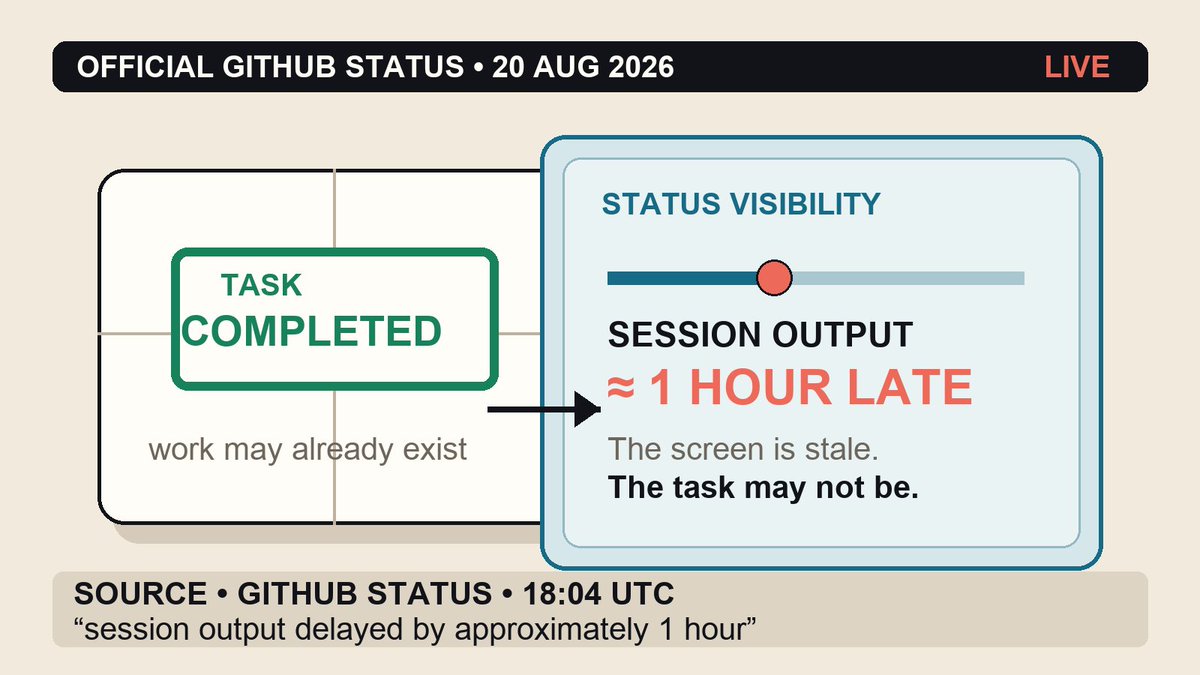
This was also High severity because the failures described were operational, not cosmetic. @stackzz warned (55 likes, 166 views) that Copilot Cloud Agent tasks could complete while status visibility lagged by roughly an hour, leaving users unable to tell whether to retry and risking duplicate work. The public GitHub outage postmortem reinforced that concern by acknowledging that some Copilot services took longer to recover because client-side retries increased traffic during restoration.
The Antigravity side showed the same trust problem in a different layer. @Soso_fun_yt reported (19 likes, 6 replies, 1,461 views, 6 bookmarks) that Antigravity's Go language server could resolve to IPv6, hit a geolocation-related 400, and surface only "agent execution terminated due to error" in the IDE and CLI. The screenshot mattered because it showed the exact failure state users would see while the body text explained that /etc/gai.conf and GODEBUG=netdns=cgo workarounds were being ignored.

When the agent's state, the network path, and the control-plane state can all disagree, users stop trusting the surface even when the underlying model may still be capable. This looks worth building for directly.
Premium gating and staggered surface rollouts weaken otherwise strong workflow features
This was a Medium-severity frustration. The product value was clear, but availability and rollout boundaries kept diluting it. @LuminaBench argued (38 likes, 2,420 views, 4 bookmarks) that Antigravity Remote Control was much less compelling while Google AI Ultra received priority access, and the screenshot of the docs confirmed that the rollout banner explicitly said so. On the collaboration side, @tiagonbotelho announced (17 likes, 6,241 views, 3 bookmarks) the new GitHub Slack and Teams experience, but one reply immediately asked whether there was even a Teams announcement somewhere.
These are not outages, but they still matter. Remote control, shared chat sessions, and auto-routing all become less useful when users cannot tell who has access yet, which plan is eligible, or which admin toggles and approvals are required before work can start. This looks worth building for directly.
3. What People Wish Existed
A routing and entitlement layer that tells the truth across every client
The clearest practical need was a way to know what model, quota, and billing path were actually in effect before starting work. @PinkSilkPham showed (5 likes, 2 quotes, 276 views) one version of the problem with mismatched GPT self-reports across Codex, ChatGPT desktop, and ChatGPT web. @github exposed (73 likes, 12 replies, 13,199 views, 6 bookmarks) another when Copilot users asked why Auto chose a model and why it could switch styles mid-task, and @testingcatalog surfaced (71 likes, 5 replies, 4,749 views, 3 bookmarks) that even an announced Sol price cut skipped several subscription tiers.
This is a practical need, not an aspirational one. People are already using fallback harnesses, alternate clients, and manual spot checks to verify what they are getting. Opportunity: direct.
A cross-surface session ledger with replay, approvals, and handoff continuity
The second strong need was a shared state layer that survives chat, IDE, CLI, and team handoffs. The GitHub Teams changelog and Slack changelog both emphasized visible threads, reviewable artifacts, and extra approval controls for agent-authored pull requests. @stele_dev responded (2 likes, 167 views, 2 bookmarks) from the builder side with Strata, while @pamelafox pointed (5 likes, 288 views) at Agent Host Protocol as a public technical model for synchronized multi-client state.
This need is both practical and emotional: teams want less screenshot archaeology, fewer duplicate runs, and more confidence that the person taking over later can see the same truth. Opportunity: direct.
Remote agent control that works on normal plans and normal networks
People clearly wanted the Antigravity Remote Control workflow, but the evidence also showed the missing pieces. @antigravity announced (2,131 likes, 139 replies, 121,839 views, 466 bookmarks) the feature while the linked product blog described the ideal version: browser access to active sessions across machines plus push notifications when an agent needs input. @LuminaBench pushed back (38 likes, 2,420 views, 4 bookmarks) on Ultra-first access, and @Soso_fun_yt showed (19 likes, 6 replies, 1,461 views, 6 bookmarks) how a dual-stack networking edge case could break the experience entirely.
This is a practical need with clear demand but a still-fluid product shape. Opportunity: competitive.
Reliable help for the boring middle of software work
The evidence also pointed to a narrower but very practical need: tools that make bounded, tedious engineering work feel easy to start. @Parsats_eth said (9 likes, 6 replies, 345 views, 2 bookmarks) Claude Code handled a delayed database migration by reading the schema, finding forgotten references, writing both migration and rollback, and leaving tests alone when they did not need changes. That was not a grand autonomous demo. It was a credible report that the backlog's most procrastinated tasks stopped feeling like a wall.
This is a practical, high-frequency need with less hype and clearer ROI than many larger agent claims. Opportunity: direct.
4. Tools and Methods in Use
| Tool | Category | Sentiment | Strengths | Limitations |
|---|---|---|---|---|
| Antigravity | Coding agent / IDE shell | (+/-) | Added browser/mobile Remote Control, kept local context on the original machine, and expanded into VS Code, Visual Studio, JetBrains, and Zed | Remote Control rollout prioritized Google AI Ultra; a documented IPv6 geolocation bug could terminate agent execution |
| GitHub Copilot | Multi-model coding agent | (+/-) | Added cheaper GPT-5.6 Sol access, discounted Auto routing, and public-preview Slack/Teams collaboration surfaces | Users questioned routing transparency, reported mixed-style diffs after model switching, and saw Cloud Agent status lag |
| Codex / GPT-5.6 Sol | Coding agent / model tier | (+/-) | Some users preferred Codex over Claude Code, praised Sol for long-running work, and welcomed lower API/credit pricing | Limit-drain complaints, banked-reset skepticism, and cross-client entitlement confusion dominated discussion |
| Claude Code | Coding agent | (+) | Still looked strong for bounded maintenance work such as migrations and reviews; JetBrains survey data put it at the top of workplace usage | Users still keep alternate harnesses and subscriptions nearby to hedge against limits and vendor churn |
| Strata | Session observability / replay | (+) | Searches, replays, tails, and normalizes local agent sessions across many shells while staying local-only and read-only | Early public release; useful only if teams already have enough agent activity to inspect |
| Skill Forge | Skill-development toolkit | (+) | Plans, scaffolds, reviews, benchmarks, publishes, and converts reusable skills across Codex, Gemini, Antigravity, and Cursor | Still rooted in a Claude Code-centered workflow and requires process discipline to get full value |
| GitReverse | Repo grounding / prompt synthesis | (+) | Builds one grounded prompt from repo metadata, a root file tree, and the README, reducing blank-page repo onboarding | Current flow still uses whole-repo context; subfolder-aware grounding is planned rather than shipped |
| Agent Host Protocol | Session-state protocol | (+) | Publicly documents synchronized multi-client state through immutable state and reconciliation, supporting portable agent clients | Evidence of adoption was still early and discussion centered more on possibility than broad deployment |
| OpenCode Go | Alternate harness / fallback path | (+/-) | Gives users another route for model access and temporary near-unlimited Ox Alpha usage, and can appear inside other shells such as Copilot | Often used as a hedge against quota and routing anxiety rather than as a stable primary environment |
Overall sentiment was mixed but increasingly tactical. Users were happiest when a tool preserved context, made agent work visible to other people, or provided a fallback route when billing and routing became hard to trust. The clearest migration pattern was not a clean switch from one vendor to another. It was a layered strategy: keep Copilot for shared surfaces, keep Codex or Claude Code for execution, keep OpenCode Go or another route in reserve, and add Strata, Skill Forge, or GitReverse so context and skills stay portable even if the preferred model changes.
5. What People Are Building
| Project | Who built it | What it does | Problem it solves | Stack | Stage | Links |
|---|---|---|---|---|---|---|
| Antigravity Remote Control | Google / @antigravity | Lets developers connect to active Antigravity sessions from a browser or mobile device while keeping the original machine's workspace and tools | Long-running agents no longer require staying at the desk or recreating the environment on another machine | Antigravity 2.0 + browser client + mobile notifications + existing local environment | Shipped | launch, blog |
| GitHub Copilot in Microsoft Teams | GitHub | Starts shared cloud-agent sessions inside Teams threads and meeting chats, then lets the work continue in GitHub surfaces later | Turns meeting decisions into visible agent work with approvals and shared context | Teams app + GitHub Copilot cloud agent + cloud sandbox + PR approval controls | Beta | post, changelog |
| GitHub Copilot in Slack / Slack Code | GitHub and Slack | Runs @GitHub in conversations and dedicated code channels with reviewable diffs and output previews |
Makes agent work collaborative from the same chat surface where the request started | Slack app + GitHub Copilot + Slack Code channels + diff/HTML preview review | Beta | post, changelog |
| Strata | @stele_dev | Normalizes agent trajectories into one CLI and TypeScript API for search, replay, watch, and stats | Cross-agent session logs are fragmented and hard to inspect or reuse | Node CLI + TypeScript API + local session adapters for Claude Code, Codex, Cursor, Gemini CLI, Copilot CLI, OpenCode, and more | Shipped | post, repo |
| Skill Forge | @DanKornas | Designs, scaffolds, reviews, benchmarks, publishes, and converts reusable coding-agent skills | Building a serious skill should not start from an empty SKILL.md or get trapped in one vendor's format |
Claude Code skill ecosystem + Python scripts + multi-platform conversion to Codex, Gemini, Antigravity, and Cursor | Shipped | post, repo |
| GitReverse | @DanKornas | Converts a public repository into one grounded synthetic prompt using repo metadata, the root file tree, and the README | Helps users rebuild or understand an existing codebase without improvising the initial grounding prompt | Next.js 16 + React 19 + TypeScript + Tailwind CSS 4 + GitHub API + optional Supabase/Stripe | Beta | post, repo |
| Marie Haynes Multi-Agent Traffic Drop Assessment System | @Marie_Haynes | Uses multiple specialist agents plus GSC and Ahrefs MCP to assemble a traffic-drop assessment as a webpage and Google Doc | Speeds up expert report creation while keeping a human review step | Antigravity + Gemini 3.7 Flash + Google Drive + Google Search Console + Ahrefs MCP + generated docs/web page | Alpha | post |
Strata stood out because it attacked an infrastructure gap that kept appearing elsewhere in the discussion. The repo is explicit that it is local-only, read-only, and built to replay or inspect trajectories from many agent clients, which lines up directly with the day's concern about state truth, handoffs, and multi-client continuity.
Skill Forge and GitReverse pointed in a different but related direction: the scarce resource was not only better generation, but better starting structure. Skill Forge packages reusable skill creation and cross-vendor conversion, while GitReverse turns repo context into a ready-made grounded prompt instead of asking every user to reconstruct the same onboarding brief from scratch.


The corporate launches fit the same pattern. Antigravity Remote Control, GitHub in Teams, and GitHub in Slack all prioritized continuity and shared visibility across surfaces, not just one more place to type prompts. At the smaller scale, @Parsats_eth described (9 likes, 6 replies, 345 views, 2 bookmarks) Claude Code handling a delayed migration plus rollback in 11 minutes, which is a useful reminder that one of the most durable build patterns may be simple: reduce the activation energy for the boring maintenance work teams already understand.
6. New and Notable
JetBrains put hard numbers on how fast the coding-agent leaderboard is moving
@jetbrains said (27 likes, 5 replies, 2,857 views, 5 bookmarks) that its latest Developer Ecosystem Survey found weekly coding-agent use at 90% globally and showed workplace adoption shifting to 39% for Claude Code, 21% for GitHub Copilot, 16% for Codex, 12% for Cursor, 9% for JetBrains AI Assistant/Junie, 7% for OpenCode, and 6% for Google Antigravity. That matters because it turned the day's portability talk into a measurable market dynamic rather than a philosophical preference.

Strata made the local agent trail into a reusable public interface
@stele_dev open-sourced (2 likes, 167 views, 2 bookmarks) Strata, which normalizes private session logs from many agent clients into a single searchable and replayable interface. That matters because the day's biggest pains were about state truth, replayability, and context handoff, and Strata is one of the few concrete builds targeting exactly that layer.
Model-routing distrust became visual, not just anecdotal
@PinkSilkPham showed (5 likes, 2 quotes, 276 views) three screenshots where the same paid account and nominal GPT-5.6 choice appeared to deliver different effective models across Codex, ChatGPT desktop, and ChatGPT web. Even without high engagement, the post mattered because it compressed a widespread complaint into evidence people could inspect directly.
7. Where the Opportunities Are
[+++] Cross-client truth layer for routing, quotas, and entitlements — Evidence came from multiple sections: Copilot Auto routing questions, Sol discounts that landed unevenly across products, Ed Zitron's rate-limit backlash, TJeparskis's clarification thread, and PinkSilkPham's screenshots showing different effective models behind the same label. The strongest opportunity is not another wrapper around a frontier model. It is a control plane that tells users what they are actually running, why it was chosen, what budget path it uses, and what will happen if the run continues.
[+++] Shared session, replay, and approval infrastructure — GitHub's Teams and Slack launches, Agent Host Protocol, Strata, and Stackzz's status-lag warning all point to the same gap: agent work needs a durable ledger that survives chat, IDE, CLI, and handoffs without losing visibility or creating duplicate work. This is strong because both vendors and independent builders are converging on the same problem from different directions.
[++] Portable skill and grounding assets above any one shell — Skill Forge, GitReverse, Mortezabihzadeh's cross-vendor format excitement, and JetBrains' rapid market-share shifts all support this. The opportunity is moderate to strong because the more often leadership changes, the more valuable portable skills, grounded prompts, and reusable repo context become.
[+] Remote agent operations for normal-priced tiers — Antigravity Remote Control clearly resonated, but the same day's evidence also showed Ultra-first rollout friction and a real IPv6/network failure mode. The opportunity is emerging: if remote control becomes standard, the winning product will need to be accessible, diagnosable, and safe outside premium tiers and pristine networks.
8. Takeaways
- Antigravity's story moved from editor reach to remote continuity. The official Remote Control launch, the linked browser/mobile workflow details, and the Ultra-priority docs screenshot made the product's next battle about staying attached to a running session away from the desk, not just adding another editor plugin. (source)
- Price cuts did not solve the trust problem. GitHub and OpenAI both pushed cheaper GPT-5.6 Sol access, but the discussion kept circling back to excluded plans, model-routing opacity, and limit behavior that users still could not explain. (source)
- The sticky layer is becoming collaboration and infrastructure around the model. GitHub's Teams and Slack public previews, Agent Host Protocol, and Strata all treated the durable product as shared state, replay, approvals, and multi-client continuity rather than raw generation alone. (source)
- Portable skills and grounded repo context look more durable than vendor-specific prompting tricks. Skill Forge and GitReverse both externalized reusable structure that can survive a fast-changing leaderboard, and the JetBrains survey showed exactly why that matters. (source)