Twitter AI Coding - 2026-08-23
1. What People Are Talking About
1.1 Codex limit debugging became a public reverse-engineering exercise (🡕)
The loudest conversation was still Codex usage limits, but the emphasis shifted from yesterday's trust fight into explicit root-cause analysis, loophole preservation, and sudden efficiency anecdotes. At least five high-signal items supported it: Tibo's official explanation of the drain sources, a screenshot thread preserving how people were stretching in-progress turns past 100%, a practitioner report that a one-hour systems project consumed only about 10% of a weekly Plus limit, a growth-and-pressure thread that tied the issue to surging demand, and lower-signal failure reports that said Codex was still hallucinating or failing to upload feedback. Compared with 2026-08-22, when the argument was mostly whether the banked reset and follow-up posts could be trusted, 2026-08-23 focused more on what exactly was draining quota and how the behavior could be reproduced or exploited.
@thsottiaux said (2,591 likes, 373 replies, 126,414 views, 211 bookmarks) that OpenAI had traced abnormal Codex drain to three specific sources: inefficient image handling in long sessions with multiple compactions, unusually high Computer History usage, and a conversation-title feature that cost more than intended. That mattered because the post did not read like generic reassurance; it named operational causes, promised a full reset for paid subscriptions, and led replies from image-heavy users saying they had likely walked straight into the bug.
@ns123abc argued (659 likes, 49 replies, 19,644 views, 88 bookmarks) that OpenAI had patched the glitch and that prominent posters had quietly removed evidence they no longer wanted attached to them. The attached screenshots mattered more than the caption: one preserved maria_rcks' "Endless" harness explanation for keeping a Codex session inside one in-progress turn after 100% usage, and another preserved Theo quoting Angel Brodin's earlier explanation that OpenAI had deliberately chosen not to cut users off mid-task at the limit. The highest-signal reply pushed back immediately, saying an overnight task had still run for six hours from 1% quota after the supposed patch.

@TJeparskis reported (4 likes, 66 views, 4 bookmarks) that GPT-5.6 Sol Max built a browser-runnable x86 operating system called AstraOS in about an hour while using only roughly 10% of a weekly Plus limit. That post was notable because it took the official efficiency story out of screenshots and into a concrete artifact: a long autonomous coding task with a booting result.
Discussion insight: The replies were split between users who wanted the loopholes closed for fairness and users who treated the whole episode like harness engineering. Once the team published concrete drain sources, the community immediately started reasoning from them.
Comparison to prior day: On 2026-08-22, the strongest evidence was about whether the banked reset had landed and whether official posts could be trusted. On 2026-08-23, the strongest evidence moved one layer deeper into compaction, image handling, in-progress-turn behavior, and suddenly better efficiency on some real tasks.
1.2 Skills, trace tools, and installable docs kept replacing ad hoc prompting (🡕)
A second theme was that builders kept packaging agent behavior as reusable installables instead of longer prompts or one-off threads. At least six items supported it: a popular 28-skill reasoning catalog, a curated cross-client skills index, book-to-skill packaging for source material, a diagram-specific skill pack, a Copilot-compatible trace viewer, and a low-engagement but very specific proposal for a menu-bar badge that surfaces which Claude Code sessions are waiting on humans. Compared with 2026-08-22, when the surrounding layer was still described more broadly as memory, search, and review tooling, 2026-08-23 made the same idea more operational: installable skill packs, public indexes, and session inspection surfaces.
@senthazalravi highlighted (57 likes, 3 replies, 2,411 views, 80 bookmarks) cc-thinking-skills, whose README describes 28 portable Agent Skills for structured reasoning across Claude Code, GitHub Copilot, Codex, Cursor, and other compatible tools. The combination of modest likes and very high bookmarks suggested that people were treating it as something to keep and reuse, not just applaud once.
@DanKornas shared (21 likes, 4 replies, 1,762 views, 25 bookmarks) Awesome Agent Skills, a manually curated collection of official and community skills spanning Claude Code, Codex, Antigravity, Cursor, GitHub Copilot, OpenCode, and more. The image sharpened the claim because it showed the compatibility surface directly, while one skeptical reply added useful nuance by arguing that curation is less valuable than actual deployment.

@7h3h4ckv157 shared (9 likes, 1,263 views, 8 bookmarks) book-to-skill, which turns a technical book or document folder into a unified agent skill for GitHub Copilot CLI, Amp, and Claude Code. On the more specialized end, @DanKornas described (3 likes, 2 replies, 443 views) markdown-viewer/skills, whose README says it packages 14 diagram and visualization skills across five rendering engines.
@Siddhant_K_code announced (2 likes, 415 views) that agent-trace now works with GitHub Copilot CLI and the Copilot Desktop app to capture sessions, tool calls, failures, costs, and decisions. At the low-volume but high-specificity end of the same theme, @sebwilgosz asked (19 views) whether people would pay for a one-time menu-bar app that simply surfaces which Claude Code sessions are waiting, running, or stalled.
Discussion insight: The common pattern was externalization. People are not asking a single model to remember reasoning frames, diagram syntax, workflow rules, and session state all by itself; they are turning those into portable artifacts that can be installed, indexed, and inspected.
Comparison to prior day: On 2026-08-22, the skills layer was already growing, but it was still described alongside memory servers and search tools. On 2026-08-23, the evidence was more concrete: public skill catalogs, specialized skill packs, and trace products aimed directly at day-to-day operator workflow.
1.3 Open runtimes and anonymous models pulled attention away from closed subscriptions (🡕)
A third theme was that open shells, local runtimes, and fast-moving alternative models kept drawing attention away from the default closed subscriptions. At least six items supported it: a long opencode field report, a FreeToken local-serving thread, a viral Ox Alpha claim, a public correction saying the mystery model looked much more ordinary on another benchmark, a DesignArena chart with non-OpenAI models on top, and an opencode usage chart arguing that developers have almost no model loyalty. Compared with 2026-08-22, which focused more on local-serving research and infrastructure papers, 2026-08-23 focused much more on visible rankings, usage share, and rapid switching.
@vicky_grok profiled (74 likes, 12 replies, 2,721 views, 14 bookmarks) opencode, a roughly 200,000-star MIT-licensed coding agent whose appeal in the thread was not just that it is open source, but that it keeps planning and execution in one session through separate build and plan modes while supporting 75+ providers. The replies were notable because even supportive readers immediately framed the remaining question as economics and workload benchmarking, not ideology.
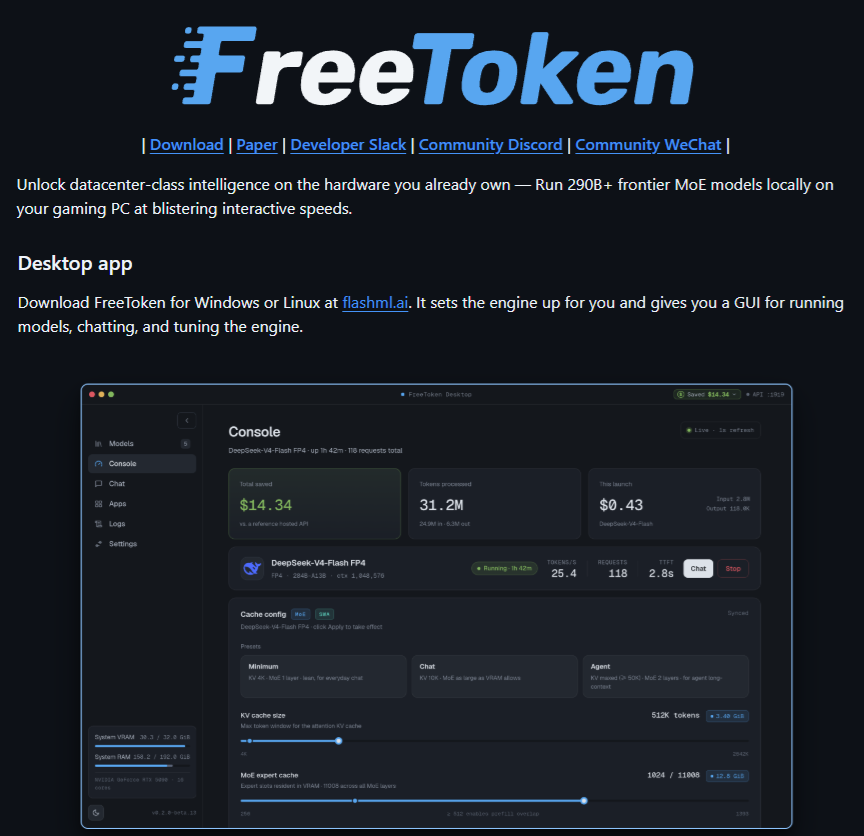
@TeksEdge reported (32 likes, 6 replies, 1,851 views, 31 bookmarks) that FreeToken could run a roughly 20GB MoE model on a 16GB RTX 5080 at around 100 tokens per second. The linked repo README describes an Apache-2.0 edge-native MoE serving engine with semantic-aware caching, OpenAI-compatible APIs, and a desktop app, while the screenshot showed the product already presenting itself as a GUI operating surface rather than a paper demo.
@DocumentingAGI said (118 likes, 4 replies, 17,528 views) that Ox Alpha on OpenRouter was outperforming Claude Fable 5 and GPT-5.6 Sol at coding, but the evidence set stayed messy. The only linked URL resolved to the generic Z.ai chatbot surface rather than a model card, while the attached image showed ox-alpha at 2.6T tokens on Aug. 21, slightly ahead of deepseek-v4-flash at 2.5T, which made usage look real even if provenance stayed unclear. @HelloSurgeAI countered (7 likes, 154 views) that its own internal agentic coding benchmark put Ox Alpha closer to the middle of the pack.
@buildwithhassan pointed out (7 likes, 307 views) a DesignArena frontend leaderboard where Qwen3.8 Max led at 1340 ELO, Kimi K3 followed at 1332, GPT-5.6 Sol sat at 1279, and GPT-5.1 Codex appeared far lower at #39 with 1056. Read together with @mehulmpt saying (29 likes, 5 replies, 1,005 views) that Ox Alpha displaced DeepSeek V4 Flash inside opencode in only three days, the practical message was that developers were willing to switch fast when another option looked better.

Discussion insight: The disagreement was less about whether to test alternatives and more about what counts as trustworthy proof. Viral benchmark screenshots, usage charts, and leaderboard snapshots all moved attention, but every one of them also drew counterclaims about methodology, ownership, or workload fit.
Comparison to prior day: On 2026-08-22, the open/local stack discussion centered more on serving economics and evaluation papers. On 2026-08-23, it moved into immediate market behavior: who developers were switching to, which models were topping public charts, and how much anonymity the market would tolerate if the output looked good enough.
1.4 Vibe coding shifted from spectacle to QA and labor consequences (🡕)
A fourth theme was that vibe coding kept widening access, but the strongest evidence now centered on what happens after the first build works. At least four items supported it: a seven-year-old iterating on a game by natural-language direction, a concrete checkout-form bug report, a beginner reporting that vibe coding already helped land a first client, and a long complaint that low-end Roblox scripting work was collapsing into revenue-share-only offers. Compared with 2026-08-22, vibe-coding mentions rose from 14 to 18 in the last eight days of data and the examples became more concrete: shipped sites, visible QA mistakes, and pricing pressure on finishing work.
@jeremykauffman said (274 likes, 15 replies, 4,284 views, 10 bookmarks) that a seven-year-old was building a video game mainly by describing games he liked and telling the AI to do better. The most useful follow-up came from the same author, who said the child was giving imprecise requests such as "add magic armor and fire damage" even when neither feature existed yet, which made the result more interesting than a polished demo clip would have.
@Joe_brendan_ argued (4 likes, 2 replies, 1,257 views, 3 bookmarks) that developers criticizing vibe coding were really criticizing missing engineering discipline after spotting a checkout form that accepted "222222222222" as a full name and reset fields on retry. The screenshot mattered because it turned the complaint into a concrete QA example instead of a culture-war abstraction.

@AREGames_Tweets reported (9 likes, 3 replies, 116 views, 5 bookmarks) that Roblox scripting commissions were increasingly just 20%-50% revenue-share offers with no upfront cash, even when the posts demanded real coding experience and "not using AI." On the optimistic side, @PinnacleCrypt said (15 likes, 14 replies, 244 views) that vibe coding had already helped them build a product, ship a client website, and assemble a portfolio as a beginner.
Discussion insight: The mood was not anti-access. The positive evidence was real. But the negative evidence clustered around the same place every time: QA, edge cases, and the underpaid last 20%-30% of delivery still separate a demo from work people trust and pay for.
Comparison to prior day: On 2026-08-22, vibe coding sat more in the background as part of the broader AI-coding culture. On 2026-08-23, it became a concrete production and labor-market topic with visible bugs, visible client work, and visible pricing pressure.
2. What Frustrates People
Quotas, resets, and abundance claims still feel untrustworthy
This was a High-severity frustration because even the strongest official explanation did not end the uncertainty. @thsottiaux said (2,591 likes, 373 replies, 126,414 views, 211 bookmarks) that OpenAI had identified the Codex drain sources and would reset paid usage, but @ns123abc argued (659 likes, 49 replies, 19,644 views, 88 bookmarks) that the loophole story had merely changed shape, not disappeared. The screenshots and replies in that thread preserved a clear operator fear: if a long in-progress turn can keep running after 100%, people will either exploit it or assume others are exploiting it.
The comparison surface was not calmer. @TJeparskis reported (4 likes, 66 views, 4 bookmarks) that a heavy Codex task suddenly felt far cheaper than similar work had felt recently, while @prayag_sonar said (7 likes, 448 views) Gemini 3.7 Flash on Antigravity felt almost unlimited. Meanwhile @Presidentlin said (55 likes, 9 replies, 4,537 views) that Antigravity 1.0 lost some of its appeal once generous limits created a reseller economy. People are coping by hoarding resets, testing alternate surfaces, or moving between providers. This looks worth building for directly.
Agents still need a better control plane for state, permissions, and read-back
This was also High severity because multiple unrelated builders were independently patching the same blind spot. @aacle_ said (25 likes, 1,294 views, 13 bookmarks) they forked Burp's official MCP server because the official version could send requests but could not read responses back, inspect Intruder results, or manage scans. @Siddhant_K_code announced (2 likes, 415 views) agent-trace support for Copilot CLI/Desktop so users can inspect sessions, tool calls, failures, costs, and decisions after the fact.
The same need appeared at the session-management layer. @sebwilgosz asked (19 views) whether people would pay for a simple menu-bar badge because four to six Claude Code sessions often leave two prompts waiting somewhere off-screen, while @charliejhills shared (14 likes, 4 replies, 1,938 views, 9 bookmarks) new Claude Code features such as session-to-session tagging and /design. People are coping with morning brief commands, trace viewers, and custom dashboards. This looks worth building for directly.
Vibe-coded shipping still breaks on QA, and the paid endgame is getting squeezed
This was a Medium-High frustration because the evidence combined visible defects with visible pricing pressure. @Joe_brendan_ argued (4 likes, 2 replies, 1,257 views, 3 bookmarks) that the real problem with some vibe-coded apps is not that AI helped build them, but that obvious engineering checks were skipped; the attached checkout screenshot showed a numeric full name being accepted and a retry flow that reset fields. On the labor side, @AREGames_Tweets reported (9 likes, 3 replies, 116 views, 5 bookmarks) that Roblox scripting work was increasingly just revenue share, even when the posts explicitly demanded someone who could really code and not use AI.
The positive side of the same story makes the frustration more credible, not less. @jeremykauffman said (274 likes, 15 replies, 4,284 views, 10 bookmarks) a seven-year-old could already iterate on a game through natural-language direction, and @PinnacleCrypt said (15 likes, 14 replies, 244 views) vibe coding had already helped them ship a product and a first client website. The result is a harsher finishing market: getting to "it works" is easier, so trust, QA, and polish carry more of the paid value. This looks worth building for directly.
3. What People Wish Existed
A truthful quota and routing layer before a long run starts
This was the clearest practical need. @thsottiaux explained (2,591 likes, 373 replies, 126,414 views, 211 bookmarks) why Codex had been draining faster than expected, but @ns123abc showed (659 likes, 49 replies, 19,644 views, 88 bookmarks) that people were still preserving screenshots of loophole behavior and arguing about whether the patch really changed it. On the Google side, @prayag_sonar said (7 likes, 448 views) Antigravity felt almost unlimited, while @Presidentlin warned (55 likes, 9 replies, 4,537 views) that generous limits can attract abuse. The need is direct: people want reliable counters, clear entitlement rules, and honest routing behavior before they commit to a run. Opportunity: Direct.
A multi-session supervisor that shows what is waiting, running, or blocked
People were not just asking for more autonomy. They were asking for a better way to manage the autonomy they already had. @sebwilgosz said (19 views) that four to six Claude Code sessions often leave a couple of prompts waiting somewhere off-screen, which is why a menu-bar badge felt worth charging for. @Siddhant_K_code announced (2 likes, 415 views) agent-trace for post-hoc session inspection, and @aacle_ built (25 likes, 1,294 views, 13 bookmarks) a dashboard because one-way MCP actions were not enough. The need is practical and urgent: a control plane should expose waiting prompts, stalled runs, decision history, and read-back without making the user hunt through tabs. Opportunity: Direct.
Portable skill and reference packaging that survives client changes
This was a practical need with growing competitive pressure. @senthazalravi highlighted (57 likes, 3 replies, 2,411 views, 80 bookmarks) a 28-skill reasoning catalog, @7h3h4ckv157 shared (9 likes, 1,263 views, 8 bookmarks) book-to-skill for packaging source material, and @DanKornas showed (21 likes, 4 replies, 1,762 views, 25 bookmarks) a curated cross-client skills index. The need is not emotional; it is operational. Teams want knowledge, diagram syntax, and workflow rules to survive when they move between Claude Code, GitHub Copilot, Codex, Cursor, OpenCode, or Antigravity. Opportunity: Competitive.
QA rails for vibe-coded apps and fair handoff workflows
The unmet need here was less "build it for me" and more "help me trust what got built." @Joe_brendan_ showed (4 likes, 2 replies, 1,257 views, 3 bookmarks) that a simple checkout flow still failed basic validation, while @AREGames_Tweets described (9 likes, 3 replies, 116 views, 5 bookmarks) a market where coding help increasingly gets pushed into underpaid revenue-share cleanup work. The need is practical: builders want help turning fast AI output into something testable, reviewable, and worth paying for. Opportunity: Direct.
4. Tools and Methods in Use
| Tool | Category | Sentiment | Strengths | Limitations |
|---|---|---|---|---|
| Codex / ChatGPT Work | Agent runtime | (+/-) | Strong autonomous coding results, explicit root-cause explanations, and suddenly better efficiency in some long sessions | Quota drains, confusing limit behavior, loophole concerns, and occasional failure reports |
| Antigravity | Agent IDE / remote shell | (+/-) | Some users report near-unlimited Gemini usage, multi-model quota buckets, and useful custom-agent workflows | Quality complaints, unclear metering, and prior abuse/reseller fears |
| Claude Code | Agent runtime | (+) | Session-to-session tagging, /design, concise output controls, and a deep surrounding skills ecosystem | Multi-session overload and state visibility still push users toward extra tooling |
| OpenCode | Open-source coding agent | (+) | Build/plan split, 75+ providers, strong community adoption, and low lock-in | Terminal-first workflow, documentation lag, and no official SLA |
| FreeToken | Local inference engine | (+) | Runs large MoE models on consumer hardware, exposes OpenAI-compatible APIs, and ships a desktop UI | Hardware-dependent results, high RAM needs, and still-early performance claims |
| Ox Alpha | Model | (+/-) | Strong short-term usage growth and visible leaderboard attention | Anonymous ownership, conflicting benchmark claims, and unclear provenance |
| Agent Skills / Skills CLI | Packaging layer | (+) | Reusable reasoning, diagram, and reference packs across many coding clients | Quality varies, curated catalogs are not audited, and the ecosystem is fragmenting |
| agent-trace | Observability tool | (+) | Captures sessions, tools, failures, costs, and Copilot CLI/Desktop activity | Experimental project, still small, and mostly post-hoc rather than supervisory |
| Custom MCP dashboards and forks | Workflow integration | (+) | Add read-back, scan control, and domain-specific visibility that official connectors often miss | Usually have to be built by users because official integrations remain one-way |
The satisfaction spectrum is increasingly determined by control-plane truth, not by model loyalty alone. Users are moving between Codex, Antigravity, OpenCode, and local/open stacks depending on quota pressure, transparency, and provider flexibility. The common workarounds are consistent: package context as skills, add trace or dashboard layers for visibility, and keep fallback providers ready so a limit problem on one surface does not stall the whole workflow. The competitive dynamic is shifting upward from "which model is best?" toward "which surface is honest about limits, keeps state visible, and lets humans intervene without friction?"
5. What People Are Building
| Project | Who built it | What it does | Problem it solves | Stack | Stage | Links |
|---|---|---|---|---|---|---|
| OpenCode | anomalyco | Open-source coding agent with build and plan modes in one session | Avoids single-model lock-in while keeping planning and execution in the same working context | TypeScript, terminal UI, multi-provider adapters | Shipped | repo |
| FreeToken | FlashML-org | Runs frontier-scale open-weight MoE models locally and exposes OpenAI-compatible APIs through a desktop app | Makes local/open agent workflows viable on consumer hardware that cannot fit the full model in VRAM | Python, MoE serving engine, desktop app | Beta | repo |
| Claude Code thinking skills | tjboudreaux | Packages 28 reusable reasoning skills for coding agents | Gives agents structured diagnosis, decision, and strategy procedures instead of ad hoc prompting | JavaScript, Agent Skills, Skills CLI | Shipped | repo |
| book-to-skill | virgiliojr94 | Converts books or document folders into installable agent skills | Stops users from repeatedly reloading large reference material into chat context | Python, document parsing, Agent Skills | Shipped | repo |
| agent-trace | Siddhant-K-code | Traces sessions, tool calls, failures, and costs across Copilot surfaces | Makes agent work inspectable after the fact | Python, Copilot plugin, CLI, trace viewer | Alpha | repo |
| Burp MCP fork | @aacle_ | Extends Burp's MCP so agents can read back requests, results, and scan state | Fixes one-way security workflows where agents can fire actions but cannot inspect what happened | Burp Suite, MCP, dashboard UI | Alpha | post |
| CanvasTTY | howdeploy | Gives AI agents an infinite-canvas desktop for local PTYs and live sessions | Makes many concurrent agent sessions more navigable than tabbed chat or stacked terminals | Electron, React, xterm.js, node-pty | Alpha | repo |
@vicky_grok profiled (74 likes, 12 replies, 2,721 views, 14 bookmarks) OpenCode as a control-plane alternative, while @TeksEdge reported (32 likes, 6 replies, 1,851 views, 31 bookmarks) FreeToken as a runtime alternative. Together they showed the strongest repeated build pattern of the day: one project removes provider lock-in at the shell level, and another removes datacenter dependence at the inference level.
The second build pattern was packaging procedures as installables. @senthazalravi highlighted (57 likes, 3 replies, 2,411 views, 80 bookmarks) cc-thinking-skills, @7h3h4ckv157 shared (9 likes, 1,263 views, 8 bookmarks) book-to-skill, and @DanKornas described (3 likes, 2 replies, 443 views) markdown-viewer/skills. All three move knowledge or output syntax out of transient chat and into reusable artifacts.
Observability and workspace control formed a third cluster. @Siddhant_K_code announced (2 likes, 415 views) agent-trace, @aacle_ said (25 likes, 1,294 views, 13 bookmarks) the Burp MCP fork only existed because the official connector was too one-way, and @monokern shared (19 likes, 3 replies, 524 views, 14 bookmarks) CanvasTTY as an infinite-canvas desktop for agent sessions. A related outlier was @RoundtableSpace sharing (14 likes, 4 replies, 15,234 views, 5 bookmarks) lattice, a zero-dependency TypeScript isometric game engine built specifically for coding agents.
6. New and Notable
Breadcrumb hunting around OpenAI models became a public workflow
@zhodonx said (43 likes, 27 replies, 813 views) that a public OpenAI PR had briefly carried the label "Written by an agent (Codex, gpt-nathree)" before the extra codename was edited out, which fit the same breadcrumb pattern people had previously associated with mewfour and Astra. The attached screenshot preserved the revision history rather than just retelling it. Read together with @TJeparskis noting (4 likes, 66 views, 4 bookmarks) that Codex autonomously named an unusually efficient OS project AstraOS, the notable signal was not proof of a hidden routing change. It was that a meaningful part of the AI-coding community is now reading repo metadata, UI labels, and generated names as rollout signals.
Agent supervision UX is turning into its own product surface
@sebwilgosz asked (19 views) whether people would pay for a menu-bar badge that shows which Claude Code sessions are waiting, while @monokern shared (19 likes, 3 replies, 524 views, 14 bookmarks) CanvasTTY as an infinite-canvas desktop for local agent sessions. Even @charliejhills highlighted (14 likes, 4 replies, 1,938 views, 9 bookmarks) Claude Code's new ability for sessions to talk to each other by name. The notable signal was that people are no longer only asking for better models; they are redesigning the workspace required to supervise many live agents at once.
7. Where the Opportunities Are
[+++] Quota truth and routing intelligence — The strongest evidence came from multiple surfaces at once. Codex users wanted exact explanations for why usage burned down, screenshot threads preserved loophole behavior after the official explanation, and Antigravity users simultaneously celebrated abundance and warned that generosity can be gamed. A product that exposes entitlement, routing, interruption rules, and expected burn before a run starts would answer the clearest pain in Sections 1, 2, and 4.
[+++] Multi-session supervision and read-back — agent-trace, the Burp MCP fork, the sebwilgosz menu-bar idea, CanvasTTY, and Claude Code's own session-to-session messaging all point at the same need: humans need better visibility into what multiple agents are doing, waiting on, or failing to read back. This is strong because people are already building workarounds in both general coding and security-specific workflows.
[++] Portable skill and reference packaging — cc-thinking-skills, book-to-skill, Awesome Agent Skills, and markdown-viewer/skills all exist because teams want reasoning patterns, source material, and output syntax to survive client changes. This looks moderately strong rather than wide-open because the market is already crowded, but the demand is clearly validated.
[+] QA and finishing rails for vibe-coded products — The Joe_brendan checkout example and the AREGames revenue-share complaint suggest the emerging bottleneck is no longer first-draft generation; it is validation, polish, and trustworthy handoff. This is still an early opportunity, but the evidence says the pain will grow as more people can ship "good enough" prototypes.
8. Takeaways
- The day's biggest conversation was still limits, but now the evidence was specific enough for users to reason from it. @thsottiaux said (2,591 likes, 373 replies, 126,414 views, 211 bookmarks) exactly which Codex behaviors had been draining usage, and screenshot threads immediately turned those details into theories about loopholes, fairness, and expected burn.
- Skills are becoming the durable unit of agent know-how. @DanKornas shared (21 likes, 4 replies, 1,762 views, 25 bookmarks) a cross-client skills index, while @7h3h4ckv157 shared (9 likes, 1,263 views, 8 bookmarks) book-to-skill for turning source material into installable agent knowledge.
- Developers are showing very little loyalty to any single model or shell. @vicky_grok profiled (74 likes, 12 replies, 2,721 views, 14 bookmarks) OpenCode as a provider-agnostic shell, and the rest of the day's evidence kept comparing Ox Alpha, FreeToken, Qwen3.8 Max, Kimi K3, and Antigravity on cost, limits, and leaderboard position instead of treating one stack as settled.
- Supervising many concurrent agents is becoming its own product problem. @sebwilgosz asked (19 views) whether people would pay for a menu-bar badge that shows which Claude Code sessions are waiting, while @Siddhant_K_code announced (2 likes, 415 views) agent-trace to expose what agents actually did.
- Vibe coding keeps widening access, but QA and paid finishing work are where the hard edge remains. @Joe_brendan_ argued (4 likes, 2 replies, 1,257 views, 3 bookmarks) from a visible checkout bug that shipping still needs engineering discipline, while @AREGames_Tweets reported (9 likes, 3 replies, 116 views, 5 bookmarks) that scripting work was already sliding toward revenue share instead of cash.