Twitter AI Coding - 2026-08-24
1. What People Are Talking About
1.1 Agent work moved into shared, mobile, and multi-model surfaces (🡕)
The strongest workflow shift was away from the private terminal and toward surfaces that keep agents visible, movable, and reviewable. Copilot-related mentions more than doubled versus the prior day, and the supporting items were unusually concrete: live voice-agent demos on phone and desktop, GitHub's Copilot app push, official model-management docs, local-model screenshots inside Copilot App, Antigravity Remote Control, Slack Code channels, and a Power Apps build completed through MCP. Compared with 2026-08-23, when surrounding-tooling discussion centered more on skills and trace layers, 2026-08-24 emphasized where the work actually happens and how humans stay in the loop.
@OpenAIDevs went live (156 likes, 13 replies, 16,878 views, 71 bookmarks) with Alex Finn's hands-free Codex workflow on desktop and mobile. That mattered less as a promotional event than as a workflow proof point: the top technical reply immediately argued that once voice removes the slow human filter, the control plane has to become stricter about permissions and confirmation, while another reply said mobile workflow cleanliness still lagged. The public broadcast link made the claim traceable beyond the tweet text itself.
@github said (163 likes, 16 replies, 38,118 views, 23 bookmarks) that the GitHub Copilot app can move the whole development workflow into one place, and the account's own replies defined that more precisely as an issue-to-merge surface with automations, Agent Merge, integrations, governance controls, and an install link. @code added (50 likes, 10 replies, 9,699 views, 6 bookmarks) an official Manage Models pointer showing that GitHub Copilot can switch built-in models and bring-your-own-key providers inside the same interface.
@SantoshYadavDev showed (4 likes, 590 views) the GitHub Copilot App configured with both the Copilot subscription and an Ollama local provider running gemma4:26b. The screenshot mattered because it turned "multi-model" from marketing language into a real operator setup with a local model sitting beside the hosted one.

@WesRoth reported (18 likes, 3 replies, 1,716 views) that Antigravity Remote Control can reconnect to running sessions from browsers or phones while preserving the original machine's files, build tools, credentials, and environment variables. In parallel, @kaddisdeployed described (11 likes, 7 replies, 215 views, 3 bookmarks) Slack Code as shared code channels where teams can watch an agent work, preview changes, give feedback, and archive the context after approval. Both posts pushed the same idea: agent work is becoming something a team supervises from many surfaces, not something one developer privately shepherds in one window.
@ShanesCows said (4 likes, 2 replies, 279 views) that GitHub Copilot App plus Model-driven MCP was enough to build a model-driven app, a generative page, Dataverse tables with relationships, and security roles inside one solution. The image sharpened the claim by showing Copilot App and Power Apps side by side rather than leaving "easy button" as a vague slogan.

Discussion insight: The replies consistently pulled the conversation away from raw model quality and toward approval flows, context continuity, and whether changes stay inspectable when the agent leaves the local IDE.
Comparison to prior day: On 2026-08-23, the strongest surrounding-layer evidence was about skills catalogs and trace tools. On 2026-08-24, Copilot-related discussion broadened into app installs, mobile access, local-model routing, and shared review channels.
1.2 Persistent codebase memory and reusable reference skills became default countermeasures to context waste (🡕)
A second theme was that people increasingly treated repeated file exploration as a solvable systems problem rather than an unavoidable cost of agent work. The supporting items were not generic prompt packs; they were concrete compilers and packaging layers for codebases, books, papers, and organizational skills. Compared with 2026-08-23, when the skills layer was still led by catalogs and indexes, 2026-08-24 added more explicit context engines that promise to survive across sessions.
@rambuilds_ argued (12 likes, 7 replies, 768 views, 10 bookmarks) that Graphify solves an obvious agent failure mode: map the codebase once, then query paths through it instead of grepping forever. The tweet was unusually specific for a tool post, stressing local tree-sitter parsing, no vector database, no embeddings, explicit EXTRACTED versus INFERRED edges, git-committable graph state, and hooks for Claude Code, Codex, Cursor, Gemini CLI, and Copilot. The README and image backed up the central claim with a wiki layer, community clusters, and token-reduction examples on mixed corpora.

@DanKornas shared (11 likes, 7 replies, 1,046 views, 6 bookmarks) codesight, a zero-dependency CLI that generates agent instruction files, a persistent wiki, blast-radius reports, and an MCP server with 14 tools. The detail that mattered was not just "context files," but that the same scan can output CLAUDE.md, Codex-friendly files, AGENTS.md, and a tool-specific wiki, which is exactly the kind of session-to-session reuse the replies said they were missing.

@0x_sakata said (18 likes, 14 replies, 580 views, 6 bookmarks) that book-to-skill can turn a technical PDF into a Claude Code skill you can query while coding, and the upstream README says the same workflow also targets GitHub Copilot CLI and Amp while cutting token use 24x-51x versus dumping the source into context. @DAIEvolutionHub added (12 likes, 1,125 views, 6 bookmarks) DeepPaperNote, whose stable v2.2.0 image and README framed paper reading as another context-packaging problem: preserve the problem, method, evidence, results, and figure context in an Obsidian-ready note that agents can revisit later.
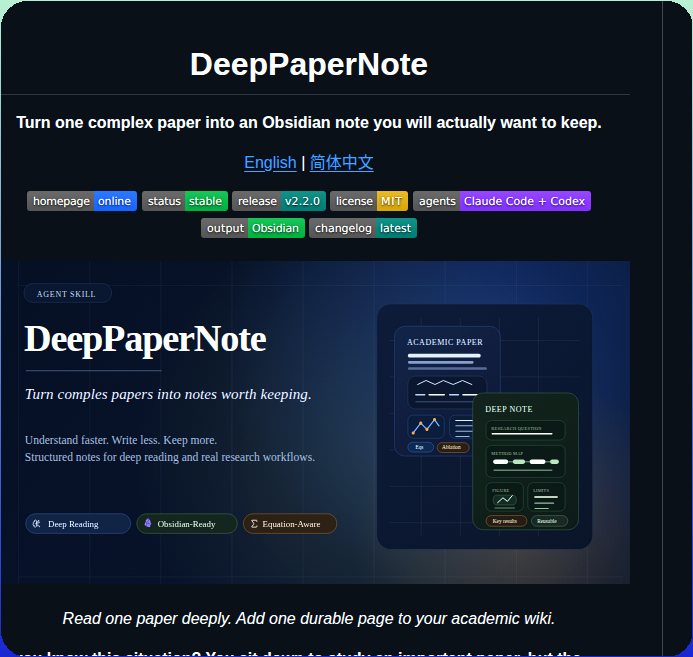
@DuncanRogoff highlighted (3 likes, 4 replies, 350 views, 6 bookmarks) VoltAgent's Awesome Agent Skills, and both the tweet and repo README emphasized the same thing: official skills published by actual teams, distributed across Claude Code, Codex, GitHub Copilot, Cursor, Gemini CLI, OpenCode, Windsurf, and more. The shift here was subtle but important: context is increasingly something teams install and version, not something they restate in every new chat.

Discussion insight: The replies and linked READMEs converged on the same complaint: long-context models still waste time rediscovering structure, so builders are externalizing memory into graphs, wikis, chapter files, and installable skills.
Comparison to prior day: On 2026-08-23, skills discussion centered on catalogs and trace surfaces. On 2026-08-24, new concrete evidence came from codebase maps, knowledge wikis, paper-ingestion tools, and document-to-skill compilers.
1.3 Governance, read-back, and harness design mattered more than another raw-model comparison (🡕)
A third theme was that the conversation kept moving upward from models into process, permissions, and review architecture. The strongest evidence came from security tooling, formal workflow guidance, enterprise adoption charts, and papers that explicitly argued harness choice can matter more than model choice. Compared with 2026-08-23, when open-model rankings and switching behavior still took a large share of attention, 2026-08-24 spent more time on who can inspect, approve, and standardize the work.
@aacle_ explained (29 likes, 1,668 views, 19 bookmarks) why they forked Burp's official MCP server: it was mostly one-way. The fix list was concrete and operational, not philosophical: stage Repeater requests and read them back by name, inspect Intruder results, manage scans, read site maps and history, use scope and cookie jars with approval, and surface everything through a live Burp dashboard. That post read like a compressed requirements document for what serious domain integrations still lack.
@dair_ai shared (7 likes, 2 replies, 1,094 views, 6 bookmarks) a paper, Applying Anthropic Primitives at Large Enterprises, whose abstract argued that frontier models lowered the cost of writing custom code but not the cost of reviewing, understanding, and maintaining fragmented bespoke solutions. The paper's proposed answer was a stable harness backbone across deployments, and the author explicitly summarized one of its key claims as "harness choice accounts for more variance in agent benchmark results than model choice does."
@techyoutbe pointed to (7 likes, 2 replies, 1,044 views, 3 bookmarks) AWS's AI-DLC 2.0 and the matching AWS overview, both of which described the same human-in-loop rhythm: AI makes a plan, asks clarifying questions, and implements only after validation. That mattered because the official workflow language was explicitly about verifiable, self-correcting engineering rather than unobserved autonomy.

@rickyho_1989 shared (6 likes, 7 replies, 980 views, 3 bookmarks) a chart sourced in-image to OAI Signals showing weekly active enterprise Codex users in legal rising 108x from their February base, versus 41x in sales and recruiting and 5x in engineering. The right reading is the indexed-growth one visible in the chart itself, not the author's more speculative labor-market extrapolation: the public signal was that agent adoption is being discussed as broader knowledge-work infrastructure now, which raises the value of standardized review and governance layers.

Discussion insight: The common thread was not "which model wins?" but "what lets a human inspect, approve, route, and standardize the work once more teams and domains start using agents?"
Comparison to prior day: On 2026-08-23, governance concerns appeared mainly through trace tools and one-way MCP complaints. On 2026-08-24, those concerns expanded into formal workflow doctrine, enterprise adoption charts, and explicit claims that harness design itself is becoming the differentiator.
1.4 Codex trust improved, but switching pressure still followed price, policy, and outage behavior (🡒)
Codex remained the biggest single topic, but the texture of the conversation changed. Codex mentions stayed high relative to the prior day, yet the strongest new evidence was not another root-cause postmortem; it was whether the fixes were already visible in real use, how much cheaper or more flexible competing stacks looked, and how quickly people should fall back when a provider or model tier breaks. Compared with 2026-08-23, the conversation moved from diagnosing the bug toward testing the patched reality.
@thsottiaux said (4,941 likes, 782 replies, 292,033 views, 172 bookmarks) that the reset had propagated and users should feel a positive difference after the newly landed usage fixes. That follow-up mattered because it quoted the prior day's specific drain sources, then drew immediate reply traffic from business-account users checking whether the reset had really reached them. A second layer of validation came from @buildwithrajath reporting (10 likes, 5 replies, 1,198 views) that hours of GPT-5.6 Sol coding on xhigh reasoning barely touched the weekly allowance after the patch.
@Haleeeemahh argued (18 likes, 7 replies, 569 views) that many Claude users were already moving to ChatGPT, Cursor, or Grok because weekly resets, cheaper GPT-5.6 variants, and cheaper alternatives like Kimi K3 or DeepSeek changed the subscription math. The screenshots mattered because they preserved concrete switch stories rather than generic model-war boasting.

Reliability and policy still constrained that switching logic. @githubstatus reported (12 likes, 2,019 views) degraded Fable availability in Copilot products and explicitly recommended choosing another model, while @theo said (98 likes, 5,293 views) they were still waiting on confirmation that Antigravity's new IDE integration push would stop Google-style auth bans from leaking into other surfaces. At the broader platform layer, @milan_milanovic summarized (14 likes, 6 replies, 1,090 views, 3 bookmarks) GitHub's outage RCA, including Copilot token-service retry loops that multiplied traffic roughly 10x after a capacity failure.

Discussion insight: The switching conversation was no longer just about benchmark preference. People were pricing in resets, auth policy, outage behavior, fallback options, and how quickly a surface can route them to another model.
Comparison to prior day: On 2026-08-23, the loudest Codex evidence was about what exactly had been draining usage. On 2026-08-24, the strongest evidence was whether the patched system finally behaved better in practice and whether competing stacks still looked easier or safer to live with.
2. What Frustrates People
One-way integrations and migration churn still interrupt serious work
This was a High-severity frustration because the strongest examples came from people already using agents in production-like workflows, not from beginners. @aacle_ said (29 likes, 1,668 views, 19 bookmarks) the official Burp MCP server could send requests but could not read responses back, inspect Intruder results, or manage scans, which is why they built a fork and a live Burp dashboard. @CodexReleases reported (88 likes, 7 replies, 7,260 views, 16 bookmarks) that codex mcp-server was deprecated in favor of the app server and Claude Code plugin, and the replies immediately filled with broken-script complaints and requests for better migration links.
The same friction appeared in newer surfaces too. A reply under @OpenAIDevs going live (156 likes, 13 replies, 16,878 views, 71 bookmarks) said voice-driven mobile workflows make confirmation stricter, not looser, while @DanKornas presented (1 like, 349 views) Kandev as a response to the separate problem of reviewing five concurrent agent tasks. People are coping by replacing official connectors, adding dashboards, or moving into review-first control planes. This looks worth building for directly.
Price, auth policy, and outage behavior keep pushing users between stacks
This was also High severity because even on a day when Codex trust improved, users still behaved as if they needed fallback routes. @thsottiaux said (4,941 likes, 782 replies, 292,033 views, 172 bookmarks) the reset had propagated and usage fixes had landed, and @buildwithrajath reported (10 likes, 5 replies, 1,198 views) that long GPT-5.6 Sol sessions were barely touching quota afterward. But @Haleeeemahh said (18 likes, 7 replies, 569 views) that many Claude users were already switching because of cheaper GPT-5.6 variants and better value from Kimi K3, DeepSeek, or 0xalpha, while @theo said (98 likes, 5,293 views) they still wanted confirmation that Antigravity auth would stop risking Google-style bans in other surfaces.
Reliability made the churn feel rational. @githubstatus reported (12 likes, 2,019 views) degraded Fable availability in Copilot products and told users to choose another model, while @milan_milanovic summarized (14 likes, 6 replies, 1,090 views, 3 bookmarks) GitHub's outage RCA, including Copilot token retries that multiplied traffic roughly 10x. On the coping side, @StudentOffersHQ showed (11 likes, 2 replies, 522 views, 9 bookmarks) that new AWS users could get six months of free access plus up to $200 in credits and then browse a Bedrock catalog that included Claude, GPT-5.6, Qwen, Kimi, and GLM cards. People are coping by keeping alternate providers, local models, or cloud-credit trials ready. This looks worth building for directly.


Working software is still not the same thing as trustworthy software
This was a Medium-severity frustration because the evidence volume was lower than the control-plane debate, but the examples were sharp. @ozi_bekee warned (5 likes, 3 replies, 50 views) that an AI-generated login flow can work perfectly and still be insecure once someone tries to break it. The point was not theoretical: the whole thread was framed as pre-ship checks that sit beyond "the UI looks right."
Read together with @aacle_ needing (29 likes, 1,668 views, 19 bookmarks) a security dashboard because one-way MCP actions were not auditable enough, the frustration is clear: shipping gets easier faster than verification does. People are coping by adding their own dashboards, doing manual security passes, and treating agent output as something that still needs adversarial review. This looks worth building for directly.
3. What People Wish Existed
One supervisory thread that follows the agent everywhere
This was the clearest practical need. @OpenAIDevs showed (156 likes, 13 replies, 16,878 views, 71 bookmarks) a voice agent moving between desktop and mobile, @WesRoth described (18 likes, 3 replies, 1,716 views) Antigravity Remote Control as a browser-and-phone view into active sessions, @kaddisdeployed described (11 likes, 7 replies, 215 views, 3 bookmarks) Slack Code as a searchable team channel for agent work, and @DanKornas presented (1 like, 349 views) Kandev as a review-first control plane for parallel tasks. The practical ask behind all of them is the same: one auditable thread for approvals, diffs, prompts, and status changes no matter which surface the human happens to be using. Partial answers exist, but they are fragmented by vendor and workflow. Opportunity: Direct.
Context that loads by need, not by repeated rediscovery
This was a practical need with strong evidence and visible competition. @rambuilds_ showed (12 likes, 7 replies, 768 views, 10 bookmarks) Graphify as a code-and-document graph, @DanKornas shared (11 likes, 7 replies, 1,046 views, 6 bookmarks) codesight as a wiki and instruction-file generator, @0x_sakata shared (18 likes, 14 replies, 580 views, 6 bookmarks) book-to-skill for technical PDFs, and @DAIEvolutionHub shared (12 likes, 1,125 views, 6 bookmarks) DeepPaperNote for research papers. This is not an emotional ask; it is a cost-and-accuracy ask. People want context layers that persist across sessions, stay small until summoned, and work across Claude Code, Copilot, Codex, and adjacent clients. Opportunity: Competitive.
Routing that understands price, policy, and failover before work starts
This was a practical need, and it looked more urgent than celebratory. @thsottiaux said (4,941 likes, 782 replies, 292,033 views, 172 bookmarks) the Codex reset and fixes were live, but @githubstatus reported (12 likes, 2,019 views) a Fable outage that required switching models immediately, @theo said (98 likes, 5,293 views) auth policy was still unresolved across Google surfaces, and @StudentOffersHQ showed (11 likes, 2 replies, 522 views, 9 bookmarks) that users were already shopping for credits and cheaper model catalogs. The unmet need is a runtime that can tell the user, before a long run begins, what the likely burn, policy risk, and fallback path look like. Opportunity: Direct.
Security and review gates that block bad output before it ships
This was a practical need with thinner but still credible evidence. @ozi_bekee said (5 likes, 3 replies, 50 views) a login flow can pass basic functional checks and still be dangerously insecure, while @aacle_ built (29 likes, 1,668 views, 19 bookmarks) extra read-back and scan controls because sending commands without inspection was not enough. Even @ShanesCows framed (4 likes, 2 replies, 279 views) MCP-assisted Power Apps building partly in terms of security-role generation, which shows that permissions and review now sit inside the build surface itself. Partial answers exist, but a simpler pre-ship verification rail is still missing. Opportunity: Direct.
4. Tools and Methods in Use
| Tool | Category | Sentiment | Strengths | Limitations |
|---|---|---|---|---|
| Codex / ChatGPT Pro | Agent runtime | (+/-) | Reset and usage fixes improved confidence; voice/mobile workflows are now public; strong autonomous coding demand remains obvious | Trust had to be rebuilt after the burn-rate issue, and runtime behavior is still judged against price and fallback options |
| GitHub Copilot App | Agent workspace | (+) | Centralizes issue-to-merge work, supports MCP-backed app building, and can mix hosted plus local models | Still exposed to provider outages and early-access friction |
| Antigravity Remote Control | Remote session control | (+/-) | Browser-and-phone access to active sessions, preserved machine context, push-notification workflow | Auth-policy uncertainty and subscriber-gated rollout limit trust |
| Graphify | Codebase memory graph | (+) | Local structural graph, EXTRACTED versus INFERRED edges, wiki output, multimodal corpus support | Requires a graph build and another artifact layer to keep current |
| codesight | Codebase context compiler | (+) | Zero-dependency scan, generated wiki, AGENTS/CLAUDE/Codex files, 14 MCP tools | Adds another context-maintenance layer and still depends on teams using the outputs consistently |
| book-to-skill | Reference packaging | (+) | Converts books and docs into on-demand skills with lower token use across clients | Best with structured technical source material; extraction quality depends on input format |
| DeepPaperNote | Research-note skill | (+) | Preserves paper problem, method, evidence, and figure context in a durable note | Narrower scope than general codebase tools |
| Awesome Agent Skills | Skills distribution | (+) | Cross-client ecosystem of official and community skills | Curation does not solve deployment, governance, or quality variance by itself |
| Burp MCP fork | Security integration | (+) | Adds read-back, scan control, scope access, and a live dashboard | Exists only because the official connector was too one-way |
| AI-DLC 2.0 | Workflow methodology | (+) | Explicit plan, clarification, validation, and implementation loop | More process overhead than a single-agent free-form session |
| Kandev | Agent orchestration workbench | (+) | Parallel task execution, review gates, integrated workspace, multi-provider support | Still early and not yet a mainstream default surface |
| FreeToken | Local MoE runtime | (+) | Consumer-hardware MoE serving, OpenAI/Anthropic-compatible APIs, desktop app | Hardware-dependent performance claims and more setup complexity than hosted APIs |
| AWS Free Plan + Bedrock | Cloud access path | (+/-) | Cheap way to test multiple frontier models with visible pricing | Time-limited, new-account constrained, and not a substitute for runtime ergonomics |
The tool stack on this date was less about winner-take-all model loyalty and more about combinability. @code linked (50 likes, 10 replies, 9,699 views, 6 bookmarks) official multi-model controls, while @SantoshYadavDev showed (4 likes, 590 views) Copilot App side by side with a local Ollama model. @Haleeeemahh described (18 likes, 7 replies, 569 views) a real migration path from Claude plans toward GPT Sol, Kimi K3, and Grok, while @githubstatus forced (12 likes, 2,019 views) immediate fallback by telling Copilot users to pick another model during the Fable incident.
The common workarounds were consistent. People are shrinking context with Graphify, codesight, book-to-skill, and DeepPaperNote; adding supervision layers with Burp dashboards, Slack Code, Antigravity Remote Control, and Kandev; and keeping cheaper or more controllable compute nearby through AWS credits or local runtimes. @Saboo_Shubham_ shared (14 likes, 5 replies, 1,118 views, 10 bookmarks) FreeToken, whose README and paper describe a local MoE runtime that speaks OpenAI- and Anthropic-style APIs so existing coding agents can plug in directly.

The competitive dynamic is therefore shifting upward. The decisive question was rarely "which model is smartest?" and increasingly "which surface lets me combine models, keep context small, inspect the work, and recover quickly when pricing or availability changes?"
5. What People Are Building
| Project | Who built it | What it does | Problem it solves | Stack | Stage | Links |
|---|---|---|---|---|---|---|
| Graphify | @rambuilds_ | Maps code, docs, PDFs, images, and videos into a queryable graph for agents | Repeated grep-and-reopen loops waste tokens and lose architecture context | Python CLI + tree-sitter parsing + wiki/graph artifacts + MCP exposure | Shipped | repo |
| codesight | @DanKornas | Scans a repo and generates agent instruction files, a persistent wiki, and an MCP server | Agents keep rediscovering the same codebase every session | Node CLI + generated AGENTS/CLAUDE/Codex files + wiki + 14 MCP tools | Shipped | repo |
| book-to-skill | @0x_sakata | Converts technical books and documents into queryable agent skills | Reference material is too large and too expensive to paste into live context | Python CLI + PDF/doc ingestion + SKILL.md/chapter output | Shipped | repo |
| DeepPaperNote | @DAIEvolutionHub | Turns one paper into a structured, revisit-ready research note | Paper-reading insights vanish between sessions | Skill workflow + Markdown/Obsidian output + figure-aware note structure | Shipped | repo |
| Kandev | @DanKornas | Runs multiple coding agents in a kanban-plus-review workspace | Parallel agent work is easy to start and hard to review coherently | Self-hosted workspace + Git worktrees + multi-agent runners + browser/terminal/git review | Alpha | repo |
| FreeToken | @Saboo_Shubham_ | Serves local MoE models behind OpenAI- and Anthropic-compatible APIs | Hosted coding agents are expensive and provider-constrained | Local MoE engine + desktop app + API-compatible runtime | Alpha | repo |
| Burp MCP fork | @aacle_ | Adds read-back, scan control, and a live dashboard to Burp's MCP flow | Security agents cannot work reliably through one-way integrations | Burp Suite + MCP server + dashboard + scan tooling | Alpha | post (29 likes, 1,668 views, 19 bookmarks) |
| Awesome Agent Skills | @DuncanRogoff | Curates official and community skills across many agent clients | Teams keep restating workflows instead of installing reusable operating rules | GitHub skill repository + cross-client packaging | Shipped | repo |
The densest builder cluster was around durable context packaging. @rambuilds_ framed (12 likes, 7 replies, 768 views, 10 bookmarks) Graphify as a graph-first alternative to file spelunking, @DanKornas positioned (11 likes, 7 replies, 1,046 views, 6 bookmarks) codesight as a reusable map and wiki generator, @0x_sakata showed (18 likes, 14 replies, 580 views, 6 bookmarks) book-to-skill turning large references into queryable skills, and @DAIEvolutionHub showed (12 likes, 1,125 views, 6 bookmarks) the same pattern applied to research papers. Multiple people independently built around the same pain point: agents cost too much when they must rediscover structure from scratch.
A second cluster focused on shared supervision. @DanKornas described (1 like, 349 views) Kandev as an AI kanban plus review surface for multi-agent work, while @kaddisdeployed described (11 likes, 7 replies, 215 views, 3 bookmarks) Slack Code as searchable team channels for agent execution and approval. The repeated pattern was not "make the agent smarter" but "make parallel agent work observable enough that a team can safely use it."

Security and cost triggered their own builds. @aacle_ built (29 likes, 1,668 views, 19 bookmarks) a Burp MCP fork because one-way request sending was not enough for real testing, and @Saboo_Shubham_ shared (14 likes, 5 replies, 1,118 views, 10 bookmarks) FreeToken because local API-compatible MoE serving makes existing coding agents cheaper to run. Together with AWS AI-DLC 2.0, which formalized a human-approval loop, the build pattern was clear: more people are constructing the layer around the model than the model itself.
6. New and Notable
GitHub-native agent workspaces looked materially more real
The combination of @github describing (163 likes, 16 replies, 38,118 views, 23 bookmarks) the Copilot app as an issue-to-merge surface, @code publishing (50 likes, 10 replies, 9,699 views, 6 bookmarks) official model-management guidance, @SantoshYadavDev showing (4 likes, 590 views) a local Ollama provider inside the Copilot App, and @ShanesCows using (4 likes, 2 replies, 279 views) it to build a Power Apps solution through MCP made this more than a positioning exercise. The notable part was the workflow concreteness: hosted model, local model, GitHub surface, and downstream application assembly all showed up in public evidence on the same day.
Harness design moved from theory into mainstream discussion
Two separate items made this signal stand out. @dair_ai circulated (7 likes, 2 replies, 1,094 views, 6 bookmarks) a paper arguing that harness choice can matter more than model choice in enterprise settings, while @techyoutbe summarized (7 likes, 2 replies, 1,044 views, 3 bookmarks) AWS's AI-DLC 2.0 workflow as "AI proposes, humans decide." The notable change was that process architecture, once treated as implementation detail, is now being publicly marketed and benchmarked as the real differentiator.
Codex was being discussed as broader work infrastructure, not only as a coding tool
@rickyho_1989 shared (6 likes, 7 replies, 980 views, 3 bookmarks) a chart showing faster indexed enterprise Codex growth in legal than in engineering, and the public chart itself supported that narrower but important point even without accepting the author's broader extrapolation. Combined with @OpenAIDevs pushing (156 likes, 13 replies, 16,878 views, 71 bookmarks) voice-driven mobile operation and with discussion around Slack Code and shared review surfaces, the notable shift was that coding agents were being framed as a general multi-step work substrate, not just a faster autocomplete replacement.
7. Where the Opportunities Are
[+++] Shared agent control planes with approvals, routing, and surface continuity — Evidence came from @github saying (163 likes, 16 replies, 38,118 views, 23 bookmarks) the Copilot App could hold an issue-to-merge workflow, @WesRoth reporting (18 likes, 3 replies, 1,716 views) Antigravity Remote Control, @kaddisdeployed describing (11 likes, 7 replies, 215 views, 3 bookmarks) Slack Code, @DanKornas presenting (1 like, 349 views) Kandev, and @githubstatus reporting (12 likes, 2,019 views) the Fable outage. The strong signal is that teams now need one place to review work, move between phone, browser, and terminal, and survive provider outages without losing context.
[+++] Durable context compilers and installable memory layers — The densest independent builder activity landed here: @rambuilds_ showing (12 likes, 7 replies, 768 views, 10 bookmarks) Graphify, @DanKornas sharing (11 likes, 7 replies, 1,046 views, 6 bookmarks) codesight, @0x_sakata sharing (18 likes, 14 replies, 580 views, 6 bookmarks) book-to-skill, @DAIEvolutionHub sharing (12 likes, 1,125 views, 6 bookmarks) DeepPaperNote, and @DuncanRogoff highlighting (3 likes, 4 replies, 350 views, 6 bookmarks) Awesome Agent Skills. This is strong because multiple builders attacked the same waste pattern from different angles and because the solutions already span codebases, books, papers, and company rules.
[++] Verification-first security and audit layers for agent actions — @aacle_ showed (29 likes, 1,668 views, 19 bookmarks) that serious security workflows still need read-back, scan management, and dashboards; @ozi_bekee reminded (5 likes, 3 replies, 50 views) people that working login flows can still be insecure; and AWS AI-DLC 2.0 formalized human approval before implementation. The opportunity is moderate to strong because the pain is real, but buyers may prefer integrated workflow products over standalone point tools.
[+] Cost-aware routing and local fallback infrastructure — @Haleeeemahh described (18 likes, 7 replies, 569 views) model switching driven by price, @StudentOffersHQ showed (11 likes, 2 replies, 522 views, 9 bookmarks) people assembling cheap Bedrock access paths, and @Saboo_Shubham_ showed (14 likes, 5 replies, 1,118 views, 10 bookmarks) FreeToken as a local API-compatible fallback for coding agents. This is emerging rather than fully mature because the need is obvious, but the market still looks fragmented between cloud credits, local runtimes, and vendor-native model routers.
8. Takeaways
- The main competition moved from model quality to workflow surface design. @github said (163 likes, 16 replies, 38,118 views, 23 bookmarks) the Copilot App can hold more of the workflow, while @WesRoth reported (18 likes, 3 replies, 1,716 views) remote control from phone and browser.
- Persistent context packaging is becoming a real product layer. @rambuilds_ showed (12 likes, 7 replies, 768 views, 10 bookmarks) Graphify, and parallel projects like codesight, book-to-skill, and DeepPaperNote pushed the same idea from different directions.
- Serious users increasingly demand read-back and auditability, not just action-taking. @aacle_ explained (29 likes, 1,668 views, 19 bookmarks) that one-way Burp MCP actions were insufficient for security work, while AWS AI-DLC 2.0 turned the same review-first instinct into a formal workflow.
- Codex trust improved, but stack choice still followed price and reliability constraints. @thsottiaux said (4,941 likes, 782 replies, 292,033 views, 172 bookmarks) the reset had propagated, yet @githubstatus reported (12 likes, 2,019 views) a Fable outage that immediately made fallback mandatory.
- Cheap and local compute paths are now part of agent operations, not side experiments. @StudentOffersHQ showed (11 likes, 2 replies, 522 views, 9 bookmarks) Bedrock-credit experimentation, and @Saboo_Shubham_ shared (14 likes, 5 replies, 1,118 views, 10 bookmarks) FreeToken as a local API-compatible fallback.