Twitter AI Coding - 2026-08-26
1. What People Are Talking About
1.1 Voice became a serious coding input surface (🡕)
Speech-to-text moved from a generic AI feature into a concrete coding workflow today. Multiple posts supported the shift: the main launch came from Antigravity, the strongest practitioner details came from a separate launch explainer, benchmark charts gave comparative evidence, and a linked open-source macOS app showed how quickly the new model was being turned into a developer tool.
@antigravity introduced (1,264 likes, 58 replies, 60,590 views, 219 bookmarks) Gemini 3.5 Transcribe inside Antigravity as a speech model that uses screen context and chat history, with permission, to stay accurate on file names, active documents, and agent context. The linked launch page made the scope more specific than the tweet alone: Google positioned it as both a real-time Live API model and a pre-recorded Interactions API model, with 85+ languages and multi-speaker support. The distinctive angle was not just dictation speed, but that the speech system was being framed as part of the coding agent itself rather than as a separate input accessory. (post link)
@_philschmid reported (81 likes, 15 replies, 6,538 views, 25 bookmarks) the most evidence-dense operator details: 2.6% WER on non-streaming, 4.0% on streaming, a 70% reduction in finalization time versus Chirp 3, and support for long spoken instructions that still preserve technical tokens like .json. That post also added the most useful practitioner claim of the day: the model had made the author use voice input materially more often because it could clean up disfluencies while keeping coding intent intact. The replies added real nuance rather than cheerleading, asking whether endpointing latency still hurts live voice agents and whether the published WER numbers were scored on cleaned or raw transcripts. (post link)
@GoogleDeepMind showed (47 likes, 7 replies, 10,733 views) the hardest public evidence behind the launch. One chart put Gemini 3.5 Transcribe at 5.04% non-streaming FLEURS WER versus Chirp 3 at 5.66%, while another put Gemini 3.5 Transcribe Live at 5.50% streaming WER versus Chirp 3 at 7.32%, OpenAI GPT Live Transcribe at 8.97%, ElevenLabs Scribe v2 Realtime at 9.70%, and Deepgram Nova-3 at 15.77%. The same thread also said the model removes filler words, preserves custom vocabulary, and handles IDs and phone numbers in noisy settings, which is exactly the failure mode that matters for code and ops speech. (post link)


@googledevs linked (19 likes, 1 reply, 2,552 views) Ammaar Reshi's open-source Jot repo, which turned the launch into a concrete developer workflow: hold fn, speak, let go, and the text lands at the cursor with local history, dictionary support, and direct Gemini API usage. That mattered because it showed immediate builder uptake around coding-adjacent dictation rather than just launch-day marketing. (post link)
Discussion insight: The pushback was precise. Replies under the Antigravity and Schmidt threads did not argue that speech is useless; they asked whether the model can handle overlap, slang, endpointing, long recordings, and whether normalized WER claims overstate real conversational conditions.
Comparison to prior day: Compared with the previous day's public attention on limits, routing, and quota planning, today's strongest new evidence was about whether speech can become an editor-native control path for coding work.
1.2 Agent work kept expanding into the tools people already use (🡕)
The second major theme was surface expansion. Multiple posts pointed the same way: agent work is no longer staying inside one chat box, but moving into Xcode, mainstream IDEs, Azure DevOps artifacts, WSL, Slack, Teams, and enterprise repository-control surfaces.
@antigravity announced (432 likes, 15 replies, 29,579 views, 73 bookmarks) that Antigravity can now run directly inside Xcode, while the quoted companion post and the public download page extended the same story to Visual Studio Code, Visual Studio, JetBrains, and Zed. The important detail was not just “more editors”; the product page described full agentic workflows inside those surfaces, while replies immediately narrowed the actual adoption blockers to Xcode 27 beta 6 gating, auth trouble, and a desire to stop splitting work between a separate IDE layer and a separate agent layer. (post link)
@pierceboggan announced (168 likes, 14 replies, 10,280 views, 42 bookmarks) that the GitHub Copilot app now supports Azure DevOps issues and pull requests as entry points for sessions. The follow-up post in the same thread was more revealing than the headline: it showed the app reading a quoted review comment, inspecting the relevant diff, and preparing the response inside the same workspace. Replies then filled in the operational details that matter to teams, including that Jira was “very soon” and that some users expected org-level enablement knobs. (post link)
@pierceboggan showed (4 likes, 630 views) the Copilot app working through unresolved Azure DevOps review comments in place. This was a small post by engagement, but one of the clearest workflow screenshots in the set because it exposed the exact review surface, diff, and reply loop instead of summarizing them abstractly. (post link)

@pierceboggan shared (42 likes, 3 replies, 3,095 views, 13 bookmarks) the new Customize tab, and the linked GitHub changelog said it brings MCP servers, plugins, skills, and canvases into one install surface. The screenshot made the packaging visible: the Featured view put Azure DevOps beside design, testing, and deployment-oriented add-ons, which is a stronger statement than a generic “extensible” claim. Together, the tweet and changelog suggested GitHub is trying to make surrounding agent infrastructure installable in the same place where work begins. (post link)

@pierceboggan said (69 likes, 6 replies, 2,879 views, 5 bookmarks) that WSL is now experimentally supported in the Copilot app, and @msdev amplified (76 likes, 2 replies, 7,537 views, 12 bookmarks) the update with a reply that spelled out the real success condition: users want paths, auth, and file watchers to become boring enough that the Windows/WSL boundary disappears. That was a better measure of demand than launch enthusiasm alone because it named the exact seams people still notice. (WSL post; quote post)
@AlternativeTo summarized (9 likes, 953 views, 2 bookmarks) the Antigravity extension rollout as support for Visual Studio Code, Visual Studio, JetBrains, and Zed, with conversations, customizations, and multi-agent tools available directly inside those editors. That independent recap mattered because it showed the editor-expansion story was visible beyond Antigravity's own launch framing. (post link)
@pamelafox showed (2 likes, 2 replies, 364 views) that @GitHub can now spin up pull requests from Slack and Teams conversations. The public GitHub changelogs made the broader claim sharper: these are shared cloud-agent sessions that continue asynchronously, keep artifacts visible in the conversation, and let teammates steer the work where the request started instead of moving to a private agent thread. (post link)

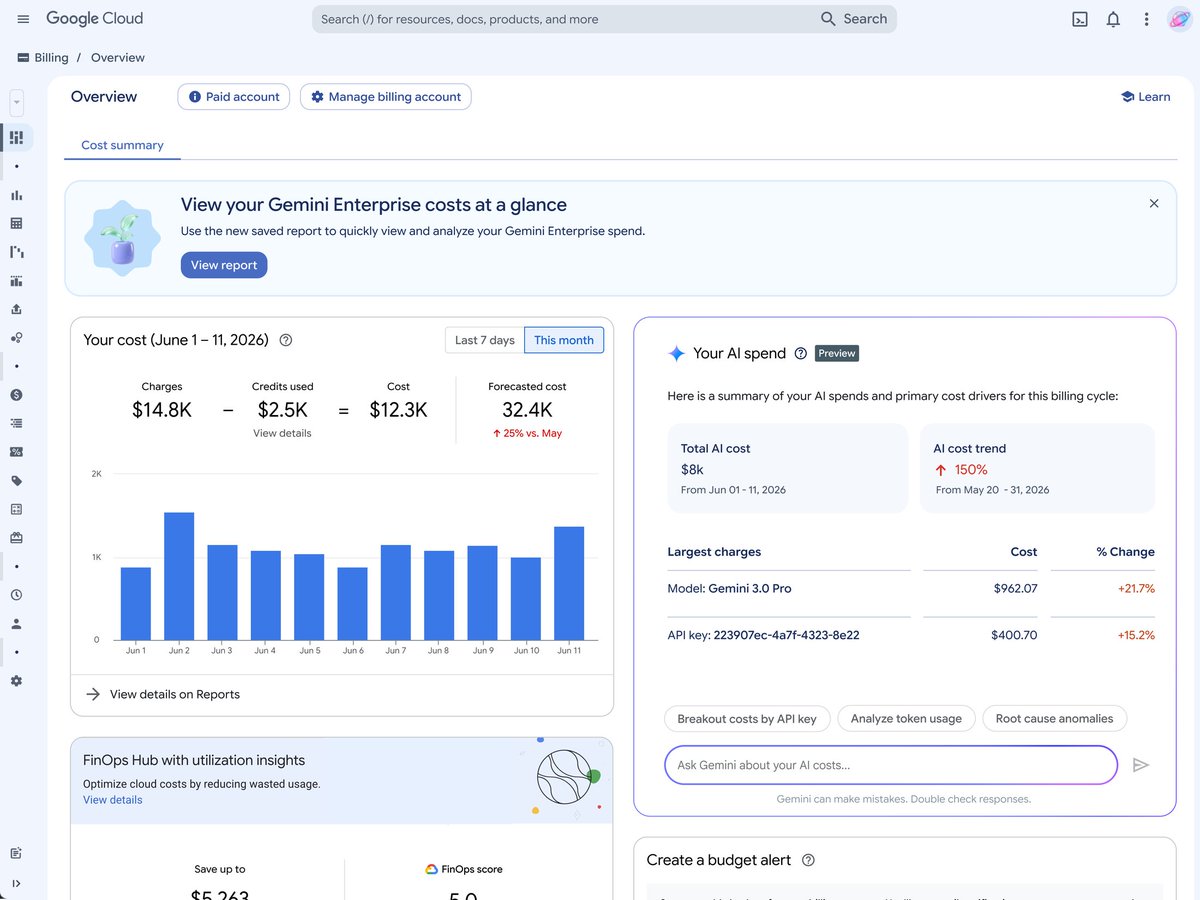
@GitHubNext positioned (6 likes, 1 reply, 945 views, 3 bookmarks) the same movement at enterprise scale: multi-repo dependency updates, org-wide policy changes, backlog reduction, and a single control plane with cost controls and auditing. In parallel, @googlecloud added (20 likes, 2 replies, 3,853 views) the financial side of the same story with pooled quotas, pay-as-you-go agent workloads, hard caps, and deferred execution pricing for Gemini Enterprise. The surface expansion is therefore not only about more places to prompt; it is also about where budgets, policies, and review controls live. (GitHub post; Google Cloud post)
Discussion insight: The most informative replies asked for fewer boundaries, not more features. People wanted Jira next to Azure DevOps, WSL to feel native instead of remote, and IDE integrations that do not split planning and execution into separate products.
Comparison to prior day: The previous day already elevated Azure DevOps and customization, but today's sample widened that surface story into Xcode, mainstream IDE extensions, WSL, shared chat sessions, and explicit multi-repo control planes.
1.3 The durable product increasingly looked like the wrapper, not the model (🡕)
A third theme carried forward from yesterday but got more concrete today. Multiple posts treated the valuable layer as the shell, workflow, and routing surface around the model: a free Codex-derived terminal agent, a multi-provider compatibility layer, a fast Codex feature release, and new capacity or commerce surfaces attached to usage.
@starmexxx argued (40 likes, 14 replies, 2,192 views, 28 bookmarks) that Grok Build is effectively a free Apache-licensed coding agent wrapper with MCP, plugins, hooks, CI/headless mode, and IDE integration. The thread mattered less for the price dunking than for the replies: one said terminal coding agents are becoming infrastructure instead of premium features, while another pushed back that the wrapper is not enough if the underlying model still lags on harder reasoning. That is a more mature market argument than simple “tool A beats tool B.” (post link)
@Codex_Changelog released (43 likes, 2 replies, 2,275 views) Codex CLI 0.150.0, and the public release notes showed why the workflow layer is the story: @ mentions for other tasks, richer /copy, auto-generated titles, rename suggestions, clickable markdown links, and interrupt hooks. Those are not model-improvement claims; they are operating-system-for-agent-work claims. The same release also fixed Windows sandbox and signature-path issues, which tied the feature push back to reliability work. (post link)
@KeisukeIshikawa described (5 likes, 192 views, 3 bookmarks) Free Claude Code as a way to keep Claude Code or Codex as the user-facing agent while routing inference through many other providers, local models, or failover backends. The screenshot sharpened the claim with concrete scope: 50 providers, nine coding agents, auto failover, local output filtering, and desktop/IDE/phone surfaces. The tweet's correction was just as important as its pitch: the “free tokens” story is not guaranteed by the wrapper itself, but by whichever free or paid providers the user connects underneath it. (post link)

@buildwithhassan showed (2 likes, 105 views) that Codex now has gift-credit tiers from 500 credits for $20 to 5,000 for $200 with one-year expiry, while @notjazii posted (22 likes, 12 replies, 978 views) an unconfirmed “Luna Reserve” UI for 5.6 Luna capacity. Neither item, by itself, proves a broad product shift, but together they showed a new layer of pricing and capacity management emerging around agent use. That is exactly the kind of surface that makes portability more valuable, because the model interface stays useful while the underlying entitlements keep changing. (gift post; reserve post)
Discussion insight: Even the most bullish posts returned to the same divide: the wrapper can preserve workflows, but developers still care whether the model underneath is actually good enough. That kept the conversation focused on routing and compatibility rather than on permanent loyalty.
Comparison to prior day: Yesterday's public evidence framed portability as a response to quotas and provider churn; today's evidence added newer packaging signals such as task-level Codex features, reserve buckets, and gift-credit commerce.
1.4 Reliability, trust, and governance stayed in the critical path (🡕)
The fastest-moving launches still ran into the same practical drag. Multiple posts showed that install trust, update safety, verbosity control, configuration hygiene, and explicit governance layers remain unresolved enough to create their own mini-market of tools and workarounds.
@alramalh0 warned (2 likes, 1 reply, 389 views, 1 bookmark) that a sponsored Google result was impersonating a Codex Desktop App download for macOS. The screenshot was unusually concrete for such a small post: the search was literally codex download macos, and the malicious sponsored result occupied the place a hurried developer might trust first. That made the problem operational rather than hypothetical. (post link)

@ayleovelle warned (1 like, 77 views) that a Windows Codex update could leave the desktop app unable to locate the Codex CLI binary. The attached screenshots went beyond anecdote: one showed the startup failure dialog, and another showed the linked GitHub issue documenting the spawn EINVAL path and the temporary CODEX_CLI_PATH workaround. For a market obsessed with autonomous execution, this was a reminder that packaging failures still block work before the model ever reasons about code. (post link)

@beyondfinites complained (6 likes, 3 replies, 444 views) that Codex and GPT-5.6 talk too much even when they already have the scripts needed to do the work. The screenshot backed the point with a long, approval-heavy terminal transcript full of narration around TestFlight, validation, and repeated command context. That complaint rhymed with the Copilot and WSL threads: once agent work reaches real environments, noise and friction become as important as raw capability. (post link)
@TheDailyViber argued (1 like, 2 replies, 48 views) that many so-called model failures are actually configuration failures in CLAUDE.md, SKILL.md, AGENTS.md, hooks, or MCP settings, and used agnix as the example response. The long thread said the project covers 423 rules with auto-fix, editor integrations, and a GitHub Action, which is a very specific sign that agent instructions and tool wiring are being treated as production infrastructure. Nearby, @dSebastien shared (116 views) a cross-agent technical-documentation skill, @Creatisoft pointed to (29 views) Lode Coding as a repo-local memory method, @ntaylormullen showed (133 views) a security-review subagent with a private vulnerability-scan tool, and @dennisyu posted (350 views) a Daybreak Blue approval email promising fewer refusals for higher-risk security workflows. The common pattern across all four is explicit governance: if the workflow matters, people increasingly want the rules, context, permissions, and security posture spelled out as artifacts. (agnix post)
Discussion insight: The day's reliability evidence was not abstract fear. It named concrete failure modes: poisoned install paths, broken Windows packaging, over-explaining agents, malformed config contracts, and the need for security-specific execution modes.
Comparison to prior day: Validation and review were already central in the previous day's public evidence, but today's posts pushed the conversation further toward installs, packaging, policy files, and governed security access.
2. What Frustrates People
Setup, installs, and environment boundaries still break too easily
This was High severity because the failures showed up before the model could do useful work. @alramalh0 warned (2 likes, 1 reply, 389 views, 1 bookmark) that a sponsored Google result was impersonating a Codex Desktop App download for macOS, while @ayleovelle warned (1 like, 77 views) that a Windows update could leave the app unable to find the Codex CLI binary and force users onto a manual CODEX_CLI_PATH workaround. The Xcode rollout was not frictionless either: in replies to @antigravity's Xcode post, one user called out the Xcode 27 beta 6 requirement and another said sign-in errors across Antigravity services were still blocking use. On the Copilot side, the WSL and Azure DevOps threads added smaller but familiar boundary pain: path/auth/file-watcher seams and questions about whether org admins must enable integrations first. The visible coping strategies were delaying updates, patching environment variables manually, and preferring surfaces that make platform boundaries less visible. This is clearly worth building for directly.
Supervising agents is still harder than starting them
This was also High severity because the complaint was about day-to-day usability, not model hype. @beyondfinites complained (6 likes, 3 replies, 444 views) that Codex and GPT-5.6 keep over-explaining even when they already have the scripts needed to finish the job, and the screenshot showed exactly that kind of narration-heavy session. The strongest coping response in the dataset came from @pierceboggan showing the Copilot app working directly on unresolved Azure DevOps review comments, which pulls supervision into the same surface as the diff and task context instead of forcing another review loop. @TheDailyViber argued that many “agent failures” are really broken config contracts in AGENTS.md, hooks, skills, or MCP settings, and used agnix as the answer. The common workaround was to move more review structure around the model: lint the instructions, expose the diff, keep the comment thread nearby, and tighten the artifact trail. This is worth building for.
Launch volume still outruns user confidence
This was Medium severity, but it was one of the clearest sentiment checks in the sample. @khushiirl provoked (119 likes, 93 replies, 6,647 views) a long “Antigravity is completely dead” thread where some replies said they still use it, but others explicitly told people to use Claude, Cursor, or Codex instead. That skepticism showed up even under launch posts: one reply to @antigravity's launch post said simple tasks still require repeated retries and end in hallucinated output, while one reply under @starmexxx's Grok Build post said the wrapper story is interesting but Claude still feels stronger on complex reasoning. The coping strategy visible in the data was not loyalty; it was fallback behavior. People switch tools, keep routing layers handy, and look for agent shells that let them change the model without relearning the workflow. That makes this frustration competitive rather than purely operational, but still highly actionable.
3. What People Wish Existed
Voice control that understands messy, real coding speech
The clearest practical need was not generic dictation, but speech input that still works when developers ramble, self-correct, use jargon, and talk about code artifacts. @antigravity introduced (1,264 likes, 58 replies, 60,590 views, 219 bookmarks) a code-aware transcription workflow, and @_philschmid reported (81 likes, 15 replies, 6,538 views, 25 bookmarks) that the model is good enough to preserve tokens like .json and clean up five-minute spoken instructions. The replies revealed the unmet need more clearly than the launch copy: people asked about overlap, slang, endpointing, recording-length limits, and whether benchmarked WER reflects real coding speech. @googledevs linking the Jot repo showed there is already immediate demand for cursor-level dictation built on top of this capability. Opportunity: Direct.
One continuous agent surface across IDE, chat, issue tracker, and local environment
People repeatedly asked for the workflow to survive context switches without feeling like a new product every time. In replies to @antigravity's Xcode post, one user explicitly asked to “merge ide and agent,” while @msdev amplified (76 likes, 2 replies, 7,537 views, 12 bookmarks) a WSL comment saying paths, auth, and file watchers should become invisible if the integration really works. @pierceboggan pushed Azure DevOps-linked sessions and said Jira is “very soon,” while @pamelafox showed @GitHub opening PRs from Slack and Teams. The need is practical and urgent: teams want one agent loop that survives the move from planning to coding to review to local verification. Opportunity: Direct.
Agent interfaces that stay stable while models, limits, and pricing change underneath
A second strong need was workflow portability. @KeisukeIshikawa described (5 likes, 192 views, 3 bookmarks) a compatibility layer that keeps Claude Code or Codex intact while routing to other providers or local models, and @starmexxx framed Grok Build as a free alternative wrapper around the same terminal-agent pattern. On the other side of the same need, @buildwithhassan showed gift-credit tiers and @notjazii posted an early reserve bucket UI, both of which make the entitlement layer more volatile and therefore make portability more attractive. This is already a competitive market, but the demand signal is direct: people want to keep their interface and swap the economics later. Opportunity: Competitive.
Durable rules and memory that keep agent behavior from drifting
The data also showed a quieter but persistent desire for explicit workflow artifacts. @dSebastien shared a technical-documentation skill for Claude Code, Codex, OpenCode, and Copilot, @Creatisoft pointed to Lode Coding as a repo-local memory method, and @TheDailyViber argued that config files like AGENTS.md, SKILL.md, hooks, and MCP settings need linting because silent mistakes look like model failure. These are practical needs more than emotional ones: people want agents to inherit standards, context, and permissions without re-explaining them every session. Several solutions already exist, so this is a competitive opportunity, but the need itself was reinforced across multiple unrelated posts. Opportunity: Competitive.
4. Tools and Methods in Use
| Tool | Category | Sentiment | Strengths | Limitations |
|---|---|---|---|---|
| Gemini 3.5 Transcribe | Speech model / voice interface | (+) | Code-aware transcription, filler cleanup, custom vocabulary, 85+ languages, strong published benchmark claims | Replies questioned endpointing, long-recording limits, and whether WER was measured on cleaned references |
| Jot | Dictation app | (+) | Hold-to-talk cursor insertion, local history, direct Gemini API use, privacy-forward architecture | macOS-only, requires API key plus microphone/accessibility permissions |
| Antigravity | Agent workspace | (+/-) | Xcode and multi-IDE expansion, screen-aware voice workflows, integrated editor presence | Xcode beta gating, auth complaints, and visible skepticism about model quality |
| GitHub Copilot app | Agent workspace / integration hub | (+) | Azure DevOps entry points, unresolved-comment handling, Customize tab for MCP/plugins/skills/canvases, WSL support | Some integrations appear admin-gated, WSL is still experimental, and adjacent requests already target Jira/GitLab-like surfaces |
| GitHub Copilot in Slack/Teams | Shared chat surface | (+) | Shared agent sessions, async PR creation, visible artifacts and diffs in the conversation | Requires cloud-agent policies and budgets, with limited direct practitioner volume in this sample |
| GitHub Agentic Workflows | Enterprise automation | (+) | Multi-repo coordination, policy propagation, backlog reduction, auditing, and control-plane framing | Enterprise-heavy positioning with low grassroots discussion today |
| Gemini Enterprise cost controls | FinOps / governance | (+) | Pooled quotas, pay-as-you-go, hard caps, runtime cost estimates, deferred execution pricing | Oriented to eligible enterprise customers rather than individual developers |
| Codex CLI | Agent CLI | (+/-) | Fast workflow shipping such as task mentions, interrupt hooks, copy controls, and better titles | Verbose sessions, Windows packaging regressions, and evolving capacity/commerce surfaces create friction |
| Grok Build | Agent CLI wrapper | (+/-) | Free Apache-licensed terminal agent with MCP, plugins, hooks, CI/headless mode, and IDE integration | Replies still treated the wrapper as secondary to model quality |
| Free Claude Code | Router / compatibility layer | (+) | Preserves familiar agent UIs while routing across many providers with failover and local filtering | “Free” capacity depends on whichever providers the user connects underneath |
| Agnix | Agent-config linter | (+) | Lints skills, hooks, MCP config, and agent instruction files; offers auto-fix, editor integrations, and GitHub Action support | Rule volume may include low-value warnings, so hard-gating too early could create noise |
| Technical-documentation skill | Cross-agent skill | (+) | Reusable documentation rules across Claude Code, Codex, OpenCode, and Copilot with no runtime deps | Narrowly focused on documentation rather than general coding tasks |
| Lode Coding | Method / context memory | (+) | Keeps durable project memory in repo-local markdown, improving continuity across sessions and vendors | Requires teams to maintain structured context files as part of the workflow |
| Zeta 2.1 GGUF | Local edit-prediction model | (+/-) | Lightweight next-edit suggestions with local deployment and Apache-2.0 licensing | Only one low-signal mention today, so practical evidence remains thin |
The overall satisfaction spectrum was highest when a tool removed a very specific workflow tax. @_philschmid reported that Gemini 3.5 Transcribe made voice input materially more usable for coding, @pierceboggan showed Copilot handling review comments inside the same workspace, and the Jot repo translated the speech model into a direct cursor-level tool. Satisfaction dropped when boundaries reappeared: @ayleovelle hit a Windows packaging failure, @beyondfinites complained about verbose agent narration, and @khushiirl surfaced blunt skepticism about Antigravity despite the launch cadence.
Common workarounds were compositional rather than loyal. @KeisukeIshikawa kept the agent interface stable while swapping providers underneath, @TheDailyViber treated config linting as part of the solution space, and @Creatisoft pointed to repo-local memory files instead of better prompting alone. The main migration pattern was therefore upward in the stack: models still matter, but more of the competition is shifting to surfaces, routers, review loops, cost controls, and workflow packages built around them.


5. What People Are Building
| Project | Who built it | What it does | Problem it solves | Stack | Stage | Links |
|---|---|---|---|---|---|---|
| Jot | Ammaar Reshi | Smart dictation app for macOS that types polished text at the cursor | Turns speech into code/editor input without a separate transcript workflow | Swift, Gemini 3.5 Transcribe, SQLite, macOS accessibility | Shipped | repo, tweet |
| GitHub Copilot app Customize + Azure DevOps | @pierceboggan | Installs MCP/plugins/skills/canvases and starts sessions from Azure DevOps issues and PRs | Keeps backlog, review, and agent work in one surface | Copilot app, Azure DevOps, MCP, skills, canvases, WSL | Shipped | Azure DevOps tweet, Customize GA |
| GitHub Copilot in Slack and Teams | @pamelafox | Starts shared agent sessions from chat, opens PRs, and keeps artifacts visible in the conversation | Turns coordination chat into collaborative execution without handing work off to a private session | Slack, Teams, GitHub Copilot cloud agent, cloud sandboxes | Beta | tweet, Slack, Teams |
| GitHub Agentic Workflows | @GitHubNext | Coordinates policy changes, dependency work, backlog reduction, and code-quality checks across many repositories | Gives organizations a control plane for repetitive multi-repo agent work | GitHub platform, auditing, cost controls, multi-repo automation | Beta | tweet |
| GitHub Copilot modernization agent | @dotnet | Uses agentic AI for large-codebase analysis, dependency mapping, upgrade planning, and safer refactors | Reduces the manual archaeology required to modernize legacy codebases | GitHub Copilot, modernization workflows, .NET codebases | RFC | tweet, event page |
| technical-documentation-skill | @dSebastien | Cross-agent documentation skill with reusable references and review checklists | Gives coding agents explicit doc-writing rules before they generate documentation | Agent Skill, Markdown references, cross-agent installers | Shipped | repo, tweet |
| Loading experiences npm library | @itskasturiii | NPM library for loading experiences in AI apps | Addresses the UX gap around waiting states that often survives after the core model call works | Codex-assisted npm library | Shipped | tweet |
| AI Lead Search | @creatorsuki | Lead-search SaaS with niche, location, and platform filters | Shows a concrete vibe-coded SaaS pattern paired with a manual design pass | Figma Make, Figma, web app | Alpha | tweet |
The build pattern was split between first-party control surfaces and small, concrete workflow products. GitHub's launches all pushed the same direction: fewer hops between planning, issue context, review comments, chat, and code. Jot and the loading-experiences library showed a narrower builder pattern: use a new model or agent to remove one painful step that users already feel, rather than launch another general-purpose wrapper.
The workflow-packaging pattern was just as strong. The technical-documentation-skill repo turned documentation standards into an installable artifact for multiple agent clients, while @TheDailyViber used agnix to argue that agent configs now need the same linting discipline as code. In the same vein, @Creatisoft linked Lode Coding as a way to keep durable repo-local memory files for future sessions.
Another signal came from monetization proof instead of feature demos. @PatrickSargis claimed (2 likes, 73 views) that an app built with Claude Code reached $387,403 ARR in three months, and the attached analytics image showed MRR, cash collected, and ARR totals even though the underlying product remained undisclosed. That is not enough evidence to profile the product itself, but it is strong evidence that builders are using AI coding publicly as part of revenue stories rather than just launch-day novelty.


6. New and Notable
Codex kept sprouting explicit capacity and commerce surfaces
@buildwithhassan showed (2 likes, 105 views) a Codex gift-credit checkout flow with tiers from 500 credits for $20 to 5,000 for $200, while @notjazii posted (22 likes, 12 replies, 978 views) an early “Luna Reserve” bucket UI for 5.6 Luna capacity. Those posts would have been easy to dismiss as isolated screenshots, but two older-looking references in the same day's dataset gave them context: @SPAC89 recalled (4 likes, 2 replies, 507 views, 3 bookmarks) an OpenAI email that gave GPT-5.5 party applicants 10x Codex rate limits as consolation, and @hrkrshnn pointed out (1 like, 1 reply, 539 views, 1 bookmark) that the old May 2025 Codex Cloud launch already used a very explicit package and rate-limit model. Together, the evidence suggests that Codex packaging and entitlement design are becoming public conversation objects in their own right, not just buried product settings.


Security-specific access layers are becoming visible
@dennisyu posted (1 like, 1 reply, 350 views, 3 bookmarks) a Daybreak Blue approval email promising GPT-5.6-Sol with fewer refusals for higher-risk cybersecurity workflows, while @ntaylormullen showed (3 likes, 1 reply, 133 views, 1 bookmark) a security-review subagent wired to a private vulnerability-scanning tool. The notable part was not just “security exists,” but that the security layer is becoming explicit in public artifacts: named access tiers, private tools, and visible subagent boundaries. That is a meaningful change from generic “agents can help with security” rhetoric. (Daybreak Blue post; subagent post)

Lightweight local assistance kept appearing beside full agent stacks
@HuggingModels shared (1 like, 1 reply, 1,044 views, 1 bookmark) Zeta 2.1 GGUF as an Apache-2.0 local model for edit prediction and next-edit suggestion rather than end-to-end autonomous coding. It was only a single low-volume post, but it mattered because it pointed in the opposite direction from the giant-agent surface story: some builders still see value in narrow, local, assistive coding models that slot into the editor without taking over the whole workflow.
7. Where the Opportunities Are
[+++] Continuous multi-surface agent workspaces — Evidence came from Antigravity's Xcode and IDE rollouts, Copilot's Azure DevOps + WSL + Customize surfaces, Slack/Teams handoff, and GitHub Agentic Workflows for multi-repo control. The opportunity is strong because users are no longer asking for “a coding agent”; they are asking for one agent loop that survives planning, coding, review, chat, and local execution without making the seams visible. (sources, 1, 2, 3)
[+++] Code-aware voice interfaces for development work — Gemini 3.5 Transcribe, the benchmark-chart thread, and the Jot repo all pointed to the same gap: developers will use speech heavily if it reliably preserves code tokens, cleans filler, and understands context. This is strong because today's evidence included both a major launch and immediate productization into a concrete cursor-level tool. (sources, 1, 2)
[++] Portable agent shells with swappable models and capacity layers — Free Claude Code, Grok Build, Codex task features, gift credits, and the reserve bucket screenshot all reinforce the same need: keep the workflow stable while models, prices, and quotas move. The signal is moderate because many wrappers are already emerging, but the public evidence suggests the demand is durable. (sources, 1, 2, 3)
[++] Agent-governance infrastructure — Agnix, the technical-documentation skill, Lode Coding, and the Antigravity security-subagent example all turned workflow rules into explicit artifacts. This is moderate because standards are still fragmented, but the need is clear: teams want lintable instructions, durable memory, and auditable tool boundaries instead of treating every failure as a model mystery. (sources, 1, 2, 3)
[+] Security-specific coding-agent tiers — The Daybreak Blue approval email and the private vulnerability-scanning subagent both show early demand for guarded higher-risk workflows with explicit access and tool isolation. The signal is emerging because the evidence is concrete but still low-volume compared with voice and surface expansion. (sources, 1)
8. Takeaways
- Voice crossed from demo territory into workflow territory. The combination of Antigravity's launch, Schmidt's operator details, Google DeepMind's charts, and the Jot repo showed speech being treated as a serious coding input path rather than as generic dictation. (source)
- The competitive surface is increasingly the place where work continues, not the model alone. Xcode, IDE extensions, Azure DevOps, WSL, Slack, Teams, and multi-repo control planes all pointed to the same demand for continuous agent supervision across tools. (source)
- Portability became more valuable as Codex packaging got more explicit. Free Claude Code, Grok Build, Codex 0.150.0, gift credits, and the reserve UI all reinforced that developers want stable workflows even while prices, quotas, and entitlements keep shifting. (source)
- Reliability and governance are now part of the product category. Malware install ads, a broken Windows update, config linting, workflow skills, and security-specific subagents all showed that agent operations now depend on trustable packaging and explicit rules, not just smarter models. (source)
- Builders kept anchoring the conversation in concrete outputs. The shipped loading-experiences npm library, the AI Lead Search SaaS, and the Claude Code revenue dashboard all gave the day a stronger build-and-monetize flavor than a pure benchmark cycle. (source)