Twitter AI Coding - 2026-08-30
1. What People Are Talking About
1.1 AI coding was framed as a workflow system, not a prompt trick (🡕)
The strongest conceptual shift was away from isolated prompt tips and toward end-to-end operating models. People were packaging AI coding as a stack of repeatable skills, bounded workflows, and artifact-driven SDLC loops; the interesting posts were the ones that specified where autonomy starts, where it stops, and which public artifacts keep humans in control.
@AndrewBolis said (109 likes, 32 replies, 10,494 views, 106 bookmarks) that professionals now need a nine-part AI skill ladder spanning prompt engineering, workflow automation, vibe coding, AI-assisted development, agentic coding, and RAG. The attached infographic mattered more than the motivational framing because it explicitly mapped the stack to working tools such as Cursor, Google Antigravity, OpenAI Codex, Claude Code, LangChain, and Haystack, which is a public snapshot of how the audience is organizing the space. (post link)

@jgonzalezferrer said (48 likes, 25 replies, 3,789 views, 7 bookmarks) that people asking how to work with AI should start with one repetitive workflow they already know and build around it, while quoting his own example of cutting KOL-management work from 1-2 hours per day to 10 minutes. The useful discussion was in the replies: one practitioner said the breakthrough came only after defining exactly what the agent may touch, which tests it must run, and when it must stop for review. (post link)
@shao__meng shared (209 views, 3 bookmarks) a bundle of Google, OpenAI, Anthropic, and LangChain reports on AI-native development. The linked public OpenAI guide explicitly describes agents contributing across planning, design, development, testing, review, and deployment, while Anthropic’s public AI-native SDLC playbook says code is no longer the bottleneck and argues for committed artifacts such as intent.md, spec.md, plan.md, diffs, and review findings as the control surface. (post link)
@RoundtableSpace said (44 likes, 17 replies, 35,618 views, 11 bookmarks) that OpenResearch CLI can run a local autoresearch loop with parallel agents in separate worktrees while keeping data on the user’s machine. The public OpenResearch repository backed up the tweet with concrete mechanics — isolated git worktrees, reproducible experiment trees, multi-agent sessions, and local or remote compute — while replies immediately shifted to oversight questions such as how to trust agent evidence and how to notice a run stalled on a permission prompt. (post link)
Discussion insight: The replies were notably procedural. Instead of asking for better prompts, people asked for bounded file access, explicit tests, stop conditions, trusted evidence, and ways to monitor blocked runs.
Comparison to prior day: The previous day already had strong “skills” and repo-policy signals. Today pushed that one step further into workflow systems and SDLC doctrine: workflow mentions ticked up from 15 to 16 and harness mentions from 8 to 10, while the cited posts were denser about operational boundaries than the 2026-08-29 set.
1.2 Quota, token burn, and progress visibility stayed in the critical path (🡒)
The day’s most practical discussion was still about whether coding tools feel predictable under real use. Heavy users were arguing over five-hour limits, repeated resets, runaway token burn, and whether a streaming response is actually telling them anything useful about the work happening behind the UI.
@babayagatwt argued (111 likes, 24 replies, 4,570 views) that OpenAI’s five-hour limit treats plan price as a proxy for seriousness, even though some developers and researchers do heavy Codex and ChatGPT Work sessions on the $20 tier because higher plans are unrealistic. The replies sharpened the unmet need: one asked for a transparent compute meter so users could choose speed, model, or session length themselves, while another defended the limit as infrastructure protection against simultaneous heavy use. (post link)
@hqmank said (13 likes, 3 replies, 1,495 views) that Codex was back to “regular resets,” and the quoted update from @thsottiaux listed what OpenAI had just fixed: compaction keeping old images, background memory workers that would not stop, runaway goals, over-frequent automations, unintended subagent escalation, repeated computer-history summaries, rolling task summaries, and double-encoded MCP results. That made the quota discussion unusually concrete: real bugs were explicitly acknowledged as burning 10% to 70% of weekly usage in some cases. (post link)
@MiaAI_lab reported (28 likes, 12 replies, 1,558 views) that GLM 5.3 in OpenCode Go burned more than $22 on a single prompt and still did not finish, turning model choice into a direct cost-risk decision instead of an abstract benchmark preference. (post link)
@theo said (69 likes, 15 replies, 9,238 views, 6 bookmarks) that only about 1% of the runtime in his real Codex and Claude Code threads was actually spent streaming text back to him. The replies did not mostly contest the number; they reframed the product problem by saying people want evidence that a run is still alive, not necessarily token-by-token prose. (post link)
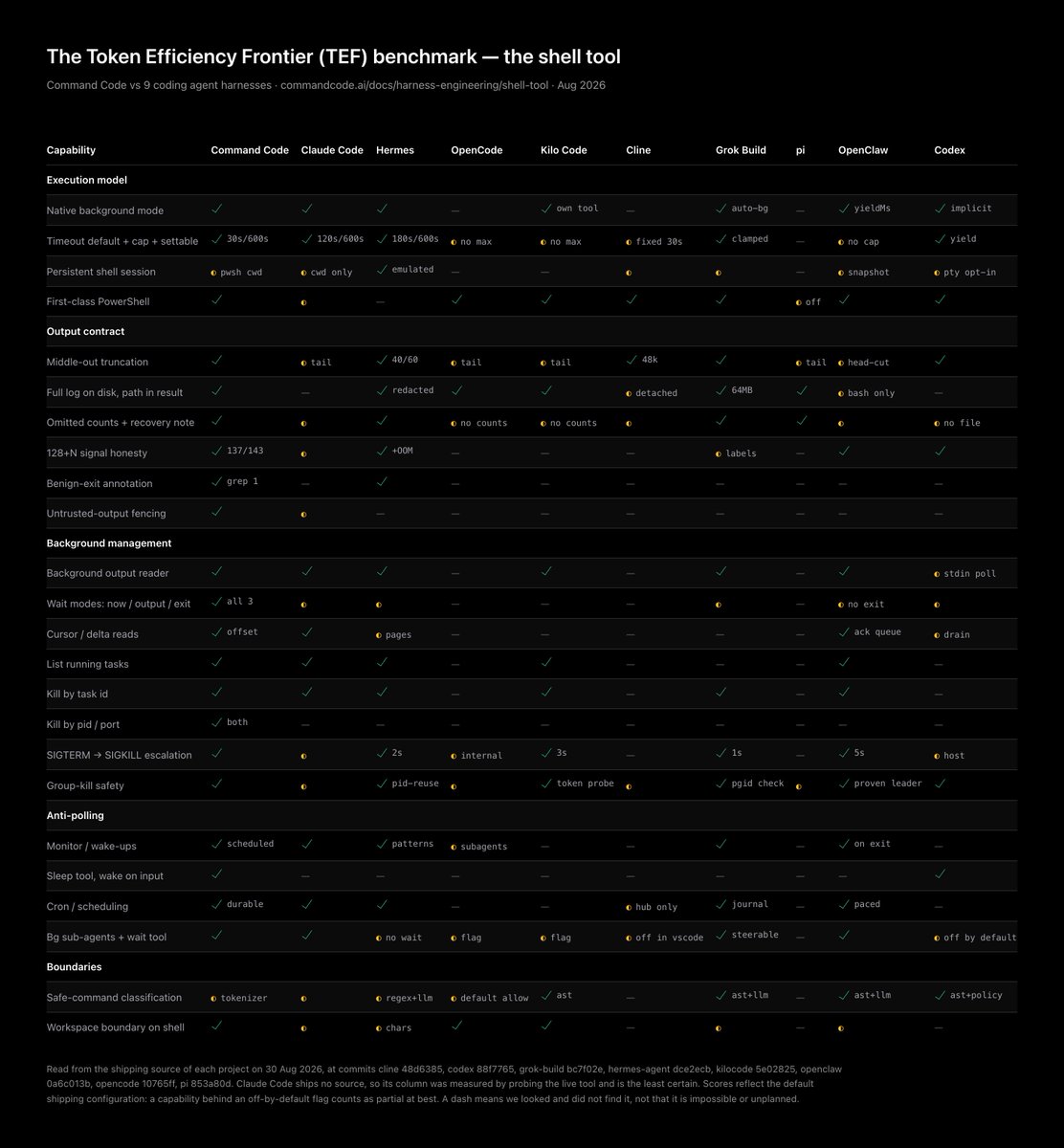
@MrAhmadAwais claimed (50 likes, 11 replies, 2,116 views, 14 bookmarks) that Command Code’s shell tool sits on a public token-efficiency frontier after grading 23 shell-tool capabilities across competing harnesses. The tweet’s distinctive value was not just the vendor claim but the specific method list — wake-up based background execution, from_offset reads, exact truncation counts, honest signal exits, kill-by-port, and untrusted-output fencing — plus replies that questioned fairness and asked for automatic best-cost routing. (post link)
Discussion insight: The conversation kept moving from raw frustration to instrumentation. The recurring asks were for transparent meters, honest state reporting, best-cost routing, and progress events that survive long-running background work.
Comparison to prior day: codex mentions rose from 34 on 2026-08-29 to 40 today, but the tone remained operational rather than celebratory. After the official rate-limit threads earlier in the week, people were still talking about quotas — only now with more specific burn sources, screenshots, and cost examples.
1.3 Antigravity and Gemini drew more firsthand reports, but sentiment stayed split (🡕)
Google’s coding stack was more visible again, but the evidence pointed to a live split rather than a consensus win. Today’s Antigravity posts were not mostly official launch threads; they were practitioners comparing real utility, model access, and whether the harness feels good enough to become a daily driver.
@benvargas said (17 likes, 7 replies, 1,913 views) that he pays for Gemini through a discount plan and still does not use Antigravity because he cannot use the harnesses he wants and the models feel irrelevant. Replies pushed back with narrower use cases instead of broad evangelism: one said Gemini is “essentially free inference” worth using for simple work, while another said it is especially fast for PR review when no files need to be written. (post link)
@LeoBuilds_ said (14 likes, 6 replies, 372 views) that after reading 360 comments on a prior Antigravity post, he concluded the product is not dead and that Gemini 3.7 Flash is actually good for coding. This mattered less as proof of dominance than as evidence that there is still active hands-on use behind the debate. (post link)
@GergelyOrosz said (7 likes, 1 quote, 1,035 views) that Anthropic had cut Antigravity off from SOTA models and left it on “7-month-old models” several releases behind Opus 5 and Sonnet 5. The linked quote-tweet from @Themadhushaw01 directly complicated that claim by saying “I can still use antigravity with opus and sonnet,” which left the day with disagreement over actual model availability rather than a settled answer. (post link)
Discussion insight: The split was not “Google good” versus “Google bad.” It was narrower: Gemini can be worthwhile for specific high-speed or included-plan use cases, but people still hesitate when the harness, model menu, or integration surface feels behind the tools they already trust.
Comparison to prior day: The topic clearly revived. In the raw data, antigravity mentions rose from 14 on 2026-08-29 to 22 today, and gemini mentions rose from 16 to 24, but the increase came from user anecdotes and access disputes rather than from one dominant official release.
2. What Frustrates People
Limits and token burn still feel unpredictable
This was High severity because the complaints were not abstract pricing talk; they were about active work becoming hard to plan. @babayagatwt argued (111 likes, 24 replies, 4,570 views) that the five-hour limit treats price tier as a proxy for seriousness even though some heavy Codex and ChatGPT Work users stay on Plus because higher plans are unrealistic. @hqmank added (13 likes, 3 replies, 1,495 views) a concrete reset example, and the quoted @thsottiaux post made the causes explicit: compaction, memory workers, runaway goals, automations, unintended subagents, computer-history summaries, rolling summaries, and MCP encoding bugs were all burning usage. @buildwithrajath said (35 likes, 14 replies, 2,816 views) repeated resets make the whole limit story feel unfinished, while @MiaAI_lab reported (28 likes, 12 replies, 1,558 views) spending more than $22 on one GLM 5.3 prompt in OpenCode Go without getting to completion. People are coping by rationing models, preferring narrower workflows, or building separate usage monitors. This is worth building for directly because the pain is frequent, measurable, and already producing its own shadow tooling.


People still cannot tell whether an agent is working, stuck, or quietly wasting turns
This was also High severity. @theo said (69 likes, 15 replies, 9,238 views) only about 1% of runtime in his Codex and Claude Code threads was spent streaming text, and the most useful replies said the real ask is proof that the run has not died. @RoundtableSpace surfaced (44 likes, 17 replies, 35,618 views, 11 bookmarks) the same issue from the local-agent side when a reply described not noticing a parallel OpenResearch run had stalled on a permission prompt for 40 minutes. @MrAhmadAwais responded (50 likes, 11 replies, 2,116 views, 14 bookmarks) by arguing for wake-up based shell tooling, honest exits, and from_offset reads instead of polling. The workaround pattern is clear: people are adding event streams, logs, and external monitors around the model because the default UI signals are not trusted. This is worth building for directly.
Ordinary developer surfaces still leave obvious automation value on the table
This was Medium severity, but the frustration was specific and practical. @neogoose_btw said (51 likes, 2 replies, 4,376 views, 9 bookmarks) GitHub’s automated release notes are still a plain changelog dump and complained that this is “the only place” they would actually want Copilot assistance. The complaint matters because it is not about frontier capability; it is about a mundane workflow where summarization and prioritization should already be obvious product wins. This looks worth building for competitively because it is narrow, recurring, and easy for users to evaluate.

3. What People Wish Existed
A transparent compute meter and better cost-to-task routing
The clearest practical ask was for users to control how they spend compute instead of discovering limits after the fact. In replies to @babayagatwt, one user explicitly asked for “a transparent compute meter” so people could choose speed, model, or session length instead of falling off a weekly cliff. In replies to @MrAhmadAwais, another asked for an endpoint that always picks the best cost/task because there are too many launches to keep comparing manually. @justkarangupta offers a partial answer with Top Notch, but that utility only covers live usage visibility for Claude, Cursor, and Codex. Opportunity: Direct.
Proof-of-life telemetry for long-running agent work
People did not ask for prettier streaming; they asked for trustworthy state. Replies under @theo said users want evidence that “nothing died,” and a reply under @RoundtableSpace described checking a phone dashboard because a parallel run had stalled on a permission prompt for 40 minutes. This is a practical need with partial solutions in wake-up based harnesses and external monitors, but no strong evidence today of a standard, cross-tool answer. Opportunity: Direct.
Launch-readiness checks for vibe-coded products
The need here was less “someone should build this” and more “people are already shipping without it.” @PrajwalTomar_ said (5 likes, 2 replies, 1,018 views, 12 bookmarks) that vibe coders are getting sued because they launch real-user apps while skipping basics such as privacy policy, data handling, and baseline security posture, and he framed the checklist around lessons from helping ship 60+ MVPs. Combined with @neogoose_btw wanting AI help on automated release notes, the pattern is that teams want AI in the boring operational chores around launch, not only in code generation. Partial answers exist as personal checklists and one-off product features, but no strong shared standard surfaced today. Opportunity: Competitive.

4. Tools and Methods in Use
| Tool | Category | Sentiment | Strengths | Limitations |
|---|---|---|---|---|
| OpenAI Codex | Coding agent / CLI | (+/-) | Handles long-running execution workflows and is a default reference point for builders | Five-hour limits, reset dependence, and quota-draining bugs kept surfacing |
| Claude Code | Coding agent / CLI | (+/-) | Common baseline for local research-agent workflows and AI-native SDLC discussion | Users still want better progress-state signals for long-running work |
| Google Antigravity | Coding agent / CLI | (+/-) | Still usable for some hands-on users, especially with Gemini 3.7 Flash | Others avoid it because harnesses or model access feel behind competing tools |
| GitHub Copilot | Coding assistant / platform | (+/-) | Remains part of the default AI-assisted development stack | Obvious AI surfaces such as release-note summarization still feel underbuilt |
| Command Code | Agent harness / CLI | (+/-) | Public shell-tool benchmark, wake-up based execution, cursor reads, exit honesty, and output fencing | Benchmark is vendor-published and reply-thread fairness questions remained unresolved |
| OpenResearch CLI | Research-agent workspace | (+) | Local-first parallel worktrees, reproducible experiments, and any-model flexibility | Users still need manual oversight for trust and blocked-run detection |
| OpenCode Go + GLM 5.3 | Open-model coding stack | (-) | Flexible access to alternate models | One public usage chart showed a $22.60 prompt that still did not finish |
| Top Notch | Usage monitor | (+) | Live Codex, Claude, and Cursor usage visibility in a native Mac utility | Personal alpha; two provider integrations rely on undocumented endpoints |
The spectrum was less about which model is smartest and more about which tool feels operable under pressure. @babayagatwt and @hqmank showed that Codex evaluations are still inseparable from quota mechanics, while @benvargas, @LeoBuilds_, and @GergelyOrosz showed that Antigravity debates hinge on harness fit and actual model access more than on broad brand preference. Workarounds were concrete: @justkarangupta built Top Notch to stop switching dashboards, @RoundtableSpace pushed research runs into local parallel worktrees, and @MrAhmadAwais argued that better shell-tool design removes wasted turns before model quality even becomes the bottleneck. No strong migration consensus emerged beyond that; users kept comparing tools through the lens of visibility, limits, and control.
@MrAhmadAwais shared (50 likes, 11 replies, 2,116 views, 14 bookmarks) a vendor benchmark claiming Command Code sits on the token-efficiency frontier for shell tooling. The public doc page supports the scope of the claim — ten harnesses, pinned commits, and shell-tool capabilities such as wake-ups, cursor reads, honest exits, and kill-by-port — but the reply thread also shows readers immediately questioning the methodology and asking for best-cost routing rather than only comparative charts. (post link)

@MrAhmadAwais followed up (286 views) with a row-by-row TEF table and pinned-commit notes for the benchmark. That second image matters because it makes the comparison criteria visible instead of leaving them implicit in a marketing claim. (post link)
5. What People Are Building
| Project | Who built it | What it does | Problem it solves | Stack | Stage | Links |
|---|---|---|---|---|---|---|
| OpenResearch CLI | @RoundtableSpace | Local-first workspace for running research agents across literature review, experiments, and artifact generation | Lets people run multi-agent research loops overnight without sending project data off-machine | Rust; Claude Code, Codex, OpenCode; local or remote compute | Shipped | tweet, repo |
| Top Notch | @justkarangupta | Native macOS utility that shows live Claude, Cursor, and Codex usage in the camera notch | Reduces dashboard-hopping and surprise quota cutoffs | Swift, SwiftUI, AppKit; provider integrations, caching, native window management | Alpha | tweet, repo |
| opencode-dotnet | @LukeParkerDev | C#/.NET porting work for OpenCode session execution and model-provider streaming | Brings agent-harness patterns into .NET workflows instead of leaving them TypeScript- or Node-centric | C# / .NET | Alpha | tweet |
| Infinite Twitch story stream | @DFintelligence | Live Twitch stream whose story is generated from chat and the prior frame, with moderation in the loop | Turns vibe-coded automation into a continuously running audience-facing product | Twitch chat, frame-reference loop, moderation; exact model stack not fully specified publicly | Beta | tweet |
OpenResearch CLI stood out because the supporting evidence went well beyond a teaser clip. The public repository describes isolated git worktrees, reproducible experiment trees, and the ability to run the same research workflow locally, over SSH, or on cluster backends, which makes the “overnight research loop” claim concrete rather than aspirational. The reply thread showed the next problem immediately: once several agents are running in parallel, trust and blockage detection become product requirements rather than afterthoughts. (tweet, repo)
Top Notch and opencode-dotnet pointed to the same builder instinct from different angles. Top Notch treats quota visibility as a product in its own right: the repo says it is a personal alpha with 209 tests and fail-closed provider reads, which matches the day’s broader frustration with hidden usage state. opencode-dotnet is earlier, but the visible C# diff showed real porting work in SessionExecutionEngine.cs, suggesting that portability into different language ecosystems is itself becoming a build target. (tweet, repo, post link)

The live Twitch experiment added a different flavor of builder activity: not better internal tooling, but a continuously running AI-native media workflow. @DFintelligence said (104 likes, 11 replies, 6,279 views, 24 bookmarks) the stream was already live after seven hours of vibe coding, with moderation and AI-based input monitoring keeping the loop safe enough to run in public. That pairs neatly with Prajwal Tomar’s checklist elsewhere in the dataset: people are no longer only prototyping with AI coding tools, they are shipping audience-facing systems and then discovering which operational gaps matter. (post link)
Repeated build patterns were clear across these projects: local-first control, quota visibility, portability across agent clients, and turning agent work into something that can run unattended for longer stretches. The common trigger was not “AI is cool”; it was operational friction that existing tools were not solving cleanly.
6. New and Notable
Runtime telemetry is starting to outrank token streaming as the UI people actually need
@theo said (69 likes, 15 replies, 9,238 views, 6 bookmarks) that across six real agent runs totaling 177.8 minutes, assistant text could have streamed for only 91.4 seconds, or 0.86% of elapsed time. The significance was not just the number: the replies converged on a new product requirement, with multiple people saying they want proof the run is alive, blocked, or finished rather than a steady drip of tokens. That is a sharper articulation of the long-running-agent UX problem than the usual “streaming feels better” debate. (post link)

Model-access confusion is now a product-level signal, not a side argument
@GergelyOrosz said (7 likes, 1 quote, 1,035 views) that Antigravity had been cut off from current Anthropic models, while the linked quote from @Themadhushaw01 said they could still use Opus and Sonnet. Read next to @benvargas and @LeoBuilds_, the important signal is not who is right in every account; it is that tool evaluation now depends on which exact model menu, harness behavior, and plan entitlements a user believes they are getting in practice.
7. Where the Opportunities Are
[+++] Cross-tool quota control plane — The evidence came from several angles at once: @babayagatwt and replies asking for a transparent compute meter, @hqmank relaying bug fixes that materially changed quota burn, @MiaAI_lab showing a single unfinished prompt costing $22.60, and @justkarangupta building Top Notch to expose usage locally. This is strong because the pain is operational, recurring, and already causing people to build partial solutions.
[++] Trustworthy background-run observability — @theo quantified how little of agent runtime is visible through token streaming, @RoundtableSpace surfaced blocked-run monitoring as a real problem, and @MrAhmadAwais argued for wake-ups, honest exits, and incremental log reads instead of polling. This is moderate because the need is clear and cross-tool, but several products are already circling parts of the answer.
[++] Launch-readiness guardrails for vibe-coded products — @PrajwalTomar_ showed that privacy, data handling, and baseline security are getting skipped in real-user launches, while @neogoose_btw highlighted how even simple release-note surfaces still miss obvious AI help. This is moderate because the work sits adjacent to shipping rather than to raw code generation, and the public evidence suggests teams will pay for fewer embarrassing omissions.
[+] Model-access normalization across provider bundles — @benvargas, @LeoBuilds_, and @GergelyOrosz all described the same product from conflicting angles depending on which models, harnesses, and plans they believed they had. This is emerging because the confusion is real, but the data today points to fragmented anecdotes rather than a single dominant buying signal.
8. Takeaways
- The conversation kept moving from prompts to operating systems. Andrew Bolis’s nine-skill map, jgonzalezferrer’s workflow-first advice, the OpenAI engineering guide, Anthropic’s AI-native SDLC playbook, and OpenResearch CLI all treated AI coding as a bounded process stack rather than a single chat trick. (source)
- Quota clarity is still the most visible blocker to serious day-to-day use. The five-hour-limit complaints, OpenAI’s own reset-and-bug-fix explanation, and the $22.60 unfinished GLM 5.3 run all point to cost visibility and usage control as product-critical, not secondary. (source)
- Builders are responding by shipping control surfaces around the agents, not just more agents. OpenResearch CLI, Top Notch, and opencode-dotnet each attacked a different operational gap: parallel local execution, live usage visibility, and language-ecosystem portability. (source)
- The next UX fight is proof-of-life, not prettier streaming. Theo’s runtime breakdown showed only 0.86% of elapsed time available for streamed text, and the replies made clear that users mainly want to know whether the run is alive, blocked, or done. (source)
- Antigravity interest rebounded, but with no consensus winner story. Mention counts for both
antigravityandgeminirose versus the prior day, yet the cited posts split between “good enough with Gemini 3.7 Flash,” “not worth the harness tradeoffs,” and “unclear which Anthropic models are really available.” (source)