Twitter AI Coding - 2026-09-01
1. What People Are Talking About
1.1 Google turned Antigravity into the day's most visible coding stack (🡕)
Google's coding stack dominated the day across at least five separate high-signal items: a new /boost mode, a broader Gemini 3.7 Flash showcase, a public claim of research-grade results, a direct recommendation to use /teamwork-preview, and user discussion that reframed recent bugs as a capacity problem rather than a lack-of-adoption problem.
@antigravity introduced (886 likes, 60 replies, 45,399 views, 317 bookmarks) /boost as a deeper reasoning mode for complex software tasks. The public /boost docs say it uses a 3-phase multi-agent pipeline with isolated worktrees, specialized subagents, and independent regression checks, and the thread's own replies narrow the intended use cases to tricky bug fixes, algorithmic optimization, non-trivial refactors, and root-cause investigation. That makes this less of a generic model upgrade and more of a new paid workflow tier inside the Antigravity harness itself. (docs)
@Google showcased (692 likes, 73 replies, 151,041 views, 175 bookmarks) teams building with Gemini 3.7 Flash across Google AI Studio, Antigravity, and Gemini App Spark, naming concrete outputs such as real-time website generators, 3D physics simulators, webcam tools, and a personalized beach field guide. In the replies, Google broke that down into individual examples like a Google Sheets video generator and a single-shot Kerr black-hole simulator, which made the post feel more like a product round-up than a single promo clip.
@ai_for_success highlighted (249 likes, 22 replies, 11,020 views, 43 bookmarks) a more technical Google claim: Antigravity plus Gemini 3.7 Flash solving seven open problems across venues like FOCS and JMLR, including Knuth's Cycles Conjecture with 40+ page Lean-verified proofs, and building a cycle-accurate out-of-order RISC-V simulator that boots xv6 to a shell. The screenshot matters because it carries details the tweet compresses into one sentence.

@ksprashu told (29 likes, 5 replies, 1,966 views, 19 bookmarks) paid Google AI users to "drop everything" and start using /teamwork-preview, while @thtbee_ argued (137 likes, 20 replies, 12,597 views, 11 bookmarks) that recent bugs were surfacing because Gemini 3.7 Flash was "getting cooked by demand," quoting Google's own Evan Otero saying it was the fastest-growing model and capacity was being expanded.
Discussion insight: The notable shift was not that everyone suddenly agreed Antigravity was best; it was that the public debate moved from "nobody uses it" toward whether demand is outrunning capacity and whether Google can keep shipping fast enough.
Comparison to prior day: Across the previous week, Antigravity showed up first as terminal and git improvements, then Xcode access, then Teamwork-driven research results. Today pushed that arc further by adding /boost as a named deep-reasoning mode and by circulating much more concrete public evidence of what the stack is supposed to be good at.
1.2 Agent trust moved from abstract safety talk to concrete security and verification work (🡕)
Four separate threads pushed the same message: coding agents are now trusted enough to touch real work, so the community is concentrating on fraud controls, malicious-tool attacks, hostile repositories, and verification loops that prove the output is safe to ship.
@thdxr warned (194 likes, 15 replies, 9,979 views, 24 bookmarks) Hermes and OpenCode Go users to update their agents and set a custom user agent because there was "a ridiculous amount of fraud going on." The replies sharpened the point rather than diluting it: one user reported a temporary ban while using Hermes, another said identity "isn't a nice-to-have in this stack," and a third argued that user agents alone are not enough without an agent ID, task ID, and approval receipt.
@rohanpaul_ai summarized (1 like, 2 replies, 758 views, 2 bookmarks) the new paper "ContextLeak: Exfiltrating LLM Agent Context via Malicious Tools," and the public arXiv abstract confirms the mechanism: reinforcement learning is used to craft malicious tool names and descriptions that induce an agent to both choose the tool and leak runtime context into tool arguments. The tweet's own numbers were specific: 92% selection on user-prompt attacks, 89% on conversation-history attacks, and a 22-of-100 selection rate in a Claude Code test when trained only against an open-source proxy. (paper)

@Ax_Sharma flagged (4 likes, 2 replies, 101 views, 1 bookmark) GitSpawn, and Manifold Security's public write-up says the flaw sits in background git context-gathering: open an untrusted repository and some agents can execute code on the host before the workspace-trust prompt. Manifold documented eight findings across seven agents and said four remained unpatched at publication. (research)

@ryanvogel showed (13 likes, 5 replies, 1,383 views, 14 bookmarks) the other side of this trust story: a remote workflow for OpenCode mobile where a headless EC2 Mac runs iOS, macOS, and iPadOS tests through serve-sim, then gates the result with screenshot verification before TestFlight. The screenshot is unusually concrete: PR #9 ready for review, portrait and landscape captures attached, and 65 tests passing.

Discussion insight: The replies were not asking for better prompting. They were asking for audit trails, explicit agent identity, and pass conditions like screenshot verification that make a remote run legible to a human.
Comparison to prior day: The previous day's reliability talk centered more on resets, outages, and retry storms. Today the emphasis moved closer to the host machine itself: what runs before trust, what gets leaked to tools, and what evidence a human needs before believing an agent actually finished the job.
1.3 Reusable rules and skills became the preferred answer to AI coding slop (🡕)
The anti-slop conversation was not mainly about changing models. It was about encoding better judgment into skills, workflows, and review bars, with at least five separate items converging on that same design instinct.
@LimestoneHQ said (6 likes, 3 replies, 4,399 views, 2 bookmarks) most teams stop at tool adoption and never reach production velocity, so it built a "Velocity Framework" around V.U.E.: every AI-generated line must be Verified, Understood, and Explainable. The image adds the rest of the operating model: AI-heavy work stays in boilerplate, tests, refactoring, CRUD, and docs, while security, payments, and architecture remain fully human-reviewed.

@diamai_ surfaced (23 likes, 9 replies, 466 views, 11 bookmarks) i-have-adhd, a ruleset for Claude Code, Codex, Cursor, Gemini CLI, and GitHub Copilot that forces agents to lead with the next action, number steps, suppress tangents, and end with one concrete next step. Public GitHub metadata shows the repo at 26,440 stars, and the best reply reframed the value well: the benefit is lower decision load, not just shorter output. (repo)
@Sejan71 positioned (1 like, 5 replies, 148 views) Taste Skill as a fix for AI-generated websites that all "scream AI," promising better layouts, typography, spacing, motion, and more project-specific visual style across Claude Code, Codex, Cursor, and Gemini CLI. The linked GitHub repo currently shows 83,354 stars and describes itself as an anti-slop frontend framework for AI agents. (repo)
@DanKornas collected (3 likes, 2 replies, 940 views, 8 bookmarks) the broader ecosystem in Awesome Agent Skills, a 33,575-star index of 1000+ skills from official teams and community builders, while a separate Dan Kornas post on OwnYourCode (7 likes, 3 replies, 393 views, 5 bookmarks) promoted a six-gate Claude Code workflow built around spec-driven development and explainability before completion. (Awesome Agent Skills, OwnYourCode repo)
Discussion insight: The strongest reply all day in this cluster was the i-have-adhd response arguing that "better output rules can beat a smarter model" because the win is reduced decision load. That matched the V.U.E. and OwnYourCode threads, which both treat AI coding failure as a judgment problem more than a typing problem.
Comparison to prior day: Skills and workflow customization were already present in the background, but today the framing tightened: instead of "here is another tool," the pitch became "here is the review bar, output contract, or visual standard your agent is missing."
1.4 Cost control became a product feature instead of a side complaint (🡒)
The prior day's loudest quota complaints did not disappear, but the discussion shifted toward tools and habits that reduce cost, smooth limits, or avoid hosted pricing altogether.
@daanisharif explained (8 likes, 3 replies, 361 views, 1 bookmark) the "agent token tax": coding agents repeatedly resend prior context, tool history, and already-read files, so teams keep paying for work the model already did. The same post quotes SOMA's claim of roughly 10% context reduction on GitHub Copilot plus DeepSeek V4 Pro, but also adds the important caveat that the savings are workflow-specific rather than universal.
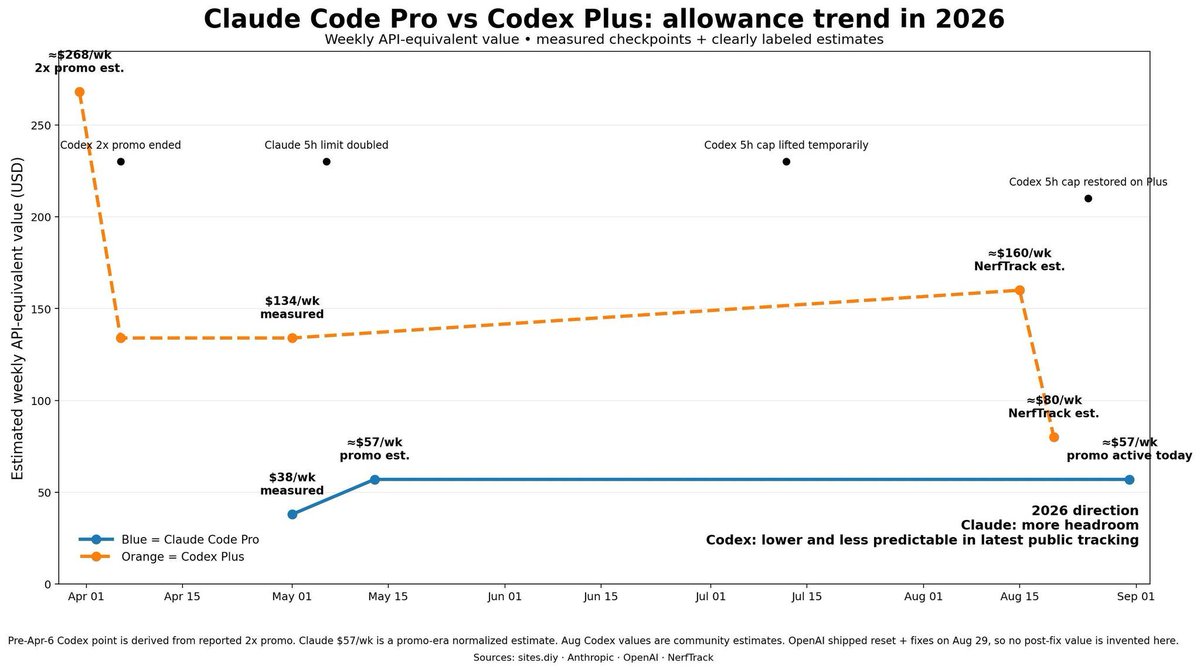
@Im_IrushiK posted (27 likes, 9 replies, 2,852 views) a budget chart arguing that Codex usage has become tighter and less predictable while Claude Code Pro looks steadier in public allowance tracking. The chart itself, not just the tweet text, is what made the post useful.
@starmexxx made (26 likes, 9 replies, 1,267 views, 21 bookmarks) the strongest local-first pricing argument of the day around textgen: a 47,595-star desktop app for local LLMs with OpenAI- and Anthropic-compatible APIs, tool-calling, and 100% private execution, positioned as a substitute for $200-per-month hosted subscriptions. The replies focused less on benchmarks than on the practical point that local AI is becoming a full stack rather than just "a model in a terminal." (repo)
Discussion insight: The coping mechanisms were concrete: context compression, session-aware pricing literacy, public budget tracking, and local APIs that let existing tools point at a cheaper backend without rewriting the workflow.
Comparison to prior day: On 2026-08-31, limit resets themselves were the meme. On 2026-09-01, the interesting part was the workaround layer people are building on top of those limits.
2. What Frustrates People
Unsafe background behavior in agent stacks
The highest-severity frustration was not model quality but trust boundaries. @thdxr described (194 likes, 15 replies, 9,979 views, 24 bookmarks) "a ridiculous amount of fraud" around Hermes and OpenCode Go, and the replies escalated that into specific control gaps: temporary bans, missing identity signals, and the need for agent IDs, task IDs, and approval receipts. The public ContextLeak paper summarized by @rohanpaul_ai shows (1 like, 2 replies, 758 views, 2 bookmarks) another path to abuse: malicious tool descriptions that get an agent to leak prompt and runtime context into tool arguments. GitSpawn pushes the same frustration to the host level: @Ax_Sharma flagged (4 likes, 2 replies, 101 views) the issue, and Manifold Security documented a class of bugs where opening an untrusted repo can trigger code execution before a trust prompt. Severity: High. This is worth building for because users are no longer asking for better prose; they are asking for explicit identity, sanitization, and evidence that background actions are safe.
Teams still do not trust raw AI output to become production code or finished UI
Several of the day's strongest workflow posts exist only because people do not believe "it shipped" means "it is safe to keep." @LimestoneHQ said (6 likes, 3 replies, 4,399 views) teams can buy Copilot seats and raise output without raising production velocity, then answered that gap with V.U.E. review rules. @DanKornas promoted (7 likes, 3 replies, 393 views, 5 bookmarks) OwnYourCode as a direct reaction to code "you can't explain," and @Sejan71 framed (1 like, 5 replies, 148 views) Taste Skill as a fix for AI-generated interfaces that all look the same. Even @ryanvogel reached (13 likes, 5 replies, 1,383 views, 14 bookmarks) the same conclusion from a different angle: screenshot verification was the part of the remote-testing workflow that made it trustworthy. Severity: Medium-High. The common workaround is to add gates, screenshots, stricter output formats, and narrower scopes of AI autonomy.
Usage limits are now being experienced as a context-management problem
Quota pain was still present, but the discussion got more technical. @daanisharif described (8 likes, 3 replies, 361 views) how agents keep re-paying for context they already processed, turning long-running work into a token tax and even causing multi-hour lockouts. @Im_IrushiK argued (27 likes, 9 replies, 2,852 views) Codex budget behavior looks tighter and less predictable than Claude Code Pro in public tracking, while @codeglitch pointed out (2 likes, 2 replies, 390 views) that Anthropic's most repeated pricing headline was really a cache-read discount, not a general capacity increase. Severity: Medium. This looks worth building for because people are reaching for compression layers, budget dashboards, session-habit advice, and local backends rather than waiting for vendors to simplify pricing on their own.
3. What People Wish Existed
Verifiable agent workflows that leave humans in control
People are not asking for less AI so much as for AI that stops before comprehension is lost. @LimestoneHQ wants (6 likes, 3 replies, 4,399 views) every generated line to be Verified, Understood, and Explainable, and @DanKornas promoted (7 likes, 3 replies, 393 views, 5 bookmarks) a workflow whose very premise is "AI guides, you build." @ryanvogel added (13 likes, 5 replies, 1,383 views, 14 bookmarks) the operational version of the same need: a run is not trusted until screenshots and passing tests prove it. This is a practical, urgent need. Opportunity: direct.
Skills that travel across tools without sending private work to a hosted layer
Several posts converged on the same wish: once a team figures out a good output contract or workflow, it should not be trapped inside one vendor surface. @DanKornas highlighted (3 likes, 2 replies, 940 views, 8 bookmarks) an index for 1000+ agent skills spanning Claude Code, Codex, Cursor, Gemini CLI, GitHub Copilot, and more, while his OpenSkills post (tweet) pushes the same idea further by running skills locally through MCP. @diamai_ showed (23 likes, 9 replies, 466 views, 11 bookmarks) the appetite for portable output rules, and @Sejan71 showed (1 like, 5 replies, 148 views) the same demand for portable UI taste constraints. This is both practical and strategic. Opportunity: competitive.
Lower context drag without changing the whole workflow
The strongest budget posts were really feature requests for invisible infrastructure. @daanisharif wants (8 likes, 3 replies, 361 views) the repeated-context tax reduced, not a new IDE; SOMA's pitch is precisely "same agent, same model, same workflow - but fewer tokens to pay for." @starmexxx wants (26 likes, 9 replies, 1,267 views, 21 bookmarks) existing tools like Claude Code, Cursor, and Codex to point at a local OpenAI-compatible backend instead of a new hosted subscription, and @codeglitch argues (2 likes, 2 replies, 390 views) pricing only helps if users can actually benefit from cache reads by staying in the same session. This is a practical infrastructure need with clear willingness to experiment. Opportunity: competitive.
Better ways to make AI-generated interfaces feel intentional rather than generic
Taste Skill's whole thesis is that AI-built sites share the same layouts, spacing, and motion patterns, and the replies agreed that agents need stronger design standards. This is partly practical and partly emotional: builders want output that does not instantly look machine-made. Because the leading solution already has large open-source adoption, this is less a blank-space wish than a demand for better defaults and stronger taste layers around existing agents. Opportunity: aspirational to competitive.
4. Tools and Methods in Use
| Tool | Category | Sentiment | Strengths | Limitations |
|---|---|---|---|---|
Antigravity /boost |
Agent harness | (+) | 3-phase reasoning pipeline, isolated worktrees, regression checks, aimed at tricky bugs and refactors | Paid-plan feature; explicitly spends more tokens; capacity discussion still active |
Antigravity /teamwork-preview |
Long-running agent workflow | (+/-) | Users describe it as worth dropping everything for on paid plans; framed around subagents and long tasks | Evidence today is still mostly user advocacy rather than broad adoption metrics |
| Gemini 3.7 Flash | Model | (+/-) | Wide public showcase across AI Studio, Antigravity, Spark, plus claims of strong research and systems results | Recent bugs were publicly tied to demand pressure; some users still want a stronger next-tier model |
| Claude Code | Coding agent | (+/-) | Rich ecosystem of skills, explainability workflows, and remote-operation add-ons | Limit sensitivity, fraud controls, and security research remain active concerns |
| GitHub Copilot | Coding assistant / platform | (+/-) | Works with modernization workflows, skill collections, and third-party compression layers like SOMA | Multiple posts argued that buying seats alone does not create production velocity |
| SOMA | Context-compression middleware | (+/-) | Claims lower context spend while keeping the same agent workflow; integrates with Copilot and DeepSeek V4 Pro | Savings claims are early, model-specific, and not independently benchmarked in today's evidence |
| textgen | Local LLM runner | (+) | OpenAI/Anthropic-compatible API, tool-calling, private local execution, and compatibility with existing agent frontends | Requires local setup and hardware; today's strongest evidence came from builder promotion rather than neutral comparison |
i-have-adhd / Taste Skill |
Output and frontend skill layer | (+) | Cuts decision load, improves actionability, and tries to remove generic AI-generated UI patterns | Strong rules can over-constrain edge cases if applied mechanically |
| OpenSkills / Awesome Agent Skills | Skill infrastructure | (+) | Local execution via MCP, and broad skill discovery across 1000+ reusable skills and many agents | The ecosystem is large enough that curation itself has become necessary infrastructure |
| Claude Fable 5.1 / Mythos 5.1 | Model | (+/-) | Public benchmark card showed gains across coding, scientific research, knowledge work, and business workflows | Pricing discussion immediately shifted to cache-read habits and gated availability rather than simple capacity gains |
@ripper0x circulated (3 likes, 3 replies, 39 views) Anthropic's Fable 5.1 benchmark card, and @codeglitch supplied (2 likes, 2 replies, 390 views) the more practical follow-up: the headline discount is about cache reads, so users only benefit when they stay inside the same session and let the system reuse prior context.

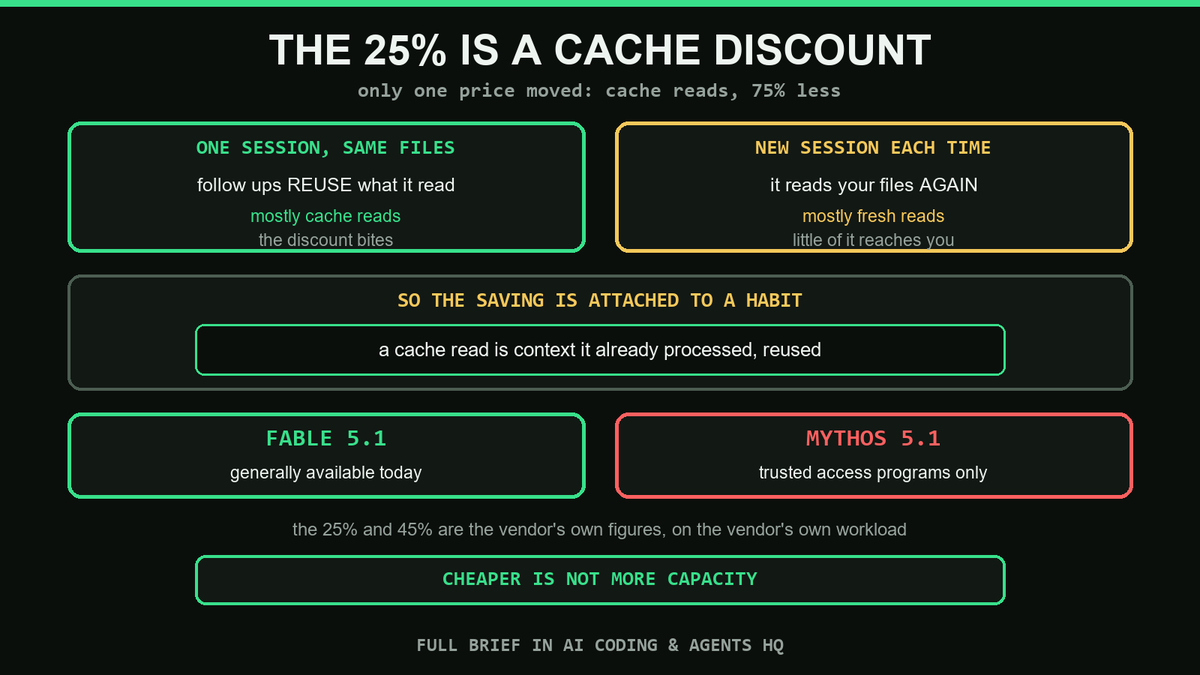
The satisfaction spectrum today was highest around layers that reshape workflow without forcing a full tool migration: output rules (i-have-adhd), explainability gates (OwnYourCode, V.U.E.), context compression (SOMA), and local backends that preserve existing agent clients (textgen). The most common workaround pattern was "keep the interface, swap the economics": point Claude Code, Cursor, or Codex at a local API, compress context before it reaches the model, or stay in the same session long enough to win cache-read savings. Competitive dynamics are therefore shifting upward from models toward workflow surfaces and middleware - Antigravity and Copilot are adding guided task modes, while open-source builders are racing to supply portable skills, local execution, and better defaults around them.
5. What People Are Building
| Project | Who built it | What it does | Problem it solves | Stack | Stage | Links |
|---|---|---|---|---|---|---|
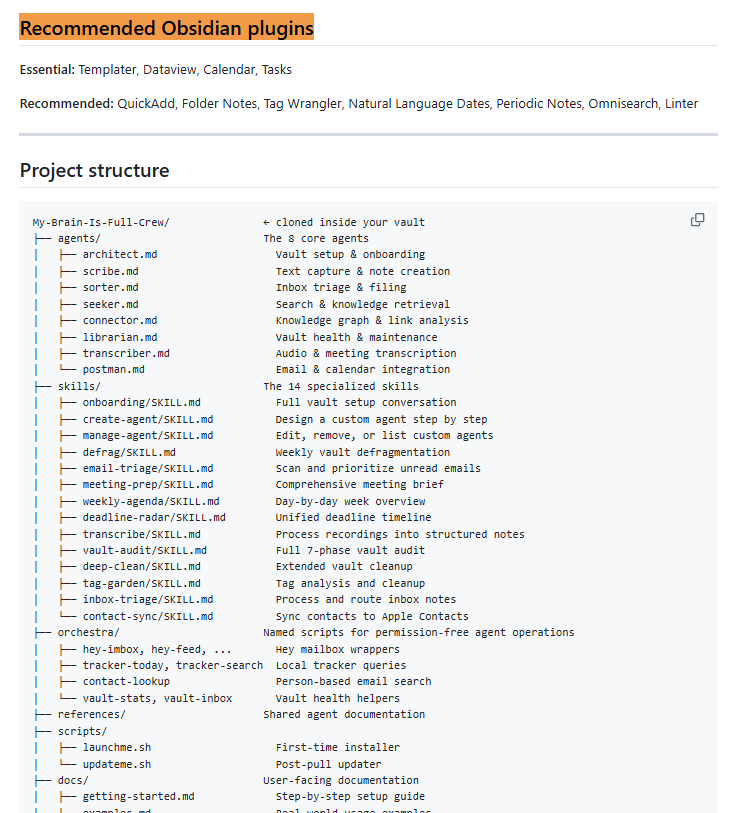
| My-Brain-Is-Full-Crew | surfaced by @KanikaBK | Multi-agent Obsidian crew with note capture, search, inbox triage, link analysis, email/calendar sync, and transcription | Personal knowledge systems usually ignore the overlap between memory, inbox chaos, diet, and mental load | Shell, Obsidian, 8+ agents, 14 skills, Claude Code, Gemini CLI, OpenCode, Codex | Shipped | tweet, repo |
| Taste Skill | @Sejan71 / Leonxlnx | Anti-slop frontend skill that improves layouts, typography, spacing, motion, and style for agent-generated UIs | AI-built websites often look interchangeable and obviously machine-made | JavaScript, skill files, tasteskill.dev |
Shipped | tweet, repo |
| i-have-adhd | @diamai_ / ayghri | Output-contract skill that forces action-first, numbered, tangent-light answers | Coding agents often bury the next step inside long, hard-to-act-on prose | Python, SKILL.md rules, multi-agent compatible | Shipped | tweet, repo |
| Awesome Agent Skills | @DanKornas / VoltAgent | Curated index of 1000+ reusable skills from official teams and community builders | Skill discovery is fragmented across vendors and repos | GitHub catalog, markdown metadata, cross-tool install paths | Shipped | tweet, repo |
| OpenSkills | @DanKornas / instavm | Local MCP server for running Claude skills with compatible AI tools on macOS | Teams want reusable skills without uploading private files to a hosted workflow | Python, MCP, macOS sandboxing, local LLM support | Shipped | tweet, repo |
| OwnYourCode | @DanKornas / Daniel Podolsky | Explainability-first Claude Code workflow with spec-driven development and six quality gates | Developers want AI help without surrendering understanding of the codebase | Shell, Claude Code workflow, spec-driven development | Shipped | tweet, repo |
| textgen | @starmexxx / oobabooga | Desktop app for local LLMs with OpenAI/Anthropic-compatible APIs, tool-calling, and privacy-first execution | Lets existing agent clients use a local backend instead of a paid hosted subscription | Python, llama.cpp, exllamav3, transformers, TensorRT-LLM, MCP-compatible API | Shipped | tweet, repo |
| SOMA | @daanisharif / @SomaSubnet | Context-compression layer for coding-agent sessions, initially for GitHub Copilot plus DeepSeek V4 Pro | Long-running agents keep re-paying to resend old context | Compression middleware, GitHub Copilot integration, DeepSeek V4 Pro | Beta | analysis tweet, product |
| ApexAgents-SkyRL-Recipe | @charlie_ruan / Mercor | Public recipe and codebase for RL-training knowledge-work agents on APEX-Agents data | Open RL recipes for long-horizon professional agents are still rare | Python, SkyRL, Harbor, APEX-Agents | Shipped | tweet, repo, blog |
The strongest build pattern was not "another chatbot." It was meta-infrastructure for coding agents: skills that change output behavior, catalogs that help users find those skills, local runtimes that swap the economics underneath existing tools, and compression layers that try to make long-running sessions cheaper without asking developers to relearn the interface.
@KanikaBK shared (9 likes, 3 replies, 537 views, 4 bookmarks) My-Brain-Is-Full-Crew as an 8-agent, 14-skill Obsidian system built by a PhD researcher to coordinate knowledge, nutrition, and mental-wellness workflows from one codebase. The downloaded screenshot matters because it shows the actual repo structure: multiple agents, a skills directory, orchestration helpers, and docs rather than just a conceptual diagram.
@DanKornas promoted (456 views, 2 bookmarks) OpenSkills as the privacy-preserving version of the same trend: keep skills local, run them through MCP, and avoid a hosted workflow layer for documents, spreadsheets, presentations, and images. The README screenshot is concrete about the intended use case and execution model.

@DanKornas also highlighted (7 likes, 3 replies, 393 views, 5 bookmarks) OwnYourCode, which turns the same anti-slop instinct into a developer training workflow: spec first, AI as mentor, and the first quality gate requiring that the developer can explain the code. That is notably different from faster-autocomplete positioning.

The other important split was economic. textgen and SOMA both preserve familiar tool surfaces while changing the cost structure underneath them: one swaps in a local API-compatible backend, the other compresses context before it reaches the model. Mercor's SkyRL recipe sits one layer lower still, sharing the training recipe itself rather than another user-facing shell.
6. New and Notable
GitHub Copilot was shown as a guided modernization agent, not just an editor assistant
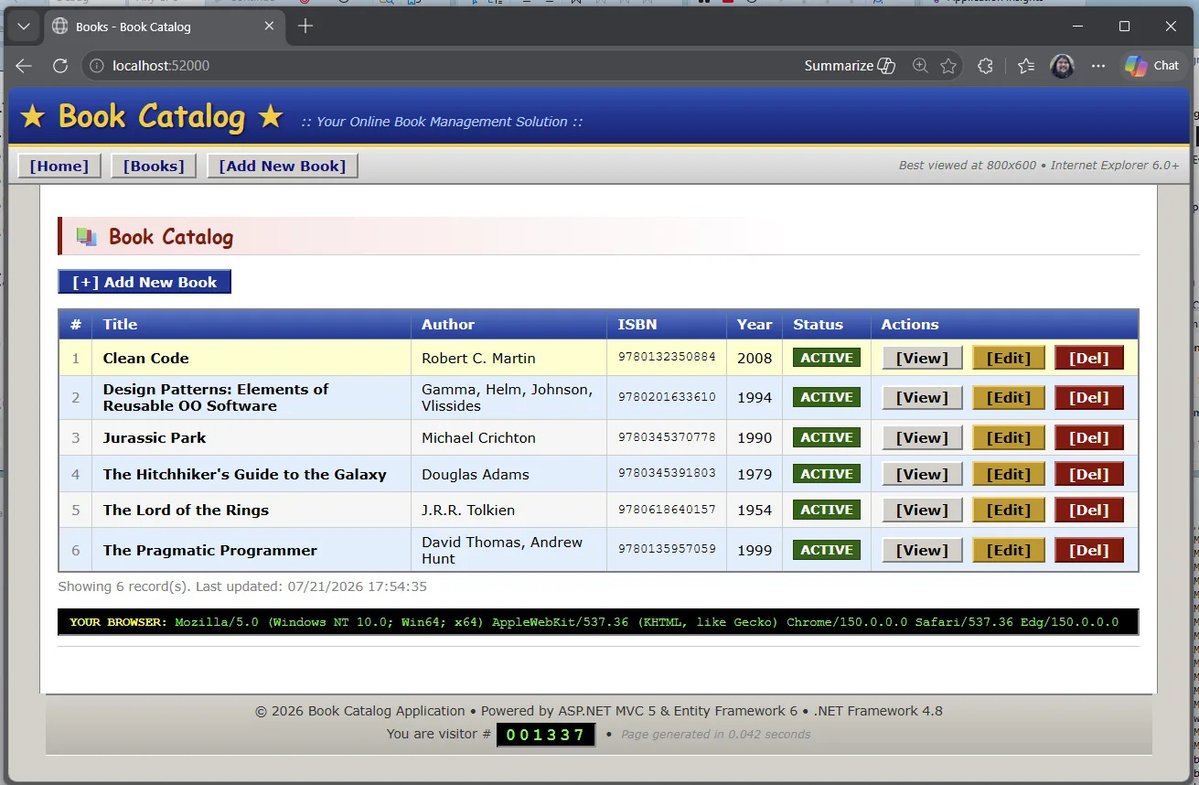
@VisualStudio shared (32 likes, 5,187 views, 14 bookmarks) a .NET Framework-to-.NET 10 modernization flow powered by GitHub Copilot, and the linked devblog is unusually specific about how the workflow is structured: Guided mode pauses at checkpoints, produces markdown artifacts that can be checked into source control, and walks a sample BookCatalog app through the upgrade process inside Visual Studio. That is a notable product framing change because the value proposition is auditability and staged review, not just "Copilot can refactor code." (devblog)
Mercor published a public RL training recipe for frontier knowledge-work agents
@charlie_ruan reported (32 likes, 4 replies, 832 views, 12 bookmarks) work with Mercor Research and SkyRL that improved Qwen3.5-397B-A17B on APEX-Agents from 16% to 27% Pass@1. The linked blog gives the stronger version of that claim: 16.11% to 27.29%, plus a public recipe repo, model weights, and eval traces, and an explicit claim that some gains transferred to OpenCode and Terminal-Bench 2.1. (blog, repo)
Codex mobile is becoming a real remote-agent control surface
@CodexReleases summarized (42 likes, 5,058 views, 4 bookmarks) a ChatGPT for iOS update that adds attachments across Windows and Linux hosts, a priority view for running tasks and unread updates, and queued prompts that sync to the connected host and send while the app stays in the background. That matters because it moves the mobile client from "notification companion" toward "lightweight remote operations console" for coding-agent sessions.

7. Where the Opportunities Are
[+++] Trust, verification, and safe context handling for agents — This is the strongest opportunity because it is supported from both the failure side and the solution side. GitSpawn shows host-level execution risk from untrusted repos, ContextLeak shows malicious tool descriptions can exfiltrate runtime context, and the Hermes/OpenCode Go thread shows real operational pain around fraud and missing agent identity. On the constructive side, screenshot verification, V.U.E., and OwnYourCode all point toward the same product direction: better evidence, tighter scopes, and explicit human checkpoints.
[++] Portable skill layers that survive vendor switching — Taste Skill, i-have-adhd, Awesome Agent Skills, and OpenSkills all exist because people want behavior they can carry from Claude Code to Codex to Gemini CLI to GitHub Copilot without rewriting everything. This is a meaningful opportunity because the ecosystem is already large enough that discovery, curation, and local execution are separate products.
[++] Cost-control infrastructure that keeps the interface but changes the economics — SOMA, textgen, public budget charts, and cache-read explainers all reflect the same demand: developers want to keep their familiar agent frontends while reducing repeated-context costs or swapping to a cheaper backend. This is moderate-to-strong because the need is repeated across complaints, workarounds, and shipped products rather than isolated to a single vendor's pricing page.
[+] Guided expert workflows inside existing development surfaces — Antigravity's /boost, /teamwork-preview, and GitHub Copilot's modernization agent all show appetite for mode-specific experiences that wrap planning, auditing, and verification around hard tasks. This is emerging rather than proven, because today's evidence shows strong product motion but not yet much independent user testimony beyond early adopters and vendor posts.
8. Takeaways
- Google spent the day turning Antigravity into a workflow stack, not just a model endpoint.
/boost,/teamwork-preview, the Gemini 3.7 Flash showcase, and the open-problems screenshot all pointed to the same direction: more structured, longer-horizon coding work inside the harness. (source) - Trust is now the main bottleneck around agent adoption. Fraud reports in Hermes/OpenCode Go, malicious-tool exfiltration in ContextLeak, and pre-trust repo execution in GitSpawn all show that background behavior is getting more scrutiny than raw generation quality. (source)
- Verification is becoming a feature, not just a best practice. V.U.E., OwnYourCode's gates, and Ryan Vogel's screenshot-verified mobile test flow all describe systems where a human can inspect evidence instead of trusting an agent run on faith. (source)
- Reusable skills are emerging as the preferred fix for slop.
i-have-adhd, Taste Skill, Awesome Agent Skills, and OpenSkills all attack the same problem from different angles: better output contracts, better design defaults, easier discovery, and local/private execution. (source) - Cost-control conversations have moved up the stack. The interesting products today were not only new models but the layers around them: context compression, local API-compatible runtimes, budget tracking, and pricing literacy about cache reads versus fresh sessions. (source)
- Some of the most notable building energy sat below the user interface. Mercor published a public RL recipe for knowledge-work agents, while GitHub Copilot and Codex both showed more structured operational surfaces around the core model. (source)