Twitter AI Coding - 2026-09-04
1. What People Are Talking About
1.1 GPT-6 Astra moved from rollout watching to real product surfaces, but access math immediately became the story (🡕)
The biggest Twitter cluster was no longer "is Astra hiding somewhere?" It was "Astra is live in real tools, but who actually gets it, how expensive is it, and what do the labels mean?" At least six separate items supported this theme across GitHub Copilot, Codex, ChatGPT plan screenshots, and practitioner reports.
@code announced (180 likes, 8 replies, 12,483 views) that GPT-6 Astra was generally available in GitHub Copilot, linking to GitHub's public changelog post. The linked post says Astra is available across Copilot CLI, the coding agent, the Copilot app, GitHub Mobile, and other IDE surfaces for Pro+, Max, Business, and Enterprise users, with gradual rollout. The attached screenshot mattered because it showed Astra in the model picker instead of as another rumor from a branch or FAQ.

Even launch-day clarity needed a follow-up fix. @Codex_Changelog reported (196 likes, 7 replies, 19,674 views, 16 bookmarks) that Codex CLI 0.153.2 was only a display correction: Astra Fast's speed label changed from 1.5x to 2x, while request behavior stayed the same. That small release drew attention because it showed how closely users were reading product surfaces for pricing and quota hints.
The quota discussion then took over. @hqmank posted (52 likes, 18 replies, 8,158 views, 15 bookmarks) that ChatGPT's GPT-6 Pro surface gave Pro $100 users 50 messages per week and Pro $200 users 200 messages per week, while Plus users got no GPT-6 Pro messages in regular chat. @Mr_Salio followed up (33 likes, 15 replies, 4,580 views) with a screenshot-driven clarification that Astra was the model behind GPT-6 Pro, and that Plus users could reach Astra through Codex or Work but not through ordinary chat. Those posts lined up with GitHub's public Copilot pricing table, which bills GPT-6 Astra above GPT-5.6 Sol and doubles rates again once sessions cross the long-context threshold.


Discussion insight: Once Astra appeared in public product surfaces, the replies stopped sounding like launch hype and started sounding like quota accounting. Even @athyuttamre clarified (102 likes, 9 replies, 5,552 views, 12 bookmarks) that Astra still does the reasoning in Codex Voice and that voice currently draws from normal usage credits.
Comparison to prior day: Earlier this week, Twitter was reading changelog bots, repo branches, and FAQ edits for hidden Astra signals. On September 4, the rollout was real enough to touch, but the detective work immediately shifted to usage caps, label corrections, and which surface actually counts against which plan.
1.2 Gemini 3.8 Flash inside Antigravity still had momentum, but the conversation moved from demos to hidden ceilings (🡒)
Antigravity did not disappear after the previous day's terms-of-service fight. It stayed central, but the tone changed again: official demos and positive field reports were still landing, while more technical users pushed hard on context ceilings, compaction behavior, and missing feedback channels. At least five separate items supported this mixed theme.
@googledevs showed (38 likes, 1 reply, 4,327 views, 15 bookmarks) Gemini 3.8 Flash inside Antigravity building a dungeon map editor with pathfinding and wave-function-collapse logic, reinforcing the platform's "real app from scratch" positioning. A second practitioner post from @ai_for_success said (226 likes, 19 replies, 11,321 views, 27 bookmarks) that Gemini 3.8 Flash felt noticeably better than 3.7 on long email threads, especially after combining it with Google Workspace MCP and custom skills.
The strongest counterweight came from @Soso_fun_yt documenting (150 likes, 14 replies, 8,251 views, 44 bookmarks, 2 quotes) a detailed runtime claim that Antigravity 2.12.0 still capped active context at 256,000 tokens and triggered checkpoint compaction around 140,000 tokens, far below Gemini's much larger native window. The replies mattered because they added corroborating frustration rather than generic agreement: one respondent said compression started when the visible context meter was only about 20% to 26% full, while another said the hidden limit is exactly what hurts production work.
Trust concerns from September 3 also lingered. @betterhn300 amplified (1 like, 276 views) Gergely Orosz's warning about third-party Antigravity usage and linked the live Hacker News thread, so the day was not just about model quality. Even when the model got praise, the product still carried governance baggage from the prior cycle.
Discussion insight: The mixed sentiment was unusually concrete. Practitioners were not arguing about abstract benchmark leadership; they were arguing about whether long-running sessions can actually retain enough state to matter and whether users have any credible place to report failures.
Comparison to prior day: The previous week started as an Antigravity demo-and-launch wave, then swung into policy and enforcement risk on September 3. On September 4, the conversation settled into product-use reality: good demos, some real praise, and much sharper complaints about hidden context management.
1.3 Cost routing, orchestration, and benchmark design started to overshadow one-model bragging rights (🡕)
The most technical cluster of the day was not about choosing one frontier model over another. It was about routing work across models, using cheaper workers for routine steps, compressing context before inference, and measuring performance on harder agentic tasks. At least six items supported this theme.
@pierceboggan introduced (43 likes, 4 replies, 1,446 views, 12 bookmarks) Project HydraFusion in GitHub Copilot, and GitHub's public research post explains why people paid attention: HydraFusion can choose a single-model run, a cascade, or a critique workflow, and GitHub says the best tested configuration improved TerminalBench 2.1 quality by 4.9 points at 67% lower estimated cost than Claude Opus 5. The attached table turned the claim into something concrete enough to debate.

@undefinedKi summarized (7 likes, 4 replies, 130 views, 6 bookmarks) Spotify's internal Claude Code setup that reportedly cut token usage by 90% by routing large file reads and repetitive code generation through two cheaper helpers before the expensive model ever saw the task. That was one of the clearest examples of a cost-architecture pattern rather than a model-architecture pattern.

@0x_Kalista framed (10 likes, 13 replies, 315 views) SOMA as a thin context-compression layer that lets users stay inside GitHub Copilot while lowering inference cost on DeepSeek V4 Pro sessions. The important distinction was that SOMA was pitched as compression plus execution in front of the existing loop, not as a replacement agent.

The evaluation layer was moving too. @ArtificialAnlys announced (58 likes, 14 replies, 3,572 views, 9 bookmarks, 10 quotes) Intelligence Index v4.2 with new private and agentic test sets such as AA-Briefcase and GDP.pdf, plus a heavier 40% weighting on held-out data to reduce gaming. In replies, the account said GPT-6 Astra gained meaningfully over GPT-5.6 Sol and remained relatively token-efficient near the frontier, which gave the day's rollout arguments a benchmark frame beyond simple vibes.

Discussion insight: Quality-per-cost, isolated review, and hidden workflow legs are becoming first-class talking points. The strongest claims were no longer "this model feels smarter" but "this routing pattern got cheaper" or "this benchmark is harder to game."
Comparison to prior day: Earlier in the week, Twitter mostly tracked model launches themselves. On September 4, the attention shifted upward into orchestration policies, compression layers, and benchmark design.
1.4 More teams were wrapping agents in boards, specs, and role splits instead of trusting one freeform chat (🡕)
Another durable theme was the move away from raw "vibe coding" toward explicit process control. The strongest examples combined a PM-and-dev role split, task boards with human validation, spec-first workflows, and portable engineering skills that travel across agents.
@AlexFinn argued (21 likes, 6 replies, 3,726 views, 27 bookmarks) that the best way to use Grok Bot plus Cursor cloud agents was to split work between a developer bot and a project-manager bot, then keep the whole loop grounded in a Notion or Linear board with one PR per task. That post mattered because it treated organization and supervision as the feature, not just raw coding speed.

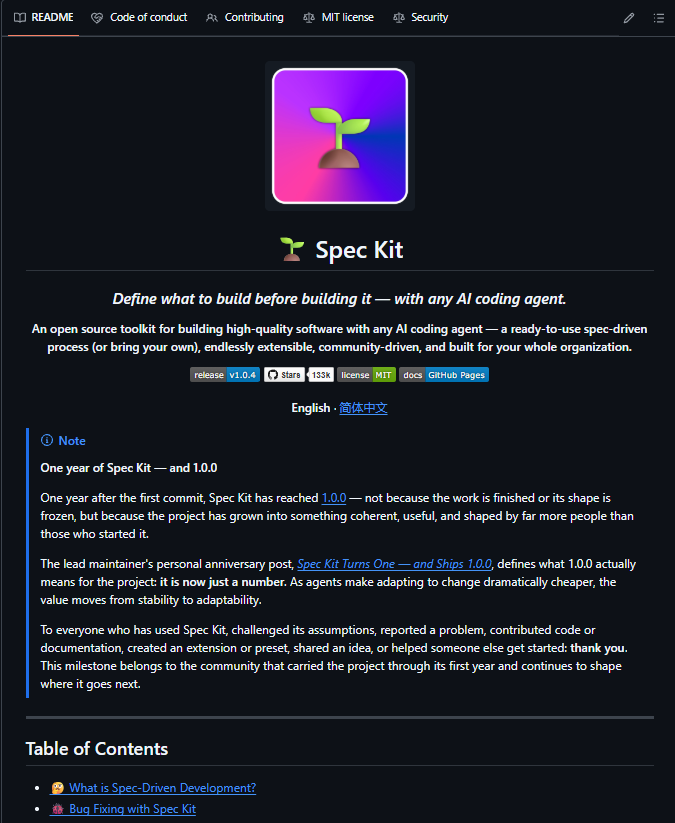
@DanKornas shared (1 like, 2 replies, 440 views) OverClick, and the public repo README makes the same pitch in product form: task cards are contracts, agents claim work over MCP, and human reviewers validate evidence plus per-model token and time telemetry. @Shruti_0810 used (4 likes, 1 reply, 800 views) GitHub's public Spec Kit to make the anti-vibe-coding case explicitly, arguing for constitution, specification, planning, tasks, and implementation as separate steps before code lands.

The skills layer reinforced the same direction. @aiedge_ pointed (9 likes, 1 reply, 1,289 views) to Matt Pocock's public skills repo, whose README explicitly positions it as "skills for real engineers" rather than vibe coding and emphasizes small, composable rules over one giant process wrapper.
Discussion insight: The shared instinct was to make agent work reviewable, routable, and restartable. Even the positive workflow posts assumed that freeform sessions drift unless someone adds contracts, specs, boards, or role boundaries.
Comparison to prior day: Earlier reports already showed skills and marketplaces gaining ground. On September 4, the control layer felt even more operational: boards, PM agents, spec pipelines, and validation steps were framed as necessary scaffolding for production work.
2. What Frustrates People
Access, quotas, and naming were still too opaque for a model this expensive
The sharpest frustration was not whether Astra was capable. It was whether normal users could tell where Astra actually existed, what it cost, and which surfaces counted against which quota. @hqmank posted (52 likes, 18 replies, 8,158 views, 15 bookmarks) the weekly GPT-6 Pro message caps, @Mr_Salio said (33 likes, 15 replies, 4,580 views) OpenAI needed to explain the Astra/GPT-6 Pro rollout better, and @Codex_Changelog spent (196 likes, 7 replies, 19,674 views, 16 bookmarks) an entire release on correcting Astra Fast's display label. The replies made the severity obvious: people were doing plan math in public because the surfaces still were not self-explanatory. Severity: High. This is worth building for because clearer availability and usage telemetry would remove real purchase and workflow friction, not just confusion.
The same theme showed up in first-hand use. @rohit3a said (1 like, 525 views, 3 quotes) Astra fixed a stubborn Codex-over-SSH problem end to end, but two active threads still burned 6% to 7% of weekly usage quickly. That is a strong capability signal wrapped inside a pricing complaint, which is exactly why the frustration mattered.
Antigravity still looked stronger in demos than in long-session observability
The most detailed product complaint of the day came from @Soso_fun_yt arguing (150 likes, 14 replies, 8,251 views, 44 bookmarks, 2 quotes) that Antigravity's orchestrator still forced a 256k effective ceiling and a roughly 140k checkpoint threshold even when Gemini itself supports a much larger native window. The replies did not dismiss the post as fearmongering; they added matching observations about early compression and wasted rereads. @betterhn300 kept alive (1 like, 276 views) the previous day's policy anxiety by linking both Gergely Orosz's warning and the Hacker News discussion about third-party usage risk. Severity: High. This is worth building for because the missing pieces are concrete: visible context meters, controllable compaction thresholds, and a safer experimentation boundary.
Freeform agent loops still feel too easy to drift and too hard to review
Several of the day's most positive workflow posts were really coping strategies for the same frustration: one big chat is not a trustworthy operating model for serious work. @AlexFinn recommended (21 likes, 6 replies, 3,726 views, 27 bookmarks) splitting Grok Bot work between a developer bot and a project-manager bot so someone keeps the coding loop on track. @DanKornas started (1 like, 2 replies, 440 views) from the same premise, saying AI-agent work gets hard to audit once it leaves the terminal, then pointing to OverClick's contract cards and human validation. @Shruti_0810 made (4 likes, 1 reply, 800 views) the complaint explicit by framing Spec Kit as a way to stop telling agents "build me something like this." Severity: Medium-High. This is worth building for because the workaround pattern is consistent: specs, task boards, and reviewable evidence are replacing trust in freeform prompting.
3. What People Wish Existed
One place that explains model access, quotas, and billing across every surface
The clearest unmet need was a single source of truth for where Astra exists and what using it actually consumes. @hqmank posted (52 likes, 18 replies, 8,158 views, 15 bookmarks) usage caps because people were plainly asking for them, @Mr_Salio wrote (33 likes, 15 replies, 4,580 views) a separate "rollout clarification" post to untangle naming, and @athyuttamre answered (102 likes, 9 replies, 5,552 views, 12 bookmarks) direct questions about whether Codex Voice uses Astra and where the usage credits come from. This is a practical need. Opportunity: direct.
Visible context telemetry and retention controls for long-running agent sessions
@Soso_fun_yt did not just complain (150 likes, 14 replies, 8,251 views, 44 bookmarks, 2 quotes); the post spelled out the desired fix: show developers exactly where they stand against the compaction threshold and let Gemini-based sessions use more of the native long context window before early summarization cuts in. The replies sharpened the need by saying people could see compression kick in when their sessions were only partly full. This is a highly practical need because the requested feature is explicit telemetry plus adjustable retention policy, not vague "better context." Opportunity: direct.
Agent work that stays reviewable after it leaves the chat
The day kept pointing toward the same wish from different angles: long-running agent work needs a durable control plane. @DanKornas described (1 like, 2 replies, 440 views) OverClick as a visible handoff loop where agents return evidence and humans validate it. @AlexFinn used (21 likes, 6 replies, 3,726 views, 27 bookmarks) a Notion or Linear board as the same kind of supervisory layer, and GitHub's public Spec Kit pushes an even more structured pipeline from constitution to implementation. This is partly practical and partly emotional: people want both operational control and the feeling that the work can be checked later. Opportunity: competitive.
Coding agents that work on constrained hardware without a giant desktop footprint
The most explicit statement of this need came from @theaungmyatmoe arguing (5 likes, 1 reply, 88 views) that most coding agents assume a 32GB laptop and fast internet, then presenting Fusion as a counterexample built around bounded state and a pure-Rust runtime. The post claims 18.2MB resident RAM, a 6.8MB static binary, and much lower upload and token cost on mobile hardware than Node-based baselines, which makes the unmet need concrete rather than aspirational.

This is a practical need with a smaller audience today, but it connects to a broader shift toward local and open backends for agent workloads. Opportunity: emerging.
4. Tools and Methods in Use
| Tool | Category | Sentiment | Strengths | Limitations |
|---|---|---|---|---|
| GPT-6 Astra | LLM | (+/-) | Strong long-horizon coding behavior, planning, validation, and tricky debugging work | Expensive, confusing rollout, hard-to-read quotas |
| GitHub Copilot | Agent platform | (+/-) | Multi-surface model access, admin model policy, HydraFusion research path | Usage-based billing and plan-dependent model access add friction |
| Project HydraFusion | Orchestration runtime | (+) | Single/cascade/critique routing and lower estimated cost at similar quality bars | Still a research preview and the routing logic stays mostly hidden from users |
| Antigravity with Gemini 3.8 Flash | Agent runtime | (+/-) | Strong app-building demos and better reasoning than 3.7 in some real workflows | Hidden context ceiling, early compaction, lingering policy anxiety |
| Codex Voice | Agent interface | (+) | Continues existing threads and keeps Astra as the reasoning engine | Consumes the normal usage-credit pool, so "voice" is not quota-free |
| Claude Code with cheap-helper routing | Workflow pattern | (+) | Cuts expensive-model exposure by offloading file reads and repetitive edits | Complex edits and bug-catching still require the expensive model |
| SOMA | Compression layer | (+/-) | Lowers cost without forcing users to leave GitHub Copilot | Early-stage evidence and narrow positioning around specific sessions/models |
| Spec Kit | Process toolkit | (+) | Spec-driven workflow, explicit task breakdown, opt-in bug workflow | More ceremony than freeform prompting |
| Matt Pocock Skills | Skills library | (+) | Small, composable engineering skills installable across agents | Requires user curation and adaptation to each repo |
| OverClick | MCP task board | (+) | Contract cards, human validation, measured token/time telemetry | Adds board/server overhead before teams see value |
| Chrome DevTools MCP | Browser debugging tool | (+) | Live browser inspection, traces, screenshots, stack traces, CLI mode | Works best on stable Chrome and enables usage statistics by default |
| Grok Bot + Cursor cloud agents + PM board | Multi-agent method | (+/-) | PR-per-task organization and explicit supervision loop | Needs a second control agent and external board to stay reliable |
| Artificial Analysis Intelligence Index v4.2 | Benchmark | (+) | More private held-out and agentic tests, less easy to game | Still a benchmark proxy, not direct production proof |
| Dulus Benchmark Arena | Benchmark | (+/-) | Scenario-based harness comparison with visible matrices | Self-published; no surfaced methodology URL in the thread |
The overall satisfaction spectrum was wide, but the pattern was coherent. Users liked stronger models and better agent loops, then immediately wrapped them with routing, specs, boards, or compression layers so the workflow stayed affordable and reviewable. The clearest workarounds were not model switches alone; they were method switches, such as cheap-helper routing around Claude Code, PM boards around Cursor cloud agents, and Spec Kit or skills packs around otherwise freeform sessions.
Migration pressure also ran in two directions. Some people were moving toward stronger premium models because Astra or Gemini 3.8 Flash solved harder tasks, while others were simultaneously looking for thinner cost-control layers, portable skills, and more local-friendly runtimes so they were not locked into one expensive surface. Competitive dynamics increasingly sat above the model: orchestration, telemetry, debugging access, and reviewability.
5. What People Are Building
| Project | Who built it | What it does | Problem it solves | Stack | Stage | Links |
|---|---|---|---|---|---|---|
| HydraFusion | GitHub via @pierceboggan | Multi-model orchestration inside GitHub Copilot | Frontier-quality coding with lower cost than always using the strongest model | Multi-provider models, single/cascade/critique workflows, Copilot runtime | Beta | tweet, blog |
| SOMA | @0x_Kalista | Thin context-compression layer for Copilot sessions | Lower token bills without forcing a new coding surface | Compression + execution layer, DeepSeek V4 Pro, GitHub Copilot | Beta | tweet |
| Fusion | @theaungmyatmoe | Constrained-device autonomous coding agent | Heavy Node-based coding agents crash or drain mobile/browser environments | Pure Rust runtime, bounded explicit state, wasm/browser VFS | Alpha | tweet |
| OverClick | @DanKornas | Self-hosted task board for hybrid human/AI teams | Agent work is hard to audit and validate after it leaves the terminal | MCP server, task board UI, Docker, Postgres, agent CLIs | Beta | tweet, repo |
| Chrome DevTools MCP | Chrome DevTools team, surfaced by @N0V4Dev | MCP server for live Chrome debugging and performance analysis | Coding agents need browser-native debugging, tracing, and screenshots | TypeScript, Node.js, Puppeteer, Chrome DevTools, CLI | Shipped | tweet, repo |
| Matt Pocock Skills | Matt Pocock, surfaced by @aiedge_ | Portable engineering skill pack for coding agents | Real engineering workflows need reusable process, not just ad hoc prompts | Claude plugin, skills.sh installer, composable skill files | Shipped | tweet, repo |
| Spec Kit | GitHub, surfaced by @Shruti_0810 | Spec-driven development toolkit for AI coding agents | Freeform prompting drifts without explicit principles, plans, and tasks | specify-cli, slash-command workflow, bug extension | Shipped | tweet, repo |
| Dulus Benchmark Arena | @KevRojox | Evidence-graded harness comparison across coding scenarios | Teams want harness-level comparisons instead of pure anecdote | Scenario matrices, weighted evaluations, multi-harness runs | Alpha | tweet |
HydraFusion and SOMA pointed at the same build pattern from different directions. @pierceboggan showed (43 likes, 4 replies, 1,446 views, 12 bookmarks) a heavyweight orchestration layer that chooses between draft, critique, and escalation paths, while @0x_Kalista showed (10 likes, 13 replies, 315 views) a thinner compression layer that leaves the visible Copilot loop alone. The shared trigger is rising premium-model cost.
OverClick, Spec Kit, and Matt Pocock Skills all attacked a different bottleneck: getting repeatable, reviewable process around agent work. OverClick turns tasks into contracts with evidence and telemetry, Spec Kit pushes work through constitution/specify/plan/tasks/implement/converge, and Matt's skills repo emphasizes small reusable engineering moves instead of one giant framework. Those are three different answers to the same trust problem.
Chrome DevTools MCP showed how fast browser tooling is becoming part of the coding-agent stack. @N0V4Dev highlighted (16 views, 1 bookmark) Google's MCP server for Chrome debugging, while the public repo README spells out tracing, console inspection, screenshots, and CLI access.

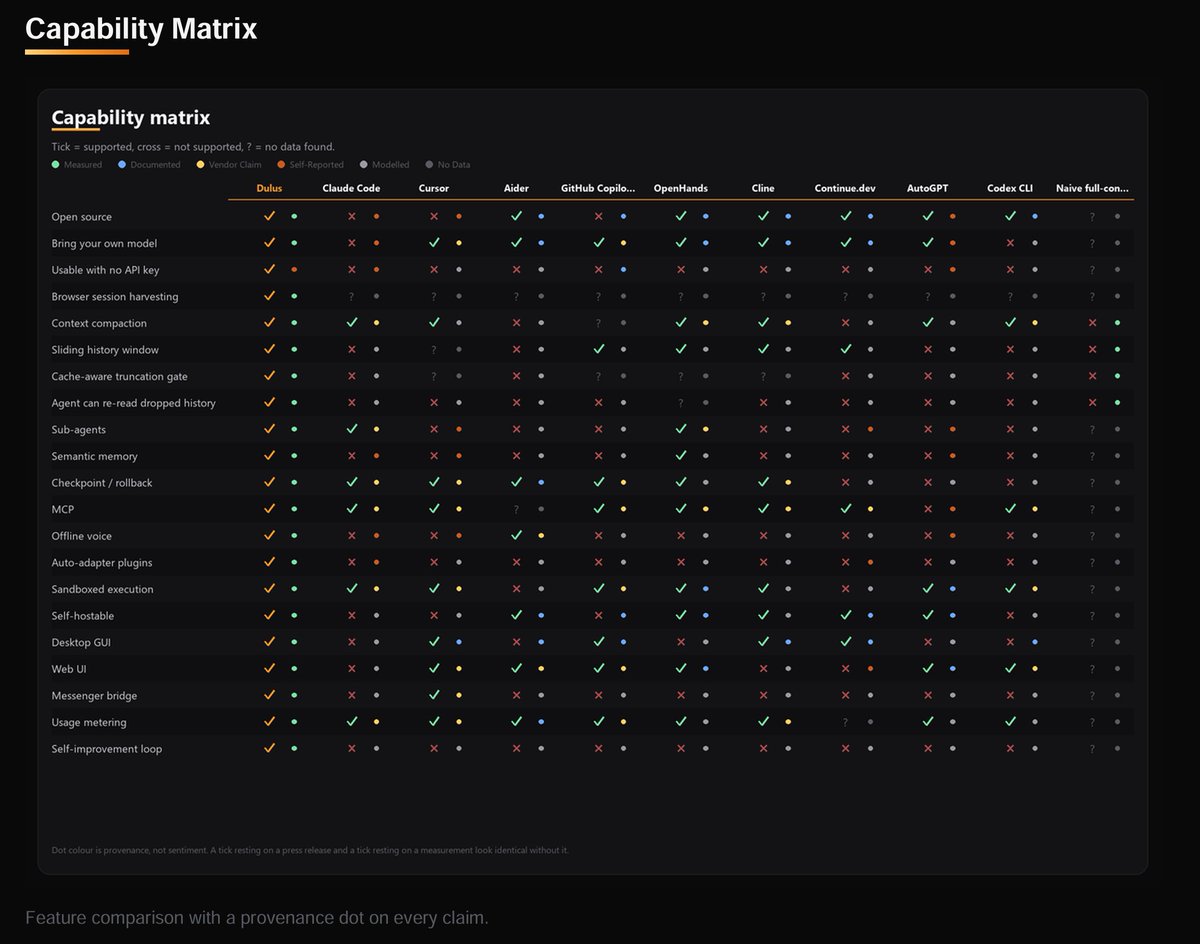
Benchmarking itself also looked like a product surface. @KevRojox published (7 likes, 1 reply, 119 views) Dulus Benchmark Arena matrices comparing Dulus, Claude Code, Cursor, Aider, GitHub Copilot agent mode, OpenHands, Cline, Continue, Codex CLI, and a naive full-context loop across multiple scenarios. The caveat is important: the thread did not surface an external methodology document, so the images are useful evidence of interest in harness benchmarking, not proof that the rankings are settled.
6. New and Notable
Codex Voice now stays inside the thread instead of forcing a relay workflow
@athyuttamre highlighted (102 likes, 9 replies, 5,552 views, 12 bookmarks) that voice can now continue existing Codex threads and projects instead of starting a disconnected conversation. The most useful detail came in the replies: Astra still handles the reasoning, and voice on desktop uses the normal usage-credit pool. That makes this notable both as a UX improvement and as another reminder that new surfaces still inherit the same quota concerns.
Chrome DevTools MCP pushed browser-native debugging further into the agent stack
@N0V4Dev pointed (16 views, 1 bookmark) to Chrome DevTools MCP, and the public README makes it more substantial than a generic MCP wrapper. It gives agents live browser control, performance traces, screenshots, console and network inspection, and source-mapped stack traces, plus a CLI for non-MCP use. That is notable because browser debugging is becoming a first-class capability rather than a bolt-on hack.
Artificial Analysis updated its benchmark to be more agentic and harder to game
@ArtificialAnlys said (58 likes, 14 replies, 3,572 views, 9 bookmarks, 10 quotes) that Intelligence Index v4.2 added AA-Briefcase and GDP.pdf while moving 40% of weighting to private held-out sets. That matters because the benchmark itself is reacting to how fast frontier-model vendors optimize for public tests. The day's Astra arguments landed in a context where evaluation methodology is becoming part of the product conversation.
Harness-level scoreboards are spreading, but evidence quality is uneven
@KevRojox shared (7 likes, 1 reply, 119 views) Dulus Benchmark Arena as an "evidence-graded" harness comparison across multiple coding scenarios. The notable part is not that everyone should accept the ranking; the thread did not surface an external methodology document. The notable part is that the community is now publishing harness-versus-harness matrices at all, which shows how attention is moving from model brands toward end-to-end execution environments.
7. Where the Opportunities Are
[+++] Rollout and quota observability for premium coding models — The demand showed up everywhere: @hqmank published (52 likes, 18 replies, 8,158 views, 15 bookmarks) weekly caps, @Mr_Salio wrote (33 likes, 15 replies, 4,580 views) a separate clarification post, and @Codex_Changelog had to correct (196 likes, 7 replies, 19,674 views, 16 bookmarks) Astra Fast labeling. This is strong because the workaround today is public detective work.
[+++] Context-control and cost-routing layers for long-running agents — @Soso_fun_yt documented (150 likes, 14 replies, 8,251 views, 44 bookmarks, 2 quotes) hidden Antigravity compaction behavior, @pierceboggan showed (43 likes, 4 replies, 1,446 views, 12 bookmarks) HydraFusion's orchestration economics, and @undefinedKi shared (7 likes, 4 replies, 130 views, 6 bookmarks) Spotify's 90%-token-cut routing pattern. This is strong because people already accept that raw frontier intelligence is too expensive and too state-fragile to run unassisted.
[++] Reviewable multi-agent operating systems — @DanKornas built (1 like, 2 replies, 440 views) OverClick around contract cards and measured handoffs, @AlexFinn used (21 likes, 6 replies, 3,726 views, 27 bookmarks) PM supervision over developer agents, and @Shruti_0810 argued (4 likes, 1 reply, 800 views) for a spec-first pipeline. This is moderate because multiple builders see the same need, but teams may adopt lighter-weight process layers before a dedicated product.
[++] Browser-aware debugging and evidence capture for coding agents — @N0V4Dev surfaced (16 views, 1 bookmark) Chrome DevTools MCP as a first-class browser control surface for agents. This is moderate because the repo already exists, but the wider opportunity is packaging debugging traces, screenshots, and reproducible browser-state evidence into normal coding workflows.
[+] Lightweight runtimes for local and constrained-device agent work — @theaungmyatmoe presented (5 likes, 1 reply, 88 views) Fusion as proof that bounded-state agents can run on far smaller footprints than Node-heavy baselines. This is emerging because the audience is smaller today, but the need connects directly to cost, battery, and local-first adoption.
8. Takeaways
- Astra became a real product surface, and that immediately exposed a transparency gap. @code announced (180 likes, 8 replies, 12,483 views) Copilot availability, but the day's discussion still revolved around screenshots, clarification threads, and label fixes.
- Gemini 3.8 Flash still generated genuine Antigravity enthusiasm, but long-session trust now depends on observability. @Soso_fun_yt documented (150 likes, 14 replies, 8,251 views, 44 bookmarks, 2 quotes) hidden context ceilings and early compaction, even while other users praised the model's quality.
- The most interesting build pattern moved above the model layer. @pierceboggan introduced (43 likes, 4 replies, 1,446 views, 12 bookmarks) HydraFusion, and adjacent posts about Spotify-style routing and SOMA pointed to cost and workflow design as the main lever.
- Process scaffolding is replacing faith in one big autonomous chat. @DanKornas shared (1 like, 2 replies, 440 views) OverClick, while other posts pushed PM boards, spec pipelines, and portable skills as the real path to reliable output.
- Benchmark culture kept expanding from model leaderboards toward harness and workflow evaluation. @ArtificialAnlys updated (58 likes, 14 replies, 3,572 views, 9 bookmarks, 10 quotes) its index with more private agentic tests, while smaller builders such as Dulus published end-to-end harness scoreboards too.