Twitter AI Coding - 2026-09-05
1. What People Are Talking About
1.1 Antigravity kept expanding into a broader product surface, but the harness argument did not go away (🡕)
The largest Twitter cluster stayed attached to Google Antigravity, but the center of gravity moved from "is Gemini 3.8 Flash good?" to "what product surfaces is Google actually shipping around it, and do people trust the harness enough to use them?" At least six separate items supported this theme across Antigravity's Mission Report, Remote Control, creator demos, a leaked voice-control surface, and direct criticism of the harness.
@antigravity posted (271 likes, 30 replies, 20,777 views, 42 bookmarks) that its latest Mission Report was already outdated by the pace of Gemini 3.8 Flash releases, then used the reply chain to point people to the new Remote Control announcement, a walkthrough, and the public livestream hub. That mattered because it showed Antigravity presenting itself less as a one-off demo shell and more as a multi-surface product with browser and mobile access, livestream programming, and a steady content cadence.
@thtbee_ reported (136 likes, 17 replies, 5,811 views, 14 bookmarks) that a one-shot Gemini 3.8 Flash demo built in Antigravity was quoted by Google News, acknowledged by Google, and included in Antigravity's official Mission Report. The attached images mattered because they showed both the original "Night Forest" result and the subsequent amplification path, turning a small creator experiment into evidence that Google was actively surfacing community-made demos.


A lower-engagement but higher-information leak added a new surface. @runtimewire said (3 likes, 3 replies, 343 views) that Antigravity was testing "Concierge," a voice-activated coding assistant that routes finalized speech to a dedicated agent instead of the prompt box. The attached mockup showed cards for review queues, CL triage, personalized rules, and skills/plugins, which is more concrete product evidence than the short tweet alone provided.

The positive creator story did not erase the criticism. @grenish_rai argued (9 likes, 1 reply, 1,240 views) that Antigravity repeatedly rereads whole files, generates Python scripts for simple edits, and still pauses for approvals even with auto-approve enabled. @johnennis added (10 likes, 4 replies, 1,014 views) that if Gemini is strong, Google should let subscribers use it through third-party harnesses instead of effectively forcing Antigravity.
Discussion insight: The split was unusually concrete. Fans were pointing to actual creator wins and new product surfaces, while critics were naming exact failure modes such as repeated file rereads, approval interruptions, and the inability to bring Gemini into alternate harnesses.
Comparison to prior day: On September 4, Antigravity discourse centered on context ceilings, checkpoint compaction, and whether the harness was obscuring Gemini's real capability. On September 5, the conversation broadened into product surfaces such as Remote Control and Concierge, but the harness-trust issue still followed every launch.
1.2 Astra discussion shifted from rollout watching to packaging, pricing, and measurable throughput (🡕)
Astra was still a major subject, but the tone changed again. Instead of mostly watching for rollout clues, people spent the day comparing packaging layers, context economics, and whether Astra's gains were visible in real tools and benchmark-style tests. At least seven separate items supported this theme.
@GHchangelog announced (12 likes, 1,431 views) that GPT-6 Astra was available in GitHub Copilot, linking to GitHub's public changelog entry. The linked post says Astra is rolling out across VS Code, Visual Studio, Copilot CLI, the coding agent, the Copilot app, github.com, mobile, JetBrains, Xcode, and Eclipse for Pro+, Max, Business, and Enterprise users.
@TokenGremlin posted (84 likes, 12 replies, 8,273 views, 10 bookmarks) a forward-looking Astra watchlist, but the strongest evidence sat in the quoted post from @thsottiaux, which said Astra had raised productivity enough to pull some internal plans forward by six months. That gave the day a stronger practitioner-performance claim than simple "Astra feels good" praise.
A second layer of evidence came from how people were selling Astra access. @MyTabulon posted (6 likes, 401 views) that Astra was live on its gateway with a 1.05M context window, 128K output, and a price jump above 272K prompt tokens; the public pricing page describes the service as a coding-model gateway with native context and no prompt or tool injection. The attached card made the pricing tiers and long-context jump visible in one place.

@rachpradhan shared (9 likes, 539 views) a Codegraff comparison claiming that, across 108 runs and 18 synthetic coding tasks, Astra reached the same pass-rate frontier as GPT-5.6 Sol with 31.8% less mean task time and 14.3% fewer tokens. The attached chart was important because it added a concrete efficiency claim instead of another generic capability ranking.

Packaging and workaround talk filled in the rest. @claudeebum claimed (20 likes, 7 replies, 2,838 views, 14 bookmarks) a Codex pricing loophole by locking context to 1M, and the linked reply pointed to the public OpenCodex repo, which describes itself as a universal provider proxy for Codex, Claude Code, Claude Desktop, and Grok Build. Replies under @opencode's Zen model-addition post (396 likes, 12 replies, 12,134 views, 16 bookmarks) immediately moved to operator questions such as exposing remaining credit balance by API and pinning recurring jobs to model versions.
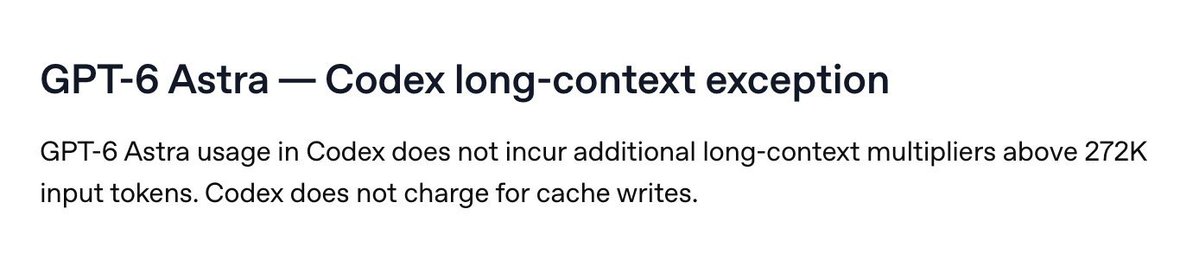
Discussion insight: The thread-level questions were no longer "is Astra out?" They were "which surface gives me native context," "which layer hides or exposes the price jump," and "how do I keep model choice from becoming manual toil across recurring jobs?"
Comparison to prior day: September 4 was dominated by access math and naming clarity around Astra in Copilot, Codex, and ChatGPT plans. September 5 kept the access thread alive, but added third-party gateways, routing proxies, and sharper speed-and-token evidence.
1.3 Orchestration and supervision layers kept gaining ground around coding agents (🡕)
A third strong cluster was about everything wrapped around the model: orchestration, supervision, browser control, queueing, and reusable context. At least six items supported this theme, and several of them were concrete open-source projects rather than workflow advice.
@DanKornas introduced (8 likes, 5 replies, 747 views) Omnigent as an open-source meta-harness for Claude Code, Codex, Cursor, OpenCode, Hermes, Pi, and custom agents, with the reply linking to the public GitHub repo. The repo says Omnigent adds cross-device sessions, shared history, policies, and disposable cloud sandboxes, while the attached screenshot made the "multiple agents, one control plane" idea easier to verify.

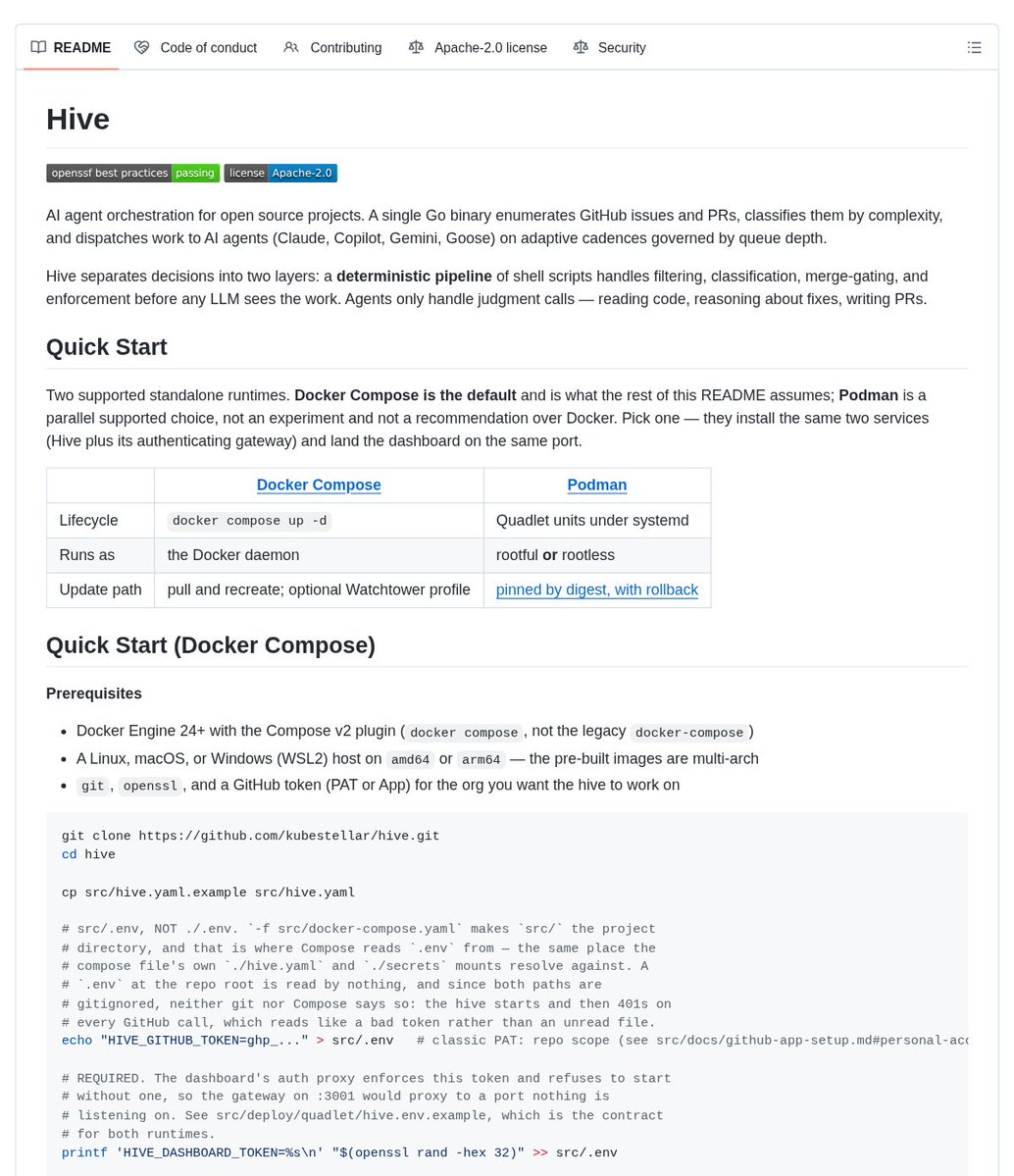
@DanKornas also shared (4 likes, 709 views) Hive, and the public repo README describes it as a single Go binary that enumerates GitHub issues and PRs, classifies them by complexity, and dispatches work to Claude, Copilot, Gemini, and Goose through a deterministic pre-LLM pipeline. That post mattered because it treated queueing, merge gates, and cadence control as the product.
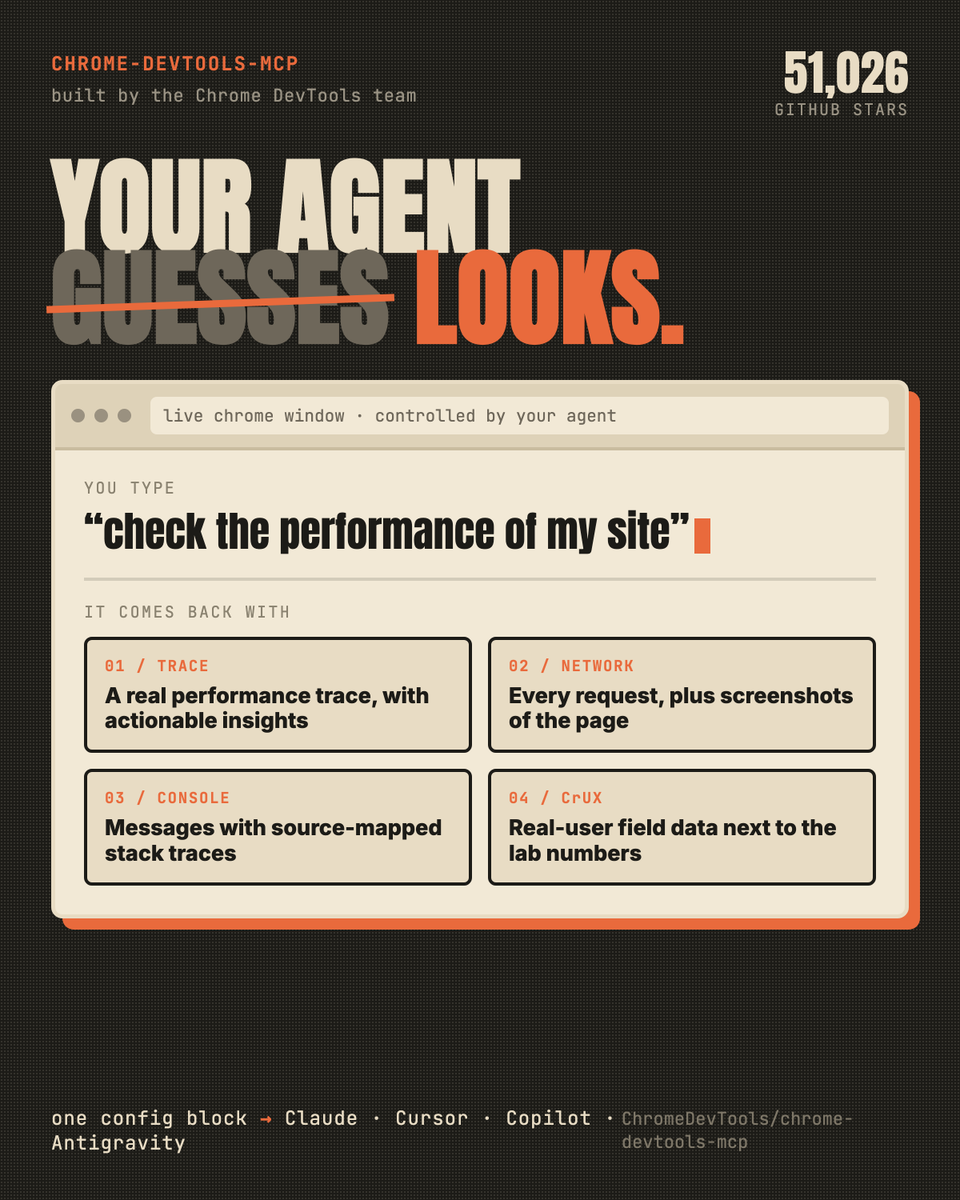
@DuncanRogoff highlighted (3 likes, 3 replies, 361 views) the chrome-devtools-mcp project from the Chrome team, and both the reply link and public repo back up the same story: the tool gives Claude, Cursor, Copilot, or Antigravity a live Chrome browser with performance traces, network inspection, screenshots, console access, Puppeteer control, and optional CrUX field data.
Replies under these posts converged on the same pain point. One Omnigent reply said supervision is the first thing that breaks when people run Claude Code and Codex side by side, and an opencode reply said every new model makes manual selection worse unless recurring jobs can be pinned to specific versions. @coreyganim described (4 likes, 407 views, 6 bookmarks) a business stack where new specialized agents can be launched in about five minutes because a weekly ingest skill keeps writing learnings back into a GitHub-based second brain.
GitHub surface polish was part of the same story. @pierceboggan reported (22 likes, 5 replies, 953 views) a new "Open in external browser" action in the Copilot app, and a reply immediately asked whether default-browser cookies are on the roadmap for automation-heavy sessions.

GitHub's public HydraFusion research post reinforced the same shift at the product level: single, cascade, and critique workflows, with GitHub claiming 67% lower estimated cost than Claude Opus 5 on TerminalBench 2.1 at a 4.9-point verified-quality gain. @stretchcloud summarized (3 likes, 468 views, 4 bookmarks) that shift as a move from picking one model to composing a workflow.
Discussion insight: The conversation assumed that the model is no longer the whole product. People were debating how to supervise fleets, how to route recurring jobs, how to expose browser state, and how to keep orchestration costs visible.
Comparison to prior day: On September 4, the control layer mostly appeared as boards, PM-vs-dev role splits, and spec-first discipline. On September 5, that same instinct showed up as actual software: meta-harnesses, queue governors, browser MCP servers, and compound-model runtimes.
2. What Frustrates People
Harness friction and forced-harness lock-in
The sharpest technical frustration was not about model quality in the abstract. It was about harness behavior getting in the way of the model. @grenish_rai wrote (9 likes, 1 reply, 1,240 views) that Antigravity sometimes rereads an entire file for a one-line edit, generates a Python script instead of editing directly, and keeps stopping for approval even when auto-approve is enabled. @johnennis framed (10 likes, 4 replies, 1,014 views) the broader complaint more bluntly: if Gemini is strong, users should not be pushed into one harness just to access it. Severity: High. People are already comparing alternative harnesses, so this looks build-worthy wherever a provider controls the model but the workflow dissatisfaction lives in the client.
Model economics were still too hard to observe in real time
The second major frustration was operational visibility. @claudeebum looked for (20 likes, 7 replies, 2,838 views, 14 bookmarks) a way around Astra's long-context price jump, @MyTabulon surfaced (6 likes, 401 views) a public pricing card that explicitly jumps above 272K prompt tokens, and replies under @opencode's Zen update (396 likes, 12 replies, 12,134 views, 16 bookmarks) asked for an API endpoint that exposes remaining credit balance. The common thread is not price alone; it is the inability to see what is being consumed early enough to steer behavior. Severity: High. This is worth building for because the workaround behavior is already visible in public.
Supervision becomes the bottleneck once teams run more than one agent
Once users move past one chat window, they seem to hit the same wall: it gets difficult to see which agent is doing what, which model is pinned where, and which run needs attention. @DanKornas presented (8 likes, 5 replies, 747 views) Omnigent partly as a response to that problem, and a reply said directly that supervision is what breaks first when Claude Code and Codex are running side by side. @coreyganim described (4 likes, 407 views, 6 bookmarks) a business stack that works only because a second-brain loop keeps feeding context back to new agents. @opencode replies added a related complaint: more models make manual selection worse unless recurring jobs can be version-pinned. Severity: Medium-High. The demand is concrete and repeated enough to justify orchestration, dashboarding, and routing products.
Agent feedback loops still waste effort on noisy code paths
A smaller but still clear frustration cluster focused on the quality of the loop itself. @byteHumi argued (7 likes, 523 views) that coding agents default to TypeScript too often, burn tokens on lint and type checks, silence problems with as any or @ts-ignore, and generate tests for facts the type system already guarantees. That complaint matched the day's broader routing conversation: people want faster, quieter feedback loops, not just bigger models. Severity: Medium. This looks worth building for where toolchains can shorten validation, surface better compiler guidance, or steer agents toward lower-noise languages and patterns.
3. What People Wish Existed
A real usage cockpit for frontier coding models
People were not asking vaguely for cheaper AI. They were asking for a place that exposes long-context thresholds, remaining credits, and per-surface consumption before a session gets expensive. The best evidence came from @opencode replies asking for a remaining Zen balance API on the Zen update thread, plus the workaround behavior in @claudeebum's Astra pricing post and the concrete threshold card in @MyTabulon's gateway post. This is a practical need. Opportunity: direct.
Better portability between strong models and preferred harnesses
The strongest unmet need around Antigravity was choice. @johnennis said that Google should let people use Gemini through third-party frameworks if the model is good enough to stand on its own, and @grenish_rai listed concrete reasons someone would want that escape hatch. Open-source projects such as Omnigent and OpenCodex exist because this portability problem is already real. This is a practical need with clear competitive pressure. Opportunity: competitive.
Agent supervision that survives scale, recurrence, and multiple devices
The day repeatedly pointed to the same missing control plane: people want to launch agents quickly, keep context between them, supervise them from more than one surface, and know when one is stuck. @coreyganim described a GitHub-based second brain plus weekly ingest loop, @DanKornas pitched Omnigent as a shared orchestration layer, and Antigravity kept shipping surfaces like Remote Control. This is both practical and urgent because the workarounds are already becoming architecture. Opportunity: direct.
Voice and browser peripherals that let agents operate on real interfaces
Two of the day's strongest auxiliary signals were about interface access. @runtimewire showed a possible voice-first Antigravity surface, while @DuncanRogoff pointed to chrome-devtools-mcp, which gives coding agents a live browser, traces, screenshots, and console access. These are practical needs because they close gaps between agent output and the interfaces developers actually debug. Opportunity: direct.
Domain-specific skill packs that turn coding agents into workflow specialists
The scientific-skills discussion showed a different kind of wish: not just a better general-purpose coder, but a pack of reusable procedures, references, and tests for one domain. @kamin00ntee highlighted the scientific-agent-skills repo precisely because each skill includes documentation, examples, references, and tests. This is a practical need where open repositories already prove demand, but the market is likely to fragment by domain. Opportunity: aspirational.
4. Tools and Methods in Use
| Tool | Category | Sentiment | Strengths | Limitations |
|---|---|---|---|---|
| Antigravity | Agent harness | (+/-) | Strong creator demos, official Mission Report cadence, Remote Control rollout, visible experimentation around Concierge | Users reported repeated full-file reads, approval interruptions, and no clean path to use Gemini through preferred third-party harnesses |
| GPT-6 Astra | LLM | (+) | GitHub says it plans and validates as it goes; third-party users shared speed and token-efficiency claims; practitioners said it materially improved output | Rollout is gradual, access depends on surface and plan, and long-context use triggers sharp pricing sensitivity |
| GitHub Copilot | IDE/agent platform | (+/-) | Broad Astra availability, HydraFusion preview, browser-canvas export, cross-surface presence | Replies still complained about usage-based credits, and upcoming model deprecations create admin and workflow churn |
| HydraFusion | Compound-model runtime | (+) | Single/cascade/critique workflows; GitHub reported major cost-quality gains in offline benchmarks | GitHub says the preview is best today on first-turn single-prompt tasks, and replies still asked for stronger multi-turn behavior |
| OpenCode Zen | Model gateway | (+/-) | Rapidly expanding model catalog including GLM, Muse Spark, and DeepSeek variants | Replies asked for remaining-credit APIs and model pinning because manual selection gets worse as the lineup grows |
| OpenCodex | Provider proxy | (+) | Routes Codex, Claude Code, Claude Desktop, and Grok Build to many providers through a local proxy and dashboard | Adds another routing layer, and the public discussion around context workarounds shows that price optimization remains operator-heavy |
| MyTabulon | Model gateway | (+/-) | Public Astra pricing, native context positioning, OpenAI-compatible endpoint | Its own pricing card highlights a substantial jump above 272K prompt tokens |
| Omnigent | Meta-harness | (+) | Shared sessions across devices, multi-agent supervision, policies, and sandbox support | More moving parts than a single-agent app, and replies questioned whether mixing agents is worth the coordination overhead |
| Hive | Backlog orchestrator | (+) | Deterministic pre-LLM pipeline, queue-aware cadence switching, multi-agent backend support | Repo setup requires deployment runtime choices and GitHub credentials, so the operational overhead is non-trivial |
| chrome-devtools-mcp | Browser MCP server | (+) | Gives agents real browser traces, network and console inspection, screenshots, Puppeteer actions, and optional CrUX data | Repo warns that browser content becomes visible to MCP clients and that usage statistics are collected by default unless disabled |
| Kimi K3 | LLM | (+/-) | Produced a live, drivable portfolio when the author supplied clear references and iterative guidance | The same author said zero-shot-style testing made Kimi look much weaker, so performance appears prompt- and supervision-sensitive |
| Scientific Agent Skills | Skill library | (+) | 163 validated skills with docs, examples, references, tests, and 100+ databases broaden what coding agents can do | Best fit is domain-specific work; it is not a lightweight substitute for generic coding prompts |
Overall sentiment stayed positive on model capability and negative on the surrounding operations. The happiest posts described what agents could do with real context, real browsers, or well-structured guidance. The mixed posts were usually about economics and control: people are adding gateways, proxies, pinned model choices, second-brain loops, and deterministic prefilters to keep costs, context, and supervision manageable.
Migration patterns were visible in three places. First, model routing is becoming deliberate: GitHub is pushing HydraFusion, operators want recurring jobs pinned to versions, and third-party gateways are turning model access into a layer of its own. Second, browser access is shifting from ad hoc screenshots to reusable MCP infrastructure through chrome-devtools-mcp. Third, workflow scaffolding is moving from advice to software, with Omnigent and Hive both treating supervision and governance as first-class features rather than side notes.
5. What People Are Building
| Project | Who built it | What it does | Problem it solves | Stack | Stage | Links |
|---|---|---|---|---|---|---|
| OpenCodex | @claudeebum | Universal provider proxy that lets Codex, Claude Code, Claude Desktop, and Grok Build run against many LLM providers | Lets people keep familiar coding-agent workflows while swapping providers, routing models, and managing account pools | Node 18+, bundled Bun runtime, local dashboard, OpenAI-compatible proxy, optional Docker Compose | Shipped | repo |
| Omnigent | @DanKornas | Open-source meta-harness that supervises Claude Code, Codex, Cursor, OpenCode, Hermes, Pi, and custom agents in one control plane | Reduces harness sprawl by giving teams shared sessions, policies, and cross-device continuity | Python 3.12+, Node/pnpm web UI, tmux wrappers, policy engine, cloud sandbox integrations | Shipped | repo · site |
| Hive | @DanKornas | Queue-aware orchestrator for GitHub issues and PRs that dispatches work to multiple coding agents behind deterministic gates | Helps open-source teams route backlog work without letting agents operate without classification, merge gates, and policy checks | Go, GitHub issue/PR integration, Docker Compose or Podman, authenticated dashboard | Beta | repo |
| chrome-devtools-mcp | Chrome DevTools team | MCP server that gives coding agents a live Chrome browser, traces, network inspection, screenshots, and console access | Closes the gap between "describe the bug" and "inspect the actual browser state" | Node/npx, Chrome DevTools, Puppeteer, MCP, optional CrUX lookups | Shipped | repo |
| Scientific Agent Skills | K-Dense-AI | Library of 163 validated scientific skills and 100+ databases for agent workflows | Turns coding agents into domain-specific research assistants instead of generic code writers | Agent Skills standard, plugin package, tested skill library, scientific database integrations | Shipped | repo |
| Folio / 3dportfolio | @SahilPanhotra | Live drivable 3D portfolio built with Kimi K3 and iterative guidance | Demonstrates that tighter references and iteration can lift front-end output quality from a weaker starting point | Vanilla JS, three.js, cannon-es, Vite, static hosting / Cloudflare Workers | Shipped | live demo · repo |
The strongest repeated build pattern was "put a control plane around the agent." OpenCodex routes familiar agent UIs to different providers, Omnigent supervises several harnesses in one session fabric, and Hive puts a deterministic governor in front of GitHub backlog work. These are all responses to the same operational pressure visible elsewhere in the dataset: model choice, approvals, and agent coordination are no longer secondary details.
@DanKornas showed (4 likes, 709 views) Hive's README and dashboard setup, which made the queue-governor concept concrete rather than theoretical. The screenshot mattered because it showed an actual deployable operator surface instead of another generic "multi-agent" claim.
The second repeated pattern was "give the agent better peripherals." @DuncanRogoff pointed (3 likes, 3 replies, 361 views) to chrome-devtools-mcp precisely because it lets agents inspect a real browser, collect traces, and use Puppeteer actions. That is a different class of project from another wrapper around prompting.
The remaining projects added two more directions. Scientific Agent Skills broadens AI coding into research and lab workflows by packaging procedures, references, and tests into reusable skills, while Folio showed that builders are still using frontier and mid-frontier models for visible front-end artifacts when they can iterate tightly enough. Taken together, the day's builders were less interested in raw code generation than in routing, supervision, browser access, and domain specialization.
6. New and Notable
Concierge points to a voice-first agent control layer
@runtimewire posted (3 likes, 3 replies, 343 views) that Antigravity is testing a voice-activated assistant called Concierge. The screenshot showed more than a microphone: it surfaced cards for pending conversations, CLs that need attention, personalized rules, and skills/plugins, which suggests a control layer for managing agent work rather than just speech-to-text input.
GitHub is publicly programming around Copilot workflows, not just shipping models
@github announced (120 likes, 10 replies, 25,097 views, 31 bookmarks) a four-hour Copilot Day focused on agent workflows, the Copilot app and CLI, customization, and HydraFusion. That matters because it turns compound-model orchestration and workflow integration into headline content for a mainstream developer audience, not just a changelog footnote.

Google Cloud is teaching stateful agent networks as an enterprise skill
@googlecloud shared (9 likes, 1 reply, 1,538 views) a four-part live series on "stateful, production-grade AI agent networks" built with Gemini Enterprise Agent Platform and Antigravity. The public tweet and poster explicitly named ADK, long-term state management, and secure deployment, which makes it a notable shift from one-off prompt demos toward operating durable agent systems.

7. Where the Opportunities Are
[+++] Agent supervision and control planes — Evidence showed up in sections 1, 2, 4, 5, and 6: Omnigent, Hive, coreyganim's second-brain workflow, Antigravity Remote Control, Concierge, and GitHub's HydraFusion programming all point to the same gap. People are already stitching together dashboards, policy layers, queue governors, and cross-device session views because the raw chat loop is not enough.
[+++] Usage, pricing, and context observability — The Astra pricing-loophole thread, MyTabulon's threshold card, and opencode replies asking for remaining-credit APIs all point to one direct need: developers want to see cost and context state early enough to change behavior. This is strong because the workaround behavior is already public and repeated.
[++] Harness portability around frontier models — Antigravity criticism, OpenCodex, and Omnigent all reflect a market where people like certain models but do not want to be trapped inside one harness. The opportunity is moderate because multiple projects are already attacking it, but the user demand is explicit.
[++] Agent peripherals for real interfaces — chrome-devtools-mcp and the Concierge leak both show that better browser and voice surfaces materially change what an agent can do. This is moderate because the need is concrete and technically bounded, but it competes with platform-native implementations.
[+] Domain-specific skill packs — Scientific Agent Skills showed one path beyond generic coding assistants: reusable, tested procedures for a specific domain. The signal is emerging rather than dominant today, but it broadens the addressable market from coding help to workflow expertise.
8. Takeaways
- Antigravity's mindshare is now coming from shipped surfaces and creator amplification, not just model demos. The Mission Report, Remote Control links, and the thtbee_ promotion cycle all point to Google building a broader product wrapper around Gemini 3.8 Flash. (source)
- Astra conversation has moved one layer up the stack into pricing, routing, and efficiency evidence. Public discussion focused on long-context thresholds, gateway packaging, and benchmark-style speed/token comparisons rather than simple availability rumors. (source)
- Supervision is becoming the real product category around coding agents. Omnigent, Hive, second-brain workflows, and GitHub's HydraFusion messaging all treat orchestration and review as first-class capabilities. (source)
- Developers increasingly want agents connected to real interfaces, not just source files. chrome-devtools-mcp and the Concierge leak both show demand for browser- and voice-level control surfaces. (source)
- Specialized skill libraries are widening what "AI coding" means. Scientific Agent Skills turned a coding-agent discussion into a research-workflow discussion by packaging 163 tested scientific procedures and database integrations. (source)