Twitter AI Coding - 2026-09-07
1. What People Are Talking About
1.1 Internal tooling, hosted agents, and runtime orchestration moved to the center (🡕)
The strongest cluster was about the machinery around agent work, not just which model is smartest. At least six high-signal items pointed in the same direction: internal tooling inside AI labs, hosted agent infrastructure, compound runtimes, and plugins that expose what each orchestration leg is doing.
@GergelyOrosz reported (1,652 likes, 62 replies, 186,070 views, 411 bookmarks) that OpenAI resisted building Meta-style internal tooling teams because, in an AGI-first world, Codex would trigger its own internal-tools explosion. The thesis landed because it reframed AI coding as an organizational design story: fewer bespoke platform teams, more internal tool creation emerging directly from agent usage. But @thsottiaux challenged (292 likes, 21 replies, 15,131 views, 19 bookmarks) that framing, saying Codex itself started as an internal tool and that OpenAI had already built substantial infrastructure over the last few years.
@testingcatalog reported (331 likes, 27 replies, 17,633 views, 91 bookmarks) that OpenAI plans to unveil Managed Agents with platform-native Agents, Environments, and Agent Sessions. The most telling replies were not arguing about model quality; they were asking whether task state, permissions, artifact provenance, and accountability survive outside the model context, which is a much more operational discussion than ordinary launch hype.
@Kisalay_ argued (4 likes, 2 replies, 224 views, 1 bookmark) that HydraFusion is "not another model in the picker" but a runtime that selects Single, Cascade, or Critique workflows, and GitHub's public HydraFusion research post describes the same architecture and its cost-quality tradeoffs. @unixterminal shared (14 likes, 1 quote, 1,042 views, 1 bookmark) Lerna, whose public repo and screenshots show HydraFusion route selection, live phase logging, and optional Azure Foundry routing for supported models.

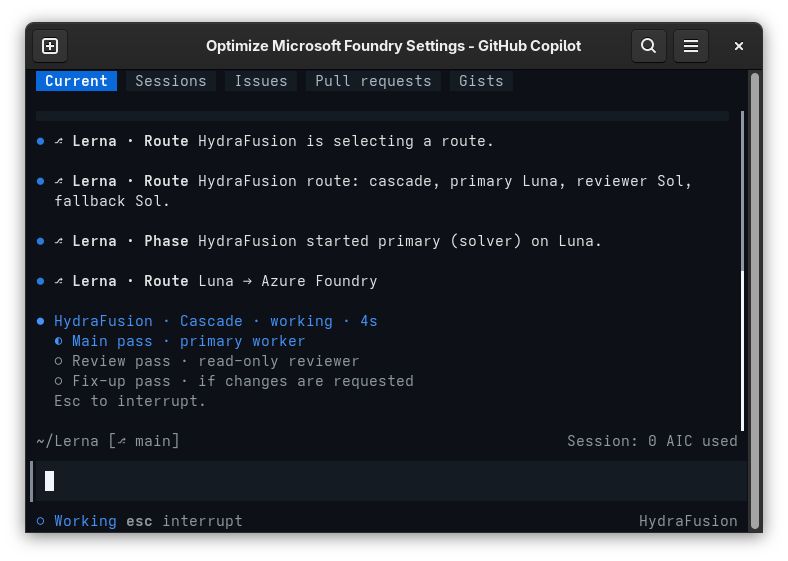
Discussion insight: The replies were asking for execution ledgers, not just more intelligence. Under the Managed Agents post, one reply said hosted loops without provenance are just "easier-to-deploy amnesia," while thsottiaux's correction turned the OpenAI thread from a culture-war take into a more useful argument about what kind of internal infrastructure AI-native organizations still need.
Comparison to prior day: September 6 already elevated canvases, verification gates, and transcript forensics. September 7 pushed the conversation one layer deeper, from workflow visibility into org design and runtime architecture.
1.2 The Astra conversation shifted from raw model hype to quota math, context budgets, and offload tricks (🡕)
The second major cluster was about the mechanics of keeping frontier coding models usable. The strongest posts were not generic claims that Astra is expensive; they were concrete screenshots of weekly caps, UI context tiers, early-access workarounds, and tools that shrink or reroute the expensive part of the work.
@bridgemindai argued (391 likes, 75 replies, 15,200 views, 11 bookmarks) that Astra is draining Codex subscriptions so quickly that resets every 48 hours are the only thing keeping the product usable. The attached usage screenshot matters because it shows a full weekly limit exhausted even while the 5-hour window is still visible. @DanDr1s added (45 likes, 9 replies, 1,360 views) that on Plus, a single serious Astra prompt can consume the whole 5-hour limit.

@cremieuxrecueil said (163 likes, 14 replies, 14,046 views, 23 bookmarks) that users can expose Astra in Codex early by asking GPT-5.6 to flip a visibility flag, which reads like an access workaround rather than an intended workflow. @StatsWire showed (5 likes, 4 replies, 153 views) a UI with only 272K default and 872K context options visible, adding more evidence that Astra access and context-size messaging are still fuzzy for users.

@aliscodes summarized (6 likes, 4 replies, 284 views) Spotify's shunt setup, and the public Spotify engineering post says the plugin intercepts reads over 350 lines, hands bulk reads and boilerplate generation to Gemini 2.5 Flash worker modes, and cuts frontier-model context by about 90% on large-read scenarios at the cost of 10-30 seconds of added latency. @thisdudelikesAI argued (17 likes, 5 replies, 894 views, 14 bookmarks) that Graft solves the same waste from the other direction: the public Graft repo says it writes a local markdown graph of the repo, and its published SWE-bench Verified comparison improved from 27/50 to 33/50 while using fewer tokens and less wall-clock time.


Discussion insight: The interesting part is where people are applying leverage. Instead of asking only for cheaper frontier plans, they are reducing full-file reads, preserving codebase memory, and exposing context tiers before a run burns the week.
Comparison to prior day: September 6 focused on compression layers and usage diagnostics. September 7 added harder evidence: quota screenshots, access hacks, UI context ambiguity, and repo-native context products that attack the waste directly.
1.3 Gemini and Antigravity gained attention from both enterprise controls and access politics (🡕)
Gemini and Antigravity stayed central, but the conversation split three ways: enterprise governance, harness portability, and who gets subsidized access. The strongest posts were about controls and eligibility rather than showy consumer demos.
@GoogleCloudTech said (260 likes, 7 replies, 31,925 views, 45 bookmarks) that Gemini Enterprise subscriptions now bring Antigravity under Google Cloud's existing security and compliance umbrella. The replies sharpened the real value proposition: procurement, blast radius, delegated authority, and whether admins can inspect and revoke task-level access without disabling the whole subscription.
@GoogleCloudTech added (144 likes, 12 replies, 16,369 views, 42 bookmarks) that Antigravity usage can now be governed through one admin console covering spend, security, observability, and usage metrics. One reply pushed the bar higher by arguing that after an agent uploads gigabytes it did not need, teams will want explicit egress controls, not just dashboard visibility.
@goon_nguyen said (329 likes, 47 replies, 34,836 views, 30 bookmarks) Gemini 3.8 Flash had become their main driver because it is good, fast, and cheap enough to use daily, while the quoted post from @haider1 praised its intelligence-to-speed tradeoff even more strongly. But the same thread argued Google is leaving support on the table by tying subscription access to Antigravity instead of letting people use the entitlement in other harnesses.
@itsPaulAi posted (44 likes, 8 replies, 6,284 views, 22 bookmarks) that eligible students can get Google AI Pro or AI Plus tiers with higher Gemini and Antigravity limits, NotebookLM benefits, and other Google surfaces bundled in. @maria_rcks asked (54 likes, 8 replies, 4,896 views) the natural follow-up from the open-source side: why is there no Antigravity for Open Source program?

Discussion insight: The official side is selling inspectability, revocation, and compliance. Users are still talking about portability and fairness: who gets subsidized access, who has to stack subscriptions, and why the best Gemini entitlement remains tied to one harness.
Comparison to prior day: September 5 centered product-surface expansion such as Remote Control and Concierge. September 7 shifted the emphasis toward governance consoles, bundled entitlements, and who is excluded from the access model.
1.4 Agents operating real software, not just repos, became a clearer subtheme (🡕)
A smaller but distinct cluster was about agents acting on software after the code is written. The posts that stood out were about real phones and desktop applications, not just source edits.
@vicky_grok reported (251 likes, 23 replies, 15,729 views, 263 bookmarks) that Google's ARTEMIS turns natural-language instructions into Android automation and can work with Antigravity, Codex, and Claude Code. The public ARTEMIS repo goes beyond the tweet by documenting MCP integration, Logcat diagnostics, and a 99%+ task-completion claim on AndroidWorld, which made the discussion feel closer to production testing than to demo-clicking.
@hybirdssss built (2 likes, 29 views) Astral-Claude, and the public repo describes a desktop MCP server, a bundled Blender MCP server, and reusable skills for observing, acting, and verifying desktop applications. That mattered because it treated desktop and creative software as first-class agent surfaces, with verification loops built into the workflow instead of assumed.
Discussion insight: Replies on ARTEMIS immediately asked about layout changes, permission prompts, and recovery. The bar is moving from "can it click?" to "can it recover, log what happened, and prove the result?"
Comparison to prior day: September 6 already had browser-grounded tooling in the mix. September 7 broadened that surface area to real phones and desktop apps.
2. What Frustrates People
Quota walls and unclear context tiers keep the best models from staying useful
The sharpest frustration was that strong model performance does not matter if a serious task can exhaust the allowance before the work is done. @bridgemindai argued (391 likes, 75 replies, 15,200 views, 11 bookmarks) that Astra can "eat a full week in a day," and the attached screenshot shows exactly why that claim resonated: the weekly bar is already empty while the 5-hour limit is still part of the UI. @DanDr1s added (45 likes, 9 replies, 1,360 views) that on Plus, one serious Astra prompt can consume the whole 5-hour window, while @StatsWire showed (5 likes, 4 replies, 153 views) that even the visible context-size choices are still ambiguous.
People are coping with resets, UI spelunking, and early-access hacks instead of getting a trustworthy usage cockpit. @cremieuxrecueil shared (163 likes, 14 replies, 14,046 views, 23 bookmarks) a visibility-flag workaround just to expose Astra in Codex. Severity: High. This looks build-worthy because the demand is already explicit: people want real-time burn-rate visibility, clearer context limits, and routing help before the run fails.
Harness and entitlement fragmentation makes people juggle tools instead of work
The next frustration was not model quality but where people are allowed to use it. @goon_nguyen said (329 likes, 47 replies, 34,836 views, 30 bookmarks) Gemini 3.8 Flash had become their daily driver, yet the same thread described Google tying the subscription to Antigravity as "such a pity." @maria_rcks asked (54 likes, 8 replies, 4,896 views) why there is no Antigravity for Open Source program, while @itsPaulAi highlighted (44 likes, 8 replies, 6,284 views, 22 bookmarks) that students can get higher limits through Google AI Pro or AI Plus.
The pattern is clear: access is being allocated by harness, plan tier, geography, or eligibility class rather than by workload need. The workaround behavior is public already, from stacked subscriptions to visibility hacks. Severity: High. This is worth building for anywhere a strong model exists behind a narrow entitlement surface.
Repeated repo discovery is still being billed like frontier reasoning
Several of the day's most useful projects existed because too much expensive context is still spent on mechanical reading. @thisdudelikesAI argued (17 likes, 5 replies, 894 views, 14 bookmarks) that Graft improves outcomes by giving agents a persistent markdown map of the codebase instead of making them rediscover it every session; the public Graft repo backs that with fewer tool calls, fewer tokens, less wall-clock time, and better SWE-bench performance. @aliscodes summarized (6 likes, 4 replies, 284 views) Spotify's shunt approach, and the public engineering writeup says reads over 350 lines are blocked and rerouted to a cheaper worker model.
That tells you how severe the waste feels in practice: teams are no longer just asking models to be cheaper, they are building systems that prevent full-file reads from ever reaching the premium model. Severity: High. This is worth building for because the workarounds are precise, repeatable, and already shipping.
Tool execution still needs tighter permissions, provenance, and audit trails
A fourth frustration was trust in autonomous tool use. @HadjKamara built (8 likes, 5 replies, 236 views) mcpvet because agentic IDEs can auto-run local MCP servers with developer privileges; the public mcpvet repo says it scans commands, env vars, URLs, headers, and origins against 34 patterns. @testingcatalog reported (331 likes, 27 replies, 17,633 views, 91 bookmarks) Managed Agents, and the replies immediately moved to provenance and blame. @GoogleCloudTech showed (144 likes, 12 replies, 16,369 views, 42 bookmarks) admin controls, but one reply still said explicit egress limits would be more convincing after an agent uploaded far more repo data than needed.
The coping strategy today is layered review: scanners before merge, isolated review phases, task-scoped permissions, and more visibility into what was uploaded or run. Severity: High. This looks build-worthy because the pain is no longer theoretical; it is driving concrete scanners, policy layers, and governance consoles.
3. What People Wish Existed
A real usage cockpit for frontier coding models
People were not vaguely asking for cheaper AI. They were asking for something that shows remaining quota, active context tier, and when a run is about to become uneconomical. @bridgemindai and @DanDr1s made the urgency obvious with allowance screenshots and first-hand complaints, while @StatsWire showed that even context-size options are not being communicated cleanly. This is a practical need, and the public workaround behavior already includes resets, flag flipping, and manual UI checking. Opportunity: direct.
Portable model entitlements across preferred harnesses
The strongest access request was simple: let people use the model they like inside the harness they already prefer. @goon_nguyen explicitly said Gemini 3.8 Flash would win more support if Google let subscribers use it outside Antigravity, and @maria_rcks asked the open-source version of the same question. Student bundles from @itsPaulAi show that providers are already using entitlement design as distribution strategy. This is a practical need with clear competitive pressure. Opportunity: direct.
Repo memory that survives the session and can be shared
The Graft and shunt posts both point to the same missing layer: agents need persistent understanding of the codebase so they do not spend premium tokens rediscovering obvious structure. @thisdudelikesAI framed that as a repo map written in linked markdown, while the Graft repo publishes benchmark gains once that map exists. @aliscodes framed the same need from the routing side: block mechanical bulk reads and replace them with cheaper summaries. This is a practical and urgent need. Opportunity: direct.
Execution ledgers and scoped permissions for hosted and multi-agent work
The Managed Agents and Google Cloud threads show a shared request for proof: who acted, with which tools, on what data, under whose authority. @testingcatalog drew replies about provenance and blame, @GoogleCloudTech drew replies about revocation and blast radius, and @unixterminal pointed to Lerna because people want to see the route and review phases instead of trusting a black box. This is a practical need rather than an emotional one. Opportunity: direct.
Recoverable operators for real phones and desktop software
Once agents start acting on software instead of only editing repos, users want something sturdier than a demo. @vicky_grok triggered replies about layout drift and permission prompts, and @hybirdssss built Astral-Claude around observe-act-verify loops for desktop apps and Blender. The need is practical: operators want agents that can recover, log, and validate. Opportunity: competitive.
4. Tools and Methods in Use
| Tool | Category | Sentiment | Strengths | Limitations |
|---|---|---|---|---|
| GPT-6 Astra | LLM | (+/-) | Strong coding benchmarks, long-horizon planning gains, high-end code generation | 5-hour and weekly caps frustrate serious use; context-size messaging is unclear |
| Gemini 3.8 Flash | LLM | (+/-) | Fast, cheap enough for daily use, good enough to replace pricier models for many users | Access is still tied too tightly to Antigravity subscriptions |
| HydraFusion | Orchestration runtime | (+) | Automatically picks Single, Cascade, or Critique workflows; strong quality-cost tradeoff in GitHub's public benchmarks | Still a research preview and best suited to first-turn tasks today |
| Graft | Context layer | (+) | Persists a codebase map as linked markdown; published gains in correctness, token use, tool calls, and latency | Requires local graph generation and workflow wiring to get the benefit |
| Portal + shunt | Router / plugin | (+) | Offloads bulk reads and boilerplate to cheaper worker models; large frontier-context savings | Adds 10-30 seconds of latency and is not suitable for nuanced reasoning or direct editing |
| Antigravity | Harness / IDE | (+/-) | Student and enterprise bundles increase limits; governance and admin controls are improving | Portability complaints remain strong; no visible open-source access lane |
| ARTEMIS | Android automation | (+) | Real-phone workflows, Logcat diagnostics, MCP integration, and 99%+ AndroidWorld claim | Still new; users are already asking how it handles layout drift and permission prompts |
| mcpvet | Security scanner | (+) | Checks MCP configs for risky commands, secrets exposure, origin issues, and CI drift | Scope is static config review, not runtime tool-description behavior |
| Lerna | Copilot CLI plugin | (+) | Makes HydraFusion routing and phase activity visible; can route supported calls to Azure Foundry | Depends on experimental Copilot CLI features and only supports HydraFusion-known IDs |
| Astral-Claude | Desktop / Blender operator | (+) | Gives Claude Code observation, action, and verification loops for desktop and creative apps | Setup is heavier and desktop-control constraints still matter |
The satisfaction spectrum was sharpest around model economics. Astra and Gemini both drew real capability praise, but users immediately qualified it with quota pain, harness lock-in, or unclear access rules. The workaround pattern was equally consistent: keep the premium model on reasoning, then either route bulk I/O to a cheaper worker, persist context in repo-readable files, or expose the runtime so people can see where the cost went.
The day's strongest migration pattern was not "switch everything to one new model." It was split execution. Spotify's shunt article explicitly keeps Gemini 2.5 Flash on bulk reads and boilerplate while Claude handles higher-risk reasoning, and HydraFusion formalizes a similar idea in runtime form with Single, Cascade, and Critique patterns. Competitive dynamics are forming around that control layer: Google is packaging Gemini access with governance and bundles, GitHub is packaging orchestration, and open-source builders are packaging memory, routing, and safety rails around whatever model the user already pays for.
5. What People Are Building
| Project | Who built it | What it does | Problem it solves | Stack | Stage | Links |
|---|---|---|---|---|---|---|
| Graft | trailhq / Nanonets | Builds a linked markdown graph of a codebase for coding agents | Agents keep re-onboarding to the same repo and missing sibling files | Node, tree-sitter, markdown graph, agent wiring hooks | Shipped | repo |
| shunt / Portal worker modes | Spotify | Reroutes bulk reads and boilerplate generation to cheaper worker models | Frontier models waste tokens on I/O-heavy tasks that need little reasoning | Portal by Spotify, AiKA Modes, Claude Code hooks, Gemini 2.5 Flash workers | Shipped | blog · plugin |
| mcpvet | @HadjKamara | Scans MCP configs for risky commands, secrets exposure, and suspicious origins | Auto-executed MCP servers can run with developer privileges before review | npm CLI, YAML pattern library, origin verification, GitHub Action | Shipped | repo |
| Lerna | sirredbeard | Adds verbose HydraFusion routing logs and optional Azure Foundry routing to Copilot CLI | Compound runtimes are hard to inspect or reroute once the orchestration starts | .NET 11 native binary, GitHub Copilot CLI, HydraFusion, Azure Foundry | Beta | repo |
| ARTEMIS | Turns natural-language instructions into real-phone Android automation with diagnostics | Agents need to operate and validate software on devices, not just write code | Python 3.12, MCP server, ADB, scrcpy, FFmpeg, multimodal models | Beta | repo | |
| Astral-Claude | @hybirdssss | Gives Claude Code desktop and Blender control with observe-act-verify skills | Repo-only agents cannot reliably inspect or validate desktop-app output | uv, desktop MCP, Blender MCP, reusable skills | Beta | repo |
The strongest repeated build pattern was reducing wasted context work. @thisdudelikesAI argued (17 likes, 5 replies, 894 views, 14 bookmarks) that Graft keeps a codebase map in plain markdown so agents stop rediscovering the same structure, while the public repo publishes both efficiency gains and a 33/50 SWE-bench Verified result. @aliscodes summarized (6 likes, 4 replies, 284 views) Spotify's shunt architecture, where cheap worker modes handle large reads and boilerplate so Claude keeps its budget for reasoning. Different implementation, same diagnosis: the expensive part of coding agents is often the repeated I/O, not the final reasoning step.
A second pattern was instrumenting or constraining powerful runtimes instead of replacing them. @HadjKamara built (8 likes, 5 replies, 236 views) mcpvet to block bad MCP configurations before merge, while @unixterminal shared (14 likes, 1 quote, 1,042 views, 1 bookmark) Lerna because users want to see route selection, review phases, and model handoffs inside HydraFusion rather than trust a silent orchestrator.
The third pattern was widening the agent surface beyond source files. @vicky_grok reported (251 likes, 23 replies, 15,729 views, 263 bookmarks) ARTEMIS as a real-phone operator with logs and MCP hooks, and @hybirdssss built (2 likes, 29 views) Astral-Claude to bring the same observe-act-verify discipline to desktop apps and Blender. The common move was not "another chat wrapper"; it was turning real interfaces into inspectable, testable agent surfaces.
6. New and Notable
Formal research pushed back on pure vibe-coding hype
@Unnati_builds24 said (3 likes, 289 views) that ETH Zurich tested 100 students doing vibe-coding tasks and found that computer-science knowledge still mattered most. The public ETH Zurich writeup is more specific: CS achievement had the strongest relationship to successful outcomes, while clear writing also helped because prompt-writing becomes a form of coding in practice.

Astra benchmark talk got more task-specific
@elliotarledge reported (45 likes, 4 replies, 2,308 views, 9 bookmarks) that Astra produced a Kimi-Linear Decode kernel running at 24.80x the optimized PyTorch baseline, edging past Claude Fable 5 in that test. @rohanpaul_ai reported (10 likes, 2 replies, 1,021 views, 3 bookmarks) a different kind of gain: 14% on the no-Python MazeBench track versus Claude Fable 5.1 at 2%, which he framed as evidence of stronger long-horizon planning rather than complete spatial understanding.
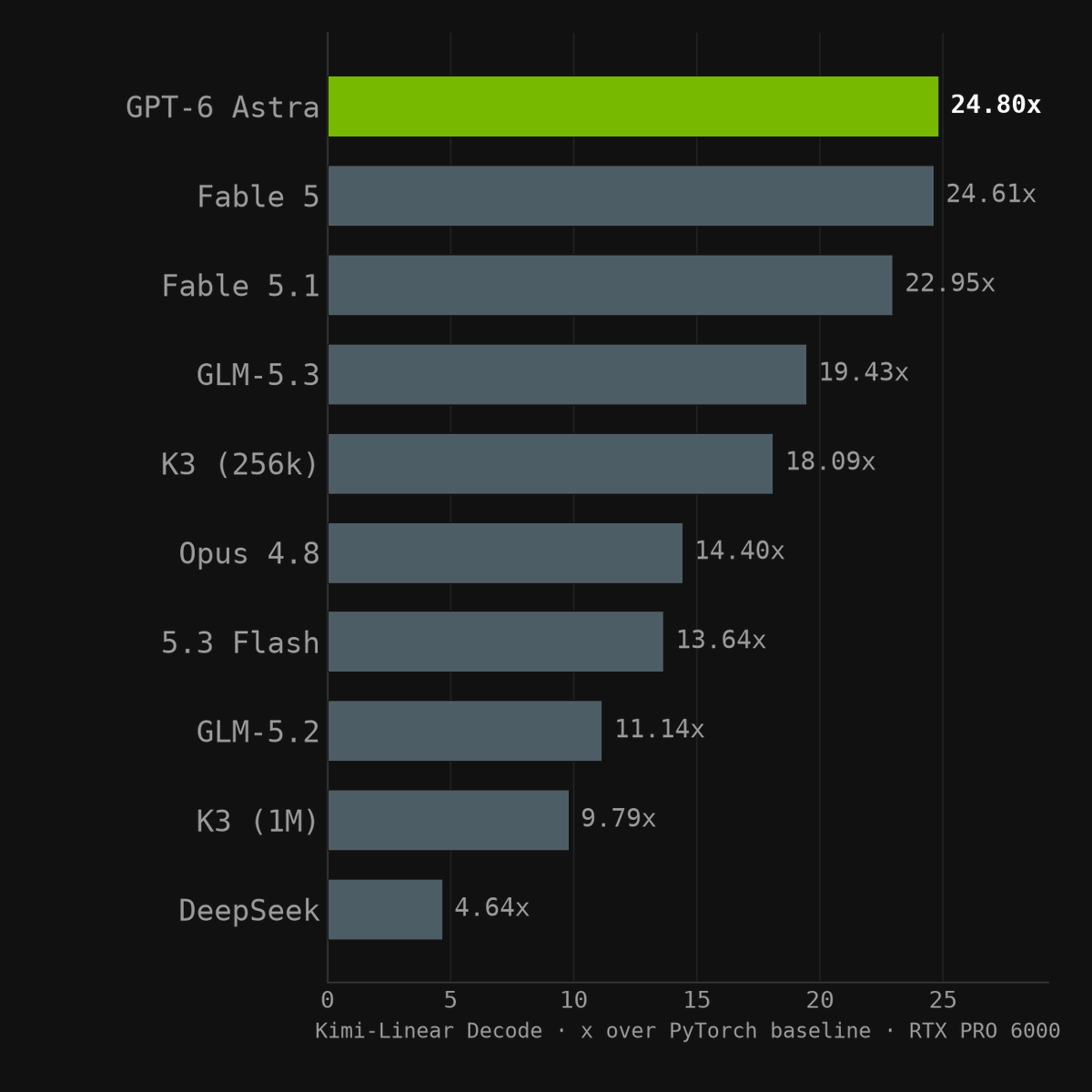
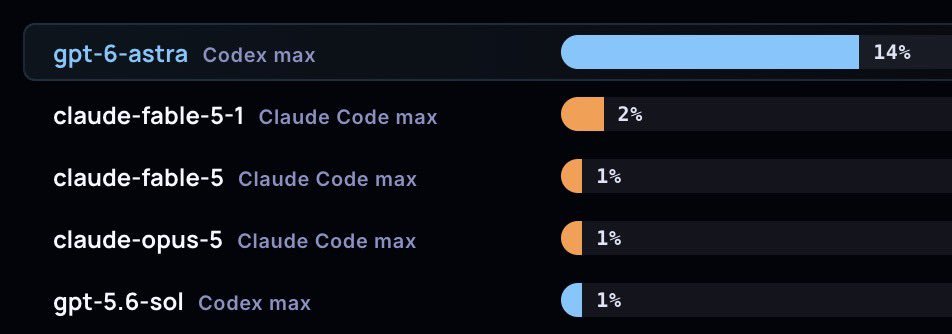
What made that notable was not just that Astra posted wins. It was that the conversation was slicing performance by environment: low-level kernel generation, long-horizon navigation, and tool-free planning, instead of collapsing everything into one generic leaderboard.
7. Where the Opportunities Are
[+++] Quota-aware agent operations — The evidence came from multiple directions: Astra allowance complaints, UI context-tier confusion, Spotify's shunt routing, Graft's published token savings, and HydraFusion's public quality-cost tradeoffs. This is strong because the pain is operational, repeated, and already producing manual workarounds.
[+++] Durable repo memory and context surfaces — Graft, Managed Agents, and HydraFusion all point to the same gap: agents still lose too much state between turns or sessions, then pay to reconstruct it. This is strong because better memory improves both cost and correctness, not just convenience.
[++] Portable model-access layers — Gemini praise paired with Antigravity lock-in complaints, student-only bundles, open-source access requests, and Astra visibility hacks all show demand for entitlement portability. The opportunity is moderate because the demand is explicit, but providers may resist anything that weakens their preferred harness.
[++] Governed autonomous execution — mcpvet, Google Cloud's Antigravity controls, Managed Agents provenance concerns, and Lerna's visible routing logs all point to the same need: know what ran, what it touched, what it cost, and how to revoke it. This is moderate-to-strong because the buyer case is already concrete, especially for enterprise teams.
[+] Real-software operators with recovery loops — ARTEMIS and Astral-Claude suggest an emerging opportunity for agents that can act on phones, browsers, and desktop apps while logging, recovering, and verifying. The signal is smaller than the memory and cost themes, but it is becoming more concrete.
8. Takeaways
- The control layer around agents is becoming the product battle. The day's highest-signal discussion was about hosted agents, runtime selection, routing visibility, and internal tooling rather than about one more raw model launch. (source)
- Frontier capability without transparent quota mechanics is creating immediate backlash. Astra drew real praise, but the evidence people shared most often was weekly limits, 5-hour caps, and access hacks rather than finished work. (source)
- Google's Gemini story is strong on governance and subsidy, but weak on portability. Enterprise admins got compliance and observability language, students got bundled access, and open-source users still asked why there is no comparable lane for them. (source)
- The most credible builders are removing wasted context work or constraining risky execution. Graft, Spotify's shunt setup, mcpvet, and Lerna all focus on memory, routing, review, or permissions instead of promising magic from a bigger model alone. (source)
- Vibe coding still rewards software skill, even as agents spread into phones and desktop apps. ETH Zurich's study said CS knowledge still predicts success best, while ARTEMIS and Astral-Claude show that the next frontier is operating and verifying software after the code is generated. (source)