Twitter AI Coding - 2026-09-10
1. What People Are Talking About
1.1 Astra's quota economics became measurable (🡕)
Quota reliability remained the largest practical concern, but the discussion moved beyond reset anecdotes toward plan-specific screenshots, controlled runs, and model-routing advice. At least seven high-signal items covered Astra's weekly burn, capacity and compaction problems, an apparently cheaper Light mode, and the limits of judging efficiency from token counts alone.
@bridgemindai reported (262 likes, 73 replies, 13,382 views) that one roughly 30-minute Astra session left only 8% of a $20 Plus account's weekly Codex allowance. The screenshot confirms the model, plan, and remaining weekly percentage; it also shows no five-hour meter on that account. Replies suggested cheaper models, but did not establish a like-for-like substitute.

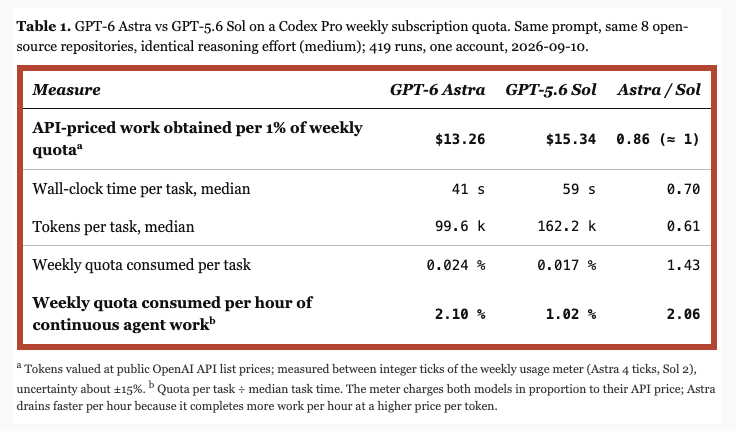
@kunchenguid published (13 likes, 1 quote, 8 bookmarks, 551 views) a more controlled comparison: 419 medium-effort runs using the same prompt across eight open-source repositories. The table values Astra at $13.26 of API-priced work per 1% of weekly quota versus $15.34 for Sol, while Astra completed tasks faster and consumed quota at 2.10% per hour versus 1.02% for Sol. The author's recommendation was to reserve Astra for work that needs its speed or capability rather than make it the default.
@hqmank reported (67 likes, 23 replies, 5,918 views) the opposite experience with Astra Light, saying several tasks used under 10% of a five-hour allowance where similar work had previously felt closer to 50%. A Business-plan user replied that two or three minutes could consume an entire five-hour limit; the author's workaround was to use Astra Light for coordination and cheaper models in subagents.
@TokenGremlin summarized (76 likes, 8 replies, 3,446 views) reports involving capacity, context compaction, quota resets, and reasoning-effort state, while explicitly saying the evidence did not prove that Astra itself had been weakened. That caveat matters because the observable failures could come from the wider Codex stack rather than one model checkpoint.
Discussion insight: The day's strongest correction was that quota value and quota velocity are different measures. The controlled comparison found similar API-priced work per quota point for Astra and Sol, while faster task completion and higher model pricing made Astra drain the meter much faster per wall-clock hour.
Comparison to prior day: September 9 centered on broken banked resets and users watching limits as incidents. September 10 kept the reliability concern but added controlled model comparisons, plan screenshots, and a concrete routing strategy: use expensive models selectively and delegate implementation to cheaper workers.
1.2 Antigravity paired useful workflows with unresolved account risk (🡒)
Antigravity produced the sharpest sentiment split. At least six items ranged from official workflow tips and a detailed account of productive Gemini 3.8 Flash work to continued reports that using the service could put an entire Google identity at risk.
@theo warned (1,630 likes, 146 replies, 37 quotes, 184 bookmarks, 117,278 views) that another wave of Antigravity users appeared to have lost Google accounts. The attached report shows a 15-year-old account marked disabled after a user ran multilingual blog-post automations on an Ultra plan. Replies added two claimed bans, one user who stopped subscribing over the risk, and one appeal that restored a secondary account within a day.

@Cheeks2184 argued (110 likes, 3 replies, 4,143 views) for the clearest requested remedy: separate Antigravity or Gemini enforcement from whole-account enforcement. @wholyv made the same case (93 likes, 8 replies, 6,973 views), pointing to contacts, subscriptions, and backups that sit outside the coding product.
At the same time, @rafaelobitten described (50 likes, 7 replies, 120,757 views) productive use of Gemini 3.8 Flash High for Gemma fine-tuning, ETL, data-lake optimization, and coordination of other agents as a product owner. The same account also hit its five-hour limit and was approaching 30% of the weekly allowance, showing that capability praise and quota pressure coexisted.
The official @antigravity account shared (430 likes, 26 replies, 145 bookmarks, 22,741 views) split-agent view, prompt quote-copy, terminal splitting, full-screen artifacts, and audio-generation shortcuts. These were concrete workflow improvements, but replies to the ban discussion show that convenience did not resolve the identity-risk boundary.
Discussion insight: Users did not ask Google to abandon abuse controls. The recurring request was narrower enforcement, a legible appeal path, and a product boundary that cannot disable unrelated email, files, contacts, and subscriptions.
Comparison to prior day: The theme held steady. September 9 established whole-account loss as a severe downside; September 10 brought much larger engagement, more first-person reply evidence, and a direct contrast between useful product features and unresolved account-level trust.
1.3 Cost pushed users toward smaller models, compression, and observability (🡕)
At least eight items treated model choice as an operating decision rather than a leaderboard. People compared fast open models, compressed repeated context, inspected actual traces, and exposed per-model costs so expensive reasoning could be reserved for the parts that needed it.
@thdxr said (81 likes, 12 replies, 2,111 views) DeepSeek v4.1 Flash filled a valuable price/performance position after its OpenCode Go release. One reply corrected the "minor update" framing by saying it used a new base and architecture with a large KV-cache reduction, while another asked whether the claimed advantage appeared in real workloads or only benchmarks.
@nordin_eth described (64 likes, 14 replies, 5,652 views) SOMA's attempt to remove the repeated-context tax from stateless agent calls. Its quoted early-access announcement offered DeepSeek V4 Pro inside GitHub Copilot with about 10% claimed token savings and $5 of test credit; no independent benchmark accompanied the claim.
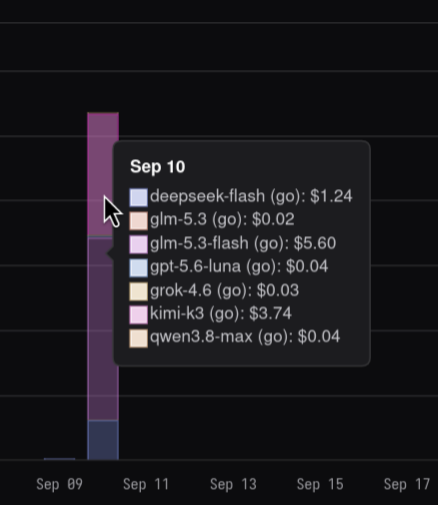
@notpronsh showed (5 likes, 2 replies, 25 views) more than 26 subagents investigating a performance change and an itemized cost view across several open models. The screenshot records $1.24 for DeepSeek Flash, $5.60 for GLM-5.3 Flash, and $3.74 for Kimi K3 on September 10, making mixed-model routing visible at task scale rather than as a generic pricing claim.
@aspnetcore_news linked (4 likes, 2 bookmarks, 423 views) a practical Copilot observability workflow using OpenTelemetry and the local Aspire Dashboard. The guide shows how to inspect model latency, tool spans, input and output tokens, cache reads, and the model that actually answered; it also warns that optional prompt-content capture is sensitive.
Discussion insight: The most grounded cost conversation focused on cost per useful task and where the spend occurred. Replies challenged benchmark-only conclusions, and builders responded with trace viewers, per-model ledgers, context compression, and cheaper subagents rather than a single universal model recommendation.
Comparison to prior day: September 9 emphasized quota monitors and prompt-level efficiency. September 10 broadened the response into active model routing, compressed context, and telemetry that can attribute cost and latency to individual calls and tools.
1.4 Builders filled the gaps between agent output, coordination, and delivery (🡕)
Builder activity clustered around the surrounding workflow. At least nine items addressed email infrastructure, event triggers, feedback tied to exact output, multi-agent delivery state, publishing, quota monitoring, and domain-specific local stacks.
@ryanvogel introduced (62 likes, 6 replies, 25 bookmarks, 3,420 views) OpenSend, a self-hosted transactional and marketing email layer over AWS SES with an API shared by its dashboard, SDK, CLI, and MCP server. The public TypeScript repository had 105 stars during review and explicitly starts real sending behind a provisioning and approval step. A reply said another builder was independently making an SES-based alternative, suggesting repeated demand to avoid separate sending vendors.

@DanKornas highlighted (1 like, 3 replies, 421 views) CCCC, a local-first coordination layer with an append-only group ledger and separate stored, delivered, read, and reply states. Its public Rust repository had 1,146 stars and documented mobile operations, remote group bridges, and 16 supported agent runtimes. That is a direct answer to the problem of treating terminal scrollback as a reliable message bus.

@HelgeRhodin released (3 likes, 2 replies, 1 quote, 247 views) sticky-chat, a small Python and tmux tool that attaches notes to selected agent output and sends the selected lines plus batched feedback back to Claude, Codex, Gemini, or another terminal agent. The repository uses the Python standard library and a local socket, preserving the native agent instead of replacing it.

@SadiaMalik182 presented (19 likes, 3 replies, 79 views) Showly as an MCP-compatible bridge from agent output to private previews, shareable pages, and restorable published versions. The product keeps the final publish action with the user, addressing the gap between a local markdown result and something a colleague can open.

Discussion insight: The event-trigger discussion exposed the production work behind apparently simple automation. After @Rasmic showed (10 likes, 6 replies, 1,069 views) webhook triggers for coding agents, a reply named signed ingress, idempotent handlers, and a durable queue as the remaining controls needed to prevent missed or duplicated side effects.

Comparison to prior day: September 9's builders concentrated on remote supervision and handoff. September 10 retained quota sidecars but spread into durable agent-to-agent messaging, exact-output feedback, event-driven work, email infrastructure, and controlled publishing.
2. What Frustrates People
Allowances disappear faster than users can connect them to completed work
The highest-severity frustration was the mismatch between a subscription label and the amount of usable agent work it delivered. @bridgemindai showed (262 likes, 73 replies, 13,382 views) a Plus account at 8% of its weekly limit after one Astra session, while @hqmank reported (67 likes, 23 replies, 5,918 views) a much lower burn with Astra Light and received a direct reply reporting the opposite on Business. @TimJayas called (15 likes, 8 replies, 714 views) a $20 plan bought specifically for Astra a poor choice under current capacity pressure.
Severity: High. Users cope by choosing Light modes, routing implementation to cheaper subagents, and watching multiple allowance windows outside the main agent. This remains worth building for because users need cost per completed task, retry attribution, and plan-specific burn forecasts rather than one unexplained percentage.
Product enforcement can threaten unrelated personal data
Antigravity account risk remained a separate high-severity problem because the affected identity may also hold mail, contacts, files, photos, and subscriptions. @theo reported (1,630 likes, 146 replies, 37 quotes, 117,278 views) another apparent ban wave, and @Cheeks2184 asked (110 likes, 3 replies, 4,143 views) Google to isolate Antigravity or Gemini sanctions from the whole account.
Severity: High. The observed coping behavior was to cancel, avoid the product, use a secondary identity, or file an appeal after the lockout. Product-specific enforcement, transparent evidence, and recoverable appeals are worth building because the downside extends far beyond an interrupted coding session.
Agent cost and quality vary too much to manage by intuition
Several posts showed that "the model feels expensive" was not enough information. @TokenGremlin reported (76 likes, 8 replies, 3,446 views) capacity and compaction symptoms that could produce retries without proving a model degradation, while @kunchenguid measured (13 likes, 1 quote, 8 bookmarks, 551 views) that Astra and Sol returned similar API-priced value per quota point but radically different burn per hour. On the high end, @hamza1234458 complained (2 replies, 6 views) that MiniMax M3 underperformed free OpenCode alternatives despite an attached annual Ultra price of $1,320.
Severity: Medium-High. The coping pattern is measurement: OpenTelemetry traces, per-model cost charts, controlled repeated tasks, and manual routing. There is a direct build opportunity for provider-neutral evaluation that joins task outcome, retries, latency, quota movement, and cash cost.
Feedback and delivery state are scattered across terminal tabs
Builders repeatedly described friction after an agent starts producing output. @HelgeRhodin said (3 likes, 2 replies, 1 quote, 247 views) plain chat feels natural but creates copy-paste when feedback cannot attach to exact lines. @DanKornas described (1 like, 3 replies, 421 views) the related coordination problem: multiple agents spread context across runtimes, machines, and terminal sessions without reliable delivery state. @SadiaMalik182 framed (19 likes, 3 replies, 79 views) the final handoff problem as useful work dying in a chat window or local markdown file.
Severity: Medium. Current workarounds are sidebars, append-only ledgers, MCP publishing, and phone or edge widgets. This is worth building for, though already competitive, because the repeated need spans feedback, agent-to-agent messaging, approvals, and delivery to nontechnical reviewers.
Private-work assurances are difficult to verify
@babakph argued (8 likes, 7 replies, 6 bookmarks, 3,582 views) that an assurance such as "unlikely, but we cannot rule it out" does not function as a control when researchers place unpublished work into an AI coding tool. The linked long-form article was unavailable during review, so the evidence supports only the narrower, observable concern: users cannot independently verify how private coding traces are handled.
Severity: Medium-High for proprietary or unpublished work. The practical response is to keep sensitive workloads local or demand enforceable retention and training controls. This is build-worthy for audit logs, local execution, and organization-visible policy evidence.
3. What People Wish Existed
Quota meters that predict completed work
People wanted to know what a remaining percentage could actually buy before starting a task. @bridgemindai showed (262 likes, 73 replies, 13,382 views) the failure mode when 92% of a weekly limit disappears in one session, while @kunchenguid supplied (13 likes, 1 quote, 8 bookmarks, 551 views) the missing dimensions: dollars of work per quota point, time per task, tokens per task, and quota consumed per hour. This is a practical, urgent need partially addressed by Codenotch, MeterUsage, and OpenTelemetry dashboards. Opportunity: direct.
Product-specific enforcement with a recoverable appeal path
The clearest account-safety request came from @Cheeks2184, who asked (110 likes, 3 replies, 4,143 views) for Antigravity and Gemini bans to be separated from full Google-account bans. Replies under @theo's report (1,630 likes, 146 replies, 117,278 views) added the practical requirements: specific reasons, an appeal that reaches review, and recovery without risking years of unrelated data. The need is practical and urgent; only the platform can fully satisfy it. Opportunity: direct.
One durable message and approval layer across agents
@DanKornas described (1 like, 3 replies, 421 views) the wish as coordination without chasing context through terminal tabs. CCCC partially addresses it with a durable ledger, explicit delivery and reply states, remote bridges, and mobile operations across multiple runtimes. The practical need extends beyond chat: users want to know which agent received a request, which one read it, which result needs approval, and whether a remote handoff preserved context. Opportunity: competitive.
Event-driven agents with production-safe side effects
@Rasmic showed (10 likes, 6 replies, 1,069 views) the desired interaction: connect a webhook to Codex, Claude, OpenCode, or Cursor and let an event start the work. A technically specific reply supplied the unmet production layer: signed ingress, idempotent handlers, and durable queues so retries cannot duplicate actions. This is a practical need partially served by trigger products and workflow engines, but the cross-agent version remains fragmented. Opportunity: competitive.
Agent output that becomes reviewable without manual repackaging
@SadiaMalik182 said (19 likes, 3 replies, 79 views) useful work often stops at a chat response or local file. Showly's private preview, version history, and explicit publish step partially address the need, while sticky-chat addresses the earlier review loop by tying comments to exact output. This is both practical and mildly emotional: builders want completed agent work to feel finished and easy to share. Opportunity: competitive.
Verifiable handling of private traces
@babakph wrote (8 likes, 7 replies, 6 bookmarks, 3,582 views) that a promise which cannot be verified is not a control when unpublished research enters an AI coding tool. Enterprise managed permissions can constrain operations, but they do not by themselves prove retention, training exclusion, or deletion of provider-side traces. The need is practical for sensitive organizations and aspirational across closed providers because independent verification requires stronger technical or contractual evidence. Opportunity: aspirational.
4. Tools and Methods in Use
| Tool | Category | Sentiment | Strengths | Limitations |
|---|---|---|---|---|
| GPT-6 Astra | Coding model | (+/-) | Fast execution, strong long-task capability, and new searchable cross-context notes | Plus quota can vanish in one session; controlled runs showed about twice Sol's quota burn per hour |
| GPT-6 Astra Light | Coding model | (+/-) | One user reported several tasks for under 10% of a five-hour allowance | A Business user reported the opposite; evidence is anecdotal and plan-dependent |
| Gemini 3.8 Flash High with Antigravity | Model and harness | (+/-) | First-hand use for fine-tuning, ETL, data optimization, and agent coordination; official UI offers split views and artifact controls | Five-hour and weekly limits, plus unresolved whole-account ban reports |
| DeepSeek v4.1 Flash on OpenCode Go | Open coding model | (+) | Fast turnaround, lower-cost positioning, and reported KV-cache reduction | Public discussion still asked for real-workload evidence beyond benchmarks |
| SOMA Copilot Compressor | Context compression | (+/-) | Claimed roughly 10% token reduction while preserving Copilot and DeepSeek V4 Pro workflow | Early access and no independent benchmark in the linked evidence |
| Aspire Dashboard with OpenTelemetry | Observability | (+) | Local span trees expose model latency, tools, tokens, cache reads, and actual responding model | Local dashboard is not persistent; content capture can expose prompts and responses |
| Codenotch | Quota and status monitor | (+) | Tracks multiple providers, windows, reset times, active state, and separate accounts using existing local sessions | Accuracy depends on each provider's exposed local state or endpoints |
| MeterUsage | Quota and spend monitor | (+) | Combines provider status, five-hour and weekly limits, reset actions, credits, and OpenRouter spend | Very early public signal with little discussion or independent validation |
| OpenSend | Email infrastructure | (+) | Self-hosted SES layer with dashboard, API, SDK, CLI, and MCP | Repository says it is not finished; operators still own AWS and sending configuration |
| CCCC | Multi-agent coordination | (+) | Durable ledger, explicit delivery semantics, mobile ops, remote bridges, and broad runtime support | Adds a coordination daemon and trust configuration between groups |
| sticky-chat | Feedback interface | (+) | Attaches notes to exact terminal output and batches them back to several agents | Requires tmux 3.7; Windows support is limited to WSL |
| Showly | Agent publishing | (+) | Private previews, shareable pages, version history, MCP integration, and human-controlled publishing | Adds a hosted publishing layer after the agent completes the content |
| GitHub enterprise managed permissions | Governance | (+) | Central deny/ask/allow policy for shell, file, and network operations across major Copilot surfaces | Governs operations but does not prove provider-side trace handling |
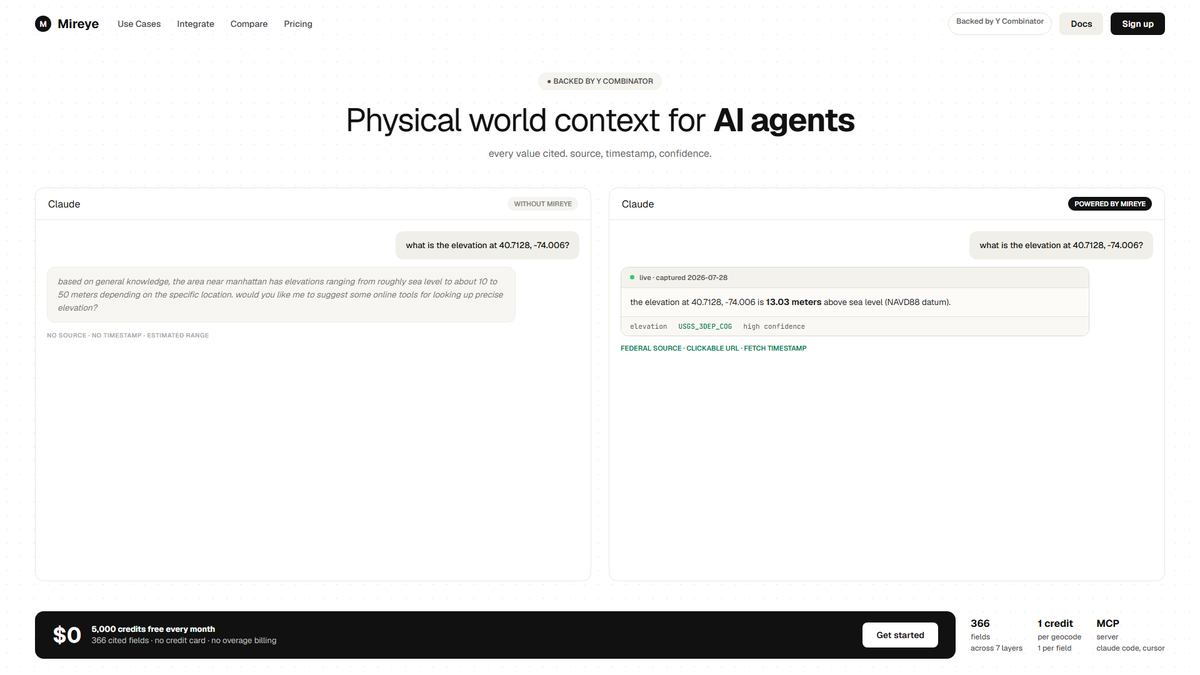
| Mireye | Grounding API and MCP | (+) | Returns timestamped, sourced physical-world fields with confidence and a free credit tier | Narrower to supported physical-world datasets and advertised coverage |
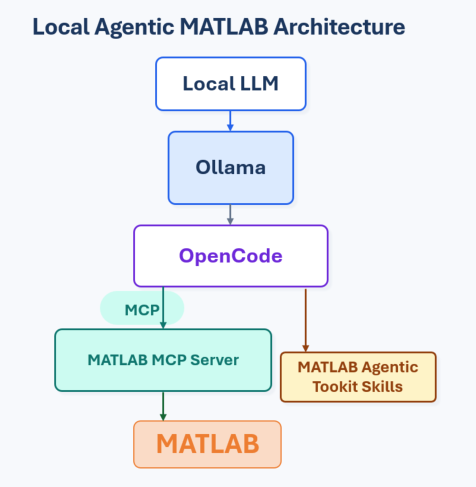
| Local MATLAB agent stack | Domain workflow | (+) | Combines local LLM, Ollama, OpenCode, MATLAB MCP, and toolkit skills | More components to configure; linked article was unavailable during review |
| Logitech MX Keypad | Physical control surface | (+/-) | Nine LCD keys, app-aware pages, macros, prompts, agent status, and terminal controls | $99.99 accessory for operations already available through software shortcuts |
Satisfaction was highest when a tool made hidden state explicit. @aspnetcore_news surfaced (4 likes, 2 bookmarks, 423 views) local traces; @PBAuren9 built (1 like, 2 replies, 2 bookmarks, 13 views) a menu-bar and side-notch quota view; and @KeisukeIshikawa described (4 likes, 4 replies, 2 bookmarks, 381 views) a cross-provider edge widget.


The day's clearest migration pattern was expensive coordinator plus cheaper workers. Astra Light was recommended for supervision while other models implemented; OpenCode users exposed per-model subagent cost; and SOMA tried to reduce repeated context before inference. @thdxr highlighted (81 likes, 12 replies, 2,111 views) DeepSeek Flash's price/performance position, while @notpronsh showed (5 likes, 2 replies, 25 views) a mixed-model fleet in practice.
Grounding and local domain access formed a second method. @alannnfx showed (10 likes, 8 replies, 4 bookmarks, 283 views) Mireye returning a cited USGS field through an MCP-compatible service, while @MATLAB outlined (5 likes, 1 reply, 2 bookmarks, 392 views) a local LLM path through Ollama and OpenCode into MATLAB.
5. What People Are Building
| Project | Who built it | What it does | Problem it solves | Stack | Stage | Links |
|---|---|---|---|---|---|---|
| OpenSend | @ryanvogel and contributors | Self-hosted transactional email, newsletters, and campaigns over existing AWS SES | Agents need a programmable sending layer without another closed email vendor | TypeScript, AWS SES, API, SDK, CLI, MCP, Docker or Cloudflare | Alpha | tweet (62 likes, 6 replies, 3,420 views) · repo |
| CCCC | ChesterRa, surfaced by @DanKornas | Coordinates users, foremen, and agent peers through one durable group ledger | Multi-agent messages, handoffs, and replies get lost across terminals and runtimes | Rust, TypeScript, append-only JSONL ledger, Web UI, CLI, MCP, mobile and IM bridges | Shipped | tweet (1 like, 3 replies, 421 views) · repo |
| sticky-chat | @HelgeRhodin | Attaches notes to selected terminal-agent output and sends a batch back to the conversation | Plain chat forces reviewers to copy, paste, and restate the exact output under review | Python standard library, tmux 3.7+, local socket | Shipped | tweet (3 likes, 2 replies, 247 views) · repo |
| Showly | Showly team, surfaced by @SadiaMalik182 | Converts agent output into private previews, published pages, and restorable versions | Useful reports and pages remain trapped in chat or local files | Web publishing service, MCP-compatible agent integration | Shipped | tweet (19 likes, 3 replies, 79 views) · site |
| MeterUsage | @PBAuren9 | Tracks coding-agent service status, quota windows, reset actions, credits, and OpenRouter spend | Users discover allowance resets and exhaustion in the middle of work | Native macOS menu bar and floating side notch; local provider sessions | Alpha | tweet (1 like, 2 replies, 13 views) |
| google-cloud-developer plugin | Google Cloud contributors, surfaced by @RemikSamborski | Packages cloud CLI, authentication, onboarding, documentation, and discoverable skills for agents | Cloud work requires repeated setup and documentation retrieval across agent harnesses | gcloud skills, Cloud Docs MCP server, skills repository | Shipped | tweet (4 likes, 3 replies, 265 views) |
| Wealth Vault realized P/L and trade book | @BTechComedian | Adds realized gain/loss and closed-trade tracking to an existing portfolio utility | Portfolio owners need an inspectable history beyond current holdings | Google Gemini Antigravity; remaining stack not stated | Shipped | tweet (8 likes, 1 reply, 464 views) |
OpenSend is the most concrete new infrastructure build. The repository exposes one public API to the dashboard, SDK, and MCP server, and its setup prompt instructs the coding agent to begin with simulated sending and ask before provisioning, deployment, or real email. The author explicitly called it "nowhere near done," so Alpha is the appropriate stage despite a functioning dashboard and public repository.
CCCC addresses a different reliability layer. Its append-only ledger distinguishes storage, runtime delivery, reading, and reply instead of treating a prompt handoff as proof that another agent consumed the message. The repository documents 16 first-class runtimes, local state, role-based routing, remote group bridges, and one daemon shared by Web UI, CLI, MCP, and messaging surfaces.
sticky-chat and Showly bracket the human review process. sticky-chat keeps feedback tied to exact terminal output before another agent turn; Showly creates a private, reviewable page after the agent has produced the artifact, then leaves publication to the user.
MeterUsage continues the independent quota-monitor build pattern already visible on September 9. Its distinct addition is one surface for service health, plan-specific windows, reset buttons, remaining credits, and OpenRouter dollar and token history.
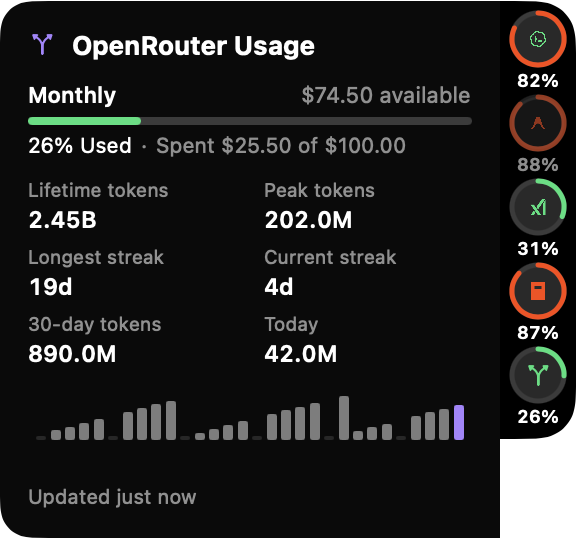
Repeated triggers were operational gaps around native agent sessions: builders wanted dependable delivery, exact-output review, usage visibility, and a safe path from generated material to a public or business-facing artifact.
6. New and Notable
Enterprise policy moved into the agent execution layer
@FlowAltDelete highlighted (9 likes, 2 replies, 7 bookmarks, 653 views) GitHub's generally available enterprise controls for Copilot operations. The GitHub changelog verifies central deny/ask/allow policy for shell commands, file reads and edits, and network domains across the Copilot app, CLI, and VS Code Agent Host. User settings, workspace settings, auto-approval, and saved approvals cannot weaken those managed restrictions.
A large prompt dump exposed the scale of coding-agent harness instructions
@elder_plinius published (116 likes, 9 replies, 74 bookmarks, 4,762 views) what was presented as GPT-6 Astra's Codex system prompt and tool definitions. The linked file contains 331 KB and 5,051 lines in the public CL4R1T4S repository, which had 49,499 stars during review. The observable artifact describes autonomy, permissions, tool use, verification, and communication behavior; it does not expose model weights or hidden neural reasoning.
OpenAI offered verified students a substantial Codex credit buffer
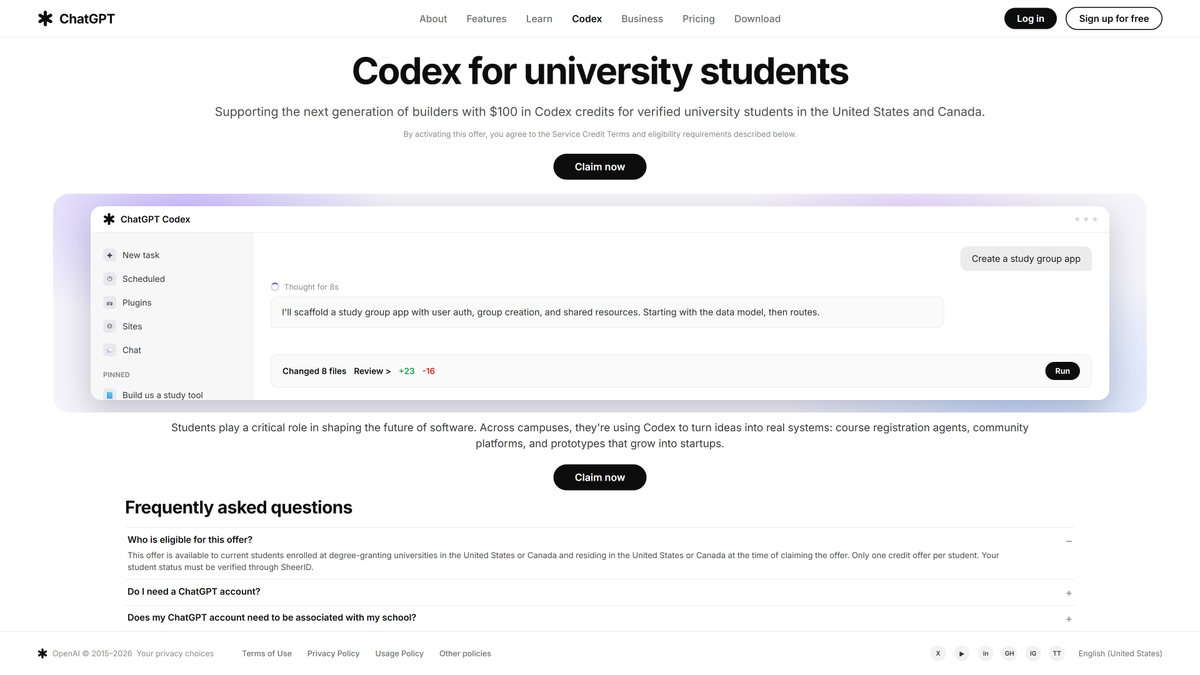
@alannnfx documented (21 likes, 7 replies, 459 views) an offer of $100 in Codex credits for verified university students. The screenshot and offer page state that eligibility is limited to students in the United States and Canada, a restriction the author initially omitted and then corrected in a reply.
A visible paper page documented an eleven-day Lean formalization run
@gurtej__gill_ shared (1 like, 1 bookmark, 29 views) a paper page titled "Formalizing Fermat's Last Theorem in Lean." The visible abstract says the run took about eleven days, relied on Lean's three standard axioms, used no unproved placeholders, and ended with about 30,300 proved theorems in the platform's running total. This is notable as a long-horizon formal-coding artifact, though the day's tweet offered no external paper URL for further verification.

Physical controls arrived for repeatable agent operations
@itsMikeKipruto pointed (4 likes, 3 quotes, 3 bookmarks, 54 views) to Logitech's $99.99 MX Keypad. The linked report describes nine programmable LCD keys, up to 15 app-aware pages, saved prompts and macros, GitHub Copilot integration, and community Claude Code and Codex plugins for agent status and terminal control. It is an unusual but concrete sign that agent workflows are becoming repeatable enough to merit dedicated hardware.
7. Where the Opportunities Are
[+++] Outcome-aware quota intelligence - @bridgemindai showed (262 likes, 73 replies, 13,382 views) how little a remaining percentage tells a user, while @kunchenguid measured (13 likes, 1 quote, 8 bookmarks, 551 views) work value, task time, token use, and hourly drain. Codenotch, MeterUsage, OpenTelemetry, and mixed-model cost views prove demand and supply partial components. The strong opportunity is a provider-neutral layer that forecasts completed work and attributes retries, latency, tools, and model routing.
[+++] Product-level account isolation and appeals - @theo reported (1,630 likes, 146 replies, 37 quotes, 117,278 views) whole-account loss around Antigravity use, and @Cheeks2184 requested (110 likes, 3 replies, 4,143 views) the direct remedy. The opportunity is unusually strong because no third party can fully substitute for product-specific sanctions, clear evidence, recoverable appeals, and protection of unrelated identity data.
[+++] Durable coordination around native agent sessions - OpenSend, CCCC, sticky-chat, Showly, MeterUsage, and Codenotch all preserve existing coding agents while adding missing delivery, feedback, publishing, or monitoring state. @DanKornas surfaced (1 like, 3 replies, 421 views) explicit delivery semantics, while @HelgeRhodin addressed (3 likes, 2 replies, 247 views) exact-output feedback. The market is competitive, but independent builders keep finding adjacent gaps.
[++] Cost-aware model routing and context reduction - @thdxr highlighted (81 likes, 12 replies, 2,111 views) a fast open model's price/performance role; @nordin_eth described (64 likes, 14 replies, 5,652 views) context compression inside Copilot; and @notpronsh exposed (5 likes, 2 replies, 25 views) per-model fleet costs. The opportunity is moderate because routing products already exist, but real task outcomes and reliable savings measurement remain uneven.
[++] Production-safe event triggers for coding agents - @Rasmic demonstrated (10 likes, 6 replies, 1,069 views) webhook-started agents, while a reply identified the exact reliability layer still needed: signed delivery, idempotency, and durable queues. This is a practical opportunity to connect CI failures, issues, deploys, and business events to agent work without double-firing side effects.
[+] Verifiable private-trace handling - @babakph argued (8 likes, 7 replies, 6 bookmarks, 3,582 views) that unverifiable assurances are not controls for unpublished work. Managed operation permissions and local-first tools address part of the concern, but provider-side retention and training claims remain difficult to prove. The signal is important but commercially and technically harder than local workflow tooling.
8. Takeaways
- Astra's cost story depends on time as well as tokens. A controlled 419-run comparison found similar API-priced work per quota point for Astra and Sol, but Astra consumed weekly quota about twice as fast per hour. (source, 13 likes, 1 quote, 8 bookmarks, 551 views)
- Antigravity's useful workflows remain overshadowed by the scope of account enforcement. The day's largest signal paired 1,630 likes and 146 replies with visual evidence of a disabled Google identity and repeated requests to isolate product sanctions. (source, 1,630 likes, 146 replies, 37 quotes, 117,278 views)
- Users are assembling economical fleets rather than choosing one universal model. DeepSeek Flash price/performance discussion, Astra Light coordination, SOMA compression, and visible OpenCode subagent costs all supported selective routing. (source, 81 likes, 12 replies, 2,111 views)
- The builder surface moved beyond code generation into reliable movement of work. OpenSend handled agent-first email, CCCC tracked delivery state, sticky-chat attached feedback to exact output, and Showly turned artifacts into controlled previews and published pages. (source, 62 likes, 6 replies, 25 bookmarks, 3,420 views)
- Control is becoming explicit at both enterprise and individual scale. GitHub shipped centrally enforced operation policy, while smaller builders added approval steps, durable queues, local traces, and reset visibility around native agent sessions. (source, 9 likes, 2 replies, 7 bookmarks, 653 views)