Twitter AI Coding - 2026-09-16
1. What People Are Talking About
1.1 Orchestration and memory layers are becoming the real product surface (🡕)
The conversation kept moving up the stack. codex rose to 84 mentions from 77 on September 15, claude code rose to 47 from 37, and multi-agent mentions tripled from 2 to 6. The strongest posts were less about a single model beating another and more about the harness around long-running work: how agents split tasks, preserve state, criticize each other, and recover after context gets compressed.
@undefinedKi argued (70 likes, 20 replies, 57 bookmarks, 3,095 views) that Google's Stellar Colosseum setup is reusable beyond theorem proving because the practical pieces are architectural, not domain-specific: route exploration, readiness gates, section-level retries, a generator-plus-falsifier pairing, and one shared file for past attempts and pitfalls. The attached paper screenshot matters because it turns that claim into a concrete staged workflow, and the post cites the system's reported results of 71% on research-level theorems and 218 out of 222 competitive-programming problems.

@RaulJuncoV framed (17 likes, 7 replies, 713 views) OpenAI's new Agents API as the same trend becoming a product: a managed harness for context compaction, tool orchestration, files, persistent sessions, and subagents, with deployment options ranging from OpenAI-hosted sandboxes to providers such as Vercel, Modal, and Cloudflare. The distinctive angle in the replies was operational: one response explicitly warned that managed infrastructure removes orchestration work, not the need to set per-session budgets or permission boundaries.
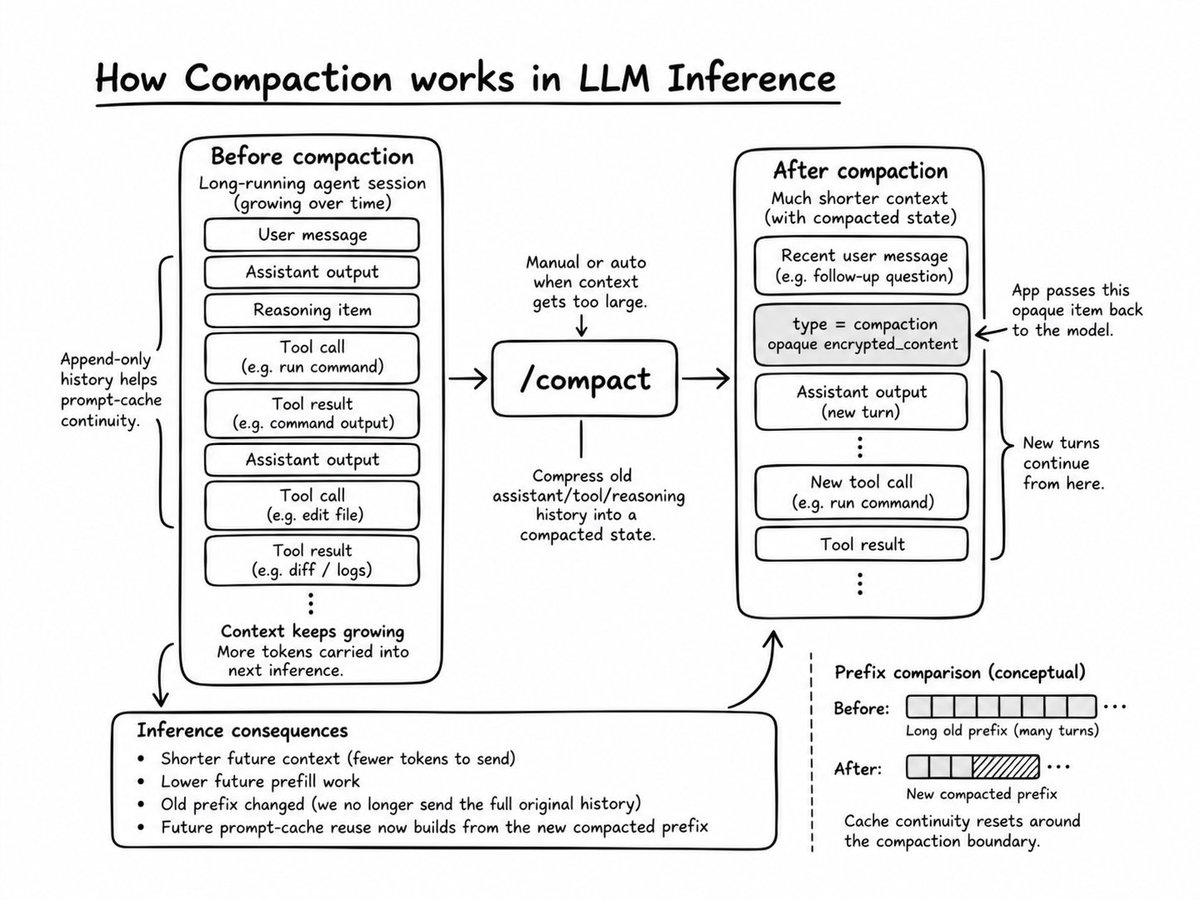
@navaneethvb explained (15 likes, 12 bookmarks, 267 views) why this layer is so visible to practitioners right now: /compact is not magic memory, but a deliberate reduction of old turns into a smaller state that must still be passed back to the model. The diagram makes the point more clearly than the prose, showing full history being replaced by user messages plus an opaque compaction state, which matches the post's explanation of OpenAI's /responses/compact flow.
@techNmak used (35 likes, 1 replies, 45 bookmarks, 2,298 views) Graphify to make the same argument from another direction: if agents keep reopening the same repository files, the bottleneck is not only context size but context reuse. The linked repo described Graphify as a 118,515-star Python project that builds a local tree-sitter-based knowledge graph with explained edges and no vector store, so the agent can query structure instead of replaying grep loops.
Discussion insight: Replies under these posts converged on a stricter standard for "memory." A continuity layer only counts if the next agent can recover the task, evidence, and prior decisions without rereading the whole transcript, and a managed harness only helps if teams can still inspect permissions and cost after the fact.
Comparison to prior day: September 15 emphasized compaction pain and runtime controls. September 16 pushed the conversation one step further, toward explicit scaffolding products and named multi-agent operating models.
1.2 Antigravity kept expanding outward even as reliability complaints stayed visible (🡒)
antigravity fell from 68 mentions on September 15 to 45, but it still sat above the prior-week average of 39.6. gemini dropped harder, from 96 to 50, yet also stayed above its prior-week average of 37.0. What changed was the mix: fewer speculative posts and more concrete examples of Antigravity as a runtime with permissions, device control, and downstream builder projects, all arriving next to complaints about load, latency, and rough migration edges.
@antigravity announced (427 likes, 42 replies, 21,584 views) a new permissions system with automatic command execution inside a stricter sandbox, and the linked sandbox docs back up the important implementation details: isolation to mounted project paths and no network access by default unless domains are allowlisted. The screenshot adds useful product evidence because it shows presets, tool toggles, and domain-level rules rather than only a marketing summary.

@itsPaulAi surfaced (150 likes, 9 replies, 204 bookmarks, 10,674 views) Google's ARTEMIS repo as an Android automation layer that already plugs into Antigravity, Codex, and Claude Code. The public repo page made the builder signal stronger: 6,500 stars, Python, native MCP support, captured logs and screenshots, and a stated 99%+ AndroidWorld benchmark.
@9to5Google reported (35 likes, 3,094 views) that Home MCP now lets Antigravity and other MCP-capable agents interact with Google Home devices. The article adds the safety constraint missing from the tweet: Google blocks sensitive actions such as unlocking doors and requires a Google Cloud project for setup, which keeps the announcement grounded as a guarded tool bridge rather than a generic "AI controls your house" claim.
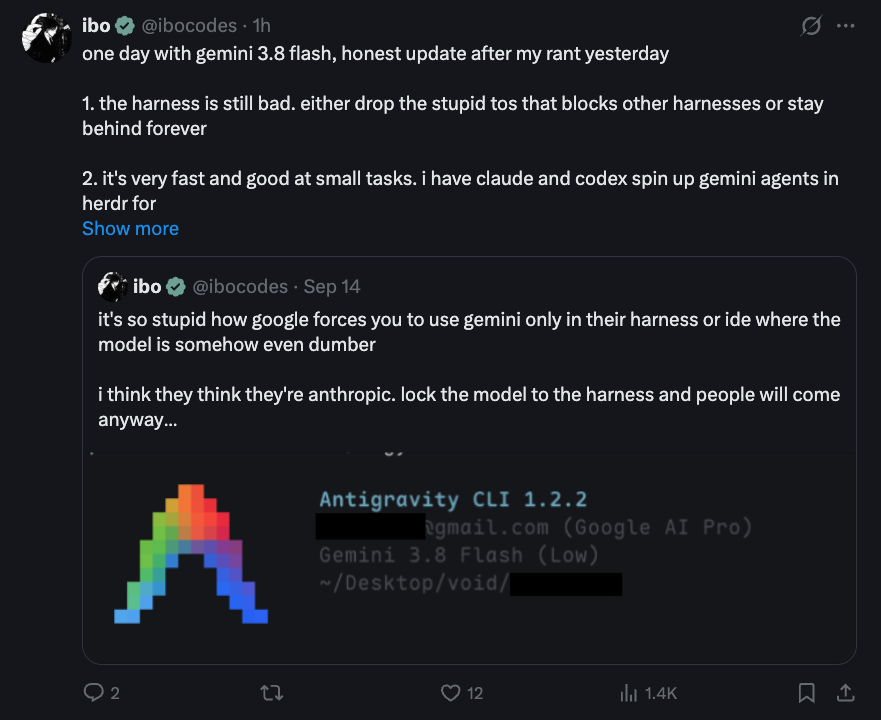
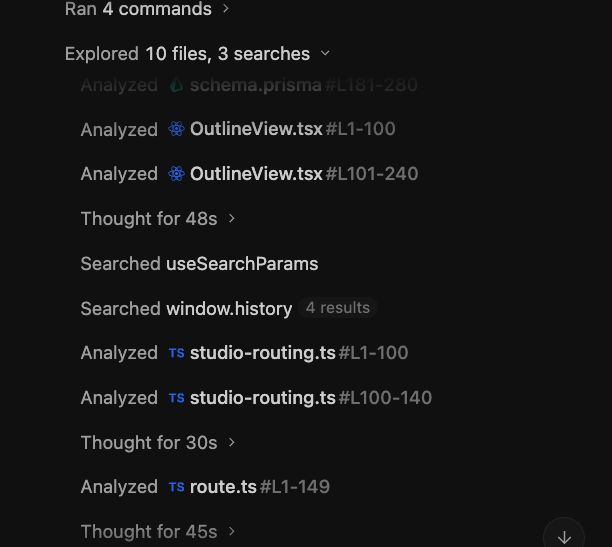
The reliability drag stayed in the same frame. @ibocodes joked (31 likes, 1 replies, 2,539 views) that their first use of Antigravity had already pushed it into high load, but the quoted post inside the screenshot is the actual evidence: an operator acknowledgement that Gemini 3.8 Flash on Antigravity was erroring under load and that rate limits would be reset after the fix. @guymograbi added (2 likes, 3 replies, 175 views) a lower-scale but more visual complaint, comparing one Antigravity reasoning step that previously took 8 seconds with another now taking 45 seconds.
Discussion insight: The replies were notably practical. Under the permissions rollout, users wanted post-run safety receipts that explain what the sandbox allowed or denied, while another reply immediately warned that no-network-by-default will still break dependency installation flows unless the product makes the exception path obvious.
Comparison to prior day: September 15 broadened Antigravity into a multi-model runtime. September 16 made the expansion more concrete with permissions, Android automation, and Home MCP, while keeping performance and migration friction plainly visible.
1.3 Builders are unbundling the agent from the interface, deployment surface, and OS (🡕)
One of the clearest day-level patterns was founders and practitioners treating ChatGPT, Claude, Codex, or Antigravity as the interchangeable engine and building the surrounding layer themselves. The wrapper could be a backend platform, a messaging surface, a local dashboard, or an operating system, but the common move was to stop selling "the model" and start selling the shell around it.
@PetrBrzek launched (19 likes, 10 replies, 10 bookmarks, 256 views) Macaly Cloud with the pitch that the coding agent should stay outside the product. The post says customers already pay for ChatGPT or Claude, so Macaly can focus on database, auth, hosting, payments, SEO, analytics, security checks, image generation, and scraping for $10 per month after October 1. The most useful replies agreed with the abstraction boundary: model choice may change weekly, while backend infrastructure should not have to.
@PhotonHQ introduced (22 likes, 6 replies, 3 quotes, 1,611 views) a Photon plus Render template for running a Codex agent inside iMessage, and the linked Render template turns the demo into a concrete deployment pattern: a Node service, Codex task execution, a PostgreSQL pg-boss queue, and persistent disk storage for credentials and workspaces. The replies immediately focused on session continuity, asking whether the iMessage thread can resume the same Codex session rather than just spawn fresh jobs.
@alex_verem argued (2 replies, 816 views) that Omarchy is the first Linux distribution built around the assumption that an AI agent lives on the machine. The tweet's specifics are what made it stand out: lazy-loaded launchers for multiple agents, a top-bar agents panel with plan and usage tracking, crash-diagnosis handoff, and a built-in skill for system changes, all layered onto a repo that had 41,559 stars during analysis.
@btsouth built (5 likes, 1 replies, 162 views) a local Omarchy usage dashboard that reads logs from Codex, Claude, OpenCode Go, and other agents, then shows token history, live quota, and API-rate value without telemetry or account switching. The screenshot is analytically useful because it shows that the wrapper has real operational depth, including billions of processed tokens, session counts, cache rate, and account-by-account comparisons.

Discussion insight: The replies in this cluster were all about continuity and substitution. Builders want to change model providers without rebuilding the rest of the product, and they want agent outputs to land in channels people already use, whether that is iMessage, a Linux top bar, or a hosted app backend.
Comparison to prior day: September 15 featured mod layers, ports, and runtimes. September 16 extended that pattern into fuller product shells: cloud backends, deployment templates, OS integrations, and unified local telemetry.
1.4 Copilot stayed present, but as a budget and trust-management topic rather than as a breakout product story (🡖)
copilot dropped to 32 mentions from 47 on September 15, and the center of gravity changed with it. The most resonant Copilot posts were not about a new workspace or model switcher. They were about what happens when credits run out, and whether users trust the agent to touch files safely when it does have room to act.
@GHchangelog announced (7 likes, 976 views) that users can now request and reviewers can now adjust Copilot AI credit budgets at the moment limits are hit, and the linked GitHub changelog entry confirms approval routing to org or enterprise owners. That is useful product plumbing, but it also reads as evidence that limits are common enough to need an in-flow escalation path.
@EricRichards22 posted (44 likes, 6 replies, 1,824 views) a small but vivid Copilot failure report. The attached screenshot, not the tweet text, supplies the actual complaint about Copilot reaching for "insane powershell" instead of native tools, and the replies add two more concrete trust issues: patch application can corrupt a file, and a safe-git wrapper may be necessary before letting the agent operate freely.

Discussion insight: Even the negative replies were still asking for a better agent, not for less automation. The desired fix was more bounded execution with safer recovery paths, not a retreat back to plain autocomplete.
Comparison to prior day: September 15's Copilot story was new workflow surfaces. September 16's Copilot story was budget escalation and lingering distrust around edits that should have been routine.
2. What Frustrates People
Opaque performance, rate limits, and forced migrations make daily use feel brittle
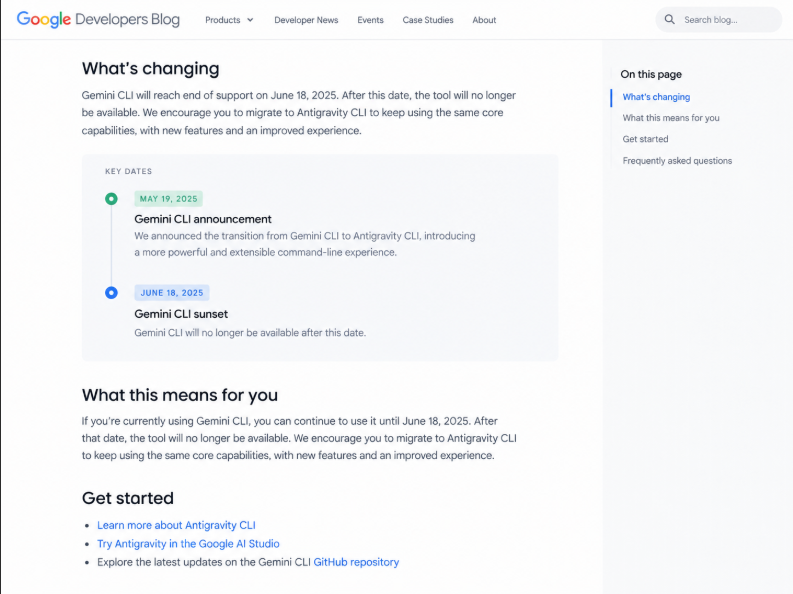
The most direct frustration was operational opacity: users could see latency, outages, and shutdowns, but they could not see a trustworthy explanation surface inside the product itself. @ibocodes shared (31 likes, 1 replies, 2,539 views) a joke post that only worked because the embedded screenshot contained a semi-official acknowledgement of high load and promised rate-limit resets after the fix. @guymograbi added (2 likes, 3 replies, 175 views) visible before-versus-after timing screenshots from Antigravity, and @tompeakycoder (4 likes, 4 bookmarks, 29 views) turned the Gemini CLI shutdown window into a product-trust complaint by arguing that a 30-day hard cutoff signaled an unfinished migration.
This is High severity because it attacks trust during active work. Users can tolerate limits, but not limits that appear as unexplained slowness, sudden failure, or abrupt migration pressure. Worth building for: High.
Autonomous edits still need human rails because tool choice and patch application are fragile
The second frustration was not anti-agent sentiment. It was frustration that the safest way to use agents still involves extra process wrapped around them. @EricRichards22 showed (44 likes, 6 replies, 1,824 views) a concrete Copilot failure mode where the agent reached for odd shell workarounds and, in replies, was accused of corrupting files during patch application often enough to justify a safe-git wrapper. @DanKornas presented (2 likes, 4 replies, 502 views) Aegis as a direct process response: baseline-first planning, evidence-backed completion, and explicit install checks. @AzamIntikhab described (5 likes, 9 replies, 177 views) the same instinct in production form, with one agent owning backend, another owning frontend, eight CI/CD checks, and a human as the only merger.

This is High severity because the missing piece is not model IQ; it is dependable execution on real repositories. People are already inventing ownership boards, wrapper tools, and verification rituals to compensate. Worth building for: High.
Long tasks still decay unless teams add explicit memory and critique structures
Several high-signal posts described the same failure from different angles: long tasks soften, context decays, and the agent starts improvising around a half-true state. @navaneethvb explained (15 likes, 12 bookmarks, 267 views) the mechanics of compaction, @undefinedKi recommended (70 likes, 20 replies, 57 bookmarks, 3,095 views) falsifier agents plus one shared file of known facts and failed attempts, and @DanKornas argued (4 likes, 7 replies, 637 views) that a continuity layer is only useful if the next agent can recover the task without rereading the transcript. @techNmak added (35 likes, 1 replies, 45 bookmarks, 2,298 views) that the cheaper fix may be to stop rereading the repository in the first place.
This is High severity because it hits the core promise of agentic coding: staying coherent over time. The coping strategies already exist, but they are fragmented across process advice, graph layers, and continuity tools. Worth building for: High.
Cost visibility still lives in sidecars instead of the main product
The last recurring frustration was economic opacity. @btsouth built (5 likes, 1 replies, 162 views) a local usage dashboard because mainstream products still do not unify token history, live quota, and API-rate equivalents across agents. @GHchangelog confirmed (7 likes, 976 views) that GitHub had to add an in-flow budget increase request when credits are exhausted, while @PetrBrzek positioned (19 likes, 10 replies, 10 bookmarks, 256 views) Macaly Cloud around the idea that customers already pay for the coding agent elsewhere and do not want to rebuy it inside every product shell.
This is Medium-High severity. Developers are clearly willing to pay, but they want the spend surface to be legible enough to compare plans, anticipate limits, and separate infrastructure cost from model cost. Worth building for: High.
3. What People Wish Existed
Persistent context that survives model switches, compaction, and handoffs
The clearest unmet need was a durable project memory layer outside any one agent session. @DanKornas argued (4 likes, 7 replies, 637 views) for ACRYL as a persistent project model spanning CLI, local Web, and Desktop surfaces, while @techNmak positioned (35 likes, 1 replies, 45 bookmarks, 2,298 views) Graphify as a way to store structural repo knowledge once instead of re-deriving it every run. @navaneethvb made (15 likes, 12 bookmarks, 267 views) the need explicit by showing that compaction necessarily throws away some verbatim history, and @undefinedKi showed (70 likes, 20 replies, 57 bookmarks, 3,095 views) why teams add shared notes and falsifiers around that limitation. This is a practical, urgent need. Opportunity: direct.
Post-run receipts, rollback, and safer bounded execution
People were not asking to approve every command forever. They were asking for trustworthy receipts and safer recovery when the agent acts on their behalf. Replies under @antigravity asked (427 likes, 42 replies, 21,584 views) for a post-run explanation of what the sandbox allowed, denied, or skipped, not just a pre-run prompt. @EricRichards22 wanted (44 likes, 6 replies, 1,824 views) a safe-git wrapper after file-editing failures, @DanKornas packaged (2 likes, 4 replies, 502 views) Aegis around proof-backed completion, and @alex_verem highlighted (2 replies, 816 views) that even Omarchy's author recommends plan mode first and rollback readiness. This is practical and urgent. Opportunity: direct.
Unified budgets and telemetry across agents, providers, and overflow paths
The day repeatedly suggested that pricing is not the problem by itself; invisible pricing is. @btsouth built (5 likes, 1 replies, 162 views) a cross-agent dashboard because mainstream tools still scatter quota and token usage across different logs and plans. @GHchangelog added (7 likes, 976 views) a formal budget increase path precisely when limits are reached, and a reply under @RaulJuncoV warned (17 likes, 7 replies, 713 views) that managed agent infrastructure makes per-session cost harder to infer from your own code. This is highly practical, and partial answers already exist, which makes the race competitive. Opportunity: competitive.
Thin deployment and interface layers that let agents live in existing channels
Several builders were implicitly asking for more places to put an agent without rebuilding the core intelligence. @PhotonHQ showed (22 likes, 6 replies, 3 quotes, 1,611 views) a Codex deployment inside iMessage, @PetrBrzek separated (19 likes, 10 replies, 10 bookmarks, 256 views) the coding agent from the rest of a cloud platform, and @9to5Google covered (35 likes, 3,094 views) Home MCP as a way to expose smart-home context to multiple agent surfaces. The emotional tone here was less "someone should invent this" than "we are already stitching it together." That makes it practical but increasingly crowded. Opportunity: competitive.
4. Tools and Methods in Use
| Tool | Category | Sentiment | Strengths | Limitations |
|---|---|---|---|---|
| Google Antigravity | Coding agent/runtime | (+/-) | New sandbox permissions, mounted-project isolation, no-network-by-default execution, and visible ecosystem bridges through ARTEMIS and Home MCP (sandbox docs) | Same-day users still surfaced high load and visible latency regressions (status-quote post (31 likes, 1 replies, 2,539 views), slowdown post (2 likes, 3 replies, 175 views)) |
| ARTEMIS | Mobile automation / MCP bridge | (+) | Real Android automation, logs, screenshots, native MCP support, and a stated 99%+ AndroidWorld benchmark (repo, share post (150 likes, 9 replies, 204 bookmarks, 10,674 views)) | Android-focused scope today; the privacy-first on-device VLM remains roadmap in the share text (share post (150 likes, 9 replies, 204 bookmarks, 10,674 views)) |
| OpenAI Agents API | Managed agent harness | (+/-) | Packages context compaction, tool orchestration, files, persistent sessions, subagents, and hosted or bring-your-own infrastructure into one agent surface (launch thread (17 likes, 7 replies, 713 views)) | Managed infra removes custom orchestration work, but not permission design, recovery planning, or budget control (launch thread (17 likes, 7 replies, 713 views)) |
| ACRYL | Continuity layer / development environment | (+) | Agent-agnostic project model across CLI, local Web, and Desktop, with structured tasks, artifacts, handoffs, and live plugin reloads (repo, share post (4 likes, 7 replies, 637 views)) | Still explicitly in early development, and even supportive replies asked how it avoids stale context (repo, share post (4 likes, 7 replies, 637 views)) |
| Graphify | Repo intelligence / knowledge graph | (+) | Local tree-sitter parsing, explained graph edges, no vector store, MCP hooks, and a large existing distribution footprint (repo, share post (35 likes, 1 replies, 45 bookmarks, 2,298 views)) | Focused on mapping and retrieval rather than code generation itself, so it complements rather than replaces the underlying agent (repo) |
| Aegis | Method pack / governance | (+) | Baseline-first planning, proof-backed completion, host-aware guides, install checks, and published benchmark gains in contract-pass accuracy (repo, share post (2 likes, 4 replies, 502 views)) | Intentionally adds ceremony for risky work, even though it preserves a lighter path for simple requests (repo) |
| Omarchy | Agentic OS / workflow host | (+/-) | Prewired launchers for multiple agents, an AI usage panel, crash-diagnosis handoff, and one-click local-model installers (repo, share post (2 replies, 816 views)) | Even the enthusiastic share emphasized plan mode first and rollback readiness before letting the system edit aggressively (share post (2 replies, 816 views)) |
| Omarchy Usage Dashboard | Local telemetry | (+) | Cross-agent token history, quota tracking, API-value estimates, and a no-telemetry local read path (repo, share post (5 likes, 1 replies, 162 views)) | Depends on local logs and an Omarchy-centered setup rather than exposing a vendor-neutral cloud service (repo) |
| GitHub Copilot | IDE assistant / budget-managed agent | (+/-) | Budget increase requests now happen at the point of exhaustion with org or enterprise approval routing (changelog, announcement post (7 likes, 976 views)) | File-edit trust remains weak in user reports around patch application and shell detours (complaint post (44 likes, 6 replies, 1,824 views)) |
Overall satisfaction was highest where tools made their structure visible: a permissions screen, a graph, a dashboard, or a proof-oriented method. @antigravity showed (427 likes, 42 replies, 21,584 views) its sandbox knobs, @techNmak showed (35 likes, 1 replies, 45 bookmarks, 2,298 views) a graph-first retrieval layer, @btsouth showed (5 likes, 1 replies, 162 views) cross-agent usage telemetry, and @DanKornas pushed (2 likes, 4 replies, 502 views) method over improvisation.
The common workaround pattern was to add another layer around the model instead of simply switching models. @PetrBrzek separated (19 likes, 10 replies, 10 bookmarks, 256 views) backend infrastructure from the coding agent, @PhotonHQ moved (22 likes, 6 replies, 3 quotes, 1,611 views) Codex into iMessage, and @AzamIntikhab split (5 likes, 9 replies, 177 views) Claude Code and Codex by ownership domain instead of expecting one agent to do everything well.
5. What People Are Building
| Project | Who built it | What it does | Problem it solves | Stack | Stage | Links |
|---|---|---|---|---|---|---|
| ARTEMIS | Turns natural-language prompts into reliable Android automation for testing and operational workflows | Bridges coding agents from code output into real-device mobile execution | Python, MCP, ADB, FFmpeg, multimodal-model support | Shipped | repo | |
| Graphify | Graphify Labs / shared by @techNmak | Maps code, docs, PDFs, images, and video into a queryable knowledge graph | Reduces repeated grep-and-reread loops that waste context on large repos | Python, tree-sitter, MCP, local graph model | Shipped | repo, site |
| ACRYL | acryldev / shared by @DanKornas | Persistent agent-agnostic development environment with shared tasks, artifacts, and handoffs | Preserves project context when teams switch agents or surfaces | TypeScript, CLI/TUI, local Web, Desktop, plugin market | Alpha | repo, site |
| Aegis | Ganyuan Ran / shared by @DanKornas | Method pack that forces baseline-first planning and proof-backed completion | Makes agent work easier to review and safer to merge | Python, benchmark harness, doctor script, host-aware guides | Shipped | repo |
| Omarchy Usage Dashboard | @btsouth | Local dashboard for cross-agent logs, quotas, and API-value estimates | Gives one usage view across subscriptions without telemetry or account switching | Python, Omarchy logs, local analytics UI | Shipped | repo |
| SceneFlow | @tarumainfo | Script-to-screen synchronization and evaluation tool for AI-generated video | Helps creators compare screenplay intent against generated footage and cue timing | TypeScript, web app, Gemini-assisted cue workflows, built with Antigravity + Gemini 3.8 Flash | Shipped | repo, live app |
| Photon + Render Codex template | Photon / Render | Deploys a Codex agent behind iMessage with queueing and persistent storage | Moves coding-agent output into a familiar messaging channel without custom ops work | Node.js, Codex, Render, PostgreSQL, pg-boss, persistent disk |
Shipped | template |
| Macaly Cloud | @PetrBrzek | Backend platform for vibe-coded apps without bundling the coding agent itself | Lets builders reuse existing ChatGPT or Claude subscriptions instead of rebuying the agent layer | Managed database, auth, hosting, payments, analytics, scraping | Beta | launch post (19 likes, 10 replies, 10 bookmarks, 256 views) |
| Omarchy | omacom / amplified by @alex_verem | Agent-aware Linux distribution with launchers, quota tracking, crash handoff, and system-tuning skills | Treats agent tooling as part of the workstation instead of a separate app | Shell, Linux distro, agent launchers, local-model installers | Shipped | repo, site |
The strongest cluster of projects attacked the same long-task problem from different layers. @techNmak showed (35 likes, 1 replies, 45 bookmarks, 2,298 views) Graphify as a retrieval layer that maps structure once, @DanKornas showed (4 likes, 7 replies, 637 views) ACRYL as the continuity layer that keeps project state outside one session, and @DanKornas showed (2 likes, 4 replies, 502 views) Aegis as the method layer that insists on proof before done.

The second cluster treated the agent as replaceable and focused on the wrapper. @PhotonHQ put (22 likes, 6 replies, 3 quotes, 1,611 views) Codex into iMessage, @PetrBrzek split (19 likes, 10 replies, 10 bookmarks, 256 views) backend services away from the model subscription, and @alex_verem described (2 replies, 816 views) Omarchy as a workstation built around agents as first-class operating-system components.
There was also a notable "apply agents to real code that matters" pattern rather than only ship new wrappers. @thdxr reported (111 likes, 18 replies, 6,000 views) that OpenCode found a bug in BLISS, and the linked pull request says the fixes correct RFI bookkeeping and count overflow that could discard already-detected signals in SETI processing.
6. New and Notable
OpenCode's BLISS pull request made agent-assisted bug finding feel materially real
@thdxr reported (111 likes, 18 replies, 6,000 views) that OpenCode found potential issues in BLISS, a Search for Extraterrestrial Intelligence pipeline. The linked pull request matters because it is concrete and consequential: the summary says the fixes correct wrong flag bookkeeping and count overflow that could discard already-detected signals. That is stronger evidence than a benchmark or demo clip because it ties coding-agent output to a public patch on scientific software.
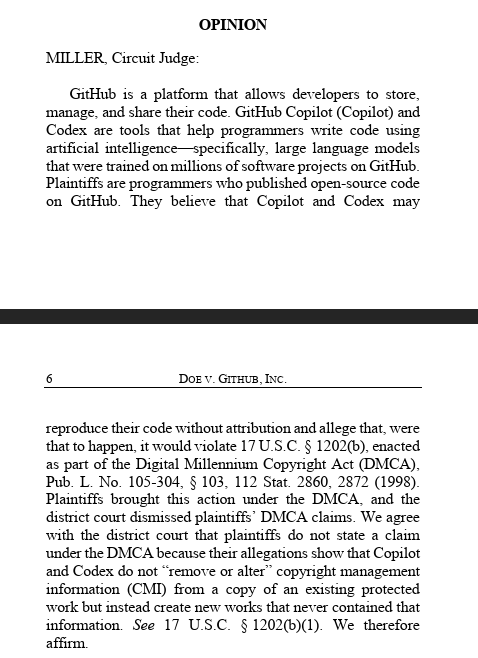
A Ninth Circuit opinion narrowed one legal attack on Copilot and Codex outputs
@EWess92 flagged (19 likes, 1 replies, 963 views) a federal appellate opinion involving Copilot, Codex, GitHub, Microsoft, and code-training claims. The analytically useful screenshot is the opinion text itself, which says plaintiffs failed to state a DMCA claim because Copilot and Codex generate new works that lack copyright-management information rather than removing it from a copied work.
"Vibe coding" crossed from in-group slang into dictionary-backed mainstream language
@FoxNews posted (29 likes, 32 replies, 23,200 views) that Merriam-Webster added 1,400 words and definitions, including "vibe coding." The first image is the useful part because it places the phrase in a mainstream editorial artifact rather than another AI echo chamber post. The replies were culture-war noise, but the source claim itself is straightforward: the term has crossed the usage threshold for dictionary inclusion.

Arena's WebDev breakdown pointed to model specialization instead of one universal winner
@arena shared (15 likes, 4 replies, 3,033 views) category-level results from its Code Arena WebDev leaderboard. The image matters because it breaks the overall ranking into task types: GPT-6 Astra Max leads in data and analytics, consumer product and platform apps, and content creation, while Claude Fable 5.1 Max leads in simulations, reference-based design, and gaming. The strongest reply read the chart as a workflow-routing lesson rather than a winner-take-all result.

7. Where the Opportunities Are
[+++] Agent-agnostic continuity and compaction-aware memory — @navaneethvb explained (15 likes, 12 bookmarks, 267 views) the mechanics of compaction, @undefinedKi recommended (70 likes, 20 replies, 57 bookmarks, 3,095 views) shared notes and falsifiers for long tasks, @DanKornas built (4 likes, 7 replies, 637 views) ACRYL around persistent project state, and @techNmak showed (35 likes, 1 replies, 45 bookmarks, 2,298 views) Graphify as a structural memory layer. The need appears in complaints, product launches, and workflow advice, which makes it one of the day's strongest direct opportunities.
[+++] Observable budgets, receipts, and recovery paths — @btsouth showed (5 likes, 1 replies, 162 views) how much telemetry users still have to build themselves, @GHchangelog added (7 likes, 976 views) a Copilot budget escalation flow at the limit boundary, @EricRichards22 asked (44 likes, 6 replies, 1,824 views) for safer file-recovery tooling after bad edits, and replies under @antigravity asked (427 likes, 42 replies, 21,584 views) for post-run safety receipts. This is strong because it spans money, safety, and debuggability at once.
[++] Safe high-agency execution into real devices and real systems — @itsPaulAi surfaced (150 likes, 9 replies, 204 bookmarks, 10,674 views) ARTEMIS as a bridge into Android devices, @9to5Google covered (35 likes, 3,094 views) Home MCP as a smart-home tool surface with guardrails, and @antigravity shipped (427 likes, 42 replies, 21,584 views) a stricter sandbox model. The technical pieces are arriving, but the trust and audit layer is still thin enough to leave room.
[++] Thin shells around existing agent subscriptions — @PetrBrzek launched (19 likes, 10 replies, 10 bookmarks, 256 views) a backend platform that assumes users already have Claude or ChatGPT, @PhotonHQ deployed (22 likes, 6 replies, 3 quotes, 1,611 views) Codex into iMessage, and @alex_verem described (2 replies, 816 views) Omarchy as an agent-aware OS. Demand is real, but the pattern is already crowded enough that differentiation will come from distribution, continuity, or observability rather than from the core model.
[+] Workflow-specialized model routing and evaluation — @arena showed (15 likes, 4 replies, 3,033 views) category-level model tradeoffs, while @AzamIntikhab showed (5 likes, 9 replies, 177 views) one real workflow already splitting Claude Code and Codex by domain ownership. This is emerging rather than fully open, but the evidence suggests teams increasingly want routing by task type, not by brand loyalty.
8. Takeaways
- The unit of competition is shifting from the model to the harness. @undefinedKi highlighted (70 likes, 20 replies, 57 bookmarks, 3,095 views) a reusable multi-agent structure, @RaulJuncoV framed (17 likes, 7 replies, 713 views) that structure as productized infrastructure, and @navaneethvb explained (15 likes, 12 bookmarks, 267 views) the compaction mechanics underneath it.
- Antigravity remained the central runtime reference point, but not a fully trusted one. The day combined @antigravity shipping (427 likes, 42 replies, 21,584 views) a more explicit sandbox, @itsPaulAi surfacing (150 likes, 9 replies, 204 bookmarks, 10,674 views) ARTEMIS as an Antigravity-connected execution layer, and @ibocodes amplifying (31 likes, 1 replies, 2,539 views) an operator acknowledgement of high load.
- Builders are increasingly monetizing or packaging the shell around existing agents instead of the agent itself. @PetrBrzek launched (19 likes, 10 replies, 10 bookmarks, 256 views) backend infrastructure without bundling the coding agent, @PhotonHQ deployed (22 likes, 6 replies, 3 quotes, 1,611 views) Codex into iMessage, and @alex_verem described (2 replies, 816 views) an operating system designed around agents.
- The practical answer to unreliable agent behavior is still process discipline. @AzamIntikhab showed (5 likes, 9 replies, 177 views) strict ownership, tests, and human-only merges in a live SaaS workflow, while @DanKornas packaged (2 likes, 4 replies, 502 views) the same instinct into Aegis.
- AI coding is now generating mainstream institutional signals, not just product demos. @thdxr pointed (111 likes, 18 replies, 6,000 views) to a public scientific-code fix, @EWess92 flagged (19 likes, 1 replies, 963 views) a federal appellate opinion touching Copilot and Codex, and @FoxNews noted (29 likes, 32 replies, 23,200 views) dictionary recognition for "vibe coding."