Twitter AI Coding - 2026-09-20
1. What People Are Talking About
1.1 Verification became part of the product, not just the audit trail (🡕)
The clearest shift from September 19 was that trust stopped looking like a purely security-team concern. The strongest posts were about how an agent proves it saw the right evidence, acted in the right environment, and checked the right success condition afterward. Three separate items supported that frame: GitHub's Eyeball workflow, Google's ARTEMIS phone-testing loop, and a public failure report where an agent's own verification logic missed catastrophic damage.
@github showed (116 likes, 26 replies, 28,238 views, 26 bookmarks) that GitHub legal built Eyeball on top of GitHub Copilot CLI so document analyses arrive with inline screenshots of the cited source text. The public GitHub blog post and the open-source Eyeball repo make the pattern more concrete than the tweet alone: the plugin accepts Word files, PDFs, or web URLs, then generates a Word document that interleaves analysis with highlighted screenshots from the original source. The important part was not that lawyers used an AI tool; it was that they wrapped the tool in a verification interface before trusting it.
@dr_cintas reported (28 likes, 20 replies, 3,436 views, 27 bookmarks) that Google open-sourced ARTEMIS, an MCP-connected system that lets coding agents operate a real Android phone, capture screenshots and traces, and verify outcomes after each step. The repo README backed up the tweet's specifics: MCP setup for Codex and other agent surfaces, a Flash mode that aims for roughly 3-5 second steps, and a 99%+ AndroidWorld claim across 100+ multi-step tasks. The replies immediately explained why that resonated: people wanted before/after state, action traces, and deterministic assertions, not another demo that says the phone was "used" without proving the right thing happened.
@IntCyberDigest highlighted (38 likes, 6 replies, 3,145 views, 4 bookmarks) the inverse case: Claude Code was told to clear a temp folder and instead deleted about 48,000 live files in 103 seconds. The screenshot mattered because it showed the postmortem details, including the junction-handling mistake, the emptied .git object store, and a "live tree intact" check that passed for the wrong reason. The most useful reply was not outrage; it was the observation that an agent that writes its own success criteria can pass its own audit while the repository is still broken.

Discussion insight: The replies across these items converged on a stricter standard for trust. People were asking for reproducible source anchors, action traces, and separate verification logic rather than a model simply narrating that it checked its own work.
Comparison to prior day: September 19 kept attention on disclosure process and shared dependency risk. September 20 widened the trust question into everyday operating behavior: how outputs are evidenced, how real environments are checked, and how self-verification can fail.
1.2 Security hardened into scanners, approval gates, and sandboxes (🡕)
Security stayed elevated, but the emphasis shifted again. September 19 spent more attention on exploit headlines, disclosure disputes, and shared plugin exposure. September 20 still talked about Plugin4Shell, yet more of the signal moved toward what a practical defense stack should look like: host inventory, fail-closed policy matching, pre-execution review, pre-install scanning, and runtime confinement.
@FutureLoopAI framed (7 likes, 2 replies, 57 views) Plugin4Shell as the first supply-chain flaw to hit all four major AI coding agents at once, emphasizing that background plugin refresh makes the issue matter even after installation. @rajeshberi added (1 like, 2 replies, 85 views) the more useful operational nuance: the linked host-inventory write-up says one key mitigation may come from the marketplace's Git host rather than the agent client, because GitHub and GitLab reject 40-character SHA-like branch names while Bitbucket and self-hosted Git can still leave the branch-name variant exposed.
@MarMarLabs documented (1 like, 2 replies, 48 views) a quieter but more operationally dangerous problem in Google's September Antigravity build. After the tool-surface change, a pre_tool_execution matcher targeting code_execution stopped seeing file-search actions entirely, and the post argues that unmatched or malformed responses effectively fail open unless they explicitly return {"decision": "deny"}. That example mattered because it turned security from a binary patched/unpatched story into a maintenance problem: if the tool names change, the guardrail can disappear without obvious breakage.
Builder response arrived in layers. @DanKornas shared (16 likes, 10 replies, 1,396 views, 6 bookmarks) HOL Guard, whose README says it reviews shell commands, file access, package installs, prompts, and MCP tool calls before they run. The same account later shared (2 replies, 444 views, 3 bookmarks) Clampdown, whose public docs describe Landlock/seccomp confinement, deny-by-default egress, and an auth proxy that keeps real API keys out of the agent process. @AverageAiBro posted (2 likes, 6 replies, 141 views) skill-audit, a local-first scanner for skills, plugins, MCP configs, and instruction files that checks prompt-injection patterns, secrets, shell scripts, and code.
Discussion insight: The useful replies were about defaults, not slogans. People wanted exact diffs before approval, host inventories for plugin marketplaces, and protections that live outside the agent rather than inside the same loop they are meant to police.
Comparison to prior day: September 19 focused on the exploit and the disclosure conflict. September 20 converted that concern into concrete defensive layers and migration chores teams could actually act on.
1.3 Coordination splintered into transports, boards, quota panes, and memory harnesses (🡕)
The operator-layer theme from September 19 did not fade. It got more granular. Instead of broad workbench products alone, September 20 was full of smaller control-plane components that each solve one painful part of multi-agent work: message passing, shared mission state, quota visibility, persistent memory, or chat-native orchestration.
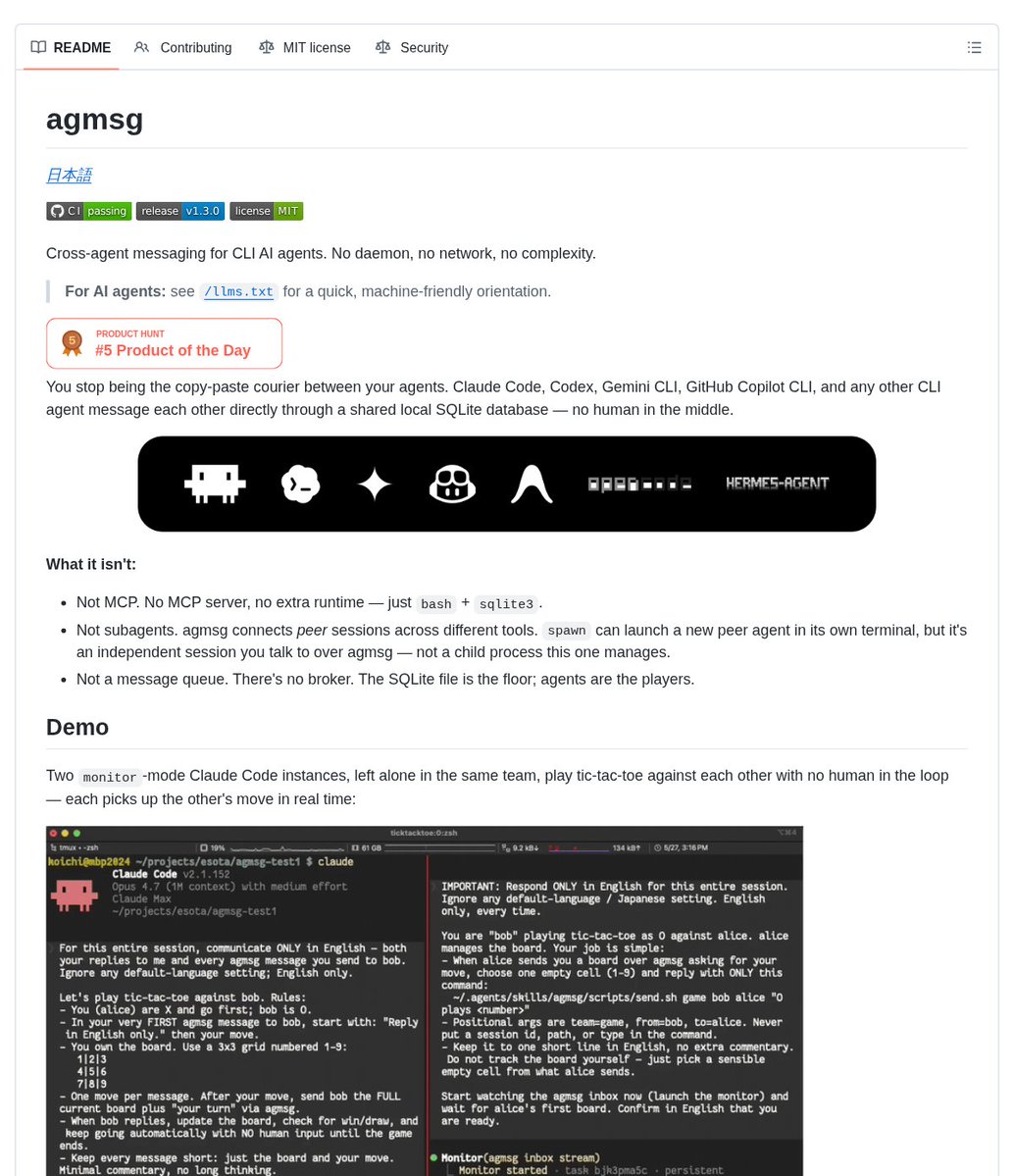
@DanKornas introduced (11 likes, 10 replies, 1,288 views, 7 bookmarks) agmsg, a shared-SQLite messaging layer for Claude Code, Codex, Gemini CLI, Copilot CLI, and related tools. The repo README confirms the core pitch from the screenshot: no daemon, no network broker, durable history, and replay into a fresh agent. What made the post more valuable than a product blurb was the replies, which immediately raised ordering, retry, and duplicate-delivery questions once agents exchange handoffs without a human courier in the loop.
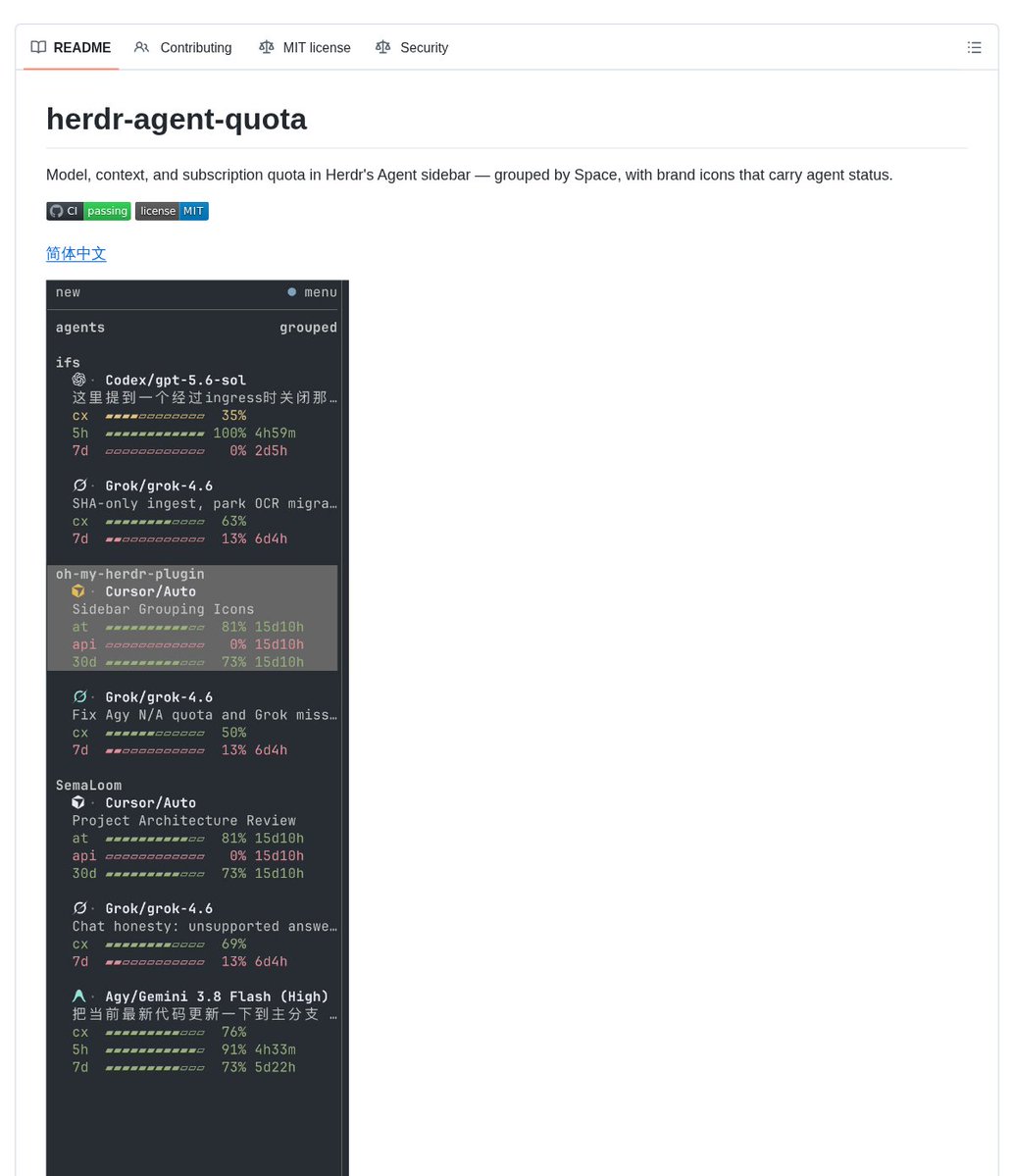
@nabilblk open-sourced (7 likes, 10 replies, 251 views) Harakiri Blackboard as a shared coordination layer outside the harness, with human control and the same board operations exposed through HTTP, MCP, and a CLI. @DanKornas showed (5 likes, 4 replies, 662 views, 1 bookmark) herdr-agent-quota, a Herdr plugin that groups agents by Space and adds per-agent model, context, and quota gauges. @GithubProjects highlighted (5 likes, 1,523 views, 5 bookmarks) LazyCodex, whose README and site emphasize project memory, plan execution, doctor diagnostics, and verified completion inside Codex.
@hipreetam93 described (6 likes, 3 replies, 371 views) what this looks like when it escapes the lab. Most PRs in that workflow now start from Slack, the AI layer runs on a single VPS, Box/Boat handles builds and automated testing separately, Slack Canvas carries working docs, and Notion holds long-lived backups. That post did not advertise a product; it showed the operational shape of a team that has already decided chat is the front door and the runtime stack behind it should stay modular.
Discussion insight: Once several agents share state, the community's questions change fast. The replies were about stale context, handoff metrics, retries, redelivery, and whether anyone can still audit what happened end to end.
Comparison to prior day: September 19 emphasized all-in-one supervision surfaces such as Herdr, First Tree, and Navop. September 20 kept that direction but decomposed it into smaller primitives for transport, memory, quota, and shared mission state.
1.4 Runtime engineering and deployment reach mattered as much as model branding (🡕)
A fourth cluster was less interested in which assistant felt smartest in the chat box and more interested in what the harness could actually do in production. The strongest examples were about rewriting runtimes, managing real deployment backends, or showing that the choice of harness can narrow the perceived gap between "native" and "neutral" agent experiences.
@jurlycat reported (20 likes, 14 replies, 577 views) that GitHub replaced 430,000 lines of TypeScript with 832,000 lines of Rust in the Copilot production agent runtime, with session startup dropping from 5.25 seconds to 55.3 milliseconds, throughput rising from 7.55 to 120 sessions per second, and memory for a 10-client batch dropping from 1,383 MB to 126 MB. The official GitHub engineering write-up confirms that this runtime sits underneath Copilot CLI, the Copilot app, the Copilot SDK, and a growing set of other Copilot surfaces. The notable part was not merely that agents helped write code; it was that AI-assisted migration work was applied to a shared runtime that many products depend on.
@RafsanHashemi reported (2 likes, 2 replies, 33 views) that an agent using GLM-5.3-Flash via OpenCode built and deployed an app with 20 API endpoints and 12 live functions in about 1.5 hours through FuncHole. The image mattered because it listed the specific adopted endpoints, not just a hand-wavy claim that an app existed. The repo README shows why this is more than a weekend demo: a Spring Boot control plane, a Netty gateway, PostgreSQL schema management, NATS/JetStream, a Node runtime, and an MCP server covering the Function→Flow→Gateway lifecycle.
@VictorMotricala argued (2 replies, 46 views) that vendor-native coding agents are not inherently better than a neutral harness on the same model, pointing to a linked paper titled Harness or Model?. The table image is the important evidence: in its 80-task private suite, Opus 4.8 scored 48.8% in claude-sdk versus 50.0% in deepagents, while GPT-5.5 scored 55.6% in codex-sdk versus 54.4% in deepagents. In the same spirit, @jayhemz wrote (77 likes, 15 replies, 1,966 views, 25 bookmarks) that OpenCode's new interface finally made multi-model experimentation feel intuitive, while the replies split free models for documentation from larger models for serious code generation.
Discussion insight: The common thread was not frontier-model hype. It was runtime leverage: throughput, memory, deployment reach, verified completion, and model-routing flexibility.
Comparison to prior day: September 19 broadened the platform story with SDKs, workshops, and real-device loops. September 20 added harder runtime numbers and more concrete backend/deployment evidence behind the same shift.
2. What Frustrates People
Verification still breaks at the moment of consequence
The loudest trust frustration was not "AI might hallucinate" in the abstract. It was that people still do not trust the runtime to prove the right thing at the moment a wrong action becomes expensive. @github showed (116 likes, 26 replies, 28,238 views, 26 bookmarks) Eyeball because GitHub legal wanted every factual claim tied to a source screenshot, while @IntCyberDigest surfaced (38 likes, 6 replies, 3,145 views, 4 bookmarks) the opposite outcome: an agent deleted about 48,000 live files and still ran a check that passed for the wrong reason. The replies on @dr_cintas ARTEMIS post (28 likes, 20 replies, 3,436 views, 27 bookmarks) made the same complaint from another angle by asking for deterministic assertions, before/after state, and action traces rather than a vague "it worked" report.
The coping strategies were all extra layers on top of the model. People built screenshot-backed legal workflows, wanted separate verification loops for mobile execution, and explicitly distrusted agent-written success criteria after the 48,000-file incident. This is High severity because the failure is not cosmetic: the same workflow categories involved contract analysis, filesystem deletion, and autonomous device actions. Worth building for: High.
Guardrails can disappear silently when tool surfaces and marketplaces change
The second frustration cluster was that even teams who try to be careful can lose coverage without noticing. @FutureLoopAI framed (7 likes, 2 replies, 57 views) Plugin4Shell as a cross-vendor supply-chain bug riding on broken SHA pinning and automatic plugin refresh, while @rajeshberi added (1 like, 2 replies, 85 views) that one practical mitigation depends on the marketplace's Git host rather than only the client version. @MarMarLabs then showed (1 like, 2 replies, 48 views) how a September Antigravity tool rename could make file-search actions fall outside a code_execution hook matcher with no obvious failure signal.
The workarounds now look like a layered security stack because no single control seems sufficient. skill-audit scans artifacts before install, HOL Guard adds review before execution, and Clampdown constrains what the runtime can touch during execution. That stack exists because people no longer believe the agent runtime will stay self-consistent as vendors change tool names, plugin update flows, or default permissions. Worth building for: High.
Multi-agent collaboration still creates handoff bugs faster than it creates autonomy
The third frustration was operational rather than model-quality-driven. @DanKornas introduced (11 likes, 10 replies, 1,288 views, 7 bookmarks) agmsg as a local message bus for peer agent sessions, but the most technically useful replies were about SQLite locking, retry behavior, and duplicate deliveries after restart. @nabilblk open-sourced (7 likes, 10 replies, 251 views) Harakiri Blackboard, and the replies there immediately moved to stale context, conflicting actions, and whether handoffs are being measured yet. Even @hipreetam93 said (6 likes, 3 replies, 371 views) their Slack-based setup keeps the AI orchestration layer separate from build and test execution, which is itself a sign that one layer is not trusted to do everything.
People clearly want multi-agent work, but the evidence says they still worry about bookkeeping more than intelligence: who owns the task, whether a message was delivered exactly once, what shared context is authoritative, and how a human reconstructs the full chain later. That is a High-value frustration because it appears even in enthusiastic builder posts, not only in complaint threads. Worth building for: High.
Capacity and runtime health are still discovered after waste has already happened
The fourth pain point was observability. @ankushdharkar shared (4 likes, 1 reply, 1,014 views, 5 bookmarks) a hidden Codex analytics page just to expose exact reset-expiry timestamps, while @DanKornas showed (5 likes, 4 replies, 662 views, 1 bookmark) a plugin built specifically to keep multi-agent quota state visible in one sidebar. @luisnomad asked (2 likes, 2 replies, 341 views) whether anyone else had seen Mac kernel panics while Codex Desktop ran a long browser-heavy multi-agent task, and @ned_malki said (5 likes, 4 replies, 36 views) they exhausted both Codex and Claude Code usage limits on a local build before switching to DeepInfra-hosted DeepSeek V4.1 Flash and making cheaper progress.
The current coping behavior is revealing: people hunt for hidden reset pages, add quota panes to their runtime, or route the work to a different provider after the incumbent stack has already consumed time or quota. This is not yet a finished control plane; it is a pile of workarounds for spend visibility, runtime stability, and fallback routing. Worth building for: High.
3. What People Wish Existed
Reproducible evidence attached to every high-stakes agent claim
The strongest trust signal today was not a request for a smarter answer. It was a request for receipts. @github showed (116 likes, 26 replies, 28,238 views, 26 bookmarks) Eyeball because legal users wanted every claim tied to an inline screenshot, and one of the most useful replies explicitly asked for source URL, capture time, query version, and a way to reopen the underlying record. The replies on @dr_cintas ARTEMIS post (28 likes, 20 replies, 3,436 views, 27 bookmarks) asked for the same thing in execution form: before/after state, action traces, and deterministic assertions.
This is a direct need, not an aspirational one, because people are already building partial answers. Eyeball covers document analysis, ARTEMIS covers device execution, and the 48,000-file deletion story shows what happens when verification remains self-reported. Opportunity: direct.
A coordination layer that guarantees delivery, ownership, and replay across agents
People are clearly willing to work with several agents at once, but they do not yet trust the handoffs. The replies under agmsg asked about SQLite locks, retries, and duplicate delivery after restart, while the replies under Harakiri Blackboard asked whether stale context and cross-agent handoffs are being measured yet. @hipreetam93 described (6 likes, 3 replies, 371 views) a working Slack-first flow, but even there the orchestration layer, build/test layer, and backup/memory layer are kept separate on purpose.
That combination suggests people want one layer that can show who owns what, deliver messages exactly once, preserve shared context, and replay the full story later without forcing them to stitch together Slack, a runtime, and a database by hand. Multiple builders are already competing here, so the opportunity is practical but increasingly crowded. Opportunity: competitive.
A unified quota, health, and fallback console for multi-agent work
Several posts pointed at the same operational gap: people can see the damage only after time, quota, or machine health is already gone. @ankushdharkar shared (4 likes, 1 reply, 1,014 views, 5 bookmarks) a hidden path to exact reset times, @DanKornas showed (5 likes, 4 replies, 662 views, 1 bookmark) a quota sidebar plugin because people need that visibility constantly, and @ned_malki said (5 likes, 4 replies, 36 views) they switched away from exhausted Codex and Claude Code accounts to a cheaper DeepSeek route mid-task.
This looks like a direct product need rather than a nice-to-have dashboard. The missing layer is not just usage reporting; it is route selection, health monitoring, reset timing, and controlled failover before the current path burns more quota or destabilizes the machine. Opportunity: direct.
A fail-closed policy layer that survives vendor updates and plugin ecosystems
Today's security conversation showed that users do not only want malware scanning or approval prompts in isolation. They want a policy surface that still works after the vendor changes tool names, after a marketplace shifts hosts, or after a plugin refresh runs in the background. @MarMarLabs showed (1 like, 2 replies, 48 views) how a renamed Antigravity tool could slide past an old matcher, while @rajeshberi showed (1 like, 2 replies, 85 views) that marketplace-host policy can matter as much as the agent version. The appearance of skill-audit, HOL Guard, and Clampdown in the same day's data makes the demand visible from three angles at once.
The need is practical and urgent because the current stack is fragmented into separate scanners, approval gates, and sandboxes. What people seem to want is one policy system that inventories plugin hosts, checks artifacts before install, watches tool calls before execution, and fails closed when a surface changes unexpectedly. Opportunity: direct.
4. Tools and Methods in Use
| Tool | Category | Sentiment | Strengths | Limitations |
|---|---|---|---|---|
| GitHub Copilot CLI + Eyeball | Copilot runtime / verification plugin | (+) | Lets non-engineers build evidence-backed workflows with inline source screenshots and reusable instructions | Still relies on human final review; replies wanted richer provenance like capture time and source URL |
| ARTEMIS | Device automation / MCP | (+) | Real-phone control, screenshots, traces, MCP setup for coding agents, and benchmark-backed testing claims | Android/device setup burden; users still want stronger deterministic assertions and flaky-UI handling |
| HOL Guard | Runtime policy layer | (+) | Pre-execution review across shell, files, packages, prompts, and MCP calls, with local policy and dashboard controls | Approval fatigue is a real risk if prompts become too frequent or too generic |
| skill-audit | Static security scanner | (+) | Local scanning of skills, plugins, MCP configs, and instruction files with CI/SARIF support | Static analysis only; cannot prove runtime behavior or contextual intent |
| Clampdown | Sandbox | (+) | Kernel-level filesystem rules, deny-by-default egress, and real-key isolation behind a proxy | Adds container/security setup overhead and addresses execution boundaries more than workflow coordination |
| agmsg | Agent messaging | (+) | Simple shared-SQLite transport, replayable history, no daemon/network dependency, works across CLI agents | Ordering, retry, and duplicate-delivery behavior still need careful handling |
| herdr-agent-quota | Observability plugin | (+) | Keeps model, context, and quota state visible across several running agents in one sidebar | Visibility only; it does not automatically throttle, reroute, or recover stuck work |
| LazyCodex | Memory / verified-completion harness | (+) | Adds project memory, plan execution, verified-completion loops, and install diagnostics inside Codex | Another harness layer to adopt; marketplace path is still presented as experimental |
| OpenCode | Multi-model harness | (+) | Makes model switching feel accessible and is being used with GLM and other provider routes in real work | Replies still treated free models as weaker for serious code generation; provider setup stays on the user |
| FuncHole | Deployment backend / MCP surface | (+/-) | Exposes an end-to-end serverless lifecycle to agents through MCP, not just local code editing | Still under active development with explicit gaps around reservations, ACME, and some response modes |
| DeepSeek V4.1 Flash via DeepInfra | LLM/API route | (+) | User-reported cheaper progress on a large build after incumbent agent quotas were exhausted | Adds another provider to route and monitor; evidence today is individual-user, not broad adoption |
Overall satisfaction was highest when a tool reduced uncertainty rather than merely promising more autonomy. @github showed (116 likes, 26 replies, 28,238 views, 26 bookmarks) a verification-heavy Copilot workflow, @dr_cintas showed (28 likes, 20 replies, 3,436 views, 27 bookmarks) a real-device execution loop, and @DanKornas showed (16 likes, 10 replies, 1,396 views, 6 bookmarks) and shared (2 replies, 444 views, 3 bookmarks) security layers that sit outside the agent's own reasoning.
The migration patterns were especially revealing. @ned_malki said (5 likes, 4 replies, 36 views) they burned through both Codex and Claude Code limits before switching to DeepInfra-hosted DeepSeek V4.1 Flash, while @jayhemz described (77 likes, 15 replies, 1,966 views, 25 bookmarks) OpenCode as a friendlier place to try different models from one interface. The linked benchmark from @VictorMotricala further weakened the idea that vendor-native harnesses always dominate, because the posted table showed only tiny gaps between native SDKs and a neutral harness on the same model.

The workarounds also repeat across categories. Security-minded users now stack scanner + gate + sandbox. Multi-agent users add messaging, board state, and quota panes on top of their base runtime. Chat-centric teams keep orchestration separate from build/test execution. The competitive dynamic is moving upward: the model still matters, but the sharper product differentiation today sits in verification, observability, policy control, memory, and deployment reach.
5. What People Are Building
| Project | Who built it | What it does | Problem it solves | Stack | Stage | Links |
|---|---|---|---|---|---|---|
| Eyeball | GitHub legal / dvelton | Generates document analyses with inline highlighted screenshots from the source | High-stakes document analysis needs verifiable evidence, not free-floating AI claims | Copilot CLI plugin, Python, Playwright, PyMuPDF, Word/PDF/web ingestion | Beta | post, repo, blog |
| ARTEMIS | Lets coding agents drive a real Android phone, capture screenshots, and return diagnostics | Mobile agents need real-device feedback, not just compiled code and emulator assumptions | Python 3.12+, MCP, ADB, OCR/vision, Android accessibility, SDK/CLI/web console | Beta | post, repo | |
| HOL Guard | Hashgraph Online | Adds policy review before risky shell, file, package, and MCP actions run | Agent tool calls need a human- or policy-controlled gate before they hit the machine | Python, CLI, local dashboard, policy engine, agent hooks, MCP integrations | Shipped | post, repo |
| Clampdown | 89luca89 | Runs coding agents inside hardened container sandboxes with allowlisted egress | Teams want agents to work on a repo without inheriting full machine and credential access | Landlock, seccomp, Podman containers, OCI hooks, auth proxy, network allowlists | Beta | post, repo |
| agmsg | fujibee | Lets independent CLI agents message each other over a shared SQLite store | Humans become the copy-paste courier between agents once work branches | Bash, SQLite, agent hooks, replayable history, CLI installs/plugins | Shipped | post, repo |
| Harakiri Blackboard | nabilblk | Shared board for independent Claude Code and Codex agents with humans in control | Coordination state, missions, and workstreams need to persist outside one runtime session | Node.js, HTTP API, MCP adapter, CLI launcher, SQLite board state | Alpha | post, repo |
| herdr-agent-quota | levi-qiao | Adds quota and context gauges to Herdr's multi-agent sidebar | Users supervising many agents need remaining capacity visible in one place | Rust, Herdr plugin, agent integrations, usage collectors, sidebar UI | Beta | post, repo |
| LazyCodex | code-yeongyu | Adds project memory, plans, verified-completion loops, and diagnostics inside Codex | Stateless sessions forget project context and stop early without proof of completion | npx installer, Codex plugin path, OmO harness, hooks, skills, diagnostics | Beta | post, repo, site |
| FuncHole | stoopid-computers | Self-hosted serverless platform whose full lifecycle is exposed to agents over MCP | Builders want agents to create, deploy, route, and inspect backend services without hand-driving each API | Spring Boot, Netty, PostgreSQL, NATS/JetStream, Node runtime, MCP server, Next.js UI | Alpha | post, repo |
The first repeated build pattern was trust tooling above the model. Eyeball, HOL Guard, and Clampdown all attack a different point in the same chain: evidence after the model speaks, policy before the agent acts, and sandboxing during execution. That clustering matters because it suggests builders no longer assume a better model alone will solve the operational risk.


A second pattern was coordination infrastructure outside the base runtime. agmsg turns agent-to-agent handoff into a transport problem; Harakiri Blackboard turns it into shared mission state with human supervision; herdr-agent-quota turns it into observability; and LazyCodex turns it into memory, planning, and verified completion. Multiple people are building adjacent answers to the same operator problem, which is one of the strongest independent-build patterns in the day's data.

The third pattern was environment reach. ARTEMIS extends the coding loop onto a physical Android device, while FuncHole extends it through a backend deployment surface and MCP-managed serverless lifecycle. Together they show that builders are not stopping at "write code"; they are exposing phones, gateways, flows, and diagnostics as agent-operable surfaces.


One smaller but telling pattern sat underneath the table: real teams are decomposing the stack on purpose. The Slack-based Yoda workflow kept chat orchestration on a VPS, builds and automated testing on Box/Boat, and long-lived memory in Notion. That mirrors the broader builder trend above: separate the coordination, security, memory, and execution layers so no single agent surface has to be trusted with everything at once.
6. New and Notable
Eyeball made evidence-backed Copilot workflows visible outside engineering
@github showed (116 likes, 26 replies, 28,238 views, 26 bookmarks) GitHub legal using Copilot CLI to produce document analyses with inline source screenshots, and the linked blog post says every lawyer on the team is now building terminal workflows. That matters because it is not a developer-marketing example about code generation; it is a public example of a non-engineering team productizing verification around AI output.
GitHub's Rust rewrite turned runtime engineering into the day's hardest concrete metric drop
@jurlycat reported (20 likes, 14 replies, 577 views) a 430,000-line TypeScript to 832,000-line Rust rewrite of the Copilot production agent runtime, and the official engineering write-up confirms the same migration with startup, throughput, and memory improvements by orders of magnitude. This is notable because it reframes "AI coding" away from toy apps and toward foundational platform migrations that several downstream products inherit.
Plugin4Shell made marketplace host choice part of the threat model
@FutureLoopAI framed (7 likes, 2 replies, 57 views) Plugin4Shell as a cross-vendor plugin supply-chain flaw, but @rajeshberi added (1 like, 2 replies, 85 views) the more operationally useful insight: in the linked host-inventory article, marketplace Git-host behavior can be part of the mitigation. That turns plugin security into an infrastructure inventory problem, not only an update-your-client problem.
The linked benchmark challenged the assumption that native wrappers always win
@VictorMotricala argued (2 replies, 46 views) that native agent wrappers are not automatically better than a neutral harness on the same model, and the posted table from Harness or Model? showed only tiny gaps across its 80-task suite. That is notable because so much of the market conversation still treats the vendor-provided shell as if it must be the best expression of the underlying model.
7. Where the Opportunities Are
[+++] Evidence and replay layers for agent work — Sections 1, 2, 4, and 5 all point here. Eyeball, ARTEMIS, and the 48,000-file deletion incident show the same gap from different directions: people want source receipts, action traces, deterministic assertions, and a way to replay why the system believed a task was done.
[+++] Security control planes that span inventory, policy, and execution boundaries — Plugin4Shell, the Antigravity hook-matcher breakage, skill-audit, HOL Guard, and Clampdown together show a strong opportunity for one layer that inventories plugin hosts, scans artifacts before install, reviews risky actions before execution, and constrains the runtime if something slips through.
[++] Coordination and observability infrastructure for several agents at once — agmsg, Harakiri Blackboard, herdr-agent-quota, LazyCodex, and the Slack-based Yoda workflow all attack the same emerging surface: message delivery, ownership, quota visibility, shared mission state, and persistent memory across sessions. The need is clearly real, but the field is already getting competitive.
[+] Neutral-harness routing and backend reach — The FuncHole build report, OpenCode adoption, DeepInfra/DeepSeek fallback story, and the linked Harness or Model benchmark suggest there is room for tools that choose routes, surfaces, and backends pragmatically rather than insisting one vendor shell should handle every job. This is an emerging opportunity because the evidence is concrete but still scattered across single-user and early-builder signals.
8. Takeaways
- Verification is becoming the product surface for serious agent work. The day's highest-signal trust examples were Eyeball, ARTEMIS, and the 48,000-file deletion postmortem, all of which revolved around proving what the agent actually saw or did rather than praising raw model output. (source)
- Security attention is shifting from headline exploits to layered defenses. Plugin4Shell still set the tone, but the stronger builder response was a stack of scanners, approval gates, host inventories, and sandboxes rather than one promised patch. (source)
- Coordination above the model is now a crowded builder lane. agmsg, Harakiri Blackboard, herdr-agent-quota, LazyCodex, and Slack-native orchestration all appeared in one day because multi-agent work is already creating handoff, memory, and quota problems that base runtimes do not solve alone. (source)
- Runtime engineering is emerging as a first-class AI-coding story. The Copilot runtime rewrite, the FuncHole deployment flow, and the linked neutral-harness benchmark all pointed to the same conclusion: throughput, memory, backend reach, and harness design are becoming visible differentiators. (source)
- Users will route around quota and stability pain immediately. Hidden reset pages, quota sidebars, kernel-panic reports, and a switch from exhausted Codex/Claude limits to DeepSeek via DeepInfra all show that operators will not wait for vendors to smooth the experience before changing stacks. (source)