Twitter AI Coding - 2026-09-26
1. What People Are Talking About
1.1 Antigravity's workflow story turned more skeptical as account friction piled up (🡖)
Antigravity still dominated the feed, but the tone shifted from yesterday's workflow-structure curiosity toward a more negative product-trust debate. At least five high-signal items supported the theme: the official /plan launch, Theo's viral backlash, Gergely Orosz's critique, ibocodes' screenshot-backed account-friction complaint, and ash_twtz's note that the same agent is already generating image assets inside coding sessions.
@antigravity announced (676 likes, 63 replies, 40,903 views, 124 bookmarks) a dedicated /plan mode that researches the task, drafts an implementation plan, and waits for approval before editing files. The public Antigravity plan docs confirm that this is intended as a separate read-only discovery phase with a reviewable implementation-plan artifact, not just a prompting trick. The most useful replies were not arguing for more raw intelligence; they asked for /status, /context, /usage, a file browser, and graceful stop-and-resume behavior when quota limits interrupt work.
@theo quote-tweeted (1,941 likes, 120 replies, 78,829 views, 67 bookmarks) the launch with the line "Antigravity actively going backwards in time," turning the launch into the day's biggest single sentiment event. @GergelyOrosz pushed the critique further (89 likes, 15 replies, 18,933 views, 11 bookmarks), arguing that Antigravity has become Google's most confusing product and framing /plan as a late answer to workflow patterns competitors already tried.
@ibocodes complained (91 likes, 5 replies, 4,168 views) that Antigravity and Gemini feel underused partly because the product keeps signing the author out and forcing verification. The attached screenshot matters because it shows the precise failure mode rather than a generic complaint: an eligibility-check failure inside the setup flow.

There was one notable positive wrinkle inside the same cluster. @ash_twtz showed (29 likes, 18 replies, 461 views) Antigravity generating an extension icon with Gemini 3.1 Flash Image after finishing code, which is a real multimodal capability jump even if the surrounding product sentiment stayed rough.
Discussion insight: The main complaint was not that planning is useless. It was that planning arrived before the surrounding ergonomics felt mature: users wanted visibility, resumability, and reliable account state as badly as they wanted another workflow mode.
Comparison to prior day: September 25 treated plans, canvases, and skill packs as promising structure. September 26 kept the workflow conversation going, but the highest-engagement items were about whether Antigravity is late and brittle rather than ahead.
1.2 Microsoft's Copilot stack consolidated into a unified app, harness, and tenant-hosted runtime story (🡕)
Copilot had a stronger day than yesterday in raw volume, and the discussion was notably more concrete. At least five items supported the theme: David Fowler's harness note, Dona Sarkar's rollout summary, Nathan McNulty's Autopilot licensing nuance, Michael Gannotti's builder read on Copilot Code, and Microsoft's own Home / Code / Autopilot and Managed Runtime blog posts.
@davidfowl said (129 likes, 12 replies, 5,684 views, 9 bookmarks) that Copilot used to be a brand spread across many uneven product experiences, but that Microsoft is now using the same GitHub Copilot SDK harness company-wide. That mattered because it turned the day from a naming exercise into an architecture story: Copilot surfaces are converging on shared runtime assumptions.
@donasarkar summarized (49 likes, 9 replies, 2,894 views, 21 bookmarks) the new split as Home, Code, Autopilot, and Copilot Managed Runtime. The official Microsoft announcement confirms the same structure and says Code is powered by the same underlying technology as GitHub Copilot, while the Managed Runtime post explains that hosted apps stay inside the Microsoft 365 tenant boundary with Entra identity, governance, and admin-center inventory.

@NathanMcNulty highlighted (7 likes, 3 replies, 1,234 views) an especially important thread from Omar Shahine: Autopilot is cloud-based and does not require GitHub Copilot. @MichaelGannotti added (12 likes, 4 replies, 515 views) a builder-side read that Copilot Code uses the same core tech as GitHub Copilot but exposes tenant-hosted widgets, dashboards, and shareable cloud-hosted apps. Together those posts answered two of the most practical questions in the feed: where these generated apps live and which quota or license bucket they belong to.
Discussion insight: Replies were less interested in model branding than in operational details: how someone gets started today, whether an M365 Copilot license is enough, whether Autopilot consumes GitHub Copilot credit, and whether Managed Runtime actually solves the "where does this thing live?" problem.
Comparison to prior day: September 24's Copilot discussion centered on huge-PR rendering, code-review architecture, and review automation. September 26 moved the center of gravity toward unified shells, shared harnesses, and tenant-hosted execution.
1.3 Cost, quotas, and routing strategies became even more explicit engineering choices (🡕)
The strongest practical pattern in the feed was that users are no longer treating model choice as a loyalty decision. They are treating it as routing logic. At least eight items supported the theme: TokenGremlin's OpenAI wishlist, GestaltU's zero-switching-costs post, Theo's usage dashboard, 9Router, Jev, outage-reset chatter, 401 auth failures, and local Qwen as a subscription substitute.
@TokenGremlin argued (127 likes, 20 replies, 3,768 views, 13 bookmarks) that OpenAI urgently needs something at Opus 5.5 quality that is smaller or cheaper than Astra and Sol, ships across Chat, Work, and Codex, and comes with saner limits. @GestaltU described (24 likes, 10 replies, 2,299 views, 9 bookmarks) the current reality from the user's side: Claude Code and Codex are now easy enough to switch between that the author uses one to drive the other in parallel with essentially no switching cost.
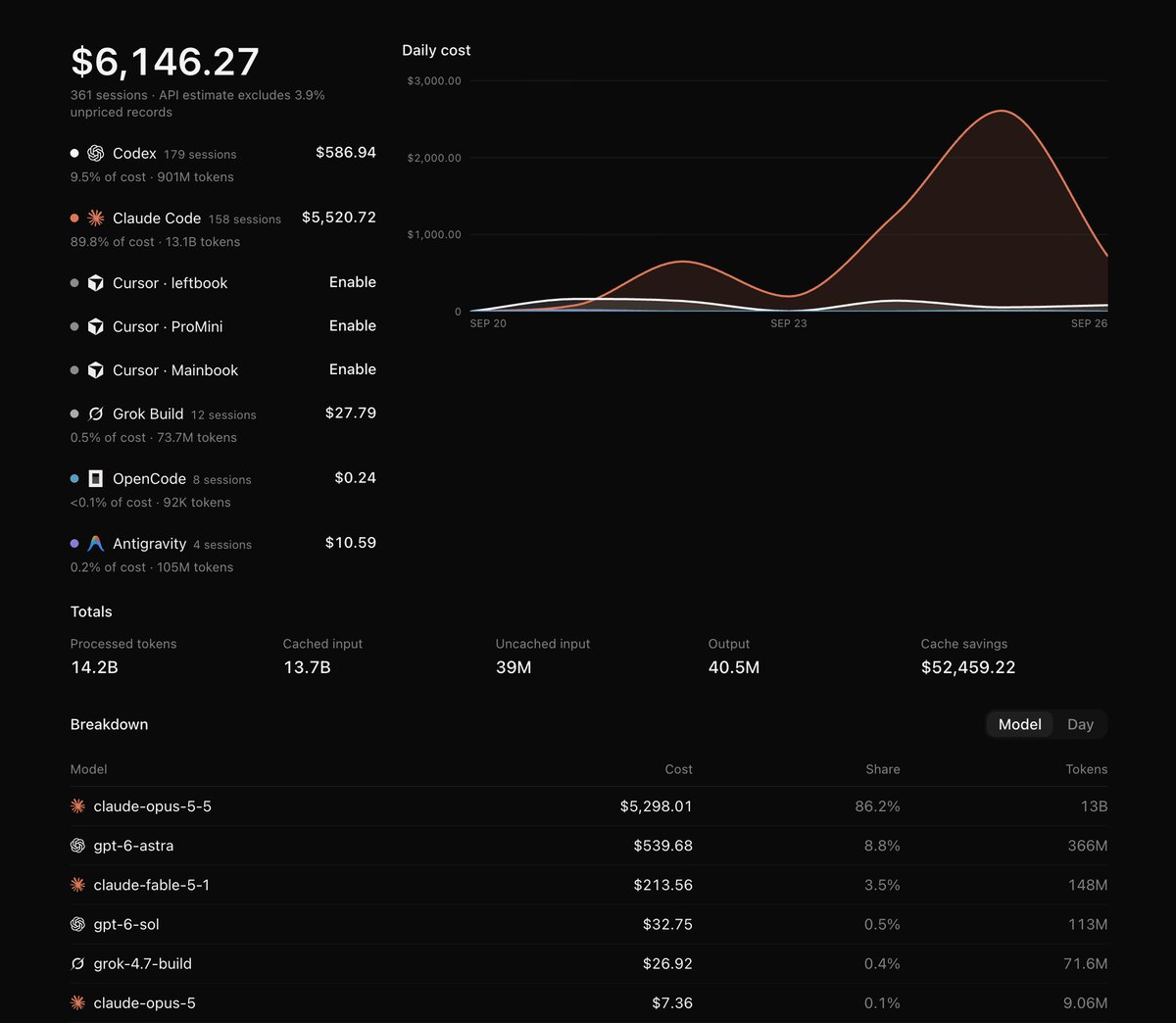
@theo shared (38 likes, 10 replies, 2,617 views) a T3 Code dashboard screenshot that made the cost stack visible instead of theoretical. It showed 361 sessions, about $6.1K in daily estimated cost, and spending dominated by Claude Code while Codex, OpenCode, Grok Build, and Antigravity stayed comparatively small.
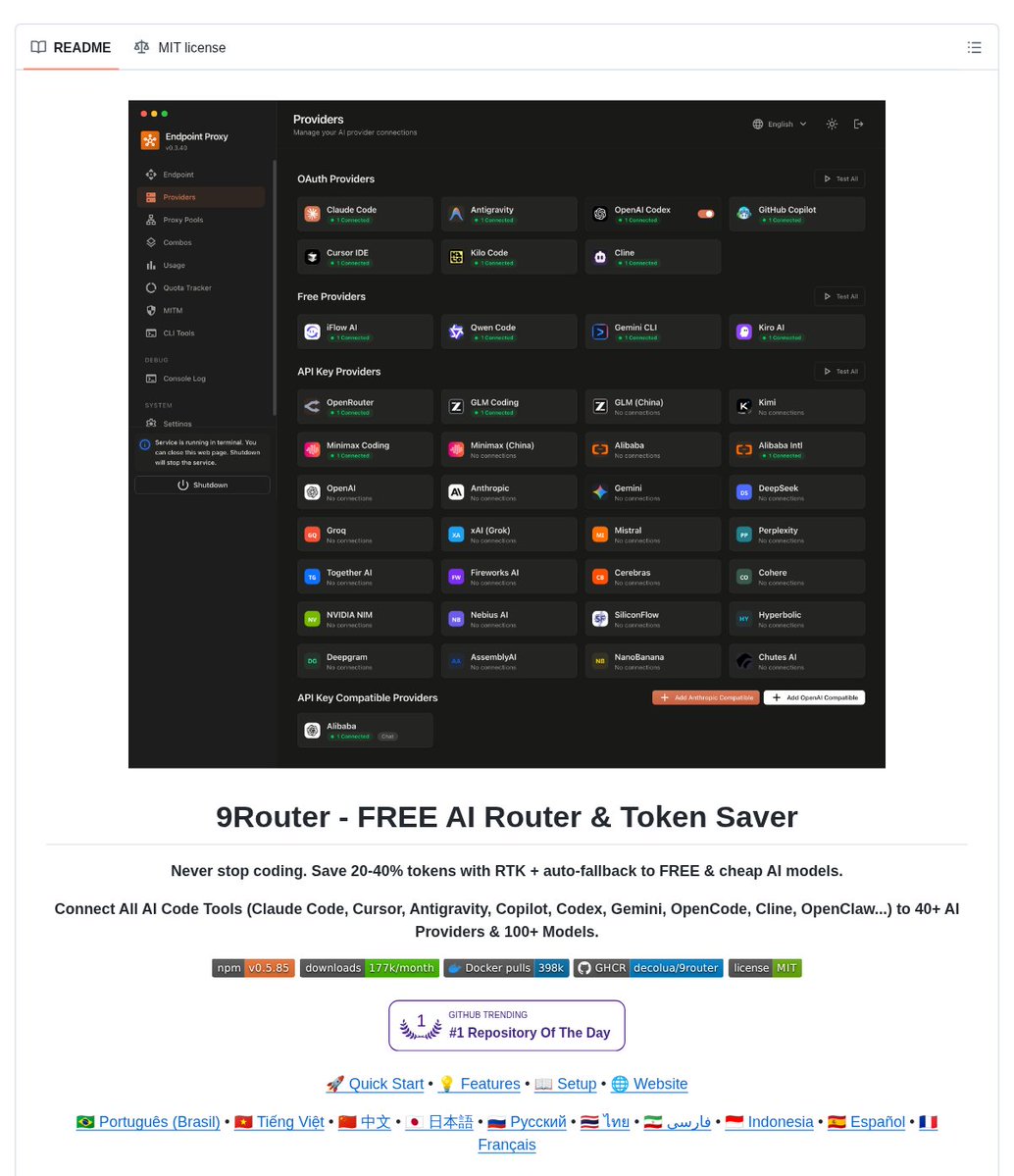
@DanKornas introduced (3 likes, 3 replies, 662 views) 9Router as a local OpenAI-compatible endpoint that keeps Claude Code, Codex, Cursor, Cline, Copilot, and other tools on one workflow while falling back across provider tiers. The public 9Router README backs up the specific claims that mattered to the feed: 40+ providers, 100+ models, quota tracking, and 20-40% token savings from RTK compression. @0xWifter showed (4 likes, 17 views, 2 bookmarks) a smaller but related pattern: put a typed Jev gate in front of Claude Code so cheap routing logic decides when expensive reasoning is really necessary.
The downside of this stack was visible too. @_ak_111 said (43 likes, 5 replies, 1,413 views) that paid Codex and ChatGPT Work users received a reset after the outage, even though some people had already just received their normal weekly reset. @jpthor posted (12 likes, 6 replies, 1,634 views) a screenshot of a 401 Unauthorized response against the Codex backend, giving the outage concrete operational shape.
Discussion insight: People increasingly talk about coding agents the way infra teams talk about workloads: route simple tasks cheaply, reserve frontier models for ambiguity, recover cleanly from resets, and keep a local or alternative path ready when a primary provider stumbles.
Comparison to prior day: September 25 already had strong pricing anxiety. September 26 pushed the conversation past subscription politics into explicit routing behavior, mixed-tool dashboards, and user-built control planes.
1.4 Agent memory, semantic state, and operator control layers became more concrete (🡕)
Another clear theme was that the ecosystem is filling in around the base model. At least five items supported it: Hindsight's breakout day, EvoOntology's self-evolving semantic layer, Kaji's operator console, jurlycat's review-bottleneck warning, and the growing interest in typed gates and review surfaces around agent work.
@RoundtableSpace amplified (85 likes, 15 replies, 53,786 views, 86 bookmarks) Hindsight, an open-source agent memory system whose public repo says it focuses on retain, recall, and reflect rather than just chat-history replay. The replies were the important nuance: several readers asked whether this is real learning or just persistent context, how stale memories get invalidated, and whether lessons should be saved at project scope versus global scope.
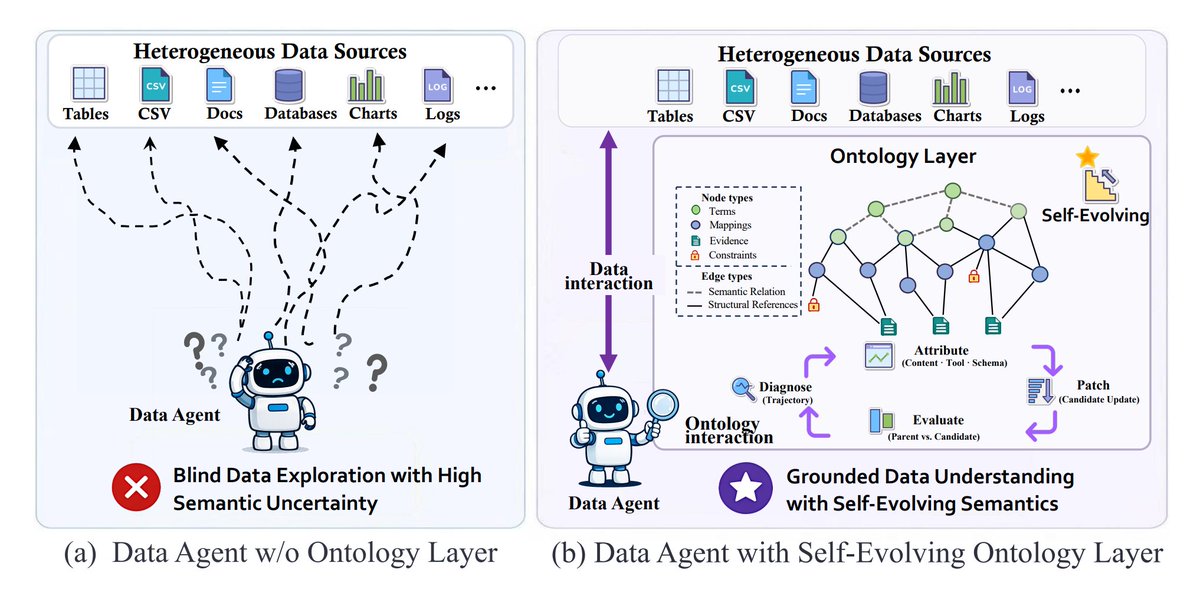
@TheTuringPost highlighted (2 likes, 2 replies, 346 views) EvoOntology, and the public repo plus attached architecture diagram make the position clear: expose grounded semantics through MCP tools, then evolve that ontology layer from task history under gated evaluation. This is not just another prompt template; it is a claim that semantic state should be queryable runtime infrastructure.
@dishant_ic shared (1 like, 2 replies, 30 views) Kaji, a terminal coding agent benchmark entry that also points to a public Kaji repo describing a native macOS command center for Codex, Claude Code, OpenCode, Pi, projects, and worktrees. @jurlycat made the need for these operator layers explicit (5 likes, 6 replies, 86 views): one task took an agent five minutes, but reviewing the result took two days, and the author's conclusion was that understanding, not tokens, had become the real bottleneck.
Discussion insight: The feed increasingly treated state outside the base model as product work: memory banks, ontology layers, worktree dashboards, typed gates, and hosted review surfaces. The common goal was not "more output" but "more recoverable and inspectable output."
Comparison to prior day: September 25 was heavy on skills, canvases, and plan artifacts. September 26 pushed the conversation further toward persistent memory, semantic grounding, and native operator consoles that sit beside the model.
2. What Frustrates People
Antigravity still feels late and brittle for daily use
The loudest frustration was that Antigravity's new workflow structure did not erase the feeling that the surrounding product still lags. @theo framed (1,941 likes, 120 replies, 78,829 views, 67 bookmarks) /plan as regression, while replies to @antigravity asked for basic operator features such as /status, /context, /usage, a file browser, and graceful resume after quota stops. @GergelyOrosz described (89 likes, 15 replies, 18,933 views) the product as confusing rather than clearly differentiated.
@ibocodes added (91 likes, 5 replies, 4,168 views) the concrete day-to-day failure mode: repeated sign-outs and verification loops during setup. That matters because people are already persuaded enough by the local or hybrid story to try the product; what blocks them is not model capability alone but operational trust. Severity: High. Worth building: High.
Reliability, resets, and control gaps still break trust in frontier coding agents
The second major frustration was that provider trust still feels fragile even when people like the underlying models. @_ak_111 said (43 likes, 5 replies, 1,413 views) that paid Codex and ChatGPT Work users were reset after the outage even though some had just received their normal weekly reset, which left people debating whether they had been helped or had simply lost unused quota. @jpthor posted (12 likes, 6 replies, 1,634 views) a 401 Unauthorized error against the Codex backend, and @notjazii circulated (38 likes, 13 replies, 1,366 views) screenshots from published OpenAI safety-report material discussing network-control gaps and a pause on broad classes of capable-model training or evaluation.
These are different failure modes, but the community treated them as one trust problem: the model may be smart, yet the surrounding system can still stall, reset unexpectedly, or fail containment assumptions. The common coping behaviors were to keep a second provider ready, move some work local, or insert an explicit router in front of the expensive surface. Severity: High. Worth building: High.
Human review is becoming the slowest and most expensive part of the loop
@jurlycat summarized (5 likes, 6 replies, 86 views) a feeling that showed up in several other posts: one agent task took five minutes, but reviewing the output took two days, a stalled run burned money, and the developer no longer understood every line being pushed to production. That complaint pairs neatly with the existence of tools such as Kaji and typed Jev gates: builders are already trying to restore legibility, worktree discipline, and verification state because they do not trust raw throughput on its own.
This frustration is severe because it attacks the value proposition directly. Faster execution stops mattering if ownership, verification, and debugging all move downstream into a slower human bottleneck. The workarounds in the feed were TDD, smaller PRs, shadow-mode gates, and native command centers that keep changed files and verification visible. Severity: High. Worth building: High.
Local-private stacks look attractive, but the speed tax is still real
@loudchirper argued (6 likes, 5 replies, 85 views, 4 bookmarks) that five days with local Qwen 3.8 Next on an M1 Ultra were enough to replace a frontier-model subscription for research and business work. The useful part of the post was the trade-off language: privacy and zero monthly bills looked compelling, but long-context prefill and bursty multi-agent workflows still favored the cloud. Replies made the same point more bluntly by calling out unified-memory bandwidth as the ceiling that shows up first.
This is not a rejection of local work. It is a frustration that the "private daily driver" is close, but not fully there for the heaviest workloads. People clearly want the sovereignty; they do not yet get cloud-like speed at the same time. Severity: Medium-High. Worth building: Medium-High.
3. What People Wish Existed
One stable workflow across providers, quotas, and local fallbacks
The clearest practical need was continuity. @DanKornas explicitly framed 9Router around the idea that AI coding work should not stop when one provider hits its quota, while @GestaltU described using Claude Code and Codex interchangeably and even in parallel. Theo's T3 dashboard showed why that matters: heavy users are already splitting work across multiple surfaces because no single tool owns the whole workload economically.
This is not an aspirational wish. It is a direct product need: one endpoint, one workflow, and graceful fallback from premium to cheap to local when capacity, price, or policy changes. Opportunity: Direct.
Agent surfaces that keep status, ownership, and runtime boundaries visible
A second need was for agent surfaces that make work legible before, during, and after execution. Replies to @antigravity asked for /status, /context, and graceful resume semantics, which are all visibility requests more than intelligence requests. The Microsoft side answered a related enterprise concern by tying Code and Autopilot to hosted runtime, tenant boundaries, and clear ownership: @donasarkar translated the product split into practical language, while @NathanMcNulty surfaced the crucial clarification that Autopilot is cloud-based and not a GitHub Copilot license feature.
What people seem to want is not merely a better chat shell. They want a surface that shows where the work is running, what it is changing, when it is waiting, and who owns the resulting app or process. Opportunity: Direct.
Memory and semantic layers that are scoped, inspectable, and actually improve future work
Hindsight and EvoOntology pointed to a third need: durable agent state that is not just more prompt text. @RoundtableSpace highlighted Hindsight's world-facts, experiences, observations, and mental-model framing, but the replies immediately asked for stale-memory boundaries and whether lessons should live at project scope or global scope. @TheTuringPost described EvoOntology's MCP-exposed ontology layer, where semantic state is retrieved on demand and only evolves when evaluation shows improvement.
The wish here is specific: keep what the agent learns, but keep its provenance, scope, and reversibility visible enough that users can trust it. That makes the opportunity competitive but very real. Opportunity: Competitive.
Private daily-driver agents without auth roulette or cloud dependence
The feed also showed a desire for a private default workflow that does not collapse into account or infrastructure friction. @ibocodes wanted Antigravity to stop signing people out and re-verifying them. @loudchirper wanted local Qwen to be good enough that a workstation and free software could replace a recurring subscription, while still admitting that long-context and bursty multi-agent work are slower locally.
This is a practical need with real trade-offs rather than a pure ideology play. People want privacy, predictable access, and current models at the same time. Opportunity: Competitive.
4. Tools and Methods in Use
| Tool | Category | Sentiment | Strengths | Limitations |
|---|---|---|---|---|
| GitHub Copilot app / SDK | Agent platform | (+) | Shared harness across products, hosted execution path, broader non-developer reach | Rollout and licensing details are still being clarified |
| Antigravity | Agent runtime | (+/-) | Approval-gated planning, local or hybrid story, emerging multimodal workflows | Missing status/context basics, account friction, skeptical community sentiment |
| Codex | Coding agent surface | (+/-) | Still part of many mixed-tool workflows, integrated with ChatGPT Work | Outage sensitivity, reset ambiguity, auth and usage-page failures |
| Claude Code | Coding agent | (+) | Trusted for hard tasks, strong daily-driver reputation, often used as premium executor | Heavy-user spend can dominate quickly |
| 9Router | Routing gateway | (+) | One local endpoint, quota-aware fallback, 20-40% token savings via RTK | Extra local infrastructure and provider setup |
| Jev | Decision / gating layer | (+) | Typed routing, human escalation, cheap prefilter before expensive reasoning | Custom setup, depends on surrounding workflow discipline |
| Hindsight | Memory system | (+/-) | Retain/recall/reflect model, many providers, coding-agent integrations | Open questions about stale memories and whether behavior truly improves |
| EvoOntology | Semantic / MCP layer | (+) | Grounded semantic retrieval, versioned ontology evolution, Codex and Claude plugins | More complex setup and still benchmark-driven rather than mainstream |
| Kaji | Ops console | (+) | Native project/worktree/session control across multiple agents | Early-stage adoption and macOS-only scope |
| Local Qwen 3.8 Next + OpenCode | Local model stack | (+/-) | Privacy, no recurring bill, usable for knowledge-work-heavy flows | Slower long-context prefill and weaker fit for bursty multi-agent work |
The overall satisfaction spectrum was polarized. People were positive about tools that make agent work more legible or more controllable, and much less positive about surfaces that expose them to opaque resets or brittle account state. @davidfowl and Microsoft's own runtime posts gave Copilot a strong governance-and-harness story, while @ibocodes and the Theo / Gergely quote-tweet cluster kept Antigravity's product-trust score mixed.
The most visible method trend was layered routing. @GestaltU described switching between Claude Code and Codex with effectively no lock-in. @0xWifter put a typed Jev gate in front of Claude Code so hard work gets premium reasoning and low-risk work does not. @DanKornas took the same instinct to the network edge with 9Router: stabilize the endpoint first, then decide which provider pays for the answer.
The migration pattern behind those choices was just as clear. Theo's T3 dashboard showed that frontier-model coding is still valuable enough to keep in the stack, but not cheap enough to use carelessly; loudchirper's local-Qwen post showed that a private workstation is now a credible fallback for some knowledge-heavy work; and jurlycat's review-bottleneck story explained why builders are adding operator consoles, verification state, and gating layers around the model instead of trusting a single uninterrupted agent loop.
5. What People Are Building
| Project | Who built it | What it does | Problem it solves | Stack | Stage | Links |
|---|---|---|---|---|---|---|
| Hindsight | Vectorize | Open-source agent memory system built around retain, recall, and reflect | Helps agents keep useful state across sessions instead of replaying chat history | Docker, PostgreSQL-backed service, 25+ LLM providers, coding-agent integrations | Shipped | tweet · repo · docs |
| 9Router | decolua | Local AI router and token saver for coding tools | Keeps one coding workflow alive when quotas run out or provider quality changes | Local OpenAI-compatible endpoint, RTK compression, multi-provider fallback, Node/npm | Shipped | tweet · repo |
| EvoOntology | RUC DataLab | Self-evolving ontology layer for data agents | Gives agents grounded semantics over heterogeneous tables, files, and databases | MCP runtime, Codex/Claude plugins, ontology workspace, benchmarked evaluation loop | Beta | tweet · repo · paper |
| Kaji | @dishant_ic | Native macOS command center for terminal-native AI coding agents | Keeps projects, worktrees, sessions, and verification state under control across multiple agents | SwiftUI, TermyKit, Codex/Claude Code/OpenCode/Pi integrations | Beta | tweet · repo |
| KARAvaan | @codewithkara | Hosted travel journal app built with Codex | Shows idea-to-deployment app building for a solo developer with limited CI/CD friction | Codex, Next.js, hosted web app | Shipped | tweet · site |
| Cozy metal detector game | @zacxbt | Browser game prototype built in a few prompts | Demonstrates how quickly frontier coding models can scaffold creative side projects | Opus 5.5, raw WebGL2 | Alpha | tweet |
Hindsight and EvoOntology represent two different bets on persistent agent state. Hindsight pushes toward a general memory substrate that works across many providers and coding surfaces, while EvoOntology treats state as a queryable semantic layer that agents retrieve through MCP tools and then evolve under evaluation. The replies around Hindsight showed why this space is active: people want the benefit of accumulated state, but they also want clear stale-memory boundaries and user-visible scope for what gets remembered.
A second builder pattern was operator control. 9Router and Kaji both assume that the hard part is no longer just generating code; it is deciding which provider to use, which worktree the run belongs to, and what verification state the human can inspect afterward.
The lighter-weight builds still mattered because they showed where the productivity story lands. @codewithkara said (8 likes, 4 replies, 95 views) KARAvaan went from idea to deployment with surprisingly few CI/CD problems, and the screenshot shows a real browseable travel-journal surface rather than a rough mockup. @zacxbt said (49 likes, 24 replies, 1,678 views) the cozy metal-detector game was raw WebGL2 and built a few prompts in on Opus 5.5, which is exactly the sort of small-but-real prototype that keeps creative experimentation alive.
Across the table, the common trigger was not "make a smarter model." It was "make the workflow cheaper, more legible, more grounded, or easier to ship." That is why the strongest projects of the day were routers, memory layers, semantic runtimes, and operator consoles rather than another thin wrapper around the same base models.
6. New and Notable
Copilot Managed Runtime made tenant-hosted AI-built apps feel concrete
The most notable enterprise signal was that Microsoft's Copilot story answered the boring but decisive question: where does AI-built code actually live? @donasarkar translated the launch into Home, Code, Autopilot, and Managed Runtime, while the official Managed Runtime post laid out Entra identity, governed data access, admin-center inventory, and SDK or CLI support. That turns "vibe coding for everybody" into a more credible enterprise deployment story than a standalone chat demo.
Agent memory and ontology layers broke out as mainstream infrastructure topics
Hindsight was notable not just because it was open source, but because a memory system pulled real attention in a feed that often defaults to model chatter. @RoundtableSpace tied it to 1,668 stars in a day and 22.1K total, while the public repo framed it as coding-agent-compatible memory infrastructure rather than an academic sidecar. EvoOntology pushed the same state problem from a different direction by turning semantic grounding into an MCP-accessible layer with Codex and Claude plugins. Together they made memory and semantics look like first-class product categories, not optional prompt add-ons.
Coding sessions are starting to produce assets and polished front ends, not just code diffs
A third notable shift was how often code-generation posts touched adjacent artifacts. @ash_twtz showed Antigravity generating extension icons with Gemini 3.1 Flash Image after finishing code. @codewithkara moved from prompt to deployed travel-journal UI, and @zacxbt went from a few prompts to a playable raw-WebGL2 game. The signal is still early, but it suggests that "AI coding" on Twitter increasingly means full-session artifact creation rather than only line edits.
7. Where the Opportunities Are
[+++] Cross-provider routing and quota control — The evidence came from multiple sections at once: TokenGremlin's call for better economics, GestaltU's zero-switching-costs workflow, Theo's mixed-tool spend dashboard, 9Router's local fallback gateway, Jev's typed gate, and outage-reset chatter around Codex. The opportunity is strong because the pain is concrete, repeated, and already causing users to assemble their own control planes. (9Router source, usage source, routing source)
[+++] Reviewable execution surfaces with hosted state and resume semantics — Antigravity replies asking for /status and graceful resume, jurlycat's two-day review complaint, Kaji's worktree-and-verification console, and Microsoft's Managed Runtime all point to the same gap: agent work needs visible state before users will trust it. This is strong because both consumer and enterprise posts want the same thing, just at different scales. (Antigravity source, review bottleneck, Managed Runtime)
[++] Inspectable memory and semantic state for coding agents — Hindsight and EvoOntology showed real momentum behind durable state that sits outside the prompt. The need is not just memory retention; it is memory with scope, provenance, stale-data boundaries, and reversible updates. That makes the opportunity moderate-to-strong: technically harder than a router, but clearly becoming part of serious agent workflows. (Hindsight source, EvoOntology source)
[+] Multimodal finishing layers around coding agents — Antigravity generating icons, KARAvaan shipping a polished interface, and Opus 5.5 building a small game all suggest an emerging market for tools that help agents produce assets, layouts, and final-touch UI alongside code. The signal is earlier and more experimental than routing or memory, but it is visible enough to watch. (asset-generation source, KARAvaan source, game source)
8. Takeaways
- Workflow UX is now judged as harshly as model quality. Antigravity's
/planlaunch drew attention, but the strongest responses focused on missing status, resume, and account reliability rather than on whether planning itself is a good idea. (launch, backlash) - Microsoft's Copilot move is about platform consolidation and hosted execution, not just better chat. The combination of a shared GitHub Copilot SDK harness, the Home / Code / Autopilot split, and Managed Runtime makes Copilot look more like an app-and-agent platform than a standalone assistant. (David Fowler, Microsoft blog)
- Users are already building their own control planes around coding agents. 9Router, typed Jev gates, Kaji, and mixed-provider workflows all exist because people do not want a single provider outage or quota wall to stop work. (9Router, Jev, Kaji)
- Persistent state is becoming product infrastructure. Hindsight and EvoOntology show that memory and semantics are moving out of the prompt and into dedicated layers with their own scope, evaluation, and runtime interfaces. (Hindsight, EvoOntology)
- Human understanding is becoming the new scarce resource. Theo's dashboard, jurlycat's two-day review story, and loudchirper's local-Qwen trade-off post all point to the same conclusion: execution is getting cheaper, but verification, ownership, and operating discipline are becoming the real constraints. (usage, review bottleneck, local fallback)