Twitter AI Coding - 2026-09-28
1. What People Are Talking About
1.1 Harness design eclipsed raw model choice: people wanted worktrees, shared intent, and cross-agent composition (🡕)
The biggest shift in today's feed was away from “which model wins?” and toward “which harness lets me coordinate work safely?” At least four items supported that framing: GitHub's official parallel-sessions walkthrough, Stretchcloud's Campfire pitch that the moat is the harness rather than the model, Awakecoding's proposal to wrap Copilot CLI inside Claude Code subagents, and the Gemini-switch thread where replies kept saying the right answer was to run multiple systems in parallel.
@github showed (198 likes, 35 replies, 40,864 views, 54 bookmarks) that the GitHub Copilot app can run parallel agent sessions with a separate Git worktree and preserved context for each session. The linked GitHub blog post made the value proposition explicit: start a new session whenever you want, track progress in the sessions view, and let isolated tasks run without disturbing one another. The replies were the important nuance because they immediately turned the announcement into a coordination problem: isolation solves branch overlap, but not continuity or merge cleanup.
@stretchcloud argued (3 likes, 4 replies, 310 views) that the real lock-in is now the harness around the model, not the model itself. The public Campfire repo says the TypeScript project runs Claude Code, Codex, Goose, Aider, OpenHands, OpenClaw, and OpenCode side by side with permission voting, isolated worktrees, collaboration, and a per-session cost dashboard. The quoted customer story from @iseff claimed a Devin-equivalent workflow could be rebuilt in two days at roughly 25% of the cost (quoted post), while replies pressed Campfire on the harder part: whether approvals fail closed and whether logs from different backends can be normalized into one trustworthy audit trail.
@awakecoding proposed (1 like, 283 views, 1 bookmark) a smaller but telling version of the same idea: custom Claude Code subagents that wrap Copilot CLI so review work can use non-Anthropic models while preserving Copilot-app-style /rubber-duck ergonomics. That was a useful companion signal because it showed people no longer accept the harness/model bundle as fixed.
Discussion insight: The common request was not “give me one winner.” It was “let me combine agent shells, keep tasks isolated, and still preserve shared intent, approvals, and logs.”
Comparison to prior day: September 27 emphasized portable skills and worktree isolation. September 28 pushed that one level further into multi-harness composition, permission governance, and side-by-side evaluation.
1.2 Usage ceilings and perceived reliability kept driving model hopping more than brand loyalty (🡕)
The second major theme was that people are still switching tools less because of ideology than because of headroom and stress. At least five items supported it: NovaXCode's Gemini-switch prompt, Uglyrobot's progression across Copilot, Cursor, Codex, and Opus 5.5, Kulshekhar's weekly Codex exhaustion post, Misaalanshori's OpenCode Go usage screenshots, and several replies framing the correct strategy as routing each task to whichever stack feels least restrictive.
@NovaXCode asked (68 likes, 55 replies, 3,680 views) whether people would leave Claude and Codex for Antigravity if Gemini 4 Pro beat Opus 5.5 and GPT-6 Astra. The replies mattered more than the hypothetical benchmark: one person said they already split backend work to Claude Code and UI work to Antigravity, while another said switching is only about “shipping less stress,” not crowning a permanent king. Even the author agreed the practical answer was often to run both in parallel.
@uglyrobot said (6 likes, 7 replies, 680 views) Opus 5.5 was the first thing that made the author consider switching again, after progressing through GitHub Copilot, Cursor Sonnet, Cursor Composer, and Codex. The replies turned the post into a budgeting discussion: one response immediately asked why anyone would tolerate OpenAI's usage limits, while the author answered in cost-per-task terms and another reply said people should simply use whichever company wins “per buck for the task.”
@Kulshekhar reported (1 like, 2 replies, 46 views) that weekly Codex usage was disappearing in one to two days, while Claude Code with Opus 5.5 and Fable 5.1 felt more reliable than before. The key detail was that the post still treated the improvement as temporary: the author expected the advantage to disappear once limits were tightened again.
A smaller but more numeric companion signal came from @misaalanshori03 posting (2 replies, 14 views) OpenCode Go screenshots showing monthly usage already at 50% after one week, alongside a dashboard reporting $16.57 cost, 6,414 requests, and 2.163B tokens. That did not contradict the “use whatever works” mood; it reinforced it by showing that even transparent dashboards can still end in rapid quota burn.
Discussion insight: Users increasingly sound like cloud schedulers. They compare plans on stress, usable output, and reset behavior, then spread work across multiple tools instead of waiting for one vendor to dominate.
Comparison to prior day: September 27 focused on opaque tiers and vague Pro language. September 28 made the same complaint more operational and more first-hand: users attached actual burn rates, reset windows, and fallback paths.
1.3 Open-source agent infrastructure kept getting narrower, more auditable, and more searchable (🡕)
The strongest builder posts were not generic copilots. They were tightly scoped infrastructure pieces. At least three items supported that pattern: Open-Agent-DB for discovery, geo-sleuth for evidence-first visual investigation, and EugeneSmarts' commentary on how serious users now assemble large public tool stacks to patch over model and harness weaknesses.
@ns0bj launched (11 likes, 8 replies, 165 views) Open-Agent-DB, describing it as a universal catalog and semantic search engine for agent assets. The public repo and README say the Python project indexes 3.48 million-plus assets and 113,000-plus MCP servers across seven ecosystems, stores full source in SQLite FTS5, ships dense vector embeddings via Hugging Face, and exposes npx open-agent-db search, info, and install flows for immediate use. That is a much more concrete answer to ecosystem sprawl than another screenshot of a prompt.
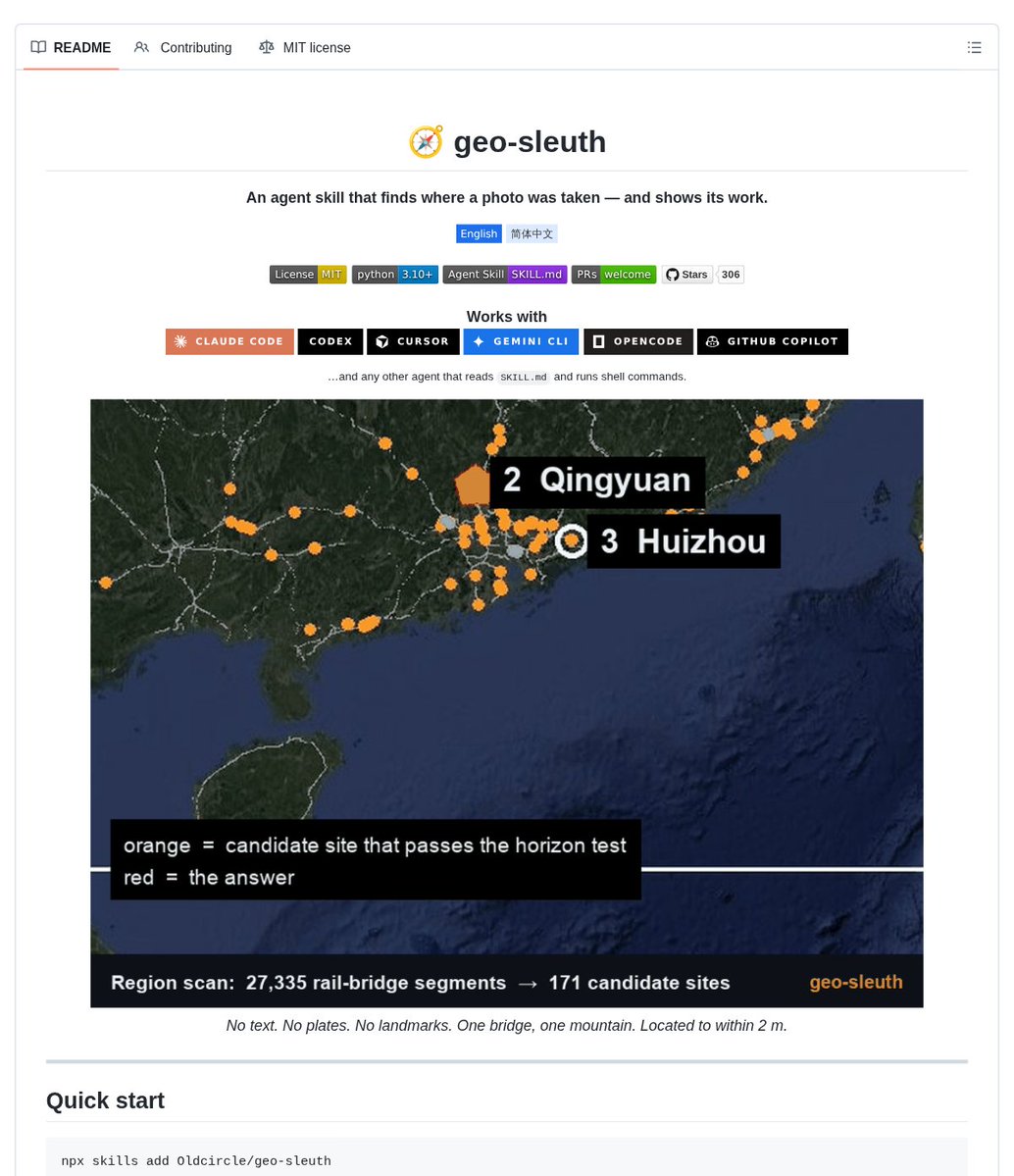
@DanKornas shared (6 likes, 1 reply, 1,283 views, 3 bookmarks) geo-sleuth, a 502-star Python skill repo from Oldcircle that tries to geolocate a photo and show its work. The README says the skill uses 20 scripts plus SKILL.md, works across Claude Code, Codex, Cursor, Gemini CLI, OpenCode, and GitHub Copilot, and can narrow a rail-bridge search from 27,335 segments to one answer with an error radius. That specificity mattered because it replaced “AI can probably figure it out” with a visible evidence pipeline.
@EugeneSmarts argued (5 likes, 2 replies, 69 views, 2 bookmarks) that local open-weight coding stacks still inherit Anthropic's tone through synthetic distillation, so escaping the “corporate assistant voice” now requires architectural work. The quoted toolkit inventory from @DeRonin_ (quoted post) made the stack complexity visible: planning models, coding harnesses, memory layers, grounding tools, compression helpers, frontend tools, and media systems tied together at an estimated $1,300 per month. The point was not just that people use many tools; it was that composition itself has become a serious craft.
Discussion insight: The feed cared less about “one magic prompt” and more about installable, searchable, auditable building blocks that can be recombined across shells.
Comparison to prior day: September 27's skills discussion centered on packaging and portability. September 28 moved toward discovery layers, specialized workflows, and public stack design.
1.4 People accepted that agents can generate more output, but not that they can be trusted blindly (🡒)
Capability claims were common, but trust stayed conditional. Three items captured the tension especially well: Yongfook's “meat proxy” celebration, Ed Andersen's refusal to run unread autonomous code on his own machine, and JD Johnson's complaint that Grok Bot and Muse still fail basic business-agent reliability tests.
@yongfook said (16 likes, 3 replies, 732 views) a single weekend with Claude produced a one-shot launch video, a Rails 8 app, and a landing page “without touching any code.” The replies did not dispute that output. Instead they reframed the remaining human job as deciding what is actually worth making, which is a subtle but important shift in where people think the bottleneck lives.
@edandersen objected (6 likes, 2 replies, 712 views) to paying for GitHub Copilot plus Spark/Autopilot just to run code on a local machine that the author “hasn't even read.” The quoted @OmarShahine (quoted post) celebrated not needing to know Rust even though Autopilot's runtime uses it, which turned Andersen's complaint into a governance issue rather than a language argument.
@jdjohnson wrote (2 likes, 4 replies, 68 views) that Grok Bot and Muse still look magical at first but are “too dumb to be useful as general agents for business.” The quoted complaint from @BradGroux described specific failures—asking again for credentials it already had, forgetting a simple HTML deploy flow, and creating the wrong tunnel (quoted post)—which made the reliability gap versus Claude Code or Codex feel concrete rather than rhetorical.
Discussion insight: The feed was not denying that agents can ship more. It was drawing a line between output volume and autonomy that deserves trust on real business or local-machine tasks.
Comparison to prior day: September 27's complaints mostly centered on reviewing giant agent-written diffs. September 28 moved one step earlier and asked whether some agents deserve that much freedom in the first place.
2. What Frustrates People
Parallel work still breaks down around continuity, approval logic, and local trust
The frustration was not that agents cannot do parallel work. It was that the surrounding control plane still feels unfinished. @github showed (198 likes, 35 replies, 40,864 views, 54 bookmarks) isolated worktrees and session context, but the most useful replies immediately pointed out that someone still has to remember the shared goal and merge the resulting branches back together. @stretchcloud proposed (3 likes, 4 replies, 310 views) permission voting and shared auditability in Campfire, only for replies to question whether approval rules fail closed and whether backends with different tool semantics can really be normalized. @edandersen added (6 likes, 2 replies, 712 views) the sharpest trust version of the complaint by refusing to pay to run autonomous code locally when the author has not even read the runtime source path it depends on. Severity: High. Worth building: High.
Usage budgets still snap long before the workday is over
The second frustration was brutally concrete: people keep running out of headroom before they run out of tasks. @Kulshekhar said (1 like, 2 replies, 46 views) weekly Codex usage disappears in one to two days, while @uglyrobot treated (6 likes, 7 replies, 680 views) vendor choice as a rolling price-per-task calculation rather than a stable preference. The most numeric example came from @misaalanshori03 posting (2 replies, 14 views) OpenCode Go screenshots showing monthly usage already at 50% after a week, plus a dashboard with $16.57 cost, 6,414 requests, and 2.163B tokens. The coping strategy in public was not loyalty; it was constant rerouting to whichever stack currently feels less restrictive. Severity: High. Worth building: High.


Business-agent reliability outside the strongest stacks still feels too brittle
Quality complaints were thinner than the budget complaints, but the ones that appeared were specific. @jdjohnson said (2 likes, 4 replies, 68 views) Grok Bot and Muse feel magical at first and then fail on accuracy, completeness, and direction following; the quoted complaint from @BradGroux (quoted post) listed repeated credential prompts, a forgotten HTML deploy flow, and the wrong testing tunnel. @EugeneSmarts added (5 likes, 2 replies, 69 views, 2 bookmarks) a different but related complaint: even when local or open-weight models are capable enough, synthetic distillation can make them feel stylistically trapped inside the same padded assistant persona. Builders are coping by limiting autonomy, layering orchestration buffers, or falling back to Claude Code and Codex for higher-stakes work. Severity: Medium-High. Worth building: Medium-High.
3. What People Wish Existed
A coordination layer that keeps parallel agents aligned
The clearest practical need was not more raw generation. It was a layer that keeps multiple agents pointed at the same objective and makes their approvals, branches, and merge state legible. @github showed (198 likes, 35 replies, 40,864 views, 54 bookmarks) isolated worktrees, but the top replies said continuity and merge cleanup are still manual. @stretchcloud responded (3 likes, 4 replies, 310 views) with permission voting and shared audit ideas in Campfire, while @awakecoding wanted (1 like, 283 views, 1 bookmark) Copilot CLI review flows available under Claude Code subagents instead of being trapped inside one default bundle. This is a practical need with immediate workflow value. Opportunity: Direct.
Budget-aware routing that makes headroom predictable
People were explicit that they do not just want cheaper tools. They want systems that make resets, quotas, and per-task tradeoffs understandable before a session dies. @Kulshekhar ran (1 like, 2 replies, 46 views) out of weekly Codex usage in one to two days, @misaalanshori03 showed (2 replies, 14 views) OpenCode Go consuming half a monthly allowance in a week, and the @NovaXCode thread (68 likes, 55 replies, 3,680 views) kept framing the right answer as routing work to whichever stack causes less stress. Some products partially address this with dashboards and usage bars, but the public evidence still shows surprise and rerouting. Opportunity: Direct, but competitive.
More end-user products that justify all the tooling talk
The thinnest but most revealing need was for actual user-facing outcomes rather than endless meta-tooling. @mayuri_3015 asked (6 likes, 3 replies, 56 views), “If vibe coding can build anything… Where is the Spotify alternative?”, which is less a request for one specific clone than a complaint that the public conversation keeps circling tools for builders instead of products for users. @yongfook showed (16 likes, 3 replies, 732 views) that a launch video, Rails app, and landing page can already be produced quickly; the remaining scarce input is choosing an idea that feels worth shipping. This is partly practical and partly emotional, and the signal is still early. Opportunity: Aspirational.
4. Tools and Methods in Use
| Tool | Category | Sentiment | Strengths | Limitations |
|---|---|---|---|---|
| GitHub Copilot app | Agent shell | (+/-) | Parallel sessions, isolated Git worktrees, preserved per-session context | Continuity and merge cleanup are still manual once several agents finish at once (source) |
| Campfire | Orchestration platform | (+) | Seven agent backends in one browser tab, permission voting, worktrees, collaboration, cost dashboard | Replies still questioned fail-closed approvals and cross-backend audit normalization (source) |
| Open-Agent-DB | Discovery / registry | (+) | 3.48M+ indexed assets, 113k+ MCP servers, SQLite FTS5 plus vector search, installable across major ecosystems | Very new project with early validation and a very large offline database footprint (source) |
| geo-sleuth | Agent skill | (+) | Evidence-first photo geolocation, cross-agent install, coordinates plus error radius | Highly specialized workflow; the README example took about 72 minutes end to end (source) |
| Claude Code + Opus 5.5 / Fable 5.1 | Coding agent + models | (+) | Strong perceived reliability, good enough for app/page/video work, favorable comparisons to recent Codex usage | Heavy users still expect future tightening, and some still dislike Claude's app or voice style (source) |
| Codex | Coding agent | (+/-) | Remains a preferred terminal workflow and a useful second pair of hands on the same repo | Weekly usage can disappear in one to two days, pushing users to fallback tools (source) |
| OpenCode Go | Coding agent | (+/-) | Transparent usage and cost dashboard, visible model mix, active enough for heavy experimentation | One user burned half a monthly allowance in a week, and the cited LCA workflow was still described as not usable (source) |
| Grok Bot / Muse | Business agent | (-) | Ambitious general-agent surface and initially impressive demos | Fails on accuracy, completeness, credential reuse, and routine deployment memory in reported business use (source) |
Overall satisfaction was not split neatly into “good” and “bad” tools. It was split into tools that felt schedulable versus tools that still surprised users. GitHub Copilot and Campfire got attention for worktree isolation and orchestration, but both immediately triggered questions about shared intent and approval semantics. Claude Code benefited from people treating it as the reliable fallback or primary harness, while Codex kept value as a terminal-native second pair of hands even when users complained about weekly exhaustion.
The main workarounds were explicit routing and role-splitting. One NovaXCode reply used Claude Code for backend work and Antigravity for UI, Uglyrobot framed model choice in cost-per-task terms, and EugeneSmarts treated local/open models as additional layers to be filtered and buffered rather than clean replacements. The competitive dynamic looked less like winner-take-all and more like a messy control plane where people constantly rebalance quality, quota, tone, and price.
5. What People Are Building
| Project | Who built it | What it does | Problem it solves | Stack | Stage | Links |
|---|---|---|---|---|---|---|
| Campfire | @stretchcloud | Runs seven coding-agent backends side by side in one browser tab with approvals, worktrees, collaboration, and cost tracking | Teams do not want to bet their workflow on a single vendor's pricing or harness decisions | TypeScript, Bun, browser UI, isolated Git worktrees, permission voting, cost dashboard | Shipped | repo, post |
| Open-Agent-DB | @ns0bj | Catalogs and searches agent skills, rules, personas, and MCP servers across seven ecosystems | Useful agent assets are fragmented across repos, registries, and docs | Python, Node, SQLite FTS5, Hugging Face dataset, Parquet embeddings, npx installer |
Shipped | repo, dataset, post |
| geo-sleuth | @DanKornas amplifying Oldcircle | Geolocates a photo and returns a documented location hypothesis with evidence images and an error radius | Image investigations without text, plates, or obvious landmarks still take too much manual reasoning | Python, SKILL.md, OpenStreetMap, elevation data, satellite imagery, street view, 20 helper scripts |
Shipped | repo, post |
| Copilot-review wrapper subagents | @awakecoding | Proposed Claude Code subagents that would call Copilot CLI under the hood for review work | Review workflows are stuck to default model bundles and cannot easily borrow another shell's UX | Claude Code subagents, Copilot CLI | RFC | post |
@stretchcloud made (3 likes, 4 replies, 310 views) the strongest “control plane” case of the day by saying the moat is the harness, not the model. Campfire's public repo backs up the concrete implementation details from the tweet: seven backends, isolated worktrees, permission voting, collaboration, and a per-session cost dashboard. The quoted customer anecdote about recreating a Devin-equivalent workflow in two days at roughly 25% of the cost is what turned the post from marketing into a claim about switching costs.
@ns0bj released (11 likes, 8 replies, 165 views) the opposite kind of infrastructure: not a place to run agents, but a place to discover the exploding number of skills, rules, and MCP assets around them. The Open-Agent-DB repo and dataset make the scale claim concrete with SQLite FTS5, vector search, 3.48M+ assets, and one-command install flows.
@DanKornas shared (6 likes, 1 reply, 1,283 views, 3 bookmarks) the narrowest but most impressive workflow: geo-sleuth, a cross-agent skill that tries to find where a photo was taken and show its work. The README's public case study is unusually specific: 27,335 railway-bridge segments become 171 candidate sites, then 22, then 1, with an error radius. That level of evidence is exactly what many broader agent products still lack.
The Awakecoding subagent idea mattered because it pointed to a repeated build pattern: instead of inventing a brand-new assistant, builders increasingly splice existing shells together so they can borrow one tool's models and another tool's interaction pattern. Across Campfire, Open-Agent-DB, geo-sleuth, and the wrapper RFC, the repeated trigger was the same: model quality alone no longer resolves routing, governance, discovery, or specialization.
6. New and Notable
GitHub turned parallel worktrees into an official Copilot app workflow
@github made (198 likes, 35 replies, 40,864 views, 54 bookmarks) parallel agent sessions a mainstream product story instead of a power-user trick. The linked blog post is notable because it explicitly spells out worktrees, separate context, and the sessions view as first-class primitives for daily use.
Open-Agent-DB framed skills, rules, and MCP assets as a searchable software layer
@ns0bj launched (11 likes, 8 replies, 165 views) Open-Agent-DB, which is notable less for the UI and more for the scope claim: 3.48M+ assets, 113k+ MCP servers, SQLite FTS5, vector search, and direct install commands across multiple ecosystems. The launch matters because it treats agent infrastructure as something to query, rank, and install, not just talk about in screenshots.
geo-sleuth showed what an evidence-first cross-agent skill can look like
@DanKornas amplified (6 likes, 1 reply, 1,283 views, 3 bookmarks) geo-sleuth, and the public README is unusually concrete: 20 scripts, six supported agent shells, and a worked example that narrows 27,335 railway-bridge segments down to one final answer with an error radius. That makes it notable as a counterexample to hand-wavy agent demos; the workflow is narrow, slow, and inspectable on purpose.
7. Where the Opportunities Are
[+++] Shared-intent, merge, and approval control planes for parallel agents — Evidence came from GitHub's official worktree push (source), Campfire's attempt to unify backends and permission voting (source), Awakecoding's wish to borrow Copilot review UX inside Claude Code (source), and Ed Andersen's refusal to trust unread local runtimes (source). The opportunity is strong because people already have multiple agents; what they lack is a trustworthy layer that keeps them aligned.
[++] Usage-budget routing and quota clarity — Kulshekhar's one-to-two-day Codex burn (source), Uglyrobot's cost-per-task framing (source), Misaalanshori's 50%-in-a-week OpenCode screenshot (source), and NovaXCode's “ship with less stress” replies (source) all point to the same gap. A product that forecasts headroom, routes work by urgency and cost, and explains resets before failure would meet an immediate need.
[++] Discovery and installation infrastructure for agent assets — Open-Agent-DB's cross-ecosystem catalog (source) and geo-sleuth's one-skill-many-shells install story (source) show that the ecosystem is already too fragmented for manual discovery. The opportunity is moderate because builders clearly want portable workflows, but the winning solution will need both search quality and clean install paths.
[+] End-user products that justify the tooling boom — Yongfook's “meat proxy” post (source) suggests shipping mechanics are getting cheaper, while Mayuri's “Where is the Spotify alternative?” question (source) shows that observers still do not see enough memorable user-facing outcomes. The signal is early, but it points to an opening for teams that use cheap generation to build products people actually want rather than more builder meta-tools.
8. Takeaways
- Harness features are becoming the real differentiation layer. The strongest official and builder posts were about worktrees, session isolation, approvals, and orchestration, not a benchmark jump from one model. (source)
- Users are acting like schedulers, not loyalists. They route backend work to one tool, UI work to another, and switch again when weekly limits or stress get too high. (source)
- The open-source edge is increasingly specialization plus inspectability. Open-Agent-DB tackles discovery at ecosystem scale, while geo-sleuth tackles one visual-investigation job with a public evidence chain. (source)
- Autonomy still stops where trust breaks. People will use agents to ship faster, but they still hesitate to run unread local runtimes or trust weaker business agents with credentials and deploy flows. (source)
- As generation gets cheaper, idea quality becomes the scarcer asset. One poster could already make a launch video, app, and landing page in a weekend, while another openly asked why all this capability still has not produced a compelling Spotify alternative. (source)