Twitter AI Coding - 2026-10-08
1. What People Are Talking About
1.1 Antigravity excitement shifted from demo quality to rollout friction and billing clues (🡕)
Antigravity was still the loudest surface in the Twitter AI-coding feed, but the center of gravity changed. On 2026-10-07 the strongest evidence was a real Android design-to-device workflow. On 2026-10-08, that workflow still mattered, but the discussion was increasingly about who could access the best models, how credits and limits were packaged, and how much launch evidence could be inferred from UI breadcrumbs.
@googledevs showed (295 likes, 16 replies, 40,032 views, 167 bookmarks) that Antigravity can connect Stitch MCP to the Android CLI, translate designs into Jetpack Compose, validate in an emulator, and run the final build on a physical device. That remained the strongest direct evidence that Google has a real coding workflow here, not just a teaser surface.
@EvanOtero reminded (503 likes, 33 replies, 24,247 views, 564 bookmarks) subscribers to redeem monthly Gemini API credits for use in code, Antigravity CLI, or third-party harnesses, but the replies quickly turned into support-thread evidence. Users complained that the redemption flow was too fragmented, and Evan said it should move into AI Studio in about two weeks because the current path was intentionally temporary.
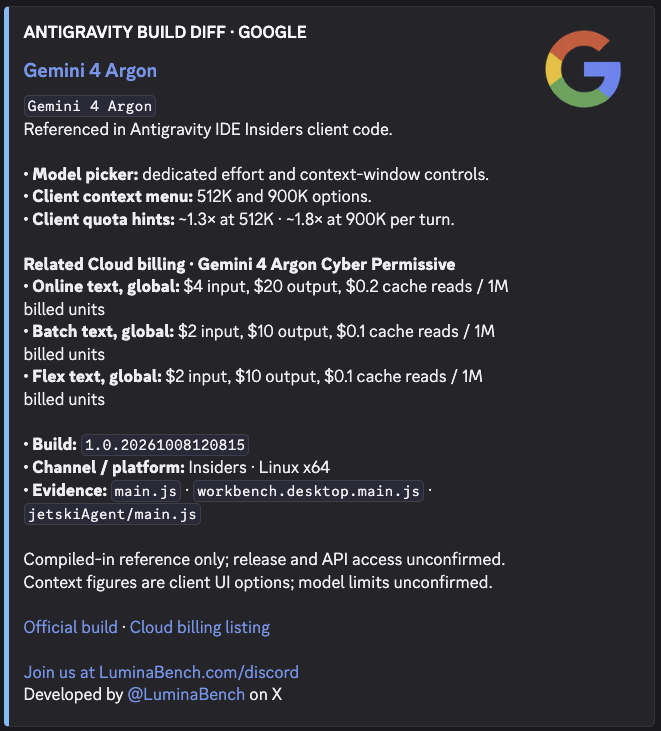
@LuminaBench argued (250 likes, 20 replies, 14,649 views, 15 bookmarks) that Gemini 4 Argon was already sitting in Antigravity code “with effort sliders and everything,” and the attached image added concrete details: 512K and 900K context options plus billing hints around $4 input and $20 output. @testingcatalog added (358 likes, 39 replies, 25,015 views, 44 bookmarks) a screenshot showing the agent renamed to “Chief of stuff,” which made the rollout feel even more like an in-product scavenger hunt.
@ash_twtz captured (159 likes, 27 replies, 10,815 views) the mood plainly: people had been waiting several days for an official Argon release while rumors kept pointing to Antigravity and Google Cloud. The thread quality was low, but the frustration signal was real and repeated across higher-signal posts too.
Discussion insight: The most interesting shift was that packaging details started to matter as much as model quality. Credits, routing, context limits, and rollout timing were no longer back-office details; they were the user experience.
Comparison to prior day: On 2026-10-07, the Antigravity story was “this workflow is real.” On 2026-10-08, the story became “the workflow is real, but access and packaging still feel improvised.”
1.2 Speed tiers, local routing, and sandbox boundaries became competitive product features (🡕)
The second major theme was that coding-agent competition is increasingly happening on latency, routing, and execution boundaries rather than on raw model naming alone. The best-supported posts were not “our model is smartest.” They were “our workflow is faster,” “our routing is smarter,” or “our sandbox boundary is clearer.”
@OpenAIDevs announced (463 likes, 64 replies, 20,172 views, 48 bookmarks) GPT-6.1 Sol Ultrafast for the API, Codex, and ChatGPT Work, describing it as near-Astra intelligence at up to 8x Sol Standard speed. The reply thread supplied the operational details the headline lacked: $12 per million input tokens, $60 per million output tokens, and access gated to Pro 500, eligible usage-based Enterprise, and credit-based Edu plans, with EU data residency support.
@msdev announced (36 likes, 5 replies, 3,632 views, 6 bookmarks) the next Project HydraFusion step for GitHub Copilot on Windows: local models plus intelligent routing between on-device and cloud-scale inference. The replies were more useful than the applause. One said routing only works if it is invisible, while another worried that local inference would compete with Docker, IDEs, and builds for already-constrained workstation resources.
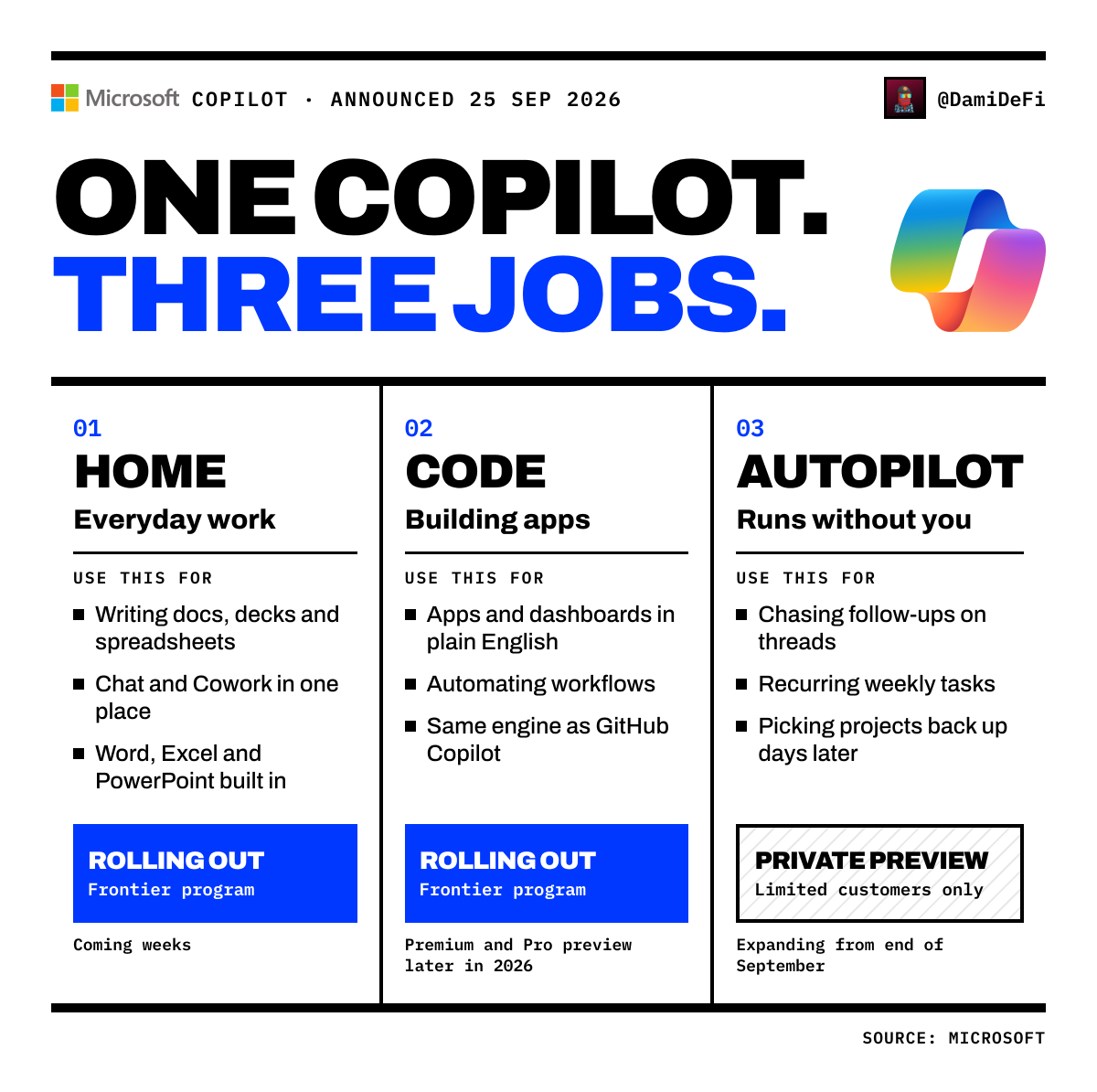
@DamiDefi summarized (141 likes, 10 replies, 2,197 views) Microsoft’s three-way Copilot split into Home, Code, and Autopilot. The most notable part for this dataset was not the branding. It was the product boundary: Code runs sandboxed inside the company tenant, while Autopilot gets its own identity, memory, workspace, and usage-based billing.
@thsottiaux said (265 likes, 78 replies, 16,812 views, 14 bookmarks) “we silently re-shipped codex cloud,” quoting Tailscale’s note that Codex Cloud can now securely connect to tailnet resources. The replies immediately asked for Mac and Windows cloud environments, SSH access, and local-to-cloud chat continuity, which shows where the next bar is moving: once cloud execution exists, people want their existing session state and device context to follow it.
Discussion insight: Latency is no longer the only speed question. People increasingly care about the whole path: plan gating, routing decisions, data residency, local-vs-cloud transitions, and whether execution boundaries are explicit enough to trust.
Comparison to prior day: On 2026-10-07, local-plus-cloud routing looked like a promising architecture. On 2026-10-08, routing, billing, and sandboxing were treated as user-facing product knobs.
1.3 Wrappers, registries, and vertical helpers kept becoming the real coding-agent product surface (🡕)
The third theme was that many builders are not replacing frontier models. They are wrapping them with registries, gateways, document parsers, and collaboration layers that make the same models cheaper, narrower, or easier to compose.
@Aria_Nawi described (76 likes, 13 replies, 8,619 views) an earnings-day workflow where NDI document intelligence parses a 10-Q, synthetic GPU invoices, and leadership posts from X, while Drex 1.5 turns the material into 500 decision questions and explicitly says “insufficient data” when the evidence does not support a claim. That last detail mattered because it framed narrow vertical tooling as a reliability move, not just a cost move.
@Bober_smart promoted (30 likes, 12 replies, 1,403 views, 26 bookmarks) OmniRoute as a local, OpenAI-compatible gateway that can combine free limits from 350+ providers and 90+ services, auto-fallback on quota errors, and compress context before dispatch. The post is obviously promotional, but the interesting angle was the product thesis: routing, compression, and key custody become the differentiator rather than model ownership.
@bernirov boosted (15 likes, 9 replies, 244 views, 8 bookmarks) alook as a way for existing local coding agents to get handles, inboxes, rooms, and direct messaging without moving the files off-machine. @Freedkinng made (28 likes, 8 replies, 513 views, 10 bookmarks) a similar point about Rokha: discovery, execution traces, and MCP/A2A registries are increasingly the product, not just the chat shell around them.
Discussion insight: The sharpest builder signal was not “another copilot.” It was “help me reuse the agents, providers, and subscriptions I already have, but make them easier to route, discover, and trust.”
Comparison to prior day: On 2026-10-07, wrappers and connectors were emerging. On 2026-10-08, they looked even more like the real product layer around shared model access.
2. What Frustrates People
Access, rollout timing, and credits are still too fragmented
Severity: High. @EvanOtero posted (503 likes, 33 replies, 24,247 views, 564 bookmarks) a credits reminder, but the replies turned into a bug report on fragmented redemption flows. @ash_twtz complained (159 likes, 27 replies, 10,815 views) that Google still had not officially announced Argon despite rumors and sightings, and @LuminaBench showed (250 likes, 20 replies, 14,649 views, 15 bookmarks) why users felt baited: the UI already exposed concrete context and pricing hints. People are coping by watching build diffs, developer replies, and model pickers instead of trusting official rollout copy. Worth building: High.
Plan gating and quota economics are shaping tool choice as much as model quality
Severity: High. @OpenAIDevs announced (463 likes, 64 replies, 20,172 views, 48 bookmarks) Ultrafast, but the immediate questions were about pricing and who gets access. @thsottiaux said (265 likes, 78 replies, 16,812 views, 14 bookmarks) Codex Cloud is back, and the replies asked for more value, more continuity, and more platforms rather than another branded surface. @Bober_smart framed (30 likes, 12 replies, 1,403 views, 26 bookmarks) OmniRoute around squeezing more useful work out of free limits and auto-fallbacks. The coping strategy everywhere was obvious: people route around quotas before they route around capability. Worth building: High.
Local-cloud continuity is still weaker than the surrounding marketing promises
Severity: Medium-High. @msdev promoted (36 likes, 5 replies, 3,632 views, 6 bookmarks) intelligent local/cloud routing, but replies worried about workstation contention and invisible model switching. @thsottiaux got (265 likes, 78 replies, 16,812 views, 14 bookmarks) direct requests for Mac and Windows cloud environments, SSH, and local-to-cloud chat carryover. The pain is not “cloud agents do not exist.” It is “the session boundary still feels sharper than it should.” Worth building: High.
General coding agents still need narrow data and document helpers to avoid guessing
Severity: Medium-High. @Aria_Nawi highlighted (76 likes, 13 replies, 8,619 views) a filing-review workflow where the differentiator was not just reading faster, but explicitly returning “insufficient data” instead of forcing a confident answer. @bernirov boosted (15 likes, 9 replies, 244 views, 8 bookmarks) alook precisely because it works with agents people already run, and @Freedkinng argued (28 likes, 8 replies, 513 views, 10 bookmarks) that registries and traces may matter more than smarter standalone models. Worth building: High.
3. What People Wish Existed
A single entitlement-aware control plane for coding agents
People clearly want one place that understands credits, quotas, model availability, and subscription entitlements before a session breaks. @EvanOtero and @LuminaBench both show why: users are reading UIs and reply threads to reconstruct access rules that the product should probably explain itself. This is a practical need with immediate workflow value. Opportunity: Direct.
Fast modes with simple access rules and visible tradeoffs
The demand for Ultrafast was not just “make it faster.” It was “make the fast path understandable.” @OpenAIDevs supplied pricing and access details in replies because people increasingly evaluate a speed tier as a separate product with separate billing semantics. The same pattern shows up in local routing and cloud continuity posts. Opportunity: Direct.
Seamless local-cloud handoff without session amnesia
The Codex Cloud and HydraFusion posts imply a pretty specific need: let local and cloud execution feel like one agent with one memory and one trust boundary, not two separate modes. The replies asking for local-chat carryover, SSH, and invisible routing were much more concrete than generic “I want better tooling” language. Opportunity: Direct.
Narrow document, registry, and routing layers that keep agents from guessing
NDI/Drex, alook, Rokha, and OmniRoute all point at the same desire: use a smaller, more bounded layer to parse, route, discover, or prove before the big model improvises. This need is partly practical and partly emotional. People want fewer unsupported guesses and fewer full rewrites when a smaller control layer could have prevented the mistake. Opportunity: Competitive.
4. Tools and Methods in Use
| Tool | Category | Sentiment | Strengths | Limitations |
|---|---|---|---|---|
| Antigravity | Agent coding surface | (+/-) | Real design-to-device Android workflow, emulator validation, physical-device build | Access and rollout still feel fragmented, especially around Argon |
| GPT-6.1 Sol Ultrafast | Model tier | (+/-) | Much faster response path for coding and live agent work, clear API pricing | Plan gating and higher spend make it a selective tool, not a default |
| GitHub Copilot HydraFusion | Local/cloud routing | (+) | Promises automatic on-device vs cloud routing and clearer sandbox boundaries | Replies raise workstation contention and hidden-routing concerns |
| Codex Cloud + Tailscale | Cloud execution | (+/-) | Secure tailnet access and a revived cloud-agent surface | Users still want better continuity, SSH, and non-Linux environments |
| NDI 1.0 + Drex 1.5 | Vertical document intelligence | (+) | Domain-specific parsing and decision workflows with explicit “insufficient data” behavior | Evidence is still mostly vendor-adjacent and narrow to document-heavy jobs |
| OmniRoute | Routing gateway | (+/-) | Multi-provider fallback, context compression, local key custody | Promotional evidence only; actual savings and robustness need broader validation |
| alook / Rokha registry patterns | Agent collaboration / discovery | (+) | Works with existing agents, adds traceable discovery and communication layers | Early ecosystems with limited neutral evidence so far |
The tools picture was less about picking one winner and more about stacking layers. Builders mixed a primary coding surface, a speed tier or routing engine, and one or more narrow helpers for documents, discovery, or coordination.
The competitive dynamics were also clear: Google owned the most attention, OpenAI owned the cleanest speed-tier announcement, and the open-source edge kept showing up in gateways, registries, and wrappers that help reuse what people already pay for.
5. What People Are Building
| Project | Who built it | What it does | Problem it solves | Stack | Stage | Links |
|---|---|---|---|---|---|---|
| Antigravity Android loop | @googledevs | Turns design inputs into native Android components, validates in an emulator, and builds on a device | Reduces the gap between design intent and verified mobile implementation | Stitch MCP, Android CLI, Jetpack Compose, emulator + device loop | Beta | tweet |
| Codex Cloud with tailnet access | @Tailscale / @thsottiaux | Lets Codex Cloud connect securely to tailnet resources | Makes cloud execution usable against private development environments | Codex Cloud, Tailscale tailnet connectivity | Beta | tweet |
| NDI 1.0 + Drex workflow | @NaceAI | Parses financial documents and turns them into decision questions with provenance-aware output | Helps document-heavy workflows avoid unsupported conclusions | Small document model, Drex 1.5, CLI + SDK integrations | Shipped | tweet, workflow example |
| alook | @im_gusye | Gives local coding agents handles, rooms, inboxes, and direct communication | Lets teams reuse existing local agents instead of moving to a new hosted platform | Local agents, open-source collaboration layer, BYO agent runtimes | Alpha | quote source |
| Rokha registry | @rokha_agent | Pulls skills and tools from multiple registries and exposes discoverable execution traces | Makes agent discovery and execution distribution visible across MCP/A2A surfaces | Registry aggregation, MCP, A2A, execution traces | Beta | tweet, registry note |
The strongest build pattern was not “train a better model.” It was “put a narrower system around the model.” Builders kept shipping routing layers, registries, local-first collaboration shells, and document-specific stacks that make general models safer or cheaper to use.
A second repeated pattern was reuse. Codex Cloud leans on existing private infrastructure, alook works with agents people already run, Rokha aggregates existing skills, and OmniRoute tries to combine existing provider limits instead of inventing a new model tier from scratch.
6. New and Notable
Copilot’s split into Home, Code, and Autopilot made the product strategy legible
@DamiDefi summarized (141 likes, 10 replies, 2,197 views) Microsoft’s three-part Copilot surface, and the most important part for this feed was Autopilot’s positioning as a long-running worker with its own identity, memory, workspace, and usage-based billing. That is a meaningful shift away from “copilot as chat tab.”
Discovery and communication layers kept looking like the next battleground
@bernirov boosted alook as Discord-like coordination for existing agents, while @Freedkinng argued that Rokha’s registry and trace surfaces are where agent utility compounds. The notable part is not just that these projects exist. It is that they treat discovery, messaging, and traces as first-class product surfaces.
7. Where the Opportunities Are
[+++] Entitlement-aware agent control planes — The clearest pain today was fragmented access logic across credits, rollouts, tiers, and model selectors. A product that explains and optimizes entitlement state before work begins would remove obvious friction.
[++] Seamless local/cloud routing with session continuity — HydraFusion, Codex Cloud, and the related replies all point toward the same moderate-strength opportunity: unify routing, continuity, and sandbox boundaries so developers do not have to think in separate local and cloud modes.
[+] Vertical document and decision helpers — NDI/Drex proved there is real appetite for narrow models that can say “insufficient data” and stay close to source evidence. The opportunity is emerging, but it is already grounded in a concrete workflow class.
8. Takeaways
- Google still owned the loudest coding-agent narrative, but users increasingly judged it on access and packaging rather than on demo quality alone. The Android workflow remained credible, while credits and Argon rollout clues dominated the replies. (googledevs, EvanOtero, LuminaBench)
- Speed became a separate product surface with its own billing and trust questions. Ultrafast, HydraFusion, and Codex Cloud all sold workflow shape, not just model quality. (OpenAIDevs, msdev, thsottiaux)
- The real open-source differentiation kept showing up in gateways, registries, and wrappers. Builders were not trying to out-model OpenAI or Google. They were trying to route, compress, discover, and coordinate more effectively around shared model access. (Bober_smart, bernirov, Freedkinng)
- Narrow vertical helpers are becoming one of the cleanest ways to make coding-adjacent agents feel trustworthy. The best example in the dataset was a document-and-decision stack that prefers “insufficient data” over a forced answer. (Aria_Nawi, NaceAI)