Twitter AI Coding - 2026-10-10
1. What People Are Talking About
1.1 Gemini 4 Argon looked more wired-up than released (🡒)
Gemini 4 Argon remained the loudest single topic in Twitter AI-coding, but the conversation was still centered on hidden UI states, context limits, and plan behavior rather than a public launch. At least five high-signal items supported the same pattern: people could see more of Antigravity's internal shape than its actual availability.
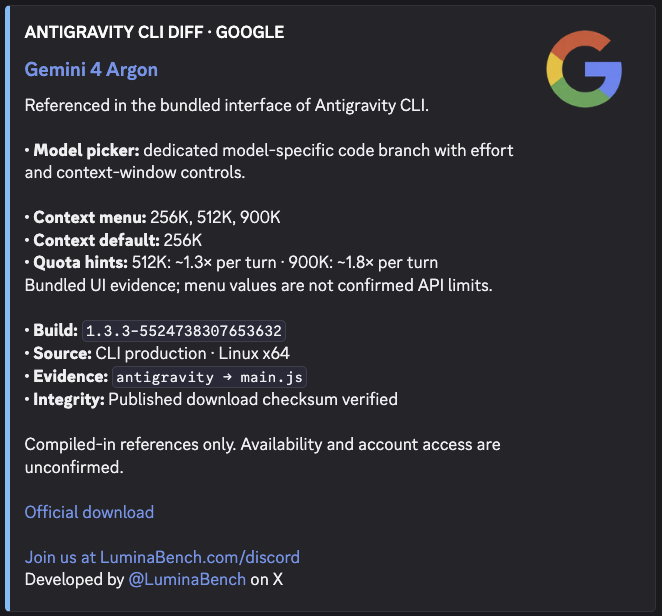
@LuminaBench argued (428 likes, 42 replies, 22,981 views) that Argon looked fully wired into Antigravity and that older models were leaving soon. The attached diff card mattered more than the caption because it listed a dedicated Argon branch, 256K, 512K, and 900K context options, and quota hints of roughly 1.3x and 1.8x per turn while still warning that availability and account access were unconfirmed.
@testingcatalog reported (217 likes, 16 replies, 16,928 views) that hidden Antigravity builds now referenced low, medium, and high Argon reasoning efforts, while Gemini web showed the same selector across models. The screenshot also showed Gemini 3.7 Flash, Gemini 3.6 Flash, and Gemini 3.1 Pro marked Leaving Soon, making rollout timing feel more urgent because the visible replacement was still server-side hidden.

@StatsWire showed (49 likes, 6 replies, 4,523 views) a narrower but useful version of the same claim: a 256K, 512K, and 900K context chooser where the two larger options were labeled expensive.

@VulKan42069 added (30 likes, 3 replies, 1,704 views) that Opus 5.5 and Sonnet 5.5 had appeared for some Google AI Pro discount or student users, reinforcing the sense that entitlement state, not raw capability, was the practical bottleneck.
Discussion insight: The replies were less about Argon's quality than about release trust. One prominent reply said, "At this point I give up expecting it to release," while testingcatalog explicitly answered that the feature was still hidden and not released server-side.
Comparison to prior day: On 2026-10-09 the same conversation revolved around redeeming credits and Leaving Soon labels. On 2026-10-10, users had more concrete UI evidence—reasoning tiers and 900K context hints—but still not a public rollout.
1.2 Memory stopped being a vague wish and became a product category (🡕)
Persistent context was the clearest growth theme underneath the headline model chatter. At least six retained items were not asking whether memory matters; they were comparing built-in memories, repo-bound memories, project surfaces, and cross-agent recall systems.
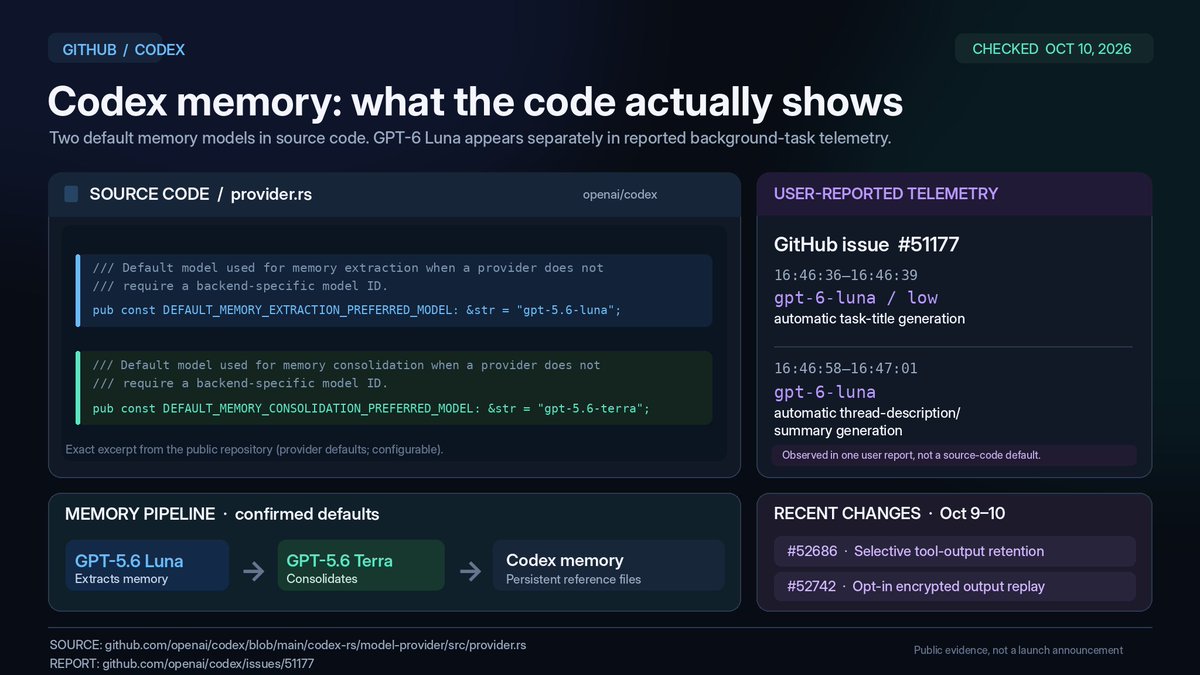
@TokenGremlin claimed (82 likes, 11 replies, 4,119 views) that Codex memory currently splits work across GPT-5.6 Luna for extraction, GPT-6 Luna for titles and descriptions, and GPT-5.6 Terra for consolidation. The attached card grounded that claim in cited source-code defaults and one public telemetry report, while the tweet's main warning was that some Plus and Team users were already seeing meaningful usage consumption from the memory pipeline.
@Nozelcode argued (15 likes, 14 replies, 1,586 views) that coding agents do not just forget the chat; they forget the project, including failed approaches and odd-looking functions that already have context behind them. The quoted launch post from @MemoraX_AI reframed that as a shipping product problem rather than a vague future wish, promising a memory layer for Codex, Claude Code, OpenCode, Trae, and WorkBuddy.

@shadcn said (60 likes, 9 replies, 3,751 views, 25 bookmarks) that most Claude Code work now happens inside Projects. The reply thread immediately exposed the next problem after persistence: one reply said GitLab support was still missing, and another asked whether Projects create a walled garden that makes other tools harder to use.
@jetwaniavinash shared (1 like, 2 replies, 11 views) a smaller but unusually concrete result set for jevmem: Claude followed prior rules in 66 of 72 sessions with the memory layer versus 28 of 72 without it. The public repo README makes the same point in more detail, positioning JEVMEM.md as a repo-tracked memory file that Claude, Cursor, and Codex can reuse.

@DanKornas described (8 likes, 11 replies, 625 views) cass-memory as a cross-agent playbook system that turns session history into searchable context, structured summaries, and confidence-tracked rules. Its public repo framed the same idea as three layers—episodic, working, and procedural memory—so the same lesson can help Claude Code, Codex, Cursor, Aider, and other tools.
Discussion insight: The replies were not blindly positive. Users immediately asked about bad memories, cleanup over time, portability to chat products, and whether memory systems should be opt-in because they may burn usage or preserve the wrong lesson.
Comparison to prior day: On 2026-10-09, persistence showed up as a useful feature request around mobile shells and decision layers. On 2026-10-10, memory had visibly fragmented into competing implementation choices with measured A/B claims, source-code screenshots, and launch posts.
1.3 Skill packs, evals, and guardrails were becoming first-class agent infrastructure (🡕)
A third cluster of high-signal tweets treated agent quality as something to be taught, measured, or constrained rather than simply bought from a stronger model. At least five retained items fit this pattern, spanning eval design, per-domain skills, and runtime controls.
@sermakarevich posted (80 likes, 22 replies, 3,378 views, 108 bookmarks) about agentic evals, and the most useful evidence came in the replies. He said a reply-only grader passed 58 of 60 runs in one example, but a state-based check passed only 48 because 10 runs claimed "your refund is on its way" without any refund existing in system state.
@alex_verem surfaced (32 likes, 3 replies, 2,398 views, 36 bookmarks) Matt Pocock's Skills For Real Engineers repo as a fix for agent misalignment. The public repo showed about 284,000 stars and centered on small reusable skills such as /grill-me, /grill-with-docs, /tdd, and /diagnosing-bugs rather than a single end-to-end framework.
@DanKornas shared (14 likes, 8 replies, 827 views) Pulumi Agent Skills for infrastructure-as-code work. The README showed why that resonated: the pack is split into migration, Pulumi operations, package maintenance, and Neo handoff skills, and it explicitly supports Claude Code, GitHub Copilot, Cursor, VS Code, Codex, and Gemini CLI.
@KitPloit highlighted (10 likes, 1,412 views) geo-sleuth, an agent skill that geolocates a single photo using OpenStreetMap geometry, elevation skylines, satellite tiles, and street view while showing its work. Its public repo showed about 1,680 GitHub stars and emphasized file-by-file evidence rather than opaque model guesses.
@OrenMe argued (26 likes, 4 replies, 2,343 views) that org-billed Copilot code review and policy controls turn review into a team capability instead of a personal quota gamble, while @GHchangelog announced (5 likes, 1,089 views) local sandboxing for Copilot sessions at no extra cost.
Discussion insight: The most consistent ask was not make the model smarter. It was make the agent easier to steer, safer to run, and easier to verify. Even the eval thread pushed toward state checks, tool traces, and permission scope rather than nicer prose.
Comparison to prior day: On 2026-10-09 the strongest builder activity was around routers, decision models, and private inference. On 2026-10-10 the same impulse spread into standardized skills, formal eval criteria, and built-in sandboxing.
2. What Frustrates People
Launch-state opacity and quota math around Antigravity
Severity: High. @LuminaBench argued (428 likes, 42 replies, 22,981 views), @testingcatalog reported (217 likes, 16 replies, 16,928 views), and @StatsWire showed (49 likes, 6 replies, 4,523 views) the same pattern from different angles: hidden Argon tiers, older models marked Leaving Soon, and larger context sizes explicitly labeled expensive before the public release existed. @VulKan42069 reported (30 likes, 3 replies, 1,704 views) that Opus 5.5 and Sonnet 5.5 had appeared for some Google AI Pro discount or student users, implying entitlement paths were already diverging. People are coping by tracking hidden menus, trying alternate plans, and reusing whatever authenticated client surfaces already work. Worth building: High.
Agents still lose project memory between sessions
Severity: High. @Nozelcode argued (15 likes, 14 replies, 1,586 views) that agents forget the project itself, including prior fixes and the reasons behind awkward-looking code. @shadcn said (60 likes, 9 replies, 3,751 views, 25 bookmarks) that most Claude Code work now lives in Projects, @TokenGremlin claimed (82 likes, 11 replies, 4,119 views) Codex memory can itself consume meaningful usage, and @jetwaniavinash showed (1 like, 2 replies, 11 views) a 66-of-72 versus 28-of-72 rule-following result for jevmem. @DanKornas described (8 likes, 11 replies, 625 views) cass-memory as another attempt to carry decisions and anti-patterns across tools. People are coping with Projects, repo-scoped memory files, and cross-agent playbooks layered on top of the agent. Worth building: High.
Usage ceilings, resets, and cost ownership still interrupt real work
Severity: High. @CodexResets1 complained (13 likes, 2 replies, 1,001 views) that Astra usage seemed depleted after two prompts, and the attached screenshot showed a 5-hour limit with 25% left and a weekly limit with 45% left. @OrenMe argued (26 likes, 4 replies, 2,343 views) that developers avoid Copilot code review when it burns their personal quota, while GitHub's code review billing update explicitly added org-billed reviews and optional budgets. People are coping by rationing resets, treating reviews as a limited baseline instead of an every-push default, and moving spend to org cost centers where possible.

Worth building: High.
Some coding tasks remain stubbornly weak fits for today's agents
Severity: Medium. @theo asked (85 likes, 73 replies, 7,585 views) what AI is still really bad at, and the best replies clustered around UX hierarchy and navigation work, Xcode performance optimization, batch files plus GitHub CI, distributed-systems design, and 3D humanoid modeling or animation. This is only one discussion thread, but it is still a useful practitioner signal because the answers named concrete failure classes instead of offering generic skepticism. People are coping by keeping humans deeper in design, performance, and system-shape decisions even when agents handle more routine coding. Worth building: Medium.
3. What People Wish Existed
A portable memory layer that survives tools and sessions
People are explicitly asking for memory that is not trapped inside one vendor surface. @Nozelcode, @shadcn, @jetwaniavinash, and @DanKornas all described the same problem in different words: agents keep losing project-specific decisions between sessions. Partial solutions exist today—Projects, JEVMEM.md, MemoraX Code, and cass-memory—but the field is still fragmented between vendor-native memory and add-on memory layers. Opportunity: Direct.
Eval systems that grade end state, tool use, and permission scope
The strongest explicit request today was for evaluation that checks whether an agent actually changed the right state, called the right tools, and stayed within allowed scope. @sermakarevich said a reply-only grader passed 58 of 60 runs while a state check passed 48, and multiple replies asked how to handle nondeterminism, null-agent baselines, and permission reach. This is a practical need for teams already deploying agents, not an aspirational research wish. Opportunity: Direct.
Clear release, quota, and billing dashboards for agent products
Argon watchers were effectively asking for one truthful control plane: what is live, what is hidden, what is leaving, what larger context costs, and which account actually qualifies. The same need appeared on the OpenAI side via Astra limit complaints and on the GitHub side via org-billed code review and budget controls. Current partial answers exist in model pickers, plan pages, and admin policies, but the evidence today shows users still triangulating from screenshots and reply threads. Opportunity: Direct.
Disposable and mobile agent surfaces with the same tooling
Users want the same agent loop on a phone, in an ephemeral Linux VM, and inside safer local sandboxes without reinstalling or relearning everything. @SahilPanhotra showed a Railway trial VM with Claude Code, Codex, and OpenCode preinstalled; @st7evechou showed OpenCode iOS pairing screens; @bidyut_io ran Antigravity CLI on Android; and GitHub added local sandboxing across Copilot surfaces. This is practical, but the market already has multiple partial answers, so the opportunity looks more competitive than empty. Opportunity: Competitive.
4. Tools and Methods in Use
| Tool | Category | Sentiment | Strengths | Limitations |
|---|---|---|---|---|
| Gemini 4 Argon / Antigravity | Agent IDE / model surface | (+/-) | Hidden reasoning tiers, 256K-900K context hints, strong demand | Still hidden, quota-sensitive larger windows, entitlement ambiguity |
| Claude Code Projects | Project memory surface | (+) | Repo-specific persistence; preferred default for some heavy users | GitLab gap; walled-garden concern |
| Codex memory | Memory layer | (+/-) | Automatic extraction, summarization, and consolidation of context | Users report extra usage consumption; cleanup quality is questioned |
| jevmem | Repo memory plugin | (+) | Repo-tracked rules, 66/72 recall example, works across Claude, Cursor, and Codex | Extra setup and key management; still complements rather than replaces hand-written rules |
| cass-memory | Cross-agent memory CLI | (+) | Searchable history, playbook rules, anti-pattern tracking across agents | Alpha-stage and additional workflow overhead |
| Skills For Real Engineers | Skill pack | (+) | Alignment, glossary, TDD, and bug-diagnosis workflows across agents | Requires per-repo customization and user discipline |
| Pulumi Agent Skills | Domain skill pack | (+) | Focused IaC migrations and operations across major coding agents | Narrow to infrastructure workflows |
| geo-sleuth | Specialist agent skill | (+) | Verifiable photo geolocation with an explicit evidence trail | Narrow use case and non-trivial setup |
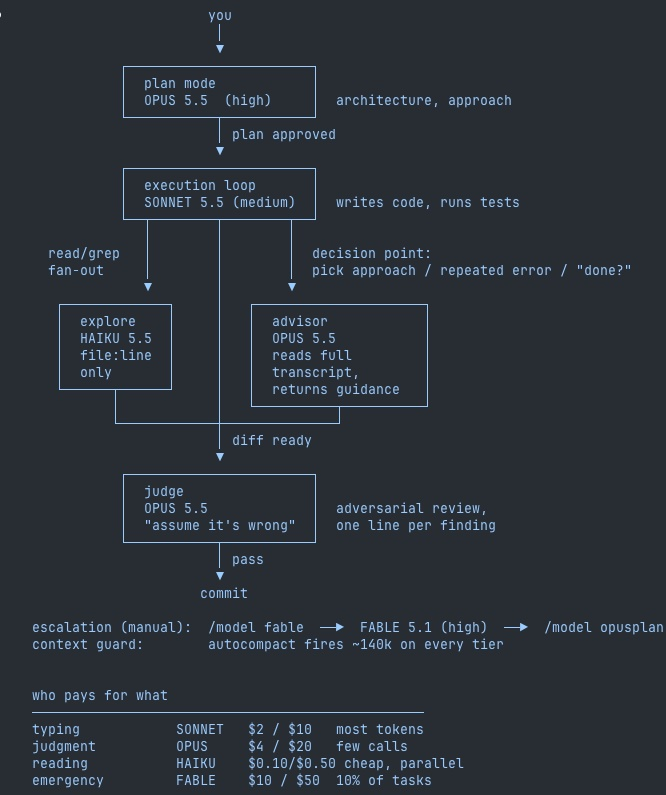
| Custom multi-model routing in Claude Code | Workflow method | (+) | Splits planning, coding, search, and criticism across cheaper or stronger models | More moving parts and configuration complexity |
| GitHub Copilot local sandboxing | Safety / runtime control | (+) | Limits file, network, and credential access at no extra cost | Needs policy decisions and does not solve model or quota gaps |
| Railway trial VM | Runtime / sandbox | (+) | Instant Linux box with Claude Code, Codex, and OpenCode preinstalled | 60-minute build window and 24-hour claim period |
The satisfaction spectrum was widest around memory and control layers. Users were clearly willing to add extra software—Projects, JEVMEM.md, playbooks, skill packs, or local sandboxes—if it reduced repeated explanations or made failures easier to inspect.
A common workaround pattern was role splitting: @cyrilXBT shared (33 likes, 12 replies, 2,045 views) a Claude Code setup where Opus plans, Sonnet codes, Haiku searches, and a critic agent reviews the diff before merge.
Migration patterns were less about switching permanently from one lab to another and more about keeping optionality. Projects, repo-memory files, Railway sandboxes, and GitHub sandboxing all reduce lock-in by letting users carry workflow habits across tools or tighten control around a chosen tool. Competitive dynamics are therefore strongest in memory, guardrails, and skill ecosystems, not just base-model branding. Even model choice was framed in task economics instead of list prices: @Vladic_ETH argued (32 likes, 18 replies, 2,001 views) that Sonnet 5.5 on max could cost $7.67 per task while Opus 5.5 on xhigh cost $3.46 for the same score.
5. What People Are Building
| Project | Who built it | What it does | Problem it solves | Stack | Stage | Links |
|---|---|---|---|---|---|---|
| Skills For Real Engineers | Matt Pocock | Reusable engineering skill pack for coding agents | Reduces misalignment, weak specs, brittle tests, and recurring bug loops | Markdown agent skills, plugin installers, multi-agent marketplaces | Shipped | tweet, GitHub |
| MemoraX Code | MemoraX AI | Memory layer that saves project lessons and prior approaches across agents | Agents forget prior fixes, reasoning, and local conventions between sessions | Memory layer, Codex, Claude Code, OpenCode, CLAUDE.md-style conventions |
Shipped | tweet, launch |
| jevmem | Avinash Jetwani | Saves decisions, rules, and failed approaches to JEVMEM.md and recalls them later |
Repo-specific memory without manually maintaining every rule | TypeScript, Jev, Claude plugin, MCP | Shipped | tweet, GitHub |
| cass-memory | Dicklesworthstone | Cross-agent procedural memory CLI with searchable history and playbook rules | Keeps lessons from one agent session available to other tools later | TypeScript, Bun, CLI, playbook and diary layers | Alpha | tweet, GitHub |
| Pulumi Agent Skills | Pulumi | Domain-specific skills for migrations, Pulumi operations, provider maintenance, and Neo handoff | Gives coding agents repeatable infrastructure workflows instead of ad hoc prompt discovery | Python and Markdown skill packs, Pulumi CLI, agentskills standard | Shipped | tweet, GitHub |
| geo-sleuth | Oldcircle | Agent skill that geolocates a photo and returns evidence-backed camera position | Turns image geolocation into a reproducible workflow instead of guesswork | Python, OpenStreetMap, elevation skylines, satellite tiles, street view | Shipped | tweet, GitHub |
| OpenCode iOS | @thdxr | Mobile companion that pairs a phone with an OpenCode session | Extends coding-agent access away from the desktop | OpenCode, iOS, remote pairing | Beta | tweet |
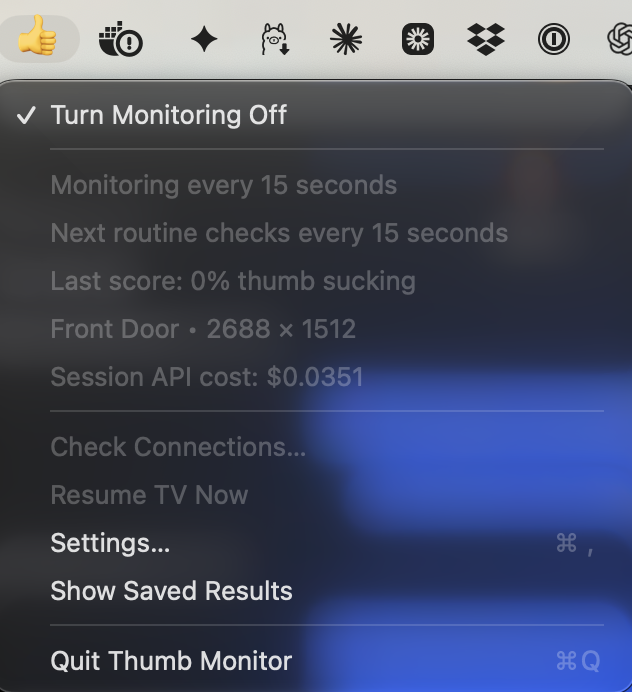
| Thumb-monitor Decisions app | @jamiequint | Watches a Ubiquiti stream and auto-pauses a TV when a thumb-sucking habit is detected | Personal automation built from a real-world home-monitoring need | OpenAI Decisions API, Ubiquiti stream, local controls | Alpha | tweet |
Memory infrastructure dominated the builder table. MemoraX Code, jevmem, and cass-memory all solve the same root pain—agents repeatedly relearning local context—but they place memory in different places: a managed layer, a repo-tracked Markdown file, or a cross-agent playbook system.
The next strongest pattern was narrow, verifiable skills. Skills For Real Engineers, Pulumi Agent Skills, and geo-sleuth all narrow the task, encode expected workflow, and make the agent's work easier to inspect. That is a different builder instinct from shipping another frontier model wrapper.
Lighter-weight surfaces still mattered. OpenCode iOS took agent sessions to the phone, and @jamiequint showed (19 likes, 4 replies, 1,108 views) a working household app tied to a Ubiquiti stream and the Decisions API instead of a generic demo page.
6. New and Notable
State-based agent evals got a concrete benchmark gap
The most useful eval detail today was not a leaderboard. It was a failure mode. @sermakarevich wrote (80 likes, 22 replies, 3,378 views, 108 bookmarks) that reply-only grading can substantially overstate success, and his reply gave a clear example: 58 of 60 runs passed when grading only the answer, while 48 passed when checking end state, required tools, forbidden tools, and step budget. That matters because it turns agent quality from a vague vibe into a narrower, falsifiable claim.
Copilot governance kept expanding across review, sandboxes, and IDE defaults
GitHub's code review billing update let organizations bill reviews to the org instead of the member quota and optionally enforce authorized-user rules. The next day's weekly release note added local sandboxing and separate GitHub and Copilot accounts in the app, and the JetBrains update added enterprise-managed default models plus manual control over MCP server startup. The overall signal is that governance features are no longer edge-case admin work; they are part of the core product race.
Agent portability got lighter-weight fast
@SahilPanhotra showed (32 likes, 10 replies, 1,602 views, 27 bookmarks) a Railway trial VM with 2 vCPU, 2 GB RAM, a live preview URL, and Claude Code, Codex, and OpenCode preinstalled. @st7evechou started testing (3 likes, 2,415 views) OpenCode iOS and showed the remote-pairing flow, while @bidyut_io showed (4 likes, 2 replies, 86 views) Antigravity CLI running inside Termux on Android with a Google AI Pro account. Together they point to the same shift: coding agents are escaping the single desktop shell.


7. Where the Opportunities Are
[+++] Cross-tool project memory with low-overhead recall — Evidence from sections 1, 2, and 5 all points to the same pain: agents still forget local decisions, failed paths, and repo conventions between sessions. Users are testing Projects, MemoraX, jevmem, and cass-memory because the pain is already real. The strongest opening is a memory layer that survives vendor changes, stays inspectable in-repo, and does not burn a noticeable usage budget.
[++] Release and quota observability for agent products — Argon's hidden rollout, 900K context cost hints, Astra depletion complaints, and org-level Copilot billing changes all show a gap between capability and user-visible state. A dashboard that explains availability, context cost, remaining quota, and billing owner before a session starts would solve a problem users are already working around manually.
[++] State-based eval and permission auditing kits — The eval thread's 58-of-60 versus 48-of-60 gap, plus GitHub's sandboxing and review controls, show demand for tooling that checks what an agent changed, which tools it used, and whether its permissions matched policy. This is strong because it touches both quality and safety at once.
[+] Narrow skill packs with verifiable outputs — Skills For Real Engineers, Pulumi Agent Skills, and geo-sleuth all showed that small reusable workflows are getting traction across agents. The opportunity is emerging because the evidence today is still builder-heavy, but the pattern is consistent: when tasks are narrow and outputs are inspectable, trust rises.
8. Takeaways
- Argon dominated attention without becoming a public product. Hidden model pickers, Leaving Soon labels, and 900K context hints gave users more rollout clues, but the main evidence was still screenshots rather than shipped access. (source)
- Persistent memory is now a central AI-coding battleground. Codex memory, MemoraX Code, Claude Code Projects, jevmem, and cass-memory all attacked the same pain: agents keep forgetting repo-specific decisions and failed paths. (source)
- Quality conversations are moving from smart output to state, tools, and guardrails. The clearest eval example today showed 58 of 60 reply-only passes falling to 48 of 60 when state and tool use were checked. (source)
- Builder energy is clustering around narrow, inspectable skills. Skills For Real Engineers, Pulumi Agent Skills, and geo-sleuth all package repeatable workflows that can travel across multiple agent shells. (source)
- Portability is becoming a default expectation. Trial VMs, OpenCode iOS pairing, and Antigravity CLI on Android all pointed toward agent workflows that are no longer anchored to one desktop machine. (source)