Twitter AI - 2026-05-17
1. What People Are Talking About
1.1 Evaluation is moving from generic benchmarks into domain workflows and scorecards 🡕
The strongest May 17 cluster was not another abstract “evals matter” debate. The higher-signal posts were about where evaluation has to live inside real workflows: document-heavy finance work, consumer-finance copilots, industrial procurement, hackathon judging, and formal security venues. Compared with May 16, when the conversation centered on trust becoming operational, May 17 pushes that idea into narrower and more actionable settings.
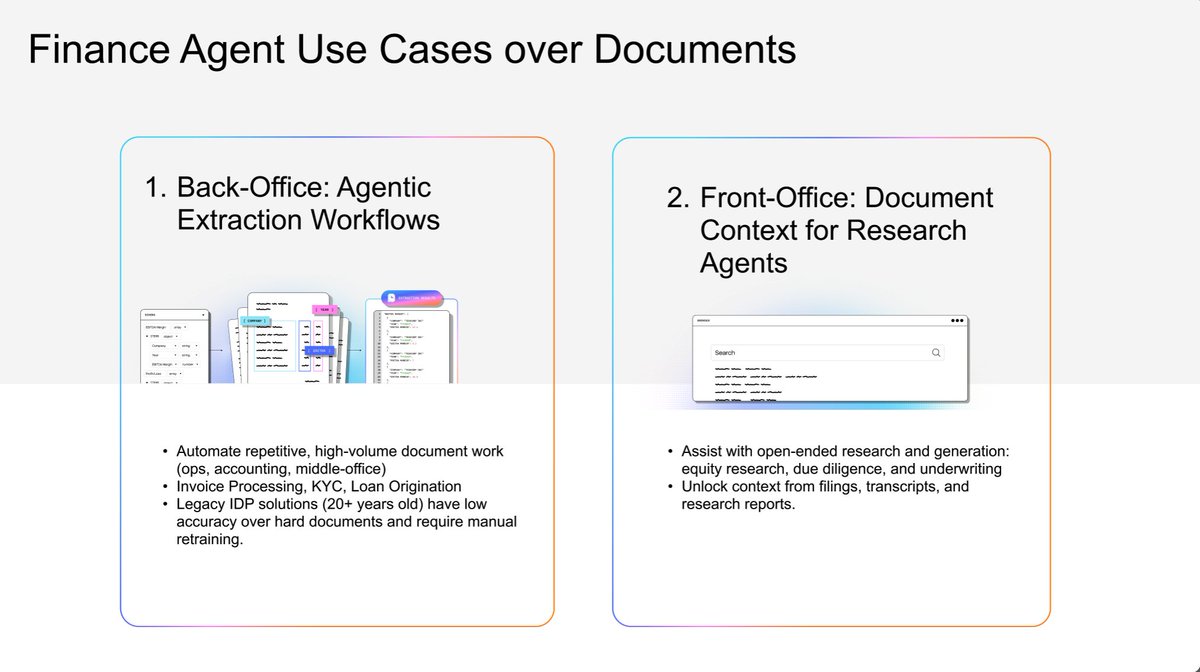
@jerryjliu0 said (86 likes, 8 replies, 5,983 views, 124 bookmarks) that finance agents split into two practical buckets: back-office extraction workflows such as invoice processing, loan origination, and KYC, and front-office research agents for diligence and equity research. The attached slide is informative because it makes that split explicit, and the post ties success to a rigorous OCR layer, evaluation checks, and human-in-the-loop review because “even a slight mistake in number can have catastrophic consequences downstream.”
@emollick argued (106 likes, 21 replies, 9,008 views) that ChatGPT for personal finance is only useful if it ships with pre-built skills that guide users toward good questions and better prompts. His follow-up replies make the operational gap clearer: the system should interview the user to gather context, and at least one practitioner replied that any serious use should force the model to calculate in Python and show the code.
@sahar_abdelnabi announced (23 likes, 3,114 views, 18 bookmarks) the AISec 2026 call for papers, and the workshop page now explicitly includes dangerous-capability evaluations, red-teaming and stress-testing of foundation models, multi-agent coordination risks, and benchmark papers that require artifact sharing at submission time. That matters because the venue is formalizing benchmark and guardrail work as a first-class research output rather than an informal side conversation.

The lower-engagement posts in this cluster were still dense with evidence. @liangdingNLP shared (4 likes, 123 views) Alibaba’s IndustryBench, and the linked paper plus abstract image say the benchmark covers 2,049 industrial-procurement QA items, rejects 70.3% of LLM-generated candidates during external verification, and finds that extended reasoning lowers safety-adjusted scores for 12 of 13 models. @iammaskid posted (51 likes, 13 replies, 800 views) a hackathon-evaluation prototype called JudgeLayer, whose screenshot shows wallet-connected submission, consensus-based scoring, and on-chain verification.

Discussion insight: The discussion did not reject evaluation; it sharpened it. In the personal-finance thread, replies pushed toward interview-style context gathering and visible Python calculations. In the industrial-eval material, the main correction is methodological: aggregate accuracy hides safety violations and unsupported details.
Comparison to prior day: May 16 framed trust as something teams should test. May 17 keeps that direction but narrows it into specific environments: finance documents, industrial standards, hackathon judging, and formal security workshops.
1.2 Smaller, cheaper, and more private AI is becoming a practical demand, not just a research goal 🡕
A second strong theme was capability compression: people were not mainly asking for bigger frontier systems, but for models and methods that fit on one GPU, on edge devices, or on local hardware. The best-supported items combined concrete parameter or bandwidth claims with explicit privacy and cost arguments.
@_vmlops claimed (184 likes, 4 replies, 8,502 views, 165 bookmarks) that Hugging Face PEFT makes single-GPU fine-tuning practical enough that a 12B model that would otherwise OOM on an 80GB A100 can run with LoRA-style adaptation, while a final checkpoint shrinks from 11GB to 19MB. The most useful reply added the constraint: the “0.1% of parameters” framing may hold for loss, but learning a new output format can require a higher rank.
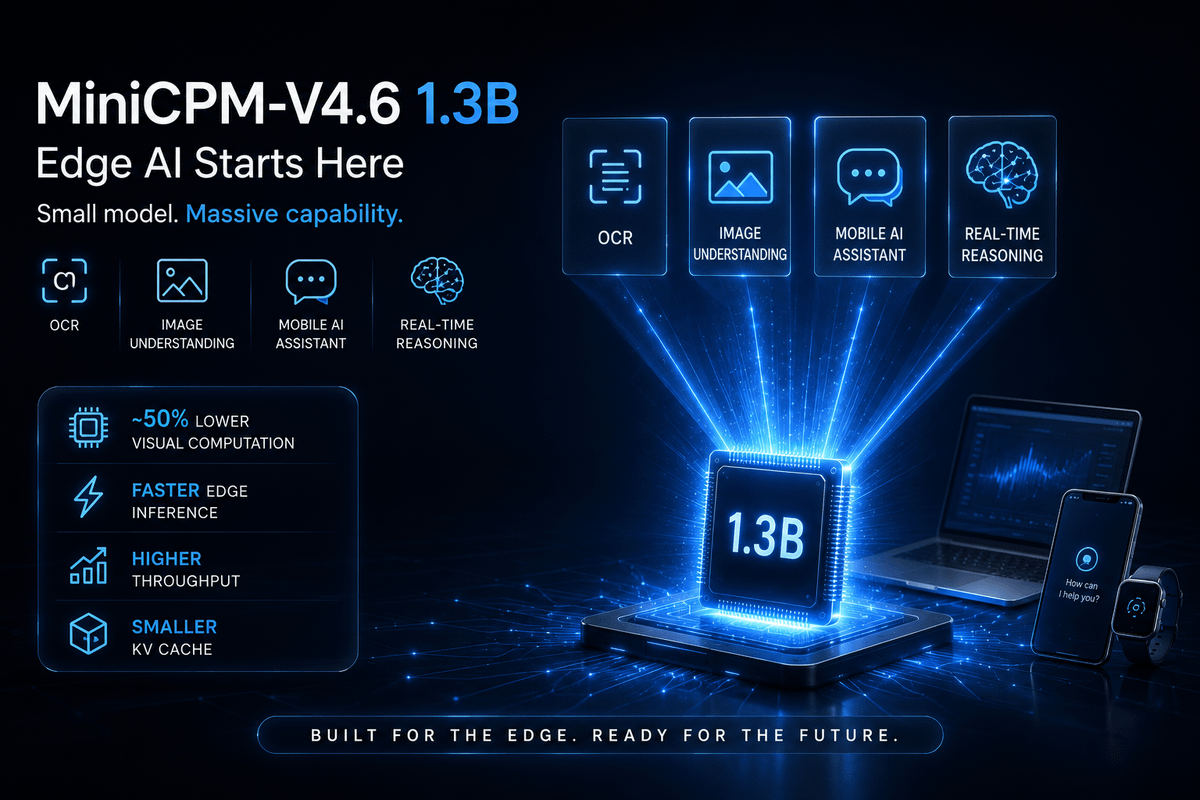
@nrqa__ posted (29 likes, 7 replies, 11,091 views, 14 bookmarks) that MiniCPM-V4.6 1.3B runs on edge devices, beats Qwen3.5-0.8B on key multimodal benchmarks, and cuts visual-compute cost by about 50%. The image is informative because it spells out the intended use cases directly: OCR, image understanding, mobile assistant behavior, realtime reasoning, faster edge inference, higher throughput, and a smaller KV cache.
@jun_song argued (45 likes, 14 replies, 1,403 views) that most non-developers do not need the strongest model; they need uncensored, private, cost-effective local LLMs. The replies make the demand more specific than the headline: one person asked for easy instructions and phone access so ordinary users can actually set up a local model instead of just admiring the idea.
Discussion insight: The push for smaller/private AI is not anti-capability. It is a demand for capability in the right place: a model that can be fine-tuned cheaply, run near the device, or keep user data off the cloud.
Comparison to prior day: May 16 already had edge and specialist-model signals. May 17 is more practical and user-facing: single-GPU fine-tuning, edge multimodal deployment, and explicit calls for local setups ordinary users can operate.
1.3 AI’s physical constraints are showing up in both infrastructure politics and device roadmaps 🡕
The third theme was that AI is still a physical-systems story. On one side, communities are fighting large data centers on energy, land, and governance grounds. On the other, on-device AI ambitions are being bottlenecked by memory packaging and thermals rather than by model marketing alone.
@democracynow reported (183 likes, 4 replies, 5,694 views, 21 bookmarks) Astra Taylor’s argument that resistance to data centers is about “democratic governance over AI,” not just NIMBYism. The accompanying transcript adds the strongest public numbers in the dataset: Gallup found seven in ten Americans oppose nearby data centers, and a proposed Utah complex could consume more energy than the entire state.
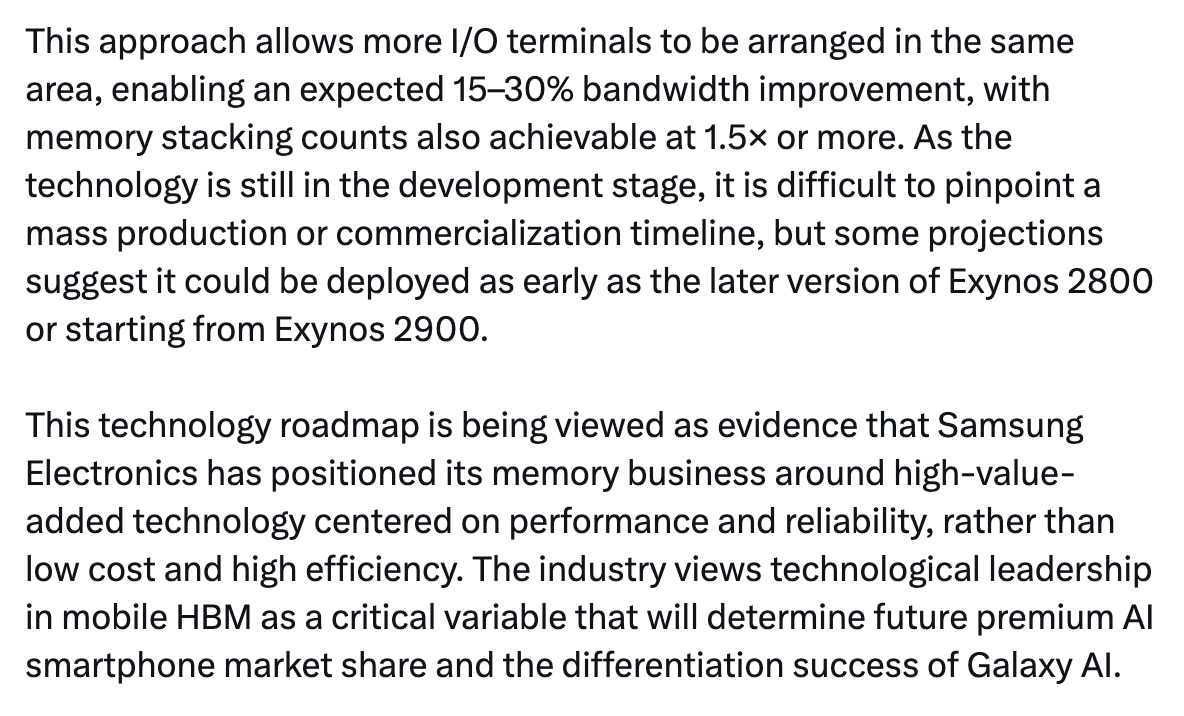
@jukan05 wrote (58 likes, 9 replies, 9,845 views, 17 bookmarks) that true agentic smartphones remain 2-3 years away because existing LPDDR cannot support them, and mobile HBM is the real gating factor. The attached screenshot is informative because it gives the concrete roadmap claim: Samsung’s packaging approach could improve bandwidth by 15-30% and allow 1.5x or greater stack counts, but commercialization timing is still uncertain; replies then add the missing caveat that thermals and power density matter as much as memory bandwidth.
Discussion insight: These posts disagree on scale and politics, but they share one operational point: AI adoption is constrained by energy systems, packaging, cooling, and local tolerance. The obstacles are not just model-quality problems.
Comparison to prior day: May 16 treated data centers as a governance fight. May 17 keeps that fight visible while adding a more product-level bottleneck: on-device AI depends on memory packaging catching up.
1.4 Sector-specific AI adoption is becoming more visible, even as market power stays concentrated 🡕
A final theme was verticalization under concentration. The dataset shows domain-specific AI work appearing in medical education and public health hiring, while a separate market-structure signal says revenue remains heavily concentrated among just two labs.
@PKU1898 showcased (18 likes, 18 replies, 1,440 views) MedSeek, described as China’s first medical-education LLM, at the World Digital Education Conference. The booth photos are informative because they show this is not a vague announcement; there is a live conference exhibit built around an “LLM + Knowledge Base + Smart Agents” stack for healthcare learning.

@ajay_2512x posted (30 likes, 5 replies, 1,847 views, 13 bookmarks) that Tamil Nadu’s government is seeking hands-on AI engineers for healthcare or public-health deployment work in Chennai. The post is just a hiring request, but that is exactly why it matters: it turns “AI in public health” from a conference slogan into a staffing need.
@amir shared (25 likes, 3 replies, 8,177 views) an image stating that Anthropic and OpenAI now capture 89% of model and application revenues generated by 34 top AI startups. The image does not explain the whole market, but it does make the day’s structural contrast legible: domain adoption is widening, while the revenue base feeding those apps is still highly concentrated.
Discussion insight: The adoption posts are concrete but not triumphalist. They show AI entering healthcare education and public administration through demos and hiring, while the revenue-concentration image implies much of the upstream value remains pooled in a few providers.
Comparison to prior day: May 16 mixed institutions, specialist models, and infrastructure. May 17 makes vertical deployment easier to see: healthcare education, public-health hiring, and an explicit concentration datapoint sitting above them.
2. What Frustrates People
Decision-heavy AI still fails unless it gets context, checks, and visible reasoning
The finance-agent and personal-finance posts point to the same frustration from two angles. @jerryjliu0 says document agents in finance still need rigorous OCR, evaluation checks, and human review because even small numeric mistakes can be catastrophic. @emollick says ChatGPT for personal finance still depends too much on the user knowing what to ask, and replies immediately add requirements for interview-style context collection and Python-visible calculations. The IndustryBench paper sharpens the same complaint in another domain: aggregate correctness can hide safety-critical contradictions. Severity: High. Worth building for: yes.
Evaluation is still too manual for most teams that need it
The gap is not whether evaluation matters; it is that many teams still do not have a usable way to do it. @iammaskid is building JudgeLayer because hackathon projects can miss prizes over rule interpretation, while @TDataScience links an article arguing that production AI needs a scorecard spanning accuracy, reliability, latency, cost, and decision quality rather than a “vibe check.” Even @sahar_abdelnabi points the same way indirectly: AISec now requires artifact sharing for benchmark papers. Severity: High. Worth building for: yes.
Private and local AI still has too much setup friction for ordinary users
@jun_song makes the complaint explicit: many users do not need the strongest hosted model, they need private and cost-effective local AI. The replies then translate that into a product requirement: easy instructions, less jargon, and phone access. @_vmlops shows the enabling side of that shift with PEFT-based single-GPU tuning, but the reply about needing higher rank for some output formats is a reminder that these methods still have sharp edges. Severity: Medium-High. Worth building for: yes.
AI infrastructure keeps pushing its hardest constraints onto communities and hardware roadmaps
The Democracy Now transcript linked by @democracynow says communities are being asked to absorb energy use, water use, pollution, and utility-cost risk while getting limited jobs in return. At the device layer, @jukan05 argues that existing mobile memory cannot yet support the agentic-smartphone vision people market today, and replies add that packaging and thermals are just as important as bandwidth. Severity: High. Worth building for: yes.
3. What People Wish Existed
Guided domain skills instead of blank-slate copilots
The clearest demand is not “better AI” in the abstract; it is AI that arrives with the right workflow already encoded. @emollick says personal-finance AI needs pre-built skills, and his replies imply a very specific shape: ask users for missing assumptions, then show the calculations. @jerryjliu0 points to the same gap from the enterprise side, where document agents need OCR, checks, and HITL review before they can be trusted. Opportunity: direct.
Evaluation layers that non-experts can actually use
JudgeLayer is interesting because it starts from an everyday failure mode: projects are judged inconsistently, or against rules that teams only half understood. @iammaskid turns that into a concrete wish for an app that scores a submission before the judges do. The IndustryBench paper and the scorecard article linked by @TDataScience point to the same broader need: evaluation that is source-grounded, safety-aware, and operational enough to survive production. Opportunity: direct.
Local and edge AI that is simple enough for normal users
@jun_song and the replies under that post show that the unmet need is not only cheaper inference. People want private local models they can install without a dense tutorial, and they want those models to work on phones or lightweight devices. @nrqa__ adds the supply-side version of that wish: a 1.3B multimodal model small enough for edge deployment but still useful for OCR and realtime reasoning. Opportunity: direct and competitive.
Physical enablers for true on-device AI
The mobile-HBM thread from @jukan05 reads like a request disguised as analysis. The wish is for a memory and packaging stack that makes agentic smartphones plausible without pretending LPDDR can already do the job. That is a practical infrastructure need rather than a consumer feature request, but the market it unlocks is obvious in the tweet itself. Opportunity: emerging.
4. Tools and Methods in Use
| Tool | Category | Sentiment | Strengths | Limitations |
|---|---|---|---|---|
| PEFT / LoRA | Fine-tuning method | (+) | Makes single-GPU tuning plausible and can shrink checkpoints dramatically | Reply-level evidence says some tasks still need higher rank, especially for new output formats |
| ChatGPT | Consumer AI assistant | (+/-) | Useful for finance exploration and scenario simulation when guided well | Needs better default skills, more context gathering, and visible calculations for trust |
| MiniCPM-V4.6 1.3B | Edge multimodal model | (+) | Promises OCR, image understanding, realtime reasoning, and lower visual-compute cost on edge hardware | Evidence today is still launch-style capability claims rather than independent field reports |
| Local LLMs | Deployment approach | (+/-) | Offer privacy, lower recurring cost, and less dependence on subscriptions | Setup remains too technical for mainstream users and phone integration is still awkward |
| IndustryBench | Benchmark / dataset | (+) | Separates raw correctness from safety violations and releases prompts, scripts, and docs | Research artifact with low present-day adoption signal in the dataset |
| JudgeLayer | Evaluation product / protocol | (+/-) | Makes evaluation legible through transparent scoring, validator consensus, and on-chain verification | Early prototype with wallet flow and no evidence yet of broad production use |
| AISec | Research venue | (+) | Formalizes benchmark papers, dangerous-capability evals, and artifact sharing | Venue, not an operational runtime tool |
| MedSeek | Domain application | (+) | Packages an LLM, knowledge base, and smart agents for medical education | Evidence is a conference exhibit, not outcome data from classrooms or clinics |
The satisfaction spectrum was split by layer. Compression, edge deployment, and local inference drew positive attention because they promise lower cost and more control. Evaluation tools and methods drew supportive but more conditional attention: people want them badly, but the dataset keeps showing how early they still are, from JudgeLayer’s prototype stage to IndustryBench’s “headroom remains” conclusion. The clearest migration pattern was away from one-size-fits-all “best model” thinking and toward narrower stacks: small edge models, local models, explicit scorecards, and domain-specific benchmarks.
5. What People Are Building
| Project | Who built it | What it does | Problem it solves | Stack | Stage | Links |
|---|---|---|---|---|---|---|
| JudgeLayer | @iammaskid | Evaluates hackathon projects against stated rules before submission | Helps teams avoid losing on missed criteria or inconsistent judging | GenLayer, wallet-connected web UI, validator consensus, on-chain verification | Alpha | post |
| IndustryBench | @liangdingNLP | Source-grounded benchmark for industrial procurement QA with separate safety-violation checks | Exposes where aggregate benchmark scores miss unsafe or unsupported answers | Benchmark dataset, scoring scripts, Qwen3-Max judge, source-text verification | Shipped | post, paper, GitHub |
| MedSeek | @PKU1898 | Medical-education model combining an LLM, knowledge base, and smart agents | Gives healthcare learners a domain-specific teaching and reference layer | LLM, knowledge base, smart agents | Alpha | post |
| Awesome AI Agent Papers | @leastsquared_ | Curated 2026 paper list covering multi-agent coordination, memory/RAG, tooling, observability, and security | Reduces the manual work of tracking the exploding AI-agent literature | GitHub, Markdown curation, arXiv links | Shipped | post, repo |
JudgeLayer is the most obviously “born from the feed” build. The meetup photo shows the in-person origin story, and the product screenshot makes the mechanism concrete: connect a wallet, submit a project, and receive a validator-backed evaluation. It is still early, but it is a clean example of evaluation moving from paper talk into product shape.
IndustryBench is less of a product than a piece of shared infrastructure, but it is still builder activity in the sense that it releases prompts, scoring scripts, and dataset documentation for others to build against. Its key distinction is not scale alone; it is the decision to separate raw correctness from explicit safety-violation checks.
MedSeek and the paper-curation repo point to a second builder pattern: vertical packaging. One packages AI for a narrow educational domain; the other packages research discovery for AI engineers who do not want to manually sift arXiv every week. The public-health hiring post from @ajay_2512x reinforces the same direction by showing that at least one government team now wants hands-on AI deployment talent in healthcare, not just strategy talk.
6. New and Notable
Trust in authorship is becoming a visible institutional problem
@htuhairwe claimed (52 likes, 7 replies, 10,604 views) that the weekend front-page story in Uganda's Daily Monitor was written with/by a large language model. That is only one post, but it stands out because it frames AI use as a disclosure and credibility question in mainstream publishing rather than in student cheating or obvious spam alone. The same anxiety appears in another part of the dataset: @TheAtlantic linked (5 likes, 3,406 views, 6 bookmarks) an article arguing that Princeton's 133-year Honor Code has effectively met its match in generative AI, prompting a return to proctored exams. Together, the two items show provenance and authorship moving into public-facing institutions.
Revenue concentration is still outrunning the apparent diversity of AI apps
@amir shared (25 likes, 3 replies, 8,177 views) an image stating that Anthropic and OpenAI now account for 89% of model and application revenues generated by 34 top AI startups. Even if the post is only a headline card, it is still a notable market-structure signal inside a dataset otherwise full of niche builders, local models, public-health hiring, and domain-specific demos.
7. Where the Opportunities Are
[+++] Guided evaluation and workflow layers — The strongest evidence spans sections 1, 2, 3, and 5: finance agents still need OCR, checks, and HITL review; personal-finance copilots need domain skills and visible calculations; IndustryBench shows why raw correctness is not enough; and JudgeLayer turns rule-aware evaluation into a product. This is the clearest direct opportunity in the dataset.
[++] Local and edge AI enablement — The combination of PEFT single-GPU tuning, MiniCPM edge deployment claims, and local-LLM demand points to a real market for onboarding, packaging, and deployment tools that make private AI usable without a specialist. The opportunity is competitive because many pieces already exist, but the usability gap is still obvious.
[+] Physical-AI planning and infrastructure intelligence — Data-center backlash and mobile-HBM bottlenecks both show a need for better planning around energy, memory, thermals, and local tradeoffs. The opportunity is emerging because the need is clear, but the buyers and product boundaries are less settled than in evaluation tooling.
8. Takeaways
- Evaluation is getting embedded inside narrow, high-stakes workflows instead of staying at the benchmark layer. Finance-document agents, consumer-finance copilots, hackathon evaluators, and industrial QA all point in the same direction. (source)
- The demand signal on May 17 favored smaller, cheaper, and more private AI over “largest model wins.” PEFT-based single-GPU tuning, MiniCPM edge deployment, and local-LLM advocacy all reinforce that shift. (source)
- AI’s physical bottlenecks remain visible from both ends of the stack. Communities are pushing back on data-center growth while mobile-AI advocates are still waiting on memory packaging to catch up. (source)
- Vertical adoption is widening even while upstream revenue stays concentrated. Medical education demos and public-health hiring are appearing in the same feed that says Anthropic and OpenAI take 89% of startup AI revenues. (source)