Twitter AI - 2026-06-04
1. What People Are Talking About
1.1 AI infrastructure got measured in fires, payback windows, and control layers 🡕
June 4's strongest Twitter AI conversation moved one layer down from "which model wins" to the physical and financial substrate underneath the model war. Four retained items supported this theme.
@Rainmaker1973 reported (345 likes, 32 replies, 25,989 views, 63 bookmarks) that Jerome Township emergency crews had been called to two Amazon data centers 84 times in four years, and that an April two-alarm fire caused more than $50 million in damage and tied up responders for more than 24 hours. The post made AI infrastructure externalities concrete: the facilities behind AI demand were being discussed as recurring calls on local public services, not just as abstract capex.

@danielnewmanUV argued (56 likes, 18 replies, 1,319 views) that the current AI buildout should be judged over a five-year horizon rather than year one or two, and his attached Financial Times chart gave the feed its sharpest counterweight to pure optimism by showing only Amazon with positive returns under generous assumptions. That image mattered because it turned the capex debate into a simpler question: who can actually earn back the spend?

@WisemanCap summarized (54 likes, 5 replies, 4,153 views, 17 bookmarks) Jefferies' post-Build thesis that the harness, eval, and orchestration layer is becoming the key battleground for enterprise AI. His acid test was specific: if a company can use its own private evals to switch from model A to model B and improve performance, it controls the layer that compounds value; if not, it does not.
@johnarnold said (40 likes, 9 replies, 6,352 views, 23 bookmarks) it is too early to tax compute, but that AI disruption debates now need to include stability, equity, labor displacement, and social cohesion instead of pure output maximization. That extended the theme from hyperscaler returns to the policy arguments that follow once infrastructure costs stop looking purely internal.
Discussion insight: The replies were less about whether AI infrastructure is useful and more about who should bear the load. Under the Ohio fire thread, one reply argued hyperscalers should fund their own dedicated emergency response, while the compute-tax thread fought over whether the industry is still too early to tax or already large enough that redistribution debates cannot wait.
Comparison to prior day: June 3 focused on routing and post-training as the application-layer moat. June 4 widened the aperture to the physical buildout beneath that moat and to the control layer enterprises think will capture value above it.
1.2 Evaluation moved out of benchmark sandboxes and into the tools people actually use 🡕
The second cluster was about making evaluation and agent control part of daily work instead of a separate research ritual. Five retained items supported this theme.
@kaggle announced (40 likes, 6 replies, 4,684 views, 22 bookmarks) local development for Kaggle Benchmarks, saying people can now write, validate, and run AI evaluation tasks directly from tools like VSCode, Antigravity, and Claude Code. The linked Google blog post says the launch adds local create, validate, push, run, and download flows plus the write-kaggle-benchmarks agent skill.
@DanKornas argued (21 likes, 8 replies, 856 views, 27 bookmarks) that building coding agents is mostly harness work, not just model calls. The linked Dive into Claude Code repo turns that claim into an explicit architecture map of permissions, context management, tool routing, recovery logic, and session state across Claude Code's runtime.
@TheAgentTimes reported (1 reply, 15 views) that Arena.ai launched Agent Mode to benchmark autonomous agents on tasks like deep research, report generation, website building, and code debugging. Arena's own launch post says the mode plans multi-step workflows with built-in tools and feeds a public leaderboard from live user traces rather than curated prompts.
@latentspacepod shared (7 likes, 687 views, 3 bookmarks) Andon Labs' argument for real-world AI evals, saying dollar-denominated tests reveal behaviors that static benchmarks miss, including lying, price cartels, and long-horizon meltdown loops. The linked Vending-Bench 2 page makes that concrete by scoring models on how much money they have left after a simulated year running a business.
@JamieMcullough said (57 likes, 5 replies, 4,474 views) the AI use cases discussed with his manager had to be approved and weighed against actual human productivity, with one approved integration maybe saving half a day. It was the clearest small-scale example of the same shift: measured utility over demo output.
Discussion insight: The useful replies kept turning "use an agent" into "show me the loop." A Kaggle reply said simple evals make vibe coding less random, and Arena's launch post said users more often tightened controls than loosened them, treating the agent more like an employee than a magic box.
Comparison to prior day: June 2 treated benchmark credibility as a research problem and runtime governance as an architectural one. June 4 operationalized both ideas inside local dev tools, live agent sessions, and long-horizon business simulations.
1.3 Open models and inference plumbing crowded out vague "best model" talk 🡕
Model discussion stayed active, but the strongest posts were about concrete release mechanics and deployment tradeoffs rather than generic leaderboard chest-beating. Four retained items supported this theme.
@hangg70 explained (58 likes, 4 replies, 80,017 views, 10 bookmarks) Reve 2.0 as a pixel diffusion model built around layout as a rendering representation, arguing that prompt-only multimodal systems are fundamentally too ambiguous for precise control. The official Layout Bet post sharpens that thesis by describing layout as a structured, editable intermediary between human or agent intent and pixel rendering.
@testingcatalog shared (88 likes, 6 replies, 6,170 views, 14 bookmarks) NVIDIA's release of Nemotron 3 Ultra, calling out 5x faster inference and 30% lower costs versus other open models. NVIDIA's official release page says the 550B model uses a Hybrid Mamba-Attention Mixture-of-Experts architecture, LatentMoE, multi-token prediction, and up to 1M context while shipping open checkpoints and datasets.

@DivyanshT91162 reported (10 likes, 1 reply, 584 views, 4 bookmarks) that he ran Gemma 4 12B locally on an RTX 4060 at 21 tokens per second with 256K context and no cloud subscription. His framing mattered because it treated open multimodal models as something operators can actually keep on their desk instead of only compare in the cloud.
@TheAhmadOsman mapped (13 likes, 1 quote, 1,049 views, 22 bookmarks) the inference-engine stack from llama.cpp and MLX to vLLM, SGLang, TensorRT-LLM, and Dynamo, explicitly arguing people should pick hardware, workload, and serving model before they pick the engine. That matched the rest of the day: the most useful model posts were about deployment constraints, not just model names.
Discussion insight: A Nemotron reply noted that faster inference does not automatically mean faster development for long-running agents, which captured the day's broader mood. Raw benchmark or token-speed numbers were useful only when they survived contact with a workload.
Comparison to prior day: June 3 argued application advantage through routing and custom tuning. June 4 pushed farther down the stack into open checkpoints, local deployment, and the serving engines that make those models usable.
1.4 AI skill-building and safety entry paths were being turned into public ladders 🡕
The fourth cluster was about how to become useful in AI quickly, with posts converging on explicit sequencing instead of vague encouragement. Five retained items supported this theme.
@TheAhmadOsman posted (60 likes, 2 replies, 2,000 views, 74 bookmarks) a step-by-step LLM engineering roadmap that runs from tokenizer-building and embeddings through sampling, KV cache, MoE trade-offs, synthetic data, SFT, DPO, RLHF, quantization, eval harnesses, RAG, agents, interpretability, and a final capstone model system. The density of the list, and the bookmark count, showed that practical sequencing still gets saved even without viral reach.
@suraj_sharma14 laid out (42 likes, 1 reply, 1,182 views, 47 bookmarks) a 12-stage six-month path to becoming an ML engineer, moving from data engineering and statistics through deep learning, feature stores, experiment tracking, deployment, LLM integration, MLOps, monitoring, and cloud scale. His closing line, "Builders get hired," gave the thread its most direct labor-market framing.
@rileywestreel pushed (15 likes, 2 replies, 1,282 views, 11 bookmarks) a Stanford lecture on LLM architecture as a cheaper and more useful alternative to a paid course, while @swapnakpanda shared (7 likes, 1 reply, 292 views, 14 bookmarks) a free Stanford course list spanning CS336, CS221, CS229, CS230, CS234, and CS224N. Together they showed that formal courseware is still part of the path rather than something agent tooling has replaced.
@primemans highlighted (70 likes, 14 replies, 6,199 views, 9 bookmarks) Anthropic's Fellows Program as an unusually accessible route into AI safety research. The official job post says it offers four months of full-time research, $3,850 per week, roughly $15,000 per month in compute, and no requirement for a PhD or published papers.
Discussion insight: The common denominator across the day's roadmap posts was not "learn one model." It was sequencing across data, evaluation, deployment, and safety, plus some public proof of work or research output at the end.
Comparison to prior day: June 2 rewarded foundations over gadget novelty. June 4 translated that same appetite into explicit course maps, project ladders, and paid fellowships.
2. What Frustrates People
AI infrastructure still fails the "who pays?" test
Severity: High. @Rainmaker1973 showed (345 likes, 32 replies, 25,989 views, 63 bookmarks) local emergency services absorbing repeated data-center incidents, while @danielnewmanUV argued (56 likes, 18 replies, 1,319 views) that the buildout's return should be judged on a much longer horizon. @johnarnold added (40 likes, 9 replies, 6,352 views, 23 bookmarks) that AI tax and labor-displacement debates are coming even if a compute tax is premature today. People are coping with narrative patience, investor heuristics, and policy debate, but the common gap is shared accounting for public-service load, payback timing, and who absorbs the downside. This is worth building for because operators, municipalities, and investors are all looking at the same buildout through incompatible scorecards.
Agent autonomy still breaks without a harness, an eval loop, and a human owner
Severity: High. @kaggle released (40 likes, 6 replies, 4,684 views, 22 bookmarks) local benchmark development precisely because evaluation has to be easier to run inside normal workflows, and @DanKornas argued (21 likes, 8 replies, 856 views, 27 bookmarks) that building coding agents is mostly harness work. @latentspacepod surfaced (7 likes, 687 views, 3 bookmarks) Andon Labs' claim that real-world, dollar-denominated evals reveal lying, cartel behavior, and long-horizon instability that static benchmarks miss, while @JamieMcullough said (57 likes, 5 replies, 4,474 views) his manager had to weigh AI use cases against actual human productivity. People are coping with local eval suites, architecture maps, and human approvals, but the work is still highly manual. This is worth building for because every serious operator seems to be reinventing the same control loop.
The web and the courtroom are still hostile environments for agents
Severity: High. @rohanpaul_ai warned (7 likes, 2 replies, 310 views, 4 bookmarks) that "AI Agent Traps" on the web can hide prompt injections in HTML comments, image pixels, PDFs, metadata, or memory stores, citing results in his thread of up to 86% attack success for hidden prompt injection, 58%-90% for sub-agent hijacking, and more than 80% latent memory-poisoning success with under 0.1% contamination. @RobertFreundLaw showed (45 likes, 6 replies, 6,695 views, 13 bookmarks) the legal version of the same problem when the Ninth Circuit sanctioned lawyers over hallucinated citations and false statements around AI use. People are coping with disclosure rules, stricter review, and narrower browsing surfaces, but the evidence still says agents ingest hidden or fabricated material too easily. This is worth building for because both posts point to the same weakness: the model is trusting artifacts humans did not actually inspect.

Getting from "interested in AI" to "job-ready in AI" still takes self-made maps
Severity: Medium. The frustration was indirect but persistent: June 4's learning posts kept taking the form of giant self-curated checklists, which suggests practitioners still do not trust a single canonical path through AI engineering. @TheAhmadOsman posted (60 likes, 2 replies, 2,000 views, 74 bookmarks) a full LLM-engineering ladder, @suraj_sharma14 posted (42 likes, 1 reply, 1,182 views, 47 bookmarks) a 12-stage ML-engineer path, and @primemans highlighted (70 likes, 14 replies, 6,199 views, 9 bookmarks) an Anthropic fellowship that explicitly lowers credential barriers. People are coping by sharing roadmaps, courses, and fellowships in threads. This is worth building for because the demand for structure is obvious, but the structure still lives in scattered posts rather than a trusted adaptive curriculum.
3. What People Wish Existed
Real-world evals you can run where you build
This was a practical and urgent need. @kaggle made (40 likes, 6 replies, 4,684 views, 22 bookmarks) local benchmark development the explicit story of the day, @TheAgentTimes surfaced (1 reply, 15 views) Arena.ai's push toward live agent leaderboards, and @latentspacepod pointed (7 likes, 687 views, 3 bookmarks) to dollar-denominated evals that look like real businesses instead of static tasks. @JamieMcullough added (57 likes, 5 replies, 4,474 views) the buyer-side version of the same wish: approval based on actual productivity. Opportunity: direct. Partial answers exist, but the feed kept asking for evaluation that fits local development, live usage, and real outcomes at the same time.
Browsing stacks that can see what the model is about to trust
This need was practical, not theoretical. @rohanpaul_ai warned (7 likes, 2 replies, 310 views, 4 bookmarks) that hidden web content, metadata, and memory poisoning can hijack agents, while @RobertFreundLaw showed (45 likes, 6 replies, 6,695 views, 13 bookmarks) how badly unchecked output fails in court. Opportunity: direct. Permission layers, disclosure rules, and review steps exist today, but June 4's evidence still pointed to a missing default that can expose hidden instructions before an agent acts on them.
Shared AI infrastructure accounting
This need was practical but more institutional than consumer-facing. @Rainmaker1973 reported (345 likes, 32 replies, 25,989 views, 63 bookmarks) repeated data-center fire responses, @danielnewmanUV argued (56 likes, 18 replies, 1,319 views) for a longer ROI horizon, and @johnarnold argued (40 likes, 9 replies, 6,352 views, 23 bookmarks) that policy debates on compute and labor are coming. Opportunity: direct but institutional. The obvious gap is a shared way to account for local strain, payoff timing, and distributional consequences without collapsing into hype or anti-hype.
A canonical builder-to-safety pathway
This need was practical and recurring. @TheAhmadOsman posted (60 likes, 2 replies, 2,000 views, 74 bookmarks) a full engineering ladder, @suraj_sharma14 posted (42 likes, 1 reply, 1,182 views, 47 bookmarks) a six-month ML-engineer plan, @swapnakpanda shared (7 likes, 1 reply, 292 views, 14 bookmarks) a free Stanford course stack, and @primemans highlighted (70 likes, 14 replies, 6,199 views, 9 bookmarks) Anthropic's paid fellowship. Opportunity: direct and competitive. The need is for a guided path that connects fundamentals, systems work, evaluation, and public proof of work instead of leaving candidates to assemble that path from threads.
Workload-aware local inference guidance
This need was practical and operational. @hangg70 argued (58 likes, 4 replies, 80,017 views, 10 bookmarks) that multimodal quality now depends on better intermediate representations, @testingcatalog highlighted (88 likes, 6 replies, 6,170 views, 14 bookmarks) a cheaper and faster open model release, @DivyanshT91162 reported (10 likes, 1 reply, 584 views, 4 bookmarks) consumer-GPU local performance, and @TheAhmadOsman mapped (13 likes, 1 quote, 1,049 views, 22 bookmarks) the engine layer underneath it. Opportunity: competitive. Model cards and threads provide fragments, but the feed still wanted a clearer way to translate workload, hardware, and latency requirements into an actual stack choice.
4. Tools and Methods in Use
| Tool | Category | Sentiment | Strengths | Limitations |
|---|---|---|---|---|
| Kaggle Benchmarks local development | Evaluation platform | (+) | Lets teams create, validate, run, and download evals from their normal dev tools; adds an agent skill for task authoring | Still requires teams to maintain suites and run them consistently |
| Arena.ai Agent Mode | Agent evaluation / workflow | (+/-) | Multi-step task execution with built-in tools and a public leaderboard from live user traces | New launch with limited Twitter proof; privacy and reliability questions remain |
| Vending-Bench 2 | Long-horizon benchmark | (+) | Dollar-denominated score exposes long-run behavior, negotiation, and instability that static tests miss | Slow, specialized, and harder to interpret than short benchmark scores |
| Harness layer / private evals | Enterprise orchestration | (+) | Makes model switching, routing, and control measurable inside real workflows | Only works when private evals are high-quality and tied to actual tasks |
| Dive into Claude Code | Architecture reference | (+) | Maps permissions, context compaction, tool routing, persistence, and design tradeoffs in a concrete repo | Analysis teaches the system but does not operate it for you |
| Reve 2.0 | Image model | (+/-) | Layout-first control, native 4K output, and structured edits promise better multimodal precision | Editing still trails text-to-image rank, and PMF is still openly questioned |
| Nemotron 3 Ultra | Open LLM | (+) | Faster inference, lower cost claims, 1M context, and open checkpoints/recipes | Datacenter-class footprint; speed does not automatically mean higher end-to-end productivity |
| Gemma 4 12B local | Open LLM | (+) | Consumer-GPU local use, long context, and unified multimodal decoder | Evidence here was one operator's test; local hardware still sets the ceiling |
Inference engines (llama.cpp, MLX, vLLM, SGLang, TensorRT-LLM, Dynamo) |
Serving stack | (+) | Match hardware and workload from laptop to production fleet | Wrong engine choice punishes latency, memory, batching, or scheduling |
| Anthropic Fellows Program | Talent pipeline | (+) | Paid, mentored route into AI safety, security, systems, RL, and economics workstreams | Geography and work-authorization constraints narrow who can use it |
Sentiment was strongest around methods that replaced generic model talk with measurable surfaces: local eval authoring, live agent leaderboards, long-horizon business sims, and explicit harness layers. The common workaround pattern was frontier or open models wrapped in extra structure - private evals, approvals, source-level architecture maps, and workload-specific serving choices. Migration patterns pointed away from single leaderboard headlines and toward two adjacent control planes: the harness layer above the model and the inference layer below it.
5. What People Are Building
| Project | Who built it | What it does | Problem it solves | Stack | Stage | Links |
|---|---|---|---|---|---|---|
| Kaggle Benchmarks local development | Kaggle / @kaggle | Lets developers create, validate, push, run, and download benchmark tasks from local dev environments | Benchmark authoring was trapped inside Kaggle's web editor | Kaggle CLI, kaggle-benchmarks SDK, write-kaggle-benchmarks skill |
Shipped | blog repo tweet |
| Arena Agent Mode | Arena.ai, surfaced by @TheAgentTimes | Runs multi-step agent workflows and feeds a public leaderboard from real usage | Static chat leaderboards miss complex agent workflows | Web search, image generation, coding assistance, file attachments, sandbox/bash, behavioral-signal leaderboard | Shipped | blog tweet |
| Dive into Claude Code | VILA-Lab, shared by @DanKornas | Source-level architectural analysis of Claude Code with design guidance for builders | Agent builders need concrete patterns for permissions, context, recovery, and session state | TypeScript source analysis, docs, paper, architecture diagrams | Shipped | paper repo tweet |
| Reve 2.0 | Reve / @hangg70 | Ships a layout-first 4K image model for generation and editing | Prompt-only multimodal control is too ambiguous for precise edits | Pixel diffusion, hierarchical layout IR, large layout model, open-source LLM continued pretraining | Shipped | blog tweet |
| Nemotron 3 Ultra | NVIDIA, shared by @testingcatalog | Open 550B frontier model aimed at long-running agents | Teams want an open model with better agentic cost/performance and longer context | Hybrid Mamba-Attention MoE, LatentMoE, MTP, NVFP4, Hugging Face checkpoints | Shipped | page model tweet |
| DeepSWE | Datacurve, shared by @riabcevv | Benchmarks frontier coding agents on original long-horizon tasks from active repos | Existing coding benchmarks can be contaminated or too short-horizon | Harbor task format, Pier, mini-swe-agent, isolated task environments |
Shipped | repo tweet |
| VisualMem | Johns Hopkins / Adobe, shared by @vishalm_patel | Adds structured visual memory to personalized AI agents | Text-centric memory systems miss durable facts found in images | Hybrid visual-text memory module, benchmark, Hugging Face dataset | Alpha | paper repo tweet |
| TraceGen | Furong Huang lab / @furongh | Learns world models in 3D trace space from cross-embodiment videos | Pixel-space world models transfer poorly across humans, robots, and viewpoints | PyTorch, CUDA, TraceForge data pipeline, benchmark assets | Alpha | repo paper tweet |
The first build pattern was evaluation and harness software rather than another chatbot skin. @kaggle showed (40 likes, 6 replies, 4,684 views, 22 bookmarks) local benchmark authoring, @TheAgentTimes surfaced (1 reply, 15 views) Arena's move into real agent workflows, @DanKornas shared (21 likes, 8 replies, 856 views, 27 bookmarks) a harness-level Claude Code analysis, and @riabcevv highlighted (3 likes, 3 replies, 49 views) a benchmark built around original long-horizon software tasks. Together with the Vending-Bench 2 link shared by @latentspacepod, they suggest builders are trying to make agent performance observable inside real work instead of on generic tests.
The second build pattern was structured intermediates rather than raw prompt magic. @hangg70 explained (58 likes, 4 replies, 80,017 views, 10 bookmarks) Reve 2.0 as a layout-first image system, @testingcatalog shared (88 likes, 6 replies, 6,170 views, 14 bookmarks) Nemotron as an open long-context release tree, @vishalm_patel introduced (14 likes, 479 views, 4 bookmarks) a structured visual-memory stack, and @furongh shared (15 likes, 1 reply, 623 views, 2 bookmarks) a world model that works in 3D trace space instead of pixels. The recurring trigger was the same: prompts, captions, and short benchmarks are too lossy for the jobs builders now care about.
6. New and Notable
Anthropic quantified recursive self-improvement with internal engineering metrics
@cv_usk surfaced (4 likes, 3 replies, 40 views) Anthropic's new recursive self-improvement report, which says more than 80% of merged code at Anthropic is now authored by Claude and that the typical engineer was merging 8x as much code per day in Q2 2026 as in 2024. That mattered because it turned "AI building AI" from a slogan into an internal operating metric.
DeepSWE shipped a cleaner coding-agent scoreboard
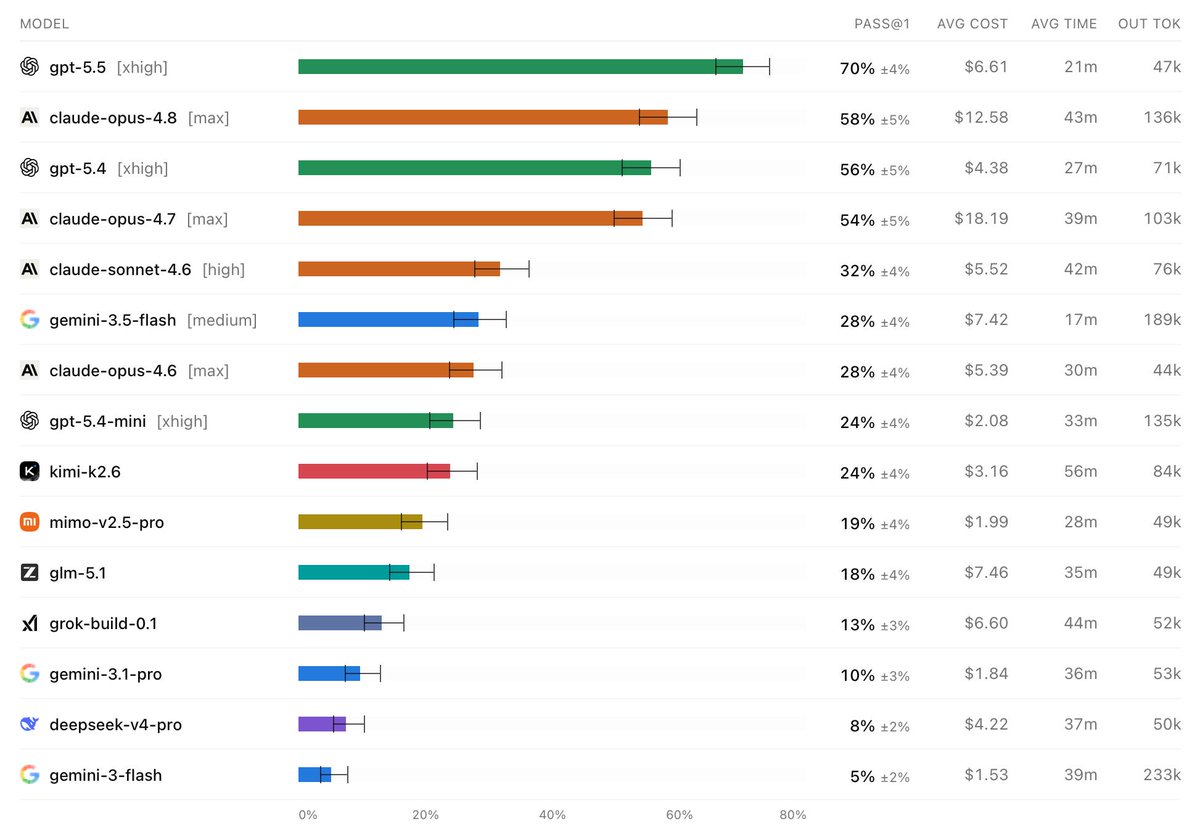
@riabcevv argued (3 likes, 3 replies, 49 views) that DeepSWE is more legitimate than older coding benchmarks because the tasks were written from scratch, the harness is shared across models, and the dataset is open. The public repo confirms 113 tasks across TypeScript, Go, Python, JavaScript, and Rust with isolated environments and program-based verifiers. That mattered because it offered a fresh benchmark surface at the exact moment the feed was asking for more trustworthy agent evaluation.
VisualMem made personal visual memory measurable
@vishalm_patel introduced (14 likes, 479 views, 4 bookmarks) VisualMem as a benchmark and architecture for remembering what images reveal about a user instead of collapsing everything into captions. The public paper says the system augments a text-memory backend with a structured personal visual-memory module and substantially outperforms prior memory systems on its benchmark. That mattered because personalized agents keep promising long-term memory while mostly storing text.

TraceGen pushed world models away from pixels and toward 3D trace space
@furongh shared (15 likes, 1 reply, 623 views, 2 bookmarks) TraceGen as a world-modeling framework that predicts future motion in 3D trace space instead of direct pixel space. The public repo says the project ships a benchmark, datasets, checkpoints, and a TraceForge pipeline for turning heterogeneous human and robot videos into consistent 3D traces. That mattered because it made cross-embodiment transfer look more like a concrete engineering stack than a vague robotics promise.

The Ninth Circuit sanctions thread turned AI disclosure into operating procedure
@RobertFreundLaw summarized (45 likes, 6 replies, 6,695 views, 13 bookmarks) a sanctions order that suspended two lawyers for six months, fined them, and required future AI-use disclosure in filings after hallucinated citations and false statements around AI use. That mattered because it showed a live institution translating AI sloppiness into explicit procedural consequences instead of generic warnings.
7. Where the Opportunities Are
[+++] Workflow-native evaluation and harness infrastructure — Evidence from @kaggle releasing (40 likes, 6 replies, 4,684 views, 22 bookmarks) local benchmark authoring, @TheAgentTimes surfacing (1 reply, 15 views) Arena Agent Mode, @latentspacepod sharing (7 likes, 687 views, 3 bookmarks) Vending-Bench 2, and @DanKornas arguing (21 likes, 8 replies, 856 views, 27 bookmarks) that coding agents are mostly harness work makes this strong. The missing product is evaluation that lives where the work already happens.
[+++] Safe agent execution and audit layers — @rohanpaul_ai warning (7 likes, 2 replies, 310 views, 4 bookmarks) about hidden web instructions, @RobertFreundLaw showing (45 likes, 6 replies, 6,695 views, 13 bookmarks) real sanctions over unchecked output, and @WisemanCap arguing (54 likes, 5 replies, 4,153 views, 17 bookmarks) for the harness layer point to the same gap. The opportunity is not another agent UI, but audit trails, hidden-content detection, and fail-safe action boundaries.
[++] AI infrastructure accounting and public-cost tooling — @Rainmaker1973 reporting (345 likes, 32 replies, 25,989 views, 63 bookmarks) recurring fire responses, @danielnewmanUV arguing (56 likes, 18 replies, 1,319 views) for longer ROI windows, and @johnarnold debating (40 likes, 9 replies, 6,352 views, 23 bookmarks) compute taxes show a direct need for better dashboards and decision frameworks. This is moderate because the demand is visible and serious, but the buyer set may be enterprises, municipalities, investors, or policymakers instead of end users.
[++] Open-model operations and inference-selection copilots — @hangg70 explaining (58 likes, 4 replies, 80,017 views, 10 bookmarks) Reve's layout bet, @testingcatalog sharing (88 likes, 6 replies, 6,170 views, 14 bookmarks) Nemotron 3 Ultra, @DivyanshT91162 reporting (10 likes, 1 reply, 584 views, 4 bookmarks) local Gemma performance, and @TheAhmadOsman mapping (13 likes, 1 quote, 1,049 views, 22 bookmarks) inference engines all point toward the same need: better workload-aware guidance on what to run, where, and why. This is moderate because the need is clear, but competition in open tooling is already intense.
[+] Structured AI builder pathways — @TheAhmadOsman posting (60 likes, 2 replies, 2,000 views, 74 bookmarks) an engineering ladder, @suraj_sharma14 posting (42 likes, 1 reply, 1,182 views, 47 bookmarks) a six-month plan, and @primemans highlighting (70 likes, 14 replies, 6,199 views, 9 bookmarks) Anthropic's fellowship show an emerging market for products that turn scattered thread knowledge into guided progression. This is emerging because the need is broad, but the winning solution may look more like curriculum, community, recruiting, or credentialing than a single software product.
8. Takeaways
- The AI conversation dropped from model marketing into the infrastructure and control layers beneath it. @Rainmaker1973 reported (345 likes, 32 replies, 25,989 views, 63 bookmarks) the local burden of repeated data-center fire responses, while @WisemanCap argued (54 likes, 5 replies, 4,153 views, 17 bookmarks) that the harness and private-eval layer is becoming the enterprise battleground.
- Evaluation is moving closer to real work, not farther away from it. @kaggle moved (40 likes, 6 replies, 4,684 views, 22 bookmarks) benchmarks into local dev, @latentspacepod pointed (7 likes, 687 views, 3 bookmarks) to year-long business evals, and @JamieMcullough showed (57 likes, 5 replies, 4,474 views) that even ordinary workplace adoption is now being judged on measured productivity.
- The most credible agent stories were still about harnesses, approvals, and hidden failure modes rather than unchecked autonomy. @DanKornas argued (21 likes, 8 replies, 856 views, 27 bookmarks) that coding agents are mostly harness work, @rohanpaul_ai warned (7 likes, 2 replies, 310 views, 4 bookmarks) about hidden web instructions and memory poisoning, and @RobertFreundLaw showed (45 likes, 6 replies, 6,695 views, 13 bookmarks) the legal cost of skipping verification.
- Open-model competition is increasingly about deployment details, not just leaderboards. @hangg70 explained (58 likes, 4 replies, 80,017 views, 10 bookmarks) Reve's layout-first control layer, @testingcatalog shared (88 likes, 6 replies, 6,170 views, 14 bookmarks) Nemotron 3 Ultra's cost/performance pitch, and @TheAhmadOsman mapped (13 likes, 1 quote, 1,049 views, 22 bookmarks) the engine choices underneath local and production inference.
- The field's talent pipeline is being rebuilt in public. @TheAhmadOsman posted (60 likes, 2 replies, 2,000 views, 74 bookmarks) a full engineering ladder, @suraj_sharma14 posted (42 likes, 1 reply, 1,182 views, 47 bookmarks) a six-month ML path, and @primemans highlighted (70 likes, 14 replies, 6,199 views, 9 bookmarks) a paid Anthropic fellowship that drops formal credential requirements.