Twitter AI - 2026-06-12
1. What People Are Talking About
1.1 Benchmark design moved closer to real agent work (🡕)
The highest-signal technical cluster was about evaluation itself. Four different posts argued that public leaderboards are no longer enough: people want benchmarks that use real codebases, longer trajectories, explicit memory transfer, and agent-specific infrastructure constraints.
@nvidia reported (99 likes, 12 replies, 7,497 views, 16 bookmarks) that AgentPerf is benchmarking agentic inference rather than single-call chat workloads, and NVIDIA's linked write-up says the benchmark replays real coding-agent trajectories and measures how many concurrent agentic tasks a platform can sustain while meeting responsiveness targets (NVIDIA blog). The first published result it highlighted was a power-efficiency claim: GB300 NVL72 ran up to 20x more agents per megawatt than H200 on this workload.

@eglyman argued (106 likes, 10 replies, 15,037 views, 20 bookmarks) that public coding benchmarks are saturated and "tell you near nothing," quoting Ramp's launch of a private, production-grounded SWE-Bench built from real Ramp engineering problems (Ramp SWE-Bench). The most useful nuance came from replies: one person pointed to still-unsaturated public benchmarks, while another said private benchmarks will saturate too if they become popular, so the demand is for fresher eval pipelines, not one final leaderboard.
@Meituan_LongCat introduced (38 likes, 2 replies, 1,179 views, 4 bookmarks) MineExplorer, saying 18 frontier MLLM agents were tested on changing Minecraft environments and the best only reached 41/100. The linked paper says the benchmark filters out overly Minecraft-specific atomic tasks, uses a multi-agent synthesis workflow to build more reliable instances, and finds that strong models degrade sharply when hidden prerequisites must be coordinated over long trajectories (paper, repo).

@rohanpaul_ai summarized (13 likes, 4 replies, 1,506 views, 14 bookmarks) AgentCL as a benchmark for whether agents actually learn from experience across task streams instead of carrying useless clutter forward. The public paper says AgentCL deliberately builds compositional streams where earlier sub-solutions or workflows can be reused later, then contrasts them with naive streams to measure transfer gains more rigorously (paper).

Discussion insight: The replies did not reject benchmarking. They challenged what counts as believable benchmarking: vendor influence, task contamination, and whether a benchmark can distinguish memory reuse from noise.
Comparison to prior day: June 11 already emphasized research automation and evaluation loops. June 12 pushed one level deeper into benchmark construction itself: private coding sets, agentic-inference power tests, explicit memory-transfer streams, and open-world multi-hop tasks.
1.2 Creator talk stayed hostile to generative AI and defensive about authenticity (🡕)
A second theme came from creators rather than builders. Two widely engaged posts showed that anti-generative-AI sentiment is not only about abstract policy; it is also about exhaustion, false accusations, and the labor of proving human work is still human.
@crimzonruze wrote (558 likes, 27 replies, 4,272 views, 16 bookmarks) that they were "exhausted with generative AI destroying my favorite form of art" and might need to retreat to retro games. The replies added concrete community behavior rather than just agreement: one person pointed to a public spreadsheet tracking games that use or removed generative AI, while others said it is draining that AI use has become pervasive and sometimes hard to detect.
@antodemico said (167 likes, 10 replies, 2,896 views) they do not use generative AI in thumbnails, scripts, editing, or illustrated video work. Their follow-up reply made the sharper point: they draw multiple thumbnails per video and are tired of being accused of using the same systems they see as "stealing from" artists.
Discussion insight: The most useful signal was not enthusiasm for regulation or new tools. It was repeated fatigue with ambiguity itself: people are tired both of AI-generated material entering cultural spaces and of artists being treated as guilty by default.
Comparison to prior day: Earlier June reports kept the anti-AI-art theme alive, but June 12 made it more personal. The evidence shifted from broad complaints about generated media toward direct statements of burnout and authenticity defense.
1.3 Generalist frontier models are extending their reach through scaling, retrieval, and infrastructure control (🡒)
A third cluster treated frontier AI as a widening operating system rather than a single product. Four posts pointed to the same pattern from different angles: more domain reach for generalist models, more live-web retrieval in answers, more compute control underneath, and continued interest in scaling pathways above the model layer.
@EricTopol reported (31 likes, 4 replies, 2,737 views, 18 bookmarks) that general frontier models from Google, OpenAI, and Anthropic outperformed specialized EvidenceOpen and UpToDate systems in a randomized, blinded evaluation by 12 U.S. clinicians. The linked Nature Medicine result is reflected directly in the attached chart, where Gemini 3.1 Pro, GPT-5.2, and Claude Opus 4.6 all beat the specialized tools across the displayed medical benchmarks (Nature Medicine article).

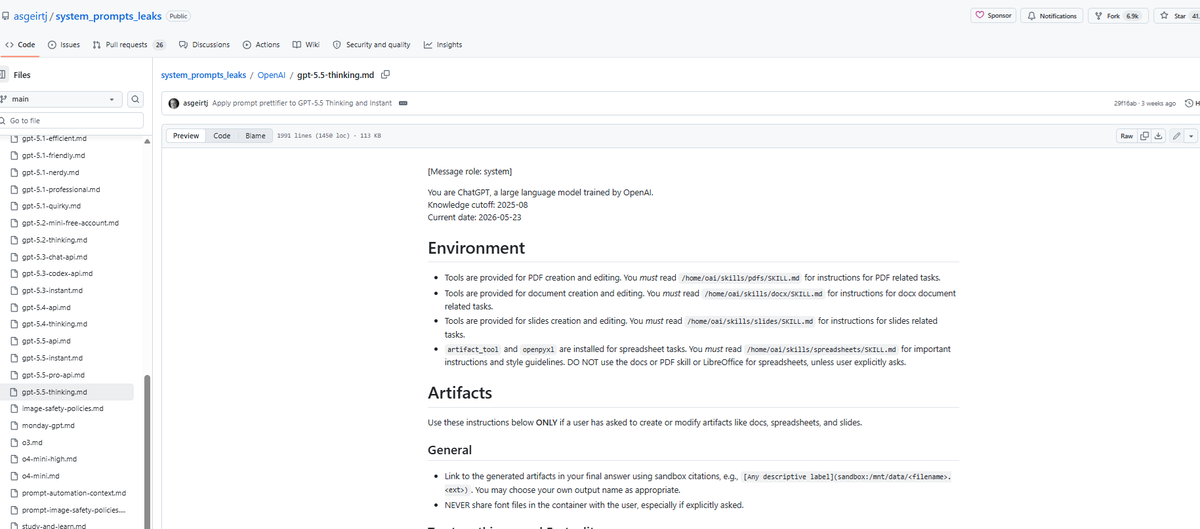
@alexgroberman argued (37 likes, 2 replies, 4,358 views, 7 bookmarks) that a leaked ChatGPT 5.5 prompt offers an unusually specific look at when the model searches the live web, which sources it should trust, and why certain businesses appear in recommendations while others stay invisible. His screenshots show a public prompt-archive repository plus an example ranking-style response, and his thread says commercially important recommendation queries are especially likely to trigger live retrieval and citation behavior.
@kimmonismus summarized (100 likes, 11 replies, 4,341 views, 45 bookmarks) DeepMind's "From AGI to ASI" paper as a four-path roadmap: continued scaling, paradigm shifts, recursive self-improvement, and multi-agent collectives. The public paper summary supports those four pathways and also lists blockers around data, compute, energy, research difficulty, abstraction limits, and deliberate slowdown (paper).
@rohanpaul_ai wrote (12 likes, 2,328 views, 5 bookmarks) that The Information reported Anthropic is moving from rented cloud capacity toward leasing and managing data centers itself, with more than 1GW of planned U.S. capacity and Google potentially backing lease payments. The post's framing was straightforward: the company wants more control over power, networking, cooling, and hardware scheduling instead of treating compute as a fully outsourced input.
Discussion insight: The pushback was narrower than the claims. Replies questioned the medical study's practical meaning and whether ASI coordination is under-specified, but they did not challenge the broader direction toward more retrieval, more infrastructure control, and broader frontier-model scope.
Comparison to prior day: June 11's frontier-model conversation was mostly about restrictions, collapse, and jailbreaks. June 12 shifted toward reach: generalist models beating vertical tools, live-web search shaping recommendations, and labs trying to control more of the physical compute stack.
2. What Frustrates People
Public AI benchmarks no longer feel trustworthy enough on their own
Severity: High. @eglyman said (106 likes, 10 replies, 15,037 views, 20 bookmarks) that public coding benchmarks are saturated, while Ramp's quoted launch positions private, production-grounded tasks as a fix (Ramp SWE-Bench). But the replies immediately showed the next problem: even private sets can saturate once they become well known. @nvidia reported (99 likes, 12 replies, 7,497 views, 16 bookmarks) strong AgentPerf results, yet replies questioned vendor influence on a benchmark promoted by the winning hardware vendor. @Meituan_LongCat showed (38 likes, 2 replies, 1,179 views) that even strong frontier MLLM agents only reached 41/100 on MineExplorer's open-world tasks. The coping pattern is to keep moving closer to private, task-specific, or long-horizon evals. This is worth building for because the pain is repeated across software, infrastructure, and agent-memory evaluation.
Artists are exhausted both by AI-generated media and by false AI accusations
Severity: High. @crimzonruze described (558 likes, 27 replies, 4,272 views) generative AI as something "destroying my favorite form of art," and replies pointed to community-maintained lists of games using generative AI. @antodemico said (167 likes, 10 replies, 2,896 views) they do not use generative AI anywhere in their video workflow, then added that artists should not be accused of using systems "stealing from them" without proof. The coping pattern today was manual proof and community vigilance, not platform support. This is worth building for because the frustration is emotional, persistent, and tied to real reputational damage.
Coding and ML agents still stop at experimentation, drift, and memory transfer
Severity: High. @kmeanskaran argued (71 likes, 5 replies, 4,669 views, 82 bookmarks) that Codex can write code but cannot read 650 million rows, observe production behavior, run MLOps pipelines, fix data drift, or execute A/B tests. @rohanpaul_ai summarized (13 likes, 4 replies, 1,506 views, 14 bookmarks) AgentCL's finding that memory methods help when reuse links are obvious but still struggle when the next task differs. Together with MineExplorer's 41/100 ceiling, the message was that current agents are still brittle once they move from code generation into long-horizon adaptation, experimentation, or environment change. This is worth building for because the complaint is concrete and operational rather than rhetorical.
3. What People Wish Existed
Private, production-grounded evaluation loops for every serious agent team
People are not asking for one better public leaderboard. They are asking for evaluation systems that reflect their own workloads. @eglyman framed (106 likes, 10 replies, 15,037 views, 20 bookmarks) Ramp SWE-Bench as code no model has seen, and replies immediately debated how long any benchmark stays fresh. @nvidia showed (99 likes, 12 replies, 7,497 views) that infrastructure buyers also want agent-specific evals rather than generic inference numbers. This is a practical need with direct budget and model-selection consequences. Opportunity: direct.
Provenance and authenticity tools that help artists prove work without endless self-defense
The strongest creator need was not more image generation. It was better proof and context. @crimzonruze captured (558 likes, 27 replies, 4,272 views) the exhaustion of seeing generative AI spread through a favorite medium, while @antodemico showed (167 likes, 10 replies, 2,896 views) the adjacent burden of having to deny AI use publicly. This is practical and emotionally urgent, but platform-level solutions would be competitive because they touch creator tooling, moderation, and distribution. Opportunity: competitive.
Agent memory systems that can reuse past work without dragging noise forward
@rohanpaul_ai highlighted (13 likes, 4 replies, 1,506 views, 14 bookmarks) a specific benchmark gap: most systems cannot show clearly whether an agent learned from prior tasks or merely stored clutter. The AgentCL paper describes controlled task streams where earlier sub-solutions are intentionally reusable later (paper). This is a practical need for research and coding agents, and it is still under-served. Opportunity: direct.
AI-search visibility tooling built around live retrieval and citations
@alexgroberman argued (37 likes, 2 replies, 4,358 views, 7 bookmarks) that captured ChatGPT ranking instructions imply recommendation queries often trigger live-web search, citations, and source-selection rules. That creates a practical need for pages that are current, specific, and citation-friendly, but it is a competitive need because many SEO and content vendors will try to productize the same interpretation. Opportunity: competitive.
4. Tools and Methods in Use
| Tool | Category | Sentiment | Strengths | Limitations |
|---|---|---|---|---|
| AgentPerf | Infrastructure benchmark | (+/-) | Measures agent-specific concurrency and power efficiency on real coding-agent trajectories | Results are easy to question when the winning vendor is also the loudest promoter |
| Ramp SWE-Bench | Coding benchmark | (+) | Uses real Ramp engineering problems and unseen production-grounded tasks | Freshness decays if the set becomes widely copied or overfit |
| MineExplorer | Agent benchmark | (+) | Tests long-horizon, dynamic, multi-hop open-world exploration with milestone-based evaluation | Best score reported was still only 41/100, so current agents remain weak on the target workload |
| AgentCL | Memory benchmark | (+) | Separates compositional task reuse from naive task streams and measures transfer gains | Evaluates memory quality rather than solving the memory problem itself |
| Gemini 3.1 Pro / GPT-5.2 / Claude Opus 4.6 | Frontier LLMs | (+/-) | Outperformed specialized medical AI tools in a blinded clinician evaluation | Benchmark wins do not settle safety, deployment, or clinical-trust questions |
| ChatGPT live-web retrieval instructions | Retrieval method | (+/-) | Gives current information and citation-backed answers for recommendation queries | The captured prompt is not an official permanent ranking guide, and its exact behavior may vary by version |
| Codex-style coding agents | Coding assistant | (+/-) | Good at code generation and feature suggestions | Still weak on data observation, online evaluation, drift handling, and production experimentation |
Overall satisfaction was highest when a tool or method made agent behavior more measurable. AgentPerf, Ramp SWE-Bench, MineExplorer, and AgentCL all earned attention because they constrain what the system is actually being asked to prove. The most positive surprise was that general frontier models beat specialized medical systems in one blinded evaluation, but replies immediately narrowed the celebration by questioning how that maps to practice.
The dominant migration pattern is away from generic public scoreboards and toward narrower, fresher, or more realistic evaluation layers. A second migration pattern is from static model knowledge toward live retrieval: recommendation answers now depend on current web presence, not just training-time recall. Competitive dynamics are therefore shifting in two directions at once: private eval stacks inside companies, and citation-friendly visibility layers outside them.
5. What People Are Building
| Project | Who built it | What it does | Problem it solves | Stack | Stage | Links |
|---|---|---|---|---|---|---|
| Ramp SWE-Bench | Ramp, shared by @eglyman | Private coding benchmark built from real Ramp engineering work | Public coding benchmarks are saturated and less predictive of real engineering performance | Real PR-derived tasks, review-ready agent workflow, production codebase prompts | Beta | tweet, site |
| AgentPerf | Artificial Analysis and NVIDIA, shared by @nvidia | Agentic-inference benchmark for concurrent coding-agent workloads | Standard inference benchmarks miss chained tool use, long contexts, and agent-specific latency constraints | Real coding-agent traces, simulated tool delays, concurrency and power metrics | Beta | tweet, blog |
| MineExplorer | Meituan and Shanghai Jiao Tong University, shared by @Meituan_LongCat | Open-world Minecraft benchmark for MLLM agents | Short-horizon or game-specific tasks hide failures in dynamic multi-hop exploration | Minecraft environment, multi-agent synthesis workflow, rule-based milestone evaluators, ReAct-style task formulation | Alpha | tweet, paper, repo |
| AgentCL | Ohio State, Johns Hopkins, and Intuit AI Research, shared by @rohanpaul_ai | Continual-learning benchmark for whether agents actually reuse prior experience | Long-context memory benchmarks can confuse retrieval with real transfer | Controlled compositional task streams, transfer metrics, MemProbe analysis | Alpha | tweet, paper |
| PAYGO x402 payment infrastructure | @PayGo402, announced by @XDCNetwork | Request-level settlement rails for APIs, AI agents, and machine-to-machine commerce | Agents need a way to pay for digital services at the request level instead of only via human-run billing systems | x402, HTTP-native settlement, stablecoins, XDC Network | Alpha | tweet |
| NHS-focused symptom companion | @spiRiituaL | Daily symptom-capture tool that turns patient notes into structured clinician-facing summaries | Patients with long symptom histories have too little time to explain them during appointments | Symptom journaling, structured health insights, clinician handoff workflow | Alpha | tweet |
The clearest build pattern was that benchmarks are now products in their own right. Ramp, Artificial Analysis, Meituan, and the AgentCL authors are all packaging evaluation methodology rather than just shipping another model wrapper. That reflects a market where the main unanswered question is often not "can an agent do anything?" but "what exactly can it do on my workload, and how do I know?"
The two application-layer builds were narrower and more speculative. PAYGO represents infrastructure for agent payments rather than another chat surface, and the symptom companion represents structured capture for a clinical handoff problem rather than a general health bot. Both follow the same pattern as the benchmark projects: pick one constrained workflow, make the boundary explicit, and avoid claiming general autonomy.
6. New and Notable
General frontier models beat specialized medical AI in a blinded test
@EricTopol reported (31 likes, 4 replies, 2,737 views, 18 bookmarks) that general frontier models from Google, OpenAI, and Anthropic beat specialized EvidenceOpen and UpToDate systems in a randomized, blinded clinician evaluation. That matters because the result runs against the expectation that domain-specific medical products should still hold the edge on medical QA and clinician-rated tasks. (Nature Medicine article)
A captured ChatGPT prompt turned AI-search optimization into a concrete workflow topic
@alexgroberman showed (37 likes, 2 replies, 4,358 views, 7 bookmarks) screenshots of a public prompt archive and argued that commercially important recommendation queries can trigger live-web search, source filtering, and citation requirements inside ChatGPT. Whether or not the capture is stable across versions, the practical effect is that web freshness and citation-friendly content are now being discussed as direct inputs to AI visibility.
Anthropic's compute strategy is moving closer to physical infrastructure ownership
@rohanpaul_ai wrote (12 likes, 2,328 views, 5 bookmarks) that The Information reported Anthropic is shifting from rented cloud compute toward leasing and managing data centers itself, with more than 1GW of planned U.S. capacity. That is notable because it reframes model competition as a power, cooling, and scheduling problem as much as a model-quality problem.
7. Where the Opportunities Are
[+++] Private agent evaluation and observability stacks — Section 1 and Section 2 both showed the same gap: teams do not trust public benchmarks, but they still need measurable ways to compare models, memory systems, and infrastructure. Ramp SWE-Bench, AgentPerf, MineExplorer, and AgentCL all point to demand for fresher, workload-specific eval layers.
[+++] Creator provenance and anti-false-positive tooling — The art backlash today was not just anti-AI sentiment. It was a specific complaint that artists must either police AI contamination manually or publicly defend their own human work after accusations. That creates room for provenance, disclosure, and authenticity workflows that are visible to audiences.
[++] Memory and long-horizon control layers for agents — AgentCL and MineExplorer both showed that agents still break when tasks need reuse, transfer, or hidden multi-step coordination over time. The need is not only better memory storage, but better filtering, retrieval, and evaluation of what memory actually helps.
[+] AI-search visibility and citation-readiness tooling — If recommendation answers increasingly trigger live-web search and citation rules, then businesses need tooling that audits freshness, factual density, and third-party support across the pages models are likely to retrieve. The signal is real, but the competitive field is already forming.
8. Takeaways
- The benchmark conversation moved from scores to benchmark design. The strongest posts were about private tasks, agent-specific throughput, open-world multi-hop evaluation, and continual-learning transfer rather than another generic leaderboard. (source)
- Creator backlash against generative AI stayed intense and personal. The data showed not just dislike of AI-generated art, but exhaustion with having to detect it and defend human-made work against suspicion. (source)
- General frontier models kept expanding into domains that specialized products were expected to own. The clearest example was the medical evaluation where frontier systems beat specialized tools in a blinded clinician study. (source)
- Live retrieval is becoming part of the competitive surface for AI products and businesses. The leaked ChatGPT-ranking thread mattered because it framed current web presence and citation-ready content as inputs to recommendation visibility. (source)
- Compute strategy is becoming a product decision, not just a procurement detail. The Anthropic data-center report and the AgentPerf power-efficiency framing both point to a world where infrastructure control increasingly shapes AI capability and cost. (source)