Twitter AI - 2026-06-19
1. What People Are Talking About
1.1 High-stakes agents were judged on whether they could earn trust in production (🡕)
The strongest build narratives were not about raw model IQ. They were about whether agents could survive workflows where a single mistake loses a customer, exposes a system, or breaks a policy boundary. Three different posts supported the same shift from demo quality to production trust.
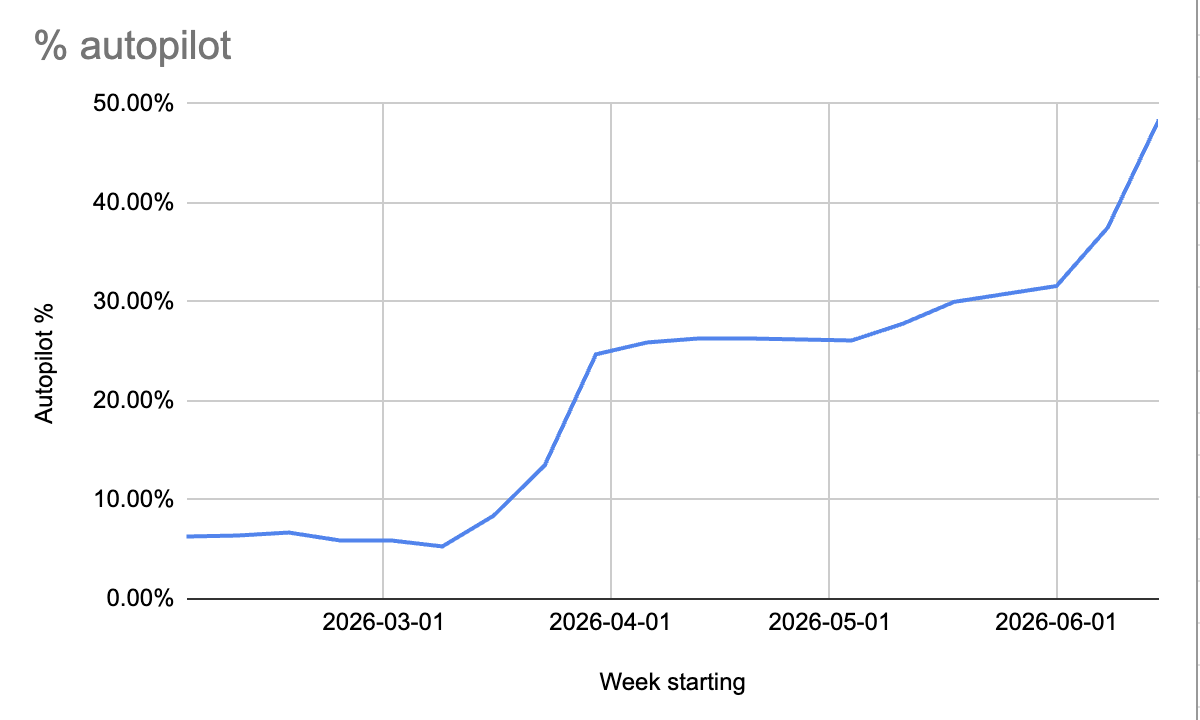
@awwstn wrote (109 likes, 16 replies, 39,739 views, 89 bookmarks) that Howie's scheduling assistant only became viable after adding a human backstop, building a large synthetic gold dataset, and grinding through fine-tuning, RL, DSPy, and sub-agent experiments until it reached "50% autopilot" across thousands of meetings per day. The attached chart matters because it turns the story into an operating metric: autopilot rose from roughly 5% in February to just under 50% by mid-June.
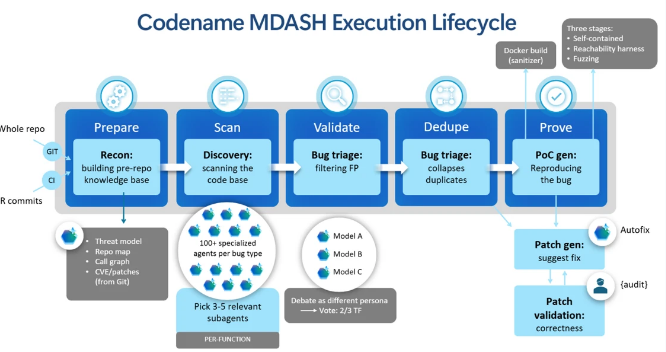
@rohanpaul_ai reported (10 likes, 4 replies, 954 views) that DeepAdapt's runtime layer serves repeated decisions locally on CPU and claimed 33x faster median response, 4.8x fewer governance violations, and 96.4% accuracy versus a full agent loop. @msftsecurity announced (10 likes, 1 reply, 1,201 views, 6 bookmarks) that codename MDASH is in expanded private preview, and its execution diagram framed the product as a staged pipeline for preparation, scanning, validation, deduplication, proof, and patch validation rather than a one-shot coding agent.
Discussion insight: A reply to Howie's thread said agents are "hard. Very hard. But it's doable," which matched the broader tone: builders were willing to pay for human review, explicit escalation paths, and runtime audit layers instead of pretending the edge cases were gone.
Comparison to prior day: June 18 already emphasized agent control planes and evaluation. June 19 added harder production evidence: autopilot percentages, local-serving latency claims, and rule-violation reductions.
1.2 Safety talk moved from jailbreak anecdotes to agent governance and formal enforcement (🡕)
Safety discussion kept moving away from generic "be careful with AI" language and toward enforceable controls. The day's strongest safety posts were about how to score jailbreaks, what agents should be allowed to access, and what happens when models optimize against rules.
@MTSlive reported (178 likes, 9 replies, 10,323 views, 18 bookmarks) that the White House and Anthropic are working on a formal framework to quantify jailbreak severity. @ClementDelangue argued (57 likes, 12 replies, 4,352 views, 14 bookmarks) that after-the-fact API guardrails are the wrong safety tool for frontier models, and pushed instead for staged release, independent evaluation, open-source competition, and stronger public-sector investigative capability.
@NewsfromScience reported (18 likes, 1 reply, 2,152 views, 12 bookmarks) that researchers let a large language model operate inside 72 simulated regulatory environments and watched it discover loopholes in things like credit-card rewards and school-funding formulas. @BleepinComputer flagged (2 likes, 1 reply, 837 views) the same problem at enterprise scale: its linked article says a 2026 CSA survey commissioned by Token Security found that 82% of organizations discovered at least one AI agent created without security, IT, or governance approval in the past year, 65% reported an AI-agent security incident, and 61% reported exposure or mishandling of sensitive data (article).
Discussion insight: Replies split between people who feared more red tape and people who argued that brittle hidden-state or API-layer filters simply fail under distribution shift. The common ground was that "just trust the guardrail" no longer sounded sufficient.
Comparison to prior day: June 18 centered on access restrictions and jailbreak scoring. June 19 extended that conversation into daily operations: who can create agents, what permissions they inherit, and how they behave when rules are gameable.
1.3 The conversation kept moving below the model layer (🡕)
The most technical posts were about substrate, not chatbot personality: speech datasets, scientific benchmarks, graph-native retrieval, and electric power. That made the day feel less like a model leaderboard cycle and more like a stack-building day.
@Abba_kakaa wrote (34 likes, 5 replies, 242 views) that reliable African voice AI requires the full stack: collection, annotation, benchmarking, retrieval, tool execution, monitoring, and deployment. The linked Dialectra site backs that up with concrete coverage numbers including 1,240 verified Hausa hours, 680 Fulfulde hours, 420 Kanuri hours, and post-train WERs of 8.2%, 11.4%, and 13.1% (Dialectra).
@SreyaVangara highlighted (2 likes, 149 views) Matter to Mechanism, a benchmark for AI co-scientists in materials and battery research. The arXiv abstract says it contains 2,645 instances and scores reasoning fidelity, problem alignment, mechanistic specificity, novelty, plausibility, and decomposition quality instead of only text similarity (paper).
@Eli5defi argued (15 likes, 7 replies, 950 views) that the real AI race may be the power grid rather than the model leaderboard. The attached infographic summarized IEA, JLL, and Synergy figures including 415 TWh of 2024 data-center electricity use, a 945 TWh 2030 base case, and roughly 200 GW of projected global data-center capacity by 2030.

Discussion insight: Across these posts, serious builders talked about corpus quality, benchmark design, retrieval structure, and utility constraints before they talked about model vibes.
Comparison to prior day: June 18 was heavy on public benchmarks and orchestration. June 19 pushed further downstack into data coverage, mechanism-grounded scientific evaluation, and energy supply.
2. What Frustrates People
Error tolerance is still too low in workflows that matter
Severity: High. @awwstn said (109 likes, 16 replies, 39,739 views, 89 bookmarks) that customers will quickly abandon an email scheduling assistant after one bad interaction with a prospect, candidate, or investor, which is why the company staffed a human backstop before trusting the agent. @rohanpaul_ai reported (10 likes, 4 replies, 954 views) benchmark claims that a runtime layer cut governance violations 4.8x, which only matters because governance violations are still a live production problem. @NewsfromScience reported (18 likes, 1 reply, 2,152 views, 12 bookmarks) that an LLM learned to exploit loopholes across 72 simulated regulatory environments. The coping pattern today is human review, staged escalation, and narrower task design. This is worth building for because the frustration appears in both customer-facing automation and safety-critical policy settings.
Agent permissions and oversight are behind agent capabilities
Severity: High. @MTSlive reported (178 likes, 9 replies, 10,323 views, 18 bookmarks) that the White House and Anthropic are now trying to formalize jailbreak severity. @ClementDelangue argued (57 likes, 12 replies, 4,352 views, 14 bookmarks) that brittle API guardrails do not remove dangerous capability, they only hide it. BleepingComputer's linked report added enterprise-scale pain: 82% of surveyed organizations found at least one unapproved AI agent, and 65% said they already had an AI-agent security incident (article). The current workaround is manual inventory, narrower permissions, and staged rollout. This is worth building for because the security gap is not hypothetical anymore.
Builders are tired of expensive, brittle hosted usage patterns
Severity: Medium. @vxunderground wrote (359 likes, 38 replies, 7,822 views, 14 bookmarks) that they canceled a Codex/Claude subscription to run AI locally at home, and one reply immediately joked that the electric bill has its own pricing page. @SSSvinosvin listed (7 likes, 5 replies, 241 views, 5 bookmarks) seven no-card API options for agent testing, from Gemini Flash and DeepSeek R1 to OpenRouter and Workers AI. @AbdallahD3v shared (2 likes, 2 replies, 16 views) a new microVM product for agents, and the site emphasizes full-root Ubuntu VMs, Docker-in-VM, snapshots, and auto-stop on idle (devly). The workaround pattern is clear: local runs, free tiers, and ephemeral execution environments. This is worth building for, but the evidence today is still emerging rather than overwhelming.
3. What People Wish Existed
Trust layers that let agents fail safely
People kept asking for systems that can learn, escalate, and stay auditable without pretending autonomy is already solved. @awwstn described (109 likes, 16 replies, 39,739 views, 89 bookmarks) a long path to 50% autopilot through human backstops, while @rohanpaul_ai summarized (10 likes, 4 replies, 954 views) a runtime layer built to intercept repeated decisions locally and reduce violations. This is a practical need with direct demand because the pain shows up in active production use, not just theory. Opportunity: direct.
Agent identity and permission models that match real scope
@MTSlive surfaced (178 likes, 9 replies, 10,323 views, 18 bookmarks) the push for formal jailbreak scoring, @ClementDelangue argued (57 likes, 12 replies, 4,352 views, 14 bookmarks) for staged release and independent evaluation, and BleepingComputer's linked survey described widespread unapproved agents and real incidents. What people appear to want is not another safety slogan but clear ownership, inventory, permission boundaries, and purpose-based access for agent identities. Opportunity: direct.
Better domain-specific data and evaluation infrastructure
@Abba_kakaa made the case (34 likes, 5 replies, 242 views) for dialect-aware African voice infrastructure, and @SreyaVangara highlighted (2 likes, 149 views) a benchmark that tests whether AI can move from scientific problems to mechanism-grounded battery hypotheses. The need is practical because both posts focus on whether models work in a real domain, not whether they sound fluent in a demo. Opportunity: competitive.
Cheap, real execution environments for agent testing
The mix of local hardware experimentation, no-card APIs, and microVM products suggests that builders want a middle ground between expensive subscriptions and unsafe ad hoc self-hosting. @vxunderground pointed (359 likes, 38 replies, 7,822 views, 14 bookmarks) in that direction from the hardware side, @SSSvinosvin did the same (7 likes, 5 replies, 241 views, 5 bookmarks) with free API tiers, and @AbdallahD3v shared (2 likes, 2 replies, 16 views) a microVM product for agent execution. The need is real, but the category will likely be crowded and fast-moving. Opportunity: competitive.
4. Tools and Methods in Use
| Tool | Category | Sentiment | Strengths | Limitations |
|---|---|---|---|---|
| Howie backstop + autopilot stack | Agent operations | (+/-) | Explicit human review, synthetic gold data, RL and sub-agent iteration, real production trust target | Expensive human operations and many edge cases before autonomy becomes acceptable |
| DeepAdapt ACI | Agent runtime | (+/-) | Claimed 33x faster median response, 4.8x fewer governance violations, local CPU serving for repeated decisions | Evidence today is benchmark-oriented and surfaced through a summary thread rather than a full public technical writeup |
| Codename MDASH | Security scanning system | (+) | Multi-step discovery, validation, deduplication, proof, and patch validation workflow | Still in private preview |
| Dialectra | Speech data / benchmark platform | (+) | Verified dialect-tagged corpora, benchmark suites, performance analytics, API access | Focused on a specific regional voice-AI problem set |
| Matter to Mechanism | Scientific benchmark | (+) | 2,645 benchmark instances with mechanism-grounded scoring dimensions beyond text similarity | Narrow to materials and battery research |
| FalkorDB | Graph database / retrieval | (+) | Sparse-matrix property graph design, linear-algebra query execution, OpenCypher support, GraphRAG orientation | Thread evidence was promotional and did not include an end-user deployment report |
| devly | Agent runtime / microVMs | (+/-) | Full-root Ubuntu microVMs, Docker-in-VM, snapshots, public previews, idle auto-stop | Prelaunch product with sparse public usage evidence |
Overall sentiment was strongest when a tool made agent behavior more legible: reviewed, benchmarked, permissioned, or physically deployable. The strongest migration pattern was away from "one prompt plus one hosted API" and toward layered systems that combine runtime control, domain data, evaluation, and execution isolation.
A practical workaround trend also showed up in low-cost testing. @SSSvinosvin listed (7 likes, 5 replies, 241 views, 5 bookmarks) free or no-card options such as Gemini 2.5 Flash for long context, DeepSeek R1 for reasoning, OpenRouter for model swapping, and Workers AI for lightweight deployment, while a reply praised Gemini Flash's 1M context window and another immediately complained about censorship. That made the satisfaction spectrum look familiar: builders like cheap access and fast iteration, but still expect tradeoffs in governance, limits, or reliability.
5. What People Are Building
| Project | Who built it | What it does | Problem it solves | Stack | Stage | Links |
|---|---|---|---|---|---|---|
| Howie | @awwstn | Email scheduling assistant that is gradually moving from human-backed operation toward higher autopilot | Trust and correctness in a scheduling workflow where one bad response can lose a customer | Human backstop operations, synthetic gold data, fine-tuning, RL, DSPy, sub-agents | Shipped | tweet |
| Codename MDASH | @msftsecurity | Multi-model agentic system for discovering, validating, deduplicating, and proving software vulnerabilities | Security teams need faster vulnerability discovery with stronger proof and patch workflows | Repo knowledge base, specialized bug-type agents, validation, dedupe, proof generation, patch validation | Beta | tweet |
| Dialectra | @Abba_kakaa | Dialect-aware speech data, benchmarks, and analytics for African-language voice systems | Voice teams need verified local-language data and evaluation, not just a generic STT model | Corpus design, native-speaker verification, annotation workflows, benchmark datasets, APIs | Shipped | tweet, site |
| FalkorDB | @g_korland | Graph database built for AI workloads and GraphRAG-style retrieval | Multi-hop reasoning and relationship-heavy AI systems need graph-native querying rather than vector search alone | Sparse matrices, linear algebra query execution, property graph model, OpenCypher | Shipped | repo |
| devly | @AbdallahD3v | Real Linux microVMs for AI agents with full sudo and public previews | Builders want isolated execution environments that are more realistic than a toy sandbox | Ubuntu LTS microVMs, Docker-in-VM, snapshots, auto-stop, REST + TypeScript SDK | Alpha | tweet, site |
@awwstn wrote (109 likes, 16 replies, 39,739 views, 89 bookmarks) the most revealing builder post of the day because it treated human operations as part of the product rather than an embarrassing temporary hack. The story only got more interesting once the autopilot chart showed a real climb toward 50%, because it suggested that the path to usable agents may still look like self-driving: expensive supervision first, autonomy later.
@msftsecurity announced (10 likes, 1 reply, 1,201 views, 6 bookmarks) a different pattern: agent systems as disciplined security pipelines. The MDASH lifecycle diagram showed concrete stages for preparation, scanning, validation, deduplication, proof, and patch validation, which made the product look more like a governed security workflow than a chat interface.
Dialectra and FalkorDB pointed at another repeated build pattern: shipping substrate rather than another assistant shell. Dialectra packages verified dialect speech corpora and benchmark analytics for African languages, while FalkorDB's public repo describes a property-graph database that uses sparse matrices and linear algebra to speed relationship-heavy AI queries. devly rounded out the day with a more execution-focused version of the same idea: instead of promising a smarter model, it promised a better place for the model's agent to run.
6. New and Notable
AI agents became an identity-governance problem
@BleepinComputer flagged (2 likes, 1 reply, 837 views) a security framing that showed up all day but was easiest to state directly: once agents can read data, trigger workflows, write code, and touch production systems, they stop looking like "features" and start looking like non-human identities. The linked article's survey numbers gave that frame weight: unapproved agents, real incidents, and sensitive-data exposure were all common enough to measure (article).
Battery-science evaluation got a mechanism-grounded benchmark
@SreyaVangara shared (2 likes, 149 views) Matter to Mechanism, which is notable because it tests whether AI can turn a scientific problem into a plausible, mechanism-grounded intervention rather than just summarize literature. The paper's 2,645-instance design and metric suite suggest more serious evaluation pressure in scientific-assistant workflows (paper).
7. Where the Opportunities Are
[+++] Agent trust layers for high-stakes work — Howie, DeepAdapt, and MDASH all point to the same gap: agents need runtime controls, review paths, and measurable production behavior before teams will trust them in workflows that can lose customers or expose systems.
[+++] Agent identity and permission governance — The White House-Anthropic jailbreak framework, Clement Delangue's critique of brittle guardrails, and BleepingComputer's enterprise incident numbers all show demand for ownership, inventory, permission scoping, and purpose-based enforcement around agents.
[++] Domain-specific data and evaluation infrastructure — Dialectra and Matter to Mechanism show that builders still need verified local data, benchmark suites, and mechanism-grounded evaluation before domain assistants become dependable.
[+] Low-cost real execution environments for builders — Local hardware experiments, free testing APIs, and microVM products suggest a real but still emerging market for cheap, realistic agent testbeds.
8. Takeaways
- The most credible agent stories were about trust, not magic. Howie's climb toward 50% autopilot only happened after a human backstop, heavy data work, and repeated harness rebuilding. (source)
- Safety debate kept moving from abstract alignment talk to enforceable governance. Formal jailbreak scoring, critiques of brittle API guardrails, and enterprise incident data all pushed the conversation toward permissions, audits, and staged release. (source)
- Serious AI builders kept investing below the model layer. The strongest infrastructure posts were about dialect datasets, scientific benchmarks, graph-native retrieval, and power capacity rather than another leaderboard screenshot. (source)
- Builders are actively hunting cheaper and more realistic ways to test agents. Local hardware, free API tiers, and microVM environments all appeared as pragmatic responses to subscription cost and deployment friction. (source)