Twitter AI - 2026-06-30
1. What People Are Talking About
1.1 Local AI became a product surface, not just a cost argument (🡕)
The strongest local-first cluster came from three very different parts of the feed: a node network pitching local AI utilities, a model hub adding hardware-aware search, and a self-hosted software thread framing privacy and seat-free pricing as default expectations. Together they show local AI being sold as ownership, privacy, and operational control rather than as a hobbyist compromise.
@PiCoreTeam announced (2,020 likes, 346 replies, 134,359 views) that SoloHost launched in beta on Pi Desktop, letting users run local apps, AI utilities, and distributed-compute workloads on their own machines, while giving developers an open framework and a claimed base of more than 420,000 Pi Node operators. The replies mostly reinforced the ownership angle: one user said local AI "feels more practical when privacy stays in users hands," while another summarized node operators as "mini compute providers."
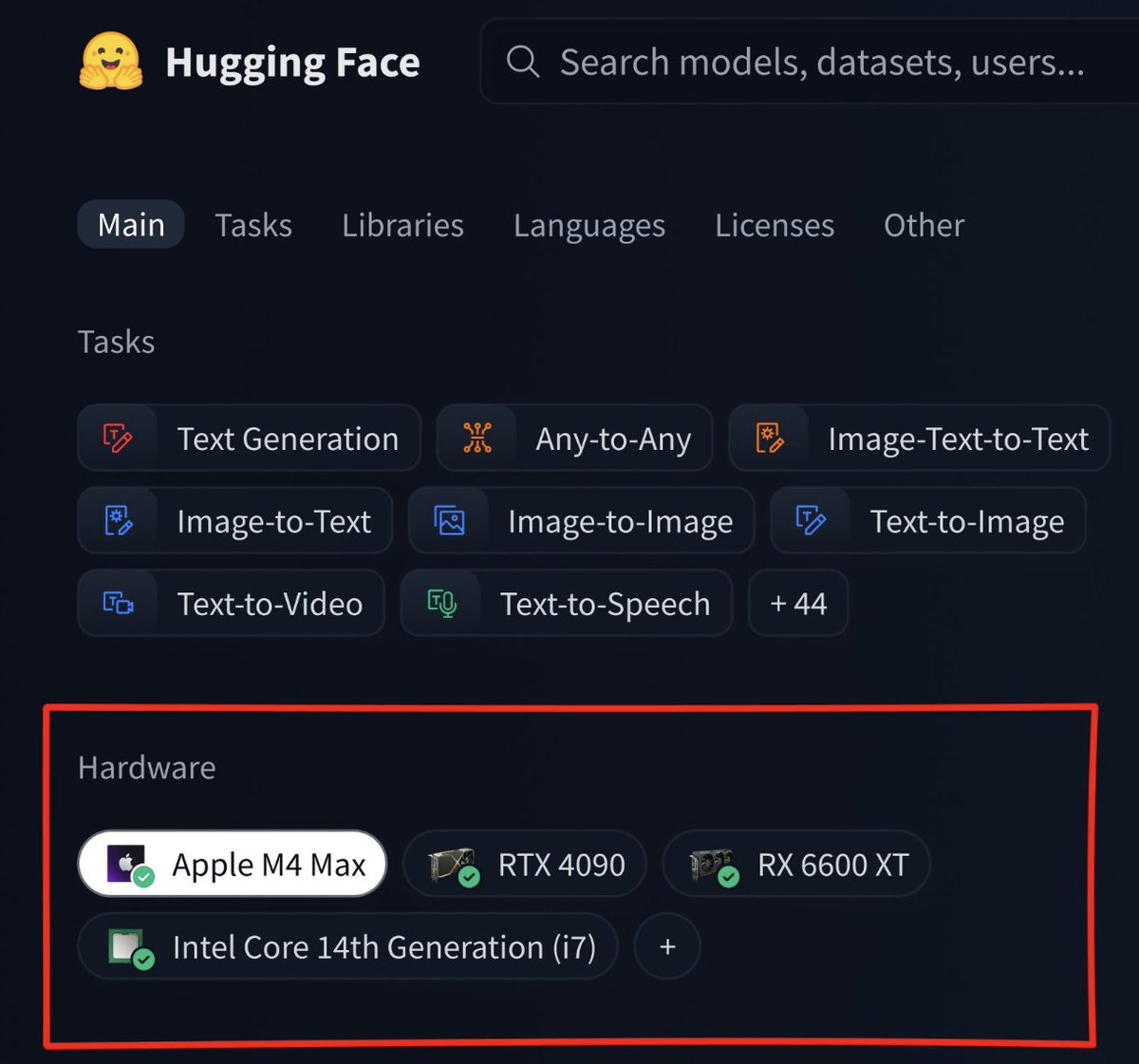
@ClementDelangue argued (85 likes, 16 replies, 5,332 views) that a Stanford study found 71.3% of ChatGPT queries could be answered by a local model, then tied that claim to a new Hugging Face filter that lets people browse models by local hardware. The attached product screenshot showed hardware filters for Apple M4 Max, RTX 4090, RX 6600 XT, and Intel Core i7.
@aiwithjainam compiled (8 likes, 2 replies, 318 views) a thread of self-hosted alternatives such as Immich, Stirling PDF, RustDesk, Vaultwarden, and Gitea. One concrete example in the thread was Immich, whose GitHub repo describes it as a "high performance self-hosted photo and video management solution" and currently shows 104,778 stars.

Discussion insight: The replies that added signal were about control, not raw benchmark quality. On this date, "local" was mostly shorthand for privacy, predictable pricing, and avoiding platform dependency.
Comparison to prior day: On 2026-06-29, local-model discussion centered on serving speed and token costs. On 2026-06-30, the conversation moved closer to end-user workflows: hardware-aware discovery, self-hosted apps, and locally run utilities.
1.2 Evaluation became a cost-aware control plane for agents (🡕)
Four posts and one linked product page all pushed evaluation away from one-number benchmarks and toward practical operating metrics: task success, tool use, reasoning quality, cost per task, and live market demand. The conversation was less "who won the benchmark" and more "how do I decide a system is worth deploying?"
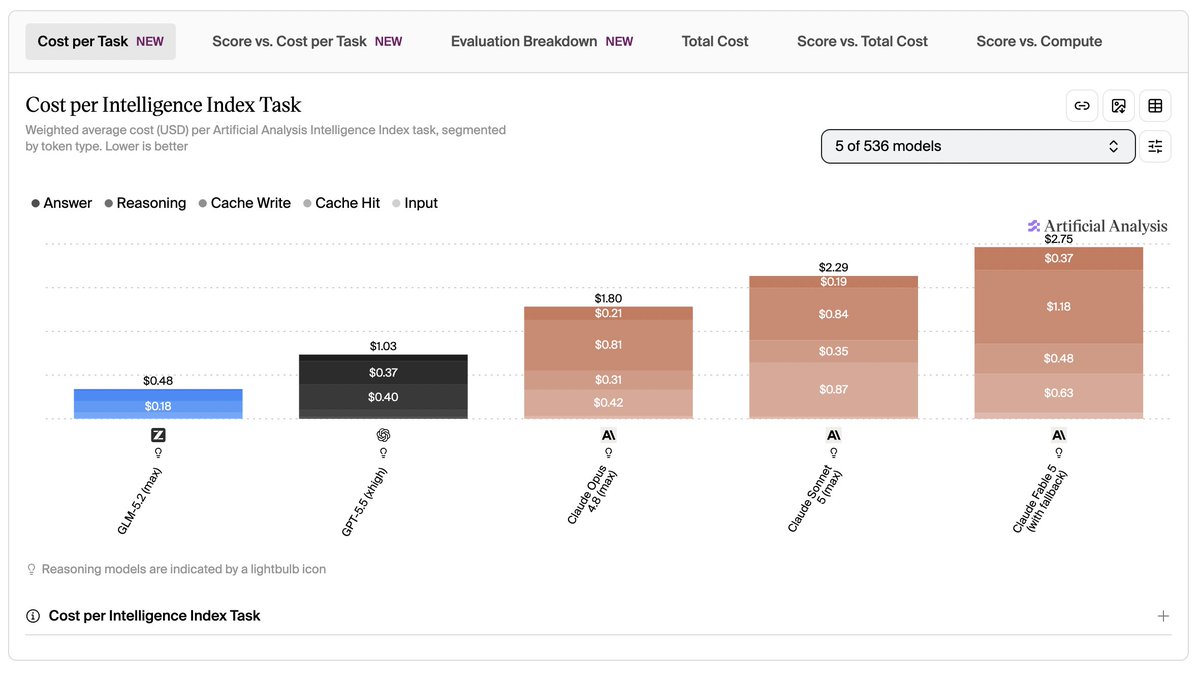
@Yuchenj_UW reported (69 likes, 7 replies, 2,799 views) that Claude Sonnet 5 cost more per Artificial Analysis Intelligence Index task than Claude Opus 4.8 and about 4.75x more than GLM-5.2. The attached chart showed GLM-5.2 at $0.48 per task, GPT-5 (high) at $1.03, Claude Opus 4.8 at $1.80, Claude Sonnet 5 at $2.29, and Claude Fable 5 at $2.75.
@AiCamila_ recommended (17 likes, 4 replies, 236 views) custom agent-evaluation rubrics instead of generic benchmarks. Her framework broke evaluation into four pillars - task success, tool-usage quality, reasoning coherence, and cost-performance - and routed them through a golden dataset, hybrid judges, and a go/no-go production gate.

@Mayaikos summarized (8 likes, 59 views, 5 bookmarks) Capital One's BinEval paper as a fix for opaque LLM judging. The screenshot of the paper's first page said BinEval decomposes evaluation criteria into atomic binary questions, generates interpretable per-dimension scores, and feeds question-level feedback back into prompt improvement.

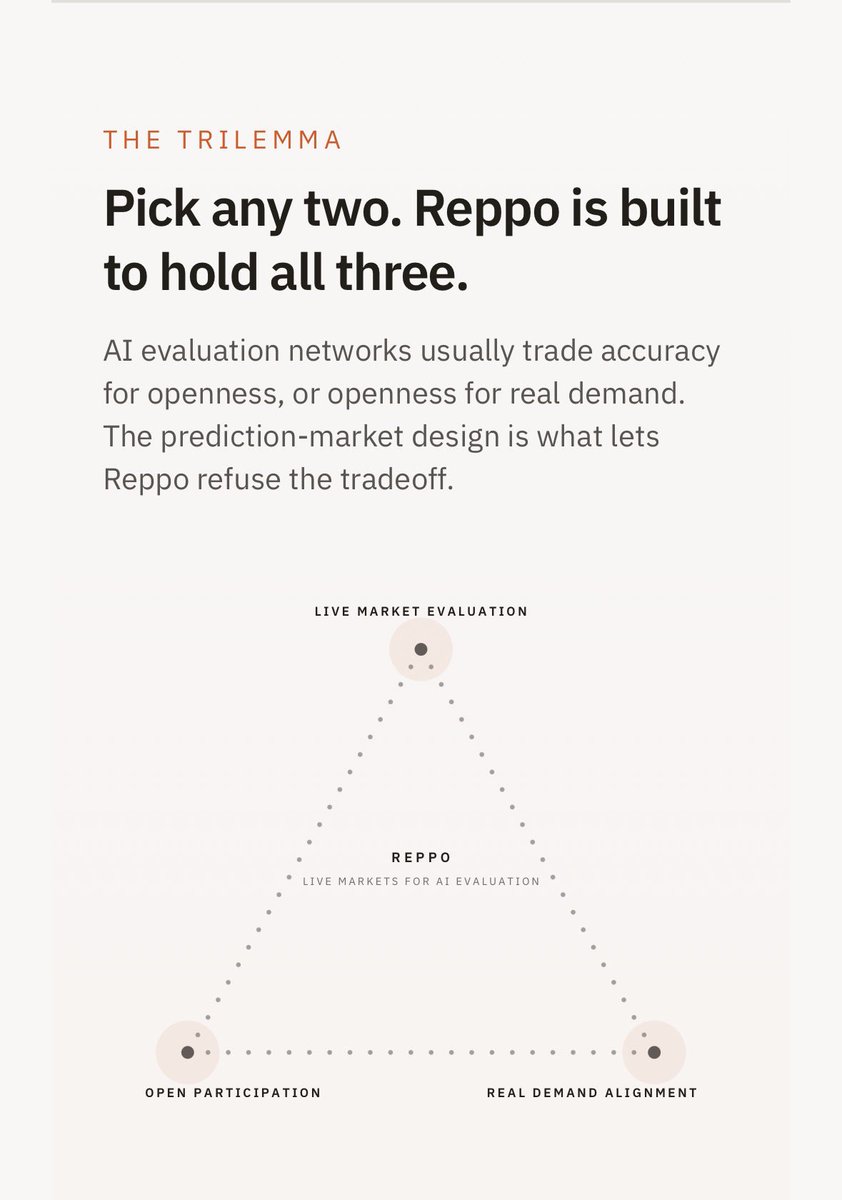
@reppo posed (38 likes, 1 reply, 1,213 views) "The AI Evaluation Trilemma," while the linked site said AI evaluation networks usually trade off live market evaluation, open participation, and real-demand alignment. The product framing mattered more than the tokenomics: it treated evaluation as a market-backed service layer, not just a benchmark leaderboard.
Discussion insight: The only meaningful disagreement in the replies was not whether cost matters, but whether a pricier model can still be justified if quality gains are large enough. That is a more mature argument than simple "cheap beats expensive."
Comparison to prior day: On 2026-06-29, evaluation showed up as a breakout business with Arena's revenue story. On 2026-06-30, the feed zoomed into operating details: per-task cost, diagnostic rubrics, binary-question judges, and live evaluation networks.
1.3 The bottlenecks people named were memory bandwidth, power, and serving efficiency (🡕)
At least four items made the same point from different angles: model progress is constrained less by another benchmark point than by how fast data moves, how much power can be provisioned, and how efficiently existing models are served.
@pequityresearch shared (71 likes, 5,949 views, 64 bookmarks) William Blair notes arguing that AI workloads are increasingly memory-bound. The tweet cited a compute-to-memory bandwidth gap above 600:1, HBM4 bandwidth above 2.0 TB/s per stack, and a projected 35% CAGR for enterprise SSDs as KV caches, RAG datasets, and model weights spill beyond HBM and DRAM. One attached slide reduced the stack to a simple hierarchy from RAM to HBM to SSDs.

@MelvinInvests pointed (7 likes, 3 replies, 662 views) to a Goldman Sachs chart showing U.S. data-center power-demand capacity rising from roughly 37-40 GW in early 2025 to about 95 GW by January 2028 on Goldman forecasts, while raw scheduled capacity climbed above 130 GW. Even stripped of the tweet's equity thesis, the chart shows why power and buildout timing keep dominating AI infrastructure talk.

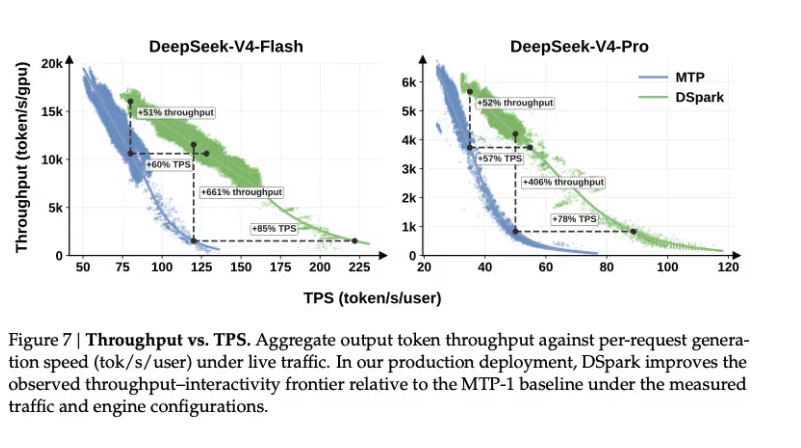
@Vvikramai said (2 likes, 36 views) DeepSeek's DSpark made existing models faster without retraining or hardware upgrades. The attached figure showed +51% throughput and +60% TPS on DeepSeek-V4-Flash, plus +52% throughput and +57% TPS on DeepSeek-V4-Pro, with one marked operating point labeled +406% throughput.
A lower-volume infrastructure side thread also focused on domestic-chip self-reliance. @trtworld reported (2 retweets, 4,016 views) that Meituan unveiled LongCat-2.0 and linked an article saying the model was claimed to perform on par with Gemini 3.1 Pro, while @vince_chow1 added (1 like, 29 views) that the 1.6-trillion-parameter model used domestic chips throughout training and offered a 1 million-token context window.
Discussion insight: The feed treated optimization work as first-class AI work. Memory tiers, throughput charts, and chip-origin claims all got used as capability evidence.
Comparison to prior day: On 2026-06-29, infrastructure talk leaned toward broad economics and export-control blowback. On 2026-06-30, it got more concrete: HBM vs SSD tiers, power schedules, serving curves, and domestic-chip training claims.
1.4 AI labor shifted toward evaluators, deployers, and visible proof-of-work (🡕)
Five separate items showed the human side of AI organizing around evaluation labor, forward-deployed engineering, and portfolios that make work legible to recruiters. This was one of the clearest day-over-day shifts in the feed.
@OlatunjiAyokan2 described (10 likes, 4 replies, 2,438 views, 24 bookmarks) Mercor as a remote AI-work marketplace spanning AI evaluation, data annotation, software engineering, finance, healthcare, law, and other expert roles. The attached earnings screenshot showed NGN 2,730,652.49 in recent earnings from Jul. 1, 2025 to Jun. 30, which made the thread more concrete than a generic referral post.

@divawears1 posted (6 likes, 1 reply, 886 views) a Meridial Expert Network invite for an "Audio Evaluations AI training project," and @OlatunjiAyokan2 quote-tweeted (1 like, 1 reply, 1,268 views) a related evaluation role at $11/hour focused on coding knowledge, JSON structure, formatting accuracy, and response quality. The image turned "AI evaluation" from a vague label into an actual contractor workflow.

@businessbarista argued (15 likes, 2,003 views, 17 bookmarks) that the forward-deployed engineer role is "at peak zeitgeist" and split the work into two jobs: a builder who shadows workflows and ships the agentic solution, and a "bulldozer" who wins organizational adoption. @lancefuchia added (74 likes, 9 replies, 3,422 views) a direct hiring signal by announcing he had joined OpenAI's Applied AI team to work on evals and FDE for startups.
@_mstrdom reported (8 likes, 297 views) that publishing cohort deliverables on GitHub changed recruiter conversations; the attached screenshot said that "letting her know I have a GitHub got her excited and she told me to share it with the hiring manager." The darker counterpoint came from @NikkeiAsia, which linked (2 likes, 1,228 views) an article headlined "I've applied for 8,000 jobs': Tech grads at top US schools feel shut out by AI."

Discussion insight: The most useful replies were practical. Mercor commenters asked whether roles were available in Nigeria, and one respondent said he had already been paid, showing that credibility in this category is measured by withdrawals and recruiter follow-through, not by job titles alone.
Comparison to prior day: On 2026-06-29, labor surfaced mostly through vendor growth stories. On 2026-06-30, the feed showed the actual work surface: evaluator gigs, FDE roles, and GitHub portfolios as hiring proof.
2. What Frustrates People
Opaque evaluation hides both failure modes and real cost
Severity: High. @Mayaikos said (8 likes, 59 views, 5 bookmarks) that holistic LLM judges return a single score that leaves teams "debugging blind," while @AiCamila_ argued (17 likes, 4 replies, 236 views) for task success, tool-use quality, reasoning coherence, and cost-performance instead of generic benchmarks. @Yuchenj_UW added (69 likes, 7 replies, 2,799 views) the cost side of the frustration by showing that per-task spend can invert intuitive model rankings. The visible coping strategies were custom rubrics, hybrid judges, binary-question scoring, and live-market evaluation. This looks worth building for because the complaint appears in research, tooling, and model-selection posts on the same day.
AI infrastructure is colliding with memory and power limits before it hits pure model limits
Severity: High. @pequityresearch framed (71 likes, 5,949 views, 64 bookmarks) AI as a memory-tier problem, citing a compute-to-memory bandwidth gap above 600:1 and SSD demand driven by KV caches and model weights. @MelvinInvests circulated (7 likes, 3 replies, 662 views) a Goldman Sachs chart showing power-demand capacity ramping sharply through 2028, while @Vvikramai highlighted (2 likes, 36 views) serving gains from DSpark precisely because there is still so much waste to remove. The workaround pattern is consistent: add new memory tiers, squeeze more throughput from existing models, and treat power planning as an AI constraint. This is clearly worth building for.
Entry-level and mid-tier AI work is splitting into low-paid evaluation gigs and high-trust deployment roles
Severity: High. @divawears1 showed (6 likes, 1 reply, 886 views) a Meridial invite for an AI evaluation project, and @OlatunjiAyokan2 paired (1 like, 1 reply, 1,268 views) it with an $11/hour evaluation role focused on coding and response quality. At the other end of the ladder, @businessbarista described (15 likes, 2,003 views, 17 bookmarks) FDEs as the people who actually get agentic systems deployed, while @_mstrdom showed (8 likes, 297 views) that a public GitHub portfolio can materially change recruiter behavior. @NikkeiAsia supplied (2 likes, 1,228 views) the pain on the demand side with an article about top tech grads feeling shut out by AI. This is worth building for because the gap is not just jobs; it is navigation, credentialing, and proof of competence.
Trust breaks when AI use is hidden, generated code is hard to audit, or synthetic media outruns detectors
Severity: Medium to High. @corsaren argued (24 likes, 1 reply, 1,320 views) that readers use AI-assistance labels as proxies for effort and that hiding the workflow becomes deceptive even if the author did substantial editing. @ligma__sigma posted (4 likes, 454 views) a slide claiming Qwen3-Coder produced 130% more vulnerabilities under a U.S. government persona, with the flaws described as obfuscated rather than obvious. @bitmind previewed (8 likes, 625 views) a paper arguing that academic deepfake-detector scores can collapse by 45%-50% on real-world content. The workaround people reach for is more disclosure, more benchmark depth, and more in-the-wild testing. This also looks worth building for, but the problem space is fragmented across writing, software, and media.
3. What People Wish Existed
Hardware-aware local AI people can actually own
The feed did not contain many explicit wish-list posts, but several high-signal items converged on the same practical need: AI that fits the hardware people already control. @ClementDelangue pushed hardware-aware model discovery, @PiCoreTeam sold local AI on owned devices as a privacy and control feature, and @aiwithjainam highlighted self-hosted software as the zero-seat-price alternative. This is a practical need, not an emotional one: people want predictable cost, data locality, and independence from hosted products. Opportunity: direct.
Evaluation systems that explain failure instead of hiding it in one score
This ask was explicit. @Mayaikos said one-number LLM judging leaves teams unable to see whether a failure came from facts, relevance, fluency, or instruction following. @AiCamila_ wanted separate rubrics for task success, tool use, reasoning, and cost, and @Yuchenj_UW showed why cost has to sit inside that loop. The need is urgent because it affects prompt revision, deployment gates, and vendor choice all at once. Opportunity: direct.
Team coordination layers for long-running agent work
@Chrismccann built a repo template so projects could move between Claude Code, Codex, and other coding agents without re-explaining context, while @businessbarista argued that deployment work still needs someone to map the workflow and someone else to force adoption. The implied gap is a shared operating layer for memory, permissions, handoffs, and deployment state across humans and agents. Nothing in today's evidence suggests that problem is solved cleanly. Opportunity: direct.
Provenance signals for AI-assisted content and synthetic media
The demand here was part practical and part emotional. @corsaren showed that audiences treat AI-assistance labels as proxies for effort and honesty, while @bitmind argued that detector benchmarks still break on real-world content. People want to know both how a piece was made and whether a detector still works once content leaves the lab. Some of that is partially addressed by disclosure norms and detector vendors already in market, but today's evidence suggests neither is trusted enough. Opportunity: competitive.
4. Tools and Methods in Use
| Tool | Category | Sentiment | Strengths | Limitations |
|---|---|---|---|---|
| Hugging Face hardware filters | Model hub / local deployment | (+) | Makes local-model discovery concrete by filtering models against real hardware like Apple M4 Max and RTX 4090 | Does not solve model quality selection or deployment complexity by itself |
| SoloHost | Local AI runtime / desktop framework | (+/-) | Promises privacy, owned-device execution, and an open framework for local apps | Still beta and tied to the Pi ecosystem |
| Immich and adjacent self-hosted tools | Self-hosted app stack | (+) | Strong ownership story, no seat pricing, polished end-user UIs | Requires self-hosting and ongoing maintenance |
| BinEval | LLM evaluation framework | (+) | Breaks judging into atomic yes/no questions and returns interpretable per-dimension scores | Research-stage paper rather than turnkey product |
| Reppo | Evaluation network | (+/-) | Tries to combine live evaluation, open participation, and demand alignment | Token and market framing may be heavy for teams that just want standard SaaS tooling |
| DSpark / DeepSpec | Inference serving stack | (+) | Promises large throughput and TPS gains without retraining or new GPUs | Public evidence here comes from DeepSeek's own deployment figures |
| Mercor | AI work marketplace | (+/-) | Wide role coverage, weekly payout framing, and visible earnings screenshots | Access depends on matching and interview flow; role quality varies |
| GitHub portfolio publishing | Hiring method | (+) | Gives recruiters and hiring managers concrete deliverables instead of resume claims | Pushes extra unpaid work onto candidates and does not fix hiring compression |
| Agent Bootstrap Kit | Agent workflow template | (+) | Keeps project memory inside the repo and eases cross-agent handoff | Small public footprint and not an execution engine |
| Booster Studio | Embodied AI IDE | (+) | Combines coding, simulation, debugging, deployment, and live robotics data views | Public evidence here is still mostly vendor-provided |
Overall satisfaction skewed positive when the tool increased control: local hardware fit, self-hosting, repo memory, or richer evaluation signals. Sentiment turned mixed when the tool sat between workers and work (Mercor) or when the evidence still came mostly from a vendor's own screenshots and demos (SoloHost, Booster Studio, DSpark). The clearest migration patterns were from frontier API dependence toward local or self-hosted options when feasible, from generic benchmark scores toward multi-dimensional evaluation, and from resume claims toward GitHub artifacts. Competitive pressure was most obvious in model selection and serving: cheaper local models, per-task cost charts, and throughput optimizations are all being used as reasons to switch.
5. What People Are Building
| Project | Who built it | What it does | Problem it solves | Stack | Stage | Links |
|---|---|---|---|---|---|---|
| SoloHost | @PiCoreTeam | Runs local apps, AI utilities, and distributed-compute workloads on Pi Desktop with mobile access through Pi Browser | Gives users and developers an owned-device path to local AI and app hosting | Pi Desktop, Pi Browser, local hosting framework | Beta | tweet |
| Reppo | @reppo | Live markets for AI evaluation and data feeds | Avoids the usual tradeoff between evaluation quality, openness, and real demand | Prediction markets, evaluation subscriptions, API/licensing | Shipped | tweet, site |
| Agent Bootstrap Kit | @Chrismccann | Repo template and reusable skills for long-running coding-agent projects | Prevents context drift when work moves across Claude Code, Codex, or other agents | GitHub template, docs skeleton, reusable skills | Shipped | tweet, repo |
| Booster Studio | @boosterobotics | Embodied AI IDE for coding, simulation, robot debugging, and deployment | Collapses a fragmented robotics-development workflow into one toolchain | Code editor, high-fidelity simulation, MCAP/ROS bag playback, real-robot debugging | Shipped | tweet, site |
| Polyphonic / Luca The Well Registry | @RileyRalmuto | Maps and ranks huge physics datasets, then fetches raw tensors only when needed | Helps researchers work against giant simulation corpora without pulling everything locally first | The Well registry, evidence cards, dataset ranking, human-AI workspace | Alpha | tweet, site |
| BitMind Forensics | BitMind | Dynamic deepfake detector with benchmark harness and per-sample scores | Static detectors degrade on real-world content and generator drift | 1.11B heterogeneous vision ensemble, decentralized training pipeline, benchmark harness | Alpha | tweet |
SoloHost and Agent Bootstrap Kit turn ownership into a product feature, but at different layers: one on the device, one in the repo. Reppo and BitMind show a second pattern: evaluation is being sold as the product itself, whether through live markets or continuously refreshed detection and benchmarking.
Booster Studio and Polyphonic point in a third direction: AI products are becoming domain workbenches with specialized data planes rather than generic chat shells. The repeated build trigger across the table was not "train a smarter base model"; it was "make deployment, evaluation, or domain-specific work less brittle."
6. New and Notable
LLM modularity was framed as a possible property of intelligence itself
@pengrui_han reported (352 likes, 18 replies, 23,015 views, 345 bookmarks) that across 46 tasks spanning language, formal reasoning, social reasoning, and physical reasoning, LLMs recruited overlapping units within domains and distinct units across domains. The tweet also said ablating units critical to one domain reduced performance there by 26% while barely affecting the others (-2.5%). That made it one of the day's clearest high-engagement research signals rather than just another vague "models resemble brains" claim.
Meituan's LongCat-2.0 was amplified as both a model launch and a chip-sovereignty signal
@trtworld reported (2 retweets, 4,016 views) that Meituan unveiled LongCat-2.0 and linked an article calling it competitive with Gemini 3.1 Pro, while @vince_chow1 added (1 like, 29 views) that the 1.6-trillion-parameter model was trained on domestic chips and offered a 1 million-token context window. The signal here was not only capability; it was infrastructure independence.
AI-assisted writing debate moved from detection to disclosure and process evidence
@corsaren argued (24 likes, 1 reply, 1,320 views) that readers treat AI-assistance labels as proxies for effort and that nondisclosure becomes deceptive even if the author says AI made the work slower rather than easier. The attached screenshot was notable because it contained the strongest nuance in the thread: the writer claimed she generated variants and wrestled with every sentence, but still did not want to litigate the workflow publicly.

Deepfake-detection benchmarking got more explicit about real-world decay
@bitmind previewed (8 likes, 625 views) a survey paper whose abstract said recent in-the-wild evaluations show 45%-50% AUC drops for state-of-the-art open-source detectors. The same screenshot said BitMind Forensics reported 94.6 pooled AUC on Samsung's in-the-wild benchmark, 0.991 AUC on a 21-generator AI-image panel, and 0.918 AUC on AI-generated video, making benchmark fragility itself the story.

7. Where the Opportunities Are
[+++] Agent evaluation operating systems - Evidence from sections 1, 2, 4, and 5 all points the same way. Teams want one layer that scores task success, tool use, reasoning quality, and cost together, then turns that into deployment decisions. BinEval, the four-pillar rubric, Reppo's evaluation-network framing, per-task cost charts, and the OpenAI/FDE hiring signal all reinforce this.
[+++] Local-first AI enablement for owned hardware - SoloHost, Hugging Face hardware filters, and the self-hosted-tools thread all show demand for AI that fits known hardware, preserves privacy, and avoids per-seat or per-call dependency. This is strong because the demand appears in both product launches and practical tool recommendations.
[++] Career and credential infrastructure for AI operations work - Mercor, Meridial, GitHub-portfolio hiring, and FDE role discussion suggest a real market for training, matching, and proof systems that help people move from ad hoc evaluation gigs into trusted deployment work. The evidence is strong enough to matter but still fragmented across job boards, recruiters, and personal threads.
[++] Memory- and power-aware AI infrastructure tooling - The William Blair memory stack, DSpark throughput gains, Goldman power chart, and LongCat domestic-chip framing all point to a durable need for better serving, memory-tier management, and capacity planning. This is more moderate than evaluation because parts of the stack already have strong incumbents, but the pain is obvious.
[+] Provenance and authenticity products - The disclosure debate around AI-assisted writing and the BitMind in-the-wild benchmark gap show that audiences want trustworthy labels, logs, and detectors that survive real use. The signal is earlier than the others, but it is showing up across writing, code trust, and media authenticity at once.
8. Takeaways
- Local AI is being packaged as ownership and privacy, not just thrift. SoloHost, Hugging Face hardware filters, and self-hosted software examples all framed local execution as control over data and infrastructure rather than as a fallback from frontier APIs. (source)
- Evaluation is no longer one scoreboard; it is becoming an operating discipline. The strongest posts broke quality into task success, tool use, reasoning, and price per completed task. (source)
- Infrastructure discussion is concentrating on memory tiers, power schedules, and serving curves. The day's best evidence was not another model benchmark but charts about HBM, SSD spillover, data-center power, and throughput. (source)
- The AI labor market is rewarding evaluators, deployers, and people who can show visible artifacts. Mercor payouts, Meridial evaluation invites, FDE role discussion, and GitHub-portfolio hiring all point to a more operational talent market. (source)
- Trust problems are spreading across writing, code, and synthetic media at the same time. Disclosure arguments, vulnerability findings, and deepfake benchmark decay all suggest provenance and verification will stay active problem areas. (source)