Twitter AI - 2026-07-03
1. What People Are Talking About
1.1 Open weights, sovereignty, and the application layer moved from theory to market pressure (🡕)
The strongest theme in the feed was that model quality alone no longer decides where value sits. Three high-signal threads and a concrete product screenshot pushed the same direction: countries and enterprises want more control, open-weight models are now exerting visible price pressure, and durable value may move above the model into governance, integration, and workflow ownership.
@RnaudBertrand argued (397 likes, 23 replies, 37,037 views, 201 bookmarks) that Palantir's new sovereignty messaging is really a reaction to countries pushing back on dependence, and used that to claim closed AI labs are charging a premium for models that no longer justify both the cost and the loss of control. The replies added two useful nuances: one legal reply said privacy litigation could hit Palantir directly, while another argued that open-weight commoditization makes frontier labs easier to substitute.
@ylecun backed (60 likes, 7 replies, 3,798 views, 15 bookmarks) the same direction more bluntly, saying concentration of power is the real AI danger, foundation models are becoming infrastructure, and long-run value sits in the application layer. The reply thread sharpened the commercial angle: if tokens are interchangeable, sticky value comes from vertical workflows and proprietary process memory, not from raw model access.
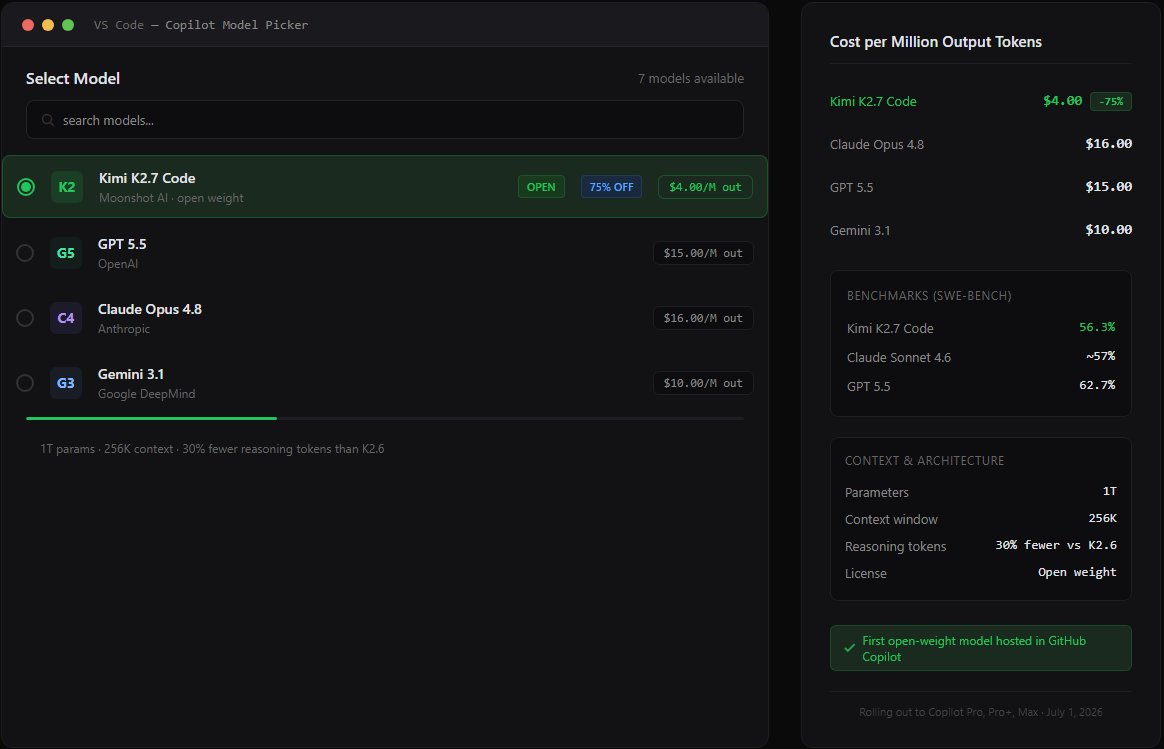
@Alan_Earn showed (49 likes, 20 replies, 1,141 views) that this argument is already reaching everyday tooling: an open-weight Kimi K2.7 Code option inside GitHub Copilot, priced at $4.00 per million output tokens, versus $15.00 for GPT 5.5 and $16.00 for Claude Opus 4.8 in the attached model-picker screenshot. The same image also showed the tradeoff: Kimi's visible SWE-Bench number sat below GPT 5.5, and replies immediately asked whether the price win holds up on messy real repositories.
Discussion insight: The disagreement was not over whether open models matter. It was over where the surplus goes when they do: some replies pointed to application vendors, others to clouds and chip makers, and several framed model providers as the layer most at risk of commoditization.
Comparison to prior day: On 2026-07-02, the feed already treated the application layer as the durable commercial edge. On 2026-07-03, that idea hardened into sovereignty, pricing, and lock-in arguments with a concrete open-weight price comparison inside a mainstream coding product.
1.2 Long-running agents are being designed around loops, memory, and cost control instead of one-shot prompting (🡕)
A second cluster focused on the runtime around agents rather than the base model. The feed kept returning to the same operating question: can the system observe reality, preserve context, manage cost, and keep improving over many steps instead of just producing a plausible first answer?
@0xlelouch_ explained (24 likes, 4 replies, 1,473 views, 20 bookmarks) loop engineering as a system design pattern: give the agent goals, rules, tools, tests, memory, and a stop condition, then force it to inspect failures and correct itself until checks pass. The distinctive angle was the shift from better prompts to better feedback systems.
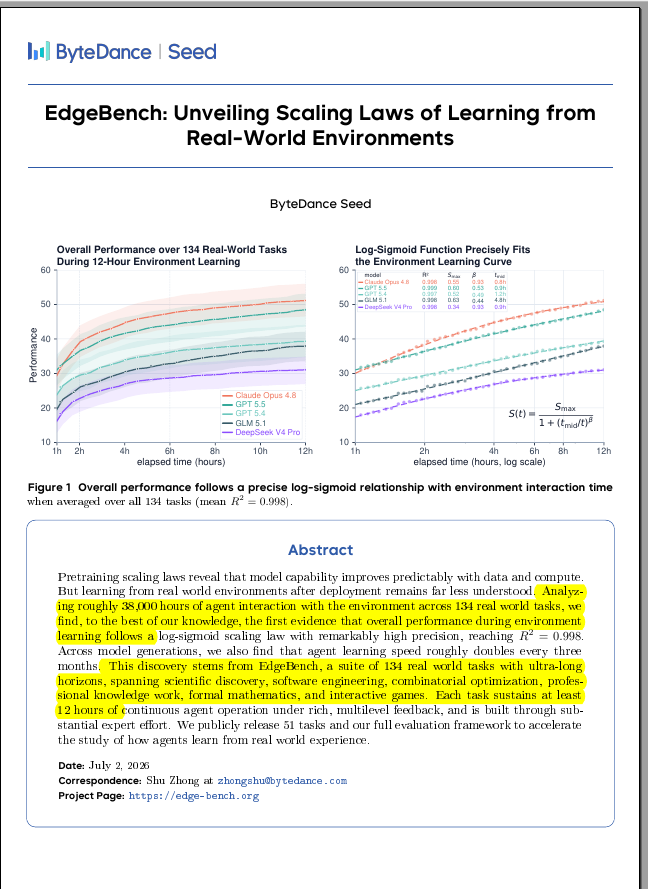
@rohanpaul_ai highlighted (20 likes, 11 replies, 4,044 views, 9 bookmarks) EdgeBench, which studies whether agents improve through experience on 134 real-world tasks that run for at least 12 hours. The attached figure mattered because it visualized the benchmark's central claim: after roughly 38,000 hours of runs, aggregate performance follows a clean learning curve as interaction time increases. One reply supplied the most practical objection in the whole thread: many agents do not fail because they cannot learn, but because they forget what they learned earlier in the run.
@DivyanshT91162 reported (24 likes, 8 replies, 912 views) that condense beat Headroom and Headroom Kompress on replayed coding sessions, claiming 28.0% lower bills overall and 53.4% savings on deeper sessions where context rereading dominates costs. The replies treated the methodology as the main signal: people explicitly liked that the comparison used real sessions and published numbers instead of synthetic marketing screenshots.
Discussion insight: People were not asking for prettier agent demos. They were asking whether the agent remembers prior work, survives deeper sessions, and stops burning tokens on dead context. That is why loops, memory, hidden judges, and compression all kept appearing together.
Comparison to prior day: On 2026-07-02, evaluation broadened into institutions and open-world testing. On 2026-07-03, the conversation became more operational: long-horizon learning curves, runtime memory failure, and bill-reduction tooling around actual coding sessions.
1.3 Builders kept treating AI credibility as proof-of-work, not prompt fluency (🡕)
The builder conversation kept moving away from generic "learn AI" advice and toward artifacts that prove someone can run a whole system. The recurring message was that one complete project or one inspectable experiment is worth more than a stack of tutorials.
@kmeanskaran said (165 likes, 11 replies, 6,392 views, 216 bookmarks) that a single project, STOCK-AGENT-OPS, brought him freelance work and an MLOps offer because it covered feature engineering, Feast, model training, MLflow, FastAPI, Redis, AWS, observability, and agent logic in one architecture. The key reply was unusually concrete: he said one AWS run cost about $12 in 50 minutes, which made the project feel like an accessible but serious systems exercise rather than a fantasy stack.
@rohit4verse wrote (30 likes, 10 replies, 1,950 views, 24 bookmarks) that Karpathy's nanochat let him train a small GPT on public web text and then fine-tune it on his own notes, chats, and writing for around $100 in GPU time. The replies echoed his framing that the real learning payoff is not frontier quality but inspectability: tokenizer, pretraining, fine-tuning, evaluation, UI, and inference all become legible once you build the smallest version yourself.
@cjzafir described (50 likes, 17 replies, 5,441 views, 62 bookmarks) a "deslop" skill built with Claude Fable 5 that scores and rewrites AI text, then uses that workflow to generate training data for a smaller Ornith 1-based writing model. The replies split in a revealing way: some immediately asked whether he would share or sell it, while another said the post itself felt like slop, which shows how quickly quality claims now get socially tested.
Discussion insight: The feed treated real AI skill as stack literacy plus execution: caching, latency, eval, deployment, data prep, and quality control. Even posts about learning kept collapsing back to "build, deploy, iterate" rather than "consume more content."
Comparison to prior day: On 2026-07-02, builder energy centered on agent operating systems, approvals, and workflow packaging. On 2026-07-03, the emphasis shifted toward portfolio proof, smaller but complete experiments, and tools built to counter AI-quality fatigue.
2. What Frustrates People
Closed-model dependence still feels expensive and strategically brittle
Severity: High. @RnaudBertrand argued (397 likes, 23 replies, 37,037 views, 201 bookmarks) that closed AI labs are still asking for premium pricing while forcing customers to give up control over data and weights, and he tied that complaint to a broader sovereignty backlash against dependence on US vendors. @ylecun added (60 likes, 7 replies, 3,798 views, 15 bookmarks) that concentration of control, not just model capability, is the real long-term risk. @Alan_Earn made (49 likes, 20 replies, 1,141 views) the pricing gap tangible with a screenshot showing an open-weight coding model in Copilot at $4.00 per million output tokens versus $15.00 to $16.00 for GPT 5.5 and Claude Opus 4.8. The coping pattern is obvious: try cheaper open-weight options first and push sticky value into the application layer. This looks worth building for because the pain spans cost, trust, and strategic control at once.
Long-running agents still forget, drift, or hide their failures
Severity: High. @0xlelouch_ wrote (24 likes, 4 replies, 1,473 views, 20 bookmarks) that useful agents need explicit goals, tools, tests, memory, and stop conditions because otherwise the human stays "the loop." @rohanpaul_ai surfaced (20 likes, 11 replies, 4,044 views, 9 bookmarks) the same issue from evaluation: one reply said agents often fail long runs because they forget what they solved earlier in the session. The coding-tool threads echoed that frustration directly. In replies to @alexandr_wang announcing (519 likes, 74 replies, 83,763 views) a coming Muse Spark update, one user said the first thing they would test is whether it remembers what was asked 20 minutes ago, and in replies to @FareaNFts promoting (37 likes, 12 replies, 6,364 views, 60 bookmarks) free Fable 5 access, another said rate limits are tolerable but silent context truncation is not. People cope by layering tests, loops, and manual review around the model. This is worth building for because the failure mode appears before the agent is fully autonomous.
Benchmark wins still fail the messy-repo smell test
Severity: High. The feed repeatedly challenged benchmark-first marketing with a simpler question: what happens on a weird real codebase? In replies to @Alan_Earn posting the Kimi K2.7 Code launch, one user said cheaper coding models often fall apart on edge cases in real repositories. Replies to @FareaNFts promoting free Fable 5 access asked whether the model survives dependency hell and catches its own bugs in agent loops. Even the positive compression thread from @DivyanshT91162 stood out (24 likes, 8 replies, 912 views) because it used replayed coding sessions and provider bills instead of synthetic tests. The workaround today is verification by replay, tests, and workflow-specific evaluation. That makes this worth building for because people clearly want benchmark claims translated into task-level proof.
Visible LLM voice is becoming a quality and trust problem
Severity: Medium. @tenobrus joked (470 likes, 14 replies, 13,944 views, 66 bookmarks) that some people now sound like "anglerfish lures" for the language model that ate their soul, but the replies made clear that readers recognized a real pattern of flattened, model-shaped phrasing. @cjzafir responded from the builder side by creating a "deslop" workflow intended to make smaller models write more humanly, only to get a reply saying the post itself sounded like slop. The coping pattern is already emerging: score outputs, rewrite them, fine-tune smaller models for tone, or dismiss polished synthetic voice on sight. This looks worth building for, but it is likely to be a crowded and subjective market.
3. What People Wish Existed
Provider-independent AI access with governance at the application layer
The clearest practical need was not just a better model. It was dependable access to strong models without surrendering pricing power, workflow control, or data sovereignty. @RnaudBertrand framed (397 likes, 23 replies, 37,037 views, 201 bookmarks) closed-model dependence as both expensive and strategically weak, while @ylecun argued (60 likes, 7 replies, 3,798 views, 15 bookmarks) that models are becoming infrastructure and value will shift upward into the application layer. @Alan_Earn added (49 likes, 20 replies, 1,141 views) a concrete product example: open-weight Kimi K2.7 Code inside Copilot at a much lower visible token price than Claude or GPT. This is a practical need with immediate workflow and budget consequences. Opportunity: direct.
Agent runtimes that remember, verify, and spend less as sessions deepen
People are not asking for one more prompt trick. They are asking for an execution layer that can hold context, run checks, compress dead weight, and know when to stop. @0xlelouch_ made (24 likes, 4 replies, 1,473 views, 20 bookmarks) the design brief explicit with goals, rules, tests, memory, and stop conditions. @rohanpaul_ai added (20 likes, 11 replies, 4,044 views, 9 bookmarks) long-horizon evaluation pressure through EdgeBench, and the replies said the real failure mode is forgetting mid-run. @DivyanshT91162 supplied (24 likes, 8 replies, 912 views) the cost angle by arguing that context compression becomes more valuable as sessions lengthen. This is an urgent operational need rather than an aspirational one. Opportunity: direct.
Better proving grounds for builders who want full-stack AI credibility
The strongest learning signal in the feed was not another static roadmap. It was the desire for cheap but complete proving grounds. @kmeanskaran treated (165 likes, 11 replies, 6,392 views, 216 bookmarks) one end-to-end MLOps project as the thing that unlocked interviews and freelance work, while @rohit4verse treated (30 likes, 10 replies, 1,950 views, 24 bookmarks) a weekend-scale tiny GPT build as the fastest way to understand tokenizer, pretraining, fine-tuning, evaluation, and inference. The implied wish is for environments where builders can learn the entire stack without needing frontier-lab budgets. Opportunity: competitive.
Neutral adjudication when autonomous agents disagree about what a contract meant
This was a smaller but distinctive need. @Bella_Hadide used (70 likes, 30 replies, 7,017 views, 35 bookmarks) a manufacturing example to argue that two agents can follow the same contract and still dispute whether something was truly "production ready," and the replies agreed that the hard part is interpreting ambiguous business language rather than recording measurements. The need is still early and partly conceptual, but it points to a real gap between payment rails, logging, and semantic dispute resolution. Opportunity: aspirational.
4. Tools and Methods in Use
| Tool | Category | Sentiment | Strengths | Limitations |
|---|---|---|---|---|
| GitHub Copilot + Kimi K2.7 Code | IDE / coding model | (+/-) | Open-weight option, broad IDE support, and much lower visible output-token pricing inside the picker | Visible screenshot benchmark trailed GPT 5.5, and replies questioned real-repo edge cases |
| Claude Fable 5 | Coding model | (+/-) | Strong coding and tool-use benchmark claims, 1M context, and active use in rewriting or multi-file workflows | Free-access routes appear rate-limited or inconsistent, and users still test it for bug-catching and context loss |
| Muse Spark | Frontier coding model | (+/-) | Promised coding and agentic upgrades plus rollout to Meta AI and the API | No public benchmark packet in the thread, and replies immediately asked about memory and benchmark anchors |
| condense | Context compression | (+) | Claimed lower bills and far fewer read/write tokens on replayed coding sessions | Comparison was vendor-published and still needs broader replication |
| Headroom / Headroom Kompress | Context compression | (+/-) | Still reduced bills versus baseline in the cited replay benchmark | Reported savings lagged condense on the same workloads |
| Loop engineering | Agent workflow method | (+) | Forces goals, rules, tests, memory, and stop conditions into the runtime | Requires tool access and verification discipline, not just a better prompt |
| EdgeBench | Long-horizon evaluation | (+) | 134 real-world tasks, 12-72 hour runs, hidden judges, and a concrete learning-curve framing | Reply thread suggests current agents still break when memory or context runs out |
| LangGraph + Feast + MLflow + Redis + FastAPI | MLOps stack | (+) | Gives builders a credible end-to-end surface for training, serving, caching, and monitoring | Operationally heavy; builders still have to justify cloud cost and optimize GPU time |
| nanochat | Learning / training repo | (+) | Makes tokenizer, pretraining, fine-tuning, evaluation, and inference inspectable for a weekend-scale budget | Small-model quality remains far below frontier systems, and data prep is still the hardest part |
The overall satisfaction spectrum was pragmatic. People liked anything that made cost, control, or evaluation more concrete, but they remained skeptical of pure benchmark flexing. The common workaround pattern was to route routine work toward cheaper or open-weight options, wrap the run in loop engineering and tests, then compress context before escalating to a stronger model. The competitive dynamic is widening sideways: pricing pressure from open-weight coding models, access arbitrage around frontier models, and a growing layer of compression and evaluation tools that exist because raw model quality still does not solve runtime waste.
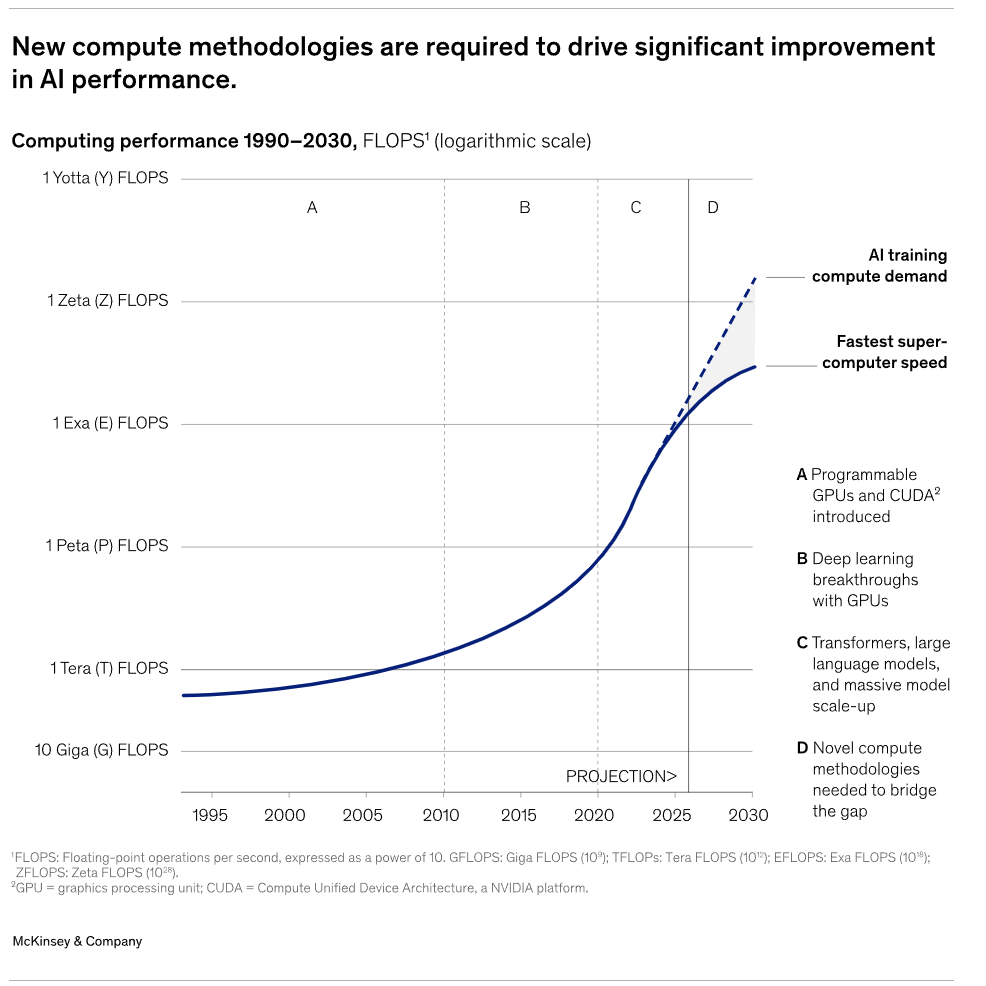
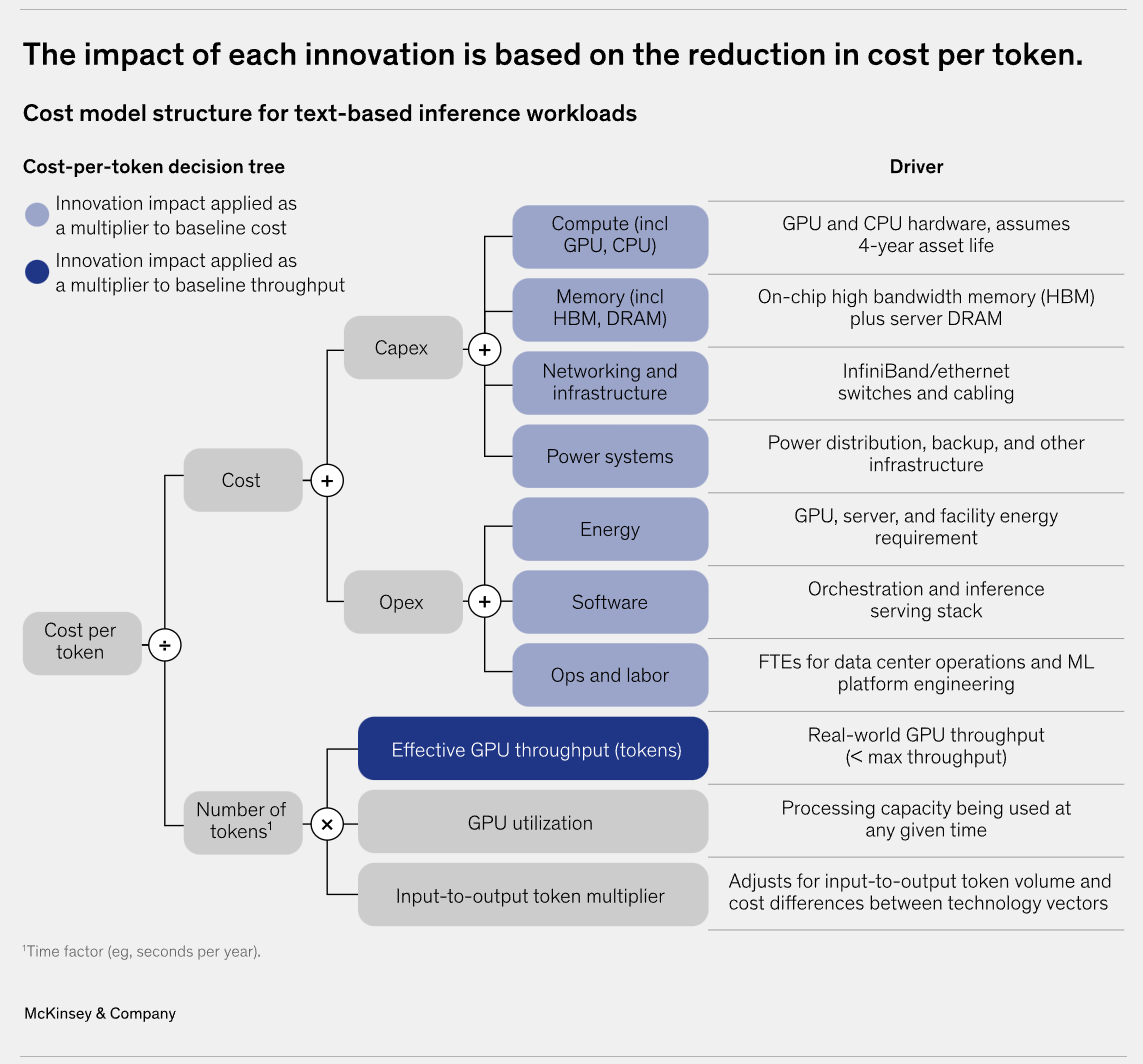
Two images made that economics story legible. @FareaNFts attached (37 likes, 12 replies, 6,364 views, 60 bookmarks) a provider card marketing Claude Fable 5 as a free, rate-limited option with a 1M context window, while @glocalinvestor attached (14 likes, 2 replies, 1,281 views, 20 bookmarks) two McKinsey slides that shifted the conversation from smarter models to the mechanics of compute demand and cost per token.

5. What People Are Building
| Project | Who built it | What it does | Problem it solves | Stack | Stage | Links |
|---|---|---|---|---|---|---|
| STOCK-AGENT-OPS | @kmeanskaran | End-to-end weekly stock-report pipeline with prediction, serving, caching, and agent-written reporting | Toy AI demos do not prove production skills around latency, feature stores, deployment, and observability | PyTorch LSTM, LangGraph, Feast, MLflow, Redis, Qdrant, FastAPI, Prometheus, Grafana, AWS | Beta | tweet · repo |
| EdgeBench | ByteDance Seed (via @rohanpaul_ai) | Long-horizon benchmark for agents that learn during 12-72 hour real-world tasks | Short benchmarks over-measure one-shot knowledge and under-measure learning from environment feedback | 134 tasks, local workspaces, hidden judges, multi-domain feedback loops | Beta | tweet · site |
| Tiny personal GPT via nanochat | @rohit4verse | Trains and fine-tunes a small GPT on public text plus personal notes, chats, and writing | Builders want an inspectable full-stack training exercise without frontier-lab budgets | nanochat, public web text, personal corpus, fine-tuning, chat UI, inference stack | Alpha | tweet |
| deslop 1 | @cjzafir | Scores and rewrites AI text, then uses that workflow to generate fine-tuning data for a smaller writing model | Visible AI slop and generic model voice are becoming quality liabilities | Claude Fable 5, SKILL.md workflow, scoring metrics, Ornith 1/Qwen 3.5 9B fine-tuning plan | Alpha | tweet |
| CreativityNeuro | @samschapiro | Steers model weights to improve divergent thinking and reduce mode collapse | Creative output still collapses into similar answers even on open-ended tasks | Contrastive weight steering, human evaluation, creativity tests | Alpha | tweet · paper |
STOCK-AGENT-OPS stood out because it treated AI credibility as systems work, not model fandom. The public repo makes the tweet more concrete: feature stores, observability, caching, vector search, and agentic reporting all sit in one stack, and the reply thread even put a small but believable dollar cost on running it.
EdgeBench, deslop 1, and CreativityNeuro point in a different but related direction: builders are spending more energy on the missing layers around models than on another generic chat wrapper. EdgeBench measures whether agents improve through time and feedback, deslop 1 tries to clean up recognizably model-shaped writing, and CreativityNeuro treats creative divergence as something that can be changed in the weights rather than in the prompt alone.
The repeated build trigger was not "make an AI app." It was fill a control gap. Some builders wanted proof-of-skill artifacts for hiring and freelancing, others wanted lower-cost experimentation, and others wanted quality-control layers around outputs that currently feel too repetitive or too brittle.
6. New and Notable
Open-weight coding models reached the Copilot picker
@Alan_Earn showed (49 likes, 20 replies, 1,141 views) what he described as the first open-weight model available inside GitHub Copilot: Kimi K2.7 Code, with a much lower visible output-token price than GPT 5.5 or Claude Opus 4.8. That is notable because it moves open-weight competition out of side channels and into a default developer surface where pricing and switching behavior can change day-to-day habits.
Creativity steering and creativity measurement both advanced in one ICML poster
@samschapiro shared (34 likes, 3 replies, 1,610 views, 20 bookmarks) two ICML workshop posters at once: one for CreativityNeuro, which the linked paper says can improve divergent-thinking performance by up to 14 human percentile points without retraining, and another asking whether semantic-distance tests are even valid measures of machine creativity. The combination is what made it notable: the work was not only trying to make outputs more original, but also trying to fix how originality gets measured.

Sakana framed black-box optimization as one design space instead of separate camps
@SakanaAILabs presented (186 likes, 6 replies, 21,971 views, 70 bookmarks) research arguing that major black-box optimization families differ mostly in fitness aggregation and consensus scope, not in kind. The linked paper matters because it turns a historically split literature into a composable design space and explicitly ties that back to language-model merging under tight evaluation budgets.
7. Where the Opportunities Are
[+++] Open-weight governance and application-layer routing — Evidence came from sections 1, 2, and 4 together: sovereignty complaints, model commoditization arguments, Kimi's lower visible Copilot price, and repeated talk about value moving into workflow ownership rather than raw token sales. This is strong because the pain spans pricing, control, and product architecture at once.
[+++] Long-running agent memory, verification, and context economics — Loop engineering, EdgeBench, condense, the Muse Spark memory questions, and the Fable 5 truncation complaints all point to the same gap: agents need runtimes that remember, verify, and stop wasting tokens as sessions deepen. This is strong because it appears simultaneously in public research, builder practice, and tool marketing.
[++] Portfolio-grade AI proving grounds — STOCK-AGENT-OPS and the nanochat experiment both show demand for artifacts that prove full-stack ability without requiring frontier-lab resources. This is a moderate opportunity because the need is obvious, but the winning product shape could range from managed sandboxes to template repos to challenge-based learning products.
[+] Output-quality and anti-slop tooling — The tenobrus backlash and cjzafir's deslop build point to a real trust problem around recognizably model-shaped prose. This is emerging rather than fully formed, but it is already strong enough that builders are trying to score, rewrite, and fine-tune around it.
[+] Semantic adjudication for agent-to-agent work — Bella_Hadide's manufacturing example exposed a narrow but real problem: logging approvals is not the same as resolving what an ambiguous contract meant. This is still speculative, but it is one of the clearest early examples of agent infrastructure moving beyond payments and into dispute resolution.
8. Takeaways
- Open-weight competition is now affecting mainstream developer pricing. The clearest proof was a Copilot picker screenshot showing Kimi K2.7 Code at $4.00 per million output tokens against much higher visible prices for GPT 5.5 and Claude Opus 4.8. (source)
- Sovereignty is no longer just a policy talking point; it is part of the commercial AI argument. The strongest thread of the day tied control over weights, data, and vendor dependence directly to who captures value as models commoditize. (source)
- Agent quality is being reframed as a runtime problem, not a prompt problem. Loops, memory, hidden judges, and context compression all got more attention than raw one-shot generation quality. (source)
- Real AI credibility still comes from shipping complete systems. A single public project that included feature stores, serving, caching, monitoring, and agent logic was described as enough to unlock both freelance work and an MLOps offer. (source)
- Cheap, inspectable experiments are widening the builder on-ramp. A weekend-scale tiny GPT build for around $100 in GPU time was framed as a better learning path than another layer of wrapper demos. (source)
- AI output quality now faces a social taste test as well as a benchmark test. One high-engagement joke about people sounding like LLM puppets and one serious "deslop" build landed on the same diagnosis: polished model voice is becoming a credibility problem of its own. (source)