Twitter AI - 2026-07-08
1. What People Are Talking About
1.1 Benchmark trust shifted from leaderboard scores to task-grounded measurement (🡕)
The biggest cluster was not another generic model ranking. It was a push to audit the ruler itself, replace public averages with workload-specific tests, and separate model quality from measurement artifacts. At least five retained items supported this theme across coding and scientific ML.
@OpenAI said (611 likes, 66 replies, 64,954 views, 85 bookmarks) that it audited SWE-Bench Pro and found 30% of tasks broken badly enough to retract its earlier recommendation that the field use the benchmark as a leading coding eval. The reply thread made the critique more concrete: correct solutions can fail because of hidden requirements, contradictory instructions, overly strict tests, or incomplete grading criteria, and OpenAI said the audit paired model-based investigator agents with five experienced software engineers.
@Yuchenj_UW argued (104 likes, 16 replies, 9,268 views, 30 bookmarks) that Databricks learned more from an internal coding benchmark on its multi-million-line codebase than from token-price comparisons. The distinctive claim was not only that GLM-5.2, OpenAI, and Anthropic all looked competitive on internal tasks, but that teams should compare models by dollars per task and then use a router to pick the right model for each job.
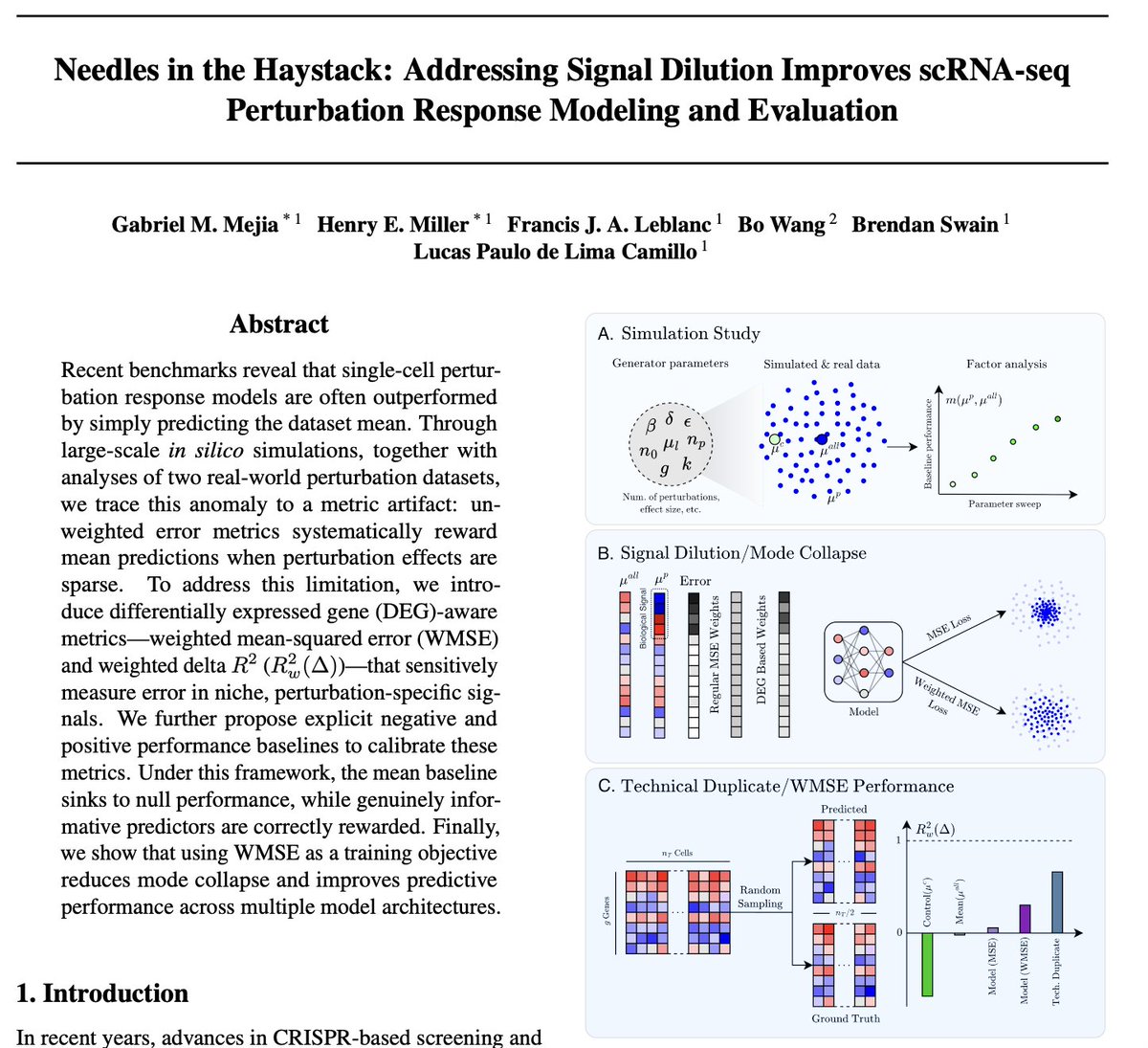
@BoWang87 made (28 likes, 1 reply, 2,940 views, 23 bookmarks) the same argument in perturbation biology from a different angle. His Needles in the Haystack paper and code argue that standard MSE rewards the mean predictor because only a few dozen genes out of roughly 20,000 carry the real perturbation signal, so weighted MSE is needed to recover what models actually learned.
@jayair described (1,219 likes, 58 replies, 89,000 views, 202 bookmarks) a rare model comparison that resonated because it was lived experience rather than a benchmark screenshot: his team repeatedly preferred GPT-5.6 over Fable after both models disappeared and returned. The useful angle was not that the post proved a universal ranking. It was that a workflow-level preference test drew far more attention than yet another benchmark chart.
Discussion insight: The strongest pushback came from a reply to the @jayair thread, where @kakatorro argued (81 views) that weeks spent missing GPT-5.6 created its own reverse bias. That objection fit the day's larger mood: people still want comparisons, but they increasingly distrust any comparison that is not grounded in blind tests, internal tasks, or audited metrics.
Comparison to prior day: On 2026-07-07, reliability talk focused on replayable failures, evaluator loops, and regression testing. On 2026-07-08, the skepticism moved one layer further upstream into the benchmarks themselves.
1.2 Orchestration, specs, and operating models looked more important than prompts (🡕)
A second cluster treated agent performance as a coordination problem across people, models, and artifacts. The common pattern was that better prompts alone do not solve ownership, routing, or intent drift; teams need an operating model, a routing layer, and durable specifications.
@levie summarized (200 likes, 33 replies, 16,584 views, 264 bookmarks) conversations with enterprise IT leaders who are trying to deploy agents across organizational boundaries. His post was unusually specific about the blockers: siloed processes, fragmented data, unclear ownership, weak adoption metrics, multi-model routing needs, and a talent shortage for people who can actually manage agent rollouts.
@SakanaAILabs highlighted (92 likes, 6 replies, 9,392 views, 37 bookmarks) the Fugu case study, where orchestration rather than one monolithic model is the core idea. Sakana's public write-up says Fugu and Fugu-Ultra break work into agent-specialized subtasks so smaller or cheaper models can do easier pieces while the overall system stays near the top on GPQA Diamond, LiveCodeBench Pro, and SWE-Bench Pro without depending on a single provider.
@gokulr introduced (22 likes, 1 reply, 7,511 views, 38 bookmarks) ProductSpec as a durable intent layer before implementation. The repo makes that concrete with required sections like problem, hypothesis, scope, acceptance criteria, and success metrics, plus handoff docs that show how the same artifact can survive design reviews, task tracking, engineering planning, and AI-agent execution.
Discussion insight: Replies to Levie's thread explicitly reframed adoption as an operating-model problem rather than a prompt problem, while replies to Sakana asked how orchestrator decisions become transparent enough to trust. That combination matters: the feed was not only asking for smarter agents, but for systems that explain who is routing what and why.
Comparison to prior day: On 2026-07-07, specs and replay systems were discussed mainly as engineering hygiene. On 2026-07-08, they were tied to org design, cross-team ownership, and multi-model control.
1.3 Open weights turned from a cost hedge into an access and control strategy (🡕)
Open-model talk was still about price, but it was no longer only about price. The stronger framing was that open weights reduce dependence on one provider's pricing, licensing, outages, geopolitics, and product priorities. At least six retained items supported this theme from different angles.
@demian_ai argued (36 likes, 7 replies, 3,611 views, 20 bookmarks) that open source AI is graduating from a cheaper alternative into a strategic asset. The thread tied that shift to regulated deployment, air-gapped environments, vendor-control risk, and the question of who actually controls the weights once model providers start moving into adjacent application categories.
@Forbes reported (19 likes, 14 replies, 13,804 views, 3 bookmarks) that Chinese authorities were discussing potential limits on overseas access to leading domestic AI models, including open-source or open-weight ones. Even as a news peg rather than a builder thread, it changed the tone of the day's open-model discussion by turning access itself into a strategic variable.
@Sentdex offered (84 likes, 4 replies, 2,328 views, 13 bookmarks) the operator-level version of the same hedge. He said he canceled Claude and GPT subscriptions after GLM-5.2, now runs DSV4F and GLM-5.2 locally, and framed batching, tensor parallelism, and local throughput as a serious alternative to permanent API dependence rather than a hobbyist experiment.
@CDGalpha flagged (15 likes, 10 replies, 313 views, 3 bookmarks) MiniMax M2.7 as a 230B open-weight coder that can be tried for free through NVIDIA's hosted developer page. The useful detail was not only the benchmark claim, but the caveats: non-commercial licensing, self-reported numbers, free-tier fragility, and the gap between development access and production readiness.

@S1r1u5_ showed (14 likes, 1 reply, 832 views, 6 bookmarks) a cyber benchmark where the relative ordering changed once the harness stayed fixed and only the model changed: GPT-5.5 led, but GLM-5.2 and DeepSeek V4 beat Opus 4.8 in that setup. That made the open-weight case feel less ideological and more like a routing problem.
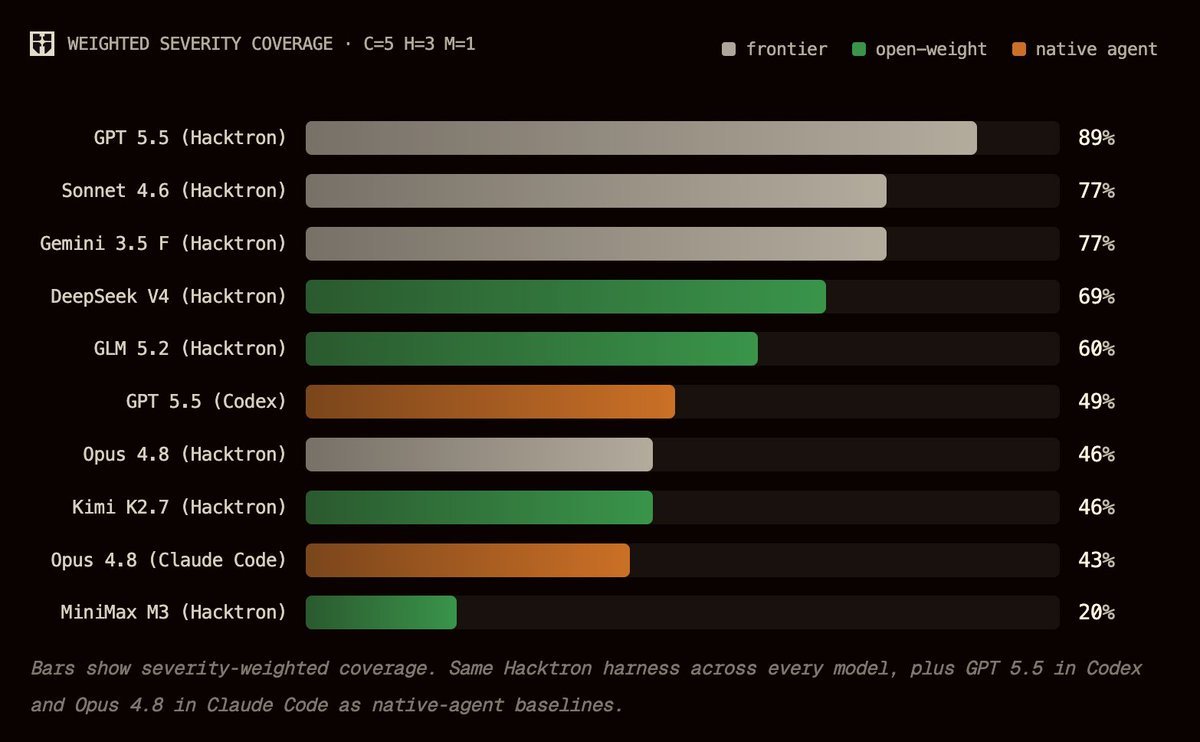
Discussion insight: The interesting split here was not "open versus closed" in the abstract. It was whether access is durable, commercially usable, and controllable inside real organizations, which is why local deployments, licensing caveats, regulatory reporting, and model-routing screenshots all belonged to the same conversation.
Comparison to prior day: On 2026-07-07, open-weight discussion centered on deployment economics and local compute. On 2026-07-08, the same thread picked up sovereignty, access risk, and control of the optimization loop.
1.4 Builders shipped new control layers around models, data, and perception (🡕)
The builder signal was less about a new general assistant and more about the infrastructure around model use: new architectures, edge deployment surfaces, document-verification tooling, model editing, and full training stacks. The feed kept rewarding posts that made a previously hidden layer inspectable or controllable.
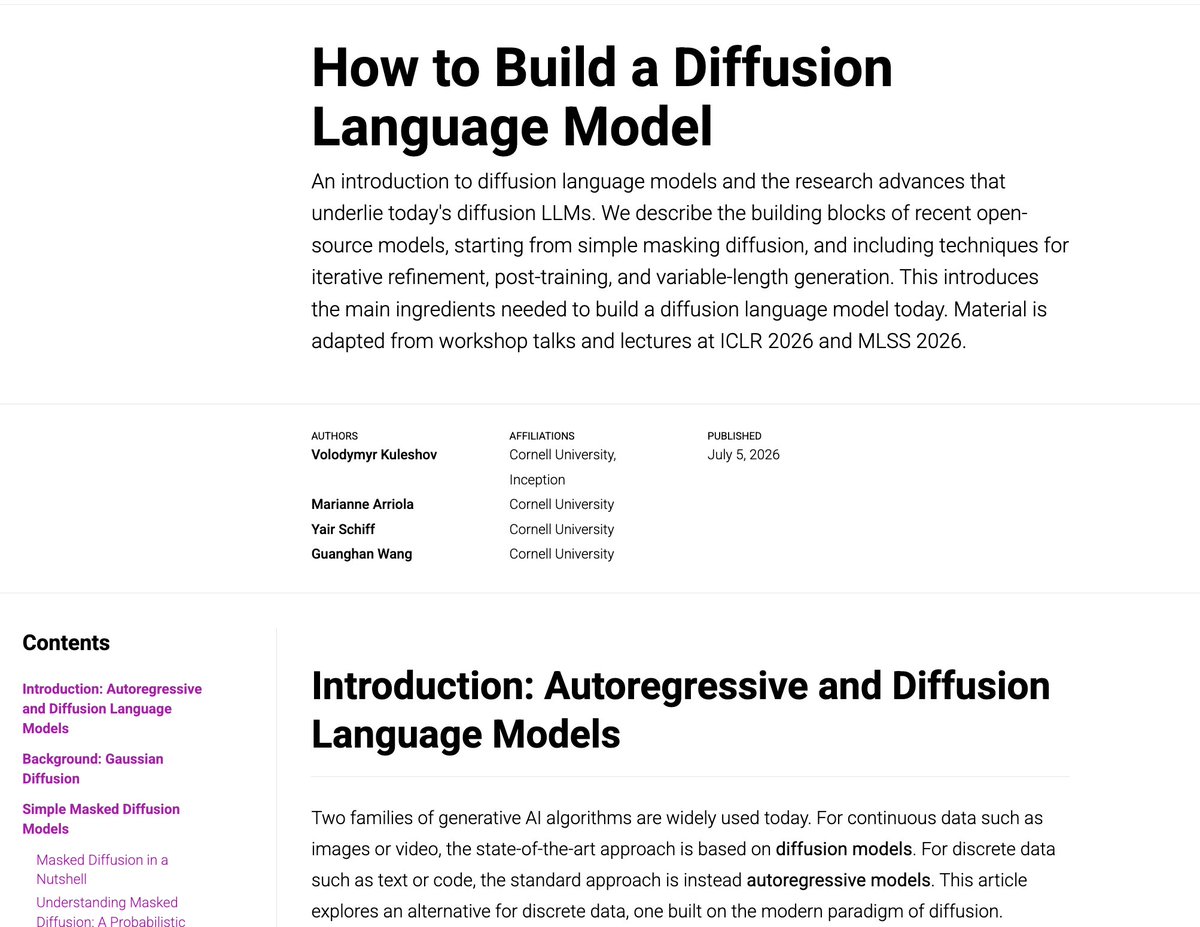
@volokuleshov introduced (440 likes, 4 replies, 13,507 views, 518 bookmarks) a public diffusion LLM guide that treats Mercury 2, Gemma Diffusion, and Nemotron Diffusion as the first practical examples of a once-open problem becoming buildable. The post mattered because it translated a research arc into a recipe: masked diffusion, iterative refinement, variable-length generation, controllable generation, fast samplers, and RL post-training.
@CloudflareDev announced (21 likes, 4 replies, 3,328 views, 6 bookmarks) Moondream 3.1 on Workers AI, and the linked Cloudflare changelog plus Moondream blog added the operational details missing from the tweet: a 9B total / 2B active MoE vision model, 32K context, and sub-second p50 latencies for query, caption, point, and detect actions.
@DataChaz surfaced (7 likes, 3 replies, 1,228 views, 7 bookmarks) OfficeCLI, an open-source Office suite built for agents. The repo is the key evidence here: single-binary distribution, a built-in renderer that turns Word, Excel, and PowerPoint into HTML or PNG for inspection, headless automation, MCP support, and no requirement to install Microsoft Office at runtime.
@zxlzr announced (12 likes, 0 replies, 434 views, 2 bookmarks) a major EasyEdit update that expands knowledge editing, model steering, multimodal support, and vLLM-oriented workflows. In the same control-layer spirit, @vincentweisser said (57 likes, 12 replies, 1,584 views, 3 bookmarks) Prime Intellect raised $130M to build an open stack spanning compute, RL, environments, sandboxes, evals, deployment, and continuous model improvement.
Discussion insight: Across OfficeCLI, EasyEdit, Prime Intellect, and Harvey's model-training push, the repeated build pattern was not "give me one smarter model." It was "give me a way to see, steer, evaluate, and continuously improve the system wrapped around the model."
Comparison to prior day: On 2026-07-07, builders were mostly shipping specialized runtimes and domain benchmarks. On 2026-07-08, the emphasis shifted toward control surfaces around architectures, edge inference, documents, and post-training stacks.
2. What Frustrates People
Benchmark integrity and task fit remain a blocker
Severity: High. @OpenAI said (611 likes, 66 replies, 64,954 views, 85 bookmarks) that 30% of SWE-Bench Pro tasks are broken and listed hidden requirements, contradictory instructions, overly strict tests, and incomplete grading as concrete failure modes. @BoWang87 argued (28 likes, 1 reply, 2,940 views, 23 bookmarks) that perturbation-biology benchmarks were effectively rewarding mean predictions over real biological signal until WMSE reweighted the metric, while @Yuchenj_UW said (104 likes, 16 replies, 9,268 views, 30 bookmarks) teams should compare models by dollars per task on internal code, not dollars per token. The coping pattern is to audit public benchmarks, build private task suites, and use domain-aware metrics. This is worth building for because trustworthy evaluation is now part of the product, not just part of research.
Enterprise agent rollouts still break on org and data boundaries
Severity: High. @levie described (200 likes, 33 replies, 16,584 views, 264 bookmarks) a stack of enterprise blockers that have little to do with prompt phrasing: siloed processes, fragmented data, unclear ownership, weak success metrics, and a shortage of people who can run adoption. @gokulr answered (22 likes, 1 reply, 7,511 views, 38 bookmarks) part of that pain with ProductSpec's durable intent layer, while @SakanaAILabs showed (92 likes, 6 replies, 9,392 views, 37 bookmarks) that even high-end capability now depends on orchestration across multiple models. Teams are coping with spec layers, routing layers, and internal memory/context systems, but the thread-level sentiment was that this remains hard. This is worth building for because the pain appears as soon as agents cross team boundaries or touch fragmented enterprise systems.
Single-provider dependence still feels brittle on price, availability, and access
Severity: High. @jayair said (1,219 likes, 58 replies, 89,000 views, 202 bookmarks) his team felt a real workflow loss when GPT-5.6 disappeared and Fable did not fully replace it, which is a product-availability frustration more than a benchmark debate. @Sentdex responded (84 likes, 4 replies, 2,328 views, 13 bookmarks) by going local with GLM-5.2 and DSV4F, while @Forbes reported (19 likes, 14 replies, 13,804 views, 3 bookmarks) and @demian_ai argued (36 likes, 7 replies, 3,611 views, 20 bookmarks) that control of open weights is becoming geopolitical and strategic. @CDGalpha added (15 likes, 10 replies, 313 views, 3 bookmarks) a different kind of brittleness: even when an open-weight model is free to try, licensing and hosting terms can still block commercial use. This is worth building for because users are clearly looking for routing, fallback, hosting, and license-aware deployment layers.
Raw models still need external control and verification layers
Severity: Medium. @DataChaz highlighted (7 likes, 3 replies, 1,228 views, 7 bookmarks) OfficeCLI because agents can otherwise generate Office documents without being able to see layout failures. @zxlzr released (12 likes, 0 replies, 434 views, 2 bookmarks) new EasyEdit capabilities for model editing and steering, @gabepereyra described (121 likes, 9 replies, 45,625 views, 44 bookmarks) Harvey's push into synthetic data, RL, and model training, and @S1r1u5_ showed (14 likes, 1 reply, 832 views, 6 bookmarks) that rankings can change sharply once a different harness is applied. The workaround pattern is to add render loops, editing layers, synthetic environments, and per-task eval harnesses around the base model. This is worth building for because the missing control surface is often the real production bottleneck.
3. What People Wish Existed
Router-and-eval stacks tied to real workloads
The most explicit ask in the feed was not for another single winner model. It was for infrastructure that can test models on the work a team actually does and then route each task accordingly. @Yuchenj_UW said (104 likes, 16 replies, 9,268 views, 30 bookmarks) Databricks is building an intelligent router after finding multiple models on the Pareto frontier for its internal codebase, and @S1r1u5_ showed (14 likes, 1 reply, 832 views, 6 bookmarks) that rankings can flip inside a different harness. @OpenAI added (611 likes, 66 replies, 64,954 views, 85 bookmarks) the warning that even widely used public coding benchmarks may not be trustworthy enough to play that role by themselves. Some pieces exist today, but the unmet need is a production-grade layer that combines workload sampling, benchmark auditing, routing, and cost-per-task reporting. Opportunity: direct.
Shared intent and context layers for cross-team agents
People were asking for a way to preserve goals, constraints, and business context as work moves across teams and across agents. @levie described (200 likes, 33 replies, 16,584 views, 264 bookmarks) that enterprises still do not know who should own centrally managed agents or how to measure success, while @gokulr proposed (22 likes, 1 reply, 7,511 views, 38 bookmarks) ProductSpec as a durable artifact for intent before implementation. The responses made the emotional valence clear: people do not only want smarter outputs, they want a system they can trust to carry the same objective across organizational boundaries. ProductSpec is a partial answer, but the broader need for agent-readable context, ownership, revision history, and measurable acceptance criteria remains open. Opportunity: direct.
Sovereign, commercially usable open-model access
The feed repeatedly showed that "open" is not enough if access is revocable, licensing is unclear, or regional policy can change the supply of weights. @Forbes reported (19 likes, 14 replies, 13,804 views, 3 bookmarks) that China was discussing potential overseas-access limits, @demian_ai argued (36 likes, 7 replies, 3,611 views, 20 bookmarks) that control of weights is becoming strategic infrastructure, and @CDGalpha noted (15 likes, 10 replies, 313 views, 3 bookmarks) that even a free model like MiniMax M2.7 comes with non-commercial caveats. What people seem to want is dependable access to strong open bases, plus clear commercial terms, regional hosting options, and deployment guidance for regulated environments. Opportunity: competitive.
Verification layers for artifacts and model behavior
Another practical need was for systems that let agents verify what they just produced or changed. @DataChaz framed (7 likes, 3 replies, 1,228 views, 7 bookmarks) OfficeCLI as the missing way for agents to "see" Office layouts, while @zxlzr expanded (12 likes, 0 replies, 434 views, 2 bookmarks) EasyEdit for editing and steering model behavior itself. @gabepereyra described (121 likes, 9 replies, 45,625 views, 44 bookmarks) Harvey's synthetic environments and post-training stack as another answer to the same gap: models still need evidence-backed verification loops around them. Partial solutions exist, but they are fragmented by artifact type and domain. Opportunity: direct.
4. Tools and Methods in Use
| Tool | Category | Sentiment | Strengths | Limitations |
|---|---|---|---|---|
| SWE-Bench Pro | Coding benchmark | (-) | Widely recognized, grounded in real repo tasks | OpenAI said 30% of tasks are broken; hidden requirements and strict tests can distort results |
| Internal codebase benchmarks + task routers | Eval / routing method | (+) | Measures real work, supports dollars-per-task comparisons, reveals routing wins | Private by nature, harder to compare across companies |
| WMSE / Needles in the Haystack | Eval metric / scientific ML method | (+) | Reweights toward true perturbation signal and collapses misleading mean baselines | Domain-specific and requires extra dataset understanding |
| Fugu / Fugu-Ultra | Agent orchestration | (+) | Splits work across specialized models and keeps strong benchmark results without one provider | Router transparency and governance still matter |
| ProductSpec | Spec standard | (+) | Makes intent, acceptance criteria, and success metrics durable for humans and agents | Only works if teams keep the spec current |
| GLM-5.2 / DSV4F local inference stacks | Open models / infra | (+) | Strong local economics, fast throughput, less API dependence | Requires hardware, ops skill, and workload-specific validation |
| MiniMax M2.7 | Open-weight coding model | (+/-) | Free developer access and strong self-reported coding numbers | Non-commercial license, self-reported benchmarks, free tier may not be stable |
| Moondream 3.1 on Workers AI | Vision model / edge inference | (+) | Query, caption, point, and detect in sub-second edge deployments | Narrower task scope than general LLMs and tied to a platform runtime |
| OfficeCLI | Document automation / agent tooling | (+) | Gives agents a render-check-fix loop for Word, Excel, and PowerPoint | Office-domain specific and still new in production terms |
| EasyEdit | Model editing / steering | (+) | Broad editing algorithms, multimodal support, stronger steering workflows | Advanced research-oriented tooling that still needs careful evaluation |
The satisfaction spectrum ran from outright skepticism about generic public benchmarks to guarded optimism about workload-specific systems. @OpenAI undercut (611 likes, 66 replies, 64,954 views, 85 bookmarks) one of the field's most-cited coding benchmarks, while @Yuchenj_UW described (104 likes, 16 replies, 9,268 views, 30 bookmarks) a move toward private task suites and routers. In parallel, @Sentdex reported (84 likes, 4 replies, 2,328 views, 13 bookmarks) migration away from API subscriptions toward local open-model stacks, while @CDGalpha showed (15 likes, 10 replies, 313 views, 3 bookmarks) that even attractive free-access models come with licensing caveats.
The common workaround pattern was to add layers rather than switch faiths. Teams are routing across models instead of marrying one provider, auditing benchmarks instead of trusting one scalar score, and adding artifact-verification tools like OfficeCLI or control layers like EasyEdit instead of asking raw models to magically become reliable. Competitive dynamics looked workload-shaped: frontier models still top some harnesses, but open weights, local inference, and orchestration are now credible enough that many teams want a portfolio rather than a single bet.
5. What People Are Building
| Project | Who built it | What it does | Problem it solves | Stack | Stage | Links |
|---|---|---|---|---|---|---|
| ProductSpec | @gokulr | Open Markdown standard for software intent before implementation | Prevents intent drift across humans, tickets, engineering plans, and AI agents | TypeScript, Markdown, parser/schema tooling | Beta | repo |
| Fugu / Fugu-Ultra | @SakanaAILabs | Multi-model orchestration system that delegates subtasks across specialized agents/models | Avoids dependence on one provider while keeping strong benchmark performance | Agent orchestration, model routing, benchmark harnesses | Beta | case study |
| OfficeCLI | GoWorm / iOfficeAI | Agent-native Office suite and CLI with rendering, automation, and MCP support | Lets agents inspect and fix Word, Excel, and PowerPoint output instead of editing blindly | C#, single binary, built-in renderer, MCP server | Shipped | repo |
| EasyEdit | @zxlzr | Framework for knowledge editing and model steering | Changes model knowledge or behavior without full retraining | Python/Jupyter, multimodal editing, vLLM steering | Beta | repo |
| Needles in the Haystack | @BoWang87 | Benchmark/evaluation package for perturbation modeling using WMSE and calibrated baselines | Fixes evaluation setups that reward mean predictions over real perturbation signal | Python, OpenReview paper, DEG-aware metrics | Beta | repo, paper |
| Moondream 3.1 on Workers AI | Cloudflare + Moondream | Ultra-fast edge vision inference for query, caption, point, and detect tasks | Brings action-ready image understanding into low-latency edge workflows | Workers AI, 9B/2B active MoE VLM, edge inference APIs | Shipped | changelog, blog |
| Open superintelligence stack | @vincentweisser / Prime Intellect | Train, deploy, and continuously improve company-specific models and agents | Lets companies own the optimization loop instead of renting it from one lab | Compute, RL, environments, sandboxes, evals, deployment | Shipped | site |
ProductSpec and Fugu show two sides of the same build pattern. One side makes intent durable before work starts; the other side routes execution dynamically once the work is underway. Together they suggest that agent quality is increasingly being engineered through specs and orchestration rather than through a single prompt or single model.
OfficeCLI and EasyEdit attack two different blind spots. OfficeCLI gives agents a render-check-fix loop for documents, while EasyEdit treats model behavior itself as something that can be edited, steered, and evaluated with explicit tooling. Both are examples of builders adding control surfaces around the model rather than asking the base model to self-correct everything.
Needles, Moondream, and Prime Intellect point to a third pattern: evaluation, deployment, and optimization are becoming products in their own right. The same builder direction also showed up in @gabepereyra describing (121 likes, 9 replies, 45,625 views, 44 bookmarks) Harvey's move into synthetic data, RL, and post-training for domain-specific knowledge work. Multiple teams are now building the layers that sit above or around the model, not only the model itself.
6. New and Notable
Diffusion language models became a documented open-source recipe
@volokuleshov used (440 likes, 4 replies, 13,507 views, 518 bookmarks) a public blog post to turn diffusion LLMs from an abstract research lane into a practical build guide. The notable part was not only that Mercury 2, Gemma Diffusion, and Nemotron Diffusion now exist, but that the post itemized the techniques behind them: masked diffusion, iterative refinement, controllable generation, fast samplers, and RL post-training.
Benchmark auditing became part of the product conversation
@OpenAI publicly retracted (611 likes, 66 replies, 64,954 views, 85 bookmarks) its earlier recommendation that the research community rely on SWE-Bench Pro, while @BoWang87 showed (28 likes, 1 reply, 2,940 views, 23 bookmarks) a parallel metric failure in biology. What made this notable is that the benchmark itself, not just the model score, became the day's newsworthy artifact.
Edge vision got a concrete latency-first release
@CloudflareDev announced (21 likes, 4 replies, 3,328 views, 6 bookmarks) Moondream 3.1 on Workers AI, and the linked Cloudflare changelog supplied unusually specific inference numbers for an X thread: sub-second p50 latencies across query, caption, point, and detect flows. That made the post stand out as a deployment signal, not just another model release note.
Owning the optimization loop is becoming a company strategy
@vincentweisser said (57 likes, 12 replies, 1,584 views, 3 bookmarks) Prime Intellect raised $130M to build an open stack for training, deploying, and continuously improving models, while @gabepereyra said (121 likes, 9 replies, 45,625 views, 44 bookmarks) Harvey is moving from the application layer into the model layer via synthetic data, RL, and post-training. The notable shift is that vertical AI companies are no longer treating model improvement as something only frontier labs own.
7. Where the Opportunities Are
[+++] Workload-grounded eval and routing platforms — The strongest opportunity combines benchmark auditing, internal task suites, and runtime routing. @OpenAI showed (611 likes, 66 replies, 64,954 views, 85 bookmarks) that public benchmarks can fail, @Yuchenj_UW showed (104 likes, 16 replies, 9,268 views, 30 bookmarks) that private workloads reveal different winners, and @BoWang87 showed (28 likes, 1 reply, 2,940 views, 23 bookmarks) the same issue in another domain. This is strong because the need appears in evaluation, cost control, and model selection at once.
[++] Enterprise agent context and ownership systems — @levie laid out (200 likes, 33 replies, 16,584 views, 264 bookmarks) the operational pain around silos, fragmented data, and unclear success metrics, while @gokulr offered (22 likes, 1 reply, 7,511 views, 38 bookmarks) ProductSpec and @SakanaAILabs offered (92 likes, 6 replies, 9,392 views, 37 bookmarks) orchestration as partial answers. This is moderate-to-strong because the pain is obvious, but enterprise adoption cycles and incumbents make it competitive.
[++] Sovereign and commercially clear open-weight operations — @Sentdex showed (84 likes, 4 replies, 2,328 views, 13 bookmarks) local open-model deployment as a live hedge, @Forbes surfaced (19 likes, 14 replies, 13,804 views, 3 bookmarks) policy risk around access, and @CDGalpha highlighted (15 likes, 10 replies, 313 views, 3 bookmarks) the licensing caveats even on free models. This is moderate because the need is real, but success depends on regulation, hosting partnerships, and trust.
[+] Control surfaces for artifacts and model behavior — @DataChaz showed (7 likes, 3 replies, 1,228 views, 7 bookmarks) the need for document-visible agent tooling, @zxlzr showed (12 likes, 0 replies, 434 views, 2 bookmarks) active demand for editing and steering frameworks, and @gabepereyra showed (121 likes, 9 replies, 45,625 views, 44 bookmarks) that companies are willing to invest in synthetic environments and post-training loops. This is emerging because the use cases are concrete, but the market is still fragmented by artifact type, domain, and risk level.
8. Takeaways
- Benchmark trust is under active revision. @OpenAI said (611 likes, 66 replies, 64,954 views, 85 bookmarks) that 30% of SWE-Bench Pro tasks are broken, and @BoWang87 showed (28 likes, 1 reply, 2,940 views, 23 bookmarks) the same "wrong ruler, wrong winner" pattern in biology.
- Task success is replacing token price as the practical unit of comparison. @Yuchenj_UW said (104 likes, 16 replies, 9,268 views, 30 bookmarks) Databricks' internal benchmark put multiple models on the Pareto frontier and pushed the team toward dollars-per-task routing instead of dollars-per-token ranking.
- Agent quality is increasingly an operating-model problem. @levie focused (200 likes, 33 replies, 16,584 views, 264 bookmarks) on ownership, data fragmentation, and business metrics, while @SakanaAILabs treated (92 likes, 6 replies, 9,392 views, 37 bookmarks) orchestration as the real capability layer.
- Open weights are being valued for control, not only for cost. @Sentdex reported (84 likes, 4 replies, 2,328 views, 13 bookmarks) a local deployment hedge, @Forbes surfaced (19 likes, 14 replies, 13,804 views, 3 bookmarks) access risk, and @demian_ai framed (36 likes, 7 replies, 3,611 views, 20 bookmarks) weight control as strategic infrastructure.
- The next build wave is around control surfaces. @DataChaz showed (7 likes, 3 replies, 1,228 views, 7 bookmarks) artifact verification needs, @zxlzr showed (12 likes, 0 replies, 434 views, 2 bookmarks) active demand for editing and steering, and @gabepereyra showed (121 likes, 9 replies, 45,625 views, 44 bookmarks) that companies are investing in synthetic environments and post-training loops.