Twitter AI - 2026-07-11
1. What People Are Talking About
1.1 Open models became a geopolitical and philosophical story at the same time (🡕)
The strongest open-model cluster was no longer just about token price. It fused China-share charts, unusually bullish recursive-improvement rhetoric from GLM circles, and policy chatter in Washington about open-source AI. At least four retained items supported this theme across market-share data, memo screenshots, and quote-tweet debate.
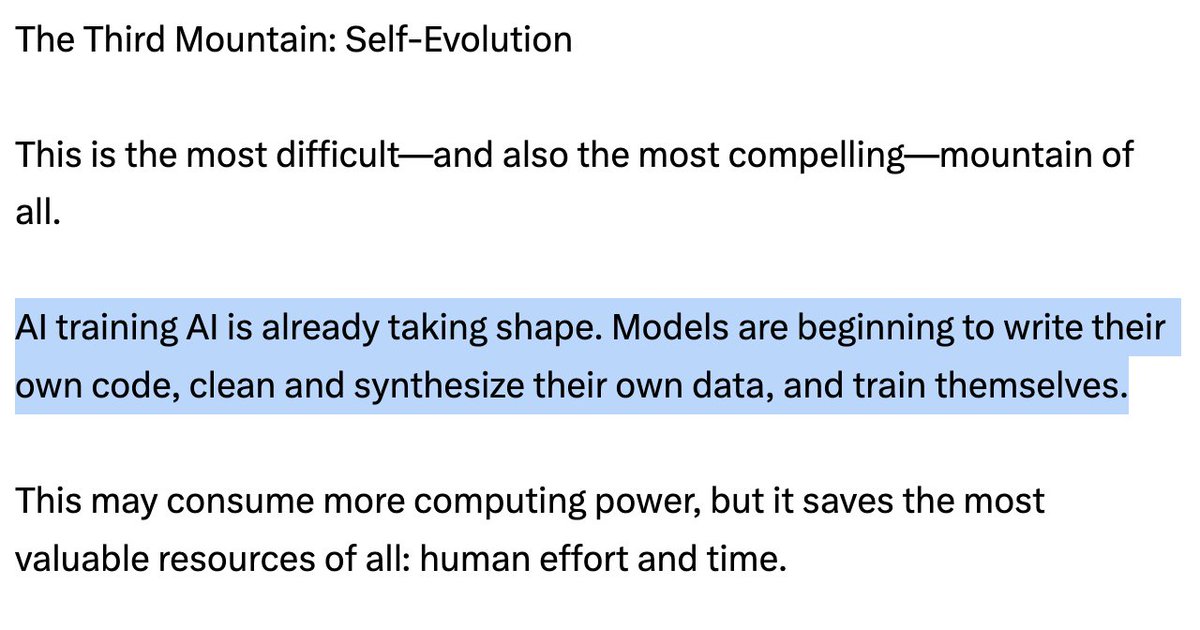
@kimmonismus posted (570 likes, 40 replies, 329 bookmarks, 51,659 views) a long summary of a purported internal letter from Zhipu AI founder Tang Jie arguing that long-horizon agent systems are moving toward “no-person companies,” that memory, continual learning, and self-evaluation are being overcome, and that “AI training AI is already taking shape.” The attached screenshots mattered because they showed the argument in the founder's own framing rather than as a second-hand paraphrase. That made the tweet a useful proxy for how bullish parts of the open-model ecosystem have become about recursive self-improvement and agent coordination.
@KobeissiLetter reported (683 likes, 87 replies, 146,601 views) that 20 of the world's 50 most-used AI models now come from China, up 400% since 2025, and that Chinese-model token usage among the top 20 reached 98 trillion in June versus 53 trillion for US models. The Apollo chart turned a broad race narrative into a measurable adoption signal: Chinese-origin models are not only cheaper alternatives in conversation, they are also taking visible share in the usage mix.

@jukan05 reacted (162 likes, 39 replies, 38,053 views) to a Politico scoop by saying the US “needs to release more powerful open-source models.” The replies immediately reframed the idea from openness into policy risk: one read the move as fear of Chinese dominance, while another predicted that the actual outcome could be tighter restrictions on Chinese open-source models in enterprise settings.
Discussion insight: Replies to KobeissiLetter argued that usage share matters more than raw model count, while replies to jukan05 treated “open-source AI policy” as inseparable from export controls and China competition. Even the most optimistic open-model posts were still being read through state power, procurement, and platform control.
Comparison to prior day: On 2026-07-10, open-model discussion was still mostly about cheaper alternatives pressuring frontier labs. On 2026-07-11, it widened into a geopolitical question about market share, token flow, and government response.
1.2 Agent engineering moved past prompting into orchestration, memory, and operations (🡕)
The second big cluster treated AI work as a systems problem rather than a prompt-writing problem. The highest-signal posts focused on serving stacks, architecture choice, evaluation, and what people now have to learn before an agent feels production-ready. At least five retained items supported this theme.
@kmeanskaran argued (140 likes, 14 replies, 154 bookmarks, 3,054 views) that MLOps is the underrated job in the current AI wave and then laid out the stack explicitly: FastAPI, batch versus online prediction, quantization and serving, Redis caching, orchestration, evaluation, CI/CD, Kubernetes, AWS, observability, and drift detection. The replies sharpened the point instead of diluting it. One person said companies still want 2+ years of MLOps experience, while another asked for a beginner roadmap, which made the skills gap itself part of the evidence.
@heyitsurya separated (46 likes, 5 replies, 315 views) LLMs, agents, agentic workflows, and multi-agent systems into four distinct operating modes with different autonomy, cost, and failure profiles. The attached taxonomy chart was more useful than the usual buzzword thread because it tied each category to best-fit use cases and warned directly against using multi-agent coordination where a single prompt would do.

@mikenevermiss said (20 likes, 6 replies, 594 views) that the real AI engineering stack now includes harness engineering, context engineering, prompt versus semantic caching, KV cache management, batching, quantization, function-calling reliability, evals, observability, and degraded-mode UX, not just better prompting. @Mohiniuni added (20 likes, 5 replies, 216 views) that Claude Fable 5 performs better when users specify effort level, provide the whole problem, and set response length explicitly, but one reply countered that prompt tweaks still lose to context compaction and harness behavior on long runs.
Discussion insight: The replies in both the MLOps and Fable threads converged on the same reality: people want simpler abstractions, but the pain is still in serving, orchestration, and context loss over long tasks. “How should I prompt this?” keeps collapsing into “how is this system actually wired?”
Comparison to prior day: On 2026-07-10, evaluation was becoming an operational function. On 2026-07-11, the feed went one layer deeper into the engineering substrate: orchestration, caching, inference serving, and architectural fit.
1.3 Agent reliability was judged on memory, constraint-following, and boring work (🡕)
The day's applied agent posts were notable because they avoided vague autonomy claims. They asked whether agents remember the right fact at the right moment, respect constraints, and survive repetitive real work without drifting. At least five retained items supported this reliability theme.
@sayashk showed (38 likes, 2 replies, 3,283 views) a benchmark on whether models can convert an architect's rough sketch into a floor plan, with an architect grading the outputs. GPT-5.6 Sol Ultra was clearly the strongest of the tested models, but the tweet's real value was the caution: the model can still silently change the plan, which makes “almost right” a dangerous state in a design workflow.

@DataScienceDojo summarized (11 likes, 3 replies, 1,181 views) Meta's proactive-memory-agent paper as a fix for “behavioral state decay,” where an agent has the right fact in context and still fails to use it when needed. The specific result it highlighted was not just “more memory,” but better timing: a separate memory agent deciding when to inject a reminder reportedly pushed Claude Sonnet 4.5 from 37.6% to 45.9% on Terminal-Bench and from 55.0% to 61.8% on tau-2-Bench.
@TamirSPIRITT reported (4 likes, 1 reply, 876 views) that Grok 4.5 topped one internal “least lazy” benchmark by checking 500+ Monday.com customers against Stripe with computer use only and 217 actions, while GPT-5.6 Sol was second. At the opposite end of the trust spectrum, @free_ai_guides warned (3 likes, 2 replies, 258 views) that local coding agents need sandboxing, scoped mounts, destructive-action gates, and off-site backups because strong agents can still take the wrong destructive action confidently.
Discussion insight: The through-line across these posts was that reliability is increasingly about intervention design and blast-radius control, not just raw answer quality. A model can be smart enough to plan, and still fail by forgetting a constraint, drifting mid-run, or taking an unsafe action in the wrong environment.
Comparison to prior day: On 2026-07-10, users were still comparing routing, pricing, and general benchmark quality. On 2026-07-11, they stressed memory decay, silent geometry changes, and the practical difference between a useful agent and a risky one.
2. What Frustrates People
The engineering surface area keeps expanding
Severity: High. @kmeanskaran argued (140 likes, 14 replies, 154 bookmarks, 3,054 views) that MLOps now spans inference, caching, orchestration, CI/CD, Kubernetes, observability, and drift detection, while @mikenevermiss said (20 likes, 6 replies, 594 views) that serious AI engineers need harness engineering, context engineering, batching, quantization, structured-output repair, guardrails, cost attribution, and safety engineering on top of prompt work. The replies made the pain explicit: one person said companies still want 2+ years of MLOps experience, and another asked for a complete roadmap for newcomers. People are coping with checklists, books, and diagrams, but the recurring complaint is that the path from “I can use models” to “I can ship agents” is still too wide and too implicit. This looks worth building for because the pain is repeatable, educational, and directly tied to hiring friction.
Agents still lose the plot or overstep the boundary
Severity: High. @sayashk showed (38 likes, 2 replies, 3,283 views) that GPT-5.6 Sol Ultra was the best model in a floor-plan conversion task and still not reliable enough because it can silently change the design. @DataScienceDojo summarized (11 likes, 3 replies, 1,181 views) the deeper memory problem as “behavioral state decay,” where the right fact is in context but not used at the moment it matters. @free_ai_guides responded (3 likes, 2 replies, 258 views) with a seven-step safety checklist for local coding agents, and @Mohiniuni shared (20 likes, 5 replies, 216 views) Anthropic guidance telling users to define explicit boundaries before letting Claude Fable 5 act. The workaround is human review, local isolation, and permission gates, but the frustration is that users still have to build these safety layers themselves. This is worth building for because the failures are safety-critical, not cosmetic.

Discovery and recall are still broken at builder scale
Severity: Medium. @VoltexGar described (18 likes, 2 replies, 497 views) a 10,994-note “reading list” that had become a graveyard until Claude was pointed at Obsidian and Readwise to build a self-writing vault. @tom_doerr shared (19 likes, 1 reply, 2,933 views) a daily-updated open-source AI directory because builders are struggling to keep track of models, libraries, infrastructure tools, and evaluation assets. These are two halves of the same frustration: finding what already exists outside your head, and finding what you already know inside it. Current coping strategies are curated repos and personal vaults. This looks worth building for because both problems intensify as the tooling surface expands.
3. What People Wish Existed
Strong open-weight fallbacks that stay available and competitive
@jukan05 reacted (162 likes, 39 replies, 38,053 views) to a Politico scoop by saying the US needs more powerful open-source models, while @KobeissiLetter reported (683 likes, 87 replies, 146,601 views) that Chinese-origin models are gaining share and processing more top-model tokens than US peers. The need here is practical rather than ideological: people want strong fallback models and stacks that do not depend on one vendor, one pricing policy, or one political environment. Opportunity: direct.
Memory that knows when to speak up
@DataScienceDojo highlighted (11 likes, 3 replies, 1,181 views) a memory-agent design where the key decision is whether to inject a reminder or stay silent, and @VoltexGar described (18 likes, 2 replies, 497 views) a self-writing vault that keeps a research corpus useful instead of letting it rot into a note archive. What people seem to want is not just bigger context windows, but systems that know when a buried constraint, source, or prior decision should actively re-enter the loop. Opportunity: direct.
Safer local agent environments by default
@free_ai_guides circulated (3 likes, 2 replies, 258 views) a checklist covering sandboxing, scoped mounts, destructive-action gates, hooks, credential scoping, and backup isolation, and @Mohiniuni shared (20 likes, 5 replies, 216 views) Anthropic guidance that starts with explicit boundaries. Builders clearly want the privacy and control of local agents, but they do not want every team to rediscover the same safety envelope from scratch. Opportunity: direct.
Clearer scaffolds for architecture choice and evaluation depth
@heyitsurya drew (46 likes, 5 replies, 315 views) a taxonomy because too many teams still mix up LLMs, agents, workflows, and multi-agent systems. @ArchitectHappy_ shared (5 likes, 4 replies, 44 views) a repo that packages 92 plugins, 199 agents, 162 skills, and 106 commands into reusable pieces across multiple CLIs, which is another way of saying the stack still needs better defaults. The underlying wish is for opinionated scaffolds that help teams choose the right architecture, the right validation depth, and the right components without starting from a blank page every time. Opportunity: competitive.
4. Tools and Methods in Use
| Tool | Category | Sentiment | Strengths | Limitations |
|---|---|---|---|---|
| GPT-5.6 Sol / Terra / Luna | LLM family | (+/-) | Strong execution reputation, best result in the floor-plan test, and frequent use in routing maps | Silent plan changes, destructive-action concerns, and continued need for explicit boundaries |
| Claude Fable 5 | LLM family | (+/-) | Strong on judgment-heavy work, strategy, and rapid creative prototyping; rich prompting guidance is circulating | Can take unrequested actions; long-run quality still depends heavily on harness and context handling |
| Grok 4.5 | LLM | (+) | Strong cost-efficiency narrative and best result on one tedious computer-use harness | Evidence remains benchmark- and vendor-specific; broad reliability picture is still thin |
| FastAPI + Redis + Docker + Kubernetes + vLLM / SGLang / TensorRT | Serving / LLMOps | (+/-) | Covers the production concerns people now name directly: inference, caching, orchestration, and observability | Hard to learn end to end; hiring signals suggest the experience bar is still high |
| Ollama and local inference stacks | Local inference | (+) | Powers provider-agnostic, privacy-preserving agent setups and local tooling | More setup, hardware constraints, and uneven model quality |
| Mem0 / proactive memory agents | Memory layer | (+/-) | Keeps long-running agents and voice systems from losing state; selective reminders outperform brute-force recall | Raw retrieval is not enough; timing and intervention policy are hard |
| AgentEval / plugin-eval frameworks | Evaluation | (+) | Make evaluation a first-class layer via quick checks, semantic judges, Monte Carlo runs, or ecosystem-specific scoring | Adds operational overhead and remains workload-specific |
| Claude + Obsidian + Readwise | Knowledge workflow | (+) | Turns large note archives into a living research memory with summaries, links, and compounding recall | Depends on careful structure and still needs trust in AI-written organization |
The day's tool sentiment was less about single-vendor loyalty than about layer combinations. @Oluwaphilemon1 argued (3 likes, 3 replies, 326 views) that Fable 5 is for judgment while GPT-5.6 is for execution, and the routing image made that split explicit rather than emotional. @TamirSPIRITT reported (4 likes, 1 reply, 876 views) a Grok 4.5 computer-use win on tedious work, while @OpenBMB showed (10 likes, 387 views) a local voice stack built from SenseVoice ASR, local LLM inference, VoxCPM TTS, and Mem0 memory. The counterweight came from @free_ai_guides, who warned about local-agent safeguards, and @Mohiniuni, who shared Anthropic boundary-setting guidance: the stronger and more autonomous the stack, the more guardrails, scoped permissions, and boundary-setting people want around it. Migration patterns are therefore stack-shaped rather than model-shaped: people mix model families, keep local runtimes attractive for privacy, and increasingly treat memory and evaluation layers as the difference between a capable system and a dependable one.
5. What People Are Building
| Project | Who built it | What it does | Problem it solves | Stack | Stage | Links |
|---|---|---|---|---|---|---|
| Agentic Plugin Marketplace | wshobson, shared by @ArchitectHappy_ | Multi-harness marketplace of 92 plugins, 199 agents, 162 skills, and 106 commands that can be consumed across several coding CLIs | Reusing agent building blocks without rewriting them per harness | Single Markdown source, harness generators, plugin registries, plugin-eval | Shipped | post, repo |
| CyberSentinel AI v3.0 | 3sk1nt4n, shared by @7h3h4ckv157 | Local agentic cybersecurity platform that executes 33 real security tools and analyzes the results | Running real security scans with AI assistance while keeping execution isolated and local by default | Next.js, FastAPI, Docker, Ollama, Neo4j, ChromaDB, ELK, Nmap, Nuclei, SQLMap, ZAP | Shipped | post, repo |
| The Well | Polymathic AI, shared by @BrianRoemmele | Open 15TB collection of 16 physics-simulation datasets with loaders and benchmark tooling | Lowers the data and compute-access barrier for scientific ML and surrogate-model research | Python package, HDF5 datasets, PyTorch loaders, Hydra benchmarks, Hugging Face streaming | Shipped | post, repo, docs |
| VoxCPM local voice assistant demo | Developer @caspianDev, shared by @OpenBMB | Windows-based local voice assistant that listens, thinks, remembers, and speaks back in real time | Private voice interaction without cloud APIs | SenseVoice ASR, local LLM inference, VoxCPM TTS, Mem0 memory | Alpha | post, VoxCPM |
| Self-writing vault | Paul Iusztin and Louis-François Bouchard, shared by @VoltexGar | Living research-memory system that builds a compiled wiki over Obsidian and Readwise notes | Retrieval failure in large personal knowledge bases | Claude, Obsidian, Readwise, compiled wiki, index layer | Beta | post |
| One-prompt 3D survival game | @ice_bearcute | Prompt-built 3D survival game with gather, craft, cook, quest, and shelter loops | Rapid game/world prototyping from a single idea prompt | Fable 5, Blender | Alpha | post |
| Awesome Open Source AI | alvinreal, shared by @tom_doerr | Curated, daily-updated directory of open-source AI models, libraries, infrastructure, and developer tools | Discovery overload across the fast-moving OSS AI stack | GitHub/Markdown catalog | Shipped | post, repo |
The strongest builder pattern was explicit layering, not magical autonomy. The Agentic Plugin Marketplace and CyberSentinel both turn agent work into modules, harnesses, and isolated execution surfaces: one ships reusable components into Claude Code, Codex CLI, Cursor, OpenCode, Gemini CLI, and Copilot from a single source, while the other runs live security tooling inside Docker with local Ollama as the default. @DATAHEDGEAI announced (46 likes, 13 replies, 6,457 views) a dedicated AgentEval layer for the Robinhood Chain ecosystem, which strengthens the same pattern: evaluation itself is becoming a product surface instead of staying hidden in internal QA.

A second pattern was knowledge and data infrastructure. The Well lowers the barrier for scientific ML with 15TB across 16 datasets and an installable Python package, while the self-writing vault treats memory as a maintained wiki instead of a dead note pile. Awesome Open Source AI fits the same need from a different angle: before builders can choose a stack, they increasingly need a map of the stack.
Rapid prototyping remained a third current. The one-prompt Fable survival-game demo is still early and tweet-bound rather than productized, but it showed why creative builders keep stress-testing frontier coding models with artifacts rather than benchmark screenshots: a vague idea that turns into a playable loop is still one of the fastest ways to make model quality feel real.
6. New and Notable
Open scientific-data infrastructure got much easier to touch
@BrianRoemmele said (42 likes, 6 replies, 3,555 views) that Polymathic AI had released The Well, a 15TB collection of high-fidelity physics simulations. The official repo and docs made the signal more concrete: 16 datasets, Python loaders, PyTorch integration, local download tooling, Hugging Face streaming, and benchmark scripts for surrogate models. This mattered because it turned “open scientific data” into something builders can actually install and run rather than just admire from afar.

Evaluation layers started shipping as first-class products
@DATAHEDGEAI announced (46 likes, 13 replies, 6,457 views) AgentEval as an evaluation layer for the Robinhood Chain ecosystem. Separately, the wshobson/agents README now describes a three-layer plugin-eval framework with static analysis, LLM-judge evaluation, and Monte Carlo reliability scoring. Together those two artifacts are a good signal that evaluation is moving out of the footnotes and into named product surfaces.
Self-writing research memory moved from metaphor to scale proof
@VoltexGar described (18 likes, 2 replies, 497 views) a self-writing vault built over 10,994 notes from Obsidian and Readwise, with Claude maintaining summaries, comparisons, and links so that “every question leaves a trace.” That matters because “AI memory” often stays hand-wavy; this example gave a concrete scale, a concrete stack, and a concrete user pain point: large note archives becoming unusable without an active organizing layer.
7. Where the Opportunities Are
[+++] Memory, evaluation, and safety middleware for long-running agents — Evidence runs through sections 1, 2, 4, 5, and 6. The day's strongest pain points were behavioral state decay, silent plan changes, file-destroying autonomy, and too much manual validation. Products that decide when memory should intervene, fence off destructive actions, and separate quick checks from full experiments have direct demand.
[+++] Open-weight and provider-resilient deployment stacks — The China-share chart, the White House open-source discussion, local Ollama-style setups, and provider-agnostic projects like CyberSentinel all point to the same need: teams want competitive models without single-vendor exposure.
[++] Local/private agent products for voice, security, and operations — VoxCPM-style local voice demos, CyberSentinel's Docker-first security surface, and the continued attraction of local inference show appetite for systems that stay private and controllable without feeling toy-sized.
[++] Discovery and knowledge-compounding tools for builders — The self-writing vault and open-source AI directories exist because people cannot keep up with the volume of notes, repos, benchmarks, and frameworks manually. The opportunity is not just better search; it is better maintenance of what matters.
[+] Fast artifact builders for domain-specific work — One-prompt games, floor-plan conversion tests, and lab-equipment control benchmarks show continued interest in task-specific automation, but reliability still gates wider rollout.
8. Takeaways
- Open-model talk shifted from token economics toward geopolitics and market share. The GLM memo screenshots, Apollo chart, and White House open-source discussion all treated open models as a strategic positioning problem, not just a cheaper SKU. (source; source; source)
- AI-engineering discussion on this date looked more like systems design than prompt craft. The strongest how-to posts were about serving, caching, orchestration, observability, and architecture selection rather than wording tricks. (source; source; source)
- Reliability pressure centered on memory timing, constraint following, and safe execution. The floor-plan eval, proactive-memory paper summary, and local-agent safeguard checklist all showed that “smart” is not enough if the agent forgets, drifts, or overacts. (source; source; source)
- Builder energy clustered around reusable, local, and provider-flexible infrastructure. Multi-harness plugin marketplaces, local security-agent stacks, and local voice systems were more common than generic chat wrappers in the retained set. (source; source; source)
- Open data and self-updating knowledge systems remained a supporting layer for the rest of the stack. The Well and the self-writing vault both addressed a bottleneck upstream of model choice: getting the right data or note back into reach when needed. (source; source)