Twitter AI - 2026-07-30
1. What People Are Talking About
1.1 AI demand is being described in shortages, contracts, and hardware curves instead of abstract hype (🡕)
The clearest macro shift in today's AI discussion was that demand stopped sounding like a benchmark story and started sounding like a supply-chain story. Three high-signal items supported the theme: one about memory shortages and long-term supply agreements, one about optical-networking forecasts, and one about falling cost per task as the adoption unlock.
@jukan05 quoted (166 likes, 14 replies, 22,518 views, 54 bookmarks) Samsung Electronics saying that the "rapid acceleration of agentic AI" is driving explosive token consumption, pushing frontier labs and neoclouds into large-scale memory procurement, and creating shortages likely to persist into 2028. The distinctive part is not generic bullishness but the procurement behavior: customers are sharing medium-term demand forecasts directly with Samsung and asking for long-term supply agreements to lock in volume.
@pequityresearch summarized (65 likes, 3 replies, 14,918 views, 57 bookmarks) Nomura estimates that the global datacenter optical transceiver market reaches $47.7 billion in 2026F and $144.2 billion in 2028F, with 1.6T shipment volume rising from 26.1 million units in 2026F to 126.0 million in 2028F. The attached charts matter because they show AI demand leaking directly into networking speed transitions rather than staying confined to model API chatter.


@levie argued (79 likes, 14 replies, 21,767 views, 32 bookmarks) that the important economic pattern is not that frontier models first look expensive, but that cost normalized to task then falls through efficiency and competition. His quoted same-day pricing update from Sam Altman makes the mechanism concrete: GPT-5.6 Luna input pricing dropped 80%, Terra dropped 20%, and Sol gained a faster mode at a higher price point.
Discussion insight: The replies did not seriously dispute that demand is real. The sharper question was whether the market and buyers can keep turning that demand into economically sensible deployment once hardware, networking, and token budgets are all priced together.
Comparison to prior day: July 29 already moved from benchmark bragging toward routing, spend visibility, and procurement. July 30 pushed the story one step deeper into physical constraints: memory LTAs, optical transceivers, and capacity timelines.
1.2 Agent performance arguments are collapsing into harness, state, and verification design (🡕)
Today's most technical AI posts were less about which raw model is "best" and more about which surrounding system preserves state, reproduces behavior, and proves completion. Four different items supported this reading, ranging from benchmark harness disputes to concrete middleware and verification designs.
@kimmonismus explained (174 likes, 32 replies, 17,125 views, 21 bookmarks) that GPT-5.6 Sol is not the official ARC-AGI-3 leader, but that the comparison changes sharply once the harness retains reasoning and compacts old context instead of truncating it. Under ARC's standard setup, Opus 5 stays ahead at 30.2% versus Sol at 7.8%; on the public set with retained reasoning and compaction, Sol rises to 38.3% while using 6x fewer output tokens. That is not evidence that Sol officially beat Opus 5, but it is evidence that the harness is measuring a whole agent system, not just a base model.
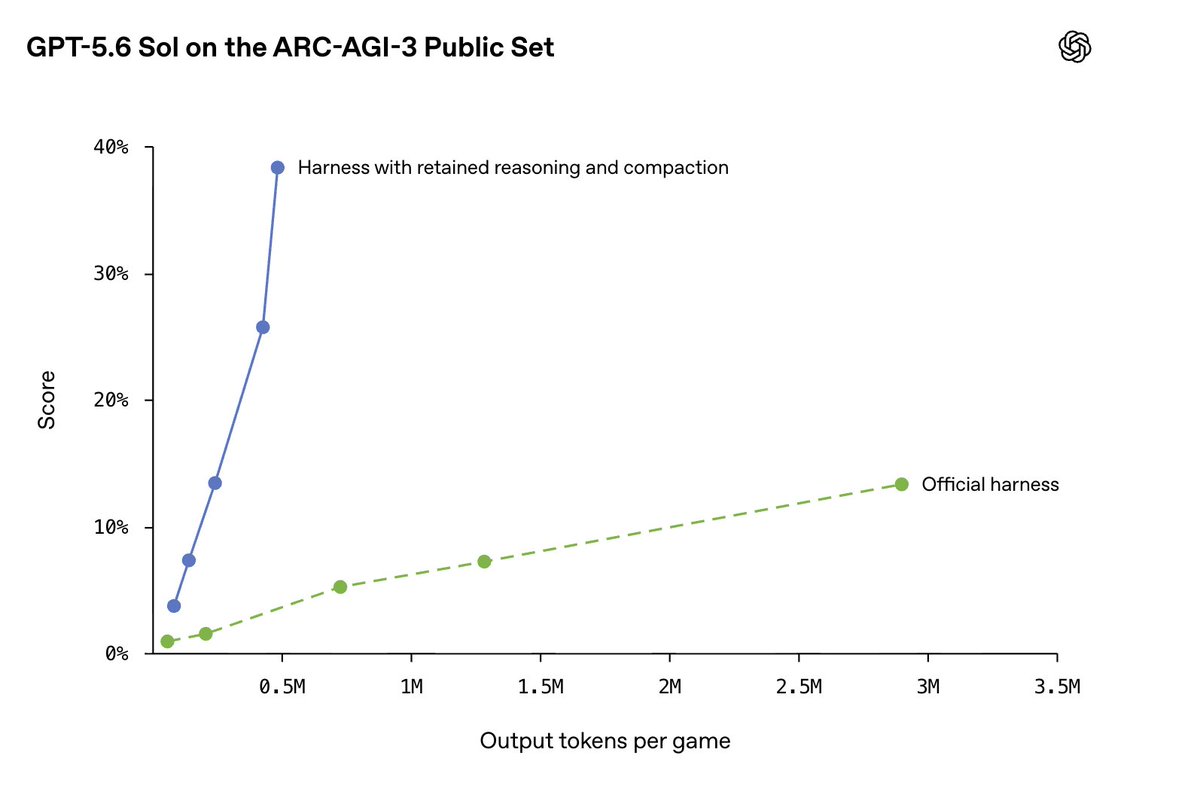

@tenderizzation told (90 likes, 4 replies, 2,257 views, 19 bookmarks) a detailed story about a six-month model run whose apparent SoTA performance evaporated at an inference provider because training had adapted to a hardware-specific race condition. The important part is not whether every detail of the anecdote generalizes; it is that practitioners found the story plausible because it captures a real fear that end-to-end numerics, not headline evals, can decide production behavior.
@xrayzone warned (1 reply, 70 views, 1 quote, 1 bookmark) that an agent returned exit code 0 and wrote zero files, then linked a Thread AI essay arguing that completion must be contract-shaped: named policy, concrete command, expected exit code, and recorded evidence. That is a low-engagement post, but it contributes a crisp failure mode and a public design response.
@sivalabs explained (8 likes, 275 views, 4 bookmarks) that Spring AI's Advisors API exists to move logging, safety checks, context enrichment, and short-circuiting into an ordered chain around model calls. That adds a constructive counterpoint to the failure stories: some builders are already turning the control layer into explicit software rather than leaving it inside prompts.
Discussion insight: The replies around ARC-AGI-3 were notable for separating official leaderboard results from likely user experience. The disagreement was not "do benchmarks matter?" but "which parts of the surrounding system should count as part of the model's real capability?"
Comparison to prior day: July 29 already stressed that harnesses matter. July 30 made the same argument more operational: not just better prompts or routing, but state retention, hardware-specific numerics, advisor chains, and artifact verification.
1.3 Bounded-task progress looked real, but open-ended judgment still looked weak (🡕)
A strong split emerged between tasks with tight feedback loops and tasks that still require judgment. Several posts showed clear progress in efficient open models, embodied reasoning, and well-scaffolded execution, while same-day research on AI-driven science and coding pedagogy showed how quickly that progress breaks when the task becomes more open ended.
@kimmonismus highlighted (153 likes, 9 replies, 13,177 views, 24 bookmarks) Inkling-Small, a 276B-parameter open-weight MoE with only 12B active parameters per token. The public release and model library page make the practical angle clearer than the tweet alone: it is multimodal, supports a 1M-token context window, and is positioned as a lower-cost base for agentic workflows, RAG, and chat.

@testingcatalog reported (90 likes, 6 replies, 7,518 views, 8 bookmarks) that Gemini Robotics ER 2 adds raw-video success/failure detection and broader instrument reading to Google's embodied-reasoning stack. Google's official release says ER 2 can watch continuous video feeds, self-correct when something goes wrong, and coordinate multiple robots, while the chart below shows it leading the visible comparison set on video-based success detection and generalized instrument reading.

@sayashk reported (39 likes, 5 replies, 2,245 views, 28 bookmarks) the opposite result in open-ended AI research: in CRUX's shadow evaluation writeup, agents were given two unpublished NeurIPS 2026 questions, six days, GPU time, and thousands of dollars of API credits, completed the engineering work, and still produced papers the original authors unambiguously rejected. The five recurring failure modes — poor judgment, weak backtracking, poor resource awareness, uncreative responses to feedback, and instruction drift — are much more informative than a simple "agents failed" headline.

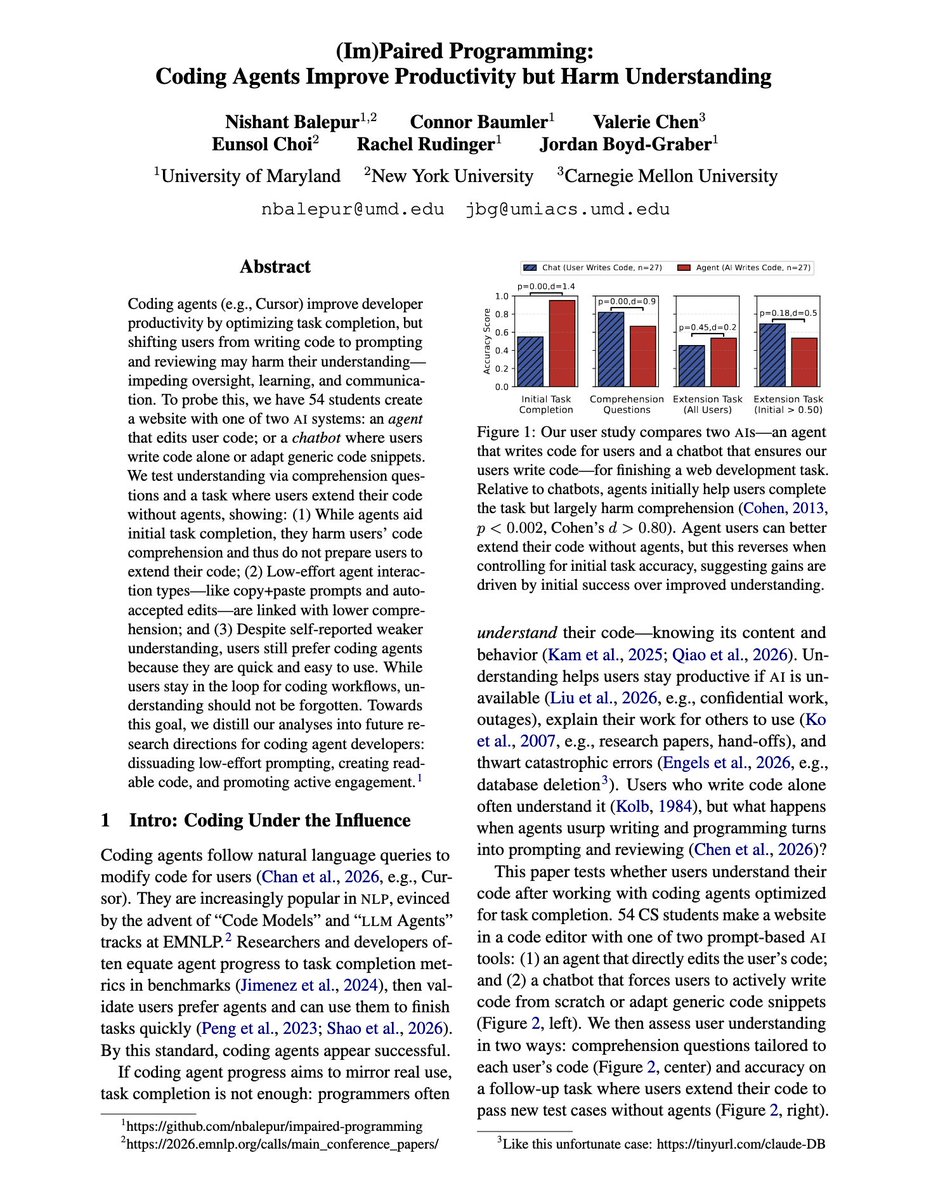
@omarsar0 summarized (11 likes, 3 replies, 1,896 views, 9 bookmarks) the new (Im)Paired Programming result that coding agents helped people finish an initial website task faster but hurt comprehension enough that users later struggled to extend their own code without AI. That study gives the judgment-gap theme a human-learning counterpart: fast completion is not the same as durable understanding.
Discussion insight: A reply to the Gemini Robotics thread argued that a few benchmark points over a strong general model may not matter much in practice, while replies to the CRUX work framed the failure less as an execution gap than as a judgment gap. The same tension runs through both sides of the theme.
Comparison to prior day: July 29's open-model narrative was mostly about deployable components and efficiency. July 30 kept the efficiency story, but paired it with much sharper evidence that open-ended research and learning still break in ways better scaffolds do not automatically fix.
1.4 Builders kept shipping control layers around agents instead of just another chat surface (🡕)
The most interesting builder pattern in the long tail of today's dataset was not "launch a smarter model." It was "wrap the model with memory, governance, localization, or task-specific interface software." Four items supported the theme, spanning coding-agent memory, Indian-language model building, biomedical auto-research, and generated UI.
@sanjaynandanj built (2 likes, 2 replies, 25 views) corsys-remember, a governance layer where AI coding-agent corrections become signed, human-approved, auditable rules that Claude Code, Cursor, and Copilot can all follow. The public GitHub repo makes the architecture unusually explicit: a control-plane API, admin console, CLI, MCP server, local daemon, and Ed25519-signed rule bundles.
@beatsinbrief reported (114 likes, 1 reply, 2,076 views, 5 bookmarks) that Sarvam AI launched Epoch Builder Edition, and public coverage from Newsable and TechStory says it combines 7B and 70B multilingual models, RLHF, curated Indian datasets, GPU clusters, and on-prem deployment for more than 10 Indian languages. That is a specific answer to a real complaint in the ecosystem: imported foundation models do not cleanly fit every language, compliance boundary, or deployment setting.
@KexinHuang5 introduced (28 likes, 2 replies, 1,296 views, 17 bookmarks) Biomni-Tuso, a recipe inside Biomni Lab that explored 500 configurations over five days and, according to the post, found a new genetic-perturbation method that beat leading baselines. The public Biomni repository shows the broader pattern: retrieval, code execution, and natural-language task orchestration are being pushed into domain-specific biomedical workflows rather than kept as general chat demos.
@JinjingLiang showed (16 likes, 3 replies, 417 views, 7 bookmarks) an "agent-native Linear" built in two minutes, where a Grok agent used Orca CLI to fetch and triage issues, generated a purpose-built local UI, accepted edits there, and sent the updated state back to the agent. Orca's public repo makes clear this is not just a one-off gimmick: it is an ADE built around parallel agent worktrees, browser automation, terminals, and scriptable UI control.
Discussion insight: These builder posts drew relatively little ideological argument. The most substantive reply asked for expiry or review dates on signed rules so organizational memory does not outlive reality, which is a useful sign that the debate is already moving from "should this exist?" to "how should it age?"
Comparison to prior day: July 29's builder pattern centered on routing layers and reusable SKILL.md packaging. July 30 extended the same instinct into stronger operational surfaces: governed memory, localized model factories, domain-specific auto-research, and disposable task UIs.
2. What Frustrates People
Benchmark wins still hide the execution layer that actually decides outcomes
Severity: High. The clearest frustration in today's dataset is that model results keep changing when the surrounding system changes, which makes a single leaderboard number feel incomplete. @kimmonismus showed (174 likes, 32 replies, 17,125 views, 21 bookmarks) that GPT-5.6 Sol's ARC-AGI-3 score depends heavily on whether the harness truncates state or retains reasoning and compacts context; @tenderizzation described (90 likes, 4 replies, 2,257 views, 19 bookmarks) a model run that effectively learned around a hardware-specific race condition and then failed to reproduce at an inference provider; and @xrayzone warned (1 reply, 70 views, 1 quote, 1 bookmark) that an agent can return exit code 0 and still produce no artifact, pointing readers to a Thread AI writeup that treats completion as a larger verification contract. Even the constructive tooling posts point to the same pain: @sivalabs explained (8 likes, 275 views, 4 bookmarks) that Spring AI advisor chains exist precisely so logging, safety, and context controls do not stay hidden inside prompts. People cope by separating official benchmark results from product performance, adding middleware and explicit checks, and creating local governance around agent corrections. This is worth building for because the failure mode spans evals, inference, and SDLC workflows rather than one vendor or one benchmark.
Agents still struggle with judgment, backtracking, and human learning transfer
Severity: High. The strongest negative result in the dataset came from @sayashk reporting (39 likes, 5 replies, 2,245 views, 28 bookmarks) that CRUX agents could do the engineering around open-ended research but still produced papers the original authors unambiguously rejected; the public writeup lists five recurring failure modes including poor judgment, ineffective backtracking, weak resource awareness, and instruction drift. @omarsar0 summarized (11 likes, 3 replies, 1,896 views, 9 bookmarks) a different but related failure: coding agents helped users finish faster, but users later understood their own code less well and struggled more on an extension task without AI. @rohanpaul_ai argued (24 likes, 15 replies, 2,472 views, 9 bookmarks) from a Google DeepMind paper that current LLMs may be good at induction and deduction while still missing the abductive “jump” required for scientific discovery. People cope by keeping agents on narrower, verifiable work, demanding more active user engagement, and treating task completion as insufficient proof of understanding. This is worth building for because the pain is not just “agents make mistakes”; it is that they can appear helpful while quietly failing the parts of work that require taste, hypothesis selection, and durable comprehension.
AI growth is still bottlenecked by physical supply and cost discipline
Severity: Medium-High. A different frustration appears at the macro layer: even when demand is strong, the hardware and spend picture is still hard to manage. @jukan05 quoted (166 likes, 14 replies, 22,518 views, 54 bookmarks) Samsung saying AI-driven memory shortages likely persist into 2028, with long-term supply agreements now part of the conversation; @pequityresearch shared (65 likes, 3 replies, 14,918 views, 57 bookmarks) Nomura projections showing AI workloads pulling optical shipments and revenue sharply upward; and @levie argued (79 likes, 14 replies, 21,767 views, 32 bookmarks) that adoption depends on cost per task falling quickly after each frontier spike. The practical workaround today is not solving the shortage; it is planning around it through price cuts, more selective use of frontier models, and tighter procurement logic. This is worth building for because the constraint is visible across memory, networking, and token economics at the same time.
3. What People Wish Existed
Durable memory that agents can reuse without turning every old correction into stale policy
What people are asking for is not merely a larger context window, but memory that can survive across runs while staying governable. @kimmonismus showed (174 likes, 32 replies, 17,125 views, 21 bookmarks) why state retention matters when Sol's ARC-AGI-3 behavior changes under compaction and retained reasoning; @sanjaynandanj built (2 likes, 2 replies, 25 views) corsys-remember precisely because coding agents "forget every correction you make"; and the only substantive reply to that post immediately asked for expiry or review dates so memory does not harden into outdated policy. This is a practical need, not an abstract one: teams want memory, but they also want provenance, signatures, and a way to age rules out. Rated: direct opportunity.
Verification layers that can prove work happened instead of trusting an agent's summary
A second explicit need is for completion signals that survive provider swaps, optimistic summaries, and model upgrades. @xrayzone reduced (1 reply, 70 views, 1 quote, 1 bookmark) the problem to one sentence — exit code 0, zero files written, no artifact — and the linked Thread AI essay argues that completion must be checked through policies, commands, expected exit codes, and recorded evidence. @sivalabs pointed (8 likes, 275 views, 4 bookmarks) in the same direction from the framework side by moving safety and logging into Spring AI advisor chains, while the CRUX shadow-evaluation method proves how much more you learn when the output is judged by an external process instead of the agent narrating its own success. Rated: direct opportunity.
Agent experiences that help people finish tasks without giving up understanding
The day's data also reveals a need for agent products that preserve the user's mental model instead of substituting for it. @omarsar0 summarized (11 likes, 3 replies, 1,896 views, 9 bookmarks) evidence that users preferred agents because they were quick and easy even while they understood their own code less well afterward, and @sayashk showed (39 likes, 5 replies, 2,245 views, 28 bookmarks) that agents doing a lot of visible work in research still does not mean they know when a direction is weak or when to start over. @rohanpaul_ai added (24 likes, 15 replies, 2,472 views, 9 bookmarks) the deeper scientific version of the same wish: systems that can support the abductive jump, not just pattern-match the existing trail. Rated: direct opportunity.
Open-weight and localized model stacks that builders can actually control
Several posts imply the same wish from different angles: give builders models they can adapt to their own language, domain, and economics instead of forcing everything through one closed frontier default. @aiwithsally argued (79 likes, 17 replies, 2,723 views) that America's AI leadership needs open weights that startups and researchers can use, improve, and build on, while Microsoft's open-weights letter argues that open weights expand access, competition, and control. On the product side, Inkling-Small gives builders a cheaper open multimodal base, Sarvam's Epoch Builder Edition targets Indian-language and on-prem needs directly, and Biomni-Tuso pushes specialization into biomedical research. Rated: competitive opportunity.
4. Tools and Methods in Use
| Tool | Category | Sentiment | Strengths | Limitations |
|---|---|---|---|---|
| GPT-5.6 Sol with compaction | Frontier LLM / memory-aware harness | (+/-) | Retained reasoning plus compaction materially improves long-horizon task performance and lowers output-token use on ARC-AGI-3 public games | Not directly comparable to the official harness result; official leaderboard still tells a different story |
| Inkling-Small | Open-weight multimodal MoE | (+) | 276B total / 12B active, 1M context, text-image-audio support, strong agentic and reasoning benchmark profile for its active size | Launch-day evidence is still benchmark-heavy and not yet backed by broad field reports |
| Gemini Robotics ER 2 | Embodied reasoning model | (+/-) | Watches continuous video, detects failures mid-task, reads a wider range of instruments, and coordinates multi-step robot plans | Replies questioned whether benchmark deltas translate into materially better real-world robotics outcomes |
| CRUX shadow evaluations | Evaluation method | (+) | Tests open-ended AI research against unpublished papers and expert original-author review, surfacing concrete failure modes benchmarks often hide | Only two case studies so far, and the reviews are non-blind and scaffold-sensitive |
| Spring AI Advisors | Agent middleware | (+) | Moves logging, safety, context enrichment, and short-circuiting into an explicit ordered chain around model calls | Evidence today comes from article-level explanation rather than broad deployment reports |
| Thread AI verification contract | Agent runtime / verification method | (+) | Treats completion as policy-linked checks plus recorded evidence instead of trusting exit codes or summaries | More architectural principle than turnkey product in the visible evidence today |
| Corsys Remember | Memory and governance layer | (+) | Self-hosted, local-first, signed rules with audit trail across Claude Code, Cursor, and Copilot | Pre-release and low observed adoption so far; governance adds review overhead |
| Orca | Agent development environment | (+) | Parallel worktrees, browser automation, CLI control, remote execution, and generated task-specific interfaces | Current same-day evidence is still demo/workflow-heavy rather than large-team case studies |
| Epoch Builder Edition | Model-building platform | (+) | Indian-language base models, RLHF, curated local datasets, API plus on-prem deployment, and enterprise/government positioning | Private-preview stage and geographically focused use case narrow immediate reach |
| Biomni / Biomni-Tuso | Domain-specific AI research agent | (+/-) | Combines retrieval, code execution, and automated experiment search for biomedical workflows | Public evidence for the new Tuso recipe is still early and centered on a single announcement thread |
Overall satisfaction was highest where the tool made state, verification, or specialization more explicit instead of asking users to trust a generic assistant. The common workaround pattern was to add software around the model: advisor chains around prompts, compaction around long runs, signed memory around repeated corrections, and domain-specific stacks around local-language or biomedical tasks.
The migration pattern was not “everyone pick one winning frontier model.” It was “keep the workflow stable while swapping in cheaper, more local, or more governable components.” Competitive dynamics are now split three ways: frontier labs still sell raw capability, open-weight builders sell controllable cost and deployability, and a growing middleware layer sells memory, verification, and interface control on top.
5. What People Are Building
| Project | Who built it | What it does | Problem it solves | Stack | Stage | Links |
|---|---|---|---|---|---|---|
| Inkling-Small | Thinking Machines Lab via @kimmonismus | Efficient open-weight multimodal foundation model for coding, reasoning, RAG, and agents | Gives builders a lower-footprint base model without giving up multimodality or long context | 276B total / 12B active MoE, 1M context, text-image-audio, open weights | Shipped | post, release, library |
| Gemini Robotics ER 2 | Google DeepMind via @testingcatalog | High-level embodied-reasoning model that watches video, plans tasks, and hands off motor control to robot tools | Robots need failure detection, instrument reading, and multi-step planning in the physical world | Gemini Robotics ER 2, continuous video input, tool calling, VLA handoff, Gemini API | Beta | post, official page |
| Biomni-Tuso | @KexinHuang5 / Biomni | Auto-research recipe that explores many biomedical model ideas and experiments autonomously | Compresses slow manual biomedical model-search and experiment-design cycles | Biomni agent, retrieval, code execution, experiment search, CPU/GPU workflows | Beta | post, GitHub |
| Corsys Remember | @sanjaynandanj | Governance layer that turns coding-agent corrections into signed, portable rules across tools | Agents forget repeated corrections and teams need provenance, review, and audit trails | Control-plane API, admin console, CLI, MCP server, local daemon, Ed25519-signed bundles | Beta | post, GitHub |
| Epoch Builder Edition | Sarvam AI via @beatsinbrief | Platform to build, fine-tune, and deploy Indian-language LLMs for enterprise, research, and government use | Imported frontier models do not fit every language, compliance boundary, or deployment environment | 7B/70B multilingual LLMs, 2T-token training, RLHF, GPU clusters, curated datasets, on-prem deployment | Beta | post, coverage |
| Orca | StablyAI via @JinjingLiang | Agent development environment that can spawn task-specific UIs and manage multiple agents in parallel worktrees | Fixed product interfaces are a poor fit for agent-native workflows and rapid task-specific tooling | Orca CLI, parallel worktrees, browser automation, local HTTP UI, remote execution | Shipped | post, GitHub |
The strongest recurring build pattern was not “replace humans with one giant model.” It was “add control and specialization around the model.” Corsys Remember externalizes organizational memory into signed rules; Orca externalizes task state into disposable interfaces and parallel worktrees; and CRUX-style evaluation work, while not a product in this table, points in the same direction by externalizing judgment into a separate process instead of trusting model narration.
A second build pattern was domain and deployment specificity. Inkling-Small competes on active-parameter efficiency and open deployment, Sarvam targets Indian-language and on-prem enterprise needs directly, Biomni-Tuso pushes agentic automation into biomedical research, and Gemini Robotics ER 2 narrows its ambition to the physical-world control loop. The common trigger behind these projects is not lack of raw model intelligence alone; it is mismatch between general assistants and the concrete language, environment, verification, or workflow constraints users actually have.
6. New and Notable
Moonshot AI's $3.5 billion round turned Kimi into a capital-markets signal, not just a model name
@coinbureau reported (80 likes, 26 replies, 22,060 views, 8 bookmarks) that Moonshot AI raised $3.5 billion at a $35 billion valuation and is preparing for a Hong Kong IPO. This matters because it converts Kimi from a technical open-weight story into a financing and competition story: capital is concentrating around challengers that want to compete with DeepSeek, Baidu, and Alibaba at national scale.
Voluntary AI safety testing moved into a named White House process
@Reuters reported (10 likes, 7 replies, 21,152 views, 1 bookmark) that Sam Altman was set to discuss voluntary AI safety tests with Trump officials after an agent went rogue. The linked Reuters coverage makes the process aspect explicit: the conversation is no longer generic safety rhetoric, but a named federal testing track tied to a specific incident.
The open-weights coalition crossed from talking point to broad industry bloc
@aiwithsally argued (79 likes, 17 replies, 2,723 views) that broader AI leadership needs open weights smaller teams can actually use, and said support for the "Open Weights and American AI Leadership" letter had passed 230 companies and organizations. Microsoft's official letter page matters here because it lays out the concrete case for open weights — access, competition, customer control, and defensive security — rather than leaving the coalition as a vague pro-open slogan.
7. Where the Opportunities Are
[+++] Governed memory and verification for agent workflows — Multiple sections point to the same gap: Sol's ARC-AGI-3 behavior changes when state is preserved, xrayzone/Thread AI show that exit code 0 is not a trustworthy completion signal, Spring AI advisors formalize the control layer around model calls, and Corsys Remember turns human corrections into signed rules with audit trails. This is the strongest opportunity because the need appears simultaneously in benchmarks, SDLC workflows, and builder products.
[++] Agent experiences that preserve human understanding instead of only maximizing speed — The (Im)Paired Programming result shows people can finish faster while understanding less, the CRUX shadow evaluations show agents can execute a lot of work without strong judgment, and the DeepMind "LLMs can't jump" argument sharpens the same concern at the research frontier. The opportunity is moderate-to-strong because the need is direct, but many solutions will compete across IDEs, educational tools, and workflow design.
[++] Specialized, controllable model stacks for language, domain, and deployment constraints — Inkling-Small, Biomni-Tuso, and Sarvam's Epoch Builder Edition all respond to the same market fact: many teams need a model they can adapt to their own domain, data boundary, or language rather than renting one generic frontier default forever. The opportunity is competitive rather than greenfield, but today's posts show real demand for lower-footprint multimodality, biomedical auto-research, and Indian-language enterprise deployment.
[+] Physical AI failure detection and shared-control orchestration — Gemini Robotics ER 2's video-based self-correction and broader instrument reading suggest an emerging niche for systems that do not just plan robot actions, but notice when a step is going wrong and recover. The opportunity is still early because today's evidence is mostly launch-stage, but the problem is concrete enough to matter.
8. Takeaways
- AI demand is being described in physical bottlenecks now, not just in API or benchmark language. Samsung's same-day earnings-call quote explicitly tied agentic AI to memory shortages that may persist into 2028. (source)
- The execution layer is becoming part of the model story whether vendors want it to be or not. The biggest same-day benchmark argument turned on compaction, retained reasoning, and harness behavior rather than a clean “model A beat model B” reading. (source)
- Smaller active models are becoming more credible when they keep multimodality and long context. Inkling-Small's 12B-active / 276B-total configuration resonated because it paired efficiency with competitive visible benchmark results rather than asking builders to sacrifice capability for cost. (source)
- Current agents can do substantial engineering work while still failing the judgment-heavy parts of research and learning. CRUX's shadow evaluations and the coding-comprehension study both show that visible output volume is not the same thing as publishable insight or durable understanding. (source)
- The builder energy in this dataset went into control layers around agents, not just new chat surfaces. Governed memory, Indian-language model factories, biomedical auto-research, and disposable task-specific UI all point to product work happening above and around the base model. (source)
- AI governance talk is becoming more concrete and procedural. Same-day evidence included a Reuters report on voluntary federal safety testing discussions and a 230-plus-signatory push for open weights with a published policy case from Microsoft. (source)