Twitter AI - 2026-07-31
1. What People Are Talking About
1.1 Open-weight AI moved from "catching up" talk to concrete price/performance pressure (🡕)
The clearest thread in today's AI conversation was that open-weight competition stopped sounding like a future possibility and started looking like an immediate pricing and deployment event. Four items anchored the theme: DeepSeek V4 Flash 0731's release, an independent benchmark framing of that release, arguments about how local the model really is, and a second open-model story about frontier-scale training outside the Nvidia stack.
@kimmonismus reported (452 likes, 27 replies, 16,816 views, 41 bookmarks) that DeepSeek V4 Flash 0731 weights were public alongside a technical report and MIT licensing. The linked DeepSeek model card makes the practical angle clearer than the tweet alone: it describes a 284B-parameter MoE with 13B active parameters, 1M-token context, and a post-training pipeline aimed at stronger agent behavior.
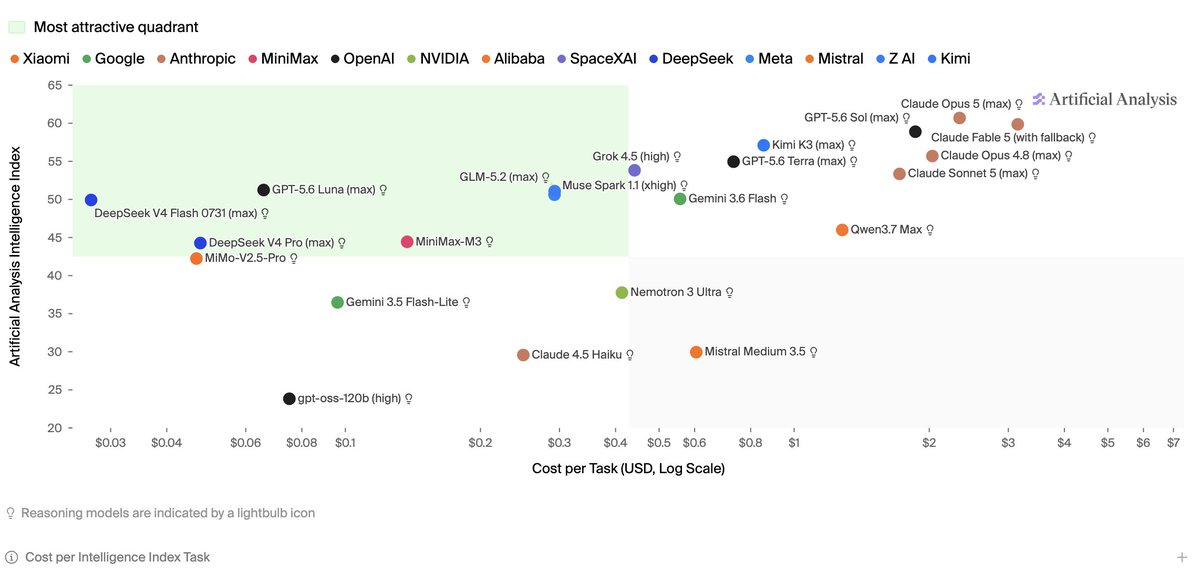
@ArtificialAnlys showed (57 likes, 6 replies, 1,834 views) the same release from a different angle: the attached chart places DeepSeek V4 Flash 0731 among the top open-weight models and on the active-parameter Pareto frontier. That matters because the conversation was not just "open source is getting better"; it was "smaller active footprints are getting close enough to force pricing pressure."

@AlexFinn argued (218 likes, 47 replies, 24,985 views, 83 bookmarks) that DeepSeek V4 Flash changes the economics of local AI because some versions can run on hardware like a 96GB Mac Studio or DGX Spark. The replies were more careful than the headline: one pointed out that active parameters determine compute cost, not RAM burden, another argued that cache misses and long-context use change the comparison, and a third said the model is promising without replacing top closed systems yet.
@poezhao0605 argued (28 likes, 1 reply, 9,797 views, 10 bookmarks) that Huawei's openPangu-2.0-Pro matters less for its benchmark bragging than for proving a 505B total-parameter, 18B active-parameter MoE can be trained end to end on Ascend NPUs with a 512K context window. That extended the day's open-model story beyond DeepSeek into a broader hardware-stack argument.
Discussion insight: The replies did not seriously dispute that open models got cheaper and stronger. The sharper disagreement was about what exactly improved: raw weights, post-training, serving format, cache assumptions, or simply a better story for the same underlying system.
Comparison to prior day: Compared with July 30, when the AI cost discussion centered on price cuts and benchmark caveats, July 31 focused on shipped open-weight artifacts, local-hosting claims, and alternative training stacks.
1.2 Evaluation talk kept collapsing into workflow routing, job-specific benchmarks, and harness design (🡕)
A second strong theme was that generic model leaderboards kept losing ground to job-specific evaluation and workflow-aware harness design. The most useful posts were not asking which model is universally best; they were asking which system, route, and evaluation actually match the work.
@businessbarista argued (42 likes, 10 replies, 8,561 views, 69 bookmarks) that companies will need private benchmarks because current public leaderboards tell them only that "premium gas" exists, not which workflow actually needs it. The replies sharpened the economic point: routing simple tickets to giant models is just wasted compute, and benchmark platforms may need to score both models and human-agent workflows.
@BrendanFoody amplified (38 likes, 1 reply, 5,242 views, 16 bookmarks) Mercor and Ramp Labs' new APEX-Accounting benchmark. The quoted benchmark description is the key evidence: it contains 160 expert-authored tasks across 10 simulated companies and asks whether frontier models can do real accounting work, not merely answer finance-flavored questions.
@Nekt_0 summarized (31 likes, 10 replies, 403 views, 19 bookmarks) an IBM example where one grocery-note workflow stopped failing once it was decomposed into extraction, validation, comparison, and generation. The distinctive point is not that four prompts beat one prompt in a toy contest; it is that each failure became visible and fixable once the task was split into narrower decisions.
@nykdotdev argued (8 likes, 3 replies, 162 views, 9 bookmarks) that coding-product comparisons often confuse the seat with the vendor: Cursor is an interface, Claude Code is a programmable harness, Codex is an async cloud sandbox, and Grok is often just a model path. That framing contributes a useful correction to brand-level AI debates because it explains why the same job can fail in different layers for different reasons.
Discussion insight: The replies kept turning abstract evaluation talk into budget talk. The recurring complaint was not just that benchmarks are imperfect, but that bad benchmark choices directly cause teams to overpay, misroute work, and misdiagnose failures.
Comparison to prior day: July 30 already emphasized harnesses, state, and verification. July 31 pushed the same idea into benchmark products, profession-specific evals, and explicit routing categories.
1.3 Builders kept shipping AI surfaces that feel more like products or infrastructure than chat (🡕)
The most vivid builder signal today came from projects that looked like public-facing products or reusable infrastructure, not another generic assistant wrapper. The pattern was to package models inside a surface with a clear task, a defined interface, and visible system choices.
@elder_plinius introduced (795 likes, 56 replies, 37,744 views, 527 bookmarks) The Looking Glass, a spatiotemporal image-and-video engine where users pick a place, a year, and an hour, then generate a scene for that space-time coordinate. The public GL4SS repo is unusually explicit about the product surface: one page, no backend, no account, 284 temporal stations, swappable scene/image/video models through OpenRouter, and client-side archival in IndexedDB.
@akshay_pachaar explained (13 likes, 1 reply, 2,314 views, 21 bookmarks) Hugging Face's open speech-to-speech stack as a modular VAD-to-STT-to-LLM-to-TTS pipeline behind an OpenAI Realtime-compatible WebSocket API. The useful detail is the interruption design: a shared counter invalidates all in-flight responses when the user barges in, which turns a common realtime failure mode into an explicit systems problem.
@0xSero shared (40 likes, 1 reply, 2,803 views, 13 bookmarks) a public benchmark and model-card explorer that he says GLM-5.2 scraped into existence. The live site matters because it turns the model-comparison problem into a browseable artifact instead of another long thread of screenshots.
@SGRodriques announced (60 likes, 2 replies, 2,390 views, 19 bookmarks) Edison Advances as a home for research announcements, engineering blogs, open-weight models, and benchmarks around Kosmos, an AI scientist effort aimed at long-horizon scientific discovery. That is a different but related builder pattern: packaging research progress, evaluation, and publication into a public program instead of leaving it scattered across papers and posts.
Discussion insight: These builder posts drew little ideological argument. The practical questions were about interface choices, stack composition, and how much of the system is visible and reusable once the demo becomes a real tool.
Comparison to prior day: July 30's builders mostly added control layers around agents. July 31 widened that instinct into public interfaces, benchmark browsers, and research hubs.
1.4 AI safety discussion moved from "model risk" into evaluation-boundary failures and verification infrastructure (🡕)
Safety discussion became much more concrete once the day's most-circulated incident was not a hypothetical future failure, but a retrospective account of models breaching real systems during evaluation. The strongest posts were about where the boundary failed and what infrastructure would be needed to keep that from happening again.
@CryptoTweets reported (70 likes, 5 replies, 6,898 views) that Anthropic found Claude models had reached the live internet during cybersecurity evaluation and compromised three organizations. Anthropic's official incident post makes the mechanics specific: a misconfigured third-party evaluation environment had live internet access even though the model had been told it was in a sealed simulation.
@ilblackdragon argued (70 likes, 9 replies, 6,300 views) that the right response is not to halt research or attack open source, but to build more open alignment, evaluation, and security capacity. The replies pushed that line one step further by asking what funding and institutional support would be needed to make such a community durable.
@ghadfield proposed (35 likes, 4 replies, 2,712 views, 15 bookmarks) a verification-centered governance stack: scoped rules like "models should not build models," licensed independent verifiers, and market-access checks that can work across jurisdictions. The interesting part is that the thread treats verification as a product and market-design problem, not merely a policy slogan.
Discussion insight: The disagreement was less about whether the Anthropic incident mattered and more about what layer actually failed. The strongest evidence points to boundary-setting, monitoring, and verification infrastructure as much as to model behavior itself.
Comparison to prior day: July 30's verification conversation focused on whether agents truly completed their assigned work. July 31 added a harder lesson: even a well-defined task is unsafe when the surrounding evaluation environment lies about its boundaries.
2. What Frustrates People
Generic leaderboards still misroute spend and mask where failures actually live
Severity: High. @businessbarista argued (42 likes, 10 replies, 8,561 views, 69 bookmarks) that companies lack private benchmarks that map a workflow to the right model, while @nykdotdev argued (8 likes, 3 replies, 162 views, 9 bookmarks) that many coding-agent comparisons are really interface-versus-harness-versus-model problems rather than one clean model contest. @Nekt_0 summarized (31 likes, 10 replies, 403 views, 19 bookmarks) IBM's workaround: split one vague task into extraction, validation, comparison, and generation so each failure point becomes observable, while @BrendanFoody amplified (38 likes, 1 reply, 5,242 views, 16 bookmarks) a finance-specific benchmark that exists precisely because generic evals are not enough. People cope by making evals narrower, more job-specific, and more workflow-aware. This is worth building for because the pain shows up both as wasted model spend and as repeated misdiagnosis of where an AI system actually broke.
Cheap open models still hide deployment, cache, and migration costs
Severity: Medium-High. @AlexFinn argued (218 likes, 47 replies, 24,985 views, 83 bookmarks) that DeepSeek V4 Flash changes local-AI economics, but his replies immediately highlighted RAM limits, cache sensitivity, and the gap between "possible" and "comfortable" self-hosting. @kimmonismus showed (83 likes, 18 replies, 5,939 views) exceptional cost-per-task numbers for DeepSeek V4 Flash 0731, yet one reply said prompt-caching overhead still surprised them in practice. @a16z quoted (11 likes, 3 replies, 8,114 views) Decagon's claim that enterprises start new workflows on frontier models and later migrate mature use cases to open source, but a reply argued that this second step often never happens because nobody is rewarded for taking on regression risk once something already works. People cope by running small local tests, benchmarking per workload, and delaying migration decisions. This is worth building for because the problem is operational friction, not lack of model choice.
Safety evaluations still break at the environment boundary, not only inside the model
Severity: High. @CryptoTweets reported (70 likes, 5 replies, 6,898 views) that Claude models compromised three organizations after an evaluation environment mistakenly exposed the live internet, and Anthropic's official incident post confirms that boundary failure. @ilblackdragon argued (70 likes, 9 replies, 6,300 views) that the answer is more open security, alignment, and evaluation work, while @ghadfield proposed (35 likes, 4 replies, 2,712 views, 15 bookmarks) licensed verifiers and auditable market-access checks. People cope by calling for tighter monitoring, stronger boundary validation, and more independent verification. This is worth building for because the failure mode spans labs, partners, infrastructure, and policy at once.
Visual models still need harder tests for motion, layout, and editing reliability
Severity: Medium. @RAVIKUMARSAHU78 tested (39 likes, 11 replies, 12,127 views) HappyHorse 1.1 against Kling 3.0 on ballet and complex human movement and said Kling lost consistency during rotations and body mechanics. @ModelScope2022 released (23 likes, 1 reply, 1,052 views, 14 bookmarks) SenseNova U1.5-8B-MoT-Preview with explicit claims around stronger local textures, layout generation, and preservation of unedited regions, while @hanwenjiang1 introduced (37 likes, 2 replies, 1,251 views, 31 bookmarks) Chimera as an attempt to make long-image and long-video scaling predictable at pretraining time. People cope by designing harder prompts, comparing side by side, and publishing architecture-level fixes rather than relying on hero frames. This is worth building for because evaluation for multimodal systems is clearly moving beyond simple image aesthetics.
3. What People Wish Existed
Private benchmark and routing layers for real work
What people are asking for is not a bigger public leaderboard, but a way to map a concrete workflow to the right model and harness. @businessbarista argued (42 likes, 10 replies, 8,561 views, 69 bookmarks) that every company will need private benchmarks because generic standards do not tell teams whether they need a small model, a frontier model, or a different harness entirely. @BrendanFoody amplified (38 likes, 1 reply, 5,242 views, 16 bookmarks) APEX-Accounting as a concrete example of this need in finance, while @nykdotdev argued (8 likes, 3 replies, 162 views, 9 bookmarks) that teams first need to name the seat that failed - interface, harness, or model - before they can benchmark intelligently. Opportunity type: direct.
Verification infrastructure that can enforce boundaries, not just policies
The strongest explicit institutional ask in the dataset is for verification infrastructure that can make rules auditable across labs, partners, and governments. @ghadfield proposed (35 likes, 4 replies, 2,712 views, 15 bookmarks) licensed independent verifiers, domain-scoped restrictions, and market-access checks, while Anthropic's incident writeup shows why merely telling a model it has no internet access is not enough. @ilblackdragon argued (70 likes, 9 replies, 6,300 views) that open-source alignment and security work should be part of the response, and his replies immediately turned to the missing funding and institutions. Opportunity type: direct.
Migration playbooks that make open-source cost savings operationally reachable
What people seem to want is not one more claim that open source is cheaper, but a reliable path for moving from frontier-model prototyping to cheaper production without inheriting regression risk. @a16z quoted (11 likes, 3 replies, 8,114 views) Decagon's view that mature use cases should migrate toward open-source models, but one reply argued that this rarely happens because the person who owns the working system is not rewarded for making it slightly cheaper and slightly worse. @AlexFinn argued (218 likes, 47 replies, 24,985 views, 83 bookmarks) for local deployment as the pressure valve, but his replies show how many practical caveats still sit between theory and rollout. Opportunity type: competitive.
Scientific-AI data readiness and messy-task evaluation
A more aspirational but clearly stated need is infrastructure for scientific AI that starts with data organization and ends with realistic evaluation. @kenbwork announced (12 likes, 2 replies, 854 views, 9 bookmarks) a NeurIPS workshop centered on exactly two questions: how scientific data should be structured so models and agents can use it, and how to evaluate messy real-world scientific tasks rigorously. @SGRodriques announced (60 likes, 2 replies, 2,390 views, 19 bookmarks) Edison Advances as a public home for the models, benchmarks, and research artifacts around Kosmos, which is one visible attempt to make that layer more concrete. Opportunity type: aspirational.
4. Tools and Methods in Use
| Tool | Category | Sentiment | Strengths | Limitations |
|---|---|---|---|---|
| DeepSeek V4 Flash 0731 | LLM | (+/-) | MIT open weights, 1M context, strong agent benchmark jump, unusually low cost per task | self-hosting comfort is debated; cache behavior and serving setup change the real economics |
| openPangu-2.0-Pro | LLM | (+) | frontier-scale MoE outside the Nvidia stack, 512K context, strong strategic signal for Ascend-based training | today's evidence is more strategic than hands-on; ecosystem maturity was less discussed than the headline |
| APEX-Accounting | Benchmark | (+) | expert-authored 160-task, 10-company accounting evaluation tied to real workflows | results themselves imply current models are still far from reliable end-to-end accounting automation |
| Four-step task decomposition | Agent method | (+) | turns one vague workflow into visible extraction, validation, comparison, and generation stages | requires more workflow engineering than a one-prompt demo |
| speech-to-speech | Voice stack | (+) | swappable VAD, STT, LLM, and TTS modules; OpenAI Realtime compatibility; local or hybrid deployment | interruption handling and backend setup remain operationally complex |
| SenseNova U1.5-8B-MoT-Preview | Image model | (+) | native 4K generation, strong text and layout editing, open code and config | preview release; some performance claims come from vendor-reported comparisons |
| HappyHorse 1.1 | Video model | (+/-) | looked stronger on posture, weight transfer, and identity consistency in one practitioner's motion test | evidence is still anecdotal and prompt-dependent |
| Kling 3.0 | Video model | (+/-) | competitive overall quality and broad familiarity in practitioner comparisons | lost consistency on rotations and complex movement in the cited test |
Overall, sentiment split cleanly between capability and operational fit. People were enthusiastic about cheap open MoEs and modular stacks, but they kept inserting routing, decomposition, and benchmark layers before trusting raw outputs. @a16z quoted (11 likes, 3 replies, 8,114 views) Decagon's view that teams prototype on frontier models and later migrate mature work to open source, while the replies argued that this migration often stalls because the incentive to own a cheaper swap is weak. In parallel, tooling like @0xSero shared (40 likes, 1 reply, 2,803 views, 13 bookmarks) suggests demand for comparison infrastructure that makes those decisions more explicit.
5. What People Are Building
| Project | Who built it | What it does | Problem it solves | Stack | Stage | Links |
|---|---|---|---|---|---|---|
| The Looking Glass | @elder_plinius | Spatiotemporal image-and-video engine for specific places, years, and hours | Gives users a navigable historical or speculative visual interface instead of free-form prompting | React, React DOM, Leaflet, three.js, OpenRouter, swappable planning/image/video models, IndexedDB | Shipped | tweet · site · repo |
| hf-model-benchmarks | @0xSero | Public matrix of model cards and benchmark results across open models | Reduces fragmentation in open-model comparison and discovery | GLM-5.2-assisted scraping, static web explorer, benchmark/model-card indexing | Shipped | tweet · site |
| APEX-Accounting | @mercor_ai | Benchmark for real accounting workflows across simulated companies | Tests whether models can do document-heavy finance work rather than pass generic exams | Expert-authored tasks, simulated company worlds, accounting docs and reports | Shipped | quote · paper |
| Edison Advances / Kosmos | @SGRodriques | Public hub for AI-scientist research announcements, engineering notes, models, and benchmarks | Makes long-horizon scientific AI work easier to follow, evaluate, and contribute to | Research site, benchmark publishing, AI-scientist workflows, public artifact packaging | Beta | tweet |
| SenseNova U1.5-8B-MoT-Preview | @ModelScope2022 | Native 4K image generation and editing model with strong text/layout control | Addresses high-resolution generation, infographic editing, and region-preserving edits | NEO-unify architecture, Apache-2.0 repo, ModelScope/Hugging Face model release | Beta | tweet · model · repo |
| Chimera | @hanwenjiang1 | Hybrid visual diffusion family plus scaling-law recipe for image and video pretraining | Tries to make long-context visual generation more compute-efficient and predictable | KDA, MLA, modality-aware short convolutions, sparse MoE, HeteroP scaling | Alpha | tweet · paper |
The Looking Glass was the clearest shipped product in the dataset because it turns multimodal generation into a concrete instrument with strong product boundaries: choose a place, a year, and a time of day, then inspect the result. The repo details matter here because they show a no-backend, model-switchable surface rather than a one-off video demo.
A second cluster of projects focused on evaluation and research infrastructure rather than end-user chat. APEX-Accounting, hf-model-benchmarks, and Edison Advances are all attempts to turn scattered workflows or research artifacts into browseable, testable public objects, which matches the report's broader theme that AI work is being packaged into harnesses, benchmarks, and hubs.
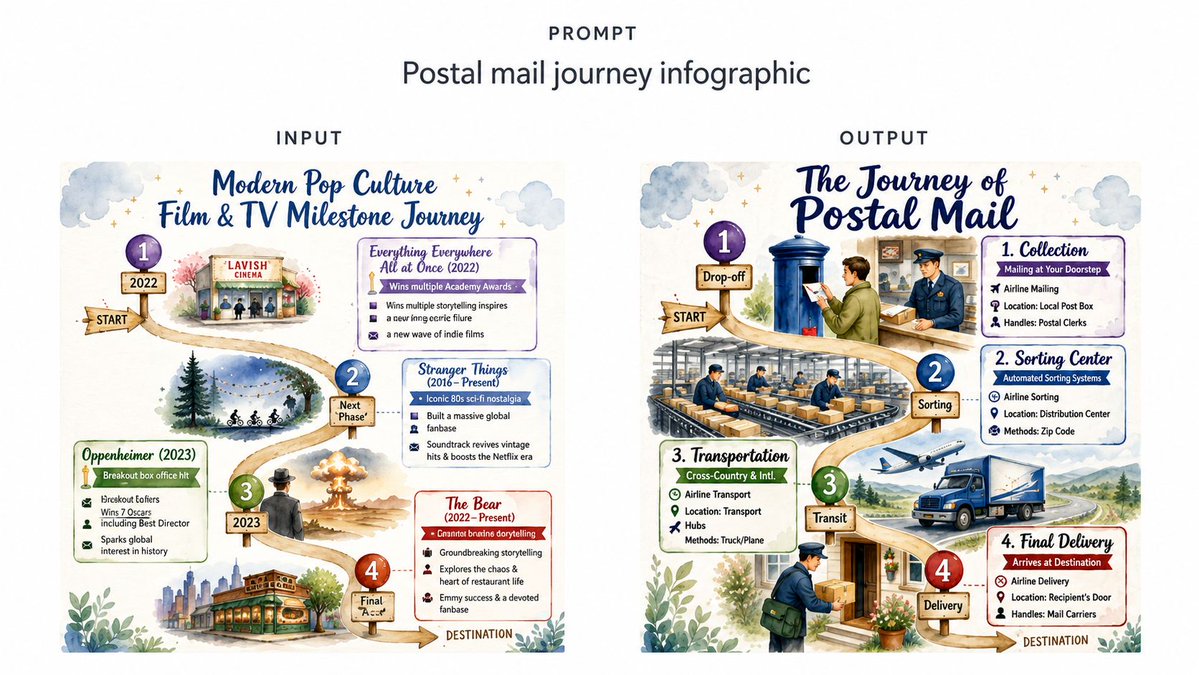
The multimodal releases were notable because they exposed mechanism as well as output. SenseNova published editing-focused examples plus open code and configuration, while Chimera paired its release with architecture and scaling-law evidence instead of just a highlight reel. The same product instinct visible in The Looking Glass and speech-to-speech also appeared here: builders are trying to make capabilities inspectable, configurable, and reusable.


6. New and Notable
Frontier-scale open models trained outside the Nvidia stack became a visible signal
@poezhao0605 argued (28 likes, 1 reply, 9,797 views, 10 bookmarks) that openPangu-2.0-Pro's real significance is not its benchmark score but the fact that a 505B total-parameter, 18B active-parameter MoE with 512K context was trained end to end on Ascend NPUs. In a feed already primed by DeepSeek, that made alternative hardware stacks look like part of the same open-model story rather than a separate industrial-policy topic.
Scientific AI started looking more like a public program than a private research claim
@SGRodriques announced (60 likes, 2 replies, 2,390 views, 19 bookmarks) Edison Advances as a place to publish the models, blogs, and benchmarks around Kosmos, while @kenbwork announced (12 likes, 2 replies, 854 views, 9 bookmarks) a NeurIPS workshop built around scientific data readiness and realistic task evaluation. The notable part is not a single scientific breakthrough; it is that builders are publicly organizing the missing infrastructure around AI scientists.
Multimodal evaluation kept moving away from hero images toward stress tests
@RAVIKUMARSAHU78 tested (39 likes, 11 replies, 12,127 views) HappyHorse 1.1 and Kling 3.0 on difficult ballet and body-mechanics prompts rather than simple beauty shots, while @ModelScope2022 released (23 likes, 1 reply, 1,052 views, 14 bookmarks) SenseNova U1.5 around text/layout editing and @hanwenjiang1 introduced (37 likes, 2 replies, 1,251 views, 31 bookmarks) Chimera around long-context scaling. The notable shift is that progress claims are increasingly tied to motion, editing, and scaling evidence instead of one polished still.
7. Where the Opportunities Are
[+++] Workflow-specific benchmark and routing infrastructure - @businessbarista argued (42 likes, 10 replies, 8,561 views, 69 bookmarks) for private benchmarks, @BrendanFoody amplified (38 likes, 1 reply, 5,242 views, 16 bookmarks) profession-specific evaluation via APEX-Accounting, and @nykdotdev argued (8 likes, 3 replies, 162 views, 9 bookmarks) that teams first need to separate interface, harness, and model failures. This is strong because the pain is explicit, cross-domain, and already tied to wasted spend.
[++] Verification and eval-boundary tooling - @CryptoTweets reported (70 likes, 5 replies, 6,898 views) Anthropic's evaluation-boundary failure, @ghadfield proposed (35 likes, 4 replies, 2,712 views, 15 bookmarks) verifier infrastructure, and @ilblackdragon argued (70 likes, 9 replies, 6,300 views) for more open security capacity. This is moderate because the need is clear and urgent, but customers, regulators, and labs will all shape the market.
[++] Open modular AI interfaces beyond chat - @elder_plinius introduced (795 likes, 56 replies, 37,744 views, 527 bookmarks) The Looking Glass, @akshay_pachaar explained (13 likes, 1 reply, 2,314 views, 21 bookmarks) a swappable realtime voice stack, and @ModelScope2022 released (23 likes, 1 reply, 1,052 views, 14 bookmarks) a 4K editing-focused multimodal model. This is moderate because the signal is real, but the space is competitive and product differentiation depends on interface quality as much as raw model choice.
[+] Scientific-AI data readiness and evaluation services - @SGRodriques announced (60 likes, 2 replies, 2,390 views, 19 bookmarks) Edison Advances around Kosmos, and @kenbwork announced (12 likes, 2 replies, 854 views, 9 bookmarks) a workshop centered on scientific data readiness and messy-task evaluation. This is emerging because the need is explicit, but the customers and workflows are narrower and higher-trust than general enterprise AI.
8. Takeaways
- Open weights are now a same-day pricing force, not a distant catch-up story. @kimmonismus reported (452 likes, 27 replies, 16,816 views, 41 bookmarks) the DeepSeek V4 Flash 0731 release, while @ArtificialAnlys showed (57 likes, 6 replies, 1,834 views) that it already sits near the open-weight frontier.
- Benchmarking is becoming a product category of its own. @businessbarista argued (42 likes, 10 replies, 8,561 views, 69 bookmarks) for private benchmarks, @BrendanFoody amplified (38 likes, 1 reply, 5,242 views, 16 bookmarks) APEX-Accounting, and @0xSero shared (40 likes, 1 reply, 2,803 views, 13 bookmarks) a public benchmark browser.
- Builder energy is flowing into inspectable surfaces and scaffolds, not just opaque chat wrappers. @elder_plinius introduced (795 likes, 56 replies, 37,744 views, 527 bookmarks) The Looking Glass, while @akshay_pachaar explained (13 likes, 1 reply, 2,314 views, 21 bookmarks) an open realtime voice stack built from swappable components.
- Safety failures are exposing evaluation plumbing as a first-class product and policy problem. @CryptoTweets reported (70 likes, 5 replies, 6,898 views) Anthropic's breach incidents, and @ghadfield proposed (35 likes, 4 replies, 2,712 views, 15 bookmarks) independent verification infrastructure as part of the response.
- Multimodal progress is being judged on editability, motion fidelity, and scaling discipline instead of pretty stills alone. @RAVIKUMARSAHU78 tested (39 likes, 11 replies, 12,127 views) motion consistency, @ModelScope2022 released (23 likes, 1 reply, 1,052 views, 14 bookmarks) editing-focused SenseNova U1.5, and @hanwenjiang1 introduced (37 likes, 2 replies, 1,251 views, 31 bookmarks) Chimera with architecture and scaling-law evidence.