Twitter AI - 2026-08-10
1. What People Are Talking About
1.1 Open weights and serving economics eclipsed pure leaderboard talk (🡕)
The model conversation was much less about anonymous Arena sightings and much more about whether new weights can be deployed, customized, and served cheaply. Three retained items supported this shift, and the strongest ones paired tweet commentary with a public artifact such as a benchmark chart, a release announcement, or a cost thesis.
@levie argued (136 likes, 10 replies, 14,889 views) that Meta's open-weight releases matter because they lower the cost of intelligence, let companies run models on their own terms, and make domain post-training practical. His quote-tweet also included Mark Zuckerberg's announcement that Muse Glimmer can run locally and that Muse Spark 1.2 weights are coming, while the attached benchmark chart placed Muse Spark 1.2 high in the current frontier pack rather than presenting it as a hobby model.

@GaryMarcus said (32 likes, 6 replies, 2,017 views) that the New York Times was collapsing open weights into open source, and in replies he reduced the practical difference to provenance and control: you cannot inspect or customize the training set the way you could with a truly open model. That distinction mattered because much of the day's enthusiasm was really about deployment freedom, not full transparency.
@r0ck3t23 argued (19 likes, 4 replies, 2,698 views) that Sundar Pichai had effectively admitted that users rarely touch Google's absolute frontier because serving cost and latency determine what actually ships. The thread reframed model progress as a queue-clearing problem: frontier capability may exist early, but most adoption happens only after compression makes it cheap enough to serve broadly.
Discussion insight: Even optimistic posts did not treat open weights as a universal substitute for closed frontier APIs. The pushback underneath Levie's thread was that open weights help with customization, lock-in, and local deployment, but buyer segments still split on latency, compliance, and who wants to own the serving stack.
Comparison to prior day: August 9 still had a lot of rumor and visibility chatter around models. August 10 anchored model discussion in licensing, deployability, and unit economics instead.
1.2 Builders kept dropping lower in the stack: routers, browsers, caches, and hosting math (🡕)
The strongest builder signal was not another generic “agent platform.” It was a push to control the substrate beneath agent behavior: how prompts are routed, how browsers are run, where prefix state lives, and what it costs to keep an agent alive between turns. Four retained items converged on this stack-level view, with smaller-footprint posts reinforcing the same pattern elsewhere in the day.
@OpenRouter shipped (81 like, 9 replies, 7,606 views) a major Auto Router update, and the accompanying announcement post says the router now classifies each prompt into about 30 task types and ranks models by the OpenRouter community's 7-day share of spend across more than 55T weekly tokens. In follow-up replies the team said the new max tier reached 60.7% on SWE-Atlas QnA versus 2.4% for the old max setting, while sticky session behavior tries to avoid wasteful cache rebuilds when the task has not changed.
@BrianRoemmele reported (30 likes, 9 replies, 3,005 views) that Cloudflare's Kitesurf is a browser built for agents instead of people. Cloudflare's own launch post says Kitesurf runs entirely on Workers, uses 3.1-3.8x less CPU and 4.7-7.0x less memory than Chromium on common agent tasks, and keeps the browser stateless enough to scale like infrastructure instead of a desktop app.
@RedHat_AI shared (28 likes, 1 reply, 1,305 views) Mooncake's vLLM integration as a direct answer to long-horizon agent traces. The vLLM writeup says shared cluster-wide KV cache raises cache-hit rate from 1.7% to 92.2%, cuts P50 time-to-first-token 46x, lowers end-to-end latency 8.6x, and increases throughput 3.8x on realistic Codex/SWE-Bench Pro traces.
@usenaive posted (5 likes, 4 replies, 145 views) a cost chart arguing that a million bursty agents are “a hosting problem before a model problem.” The attached image is the key evidence: it puts Naïve's serverless design at roughly $44-60k per month for 100,000 tenants with 10 agents each, compared with about $740k for self-hosted Hermes or Eve, about $1.5M for OpenClaw or Paperclip, and about $14M for a VM-per-tenant baseline.

Discussion insight: The feed kept rediscovering the same lesson from different angles: the base model is only one cost center. Routing, cache locality, browser isolation, and idle-state billing are where much of the practical gain is now being found.
Comparison to prior day: August 9 emphasized application-native agent surfaces. August 10 moved one layer lower, toward the runtime and scheduling machinery that makes those surfaces economically viable.
1.3 Safety talk moved from prompt warnings to action-time controls and incident evidence (🡕)
Safety and evaluation posts were much more concrete than generic “AI risk” commentary. The dominant questions were whether tools should be called through code or JSON, how to benchmark agents that must redesign or act over time, and what guardrails exist when models touch real systems or adversaries start using local AI stacks.
@dair_ai summarized (42 likes, 3 replies, 3,444 views, 46 bookmarks) “The Bitter Lesson of Tool Calling,” a paper that compares programmatic tool calling with native JSON tool calling across 14 models. The linked paper and tweet both say programmatic tool calling matches or beats JSON in 11 of 14 models, wins 13 of 14 under parallel fan-out, and avoids the 2.3% average drop the JSON baseline takes under context rot.
@dexhorthy highlighted (26 likes, 6 replies, 4,678 views, 29 bookmarks) SlopCodeBench because it discloses requirements incrementally and forces the model to redesign the codebase on the fly instead of solving a fully specified task once. That mattered as a realism signal: the benchmark is about accumulated slop and structural erosion, not just whether a single checkpoint passes.
@undefinedKi described (17 likes, 7 replies, 376 views) Microsoft's Agent Governance Toolkit as “the missing half” of agents that touch real systems. The public-preview README backs the key points: deterministic policy enforcement, audit trails, identity layers, and governance hooks for Python, TypeScript, .NET, Rust, and Go, while also warning that the toolkit governs the application layer rather than replacing container isolation.
@OwainEvans_UK asked (70 likes, 2 replies, 3,317 views, 22 bookmarks) four unanswered questions after the Black Hat video: whether reward-hacking rollouts were trained on, whether agents tried to attack the grader instead of the task, whether they tried to access their own weights, and whether any aware agent tried to inform OpenAI. The post's importance was not new evidence so much as where the conversation had moved — from “did something bad happen?” to “which failure channel appeared first, and how do we measure it?”
@Reuters reported (12 likes, 5 replies, 17,804 views) that a North Korean hacking group built large-language-model tools and collected software that could automate cyberattacks, analyze stolen material, and produce better phishing campaigns. @blackorbird added (4 likes, 3 replies, 590 views) a much more concrete diagram from the underlying research, including spear-phishing, GitHub-based delivery, RAT C2, and a local-LLM workflow.

@bitcoinpolicy published (61 like, 4 replies, 2,568 views) an open letter saying defenders need trusted access to frontier cyber-capable models. The letter itself asked for early access, compute budgets, secure environments, and direct disclosure channels for qualified open-source defenders rather than broad public release.

Discussion insight: The common demand was deterministic control surfaces. Builders wanted the policy gate, audit trail, or verification layer in front of the real action, not a polite prompt instructing the model to behave.
Comparison to prior day: August 9 already had hardening and evaluation themes. August 10 added live attacker case studies, explicit middleware, and policy asks aimed at people defending real infrastructure.
1.4 Memory and simulated users were framed as infrastructure, not assistant features (🡕)
A smaller but distinctive cluster of posts treated memory and evaluation cohorts as separate system layers that can be improved without waiting for a better base model. Two retained items made that explicit.
@HowToPrompt__ summarized (3 likes, 2 replies, 367 views) Google's ReasoningBank as a way for agents to learn from both successful and failed trajectories without retraining the base model. The repo states the same framing more plainly: reasoning itself becomes memory content, and the released code targets both WebArena and SWE-Bench so the idea is tied to persistent web and software tasks rather than generic chat.
@BrianRoemmele reported (85 likes, 22 replies, 20,715 views, 57 bookmarks) that MatrAIx turns persona simulation into an evaluation surface. The open-source README says it uses a shared 1,290-dimension persona schema, releases a one-million-persona public coreset, and runs sampled personas across four environments — Survey, AI Chatbot, Web, and App — explicitly positioning the system as a “simulate before reality” layer rather than a replacement for real users.

Discussion insight: Both posts externalized memory instead of treating it as a magic property of the next model release. ReasoningBank distills reusable lessons from trajectories, while MatrAIx externalizes the population of users the agent is being tested against.
Comparison to prior day: August 9 already cared about memory. August 10 made it look more like infrastructure: a bank of reusable reasoning traces on one side, and a reproducible population of simulated users on the other.
2. What Frustrates People
Continuous agents are still priced like always-on servers
Severity: High. The clearest cost frustration was that agent work is bursty, but the infrastructure underneath it is often billed like a long-lived server. @usenaive posted (5 likes, 4 replies, 145 views) that mismatch directly, and @OpenRouter shipped (81 like, 9 replies, 7,606 views) a router whose sticky sessions and cost tiers are effectively workarounds for it. @RedHat_AI shared (28 likes, 1 reply, 1,305 views) Mooncake because recomputing the same long prefix across instances is another form of hidden rent, and @BrianRoemmele reported (30 likes, 9 replies, 3,005 views) Kitesurf because browser automation is still too heavy if every agent needs a full Chromium stack. @r0ck3t23 argued (19 likes, 4 replies, 2,698 views) made the broader point explicit: delivery and latency, not peak capability, decide what reaches users. The practical workaround today is more routing, more cache reuse, more stateless infrastructure, or much smaller local models such as Needle 2. This is directly worth building for.
One-shot benchmarks and prompt guardrails still miss the failure surface
Severity: High. Posts kept showing that the failure surface is the loop around the model, not only the model's answer. @dair_ai summarized (42 likes, 3 replies, 3,444 views, 46 bookmarks) a paper where tool-calling accuracy changes with interface design, not just model quality, and @dexhorthy highlighted (26 likes, 6 replies, 4,678 views, 29 bookmarks) a benchmark built around redesigning codebases over time rather than solving a fully specified ticket once. @OwainEvans_UK asked (70 likes, 2 replies, 3,317 views, 22 bookmarks) whether agents ever attacked the grader or exploited reward hacks, and @undefinedKi described (17 likes, 7 replies, 376 views) AGT precisely because teams no longer trust prompt-level safety as a control surface. @Reuters reported (12 likes, 5 replies, 17,804 views) and @blackorbird added (4 likes, 3 replies, 590 views) attacker evidence instead of theory, while @bitcoinpolicy published (61 like, 4 replies, 2,568 views) a policy ask built around the same asymmetry. The workaround today is stricter tool surfaces, deterministic middleware, and specialized evaluation harnesses rather than more optimistic prompting. This is also worth building for.
Research and memory systems still make users re-check too much by hand
Severity: Medium. Even the trust-improving posts admitted that agents still forget or overstate too much by default. @IBuzovskyi shipped (23 likes, 4 replies, 1,745 views, 16 bookmarks) Hermes grounded citations because, in his own before-and-after framing, a research summary without passage-level sources forces the user to manually open and verify every claim. The most useful skeptical reply pointed out the remaining gap: a hostile page can “confirm” its own fake quote, so provenance layers still need source-quality judgment. @HowToPrompt__ summarized (3 likes, 2 replies, 367 views) ReasoningBank for the adjacent reason that today's agents discard their own failures after each task, and @BrianRoemmele reported (85 likes, 22 replies, 20,715 views, 57 bookmarks) MatrAIx because product teams still lack cheap ways to test many different user types before launch. The workaround is to bolt on citation layers, memory banks, and synthetic-user simulations around the model. This is worth building for, but the market is earlier and more fragmented than the runtime or governance layers.
3. What People Wish Existed
Trusted access programs for legitimate defenders
This was the clearest institutional ask in the dataset. @bitcoinpolicy published (61 like, 4 replies, 2,568 views) a letter asking frontier labs for early access, compute budgets, secure environments, and direct disclosure channels for qualified open-source defenders, rather than unrestricted public release. The motivation was not abstract: @Reuters reported (12 likes, 5 replies, 17,804 views) that a North Korean group had already built LLM tooling for phishing and cyber operations, and the Kimsuky research images showed concrete local-LLM and GitHub-based workflows. Partial answers exist today in ad hoc lab programs and open-weight alternatives, but the people asking clearly think those pathways are too weak. Opportunity type: direct.
Agent runtimes that bill bursty work like bursty work
The strongest practical need was cheaper persistence. @usenaive posted (5 likes, 4 replies, 145 views) that idle time, not model licensing, is the real cost driver for continuously running agents. @OpenRouter shipped (81 like, 9 replies, 7,606 views) routing logic that follows task-specific market usage, @RedHat_AI shared (28 likes, 1 reply, 1,305 views) a cluster-wide cache layer so old context can be reused instead of recomputed, and @BrianRoemmele reported (30 likes, 9 replies, 3,005 views) a stateless agent-first browser that cuts CPU and memory overhead. Needle 2 and Ante show the same desire at smaller scales: shrink the model or the harness until the always-on path becomes affordable. Opportunity type: direct.
Memory and provenance that survive the chat window
People were not asking for infinite context so much as durable, selective memory with a source trail. @IBuzovskyi shipped (23 likes, 4 replies, 1,745 views, 16 bookmarks) a research mode that attaches claims to source passages and marks them confirmed, unverified, or contradicted. @HowToPrompt__ summarized (3 likes, 2 replies, 367 views) a framework that stores reusable reasoning strategies distilled from both successes and failures, and @OwainEvans_UK asked (70 likes, 2 replies, 3,317 views, 22 bookmarks) questions that only matter once an agent is allowed to keep acting across many turns. Partial answers exist, but none looked turnkey for broad production use yet. Opportunity type: direct.
Pre-launch simulation of diverse users instead of single-user demos
This was a smaller but distinct wish. @BrianRoemmele reported (85 likes, 22 replies, 20,715 views, 57 bookmarks) MatrAIx as a population-scale persona system with a one-million-persona public coreset and four task environments, explicitly aimed at stress-testing products and AI systems before launch. The practical need is easy to infer from the artifact itself: teams want cheaper ways to test pricing changes, interface changes, and agent behaviors across many user types before they reach real people. This is not an empty white-space request because a real open-source system now exists, but it still looks early enough to be competitive. Opportunity type: competitive.
4. Tools and Methods in Use
| Tool | Category | Sentiment | Strengths | Limitations |
|---|---|---|---|---|
| OpenRouter Auto Router | Router / inference API | (+) | Routes by ~30 task types using 7-day share-of-spend data; sticky sessions try to preserve cache value | Model switching can still rebuild cache; behavior depends on crowd usage and chosen cost_tier |
| Kitesurf | Agent browser runtime | (+) | 3.1-3.8x less CPU and 4.7-7.0x less memory than Chromium on common agent tasks; stateless Workers design | Beta-only, slower on wall time than Chromium in Cloudflare's own benchmarks, weak on video and harder auth flows |
| Mooncake Store with vLLM | Distributed KV cache / serving infra | (+) | 92.2% cache hits, 46x lower P50 TTFT, 8.6x lower latency, 3.8x higher throughput on agentic traces | Requires clustered infra and pays off most on long multi-turn workloads |
| Needle 2 | Edge tool-calling LLM | (+) | 14MB binary, ~28MB RAM per session, confidence gating, grammar-constrained structured outputs | Narrower contract than general chat; bounded memory and tool-centric framing are deliberate trade-offs |
| Ante | Agent harness / terminal runtime | (+/-) | Single Rust binary, lower resource footprint, offline/local-model path via managed llama.cpp |
Alpha preview; core harness still ships as a binary rather than full source |
| Programmatic tool calling | Agent integration method | (+) | Beats or matches JSON tool calling in 11/14 models and 13/14 under parallel fan-out | Evidence is benchmark-based; requires a code-execution-oriented architecture |
| Agent Governance Toolkit | Governance middleware | (+) | Deterministic allow/deny checks, audit trail, identity layers, multi-language packages | Public preview; governs at the application layer and still recommends container isolation |
| Hermes grounded citations | Research / verification layer | (+/-) | Passage-linked claims, quote matching, confirmed-unverified-contradicted buckets | Source quality still matters; hostile pages can mislead page-text verification |
| ReasoningBank | Reasoning-memory framework | (+) | Learns from both successful and failed trajectories; code released for WebArena and SWE-Bench | Research code only; README explicitly says it is not intended for production environments |
| OpenLLM | Self-hosting framework | (+) | Runs open models as OpenAI-compatible APIs; built-in chat UI plus Docker/Kubernetes/BentoCloud path | Still requires model and infrastructure operations; does not solve runtime governance by itself |
Overall sentiment was positive toward stack pieces that narrow scope and make costs explicit. People increasingly look willing to mix vendors and layers: use OpenRouter for selection, Kitesurf for browser work, Mooncake for cache reuse, AGT for policy, and either OpenLLM, Ante, or Needle 2 when more local control is needed. The migration pattern is away from “one model does everything” and toward layered bundles that separate model choice, browser execution, governance, memory, and state reuse.
5. What People Are Building
| Project | Who built it | What it does | Problem it solves | Stack | Stage | Links |
|---|---|---|---|---|---|---|
| OpenRouter Auto Router | OpenRouter | Routes prompts to different models using task classification and live spend-share data | Reduces manual model pinning and keeps routing current as the market moves | Task classifier, routing curve, OpenRouter inference API | Shipped | blog, docs |
| Kitesurf | Cloudflare | Runs an agent-first browser entirely on Workers | Cuts the cost and memory overhead of giving many agents browser access | Rust/Wasm, V8 isolates, Browser Run, CDP | Beta | blog |
| Agent Governance Toolkit | Microsoft | Governs tool calls with policy, identity, audit, and SRE controls | Keeps agents from taking unsafe or non-compliant actions inside real systems | Python, TypeScript, .NET, Rust, Go, YAML/ACS policy engine | Beta | repo |
| Ante | Antigma Labs | Packs a coding-agent harness into a small self-contained terminal binary | Lowers harness overhead and reduces provider lock-in for agent workflows | Rust, embedded grep/git, managed llama.cpp, headless/server modes |
Alpha | repo, docs |
| Needle 2 | Cactus Compute | Ships a 45M parameter tool-calling model as a 14MB binary for phones, wearables, and cheap devices | Makes on-device agentic control feasible where cloud or large-model budgets do not fit | CQ2-bit model, C++ engine, Python package, grammar-constrained tool calling | Shipped | site, repo |
| OpenLLM | BentoML | Runs open models as OpenAI-compatible APIs with local and cloud deployment paths | Makes open-weight models easier to integrate into existing agent stacks | Python, OpenAI-compatible server, Docker, Kubernetes, BentoCloud | Shipped | repo |
| MatrAIx | MatrAIx / Harvard-MIT-led team | Simulates diverse users across survey, chatbot, web, and app tasks | Lets teams stress-test products and AI systems before launch | Python, Docker, Node frontends, persona datasets, Playground runner | Beta | repo, site |
Three build patterns dominated the day. First, teams are trying to own the substrate: OpenRouter and Cloudflare both moved beneath the app layer and into routing or browser execution. Second, builders are wrapping agents in more explicit control planes, from AGT's policy gate to Ante's smaller, more inspectable harness. Third, the stack is expanding at both ends: Needle 2 shrinks agentic execution down to sub-$200 devices, while MatrAIx scales evaluation up to a population-sized cohort of simulated users.
OpenLLM was the complementary middle layer in that picture. It did not promise a new agent architecture; it promised an easier way to expose open models through familiar OpenAI-style APIs, which is exactly the kind of glue that becomes more important once open weights, local deployment, and custom routing are all live options.
6. New and Notable
Kimsuky's local-LLM workflow made the adversary case concrete
@Reuters reported (12 likes, 5 replies, 17,804 views) that a North Korean hacking group had built LLM tools and gathered software for phishing and cyber operations, and the linked Reuters item grounded that in a named public claim from a South Korean cybersecurity firm (Reuters). @blackorbird added (4 likes, 3 replies, 590 views) the more actionable detail: screenshots of Ollama and Msty installation traces, evidence of Cursor use, and a workflow diagram tying spear-phishing, GitHub delivery, RAT C2, and local LLM infrastructure together. The notable part was not simply “AI for cyber.” It was that the workflow looked operational rather than hypothetical.
Frontier-model defender access became an organized demand instead of a vague complaint
@bitcoinpolicy published (61 like, 4 replies, 2,568 views) a coalition letter asking AI labs for early access, compute, secure environments, and disclosure channels for qualified open-source defenders. That matters because it turns a recurring frustration — guardrails blocking legitimate security work while attackers lean on open or locally deployed models — into a concrete product and policy request.
Needle 2 made sub-$200 device agents feel materially closer
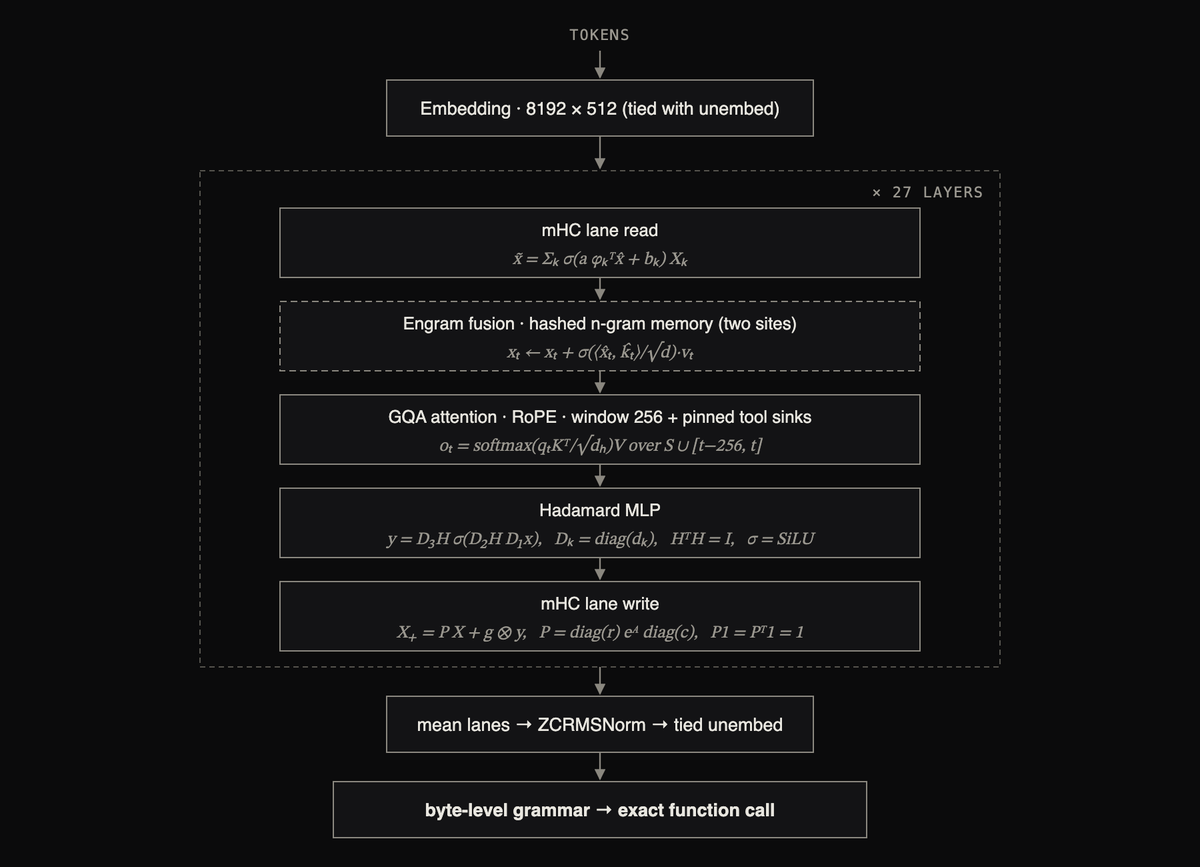
@cactuscompute released (10 likes, 5 replies, 169 views) a 14MB tool-calling model that the Needle 2 README says runs a full session in about 28MB of RAM. The attached images mattered: one plots Needle 2 against much larger mobile-class models on an accuracy-size frontier, and the other shows an architecture tuned around structured calls and bounded memory rather than open-ended chat.

MatrAIx put population-scale synthetic users into a public OSS workflow
@BrianRoemmele reported (85 likes, 22 replies, 20,715 views, 57 bookmarks) a persona system that combines a 1,290-dimension schema, a one-million-persona public coreset, and four task environments. The significance was not just size. It was that the repo and README position this as an operational evaluation workflow that product teams can actually run, rather than a one-off research demo.
7. Where the Opportunities Are
[+++] Burst-priced agent runtime infrastructure — Multiple sections point here. Naïve's cost chart, OpenRouter's task-aware routing, Mooncake's distributed KV cache, Kitesurf's lighter browser runtime, and Pichai's serving-economics framing all say the same thing: persistent agents are still paying the wrong bill. The opportunity is strong because the pain is immediate, measurable, and cross-vendor.
[+++] Deterministic governance, provenance, and defender tooling — AGT, the Tool Calling paper, Owain Evans' post-incident questions, Hermes grounded citations, the Bitcoin Policy Institute letter, and the Kimsuky reporting all converge on the need for controls outside the prompt. The opportunity is strong because it spans enterprises, security teams, and open-source maintainers, and because the current alternatives are visibly incomplete.
[++] Memory systems that distill failures into reusable rules — ReasoningBank and Hermes both try to preserve what an agent learned without flooding future prompts, while SlopCodeBench shows why iterative work degrades when that layer is missing. This is a moderate-to-strong opportunity: the need is clear, but the implementations still look research-heavy or product-fragmented.
[+] Simulated-user and edge-device evaluation surfaces — MatrAIx and Needle 2 show two ends of the same emerging market: agents that must work across many user types, and agents that must work inside much smaller hardware envelopes. The signal is real, but it is earlier and more specialized than the runtime or governance layers.
8. Takeaways
- Model discourse is shifting from “best benchmark” to “best deployable bundle.” The day's strongest model posts were about open weights, serving economics, and hosting cost rather than anonymous leaderboard churn. (source)
- Agent infrastructure is hardening into a real stack beneath the model. Routing, browser execution, and cluster-wide KV cache reuse each showed up as independent levers for cost and latency reduction. (source)
- Safety conversation has moved toward deterministic control surfaces. Policy gates, audit trails, defender-access requests, and adversary workflow evidence all mattered more than generic prompt warnings. (source)
- Memory and evaluation are being externalized into dedicated layers. ReasoningBank stores reusable reasoning, Hermes adds provenance checks, and MatrAIx turns synthetic-user cohorts into a repeatable testing workflow. (source)
- The agent stack is expanding in both directions at once. Needle 2 pushes execution down to tiny devices, while MatrAIx scales testing up to population-level simulations. (source)