Twitter AI - 2026-08-11
1. What People Are Talking About
1.1 Local, ownable agent models moved from weight drops to runnable products (🡕)
The strongest conversation was not just that new weights exist, but that they can already be benchmarked, quantized, run locally, and folded into owned enterprise workflows. Six retained items supported this shift, spanning model comparisons, same-day local deployments, desktop workbenches, and enterprise loops that keep improving after launch.
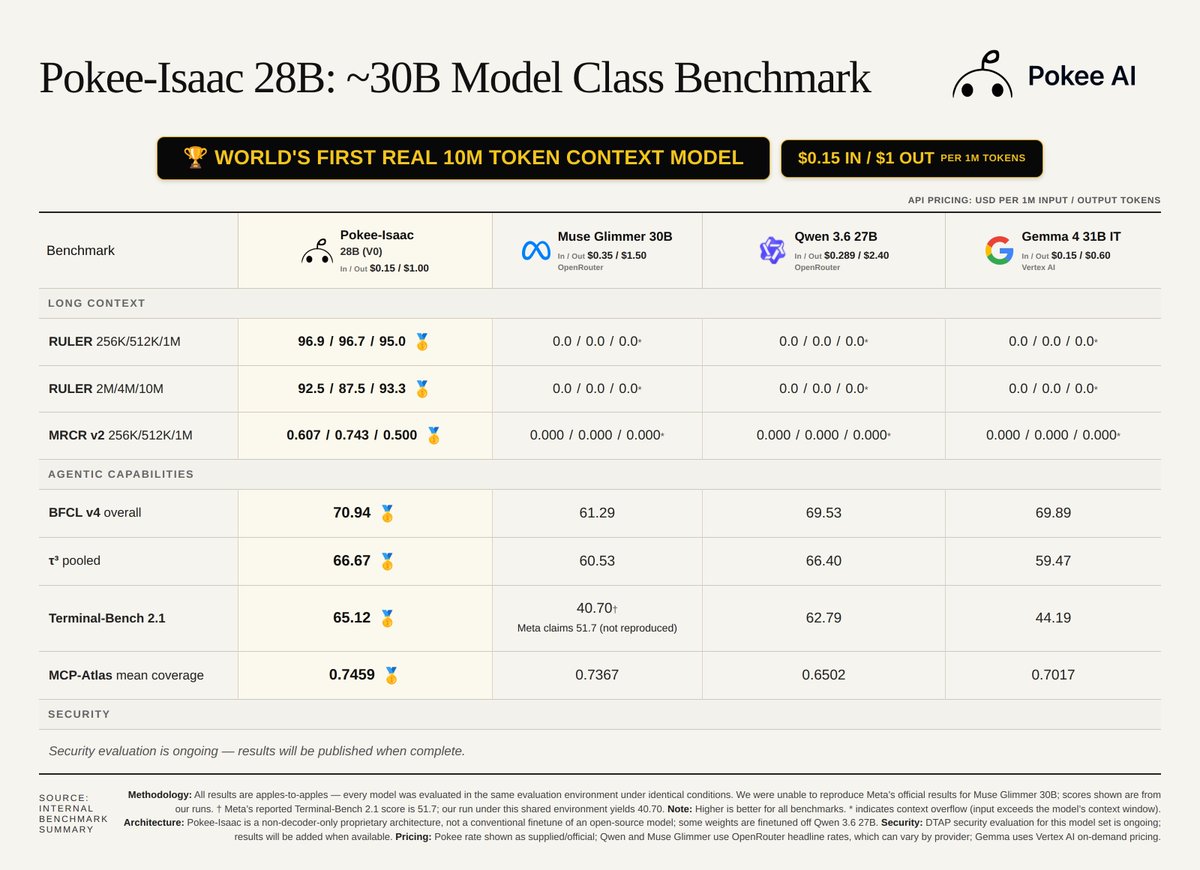
@Pokee_AI argued (1,225 likes, 23 replies, 375,104 views) that the new 30B local frontier is getting serious because Pokee-Isaac 28B beat Muse Glimmer 30B, Qwen 3.6 27B, and Gemma 4 31B across BFCL v4, τ³-bench, Terminal-Bench 2.1, and MCP-Atlas, while also posting 93.3% on RULER at 10M context. The attached benchmark table is the key evidence because it makes the day’s model talk about deployable agent capabilities and long-context behavior, not just a single leaderboard claim. The most useful reply was also a caveat: local deployment for individuals was still “coming,” which shows how fast the conversation now moves from scores to packaging.
@OsaurusAI showed (15 likes, 4 replies, 1,164 views) the same release landing immediately on a Mac, with Muse Glimmer 30B analyzing an image and building a playable game locally. In replies the team said the run used a 4-bit JANG quantization, preserved vision in FP16, enabled sandboxed file writes, and needed about 44GB RAM, which turned “runs locally” into concrete operational detail rather than marketing language.
@UnslothAI launched (45 likes, 6 replies, 906 views, 15 bookmarks) Unsloth Desktop as a local run-train-deploy surface rather than a one-off demo. The public docs back the tweet’s strongest claims: the app is open-source, works across macOS, Windows, and Linux, supports local model training and inference, connects Claude Code and Codex to local LLMs, and includes sandboxed code execution plus self-healing tool calls. That mattered because the “own your model” theme was no longer just about raw weights; it was about giving ordinary developers a workable desktop control plane.
@nvidia announced (114 likes, 21 replies, 15,591 views) Nemotron 3.5 Lightning and NeMo Switchyard as the model-and-router pair for always-on specialized work. NVIDIA’s launch framing was sparse on details inside the tweet, but the public LM Studio model page fills in the important parts: a 30B MoE with 3B active parameters, 1M context, multi-token prediction, and deployment targets from local RTX systems to the edge and datacenter. The most revealing reply was not hype but an orchestration question about whether Switchyard preserves enough shared context for one model to catch another model’s mistake.
@GesoraMeshack argued (98 likes, 8 replies, 3,371 views) that model ownership only matters if production data keeps making the model better. The quoted Oumi launch thread and the linked press release make that concrete: Oumi says enterprises can build a specialized model, deploy it, capture failures from production traffic, retrain, reevaluate, and redeploy while owning the weights, datasets, and recipes. @aryanXmahajan reinforced (31 likes, 1,446 views, 16 bookmarks) the same point from the buyer side: generic rented models work for pilots, but the real workflows arrive with proprietary language, edge cases, and security constraints that only an owned model can compound against.
Discussion insight: The shared test for “good AI” kept shifting from frontier intelligence to control: can it run on your hardware, learn from your traffic, fit your budget, and stay inside your tooling?
Comparison to prior day: August 10 already cared about open weights and serving economics. August 11 pushed the story further into local workbenches, model ownership, and same-day deployment surfaces.
1.2 Agent efficiency work shifted from bigger reasoning budgets to reusable skills and topology discipline (🡕)
A second theme was the claim that many agent costs are self-inflicted: too much repeated reasoning, too much undirected fan-out, and too little structure around when coordination helps. Two retained research-heavy items gave that argument unusually concrete numbers.
@dair_ai summarized (41 likes, 6 replies, 4,523 views, 53 bookmarks) Microsoft’s paper “Reason Wide, Not Deep,” and the linked paper supports the most important claim: if a coding agent distills compact natural-language skills from prior trajectories, a non-reasoning model can recover 55% to over 100% of the reasoning gap on held-out tasks while emitting 2.7-6x fewer output tokens. The strongest reply also supplied the main caution: a distilled skill is a frozen procedure, so part of test-time reasoning’s value is still its ability to notice when the environment has changed.
@marfinxx highlighted (55 likes, 4 replies, 2,401 views, 51 bookmarks) Google DeepMind’s agent-systems scaling paper, and both the image and the public paper matter here. The paper says the team ran 260 configurations across five architectures, found that more coordination stops helping after a capability threshold, and reported both +80.8% gains on decomposable financial reasoning and declines down to -70.0% on sequential planning when the topology is wrong. A top reply reduced the whole point to one sentence: parameter count does not cap agent performance by itself; topology does.

Discussion insight: The feed treated overhead as a design problem, not an unavoidable tax. One post amortized repeated procedures into skills; the other showed that unconstrained agent swarms can actively make the system worse.
Comparison to prior day: August 10 focused on routing, browsers, and cache locality. August 11 added more formal arguments about when reasoning should be reused and when extra agents should simply not be added.
1.3 Builders treated the infrastructure layer itself as something agents can synthesize (🡕)
The strongest builder posts were no longer just “here is a model” or “here is an app.” They were about building the runtime, kernel, and deployment machinery beneath the app — and in one case using an agent to write that machinery.
@tilderesearch released (79 likes, 5 replies, 6,729 views, 58 bookmarks) Popcorn as a public kernel-dispatch library. Its README sharpens the release far beyond the tweet headline: 96 kernels, 8 backends, 222 implementations, and 152,116 grid rows of benchmark evidence, with each implementation checked against a PyTorch reference and failed cases kept visible instead of silently omitted. The replies also show the intended audience clearly — contributors building fast, correct kernels for real training systems, not casual benchmark spectators.
@InfiniAILab released (14 likes, 1 reply, 567 views) FlashRT, and the public repo plus paper explain why it stood out. FlashRT asks a human to supply a simple sequential reference backend and frontend, then lets an optimization agent derive an intermediate representation, build the deployment, validate it, and iterate until the system is faster. Across five real-time multimodal applications, the authors report up to 70x lower latency and 3.6x higher throughput on NVIDIA and AMD GPUs.
@tom_doerr pointed to (10 likes, 2,133 views, 13 bookmarks) Razer AIKit as the local complement to that same infrastructure push. The repo describes a preview environment built on vLLM, LlamaFactory, and Ray, with multi-GPU scaling, Jupyter, Open WebUI, and local-first tuning or inference on workstation-class NVIDIA hardware. Together with Unsloth Desktop, it showed that “local AI” now means full environments and lifecycle tooling, not just opening a chat window on a laptop.
Discussion insight: The practical surface kept moving downward. The interesting work was not only what the model says, but how kernels are validated, how runtimes are synthesized, and how deployments are scaled across the hardware you already have.
Comparison to prior day: August 10 already went lower in the stack with routing and caching. August 11 went one layer deeper again, toward agent-authored serving systems and reproducible kernel-selection infrastructure.
1.4 Trust and governance signals got more concrete: provenance marks, introspection, and delegated credentials (🡕)
Trust-and-safety talk did not disappear, but it became more operational. The key questions were who signs for generated content, whether the model can notice interventions in its own internal state, and who carries the audit trail when a bot acts on a human’s behalf.
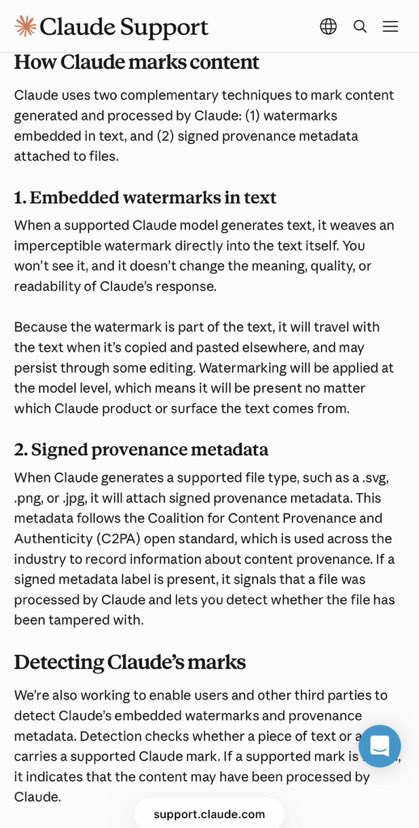
@BrianRoemmele claimed (79 likes, 10 replies, 19,178 views) that Anthropic had now publicly documented its marking system, and the linked screenshots plus the official Claude support article confirm the important parts: embedded text watermarks, signed provenance metadata for supported file types, and future detection tooling for third parties. His commentary was opinionated, but the evidence underneath it was real and concrete enough to matter on its own.
@heynavtoor summarized (8 likes, 3 replies, 2,750 views, 7 bookmarks) Anthropic’s paper on introspective awareness, and the public paper keeps the result both interesting and bounded. Claude Opus 4 and 4.1 sometimes noticed injected concepts in their own activations and could sometimes distinguish inserted outputs from their own prior internal state, but the paper also says the capability is unreliable and context-dependent. That made it notable because the signal was neither “the model is self-aware” nor “nothing is happening”; it was a measurable but unstable introspection behavior.
@cb_doge sold (420 likes, 53 replies, 29,259 views, 173 bookmarks) Grok Bot as an always-on coworker with its own computer, listing 100 tasks across sales, support, finance, research, and engineering. The thread’s most useful evidence was the reply from @Elev_30, who pointed out that if the bot signs into tools with your credentials, the log still says you did it. That one reply reframed the thread from capability theater into accountability design.
Discussion insight: The common demand was not abstract “safer AI.” It was clearer provenance, more visible control surfaces, and better answers to who owns an action once an agent touches a live system.
Comparison to prior day: August 10 emphasized hardening, governance middleware, and incident evidence. August 11 added public provenance rules, internal-state observability, and everyday credential delegation as the trust boundary readers cared about.
2. What Frustrates People
Renting generic models creates cost without compounding advantage
Severity: High. The clearest frustration was that enterprises keep paying frontier-model prices for intelligence that never becomes their own. @GesoraMeshack argued (98 likes, 8 replies, 3,371 views) that most models stop improving after deployment, while Oumi’s press release explicitly frames today’s problem as renting the same general model as every competitor. @aryanXmahajan said (31 likes, 1,446 views, 16 bookmarks) the real break happens when proprietary workflows, security data, and internal language show up, and @Pokee_AI showed (1,225 likes, 23 replies, 375,104 views) why smaller, more deployable models are part of the escape route. The workaround today is owned post-training, local deployment, and closed-loop retraining. This is directly worth building for.
Reasoning and coordination overhead still eats budget before users see value
Severity: High. Several posts made the same complaint from different layers of the stack: too much spend goes into the machinery around the answer. @dair_ai summarized (41 likes, 6 replies, 4,523 views, 53 bookmarks) a paper where reasoning mode burns 3-6x more output tokens than non-reasoning mode on multi-step agentic work, and the paper only recovers that waste by distilling reusable skills. @marfinxx highlighted (55 likes, 4 replies, 2,401 views, 51 bookmarks) evidence that adding more sub-agents can degrade accuracy on the wrong task, while @tilderesearch released (79 likes, 5 replies, 6,729 views, 58 bookmarks) Popcorn because backend choice itself still needs systematic benchmarking. @InfiniAILab released (14 likes, 1 reply, 567 views) FlashRT as a workaround that lets an agent rewrite the runtime instead of accepting the default one. This is also worth building for.
Valuable production judgment is still being thrown away
Severity: Medium-High. The strongest data complaint was not about missing web scale, but about missing outcomes. @coffeewithone argued (23 likes, 9 replies, 1,981 views, 8 bookmarks) that the highest-value training signal is the moment an expert says yes, fixes something, or kills it, with the outcome attached. The best reply sharpened that further: if a human picks the least bad option from a weak candidate set, approval alone records a false winner because the better option was never proposed. Oumi’s same-day launch matters here because it explicitly promises to capture failures from production traffic and turn them into retraining signals. The workaround today is more closed-loop instrumentation around real decisions. This remains worth building for.
Always-on agents still blur who acted, who approved, and what got marked
Severity: Medium-High. Capability threads kept colliding with accountability threads. @cb_doge pitched (420 likes, 53 replies, 29,259 views, 173 bookmarks) a bot that signs into tools and keeps working across apps, but the most useful reply warned that if it acts with your credentials, the audit log may still say you did it. @BrianRoemmele surfaced (79 likes, 10 replies, 19,178 views) Anthropic’s new content-marking documentation, which is a partial answer because it adds text watermarks and provenance metadata rather than leaving output origin entirely implicit. The practical workaround today is narrower credential scopes, explicit approval boundaries, and provenance layers. This is worth building for, especially anywhere agents touch email, documents, or live systems.
3. What People Wish Existed
Enterprise AI that compounds instead of resets at deployment
This was the clearest practical ask in the dataset. @GesoraMeshack argued (98 likes, 8 replies, 3,371 views) that most models reach production and stop improving, and the quoted Oumi thread plus Oumi’s launch announcement says enterprises want the opposite: build, deploy, capture failures, retrain, reevaluate, and redeploy while owning the weights and data. @aryanXmahajan added (31 likes, 1,446 views, 16 bookmarks) that rented general models break once the real internal language and edge cases arrive. The need is practical and urgent rather than emotional. Opportunity type: direct.
Local AI workbenches that cover the whole lifecycle, not just chat
People were rewarding tools that collapse run, train, route, and deploy into one owned surface. @UnslothAI launched (45 likes, 6 replies, 906 views, 15 bookmarks) a desktop app that runs and trains models locally, while the public docs confirm Codex and Claude Code connections, sandboxed execution, and model export. @tom_doerr pointed to (10 likes, 2,133 views, 13 bookmarks) Razer AIKit as a local multi-GPU environment built around vLLM, LlamaFactory, and Ray, and @OsaurusAI showed (15 likes, 4 replies, 1,164 views) the appeal of “your hardware, your model, no subscription.” The need here is direct but increasingly competitive.
Better ways to capture outcome-linked judgment data
A smaller but high-leverage need was for training data that comes from real decisions instead of more scraped text. @coffeewithone said (23 likes, 9 replies, 1,981 views, 8 bookmarks) that the highest-value data is the moment an expert accepts, fixes, or rejects something with the outcome attached, and the strongest reply argued that systems also need to record the better option the model never proposed. Oumi’s feedback loop is a partial answer, but the broader request is still open: pipelines that preserve expert judgment, rejected alternatives, and production failures as reusable learning signal. Opportunity type: direct.
Provenance and delegated-action controls for worker bots
The wish here was not “more agents” in the abstract; it was agents with clearer boundaries. @cb_doge pitched (420 likes, 53 replies, 29,259 views, 173 bookmarks) a bot that can live inside inboxes and apps, but the replies immediately asked who gets blamed when it acts under your credentials. @BrianRoemmele surfaced (79 likes, 10 replies, 19,178 views) Anthropic’s public marking documentation, which partially addresses output provenance but not approval flow. The need is practical and increasingly unavoidable as “AI teammate” products expand. Opportunity type: competitive.
4. Tools and Methods in Use
| Tool | Category | Sentiment | Strengths | Limitations |
|---|---|---|---|---|
| Oumi | Enterprise AI lifecycle platform | (+) | Automates build/evaluate/deploy/retrain loop; enterprises keep weights, data, and recipes | Vendor-led announcement; strongest evidence is still launch material rather than broad user results |
| NVIDIA Nemotron 3.5 Lightning | LLM / agent model | (+) | 30B MoE with 3B active params, 1M context, tuned for always-on specialized agents | Replies still ask for benchmark detail and how Switchyard preserves shared context across routed steps |
| Unsloth Desktop | Local AI workbench | (+) | Run/train/deploy locally; Claude Code and Codex connectors; sandboxed code exec; cross-platform | Beta product; reply thread still probes hardware specifics and platform fit |
| Popcorn | Kernel dispatch library | (+) | 96 kernels, 222 implementations, visible validation evidence, automatic backend selection | Repo itself warns isolated kernel benchmarks do not guarantee end-to-end workload wins |
| Reason Wide, Not Deep | Inference method | (+/-) | Distilled skills recover much of reasoning performance with 2.7-6x fewer tokens | Frozen skills may lag when task conditions change |
| Scaling Agent Systems | Multi-agent design method | (+) | Shows when centralized/master-worker setups help and when extra agents hurt | Benefits are task-dependent; sequential planning can degrade badly |
| FlashRT | Deployment harness | (+) | Agent converts reference backends into optimized real-time deployments; large latency and throughput gains | Research-stage setup; requires a reference implementation and substantial systems context |
| Razer AIKit | Local inference/tuning environment | (+/-) | vLLM + LlamaFactory + Ray stack for multi-GPU local work; Jupyter and WebUI included | Preview release and NVIDIA-oriented hardware assumptions keep it narrower than the marketing implies |
| Claude content marking | Provenance / compliance mechanism | (+/-) | Embedded text watermarks plus signed provenance metadata make origin more explicit | Detection details are still evolving, and some community reaction was openly hostile |
Overall satisfaction skewed positive wherever builders could own more of the stack: local deployment, specialized post-training, kernel choice, and explicit lifecycle tooling. Mixed sentiment appeared when the benefit depended on hidden infrastructure assumptions, such as specific GPU classes, agent-topology fit, or unresolved governance questions. The clearest migration pattern was away from “rent a frontier model and prompt harder” toward “own a narrower stack that learns, routes, and deploys on your terms.”
5. What People Are Building
| Project | Who built it | What it does | Problem it solves | Stack | Stage | Links |
|---|---|---|---|---|---|---|
| Oumi Compounding AI Factory | @Koukoumidis / Oumi | Builds, deploys, monitors, retrains, and redeploys specialized enterprise models | Generic frontier-model rental does not differentiate or improve from production use | Oumi platform, open-source library, agent-operable CLI | Shipped | announcement, site |
| Unsloth Desktop | @UnslothAI | Local desktop app for running, training, and deploying models | Teams want one owned surface for local inference, fine-tuning, agents, and tools | Desktop app, MLX, GGUF, diffusion, sandboxed code exec, OpenAI-compatible API | Beta | post, docs, GitHub |
| Popcorn | @tilderesearch | Dispatches high-performance ML kernels across validated backends | Optimized kernels are hard to compare, trust, and select for real workloads | Python, PyTorch references, benchmark cache, multiple kernel backends | Shipped | post, GitHub |
| FlashRT | @InfiniAILab | Uses an agent harness to turn reference multimodal pipelines into optimized real-time deployments | Real-time multimodal serving still requires too much manual systems engineering | IR runtime, coding agent loop, NVIDIA/AMD deployment targets | Alpha | post, paper, GitHub |
| Razer AIKit | @tom_doerr | Local AI development environment for inference and fine-tuning across single or multiple GPUs | Researchers and engineers still face high setup friction for local, scalable model work | vLLM, LlamaFactory, Ray, Docker, Open WebUI, Jupyter | Beta | post, GitHub |
| Osaurus local Muse workflow | @OsaurusAI | Demonstrates Muse Glimmer running locally on a Mac with vision and sandboxed writes | Proves new open weights can be used privately on personal hardware immediately | Muse Glimmer 30B, 4-bit quantization, local Mac runtime | Alpha | post |
The common build pattern was owner-controlled infrastructure, not another thin agent wrapper. Oumi and Unsloth both present themselves as lifecycle surfaces: one for enterprise model factories, one for local developer desktops. Popcorn and FlashRT push even lower in the stack, treating backend dispatch and real-time serving optimization as products in their own right rather than invisible plumbing.
A second repeated pattern was local-first AI arriving through multiple independent paths. Osaurus, Unsloth, Nemotron, and AIKit all point at the same destination — models that run on hardware the operator controls — but they target different layers of the stack, from direct model demos to full developer environments. That convergence made the local/owned theme stronger than any single launch could on its own.
6. New and Notable
Claude started documenting public content-marking commitments
Anthropic’s new support article, surfaced in a high-engagement thread by @BrianRoemmele here (79 likes, 10 replies, 19,178 views), is notable because it turns provenance from an abstract policy idea into a product behavior: supported models will embed text watermarks and attach signed provenance metadata to supported file types. That matters beyond Anthropic because it gives builders and buyers a concrete reference point for future compliance and origin-check workflows.
Anthropic’s introspection paper made self-observation measurable, but still unreliable
@heynavtoor highlighted (8 likes, 3 replies, 2,750 views, 7 bookmarks) a result that could easily have been overstated, but the public paper keeps it bounded: Claude Opus 4 and 4.1 sometimes identified injected concepts in their own activations, yet the capability remained unreliable and context-dependent. The novelty was not “the model is conscious.” It was that internal-state reporting moved one step closer to measurable empirical behavior.

7. Where the Opportunities Are
[+++] Enterprise compounding-intelligence loops — The strongest evidence cut across sections 1, 2, 3, and 5: Oumi’s launch, the rent-versus-own commentary around it, and repeated complaints that generic rented models stop improving after deployment. A product that captures production failures, retrains safely, and preserves ownership is solving an explicit pain, not an inferred one.
[++] Local AI workbenches and owned deployment stacks — Unsloth Desktop, AIKit, Osaurus, Nemotron, and Pokee all point to the same demand for hardware-controlled inference, training, and routing. The space is getting competitive, but the evidence says users still want better packaging, broader hardware support, and cleaner integration with existing coding-agent workflows.
[++] Agent-cost control layers — Distilled skills, topology-aware orchestration, kernel dispatch, and agent-built runtimes all attacked the same problem from different angles: too much overhead before the user sees value. The opportunity is strong because it shows up in token cost, latency, hardware utilization, and system reliability at once.
[+] Provenance and delegated-action governance — Anthropic’s marking article and the Grok Bot credential concerns show a growing need for products that explain who acted, what was generated, and how output should be verified. The signal is emerging rather than dominant, but it is attached to real deployment surfaces now.
[+] Outcome-linked training data capture — The coffeewithone thread was smaller than the local-model or orchestration themes, but it pointed at a real blind spot: accepted fixes, rejected options, and production outcomes are scarce high-value data. Whoever captures that cleanly will own a differentiated feedback asset.
8. Takeaways
- The open-weight conversation is now about deployability, not bragging rights. Pokee’s benchmark table, Osaurus’s same-day Mac demo, Unsloth Desktop, and Nemotron’s LM Studio page all framed value in terms of local execution, long context, routing, and ownership rather than raw frontier status. (Pokee post)
- Teams are trying to buy back agent efficiency by reusing procedure, not only by buying more intelligence. Microsoft’s distilled-skills paper and DeepMind’s topology work both argue that repeated reasoning and undirected fan-out are avoidable overhead. (paper)
- Builders are productizing the infrastructure beneath agents as its own layer. Popcorn, FlashRT, and AIKit each target a different part of the runtime stack — kernels, serving graphs, and local multi-GPU environments — which shows where implementation effort is concentrating. (FlashRT repo)
- Trust talk got more operational. Anthropic’s new marking documentation and the Grok Bot reply thread both focused on practical accountability questions: what gets marked, who can detect it, and whose name ends up in the log when an agent acts. (Claude marking article)
- Some of the most valuable future training data sits in real decisions, not scraped pages. The coffeewithone thread made the day’s smallest but sharpest point: approvals, fixes, rejections, and the better option that was never proposed are all high-value signals if someone captures them. (thread)