Twitter AI - 2026-08-23
1. What People Are Talking About
1.1 The open-weight race turned into strategic capital deployment (🡕)
The clearest business theme was not a model launch but a funding and control move around open weights. Multiple retained items framed frontier competition as a fight over who owns the model stack, who owns the chips, and which national ecosystem can ship cheaper, customizable alternatives to closed labs.
@kimmonismus reported (408 likes, 34 replies, 14,492 views, 48 bookmarks) that Nvidia is reportedly licensing Poolside's technology for Nemotron, investing another $1 billion in Poolside, and pulling 100+ employees into an effort explicitly framed against DeepSeek, Kimi, OpenAI, and Anthropic. The attached article screenshots do not add much beyond the tweet itself, but the replies sharpened the real point: several readers read the structure less as a partnership than as a compute supplier moving closer to owning the product layer.
@AlexFinn argued (47 likes, 10 replies, 7,165 views) that the same deal means Nvidia is no longer just selling compute into the AI boom; it is becoming a direct model competitor while still supplying everyone else's training hardware. That interpretation matters because it reframes "open source AI" less as community ideology and more as a strategic wedge for the company that already controls the fastest training path.
@VaibhavSisinty warned (42 likes, 10 replies, 6,896 views, 14 bookmarks) that the opposite side of the same race may be happening in China through the anonymous Ox Alpha preview. His thread ties the model to GLM/Zhipu fingerprints, Huawei Ascend infrastructure, and a giant free-testing window, arguing that export controls were supposed to prevent exactly this kind of zero-Nvidia frontier catch-up.
Discussion insight: Replies under the Nvidia threads were less interested in the headline amount than in structure. The recurring question was what it means when the chip supplier can invest in a company, absorb its team, and then compete with the labs whose growth it also finances.
Comparison to prior day: On 2026-08-22, competition talk was still mostly about pricing, benchmarking, and deployment fit. On 2026-08-23, the conversation moved up a layer into capital allocation, vertical integration, and U.S.-versus-China open-weight positioning.
1.2 AI-search optimization became measurable, but attribution stayed disputed (🡕)
AI-search and GEO discussion became much more operational today. The change was not that marketers suddenly discovered AI Overviews; it was that first-party measurement appeared inside Google Search Console, which immediately triggered a second debate over what those numbers still fail to capture.
@alexgroberman showed (68 likes, 6 replies, 8,577 views, 78 bookmarks) a new Search Console "Generative AI features" report that surfaces AI-search impressions and breaks them down by page, country, device, and date. Google's own help page confirms the report is rolling out to a subset of site owners and currently exposes impressions only, while Search Central's AI features guide says AI Overviews and AI Mode still depend on the same foundational indexing and SEO rules as classic Search. The useful shift is simple: AI-search visibility is no longer only screenshots, prompt tests, and referral guesses.

The same thread mattered because it was specific about the remaining blind spot. @alexgroberman said (68 likes, 6 replies, 8,577 views, 78 bookmarks) the report shows impressions, not clicks, so operators can now see whether their content appears inside AI features without yet knowing whether those appearances produce meaningful traffic.
@Yasha_br pushed back (1 reply, 108 views) from inside the AI-search tooling market, saying today's AEO products mostly measure share of voice and citation visibility, both of which are only proxies. His proposed workaround was more grounded than the dashboards: start from cited landing pages, reverse-engineer the prompts behind them, and cross-check with Search Console brand traffic, onboarding answers, and analytics data instead of treating prompt tracking as reality.
Discussion insight: The most useful disagreement here was not anti-AI-search skepticism. It was methodological skepticism: one reply under the Search Console thread said this is still just SEO fundamentals, while the counterargument from tool builders was that the new report finally gives those fundamentals a measurable AI-specific surface.
Comparison to prior day: 2026-08-22 had plenty of routing and deployment talk, but no equivalent first-party measurement layer. Today AI-search visibility became something site owners can track in a product, even if they still cannot fully attribute it.
1.3 Evaluation talk shifted from scores to verification and repeated search (🡕)
Benchmark skepticism stayed strong, but the tone changed. Yesterday's discussion emphasized ugly failure rates; today's discussion focused on how to make an agent's own doubts, repeated search passes, and long-horizon regressions actually matter.
@Da7_Tech argued (68 likes, 17 replies, 1,882 views) that coding is already the most optimized part of the model market, so coding-only leaderboards hide the real gaps: judgment, planning, vague-instruction handling, long-context consistency, and the ability to tell a user their requested path is wrong. That thread matters because it is not anti-benchmark; it is a claim that the benchmark surface has become too narrow for real work.
@J4X_Security highlighted (26 likes, 3 replies, 1,368 views, 18 bookmarks) a vulnerability-rediscovery setup where DeepSeek found 17 of 32 real bugs on one pass but 28 of 32 when the exact same setup was run three times and the results were combined. His proposed architecture was explicit: many cheap stochastic researchers generating hypotheses, fewer expensive agents rejecting false leads, and a final synthesis layer.
@rohanpaul_ai warned (14 likes, 9 replies, 1,688 views, 11 bookmarks) that agents often know their result is broken and still submit it. The public AutoResearchEval repo backs that claim with 100 frontier-science tasks, 800 trajectories, 73k tool calls, and a failure taxonomy centered on missing metacognitive loops rather than missing fluent prose.

@notEgoyard added (20 likes, 3 replies, 505 views, 17 bookmarks) a coding-specific version of the same complaint via SlopCodeBench: a model can look great on a public scoreboard and still land only a 24% strict pass rate once the same codebase has to survive 17 checkpoints of accumulating requirements. Meanwhile @twetsfyp surfaced (9 likes, 2 replies, 9,430 views) TRACES, whose public site explicitly scores tools, repair, alternatives, coherence, evidence, and scope for problems without answer keys.
Discussion insight: The sharpest reply all day was under the AutoResearchEval thread: if an agent can identify an error and still publish it, reflection is only advisory. Verification has to be a separate run or a blocking evidence gate, not just another paragraph in the same context window.
Comparison to prior day: On 2026-08-22, the benchmark conversation was about surprisingly low task-completion rates. On 2026-08-23, the focus moved to what would make those failures actionable: repeated search, artifact-linked judging, and long-run regression tests.
1.4 Local-model work got more concrete about sparsity, KV cache, and hardware fit (🡕)
The local-model cluster was unusually practical today. Instead of broad "run AI at home" enthusiasm, the strongest items were about exactly which trick makes a model fit, which runtime breaks the score, and when a context window stops being operationally useful.
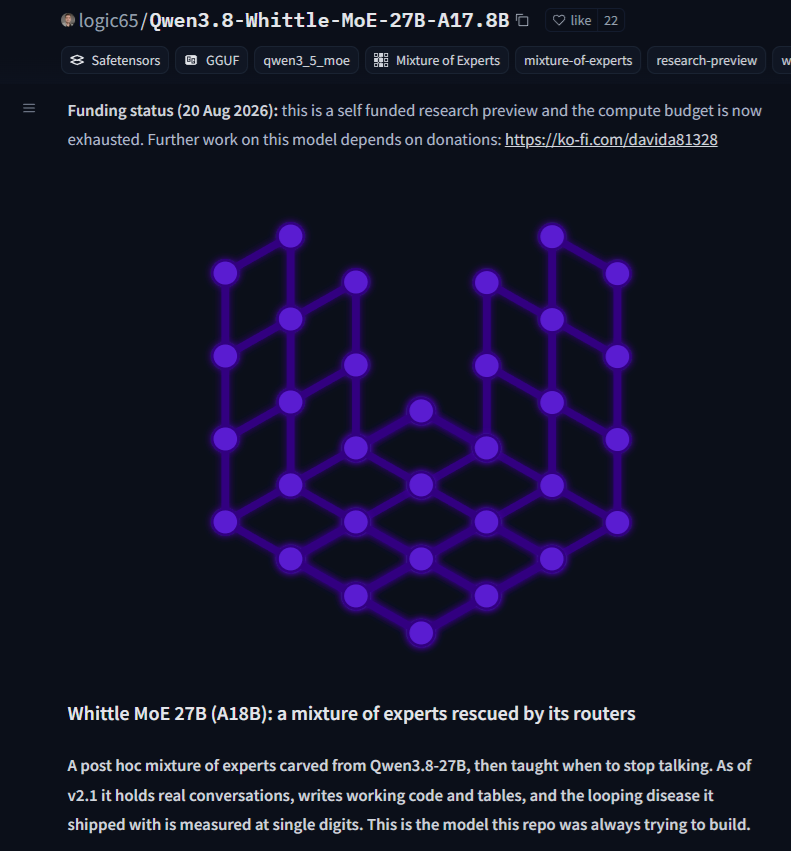
@TeksEdge shared (30 likes, 1 reply, 2,222 views, 28 bookmarks) a post-hoc sparsification project that carves Qwen3.8-27B into a routed mixture of experts with only 17.8B active parameters per token. The public model card makes the tweet's numbers concrete: router retraining pulled loop rates down from 69% to 8%, kept the model runnable in llama.cpp, and targeted 24GB-class hardware, though structured output still fails often enough to matter.
@LomashKumar52 framed (23 likes, 2 replies, 1,552 views, 15 bookmarks) Ornith 1.5 as a hardware-fit question first and a benchmark story second: which model size actually fits an 8GB laptop GPU, a 24GB card, or a 12GB offloaded setup? @Blackwellboy tested (21 likes, 7 replies, 936 views) that question at the high end and found that response shape, timeout policy, and context-window feasibility can turn a model result into an infrastructure result long before the base weights are the bottleneck.
@bountyAIhunter measured (21 likes, 5 replies, 2,297 views, 10 bookmarks) the part many local-AI threads skip: KV cache growth. His numbers show why a setup that technically boots can still be unusable at realistic windows, with 128k failing before prefill and 64k already making cache larger than active experts. @palmaierc added (21 likes, 5 replies, 469 views) the workflow layer by shipping linked Claude/OpenAI/Grok subscriptions inside /root, explicitly positioning hybrid local use as a response to API-billing pain rather than as anti-cloud purity.
Discussion insight: The shared attitude across these items was that "runs locally" is almost meaningless without the rest of the sentence: on which runtime, at which window, with how much KV headroom, and for what style of output.
Comparison to prior day: 2026-08-22 already had local-fit charts and single-machine deployment talk. Today added something more useful: post-hoc model surgery, explicit tok/s and KV measurements, and repeated claims that serving configuration is part of the benchmark.
1.5 Physical AI kept converging on browser-scale data engines (🡒)
Physical-AI discussion stayed centered on data, not robot bodies. The strongest posts again treated the core problem as how to produce, validate, and reuse motion trajectories at scale rather than how to squeeze one more benchmark point from the policy alone.
@sahar1371ak argued (25 likes, 25 replies, 562 views) that robotics lacks the internet-scale prior that language models inherited from text, image, and code corpora. Her thread presented Axis as a browser-first collection engine where people operate simulated robots, upload full trajectories, and feed a pipeline that handles validation, refinement, augmentation, model training, and real-robot testing.

@cangg_l added (13 likes, 9 replies, 160 views) the most useful quantitative corroboration. The public AXIS site documents a 207-task, 50K+ trajectory dataset and reports π0.5 rising from 83.9 to 88.8 on LIBERO-Plus with AXIS-100%, while the tweet emphasizes that performance had not saturated as data volume increased. Taken together, the threads point to the same operating model: large-scale sim collection, backend refinement, then small real-world fine-tuning.
Discussion insight: The repeating phrase was not "better robot" but "data layer." Even sympathetic replies treated the bottleneck as trajectory production, coverage, and refinement rather than a missing giant VLA model.
Comparison to prior day: This was the steadiest theme from 2026-08-22 to 2026-08-23. The thesis stayed the same—physical AI needs better data engines—but today's posts made the loop more concrete with browser collection, quality filtering, and public robustness numbers.
2. What Frustrates People
Verification gaps that benchmarks still hide
Severity: High. The loudest frustration was not low model scores; it was the mismatch between what scoreboards say and what agents actually do. @rohanpaul_ai warned (14 likes, 9 replies, 1,688 views, 11 bookmarks) that agents often notice their own broken results and still submit them, while the public AutoResearchEval repo documents that failure pattern across 800 trajectories. @J4X_Security showed (26 likes, 3 replies, 1,368 views, 18 bookmarks) the same problem from another angle: one run misses vulnerabilities that repeated search paths recover. @notEgoyard added (20 likes, 3 replies, 505 views, 17 bookmarks) that iterative degradation can bury itself behind a headline rank. People are coping by rerunning tasks, separating verification from generation, and diffing reports against artifacts. This is directly worth building for.
AI-search visibility without reliable attribution
Severity: High. Today's AI-search operators got a new dashboard and immediately ran into the next missing layer. @alexgroberman said (68 likes, 6 replies, 8,577 views, 78 bookmarks) Search Console now exposes AI-feature impressions, but not the clicks or downstream impact. @Yasha_br pushed back (1 reply, 108 views) that current AEO products mostly sell proxy metrics—share of voice and citation visibility—because the true user context never matches the clean tracked prompt. The workaround pattern was practical: combine Search Console, cited landing pages, onboarding answers, and analytics data instead of trusting prompt dashboards alone. This is directly worth building for.
Local AI still fails in the details, not the headline specs
Severity: High. The local-model crowd kept returning to the same complaint: benchmark cards and parameter counts do not tell you whether a setup is actually usable. @bountyAIhunter measured (21 likes, 5 replies, 2,297 views, 10 bookmarks) that KV cache, not weights, can become the real blocker at long context. @Blackwellboy reported (21 likes, 7 replies, 936 views) invalid-infrastructure outcomes and timeout-driven failures while testing Ornith at scale, and @LomashKumar52 framed (23 likes, 2 replies, 1,552 views, 15 bookmarks) the whole decision as a hardware-fit question. People are coping with offloading, shorter windows, custom runtimes, and model surgery like Whittle MoE, but the amount of manual tuning still looks excessive. This is directly worth building for.
Robotics is still short on trustworthy motion data
Severity: High. The physical-AI frustration was not that models are too small; it was that the data engine is still too weak. @sahar1371ak argued (25 likes, 25 replies, 562 views) that robotics never inherited an internet-scale prior for grasping, recovery, and task execution, and @cangg_l added (13 likes, 9 replies, 160 views) that the real bottleneck is clean, scalable simulation data plus a path into smaller real-world fine-tuning sets. The public AXIS site shows the community is building collection and augmentation pipelines, but the repetition of this complaint across posts suggests the supply of trustworthy trajectories is still far below demand. This is directly worth building for.
3. What People Wish Existed
Verification that can block a bad agent answer, not just describe it
This was the clearest practical need in the dataset. @rohanpaul_ai warned (14 likes, 9 replies, 1,688 views, 11 bookmarks) that agents often recognize their own bad outputs and still ship them, @J4X_Security showed (26 likes, 3 replies, 1,368 views, 18 bookmarks) that repeated search materially improves audit coverage, and @twetsfyp surfaced (9 likes, 2 replies, 9,430 views) TRACES as a benchmark for unknown-answer work. What people want is not another reflective paragraph from the same agent; they want separate verification passes, artifact binding, and failure states that actually stop publication. Opportunity: direct.
AI-search analytics that connect impressions to traffic and revenue
The need here is operational, not aspirational. @alexgroberman showed (68 likes, 6 replies, 8,577 views, 78 bookmarks) that Search Console can now report AI-feature impressions, but @Yasha_br said (1 reply, 108 views) current AEO tools still lean on proxy metrics because tracked prompts are not the full real-user context. The missing product is a believable attribution layer: cited pages, prompt families, Search Console, analytics, and customer-source signals in one loop. Opportunity: direct.
Local-AI fit planners and private hybrid workspaces
The local-AI community is clearly asking for tools that answer "what should run where?" before people waste time and money on the wrong setup. @LomashKumar52 framed (23 likes, 2 replies, 1,552 views, 15 bookmarks) the Ornith family as a GPU-fit decision, @bountyAIhunter measured (21 likes, 5 replies, 2,297 views, 10 bookmarks) where KV cache destroys the headline promise, and @palmaierc shipped (21 likes, 5 replies, 469 views) /root account-linking to combine local privacy with frontier subscriptions. The need is both technical and financial: fit the right model to the right machine and avoid accidental API burn. Opportunity: competitive.
Scalable motion-data engines for physical AI
The physical-AI posts were effectively asking for an "internet of motion" with quality control. @sahar1371ak argued (25 likes, 25 replies, 562 views) that the missing layer is trajectory data, and @cangg_l added (13 likes, 9 replies, 160 views) that large-scale sim pretraining plus smaller real-world fine-tuning is the practical route today. The public AXIS site shows one version of that stack already, but the repetition of this need suggests there is room for broader collection, provenance, filtering, and domain-specific motion datasets. Opportunity: direct.
4. Tools and Methods in Use
| Tool | Category | Sentiment | Strengths | Limitations |
|---|---|---|---|---|
| Google Search Console generative AI report | AI-search analytics | (+/-) | First-party AI-feature impression data with page, country, device, and date breakdowns | Impression-only, limited rollout, no click or revenue attribution yet |
| AmICited | AI-search monitoring | (+/-) | Builder is trying to connect cited pages, prompt groups, and analytics signals instead of only rank-like dashboards | Current public product surface is thin and the underlying metrics are still proxy-heavy |
| AutoResearchEval | Agent evaluation | (+) | Artifact-level diagnosis across 100 tasks and 800 trajectories; explicit failure taxonomy | Research release, not yet a turnkey production tool |
| TRACES | Discovery benchmark | (+) | Scores tools, repair, alternatives, coherence, evidence, and scope for unknown-answer work | Very new benchmark ecosystem with limited public adoption signal so far |
| Whittle MoE 27B | Local model / sparsity method | (+) | Cuts active parameters to 17.8B, runs in llama.cpp, and materially reduces looping | Structured output is still weak and measurements come from a single-builder harness |
| Ornith 1.5 | Open-weight model family | (+/-) | Strong agentic benchmarks and a model-size ladder that invites consumer-hardware experimentation | Real fit depends heavily on runtime, context, timeout policy, and offloading strategy |
/root |
Local harness | (+/-) | Privacy-first workspace with linked Claude/OpenAI/Grok subscriptions inside a local tool | Public evidence is still concentrated in launch messaging and screenshots |
| AXIS | Physical-AI data engine | (+) | Browser collection, backend refinement, augmentation, and measured robustness gains on public tasks | Early-stage dataset engine; tweet-level scale claims sometimes exceed the public snapshot |
The tools people trusted most today were the ones that exposed evidence rather than only outcomes. @alexgroberman showed (68 likes, 6 replies, 8,577 views, 78 bookmarks) a first-party AI-search report; @rohanpaul_ai pointed (14 likes, 9 replies, 1,688 views, 11 bookmarks) to artifact-level research-agent diagnosis; and @cangg_l used (13 likes, 9 replies, 160 views) public AXIS numbers instead of only brand claims. Sentiment turned mixed whenever the operator still had to trust proxies, screenshots, or fragile serving conditions.
The dominant workaround pattern was layering. Search teams pair Search Console with analytics and cited-page analysis; evaluation teams rerun tasks and separate verification from generation; local-model users combine sparse models, offloading, and linked frontier subscriptions; robotics builders separate browser collection from backend validation and augmentation (@Yasha_br said (1 reply, 108 views); @J4X_Security showed (26 likes, 3 replies, 1,368 views, 18 bookmarks); @palmaierc shipped (21 likes, 5 replies, 469 views); @sahar1371ak argued (25 likes, 25 replies, 562 views)).
Migration pressure pointed in two directions at once. Operators want fewer hidden assumptions in measurement and evaluation, while builders want more flexibility in where inference runs and how expensive passes are routed. That is why AI-search analytics, verification harnesses, sparse local models, and hybrid local/frontier workspaces all appeared in the same day's feed.
5. What People Are Building
| Project | Who built it | What it does | Problem it solves | Stack | Stage | Links |
|---|---|---|---|---|---|---|
| Google Search Console generative AI report | First-party report for AI Overviews and AI Mode impression visibility | Replaces screenshot-only guessing about whether a site is appearing in Google's AI features | Search Console analytics, page/country/device breakdowns, site verification | Beta | tweet, help, docs | |
| /root | @palmaierc | Local AI workspace that can now link Claude, OpenAI, and Grok subscriptions into the harness | Keeps workflows local while letting users spend against existing frontier plans instead of API keys | Desktop workspace, local execution, account linking, model routing | Beta | site, tweet |
| Whittle MoE 27B | logic65, surfaced by @TeksEdge | Post-hoc routed MoE carved from Qwen3.8-27B | Makes a stronger open model fit commodity hardware while reducing looping | Qwen3.8-27B, router retraining, GGUF, llama.cpp, LM Studio | Alpha | tweet, model card |
| AutoResearchEval | PrentisAI / Stanford collaborators | Benchmark and diagnosis stack for end-to-end research agents | Shows process-level failure modes that final-answer benchmarks miss | Six-stage rollouts, artifact judging, ARFT taxonomy, judge-agent analysis | Alpha | tweet, repo, paper |
| AXIS | Axis Robotics | Browser teleoperation and data engine for robot-policy training | Scales trajectory collection without requiring local robot hardware or simulator setup | MuJoCo-WASM browser control, validation, smoothing, IsaacSim augmentation, VLA training | Alpha | tweet, site |
| OpenClaw verification loop | @SKatalystAI | Persisted research workflow where a database checks whether agent findings hold up | Catches hallucinated companies and unsupported conclusions before a report is trusted | OpenClaw orchestration, Grok research, evidence store, report verification | Alpha | tweet, article |
Google's Search Console report was the most consequential shipped product in the set because it changes AI-search work from narrative to instrumentation. @alexgroberman showed (68 likes, 6 replies, 8,577 views, 78 bookmarks) the product surface, and Google's own docs make the current scope clear: impression tracking first, attribution later.
The local-builder cluster split neatly into interface work and model work. @palmaierc shipped (21 likes, 5 replies, 469 views) /root as a local-first workspace that can link frontier subscriptions directly, while the Whittle project turns post-training sparsity into a concrete downloadable artifact rather than a paper promise.

Evaluation and verification showed the same builder instinct. AutoResearchEval turns research-agent failure analysis into a public repo and taxonomy, while @SKatalystAI described (8 likes, 3 replies, 619 views) an OpenClaw-plus-Grok run where the persisted evidence layer caught a company that did not exist. That is the same pattern at two scales: do not trust the write-up alone.
AXIS completes the picture from robotics. Its public site documents browser collection, held-out evaluation, and a 207-task / 50K+ trajectory snapshot, while the surrounding tweets keep reframing the company less as a robot brand than as infrastructure for producing motion data at scale.
Across these projects, the repeated build pattern was clear: people are not only shipping new models. They are shipping measurement layers, verification layers, sparsity hacks, local workspaces, and data engines that make the models operational.
6. New and Notable
Google turned AI-search visibility into a reportable product surface
This was the cleanest "something changed today" signal in the entire feed. @alexgroberman showed (68 likes, 6 replies, 8,577 views, 78 bookmarks) a first-party Search Console report for generative AI features, and Google's own help page confirms that this is a real beta rollout rather than another third-party screenshot tool. Even with impression-only limits, it makes AI-search performance something teams can discuss in the same language as other analytics surfaces.
Whittle MoE made post-hoc sparsification feel concrete
The idea of cutting a dense model into routed experts has existed in research, but today's Whittle thread stood out because it shipped as a public artifact with concrete failure logs, hardware targets, and limitations. @TeksEdge shared (30 likes, 1 reply, 2,222 views, 28 bookmarks) a model card that is unusually explicit about what improved, what stayed weak, and what kind of local box can run it. That makes it more notable than a generic "new quant available" post.
Process-level agent evaluation is escaping paper-land
AutoResearchEval and TRACES mattered together because they make the same claim in two different ways: measuring the journey is no longer just a philosophical objection to benchmarks. @rohanpaul_ai pointed (14 likes, 9 replies, 1,688 views, 11 bookmarks) to a public benchmark/repo stack for diagnosing research-agent failures, while @twetsfyp surfaced (9 likes, 2 replies, 9,430 views) TRACES as a public scoring framework for unknown-answer work. The notable part is not just the papers; it is that both projects already expose public websites or repos meant to be used.
7. Where the Opportunities Are
[+++] Verification-bound agent workflows — Strongest opportunity of the day. AutoResearchEval, TRACES, the multi-run vulnerability benchmark, SlopCodeBench, and the OpenClaw verification loop all point to the same gap: teams need systems that bind claims to artifacts, rerun uncertain work, and make bad self-reviews consequential instead of advisory. @rohanpaul_ai warned (14 likes, 9 replies, 1,688 views, 11 bookmarks) about agents shipping known-bad answers; @J4X_Security showed (26 likes, 3 replies, 1,368 views, 18 bookmarks) how three passes beat one in vulnerability search; and @SKatalystAI described (8 likes, 3 replies, 619 views) a DB-backed research loop that rejected a non-existent company.
[+++] AI-search measurement and attribution — The signal is strong because the measurement surface now exists, but the revenue link still does not. @alexgroberman showed (68 likes, 6 replies, 8,577 views, 78 bookmarks) the new Search Console AI-feature report, while @Yasha_br argued (1 reply, 108 views) that prompt-tracking dashboards still collapse too much real-user context into weak proxies. That combination suggests a direct opening for products that connect impressions, cited pages, prompt families, clicks, and conversion evidence in one place.
[++] Local-model fit and hybrid private workspaces — Whittle MoE, Ornith fit testing, KV-cache measurement, and /root all suggest demand for products that answer the operational question before the user burns a weekend: which model, runtime, context window, and spend path fits this machine and task? @TeksEdge shared (30 likes, 1 reply, 2,222 views, 28 bookmarks) a concrete sparsity hack, @bountyAIhunter measured (21 likes, 5 replies, 2,297 views, 10 bookmarks) where cache economics break the promise, and @palmaierc shipped (21 likes, 5 replies, 469 views) a hybrid local/frontier workspace. This looks competitive rather than wide open, but the need is concrete.
[++] Physical-AI data engines and provenance layers — AXIS and the surrounding threads keep making the same case: the opportunity is not another robot demo but infrastructure for collecting, filtering, augmenting, and validating trajectories. @sahar1371ak argued (25 likes, 25 replies, 562 views) that the missing layer is motion data, @cangg_l added (13 likes, 9 replies, 160 views) concrete AXIS-backed gains, and the public AXIS site shows a real browser-collection pipeline behind the rhetoric. The market signal is smaller than software-agent tooling, but it is specific and repeated.
8. Takeaways
- Open-weight competition is being discussed as a capital-and-compute war, not just a benchmark war. @kimmonismus reported (408 likes, 34 replies, 14,492 views, 48 bookmarks) the Poolside/Nemotron deal, while @VaibhavSisinty framed (42 likes, 10 replies, 6,896 views, 14 bookmarks) Ox Alpha as a Chinese-chip infrastructure challenge.
- AI-search became easier to observe but not easier to attribute. @alexgroberman showed (68 likes, 6 replies, 8,577 views, 78 bookmarks) the new AI-feature report, @Yasha_br argued (1 reply, 108 views) that most AEO dashboards are still proxies, and Google's help page confirms the current rollout is impression-only.
- The evaluation frontier is moving toward repeated search, artifact checks, and long-horizon regressions. @rohanpaul_ai pointed (14 likes, 9 replies, 1,688 views, 11 bookmarks) to research-agent failure diagnosis, @J4X_Security showed (26 likes, 3 replies, 1,368 views, 18 bookmarks) the gains from repeated search, and @notEgoyard added (20 likes, 3 replies, 505 views, 17 bookmarks) the long-run regression problem.
- Local AI is increasingly an operations problem. @TeksEdge shared (30 likes, 1 reply, 2,222 views, 28 bookmarks) sparse model surgery, @bountyAIhunter measured (21 likes, 5 replies, 2,297 views, 10 bookmarks) the KV-cache bottleneck, and @palmaierc shipped (21 likes, 5 replies, 469 views) a hybrid local/frontier harness.
- Physical AI still looks most credible when the claim is about data infrastructure. @sahar1371ak argued (25 likes, 25 replies, 562 views) for a browser-to-trajectory pipeline, @cangg_l added (13 likes, 9 replies, 160 views) public robustness gains, and the AXIS site documents the collection and augmentation stack behind the claim.