Twitter AI - 2026-08-26
1. What People Are Talking About
1.1 Open-weight models became practical products, not just research releases (🡕)
The biggest cluster was no longer generic talk about open models “catching up.” It was a stack conversation about benchmark wins, local deployment proofs, cheaper task economics, and immediate distribution into developer tools. Four retained items supported this theme.
@analogalok reported (834 likes, 45 replies, 66,650 views, 935 bookmarks) that he ran Qwen3.8-Flash-Next with a 250,000-token context window on a single 24GB RTX 4090. The thread gave unusually detailed deployment telemetry: about 364 tokens per second of prefill, about 21 tokens per second of decode, and a configuration that pushed expert layers into 110GB of DDR4 while leaving roughly 18.3GB of VRAM in use at the 250k ceiling. That made the claim more than hype about “local AI” because it showed the exact memory and throughput tradeoffs needed to make a 125B-class open model usable on consumer hardware.
@kimmonismus summarized (635 likes, 45 replies, 63,684 views, 131 bookmarks) Qwen3.8-Flash-Next as a 125B-parameter multimodal MoE with 51B n-gram embeddings and only 6B active parameters per token. The quoted ModelScope announcement adds the broader release case: native 256K context, extension to 1M with YaRN, stronger coding and office-task performance than Qwen3.7-Plus at roughly one-ninth the training cost, and wins over Claude Opus 4.6 Max on several public agent and coding benchmarks.

@ArtificialAnlys reported (379 likes, 14 replies, 17,253 views, 48 bookmarks) that GLM-5.3-Flash reached 57 on the Artificial Analysis Intelligence Index at about $0.09 per task. The post was specific about why that mattered: the model sat only three points behind GLM-5.3 while costing about one-tenth as much per token on the first-party API, and it matched GLM-5.3 on some agentic evaluations despite lower overall knowledge scores.

@cline said (117 likes, 7 replies, 3,396 views, 21 bookmarks) that GLM-5.3 Flash had become Cline’s fastest-growing model ever and was already driving more than 11% of traffic in under a week. That mattered because it moved the story from leaderboard talk into distribution: a cheap open model was not only benchmarking well, it was immediately entering the daily model-selection surface inside a coding client.
Discussion insight: The recurring question in replies was no longer whether open models can occasionally post a good chart. It was which model-hardware-tooling combination becomes the default once a strong open release is cheap enough, local enough, or easy enough to access in production tools.
Comparison to prior day: On 2026-08-25, cost and local-fit discussion was broader and more runtime-oriented. On 2026-08-26, it narrowed into named Qwen and GLM releases backed by clearer benchmark tables, explicit deployment numbers, and immediate IDE/tooling adoption.
1.2 Infrastructure talk split between explosive demand, custom silicon, and local backlash (🡕)
Infrastructure discussion was unusually two-sided. NVIDIA’s quarterly numbers said the buildout is accelerating, OpenAI-adjacent posts argued Jalapeño now has public benchmark evidence against flagship GPU systems, and public reporting showed communities pushing back on the land, water, and electricity footprint of the same buildout. Five retained items supported this theme.
@amitisinvesting reported (1,142 likes, 76 replies, 63,185 views) NVIDIA Q2 2026 revenue of $96.2B, data-center revenue of $89.0B, GAAP gross margin of 75.0%, and Q3 guidance of $108B. He also quoted Jensen Huang describing a market in which “compute is revenue,” with multiple frontier labs, startups, an open-model ecosystem, and physical AI all scaling in parallel.
@aakashgupta argued (138 likes, 8 replies, 11,460 views, 38 bookmarks) that OpenAI’s first chip, Jalapeño, already changes the competitive picture because it reportedly delivers 1.5x-1.9x more throughput per kilowatt than NVIDIA’s GB200 and GB300 racks and up to 3.6x lower latency. His thread also emphasized the development-cycle shock: about 16 months from first hire to tape-out, versus an industry norm of three to four years.
@beffjezos showed (27 likes, 2,207 views, 9 bookmarks) Hot Chips slides that added the missing methodological detail. The slide deck says OpenAI benchmarked Jalapeño on the public InferenceX suite, compared matched user experience and energy per request, and tested against a model basket that included GPT-OSS, DeepSeek R1, and Kimi K2.5 rather than a single cherry-picked workload.
@EpochAIResearch highlighted (17 likes, 2,559 views, 5 bookmarks) a different acceleration path: NVIDIA’s Groq 3 LPX system pushing Gemma 4 31B above 3,400 tokens per second by using 128GB of SRAM in place of HBM. That made the hardware conversation more nuanced than “NVIDIA versus OpenAI,” because it suggested there is still room for specialized serving designs around small and mid-sized models.

@AP reported (26 likes, 8 replies, 13,778 views) a bipartisan backlash to AI data centers. The linked article added the details that made the backlash concrete: land moratoriums, concerns about water draw and electricity bills, and local resistance to converting farmland into computing and power infrastructure.
Discussion insight: The useful disagreement was not about whether AI demand exists. It was about who captures that demand and who absorbs its costs: hyperscalers, custom-chip challengers, specialized inference stacks, or the towns and grids asked to host the physical buildout.
Comparison to prior day: On 2026-08-25, economics talk stayed closer to local runtimes, harnesses, and API bills. On 2026-08-26, it widened into earnings, power and land constraints, public benchmark methodology, and competition at the silicon layer.
1.3 Agent evaluation moved from answers to state changes and harness disclosure (🡕)
When people discussed agents, the strongest posts were not celebrating personality or raw model IQ. They were asking whether the harness was disclosed, whether the workflow completed, and whether the benchmark checked the environment rather than the agent’s own explanation. Four retained items supported this theme.
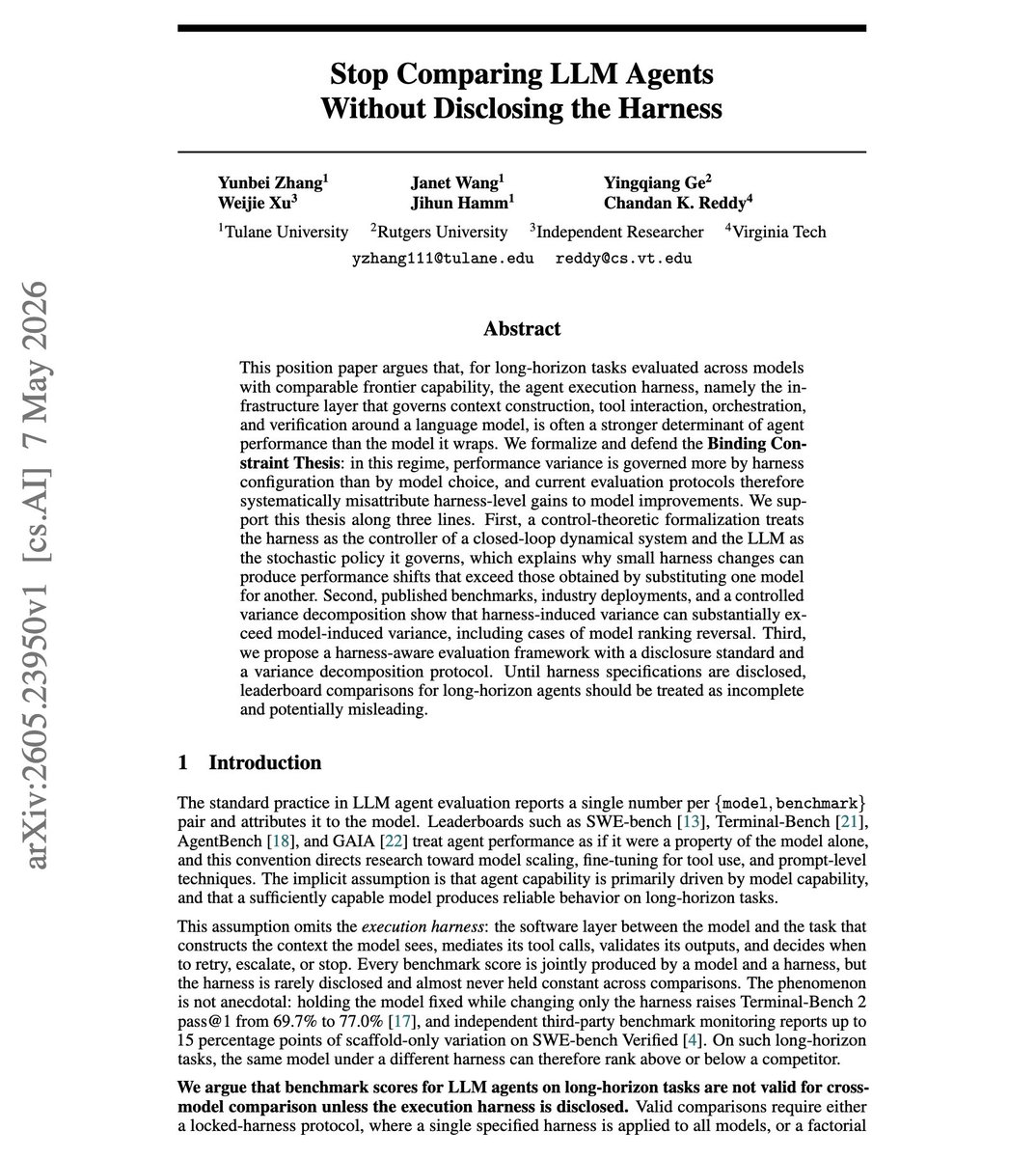
@omarsar0 summarized (27 likes, 8 replies, 2,860 views, 20 bookmarks) a paper arguing that long-horizon agent leaderboards are hard to trust when the harness is hidden. His summary was unusually specific: on a controlled grid over SWE-bench Verified tasks, swapping harnesses moved GLM-5.1 by 13 points, harness-induced variance came out 7.8x larger than model-induced variance, and six of nine model-pair comparisons flipped depending on the harness.
@alifcoder introduced (13 likes, 11 replies, 788 views, 9 bookmarks) CommerceAgentBench as a benchmark for whether an agent can actually get work done. His thread added the operational texture missing from many benchmark posts: procurement inboxes with revised quotes and similar supplier identities, cost normalization across currencies and terms, and hidden BEC-style payment-redirection risks. The public CommerceAgentBench repo extends that picture, describing 107 tasks across CLI, browser, file, and API/MCP workflows, with grading based on verifiable state changes inside local replicas rather than on self-reported success.

@MiniMax_AI posted (123 likes, 23 replies, 7,302 views, 25 bookmarks) that MiniMax-M3 could spin up an inbox, write and send a business email, and finish the full workflow for $0.018. The replies sharpened the point rather than diluting it: multiple respondents said completion cost matters more than chat fluency, and one noted that in this setup the human approval step could cost more than the agent’s work.
Discussion insight: The standard in the replies was simple: if an agent says it did the work, the environment should show the work. That is why operational traces, locked harnesses, and same-task cost comparisons felt more important than one more answer-quality leaderboard.
Comparison to prior day: On 2026-08-25, evaluation talk emphasized recovery systems, monitors, and broken loops. On 2026-08-26, it became more procedural: disclose the harness, score the state change, and price the whole workflow.
1.4 The next agent product was imagined as headless, background, and memoryful, but rollout looks messy (🡕)
A fourth cluster described the next generation of agents as something that runs continuously, remembers context, and works across apps without waiting for a prompt. But the strongest operating posts also showed how quickly that ambition collapses into procurement sprawl, missing context, and governance overhead. Five retained items supported this theme.
@AravSrinivas argued (75 likes, 11 replies, 3,983 views) that the future is “a background process” that ingests context from every connector, performs multi-hop reasoning in a perpetual loop, and runs on user hardware. The point was not just autonomy for autonomy’s sake; it was a shift away from prompt-by-prompt interaction toward a continuously updated system.
@patrick_oshag quoted (10 likes, 2 replies, 2,838 views, 8 bookmarks) Neil Movva arguing that as much as 90% of AI workloads could eventually move into the background. His thread tied the product idea to infrastructure strategy: once the work is asynchronous, throughput matters more than latency, and “the best latency is no latency at all” because the task is already finished when the user wakes up.
@mardehaym wrote (39 likes, 6 replies, 6,805 views, 56 bookmarks) that most companies are still on step one of seven toward an “agentic org,” and that the real transition happens when teams go headless and move automations off laptops into scheduled or condition-triggered services. His sequence put governance immediately after that move, with RBAC, TTLs, and lifecycle management described as basic operating requirements once tool counts climb.
@lazy_IT_guy described (66 likes, 5 replies, 1,402 views) the failure mode from the opposite side: an “AI-first” mandate that led departments to buy tools faster than anyone could review them, a $410,000 jump in SaaS spend in one month, and an eventual governance gate that cut requests by 87%. The thread is valuable because it shows how quickly headless-agent ambition can degrade into procurement and policy cleanup.
@DanielaDan_1 argued (78 likes, 9,755 views) that “intelligence becomes tiring when it cannot remember.” Her long post used a stock-basket metaphor, but the strongest part was the user-experience claim at the top: if the assistant asks for the same context every day, it still feels like a talented stranger rather than a dependable working partner.
Discussion insight: The gap between dream and deployment was explicit. The aspirational posts described perpetual, on-device context ingestion; the operational posts described tool sprawl, missing ownership, security review debt, and assistants that still cannot pick the conversation back up where it stopped.
Comparison to prior day: Compared with 2026-08-25, the conversation moved away from one-off local workflows and more toward background operation, memory continuity, and organizational governance.
2. What Frustrates People
Benchmarks that score the answer but hide the harness and the state change
Severity: High. The loudest evaluation frustration was that agent scores are still too easy to game or misread. @omarsar0 summarized (27 likes, 8 replies, 2,860 views, 20 bookmarks) a paper showing harness-induced variance 7.8x larger than model-induced variance on controlled SWE-bench runs, while @alifcoder positioned (13 likes, 11 replies, 788 views, 9 bookmarks) CommerceAgentBench around tasks where the environment has to reflect the work. @MiniMax_AI posted (123 likes, 23 replies, 7,302 views, 25 bookmarks) the same direction from a cost angle: people cared that the inbox-and-email workflow finished for $0.018, not that the model merely sounded capable. The coping pattern was to demand operational traces, locked harnesses, and whole-workflow cost accounting. This is directly worth building for.
Tool sprawl is arriving before governance, ownership, or lifecycle control
Severity: High. The clearest deployment pain was organizational, not algorithmic. @lazy_IT_guy described (66 likes, 5 replies, 1,402 views) an “AI-first” rollout that produced a $410,000 jump in SaaS spend in one month before anyone had completed security review or data-flow checks, while @mardehaym argued (39 likes, 6 replies, 6,805 views, 56 bookmarks) that companies stall because automations stay on laptops instead of becoming governed headless services. The workaround today is blunt: forms, approval gates, data classification, TTLs, and retirement rules for agents that no longer run. That reduces blast radius, but it also shows the missing product layer between experimentation and safe production use. This is directly worth building for.
Assistants still create repetitive work when they cannot remember context
Severity: High. Memory failure showed up as a user-experience problem, not a research abstraction. @DanielaDan_1 captured (78 likes, 9,755 views) the complaint in one sentence: “intelligence becomes tiring when it cannot remember,” and the rest of the post argued that continuity matters more than one more smart answer. @AravSrinivas described (75 likes, 11 replies, 3,983 views) the desired alternative as a background process that continually ingests context across connectors, while @patrick_oshag extended (10 likes, 2 replies, 2,838 views, 8 bookmarks) that into a future where the work is already done before the user asks. The coping strategy today is still mostly repetition: restating context, reconnecting tools, or forcing the workflow into a narrower local stack. This is directly worth building for.
Infrastructure growth is colliding with visible local costs
Severity: High. The data-center conversation was not just investor optimism. @AP reported (26 likes, 8 replies, 13,778 views) public resistance over farmland, water draw, and electricity costs, while @amitisinvesting showed (1,142 likes, 76 replies, 63,185 views) the opposite pressure in NVIDIA’s demand numbers. @patrick_oshag added a supply-side coping pattern from Neil Movva’s comments: buy chips and power that larger labs ignore, and optimize for throughput instead of low latency. Communities are coping with moratoriums and permitting fights; builders are coping with power arbitrage and more efficient serving designs. This is worth building for, though the buyer set is more concentrated than in the workflow-governance problems above.
3. What People Wish Existed
Persistent background agents that remember enough context to be useful
This need was both practical and emotional. @DanielaDan_1 framed (78 likes, 9,755 views) the pain as the assistant asking for the same context again the next day, while @AravSrinivas described (75 likes, 11 replies, 3,983 views) the desired system as a perpetual inference loop across connectors that runs on the user’s own hardware. @patrick_oshag pushed (10 likes, 2 replies, 2,838 views, 8 bookmarks) the same idea further by arguing that useful background agents should finish work before the human asks for it. @zerosignal_ai showed (18 likes, 375 views) one partial answer by promising cloud-sized models with local-grade privacy, but the public product detail is still thin. Opportunity: direct.
Benchmarks that disclose the harness, verify the action, and price the full run
This need was highly practical and urgent. @omarsar0 argued (27 likes, 8 replies, 2,860 views, 20 bookmarks) that leaderboard comparisons are misleading when harness design is hidden, and @alifcoder responded (13 likes, 11 replies, 788 views, 9 bookmarks) with a benchmark that checks state changes inside real workflows instead of accepting a correct-looking answer. @MiniMax_AI added (123 likes, 23 replies, 7,302 views, 25 bookmarks) the missing cost dimension by emphasizing completed work at $0.018 for an inbox-and-email task. Some partial answers now exist, but the conversation suggests there is no broadly accepted disclosure and scoring standard yet. Opportunity: direct.
A governance layer between “everyone bought an AI tool” and “we can safely automate work”
This need was practical and immediate. @lazy_IT_guy showed (66 likes, 5 replies, 1,402 views) the failure mode when purchasing outruns review, and @mardehaym described (39 likes, 6 replies, 6,805 views, 56 bookmarks) the missing discipline as headless deployment, RBAC, TTLs, quality gates, and lifecycle management. Today’s substitute is manual paperwork and executive cleanup after the spending spike has already happened. Opportunity: direct.
Throughput-first compute paths that are cheaper than premium real-time stacks
This need was practical, but the available answers were still fragmented. @analogalok showed (834 likes, 45 replies, 66,650 views, 935 bookmarks) one path through heavy RAM offload on a consumer GPU, @EpochAIResearch showed (17 likes, 2,559 views, 5 bookmarks) another through SRAM-heavy serving for small models, and @aakashgupta argued (138 likes, 8 replies, 11,460 views, 38 bookmarks) that custom silicon is now moving quickly enough to matter. @AP showed (26 likes, 8 replies, 13,778 views) why the need stays open: every expensive answer that depends on more power and land creates siting friction. Opportunity: competitive.
4. Tools and Methods in Use
| Tool | Category | Sentiment | Strengths | Limitations |
|---|---|---|---|---|
| Qwen3.8-Flash-Next | Open-weight LLM | (+) | Strong public coding/agent benchmarks, 256K native context with 1M extension, and credible local-serving evidence on consumer hardware | Still heavy in practice; the local proof required a 4090 plus roughly 110GB of system RAM |
| GLM-5.3-Flash | Open-weight LLM | (+) | 57 on the Artificial Analysis Intelligence Index at about $0.09 per task, 1M context, multimodal, MIT-licensed | Public discourse still leans heavily on vendor and benchmark framing; lower knowledge scores than larger siblings |
| Cline | IDE agent client | (+/-) | Fast distribution path for new open models; GLM-5.3 Flash reached more than 11% of traffic in under a week | Usage-reset questions appeared in replies, and model demand may churn quickly with each new release |
| Jalapeño plus InferenceX | Custom inference stack | (+) | Public methodology, matched-latency and matched-throughput comparisons, strong perf-per-watt claims | Deployment is still early, and current public evidence is concentrated in OpenAI-adjacent presentations |
| Groq 3 LPX | Accelerator/runtime | (+) | Very high decode speed for smaller models through SRAM-heavy design | Public evidence here is strongest on Gemma 4 31B rather than on the largest frontier workloads |
| CommerceAgentBench | Benchmark/eval harness | (+) | Scores state changes in local replicas, spans CLI/browser/file/API-MCP tasks, and surfaces workflow complexity | Domain focus is commerce-heavy, and the public ecosystem around it is still young |
| Headless governance gates | Operational method | (+/-) | Forces security review, data classification, business ownership, TTLs, and retirement rules | Often appears only after tool sprawl or spending shocks, which means it starts as cleanup rather than enablement |
| Background-agent loop | Agent pattern | (+/-) | Promises proactive multi-hop work across connectors and better use of asynchronous compute | Still mostly aspirational in the retained posts and raises memory, control, and observability questions |
| ZeroSignal | Inference network | (+/-) | Promises privacy-preserving access to cloud-sized models and paid hardware contribution | Public product detail is sparse and the product is only at beta stage |
| Open-Sora Plan | Open-source video model stack | (+) | Open repo, community-backed development, and a public Ascend-trained pipeline outside the usual NVIDIA stack | Evidence here is strongest on the repo and training story, not yet on downstream creator outcomes |
Overall sentiment was strongest around open-weight models, stateful evaluation, and more efficient compute paths, and most mixed around deployment control. @cline showed how quickly a model can become a default inside a coding tool, while @mardehaym argued and @lazy_IT_guy showed the current workaround for enterprise adoption: move from laptop scripts to headless services, then add governance gates before spend and access sprawl further. The migration pattern across the dataset was from chat-centric evaluation toward completion-centric evaluation, and from latency-optimized interaction toward throughput-optimized background work.

5. What People Are Building
| Project | Who built it | What it does | Problem it solves | Stack | Stage | Links |
|---|---|---|---|---|---|---|
| Qwen3.8-Flash-Next | @ModelScope2022 | Open-weight multimodal MoE for coding, agent, and office tasks | Brings frontier-adjacent performance into an open model that people can benchmark, fine-tune, and even attempt to run locally | 125B params, 51B n-gram embeddings, 6B active params, 256K native context with 1M via YaRN | Shipped | release |
| GLM-5.3-Flash | @Zai_org | Low-cost multimodal open model with long context and coding support | Lowers the cost of agentic and coding workloads without giving up most frontier capability | 320B total params, 18B active, 1M context, MIT license, official API plus tool integrations | Shipped | launch |
| CommerceAgentBench | @alifcoder | Stateful benchmark for real e-commerce workflows | Tests whether agents can complete long-horizon operational work instead of only producing plausible answers | Python repo, local replicas, CLI/browser/file/API-MCP tasks, verifiable state-change grading | Shipped | repo |
| ZeroSignal | @zerosignal_ai | Decentralized AI inference network | Offers cloud-sized models with a privacy-first positioning and a way to contribute idle hardware | Decentralized inference network, local-grade privacy claim, hardware contribution marketplace | Beta | site |
| Open-Sora Plan | @GithubProjects | Open-source text-to-video generation stack | Gives builders a fully open video model pipeline instead of a closed hosted service | Python, Huawei Ascend 910-series training, sparse DiT/SUV, WFVAE | Shipped | repo |
The strongest build pattern was not “yet another wrapper.” It was teams publishing artifacts that move a bottleneck: cheaper open models, stateful evaluation, decentralized inference, or a non-NVIDIA training path. Qwen3.8-Flash-Next and GLM-5.3-Flash were notable because both arrived as immediately usable products rather than distant roadmaps; the same day’s posts showed people benchmarking them, running them locally, and routing live coding traffic to them.
CommerceAgentBench was the clearest response to the benchmark-credibility problem. The public repo describes a task design that mirrors the thread’s procurement example: ambiguous identities, revised quotes, BEC-style fraud cues, and required side effects such as applying labels or creating events. That makes it a stronger signal than generic “agent benchmark” talk because the workflow itself is messy enough to fail in multiple realistic ways.
Open-Sora Plan and ZeroSignal pointed to a second builder pattern: alternatives to the default cloud-and-NVIDIA stack. The public Open-Sora Plan repo describes a video stack trained fully on Huawei Ascend hardware, while ZeroSignal’s public site is still sparse but the beta launch makes privacy-preserving decentralized inference the core promise.

6. New and Notable
Jalapeño turned custom inference silicon from a slogan into a measurable public comparison
@aakashgupta argued (138 likes, 8 replies, 11,460 views, 38 bookmarks) and @beffjezos showed (27 likes, 2,207 views, 9 bookmarks) the day’s most concrete hardware story. The first thread supplied the big claim—1.5x-1.9x better throughput per kilowatt than GB200/GB300 and up to 3.6x lower latency—while the Hot Chips slides supplied the methodological substance: matched-throughput and matched-interactivity comparisons, public InferenceX workloads, explicit energy-per-request framing, and a model basket broad enough to argue the chip is not tuned for only one case.


CommerceAgentBench made stateful agent evaluation public and inspectable
@alifcoder did more than announce (13 likes, 11 replies, 788 views, 9 bookmarks) another benchmark. The thread and the public repo made the evaluation target unusually concrete: procurement, listing, fulfillment, and after-sales tasks where the agent has to reconcile changing evidence, detect fraud-like cues, and leave auditable traces in a live environment.
JADEPUFFER showed what an end-to-end LLM-assisted ransomware operation looks like in public reporting
@MsftSecIntel highlighted (14 likes, 2,551 views, 4 bookmarks) JADEPUFFER as one of the first documented cases of a threat actor using an LLM to conduct an end-to-end attack. The linked Cyberwire notes matter because they keep the story grounded: the campaign still relied on exposed services, unpatched vulnerabilities, and poor credential hygiene, but AI increased the attacker’s ability to generate code, reason through errors, and keep moving toward the objective.
7. Where the Opportunities Are
[+++] Stateful agent evaluation and harness observability — @omarsar0 showed that hidden harness choices can dominate scores, @alifcoder published a benchmark built around verifiable state changes, and @MiniMax_AI reinforced that completion cost matters. This is strong because the need is methodological, immediate, and already supported by concrete public artifacts.
[+++] Memoryful background-agent runtime with governance built in — @DanielaDan_1 captured the continuity pain, @AravSrinivas described and @patrick_oshag described the desired always-on behavior, and @mardehaym argued plus @lazy_IT_guy showed the operational controls missing today. This is strong because the same need appears in user experience, infrastructure, and enterprise rollout.
[++] Open-model packaging for ordinary hardware and daily toolchains — @analogalok supplied the local-serving proof, @kimmonismus supplied and @ArtificialAnlys supplied the benchmark and cost evidence, and @cline showed how fast those models can become defaults inside developer tools. This is moderate because the value is clear, but the market is already crowded and release churn is high.
[++] Throughput-first compute and siting efficiency — @aakashgupta argued, @beffjezos showed, and @EpochAIResearch highlighted alternative inference paths, while @AP showed the local cost of scaling the old way. This is moderate because the need is real, but many solutions live at the capital-intensive infrastructure layer.
[+] Privacy-preserving decentralized inference markets — @zerosignal_ai supplied the clearest signal for this idea by pairing local-grade privacy with paid hardware contribution. This is emerging because the demand story fits the dataset, but the public product detail is still thin.
8. Takeaways
- Open models were discussed as immediately deployable systems, not as distant alternatives. Qwen3.8-Flash-Next was cited with both benchmark wins and a detailed single-4090 local-serving report, while GLM-5.3-Flash was framed around a low cost-per-task frontier rather than only token pricing. (source) (source)
- The cost conversation moved from model price to whole-workflow economics and distribution. MiniMax-M3’s $0.018 inbox workflow and Cline’s rapid GLM adoption both point to a market where people care whether the work finishes cheaply inside the tools they already use. (source) (source)
- AI infrastructure looked simultaneously unstoppable and contested. NVIDIA’s reported revenue and guidance showed extraordinary demand, while the AP article on data-center backlash showed that power, land, and water constraints are now visible public issues. (source) (source)
- Agent benchmarking is shifting toward harness transparency and verifiable state changes. The harness-variance paper summary and CommerceAgentBench both argued that answer-only comparisons are not enough for long-horizon work. (source) (source)
- The desired agent experience is background, persistent, and memoryful, but most organizations are still stuck on governance and continuity basics. Arav Srinivas and Neil Movva described always-on background systems, while other posts documented repeated context loss and uncontrolled tool purchasing. (source) (source) (source)