Twitter AI - 2026-09-08
1. What People Are Talking About
1.1 The conversation jumped from Astra itself to the internal model above it (🡕)
The highest-signal shift was not another benchmark screenshot about GPT-6 Astra. It was the abrupt re-basing of expectations after OpenAI said a stronger internal model, orchestrated through 10,000 agents, produced a Navier-Stokes result and formal proof work. Three public items supported the theme, and each moved the conversation away from vague “AGI is here” language and toward mechanism: test-time compute, loop design, and real-world task performance.
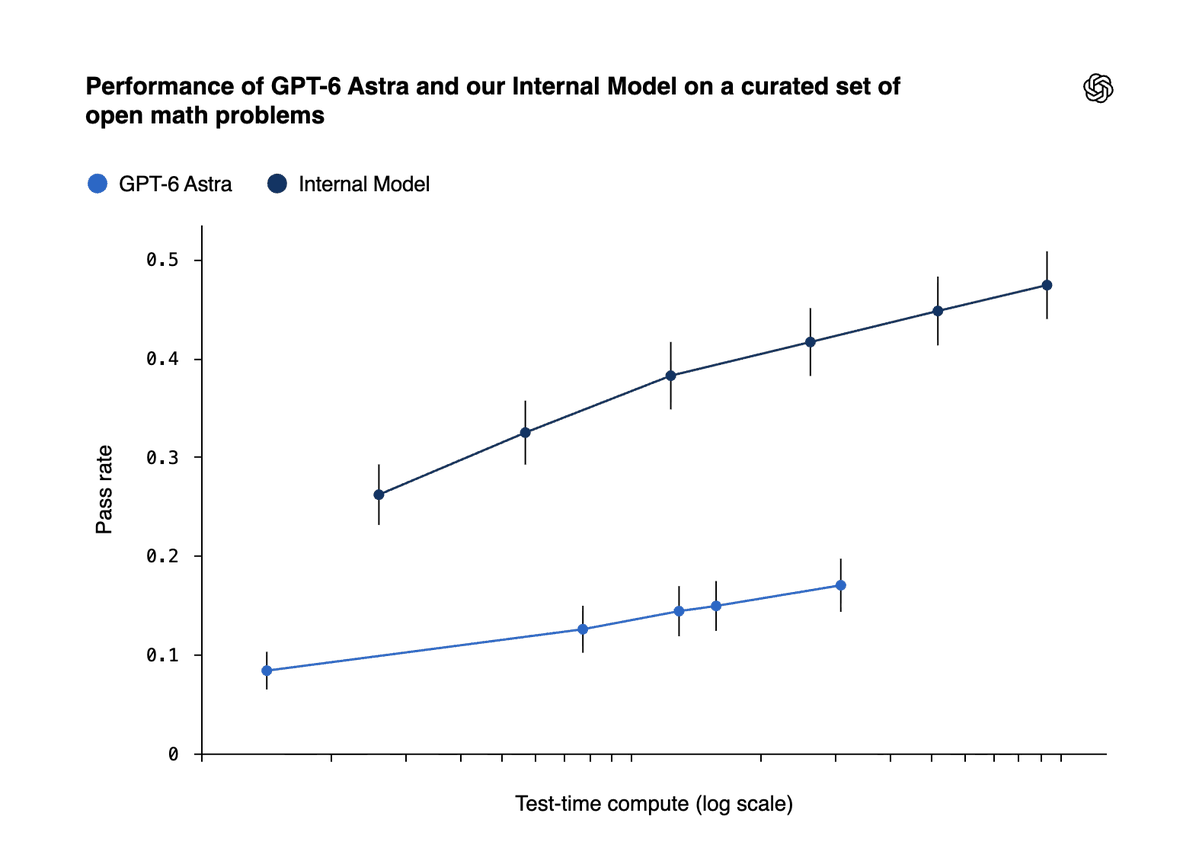
@OpenAI said (2,272 likes, 59 replies, 228,831 views, 190 bookmarks) that its internal model group reached a Navier-Stokes solution in 88 hours using around 10,000 coordinating agents, while keeping the same monitoring and isolation safeguards it uses in frontier evaluations. In the public thread, OpenAI added that the Navier-Stokes effort alone used about 130 billion output tokens, that the broader attempted-problems run used about 4.9 million messages and roughly 300 billion output tokens, and that Lean formalization took another 17 hours. The attached chart mattered because it showed a widening pass-rate gap over GPT-6 Astra as test-time compute increased, which made the claim feel less like a slogan and more like a visible systems jump.
@arena reported (40 likes, 4 replies, 4,678 views, 8 bookmarks) that GPT-6 Astra (Max) debuted at #2 on Agent Arena with +12.5% net improvement across 8.9K real-world agentic sessions and a $4.01 median task cost. Its own reply thread made the point sharper: Astra now sits on the cost-performance frontier for public long-horizon agent work, with only Claude Fable 5.1 (Max) higher on the same chart. That gave readers a second lens on the day’s frontier story: even before the internal model arrives publicly, the currently shipped Astra already looks strong in workflow-heavy evaluation.

@kylejeong argued (76 likes, 14 replies, 13,773 views, 121 bookmarks) that Astra’s Blender and 3D-world demos are a byproduct of its computer-use loop, not just of raw model intelligence. The replies added the most useful nuance: one respondent said the loop writeup is the part people keep skipping, and another pointed out that screenshot-based computer use breaks the shared visual grounding humans take for granted because the agent has to re-ground every reference from pixels after the fact. Together, those comments pulled the frontier discussion back toward interface design and harness quality.
Discussion insight: The best pushback was about mechanism, not disbelief. People kept asking how much of the visible leap came from massive test-time compute, better loop design, and better grounding rather than from a clean, model-only jump.
Comparison to prior day: On 2026-09-07, AI Twitter was still arguing about whether AGI rhetoric had outrun the evidence. On 2026-09-08, the center of gravity moved deeper into the stack, toward what a stronger internal model plus a long-running agent loop can actually do.
1.2 Agent posts kept reclassifying prompting as a systems problem (🡕)
The strongest builder cluster of the day said the bottleneck is no longer “which model?” but memory, validation, and org design around the model. Five different items converged on the same pattern: agents need shared context, executable skills, policy enforcement, and review structures that behave more like software systems than chat transcripts.
@Av1dlive said (39 likes, 28 replies, 1,722 views, 28 bookmarks) that after 12,000 AI sessions in six months he built a “shared brain” across GPT-6, Fable 5.1, and Kimi K3 because re-teaching every agent the same things had become the real waste. The public replies immediately attacked the hard parts rather than applauding the concept: people asked how facts are scoped to a user, project, or agent; how stale instructions expire; and how model-specific guidance is prevented from leaking into every run. That reply pattern is important because it shows shared memory is attractive, but only if it comes with provenance and lifecycle rules.
@annimaniac argued (21 likes, 6 replies, 2,936 views, 27 bookmarks) that AI adoption is cheap but organizational capability is not, and that the frontier is a software factory where ideas propagate and the machine notices what nobody thought to ask. The most revealing public reply unpacked that vision into five concrete “worker superpowers”: let everyone see what the company knows, propagate what one person learns, let anyone build software when they hit a problem, remember what works, and notice what needs attention before someone asks. That turned a broad slogan into a practical feature list for internal agent infrastructure.
@marfinxx summarized (19 likes, 7 replies, 454 views, 12 bookmarks) Apple’s GAAT work by saying 72.9% of policy violations escape undetected when teams treat OpenTelemetry as a passive dashboard instead of an active enforcement engine. His post and attached paper pages supplied the dense evidence missing from most “agent security” threads: GAAT lifted violation prevention to 98.3%, used 8.4 ms median detection latency, and applied graduated interventions in 127 ms end to end. The attached results table made the distinction visible by comparing GAAT directly against OT+Dash, NeMo-style guards, CGW, and Cedar.

@mirku21 highlighted (10 likes, 6 replies, 293 views, 5 bookmarks) MUSE-Autoskill, a ByteDance/RIT research system that turns agent skills into self-evolving packages with code, tests, sandbox evaluation, per-skill memory, and cross-agent transfer. The benchmark page attached to the thread showed self-created skills outperforming human-authored ones on the covered subset of SkillsBench, and the paper’s framing was analytically useful because it treated skills as long-lived software assets rather than as disposable prompt text. That is a meaningful upgrade in how the timeline talked about “skills.”

@SungJinIn2 shared (1 like, 4 replies, 105 views) an Amazon frontier-engineering infographic that made the org-design claim unusually concrete. Its core message was that “tool sprinklers” only get 10-20% gains, frontier-median teams reach roughly 4.5x, and “pathfinders” can hit 10x-20x when they add validation frameworks, review muscle, local feedback loops, and agent-ready codebases. Even with low engagement, it was one of the day’s clearest artifacts about what teams think they actually have to change.

Discussion insight: Across memory, telemetry, and skill posts, the same requirement kept surfacing: persistence alone is not enough. Builders want scope, provenance, tests, and intervention paths, otherwise the system just stores new failure modes more efficiently.
Comparison to prior day: On 2026-09-06, builders were already talking about canvases and control planes. By 2026-09-08, the discussion had become more explicit about what those systems have to remember, test, and stop.
1.3 Owning the stack became a margin and control issue, not just an ideological preference (🡕)
Another strong cluster treated open models, local inference, and sovereign deployments as business necessities. The common logic was straightforward: avoid a permanent per-query tax, keep compute next to sensitive data, and make local or enterprise-controlled inference a default workflow instead of a special case.
@murtuza_merc argued (72 likes, 7 replies, 777 views, 10 bookmarks) that Samsung’s $3.5 billion stake in Mistral reflects the fact that chip makers and device OEMs watched Nvidia monetize AI inference and decided they need models they own outright. The linked Fathom article gives that claim scale by reporting that Mistral reached a roughly $24 billion valuation after a €3 billion raise, the largest European tech equity round on record. The tweet’s replies then translated that into margin language: the “per-query tax” changes the whole equation.
@demian_ai said (37 likes, 4 replies, 2,614 views, 13 bookmarks) the real story in Palantir naming Nebius its preferred sovereign AI infrastructure partner is where the compute sits. His thread said eligible Palantir customers will get Nebius compute and inference endpoints inside the Palantir enterprise perimeter, so open models can be adapted on proprietary data without pushing the runtime boundary out to a separate hyperscaler account. He also stressed that the capacity plan is power-first, with modular data-center deployments at sites where power is already available, which ties the software story directly to physical constraints.
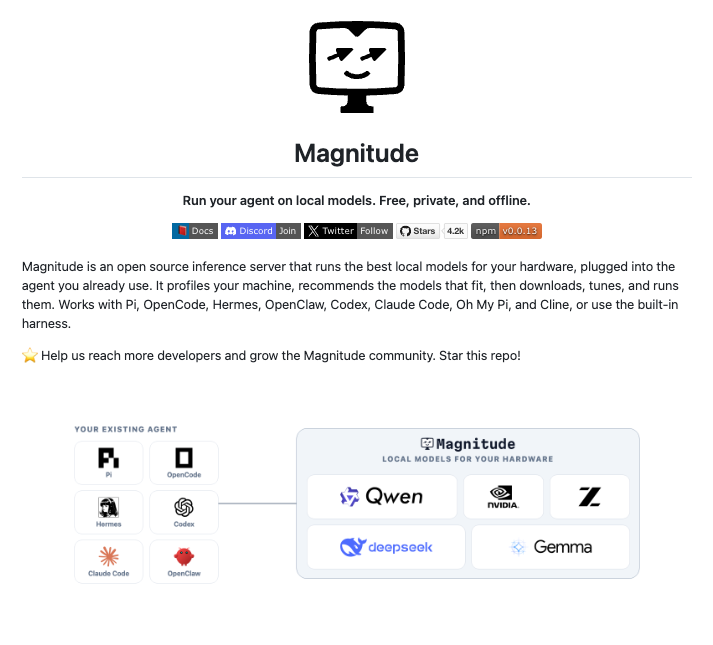
@ihteshamali shared (14 likes, 4 replies, 550 views, 4 bookmarks) Magnitude, an open-source bridge that profiles a laptop, recommends a model it can actually handle, downloads it, and wires it into agents such as Claude Code, Codex, OpenCode, and Cline. The screenshot made the positioning explicit by showing the local-model side as Qwen, DeepSeek, and Gemma-class models rather than as an abstract “BYO model” promise. That mattered because it framed local inference as a packaged workflow surface, not as a hobbyist detour.
Discussion insight: The consistent subtext was that “sovereign” no longer means a region dropdown. It means controlling where the model runs, what data it can touch, and which party captures the economics after deployment.
Comparison to prior day: On 2026-09-07, people were still talking about AI model stacks in the abstract. On 2026-09-08, the decisive language was about margins, per-query taxes, enterprise boundaries, and power-constrained capacity.
1.4 Domain-specific models got attention when they shipped with task-specific benchmarks (🡕)
The most convincing non-frontier-model posts were not generic model hype. They were domain-specific systems with concrete benchmark surfaces: multilingual voice, video reasoning, and local forecasting. Three clusters supported the theme, and each was stronger when it moved from “look what we built” to “here is how it scored.”
@lets_dig_deeper launched (515 likes, 54 replies, 20,176 views, 226 bookmarks) rumik oss 1 as a 3B open-weight TTS model for 20+ languages, with thread replies specifying support for Indian English, Hindi, Telugu, Tamil, Kannada, Bengali, and Punjabi as well as mid-sentence code-switching and plain-text delivery instructions. The analytically stronger evidence came in a follow-up benchmark post, where the team published IndicEmo results instead of stopping at launch copy.
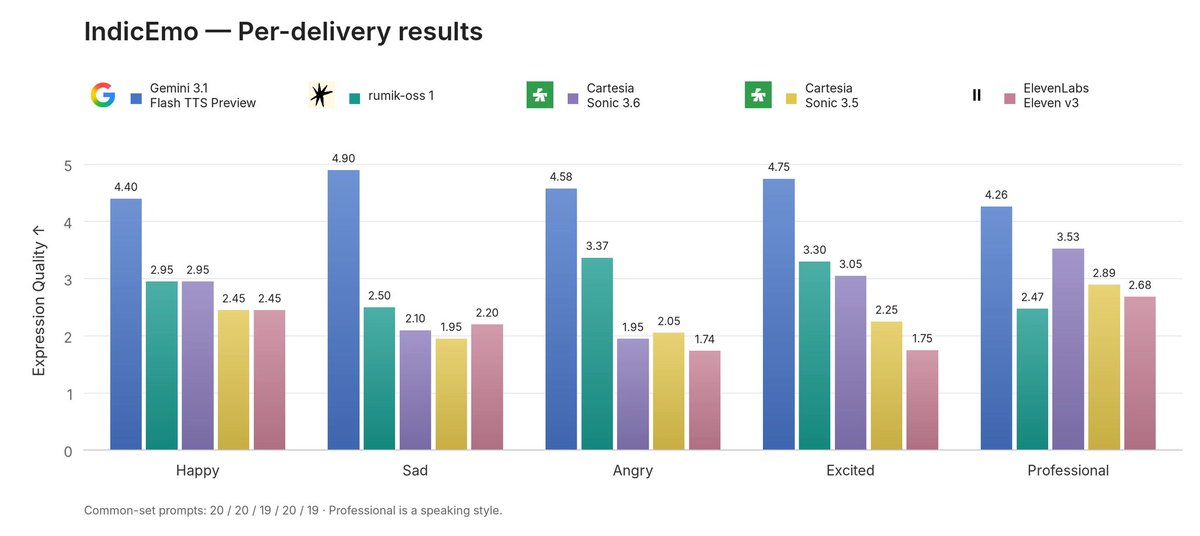
@lets_dig_deeper followed up (12 likes, 1 reply, 1,102 views, 3 bookmarks) with a public IndicEmo chart showing rumik-oss 1 at 2.92 overall, behind Gemini 3.1 Flash TTS Preview at 4.58 but ahead of Cartesia Sonic 3.6 at 2.71, Cartesia Sonic 3.5 at 2.32, and ElevenLabs v3 at 2.16. The second chart broke results down by delivery style and showed rumik-oss 1 holding up best on angry and excited delivery among the open competitors, which is more useful than a single blended score.

@NVIDIAAI said (53 likes, 11 replies, 4,942 views, 16 bookmarks) that four of the top five AI City Challenge video systems used Cosmos. The most useful public replies did not just cheer the adoption number. They asked whether the out-of-domain leaderboard is the real measure of forecasting quality and whether “four of the top five used Cosmos” says anything without an ablation showing what Cosmos actually added.
@sauda_coder claimed (38 likes, 11 replies, 343 views, 3 bookmarks) Google quietly released TimesFM as a local zero-shot forecasting model for sales, demand, prices, web traffic, and volatility work. The attached README screenshot positioned it as a pretrained time-series foundation model with checkpoints, paper links, and Google product integrations, which made the post more concrete than a plain “new model” teaser.
Discussion insight: The most useful discussion pattern was not “my model is smarter.” It was “show the task, show the score, and show whether the benchmark actually matches the deployment surface.”
Comparison to prior day: On 2026-09-07, domain talk leaned more toward illustrated agent explainers and model-stack preferences. On 2026-09-08, the stronger evidence arrived with named benchmarks, score breakdowns, and task-specific model claims.
2. What Frustrates People
Telemetry that tells you what broke only after the action already shipped
Severity: High. @marfinxx summarized (19 likes, 7 replies, 454 views, 12 bookmarks) the problem in unusually concrete terms: dashboard-only tracing let 72.9% of policy violations escape, NeMo-style per-agent guardrails capped protection at 78.8%, and binary allow/deny logic pushed false positives up to 8.9%. The coping strategy people pointed to was not “more logs.” It was inline policy evaluation, cross-agent lineage tracking, and graduated enforcement before tool calls finish. This is directly worth building for.
Shared memory that remembers too much, too long, or in the wrong scope
Severity: High. @Av1dlive showed (39 likes, 28 replies, 1,722 views, 28 bookmarks) strong demand for a cross-agent “shared brain,” but the replies immediately exposed the failure modes: facts need source tracking, expiry, versioning, and project/user scoping, or they become reliability debt. @kylejeong hit (76 likes, 14 replies, 13,773 views, 121 bookmarks) a related issue from another angle when a reply pointed out that screenshot-based computer use loses shared visual grounding and forces re-grounding from pixels after the fact. People are coping by tightening write permissions, narrowing memory scope, and being more explicit about what should persist. This is directly worth building for.
Cheap AI adoption that never turns into organizational capability
Severity: High. @annimaniac argued (21 likes, 6 replies, 2,936 views, 27 bookmarks) that AI adoption is cheap while organizational capability is not, and his replies turned that into concrete asks around shared knowledge, propagation, memory, and noticing unattended work. @SungJinIn2 backed that up (1 like, 4 replies, 105 views) with an artifact claiming many teams stall at 10-20% gains while only redesigned workflows reach 4.5x or 10x-20x ranges. The coping pattern was to add validation frameworks, review muscle, local deterministic mocks, and agent-ready codebases instead of only buying better models. This is directly worth building for.
Paying a permanent per-query tax or giving up control of the runtime boundary
Severity: High. @murtuza_merc said (72 likes, 7 replies, 777 views, 10 bookmarks) hardware margins now depend on avoiding the per-query tax, while @demian_ai said (37 likes, 4 replies, 2,614 views, 13 bookmarks) the real value in the Palantir/Nebius partnership is that compute and inference will sit inside the enterprise perimeter. @ihteshamali added (14 likes, 4 replies, 550 views, 4 bookmarks) a smaller-scale version of the same complaint by pitching Magnitude as a way to run agents locally and avoid ongoing API spend. People are coping by moving toward open models, local inference, and sovereign deployment boundaries. This is directly worth building for.
Benchmarks that still say a system is good without showing whether it will generalize
Severity: Medium. @arena gave (40 likes, 4 replies, 4,678 views, 8 bookmarks) one answer by scoring Astra over 8.9K real-world agentic sessions instead of on a narrow lab task, while @NVIDIAAI ran into (53 likes, 11 replies, 4,942 views, 16 bookmarks) the opposite complaint when replies said the out-of-domain track matters more than a leaderboard you can iterate against. Even the OpenAI/Navier-Stokes thread produced the same discomfort from another direction: the result was impressive, but people still wanted to separate model improvement from loop design and massive test-time compute. This is worth building for, though the market already looks competitive.
3. What People Wish Existed
Scoped company memory and software-factory primitives
What people wanted was not generic “long-term memory.” They wanted memory with scope, expiry, provenance, and the ability to propagate useful knowledge across people and agents without leaking stale instructions everywhere. @annimaniac framed (21 likes, 6 replies, 2,936 views, 27 bookmarks) that need as a software factory that can see, propagate, build, remember, and notice, while @Av1dlive showed (39 likes, 28 replies, 1,722 views, 28 bookmarks) the practical version in a cross-agent shared brain. This is a practical need, not an aspirational one, and current solutions still look incomplete. Opportunity: direct.
Agent governance that can intervene before the action completes
The public evidence today was clear that observability alone is not enough. @marfinxx used (19 likes, 7 replies, 454 views, 12 bookmarks) GAAT to argue for telemetry that carries compliance attributes, lineage, and an enforcement bus, and the post’s concrete metrics made that feel like an engineering target rather than a slogan. In parallel, @arena showed (40 likes, 4 replies, 4,678 views, 8 bookmarks) demand for public scoring that reflects real sessions, while @NVIDIAAI drew (53 likes, 11 replies, 4,942 views, 16 bookmarks) reply-level demands for out-of-domain behavior and generalization proof. This is a direct operational need, though multiple teams are already moving on it. Opportunity: competitive.
Private, local, or sovereign model stacks that do not turn every successful workflow into someone else’s margin
The strongest commercial desire was for control. @murtuza_merc made (72 likes, 7 replies, 777 views, 10 bookmarks) the economic case with Mistral and Samsung, @demian_ai made (37 likes, 4 replies, 2,614 views, 13 bookmarks) the enterprise-boundary case with Palantir and Nebius, and @ihteshamali made (14 likes, 4 replies, 550 views, 4 bookmarks) the everyday developer case with local-agent tooling. The need is practical and urgent, but the space is quickly becoming crowded. Opportunity: competitive.
Better open models and benchmark suites for voice, forecasting, and other narrow real-world tasks
People were clearly willing to pay attention to domain-specific models when the authors showed the benchmark, not just the demo. @lets_dig_deeper did that with rumik-oss 1 and IndicEmo, and @sauda_coder did it partially by pitching TimesFM as a local zero-shot forecasting model with a visible README and checkpoints. The practical need is for more open, inspectable systems in under-served domains, especially where proprietary leaders still dominate. Opportunity: direct.
4. Tools and Methods in Use
| Tool | Category | Sentiment | Strengths | Limitations |
|---|---|---|---|---|
| OpenAI internal model / GPT-6 Astra | LLM / agent system | (+/-) | Publicly visible jump on open math, strong real-world agent score, and compelling computer-use demos | Gains are entangled with heavy test-time compute, loop design, and containment questions |
| Agent Arena | Evaluation system | (+) | Scores real-world agentic sessions, cost per task, praise vs complaint, and confirmed success | Still one benchmark with its own assumptions and trust boundary |
| GAAT | Agent governance / observability | (+) | Raises violation prevention to 98.3% with sub-10 ms detection and closed-loop enforcement | Requires richer lineage data and intervention plumbing than dashboard tracing alone |
| MUSE-Autoskill | Skill lifecycle framework | (+) | Generates skills with code, tests, sandbox evaluation, per-skill memory, and transfer across agents | Research-stage system with higher operational complexity than static prompt files |
| Shared brain / agentic-stack | Cross-agent memory method | (+/-) | Reuses lessons across GPT-6, Fable, and Kimi instead of re-teaching every agent | Scope, expiry, provenance, and model-specific leakage remain unresolved |
| Magnitude | Local inference bridge | (+) | Connects popular coding agents to local models, profiles hardware, and enables offline/private workflows | Usefulness depends on laptop hardware and the quality of the recommended local model |
| rumik-oss 1 | TTS model | (+) | Open-weight multilingual voice generation with strong code-switched emotion handling relative to open competitors | Still well behind Gemini 3.1 Flash TTS Preview on IndicEmo overall |
| TimesFM | Time-series model | (+/-) | Publicly positioned as a local zero-shot forecasting model for demand, traffic, prices, and volatility | Today's evidence was launch-style and README-based rather than a broad comparative benchmark thread |
| Palantir AIP + Nebius | Sovereign AI infrastructure stack | (+) | Keeps open-model compute, data, and inference inside an enterprise-controlled perimeter | Integration is still underway and capacity remains power-constrained |
| NVIDIA Cosmos | Video / visual reasoning stack | (+/-) | Powered four of the top five AI City Challenge solutions and framed vision as scene understanding plus prediction | Public replies still wanted ablations and out-of-domain proof, not just leaderboard placement |
Overall, the strongest satisfaction today was around infrastructure that adds structure around the model rather than around the model brand alone. The common workaround pattern was to wrap the model in something more durable: a real evaluation loop, scoped memory, a skill lifecycle, a governance bus, or a local/sovereign runtime boundary. The clearest migration trend was away from prompt-only or pay-per-query defaults and toward systems that preserve control over context, tests, data, and costs.
5. What People Are Building
| Project | Who built it | What it does | Problem it solves | Stack | Stage | Links |
|---|---|---|---|---|---|---|
| rumik-oss 1 | lets_dig_deeper | Open-weight multilingual TTS model with code-switched emotional speech benchmarks | Strong open voice models for Indian and mixed-language speech are still scarce | 3B TTS model, multilingual training data, IndicEmo and Nova benchmarks | Shipped | launch · benchmark thread |
| Agentic-stack shared brain | Av1dlive | Cross-model memory layer and desktop app for multiple coding agents | Re-teaching every agent the same rules and context wastes high-leverage time | Shared memory, cross-model context, desktop app, Cloud Code/Codex/Cursor/Windsurf/Pi/Hermes/OpenClaw compatibility | Beta | post |
| GAAT | Apple engineers | Closed-loop governance telemetry that detects and interrupts policy violations before execution completes | Passive observability logs problems after the fact instead of stopping them | OpenTelemetry extension, OPA policies, Kafka, ECDSA-signed traces, Python, Go, Kubernetes | Alpha | post |
| MUSE-Autoskill | ByteDance + Rochester Institute of Technology | Self-evolving agent skills that are created, tested, refined, and reused as software packages | Static prompt files and skill docs go stale quickly in production workflows | Skill bank, sandbox executor, evaluator, refiner loop, per-skill memory, tests | Alpha | post |
| TimesFM | Google Research | Pretrained time-series foundation model for local zero-shot forecasting | Traditional forecasting often means custom training and slower deployment for each dataset | Time-series foundation model, checkpoints, local inference, Google integrations | Shipped | post |
| Palantir + Nebius sovereign AI stack | Palantir + Nebius | Lets commercial customers run open-model compute and inference inside a Palantir-controlled perimeter | Enterprises want model and data control without handing runtime boundaries to a separate hyperscaler | Palantir AIP/Ontology/Foundry/Apollo, Nebius compute and inference, modular power-first data centers | Beta | analysis post · announcement |
rumik-oss 1 and TimesFM were the cleanest examples of today’s domain-specific build pattern. Both were pitched as practical, open, and immediately usable rather than as universal intelligence systems: one for multilingual emotional speech, the other for local zero-shot forecasting. The crucial difference from generic launch threads is that rumik-oss 1 also came with public benchmark slices, which made the claim much easier to evaluate.
Agentic-stack, GAAT, and MUSE-Autoskill all reflect the same shift from different maturity levels. The shared pattern is that agents are no longer being treated as prompt receivers; they are being wrapped in memory, tests, provenance, evaluation, and intervention loops. That repeated pattern matters because it showed up independently across an individual builder’s setup, an Apple governance prototype, and a ByteDance research system.
The Palantir/Nebius partnership turns that same instinct into an enterprise infrastructure product. Instead of asking customers to trust a closed public endpoint, it packages authorization, isolation, inference, and capacity inside one commercial boundary. That is a stronger build signal than a normal partnership announcement because it ties software control directly to where the model actually runs.
6. New and Notable
OpenAI put explicit numbers on large-agent science work
@OpenAI did not just claim (2,272 likes, 59 replies, 228,831 views, 190 bookmarks) a math breakthrough. It also attached unusually concrete operational numbers to the effort: around 10,000 coordinating agents, 88 hours to reach the result, and about 130 billion output tokens on the Navier-Stokes run itself. That matters because it turns “agentic science” from abstract marketing language into a public statement about scale, orchestration, and cost.
Model ownership got reframed as a hardware-margin defense
@murtuza_merc used (72 likes, 7 replies, 777 views, 10 bookmarks) Samsung’s Mistral investment to argue that device and chip companies now see owned models as a way to escape inference tolls. The linked Fathom piece adds that the round pushed Mistral to roughly $24 billion, which makes the ownership thesis bigger than one hot take.
Frontier engineering got packaged as an operations playbook, not just a coding trick
@SungJinIn2 shared (1 like, 4 replies, 105 views) a dense “Beyond Vibe Coding” artifact that quantified the gap between small productivity gains and much larger frontier-team gains. Even with limited engagement, the image was one of the clearest public documents of the day on what AI-native engineering teams think they actually have to change: validation, review, local feedback loops, and codebases built for agent work.
Multilingual voice work showed up with a real benchmark instead of a vague demo reel
@lets_dig_deeper paired rumik-oss 1 with an explicit IndicEmo scorecard instead of relying on launch hype. That is notable because public open-model voice claims often stop at “listen to this sample,” while this thread exposed both where the model already beats open competitors and where Gemini still leads decisively.
7. Where the Opportunities Are
[+++] Agent governance, scoped memory, and software-factory control planes — Evidence came from @Av1dlive building (39 likes, 28 replies, 1,722 views, 28 bookmarks) a shared brain, @annimaniac describing (21 likes, 6 replies, 2,936 views, 27 bookmarks) the software-factory requirement set, @marfinxx showing (19 likes, 7 replies, 454 views, 12 bookmarks) GAAT’s enforcement metrics, and @mirku21 showing (10 likes, 6 replies, 293 views, 5 bookmarks) self-evolving skills with tests and memory. The opportunity is strong because the pain appears both at small-builder scale and at enterprise-governance scale.
[++] Owned-model inference stacks for local and sovereign deployment — @murtuza_merc made (72 likes, 7 replies, 777 views, 10 bookmarks) the margin argument, @demian_ai made (37 likes, 4 replies, 2,614 views, 13 bookmarks) the enterprise-boundary argument, and @ihteshamali made (14 likes, 4 replies, 550 views, 4 bookmarks) the developer-workstation argument. The need is broad and practical, but more teams are already competing to own it.
[++] Evaluation systems that track real work, contamination, and generalization — @arena offered (40 likes, 4 replies, 4,678 views, 8 bookmarks) real-session scoring, while @NVIDIAAI ran into (53 likes, 11 replies, 4,942 views, 16 bookmarks) reply-level demands for out-of-domain testing and ablations. Even the OpenAI/Navier-Stokes conversation turned into a question about how to separate model quality from loop design and huge test-time compute. There is clear demand for evaluation readers can actually trust.
[+] Domain-specific open models with public benchmark suites — @lets_dig_deeper showed benchmarked demand in multilingual TTS, @sauda_coder showed local forecasting interest around TimesFM, and @NVIDIAAI showed a path for visual reasoning tasks that are closer to deployment than generic image benchmarks. The signal is earlier than the governance and infra opportunities, but it is specific and recurring.
8. Takeaways
- The frontier conversation moved from “Astra is impressive” to “what system is sitting above Astra?” OpenAI’s internal-model disclosure, the public token and agent counts, and Agent Arena’s real-world ranking all pushed attention toward scaffolding, compute, and orchestration rather than toward one more static capability claim. (source)
- Agent builders are converging on the same operating layer: memory, tests, provenance, and intervention. The shared-brain post, GAAT governance work, MUSE-Autoskill, and the Amazon frontier-engineering artifact all argued that prompt quality alone is not the bottleneck anymore. (source)
- Owning the runtime boundary is becoming a commercial requirement. Samsung/Mistral, Palantir/Nebius, and Magnitude all framed the same need at different scales: stop paying an inference toll forever, keep sensitive data close to the model, and control what the deployed system becomes over time. (source)
- Domain-specific open models win trust faster when they come with public scorecards. rumik-oss 1’s launch became materially stronger once the team published IndicEmo breakdowns, and NVIDIA’s AI City Challenge thread showed that readers now expect out-of-domain evidence, not just leaderboard positioning. (source)
- The hard problem for teams is no longer access to AI, but compounding it inside the organization. The repeated public asks were about propagating knowledge, remembering what works, validating results, and noticing what matters before a human explicitly asks for it. (source)