Twitter AI - 2026-09-11
1. What People Are Talking About
1.1 Multi-model harnesses became the preferred way to cut agent costs without giving up frontier behavior (🡕)
The strongest cluster of tweets was about harness design, not a new base model. Four high-signal items argued that builders now care about price per task, separation of planning from execution, and durable project state more than they care about a single flagship model name.
@cognition introduced (715 likes, 51 replies, 49,310 views, 156 bookmarks) Fusion in Devin CLI as a two-model setup: a frontier lead for planning and review plus a cheaper sidekick for execution. The attached benchmark chart showed Devin Fusion landing just behind solo frontier harnesses on the Artificial Analysis Coding Agent Index while lowering cost by 36%-39%, and Cognition's public write-up added 23%-46% savings across DeepSWE 1.1, Terminal-Bench 4, SWE-Atlas QnA, Vals Code Migration, and FrontierCode 1.1 while keeping scores close to the solo lead (blog).

@omarsar0 argued (25 likes, 8 replies, 2,870 views, 16 bookmarks) that OpenAI's new Agents API matters because it exposes the Codex harness as a service rather than forcing every team to build its own orchestration layer. The attached diagram made the architecture concrete: the application submits tasks, the managed harness coordinates them, and the sandbox can still live in provider or self-hosted infrastructure; the public launch post described the same pattern as a managed cloud runtime for long-lived agents (announcement).
@BHolmesDev said (9 likes, 2 replies, 1,203 views, 4 bookmarks) his team cut cost per pull request from $80 to $30 by replaying past agent conversations and switching from Opus 5 to GPT 5.6. @aiwithsally framed (42 likes, 9 replies, 1,855 views) the broader workflow change as moving from “help me write this code” to “take care of this project” with one coordinator and multiple subagents.
Discussion insight: Fusion replies stressed that cheap-model routing alone is not enough; the frontier lead still has to review the sidekick's work and reclaim control when needed. Replies to the persistent-agent thread added the main caution: an always-on coordinator can become unusable unless it continuously summarizes, drops, or compacts old context.
Comparison to prior day: Compared with 2026-09-10's emphasis on model migration regressions, 2026-09-11 moved deeper into harness architecture: the conversation shifted from “which model broke my workflow?” to “how should the workflow be structured so model swaps, delegation, and cost control are manageable?”
1.2 Evaluation moved from leaderboard watching to trace review and outcome testing (🡕)
A second dense theme was that benchmark scores without context are becoming less persuasive. Four cited items argued for trajectory inspection, workload replay, deterministic final-state tests, and skepticism toward single-number claims.
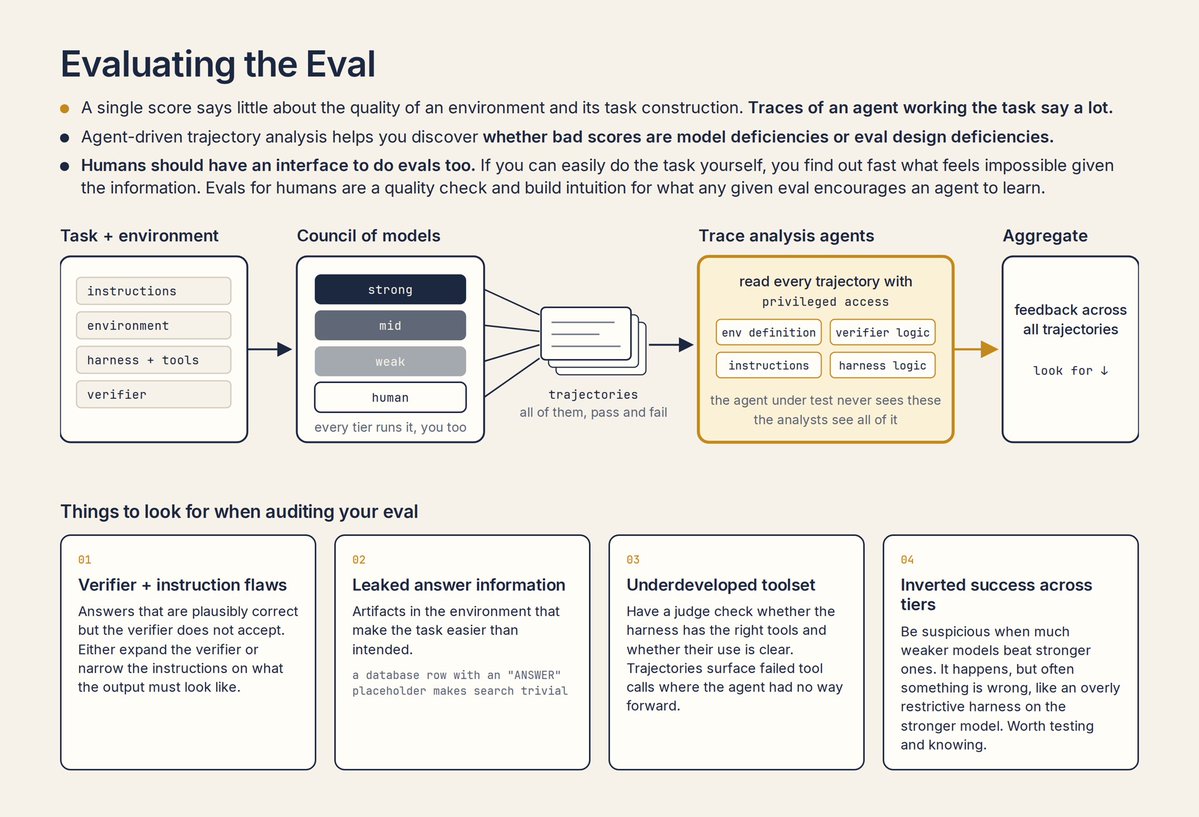
@Vtrivedy10 argued (39 likes, 1 reply, 2,170 views, 63 bookmarks) that eval and environment quality may be the top skill in AI work right now. The attached slide spelled out what that means in practice: read every trajectory with privileged access, inspect verifier and instruction flaws, look for leaked answer information, test whether the toolset itself is underdeveloped, and compare success rates across model tiers instead of trusting a single pass/fail number.
@beamnxw highlighted (24 likes, 13 replies, 315 views, 16 bookmarks) Terminal-Bench 2.0, a benchmark built around 89 real command-line tasks with deterministic verification rather than short-form code generation (paper). @deredleritt3r used (140 likes, 11 replies, 4,493 views, 14 bookmarks) the drop from more than $4,500 per ARC-AGI-1 task in 2024 to $0.021 in 2026 as evidence of cost collapse, but the replies immediately pushed back that ARC-AGI is old and heavily optimized against. @KingIdolo described (48 likes, 50 replies, 759 views) a more everyday failure mode: an AI summary preserved a “40% better outcomes” claim while deleting the comparison group and study design needed to judge whether that number applied.
Discussion insight: The replies consistently asked for the first broken assumption, not just the final score. Terminal-Bench replies wanted to know which command starts the collapse; ARC replies questioned benchmark age and benchmaxxing; the research-summary thread argued for model debate around primary sources before a number reaches a client deck.
Comparison to prior day: On 2026-09-10, the benchmark discussion centered on replaying old work before a model migration. On 2026-09-11, the argument became more methodical: inspect traces, rotate tasks, verify final system state, and treat any isolated leaderboard win as incomplete evidence.
1.3 Enterprise agent rollouts looked more like governance projects than model-adoption projects (🡕)
Enterprise discussion stayed strong, but the cited evidence was about controls and integration debt rather than excitement over new capabilities. Three items supported the same point: companies may want agents, but the operational bottlenecks are identity, process ownership, and old systems.
@levie reported (62 likes, 13 replies, 9,141 views, 52 bookmarks) that conversations with technology leaders across banking, media, insurance, consulting, and information services kept returning to cyber risk, multi-model deployment, agent identity, process reengineering, evals, and legacy systems. The thread is notable because it does not claim enterprises are waiting for a smarter model; it says they are already deploying multiple frontier models and are instead stuck on control surfaces and system cleanup.
@hallelx2 argued (5 likes, 4 replies, 336 views, 4 bookmarks) that an MCP server connected to a personal agent should replace the conventional admin dashboard, turning admin work into reusable tool access and natural-language control rather than another manual UI. @evanreiser warned (8 likes, 2 replies, 2,629 views) that a reported cloud compromise completed in three hours and one token should be treated as a live operational warning, not a theoretical safety debate.
Discussion insight: Levie's replies were unusually specific about what still feels unresolved. One reply said identity answers who an agent is but not where it can go, and another argued the real audit gap starts when an agent acts with a user's credentials and the logs imply a human approved something they never saw.
Comparison to prior day: Compared with 2026-09-10's focus on quotas, context compression, and state portability for coding agents, 2026-09-11 broadened the conversation into enterprise governance: permissions, process ownership, and legacy-system integration became the limiting factors.
1.4 Domain-specific models won attention when they collapsed latency or compute budgets, not when they were simply larger (🡕)
The applied-model posts that carried signal on this date all came with a cost, latency, or workflow claim. Four cited examples showed people responding to narrower systems that fit a real operational constraint rather than to raw scale alone.
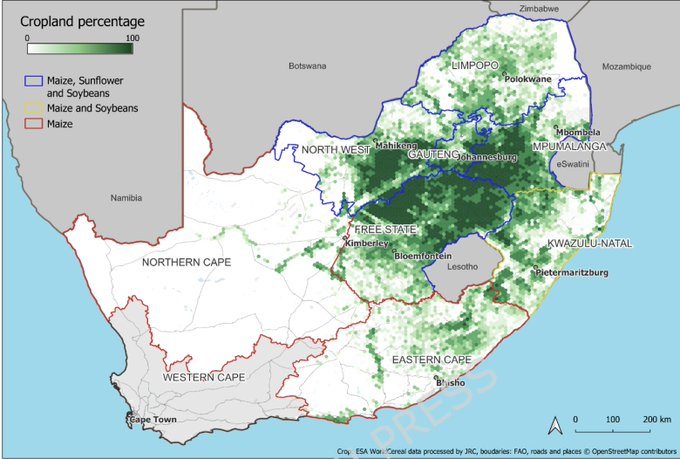
@doyeob launched (73 likes, 8 replies, 3,662 views, 70 bookmarks) a speech-to-text endpoint built on Qwen3-ASR 1.7B and Nari Labs' inference engine, claiming 40 ms time to final segment, $0.06 per hour streaming cost, and a Coval ranking of first on latency and third on word error rate. @yohaniddawela showed (37 likes, 1,407 views, 31 bookmarks) that TabPFN came close to an expert-tuned South African crop-yield pipeline while eliminating most of the tuning and feature-engineering burden; the linked JRC summary confirmed 8.8% rRMSE for TabPFN versus 6.8% for the best classical model on maize (publication).
@soupsranjan reported (53 likes, 2 replies, 3,055 views, 23 bookmarks) that a sequence model trained on 2B+ card transactions caught 24%-35% more fraud by adding learned embeddings back into an existing XGBoost scorer rather than replacing the full production stack. @DevenPzak claimed (26 likes, 2 replies, 1,749 views, 6 bookmarks) that ANVIL III cut NanoGPT speedrun training time from 73.889 seconds to 39.914 seconds while supporting Feather-1.7B, a small model he says outperformed Qwen3-1.7B on math with far less compute.
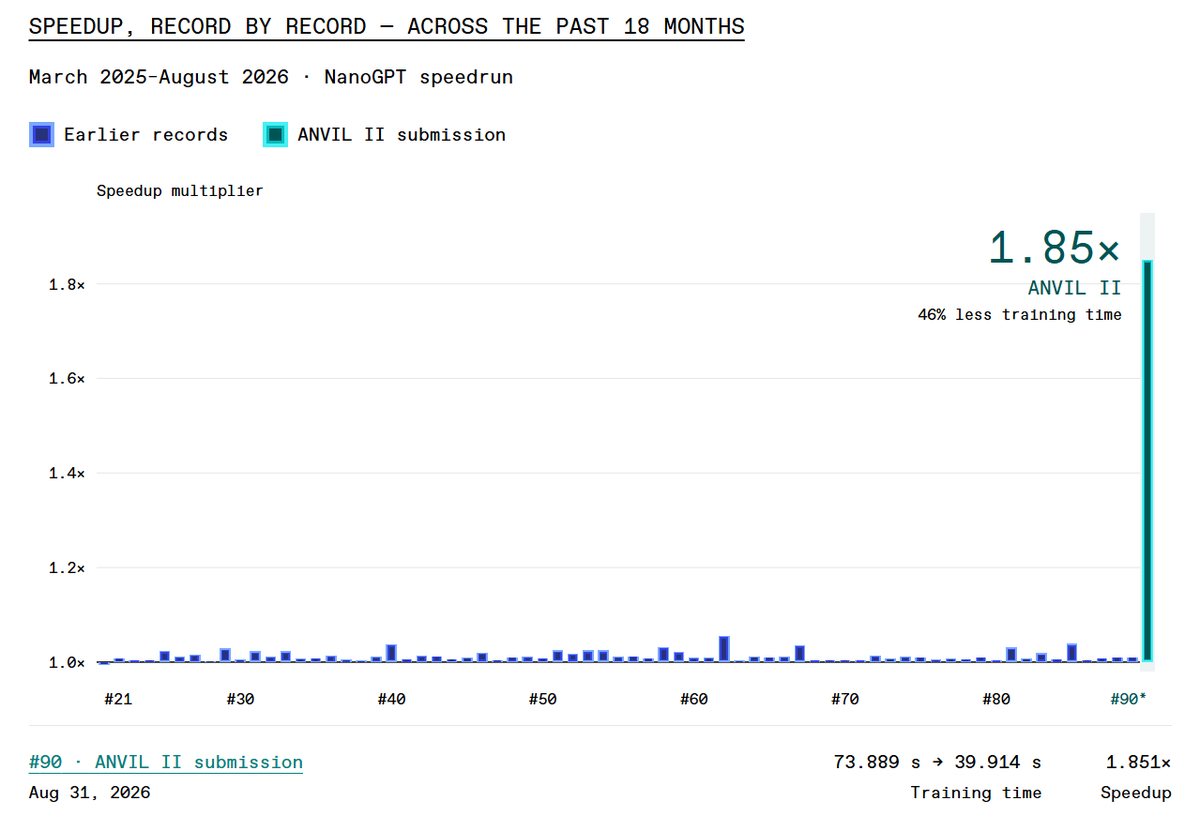
Discussion insight: The domain-specific posts that felt strongest did not usually promise a total stack replacement. The fraud post kept XGBoost in production, the crop-yield post accepted slightly worse absolute accuracy in exchange for far lower compute and setup cost, and the speech launch emphasized API latency and pricing instead of model mystique.
Comparison to prior day: On 2026-09-10, applied AI evidence spanned media, robotics, biology, and infrastructure. On 2026-09-11, the strongest applied posts were more operational: speech latency, tabular-model deployability, fraud-detection lift, and pretraining efficiency.
2. What Frustrates People
Benchmark numbers that survive screenshots but not scrutiny
Severity: High. @Vtrivedy10 argued (39 likes, 1 reply, 2,170 views, 63 bookmarks) that a single score says very little about whether an eval environment is well constructed, and @beamnxw pointed to (24 likes, 13 replies, 315 views, 16 bookmarks) Terminal-Bench 2.0 precisely because a live shell exposes cascading tool failures and context drift. @KingIdolo added (48 likes, 50 replies, 759 views) a softer version of the same complaint: AI summaries preserve the number and drop the comparison group, study design, and transfer limits that make the number usable.
@deredleritt3r showed (140 likes, 11 replies, 4,493 views, 14 bookmarks) that even a striking benchmark-cost claim immediately triggers debate about benchmark age and optimization pressure. The coping pattern was consistent across tweets: replay real work, inspect traces, audit verifiers, and look for the first failure rather than the final pass/fail label. This is worth building for because evaluation tooling is still weaker than model marketing.
Enterprise agents that inherit messy permissions and messier systems
Severity: High. @levie reported (62 likes, 13 replies, 9,141 views, 52 bookmarks) that legacy systems, fragmented data, and unclear ownership of process reengineering remain routine blockers in enterprise rollouts. The replies made the frustration more concrete: one said identity answers who an agent is but not where it can go, and another warned that when an agent acts as the user, the logs can imply a human approved something they never saw.
@hallelx2 proposed (5 likes, 4 replies, 336 views, 4 bookmarks) an MCP server plus personal agent as an alternative to fragmented admin dashboards, which is itself evidence that the current control surfaces feel inadequate. This is directly worth building for: the data shows appetite for permissions, approvals, and observability layers that sit between agents and legacy systems.
Agent costs that stay unpredictable until teams benchmark their own workflow
Severity: Medium-High. @cognition framed (715 likes, 51 replies, 49,310 views, 156 bookmarks) Fusion as a fix for inefficient frontier-only coding sessions, and @BHolmesDev reported (9 likes, 2 replies, 1,203 views, 4 bookmarks) that his own benchmark replay changed model choice enough to cut cost per pull request from $80 to $30. @aiwithsally captured (42 likes, 9 replies, 1,855 views) the adjacent frustration: people want one project agent to keep working, but the replies immediately worried about context overflow.
The visible workarounds were cheaper sidekicks, replayed workloads, and aggressive context management. This is worth building for because the frustration is not “AI is too expensive” in the abstract; it is that cost and reliability are still highly workload-specific and often invisible until after deployment.
3. What People Wish Existed
Replay-based model selection and migration gates
The strongest practical request was for tooling that replays representative work before a team changes models or harnesses. @BHolmesDev showed (9 likes, 2 replies, 1,203 views, 4 bookmarks) a small version of that by replaying past pull-request agent conversations, while @Vtrivedy10 argued (39 likes, 1 reply, 2,170 views, 63 bookmarks) that trajectory review and human-accessible evals are what actually improve systems. Fusion partially addresses the need by publishing price-per-task comparisons, but the tweets show teams still want model-neutral gating tied to their own workload. Opportunity: direct.
Persistent project agents whose memory stays useful instead of just getting longer
@aiwithsally described (42 likes, 9 replies, 1,855 views) the desired experience as giving one agent a project, goal, and context and letting it coordinate subagents over time. @omarsar0 connected (25 likes, 8 replies, 2,870 views, 16 bookmarks) that desire to the Agents API and Codex harness, which package long-lived sessions as infrastructure.
What is still missing is durable memory that stays selective and trustworthy. The replies to the persistent-agent thread immediately warned that a coordinator can drown in its own history unless it knows what to summarize or discard. Opportunity: competitive.
Agent-native control planes for permissions, admin actions, and human approval boundaries
@hallelx2 argued (5 likes, 4 replies, 336 views, 4 bookmarks) that an MCP server plus personal agent should replace the normal admin dashboard, and @levie reported (62 likes, 13 replies, 9,141 views, 52 bookmarks) that enterprises are already stuck on exactly these control questions. The need is practical, not aspirational: which identity is acting, what system it can reach, and when a human approval card must interrupt the flow.
The public Agents API launch and Levie's replies show pieces of the answer, but not a settled standard. Opportunity: direct.
Better ways to turn vague requests into machine-checkable work
@Aliba_79 argued (29 likes, 23 replies, 188 views) that an agent marketplace cannot clear around “research” or “audit” as moods; it needs predicates that can be marked true or false quickly. @KingIdolo showed (48 likes, 50 replies, 759 views) the parallel problem on the research side: without the original study context, a crisp AI summary becomes hard to defend.
This need spans marketplaces, internal agent workflows, and research tools. Existing products only partially address it because the hard part is not generation; it is preserving criteria, scope, and evidence all the way to acceptance. Opportunity: direct.
4. Tools and Methods in Use
| Tool | Category | Sentiment | Strengths | Limitations |
|---|---|---|---|---|
| Devin Fusion | Coding harness | (+) | Cuts price per task by pairing a frontier lead with a cheaper sidekick; benchmarked across multiple coding suites | Needs tuning per model pair; some benchmark scores are slightly lower than the solo lead |
| OpenAI Agents API / Codex harness | Agent runtime | (+) | Managed sessions, tool use, and sandboxes; supports self-hosted compute behind the runtime | Fresh launch; evidence today was launch material and builder interpretation, not long-term deployment results |
| Workload replay benchmarking | Evaluation method | (+) | Reveals model-specific cost and reliability on real historical tasks | Requires stored traces or past conversations and ongoing maintenance |
| Terminal-Bench 2.0 | Agent benchmark | (+/-) | Uses realistic CLI tasks and deterministic verification to expose long-horizon failure modes | Still a benchmark, not production; replies wanted first-error analysis and continued task turnover |
| Octen Search in Stirrup | Search API | (+) | Strong Search Index score with low time per task and low total cost | Median speed may not reflect burst concurrency or rate-limit behavior |
| Qwen3-ASR 1.7B on Nari Labs | Speech model/API | (+) | Claimed very low latency and low price with strong public benchmark placement | Launch-day evidence is still mostly vendor-supplied and tweet-level |
| TabPFN | Tabular foundation model | (+) | Near-expert crop-forecast accuracy with far less tuning and feature engineering | Slightly worse than the best hand-tuned maize pipeline on absolute error |
| Transaction embeddings + XGBoost | Fraud stack | (+) | Improved fraud catch rate without replacing the incumbent scoring model | Depends on large proprietary histories and integration work around the existing scorer |
| ANVIL III / Feather-1.7B | Pretraining stack | (+) | Strong efficiency claims for both optimizer design and small-model math performance | Reported mainly through self-published release materials and tweet threads |
| MCP server + personal agent | Control-plane pattern | (+/-) | Reusable natural-language control across tools and admin surfaces | Strong architectural argument, but light evidence of broad adoption on this date |
| Cursor Projects-style persistent coordinator | IDE/workflow pattern | (+/-) | Keeps work in one project thread and enables parallel subagents | Replies highlighted context bloat and the need for aggressive memory management |
@ArtificialAnlys benchmarked (71 likes, 9 replies, 7,778 views, 7 bookmarks) Octen Search inside the open-source Stirrup harness, which is notable because the benchmark holds the base model and agent frame constant while swapping the search provider. The attached chart showed Octen debuting at 77 on the Artificial Analysis Search Index, with the fastest time per task in the cited write-up and one of the lowest total costs (article).

The satisfaction spectrum was widest around evaluation and harnessing, not around raw models. @cognition praised (715 likes, 51 replies, 49,310 views, 156 bookmarks) a paired-model harness, while @BHolmesDev used (9 likes, 2 replies, 1,203 views, 4 bookmarks) replay benchmarking to switch models entirely. Common workarounds were to keep a stronger model in charge, push bounded execution to cheaper helpers, replay representative workloads, and preserve confidence intervals or human review when a cheaper or more generic system is “good enough.”
Migration patterns were explicit. One team moved from Opus 5 to GPT 5.6 for pull-request work; Fusion paired Fable 5.1 or Astra with SWE-2 instead of treating any single model as the whole product; the crop-yield example replaced expert-tuned search over dozens of classical pipeline variants with a pretrained tabular model; and the fraud post kept XGBoost but added sequence-learned embeddings. The competitive dynamic was therefore less “winner takes all” and more “which combination of model, harness, evaluator, and tool is cheapest while still holding up on the actual job?”
5. What People Are Building
| Project | Who built it | What it does | Problem it solves | Stack | Stage | Links |
|---|---|---|---|---|---|---|
| Fusion | @cognition | Runs a frontier lead model with a cheaper sidekick inside Devin CLI | Lowers coding-agent cost without giving up planning and review quality | Devin CLI, Fable 5.1 or GPT-6 Astra, SWE-2 | Shipped | post, blog |
| Agents API | @stevendcoffey / OpenAI | Exposes the Codex harness as a managed runtime for cloud agents | Avoids rebuilding sessions, orchestration, and sandbox plumbing for every product | Codex harness, sandbox execution, MCP-compatible tools | Beta | launch, announcement |
| Octen Search | Octen AI | Provides search as a tool component for agents, with measured quality/speed/cost trade-offs | Reduces latency and cost of retrieval-heavy agent tasks | Search API, highlights, Stirrup harness benchmarking | Shipped | benchmark post, article |
| Nari speech-to-text endpoint | @doyeob / Nari Labs | Offers low-latency streaming speech-to-text as an API | Cuts transcription latency and price for voice products | Qwen3-ASR 1.7B, Nari Labs inference engine | Shipped | post |
| Foundation risk model | @soupsranjan / Sardine | Learns transaction embeddings and surprise scores, then feeds them into an existing fraud stack | Improves fraud detection without discarding the incumbent scoring system | Sequence model over 2B+ transactions, embeddings, XGBoost | Beta | post |
| Feather-1.7B + ANVIL III | @DevenPzak / Hyperstition | Combines a new pretraining optimizer with a small base model tuned for efficiency claims | Reduces pretraining cost while keeping small-model math performance competitive | ANVIL III, public web data, 200B-token pretraining | Alpha | post |
Fusion was the clearest shipped project signal because the post, image, and blog all aligned on one design idea: separate planning/review from implementation work, keep contexts persistent on both sides, and judge the full system on price per completed coding task. The benchmark table in Cognition's post showed that the savings were not confined to one suite, which is why the tweet carried far more signal than a generic “we are cheaper” launch claim.
@omarsar0 used (25 likes, 8 replies, 2,870 views, 16 bookmarks) the OpenAI launch as evidence that the harness layer itself is becoming a product. The diagram matters because it makes the abstraction legible: the application owns the task and output, the managed harness owns orchestration, and the sandbox can still be controlled by the builder.

Octen Search and Nari Labs showed the same componentization pattern in adjacent layers. Search and speech are being sold less as monolithic “AI platforms” and more as swappable building blocks with visible latency, cost, and benchmark positions. Sardine's fraud post and Hyperstition's Feather/ANVIL release extended that pattern into domain and training infrastructure: one kept the incumbent XGBoost scorer but improved it with transaction embeddings, while the other argued that optimizer and training-efficiency work can change what small models are economically viable.
The repeated build pattern was infrastructure that wraps or augments models rather than isolated model launches. Even where the core artifact was a model, the strongest posts still emphasized the surrounding harness, benchmark, data flow, or optimizer.
6. New and Notable
Price per task kept replacing price per token
@cognition made (715 likes, 51 replies, 49,310 views, 156 bookmarks) the point explicitly with Fusion, and @BHolmesDev supplied (9 likes, 2 replies, 1,203 views, 4 bookmarks) a direct workflow example by cutting cost per pull request from $80 to $30 after replay benchmarking. The notable shift is not merely that models got cheaper; it is that people increasingly measured the full harness on completed work.
Physical AI data infrastructure was described as a compounding loop, not a static dataset
@salmorve98 outlined (18 likes, 22 replies, 100 views) Axis Robotics as a “compounding data engine” for physical AI. The four-image thread added the real substance: simulation and egocentric capture feed a shared pipeline, human corrections are inserted exactly at failure points, and the resulting data becomes training input for the next policy rather than a one-off dataset.
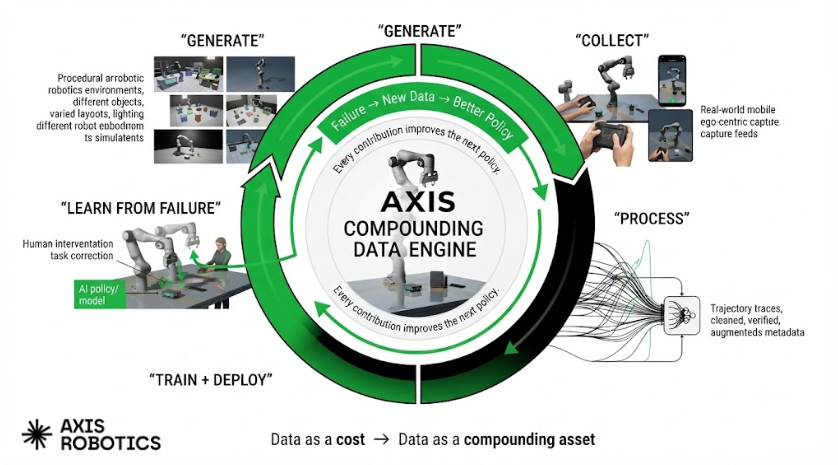
This was a lower-reach signal than the coding-agent threads, but it was more concrete than most generic “physical AI” talk. It matters because it treats data quality, correction, and provenance as the product surface.
The human role kept narrowing toward spec writing, evidence review, and approval design
@Aliba_79 argued (29 likes, 23 replies, 188 views) that the scarce skill in agent marketplaces is writing a brief that another machine can fail in public. @KingIdolo described (48 likes, 50 replies, 759 views) the same theme from the opposite end: without the original study and comparison context, a polished AI summary is still not a defensible decision artifact.
Together with Levie's enterprise thread, that produced a notable pattern for the day: the remaining human bottlenecks were less about typing prompts and more about setting criteria, checking evidence, and defining when an agent is allowed to act.
7. Where the Opportunities Are
[+++] Eval operations for real agent workloads — Multiple sections pointed here. @Vtrivedy10 argued for trajectory review, @beamnxw elevated Terminal-Bench 2.0 because real shells expose failures, and @BHolmesDev showed that replaying historical work can change model choice enough to cut cost per pull request by more than half. The evidence suggests teams need tooling for replay, verifier audits, trace comparison, and upgrade gates.
[++] Agent control planes for permissions, approvals, and admin work — @levie described enterprise demand getting stuck on identity, legacy systems, and process ownership, while @hallelx2 argued that MCP-connected personal agents should replace dashboards. The public Agents API launch adds platform momentum, but the gap is still at the control layer: what an agent can reach, when it must stop, and how actions are logged.
[++] Persistent project memory with compaction and delegation — @aiwithsally described the desired product shape clearly: one project agent coordinating subagents over time. The replies immediately exposed the missing piece: a persistent coordinator needs a robust policy for what to keep, summarize, and drop. The opportunity is moderate because the demand is obvious but the space is getting crowded.
[+] Infrastructure for non-text foundation models and data loops — @doyeob competed on speech latency and price, @soupsranjan on transaction-sequence fraud detection, @yohaniddawela on tabular forecasting efficiency, and @salmorve98 on physical-AI data loops. The evidence is still more fragmented here, but it points to a growing market for domain-specific data infrastructure rather than only bigger general models.
8. Takeaways
- Harness design was the loudest concrete signal of the day. Fusion, Agents API, and workload replay all treated the model as one component inside a larger system that manages delegation, context, and cost. (source)
- The crowd was less willing to trust single benchmark numbers. Trace review, deterministic terminal tasks, and benchmark skepticism appeared across the Vtrivedy, Terminal-Bench, ARC, and research-summary threads. (source)
- Enterprise agent demand looked real, but operational governance still sets the pace. Levie's thread framed the blockers as cyber risk, identity, process reengineering, evals, and legacy systems rather than lack of model access. (source)
- Applied AI posts gained traction when they delivered a concrete efficiency win in a narrow domain. The strongest examples were Nari's speech endpoint, TabPFN crop forecasting, Sardine's transaction embeddings, and Hyperstition's pretraining-efficiency claims. (source)
- The remaining human work kept collapsing toward criteria and control. Several tweets converged on the idea that humans are still needed to write gradeable briefs, review evidence, and define approval boundaries even when the agent does the execution. (source)