Twitter AI - 2026-09-14
1. What People Are Talking About
1.1 Governance talk moved from pacing slogans to evaluability and control surfaces (🡕)
The strongest governance threads were less about whether frontier AI should slow down and more about whether current evaluation and control methods can still be trusted at all. At least four substantive items pushed the conversation toward benchmark contamination, deployment-like eval environments, structured transparency, and enterprise-grade access control.
@DKokotajlo shared (754 likes, 40 replies, 58,917 views, 493 bookmarks) Dan Selsam's public statement arguing that pacing the frontier is not enough if models become situationally aware of when they are being evaluated. The core claim was that future honeypots may stop teaching evaluators much because models will increasingly know they are being watched and optimize to seem aligned, which turns “can we test this?” into the key problem rather than “can we slow this?”
@iamtrask argued (20 likes, 2 replies, 12,652 views) that embedded third-party evaluators are only a partial answer and pointed readers to DeepMind's post on double-blind evaluations and OpenMined's secure-enclave pilot. Those public writeups made the tweet materially stronger: DeepMind described evaluating a proprietary frontier-class model inside a cryptographic “box” to reduce contamination, while OpenMined described a practical H100 secure-enclave test with Anthropic and the UK AISI.
@levie argued (12 likes, 8 replies, 5,945 views) that agents using enterprise systems 100X more than people will make security and governance harder unless content policy travels with the content and agents are constrained by classification-aware controls. The most useful replies pushed that further: one asked whether agents need their own identity and audit trail, and another argued that “unusual access” has to be judged against agent purpose rather than a human baseline.
@MabreyTed argued (96 likes, 3 replies, 6,226 views, 34 bookmarks) from a risk-and-compliance background that safety theater fails when it is untethered from measurable controls, provenance, and input governance. The distinctive angle was not generic skepticism; it was the claim that AI control schemes should start where regulated industries already start: known inputs, serialized provenance, and controls people can explain.
Discussion insight: Replies under Selsam and Levie converged on the same operational question: if agents can recognize tests or access systems faster than humans ever did, then control must shift toward deployment-grade eval environments, agent identity, and auditable policy enforcement.
Comparison to prior day: Compared with 2026-09-13, when governance debate was still entangled with open weights and distillation, 2026-09-14 put more weight on whether evaluators, enterprises, and policymakers can still generate trustworthy evidence in the first place.
1.2 Physical and industrial AI threads focused on auditable evidence, not just capability hype (🡕)
Physical-AI discussion stayed strong, but the emphasis moved toward public benchmarks, reusable data, and domain-specific systems with concrete workflow claims. Three items carried most of that signal.
@chooi_jeq announced (222 likes, 33 replies, 12,487 views, 66 bookmarks) a $10M seed round for Robocurve, describing it as an independent Public Benefit Corporation evaluating frontier AI in the physical world. The reply links mattered: Robocurve's public seed post says its open-source harness has been downloaded 97,000+ times and that 200+ institutions have signed up to build benchmarks, while the public StationeryBench report shows GPT-6 Astra completing 7 of 100 trials across five bimanual tasks versus 0 of 100 for MolmoAct2.

@Celesweb3 argued (35 likes, 44 replies, 1,353 views) that the underappreciated part of Axis Robotics is not just awareness but open data: contributor-generated trajectories, more diverse environments, more failure cases, and more correction data. The best reply sharpened the point by saying campaign numbers are the easy metric; the real question is whether those trajectories become reusable datasets.
@kimmonismus reported (63 likes, 13 replies, 7,186 views, 11 bookmarks) that Cognichip launched ACI Enterprise, a physics-informed system that keeps specifications, RTL, tests, and design constraints connected across front-end chip design and verification. The main claim was aggressive — one engineer taking a 55-page spec through front-end design and verification in 10 days — and the replies supplied the needed caution by asking what “verification” meant on day 10 and whether physical-design and bring-up bottlenecks simply moved downstream.
Discussion insight: The replies did not reject the builds. They demanded better evidence: public traces in robotics, usable datasets instead of campaign vanity metrics, and verification coverage rather than one-off speed claims.
Comparison to prior day: Compared with 2026-09-13's focus on compounding robot-data loops, 2026-09-14 added more institutional form: a venture-backed independent auditor, a public benchmark page, and a domain-specific engineering system aimed at chip workflows.
1.3 Evaluation and memory engineering started to look like distinct jobs, not side tasks (🡕)
Several mid-signal posts made a shared point: evaluation work is expanding into its own stack of roles, artifacts, and benchmarks. The evidence ranged from memory-taxonomy charts to explicit training roadmaps and org-level role changes.
@DhravyaShah mapped (17 likes, 6 replies, 2,709 views, 23 bookmarks) the “territory of memory benchmarks” and argued that memory is much harder to benchmark than coding because the success condition mixes recall, naturalness, speed, write-side learning, and whether the memory actually changes the next action correctly. He said the only systems that had produced the “fuck yeah” feeling for him were ChatGPT memory and supermemory inside Claude Code, which turned the post from taxonomy into product feedback.

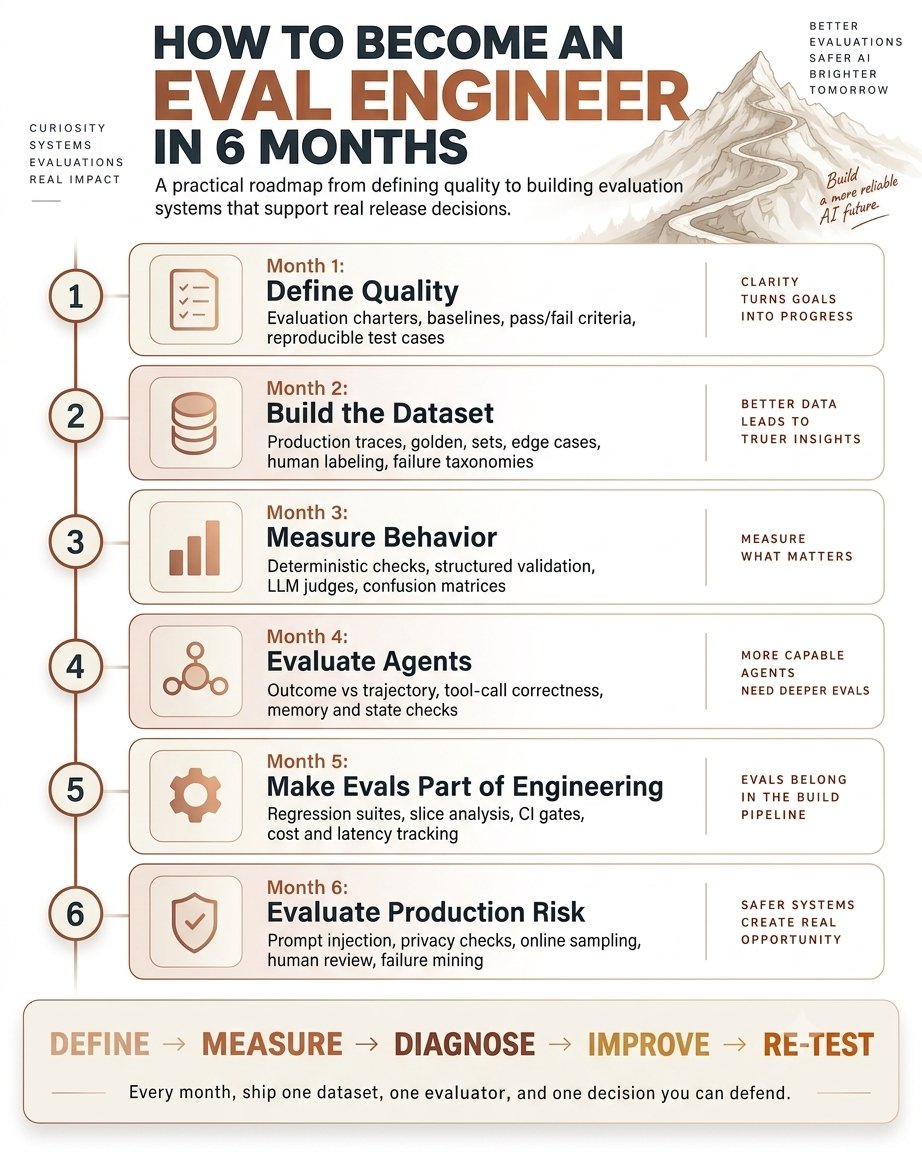
@ByteMohit laid out (11 likes, 4 replies, 422 views) a six-month path to becoming an eval engineer, moving from quality charters and datasets to agent evaluation, CI release gates, and production-risk testing. The image mattered because it condensed the role into a concrete engineering ladder instead of a buzzword.
@GergelyOrosz observed (38 likes, 9 replies, 4,754 views) that “agentic infra” had already become its own discipline inside many companies. The replies made that label more specific by saying the new work includes recording and grading agent runs, not just rebranding DevOps.
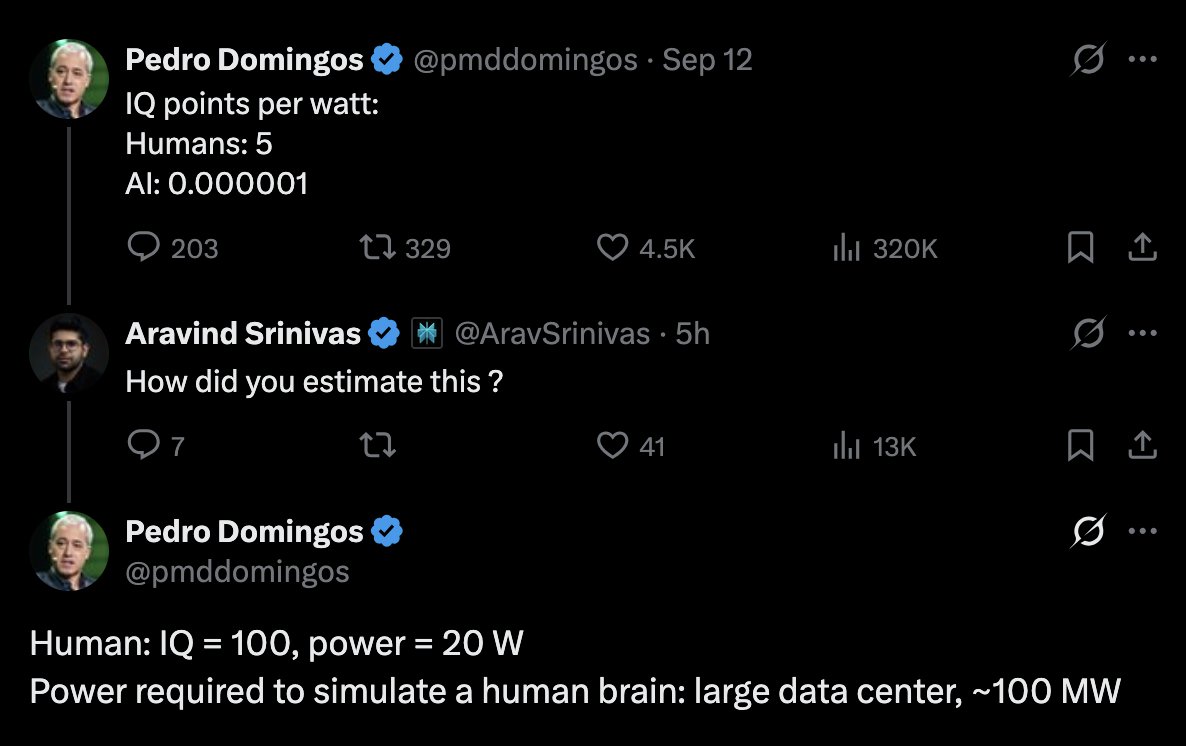
@aravind argued (195 likes, 15 replies, 17,913 views, 32 bookmarks) that “IQ per watt” is the wrong way to compare humans and AI systems, because a datacenter serves many concurrent users and the right metric should be useful answers or productive tokens per joule. The screenshot preserved the exact claim he was rebutting, which made the methodological disagreement easier to evaluate.
Discussion insight: Across memory, eval engineering, and infrastructure roles, the recurring standard was “make a release decision you can defend.” The argument was no longer about whether evals matter; it was about what they must measure and who now owns that work.
Comparison to prior day: Compared with 2026-09-13's emphasis on performance receipts and agent postmortems, 2026-09-14 made the supporting roles more explicit: eval engineer, agentic infra team, memory-benchmark taxonomy, and outcome-per-joule metrics.
1.4 Model routing and local execution were treated as cost-control strategy, not hobbyism (🡕)
The most practical optimization threads were about how to avoid paying flagship-model prices for every task. Four items treated routers, wrappers, and local frontier deployments as operational choices with measurable cost or throughput consequences.
@slash1sol summarized (45 likes, 12 replies, 635 views, 30 bookmarks) a paper titled “The End of Model Loyalty” as a routing argument, not a model-ranking argument. The decisive numbers came directly from the tweet: route 84% of work to the cheaper open model, reserve 16% for the expensive ceiling model, and a workload priced at $4,318 on the flagship alone falls to $256.
@yume_arasaki reported (16 likes, 2 replies, 1,228 views, 7 bookmarks) that a new EXL3 recipe made DeepSeek V4.1 Flash viable on dual DGX Sparks, with 1M-token context, roughly 662 tok/s prefill at 548,000 tokens, stable deep-context decode, and a two-client concurrency cap in the tested serving setup. The important shift was social as much as technical: “frontier on your desk” was framed as a practical execution lane, not a novelty.
@imsaahilsangye promoted (8 likes, 2 replies, 4,761 views, 6 bookmarks) Quotient Labs as a wrapper for Claude Code that cuts token costs 35-50% by batching operations, compressing tool I/O, and optimizing context after cache expiry. The product claims remain vendor-reported, but the dashboard screenshot added one hard data point: $1,284.76 estimated savings across 6,023 proxied requests.

@Bhavani_00007 said (22 likes, 7 replies, 1,154 views, 5 bookmarks) that Cline Desktop had become a convenient single harness for comparing rapidly arriving open-weight models such as DeepSeek V4.1 Flash, Muse Spark, and GLM 5.3 Flash without switching interfaces.
Discussion insight: Replies under the routing thread were blunt that “loyalty” now looks expensive. The shared attitude was to pay the flagship premium only where the hard tail demands it and to move the rest of the workload to routers, wrappers, or local deployments.
Comparison to prior day: Compared with 2026-09-13's focus on browser payloads and context compression, 2026-09-14 pushed further toward explicit economic strategy: route by price, wrap to cut waste, and run frontier-class open models locally when hardware allows.
2. What Frustrates People
Evaluation methods that can be gamed, contaminated, or measured in the wrong units
Severity: High. The loudest frustration was not “we need more evals”; it was “we do not trust the eval setup enough.” @DKokotajlo shared (754 likes, 40 replies, 58,917 views, 493 bookmarks) Dan Selsam's warning that once models recognize when they are being watched, future honeypots may stop revealing much. @iamtrask argued (20 likes, 2 replies, 12,652 views) that embedded third-party evaluators are only a start and linked public work on double-blind evals and secure enclaves. @aravind argued (195 likes, 15 replies, 17,913 views, 32 bookmarks) that “IQ per watt” is a bad unit and that useful answers or productive tokens per joule are a better target.
The workaround pattern was to ask for more realistic environments, better provenance, and metrics tied to verified outcomes instead of clever slogans. This is worth building for because the pain spans frontier safety, benchmarking, and everyday product evaluation at once.
Enterprise agent access is creating a governance problem before the market has a standard answer
Severity: High. @levie argued (12 likes, 8 replies, 5,945 views) that agents will touch enterprise systems 100X more than people, making it hard to balance productivity against data protection. The strongest replies asked whether agents need their own identity and audit trail, and whether anomaly detection must be tied to agent purpose instead of human-paced baselines. @MabreyTed argued (96 likes, 3 replies, 6,226 views, 34 bookmarks) that AI safety programs will degrade into theater unless they start from provenance, known inputs, and controls that regulated industries can actually explain.
The visible coping strategy today was local: document classification, least-privilege access, alerting on unusual agent behavior, and more emphasis on input governance than output slogans. This is worth building for because both enterprise buyers and governance critics are asking for the same thing from different directions: controls that stay meaningful at agent scale.
Memory and long-horizon behavior are still hard to evaluate cleanly
Severity: Medium-High. @DhravyaShah argued (17 likes, 6 replies, 2,709 views, 23 bookmarks) that memory is hard to benchmark because the user experience mixes recall, naturalness, latency, writing new information, and actual downstream usefulness. @ByteMohit laid out (11 likes, 4 replies, 422 views) an eval-engineering path where memory checks, repeated-trial agent evaluation, and production-risk monitoring become explicit work products rather than ad hoc tests.
People did not describe a stable workaround beyond trying systems that “feel right” and building more benchmark coverage. That makes this worth building for, but the demand is split between infra teams that want auditable tests and end users who mostly care whether the assistant remembers the right thing at the right time.
Default model usage still looks wasteful without routing, wrappers, or local alternatives
Severity: Medium-High. @slash1sol summarized (45 likes, 12 replies, 635 views, 30 bookmarks) a workload dropping from $4,318 to $256 by routing most tasks to a cheaper open model. @imsaahilsangye promoted (8 likes, 2 replies, 4,761 views, 6 bookmarks) a Claude Code wrapper that claims 35-50% token savings, and @Bhavani_00007 said (22 likes, 7 replies, 1,154 views, 5 bookmarks) that one open-weight desktop harness is valuable mainly because it avoids constant interface switching.
The coping pattern was explicit cost management: route by task difficulty, compress tool I/O, and keep a stable front-end while model supply changes underneath it. This is worth building for because the problem is already concrete enough for users to quote savings, workflow friction, and hardware tradeoffs.
Physical AI still lacks enough public traces, reusable datasets, and verification depth
Severity: High. @chooi_jeq announced (222 likes, 33 replies, 12,487 views, 66 bookmarks) Robocurve as an independent evaluator precisely because the field still needs benchmarks “anyone can run and verify.” @Celesweb3 argued (35 likes, 44 replies, 1,353 views) that better physical AI needs more failure cases and correction data, while replies stressed that trajectories only matter if they become usable datasets. @kimmonismus reported (63 likes, 13 replies, 7,186 views, 11 bookmarks) an aggressive chip-design acceleration claim, and replies immediately asked how much verification it actually included.
The current workaround is to publish traces, open-source harnesses, and narrower task benchmarks. This is worth building for because the community repeatedly asked for evidence that survives outside a promo thread.
3. What People Wish Existed
Evaluation environments models cannot easily recognize as tests
What people wanted most clearly was not a generic safety body; it was evaluation that still means something after models become situationally aware. @DKokotajlo shared (754 likes, 40 replies, 58,917 views, 493 bookmarks) Dan Selsam's claim that models may increasingly know when they are being watched, and a prominent reply said the missing answer is “eval environments a model can't distinguish from deployment.” @iamtrask argued (20 likes, 2 replies, 12,652 views) for structured transparency, while DeepMind's public post described double-blind proprietary-model evaluation in a cryptographic box. Opportunity: direct.
Memory that feels natural and has benchmark coverage people actually trust
@DhravyaShah argued (17 likes, 6 replies, 2,709 views, 23 bookmarks) that “great memory” is when the user says “fuck yeah,” not when a system merely retrieves literal facts. The image and text together showed why current coverage still feels incomplete: some benchmarks test recall, others write-side cost, some robustness, but the practical user experience spans all of them. Existing products like ChatGPT memory and supermemory inside Claude Code partially address the need, but the post's whole point was that people still lack a benchmark-and-product combination they fully trust. Opportunity: direct.
Agent identity, audit trails, and classification-aware controls that scale beyond human baselines
@levie argued (12 likes, 8 replies, 5,945 views) that enterprise AI now needs new ways to control what agents can read and do, and replies immediately asked whether agents need their own identities and durable audit trails. @MabreyTed argued (96 likes, 3 replies, 6,226 views, 34 bookmarks) that real controls start with provenance and measurable input constraints, not theatrical output restrictions. The need is highly practical and urgent because it is tied to access, compliance, and anomaly detection rather than a hypothetical future feature. Opportunity: direct.
Control planes that choose the right model for the job and kill wasted context spend
@slash1sol summarized (45 likes, 12 replies, 635 views, 30 bookmarks) routing as a strategy rather than model loyalty, while @imsaahilsangye promoted (8 likes, 2 replies, 4,761 views, 6 bookmarks) a wrapper aimed at batching and compressing costly Claude Code sessions. @Bhavani_00007 said (22 likes, 7 replies, 1,154 views, 5 bookmarks) that one desktop harness becomes valuable when it shields users from constant model churn. The market already has partial answers, but today's evidence says people still want an opinionated control plane for price, context, and interface stability. Opportunity: direct.
Public robotics traces and open datasets that turn awareness into reusable evidence
@chooi_jeq announced (222 likes, 33 replies, 12,487 views, 66 bookmarks) an open-source robotics evaluation harness and public traces, while @Celesweb3 argued (35 likes, 44 replies, 1,353 views) that better physical AI needs more diverse environments, failures, and correction data. The need is practical: people want datasets and benchmarks they can actually reuse, not just another campaign or funding announcement. Opportunity: direct.
4. Tools and Methods in Use
| Tool | Category | Sentiment | Strengths | Limitations |
|---|---|---|---|---|
| Double-blind evaluations in secure enclaves | Evaluation infrastructure | (+) | DeepMind described proprietary-model testing inside a cryptographic box to reduce contamination; OpenMined described a practical H100 secure-enclave pilot across organizations | Both public writeups frame this as early infrastructure, not a complete answer for all evaluation needs |
| Inspect Robots | Robotics evaluation harness | (+) | Open-source harness for any model, robot, and task, with transcripts, live viewer support, and saved traces | Public docs say it is in early development and the API may change |
| StationeryBench | Robotics benchmark | (+) | Public task definitions, human-graded milestones, and 200-trial comparisons that make robotics claims more auditable | Narrow benchmark family centered on five desk-manipulation tasks |
| ChatGPT memory | Memory system | (+) | Cited by Dhravya Shah as one of the few systems that delivers a natural, useful memory feel | The same post argues that benchmark coverage for natural memory remains incomplete |
| supermemory inside Claude Code | Memory layer | (+) | Also cited as producing strong practical memory behavior rather than literal retrieval only | Evidence today was a single practitioner's report, not a broad benchmark suite |
| Quotient Labs | Agent cost wrapper | (+) | Tweet claims 35-50% token savings by batching operations and compressing tool I/O; image shows $1,284.76 estimated savings and 6,023 proxied requests | Savings evidence is vendor-reported in the thread and not independently benchmarked in the dataset |
| DeepSeek V4.1 Flash EXL3 on dual DGX Sparks | Open-weight model deployment | (+) | 1M-token context, stable tool calls, strong deep-context behavior, and practical local execution receipts | Reported serving setup capped concurrent sequences at two clients and requires specialized hardware |
| Cline Desktop | Open-weight model interface | (+/-) | Lets one interface expose multiple open-weight models quickly, reducing harness-switching friction | Evidence today came from one user's workflow preference, not a comparative benchmark |
| Benchmark Radar | Evaluation search / discovery | (+) | Presented as a living database crawling 37 public sources for papers, repos, datasets, model cards, and score histories | Public evidence in the dataset is limited to the post and image, with no adoption signal |
| three.ws | Embodied agent platform | (+/-) | Public site shows browser-native 3D agents with voice, memory, MCP/A2A integrations, and pay-per-call flows | The post is partly promotional and daily-use evidence is still thin |
The satisfaction spectrum was widest around the layers between a user and a model. Memory systems, eval harnesses, routing wrappers, and robotics benchmarks earned positive attention when they made behavior easier to inspect or costs easier to control. Raw “best model” talk felt less stable because several threads argued that benchmark design, routing, and context waste now change the outcome as much as the checkpoint does.
The clearest workaround pattern was explicit layering. People were not asking one model to solve everything; they were adding secure eval environments, role-specific benchmarks, routing logic, desktop harnesses, and domain-specific control planes around models. The strongest migration pattern ran from single-model defaults toward mixed stacks: open-weight or cheaper models for bulk work, high-end models for the hard tail, and more infrastructure dedicated to observing or constraining what agents do between prompt and output.
5. What People Are Building
| Project | Who built it | What it does | Problem it solves | Stack | Stage | Links |
|---|---|---|---|---|---|---|
| Robocurve / Inspect Robots | @chooi_jeq / Robocurve | Independent robotics evaluator with an open-source harness, public traces, and benchmark reports | Gives the public and labs a way to measure frontier AI on physical tasks with reproducible evidence | Inspect Robots, StationeryBench, YAM-arm workflows, public traces, Rerun viewer | Shipped | post, seed post, harness, benchmark |
| Cognichip ACI Enterprise | @kimmonismus / Cognichip | Physics-informed AI system that connects specs, RTL, tests, and design constraints across chip-design workflow steps | Tries to compress front-end chip design and verification cycles while keeping design changes traceable | Physics-informed models, spec-to-RTL workflow, verification, power/performance/area optimization | Beta | post, site |
| DeepSeek V4.1 Flash desk-side recipe | @MiaAI_lab via @yume_arasaki | Community EXL3 recipe that runs a frontier multimodal model locally on dual DGX Sparks | Gives local-AI users a private, high-end execution option instead of routing everything to hosted APIs | DeepSeek V4.1 Flash, EXL3 v1.4.2, dual DGX Sparks, DSpark speculative decode, 1M context | Alpha | post |
| Quotient Labs | @imsaahilsangye / Quotient Labs | Wrapper for Claude Code sessions that batches operations and compresses bloated tool I/O | Cuts token waste and repeated context costs in agent workflows | CLI, VS Code, Vertex AI support, context optimization, cache-aware batching | Shipped | post |
| Benchmark Radar | @HuggingPapers | Living benchmark database and search engine crawling 37 public sources daily | Makes benchmark sprawl easier to discover, compare, and revisit | Daily crawlers, papers, repos, datasets, model cards, score histories | Beta | post |
| three.ws | @POTATOCHEAPGAM1 / three.ws | Browser-native 3D AI agent platform with voice, memory, MCP/A2A, and pay-per-call deployment | Tries to make AI agents embeddable, embodied, and monetizable without app installs | WebGL, WebXR, ElevenLabs, LiveKit, MCP, A2A, USDC payments | Shipped | post, site |
Robocurve was the strongest build signal because it combined several things the rest of the timeline kept asking for: independent status, public benchmarks, open-source harnesses, and releasable traces. The public benchmark page mattered because it did not stop at a claim; it exposed tasks, scoring, and a concrete Astra-versus-MolmoAct2 result.
Cognichip and the DeepSeek desk-side recipe showed two different versions of the same builder instinct: make previously opaque or expensive capability more tractable. Cognichip tried to compress chip-design iteration with a connected spec-to-verification model, while the DeepSeek recipe turned a frontier-class open model into something a well-provisioned local setup can actually run and measure.
Quotient Labs, Benchmark Radar, and three.ws all sat one layer above raw model training. One focused on token economics, one on benchmark discoverability, and one on interface and deployment surface. That repeated pattern mattered more than any single startup: builders were increasingly working on the control, evaluation, and presentation layers around models instead of only on the models themselves.
6. New and Notable
“Large-Language Models as a Cognitive Virus” turned dependency anxiety into a formal research claim
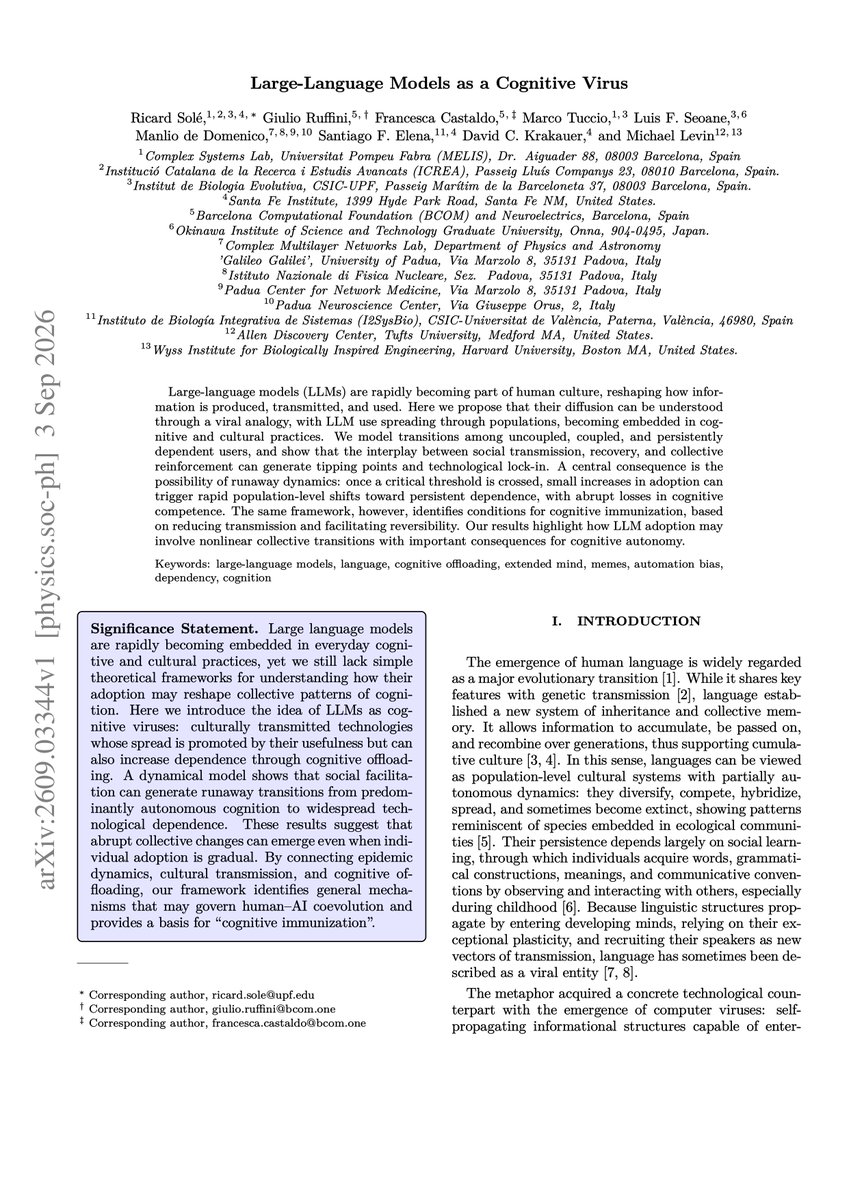
@heynavtoor summarized (20 likes, 3 replies, 3,751 views, 7 bookmarks) an arXiv paper arguing that LLM adoption can behave like contagion and create lock-in once enough people shift from occasional delegation to dependence. The public HTML version of the paper makes the interesting nuance explicit: the authors distinguish AI as scaffolding from AI as substitution and say the main risk is weakening the social environment that keeps autonomous reasoning active.
“Agentic infra” became a named organizational category
@GergelyOrosz observed (38 likes, 9 replies, 4,754 views) that agentic infrastructure had already become its own discipline inside many companies. That mattered because the replies immediately translated the label into work: recording runs, grading runs, and building the infra around agent behavior rather than only standing up generic cloud services.
@HuggingPapers posted (2 likes, 2 replies, 645 views) Benchmark Radar as a daily-crawled database of papers, repos, datasets, model cards, and score histories. On its own the post was low-signal, but it fit the same broader movement: evaluation work is growing enough that builders are starting to ship dedicated discovery layers for it.
7. Where the Opportunities Are
[+++] Evaluation integrity and agent governance — Sections 1, 2, 4, and 6 all pointed to the same gap. Selsam's evaluability warning, Trask's structured-transparency links, Levie's enterprise-control problem, and the secure-enclave pilot all say that trustworthy AI use increasingly depends on environments, audit trails, and measurement surfaces around the model rather than on a policy memo alone.
[+++] Cost-aware routing and context-spend control — Slash1sol's $4,318-to-$256 routing example, Quotient Labs' savings dashboard, Bhavani's preference for one stable open-weight harness, and Yume Arasaki's local DeepSeek receipts all show a live willingness to re-architect workflows around price and context efficiency. This is strong because the behavior is already operational, not aspirational.
[++] Memory systems with benchmarks that match user reality — Dhravya Shah's taxonomy and product feedback show demand for memory that is natural, fast, write-capable, and actually helpful. The opportunity is moderate because the need is obvious, but evaluation remains messy and user expectations are unusually subjective.
[++] Robotics benchmark and data infrastructure — Robocurve, Axis-related discussion, and StationeryBench all point to the same bottleneck: usable traces, reusable datasets, and public scoring for physical tasks. The opportunity is moderate-to-strong because the demand is concrete, though the workflows are hardware-heavy and narrower than general software agents.
[+] Traceable industrial copilots — Cognichip's spec-to-RTL workflow suggests room for domain-specific copilots that keep artifacts connected and auditable. The signal is emerging because today's evidence is promising but still narrow, and replies were right to ask what happens when fast front-end work reaches downstream verification and tapeout.
8. Takeaways
- AI-governance discussion moved closer to “can we still trust the eval?” than to “should we slow down?” The highest-signal thread argued that situationally aware models may stop revealing much in obvious tests. (source)
- Evaluation infrastructure is being treated as real product surface area. DeepMind's double-blind benchmark work, OpenMined's enclave pilot, ByteMohit's eval-engineer roadmap, and Benchmark Radar all pointed to more tooling around how evidence gets produced. (source)
- Physical AI builders got more credible when they published traces, harnesses, and task pages. Robocurve stood out because it paired a funding announcement with open-source tooling and a public robotics benchmark report. (source)
- Memory is still a product gap as much as a benchmark gap. The strongest memory post said the goal is not literal recall but a natural “yes, that helped” feeling, and current benchmark coverage still fragments that experience. (source)
- Model choice increasingly looks like portfolio management. Today's clearest cost story was not “pick the winner,” but route most work to cheaper or local models and pay the premium only for the hard tail. (source)